- Product Description Description
- Table of Contents TOC
- List of Table & Figure LOT
- Get Free Sample PDF Sample PDF
Market Size, 2025
$1,624.32 MnMarket Estimate, 2026
$1,697.25 MnMarket Forecast, 2034
$2,411.81 MnCAGR, 2026–2034
4.49%Europe Magnesium Market Summary
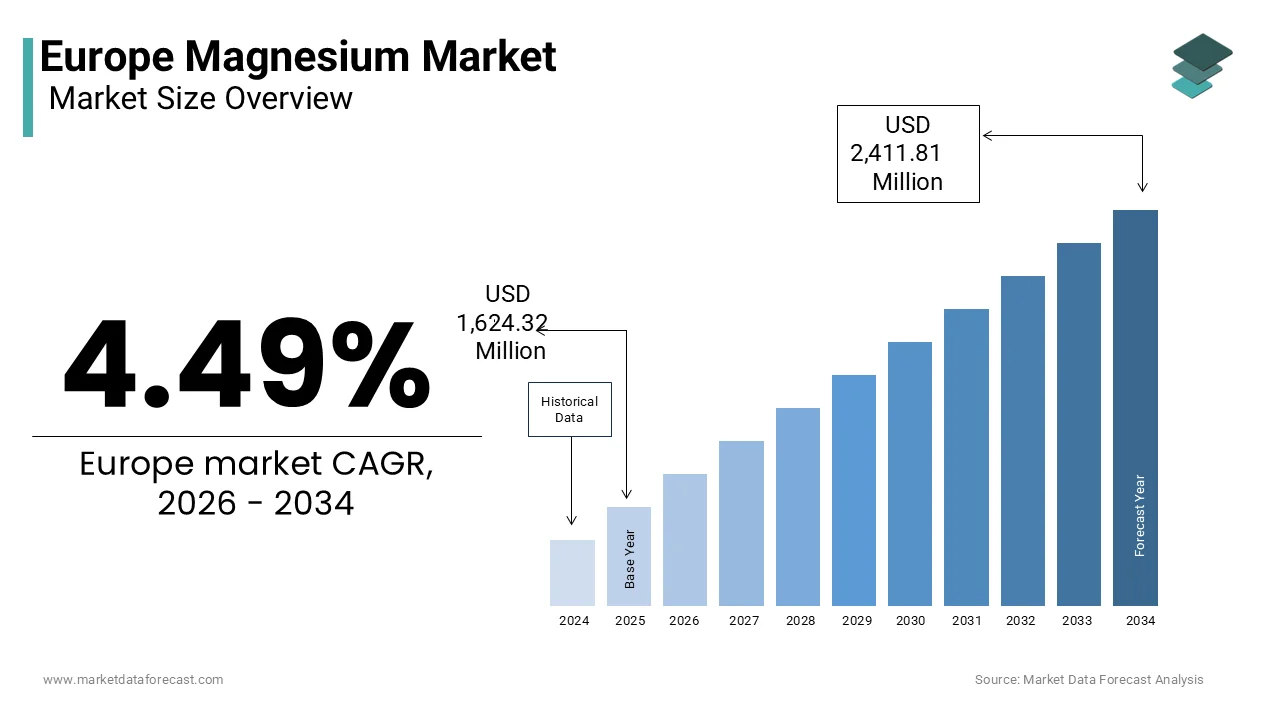
The Europe magnesium market, valued at USD 1,624.32 million in 2025, is projected to reach USD 2,411.81 million by 2034, expanding at a CAGR of 4.49%, driven by automotive lightweighting mandates, aerospace demand, and the expansion of circular magnesium recycling across the region.
Market Snapshot
- 2025 Market Size: USD 1,624.32 million
- 2026 Estimate: USD 1,697.25 million
- 2034 Forecast: USD 2,411.81 million
- CAGR (2026–2034): 4.49%
- Base Year: 2025
- Forecast Period: 2026–2034
Quick Growth Drivers
- EU vehicle CO₂ emission regulationsare accelerating lightweight material adoption
- Rising use of magnesium in electric vehicle platforms to offset battery weight
- Expanding aerospace and defense applications requiring high-strength-to-weight materials
- Increasing adoption of magnesium in aluminum alloying for structural components
- Recovery of European aerospace manufacturing and defense spending
Principal Restraints
- Near-total dependence on imported primary magnesium, primarily from China
- Exposure to geopolitical, trade, and energy-related supply disruptions
- High energy intensity and carbon footprint of primary magnesium production
- Lack of economically viable primary magnesium smelting capacity within Europe
High-Value Opportunities
- Expansion of advanced magnesium recycling and closed-loop supply chains
- Growth of circular economy-driven secondary magnesium production
- Integration of magnesium into next-generation battery and energy storage technologies
- Development of low-carbon remelting powered by renewable energy sources
Key Market Challenges
- Fragmented alloy standards and impurity-related quality inconsistencies
- Skilled labor shortages in magnesium die casting and handling operations
- High safety requirements and an outdated workforce training infrastructure
- Limited harmonization of material certification across European OEM supply chains
Fastest-Growing Segments
- Aluminum Alloying: 45.5% market share in 2025
- Die Casting: Fastest-growing segment (CAGR 6.4%) driven by EV structural components.
- Automotive Lightweight Components: Core demand anchor across the region
Regional Leadership & Dynamics
- Germany (30.1%) — Automotive dominance, recycling leadership, and R&D depth
- Italy (18.5%) — Precision die casting and luxury automotive applications
- France — Strong aerospace, defense, and EV adoption
- United Kingdom — Aerospace, motorsport, and specialty alloy recycling
- Austria — High-purity recycling and renewable-powered remelting leadership
What Wins Commercially
- High-purity, OEM-certified magnesium alloys
- Stable recycled magnesium supply with traceability
- Thin-wall, high-pressure die-casting capabilities
- Integration with automotive and aerospace lightweighting strategies
- Alignment with EU circular economy and decarbonization policies
Top Strategic Ask for Executives
Accelerate investment in secondary magnesium recycling, alloy standardization, and workforce upskilling while securing long-term supply contracts to reduce exposure to geopolitical magnesium supply risks.
Leading Players
Some of the companies that are playing a dominating role in the Europe magnesium market include:
- RZ Magnesium AG
- Magontec GmbH
- Euro Manganese Inc.
- WEBA Metallurgical Products GmbH
- Trimet Aluminium SE (Magnesium Division)
Europe Magnesium Market Size
The Europe magnesium market was valued at USD 1,624.32 million in 2025, is estimated to reach USD 1,697.25 million in 2026, and is projected to reach USD 2,411.81 million by 2034, growing at a CAGR of 4.49% from 2026 to 2034.
Magnesium is a chemical element (symbol Mg, atomic number 12) that exists both as a lightweight metal and an essential mineral for biological life. Unlike commodity metals, magnesium in Europe is defined by its strategic role in lightweighting and decarbonization. The European Union relies almost entirely on foreign suppliers, most notably China, to meet its magnesium needs because it currently lacks the industrial infrastructure to produce primary magnesium from raw ore on the continent. Magnesium’s low density, high strength-to-weight ratio, and excellent machinability make it indispensable in die-cast automotive components, such as steering wheels, seat frames, and transmission housings. Incorporating magnesium into aluminum alloys allows automotive manufacturers to significantly decrease vehicle mass compared to traditional steel constructions, which is a critical strategy for meeting increasingly stringent European environmental regulations for fleet-wide carbon emissions. Additionally, magnesium is essential in the desulfurization of steel and as a reducing agent in titanium production. Although primary production is currently absent, the European Union maintains a robust secondary market through advanced recycling and alloying centers in Central and Southern Europe that successfully reclaim substantial amounts of magnesium from scrap materials for reuse. This dependency on imports, coupled with growing demand for lightweight materials, positions magnesium as a critical yet vulnerable component of Europe’s industrial and climate strategy.
MARKET DRIVERS
Automotive Lightweighting and Emission Reduction Mandates
The EU’s stringent vehicle CO₂ emission regulations serve as the primary driver of the European magnesium market. Regulation (EU) 2019/631 mandates that new passenger cars achieve an average fleet emission of 95 grams of CO₂ per kilometer—a target that necessitates significant weight reduction through material substitution. Utilizing magnesium alloys to replace heavier metals in vehicle interiors and drivetrains allows for a drastic reduction in the weight of individual components, contributing significantly to the overall lightness of the vehicle. Integrating magnesium into a car's structure lowers its environmental footprint over time because lighter vehicles require less energy to operate, thereby decreasing total emissions throughout their service life. Automakers in Europe, particularly those producing high-end and electric vehicles, are increasingly incorporating magnesium to offset the weight of modern battery systems and luxury features. The shift toward battery electric vehicles further amplifies demand, as heavier battery packs require even greater lightweighting in chassis and body structures. This regulatory and technological imperative ensures sustained and growing magnesium consumption despite price volatility and supply risks.
Growth in Aerospace and Defense Applications
Magnesium alloys are gaining strategic importance in the region’s aerospace and defense sectors due to their exceptional strength-to-weight ratio and vibration-damping properties, which propel the expansion of the European magnesium market. According to the European Defence Agency, modern military aircraft and unmanned aerial vehicles increasingly use magnesium castings for gearboxes, housings, and avionics enclosures to enhance payload capacity and fuel efficiency. Civil aerospace manufacturers are adopting magnesium alloys for cabin interior components, such as seat frames, to achieve substantial per-aircraft weight reductions. The European Space Agency confirms that magnesium-lithium alloys are used in satellite components due to their dimensional stability in extreme temperatures. Driven by accelerated European defense investment and the post-pandemic recovery in air travel, demand for advanced magnesium materials is intensifying. These applications command premium pricing and long-term contracts, insulating the segment from broader market fluctuations and reinforcing magnesium’s role in Europe’s technological sovereignty.
MARKET RESTRAINTS
Extreme Import Dependency and Geopolitical Supply Risks
The region’s near-total reliance on imported magnesium, a significant share of which is sourced from China, poses a severe structural restraint on market stability, industrial security, and the European magnesium market. According to the European Commission’s Critical Raw Materials Act, magnesium is classified as a strategic material due to this import concentration, with China controlling over 80 percent of global primary production. In late 2021, energy-related production curbs in Shaanxi province (China's main production hub) significantly tightened supply, causing an unprecedented surge in European magnesium prices to record highs. Although prices normalized, the episode exposed systemic vulnerability. Unlike aluminum or copper, Europe has no primary magnesium smelters. Norway ended its primary magnesium production at its last remaining facility during the early 2000s, driven by elevated operational costs and changing market conditions. The EU’s Carbon Border Adjustment Mechanism does not cover magnesium, offering no protection against dumping. This dependency leaves European automakers and aerospace firms at the mercy of foreign policy shifts, trade restrictions, and logistical bottlenecks, undermining supply chain resilience and long-term investment planning in lightweight manufacturing.
High Energy Intensity and Lack of Domestic Primary Production
The absence of economically viable primary magnesium production in the region stems from the metal’s extreme energy intensity and unfavorable regulatory economics, which impede the expansion of the European magnesium market. Magnesium production via the Pidgeon process is highly energy-intensive and produces substantial greenhouse gases when reliant on coal, far exceeding the carbon footprint of aluminum production. High European carbon prices, combined with elevated energy costs,s prevent local magnesium producers from being cost-competitive under the current emission trading system. Despite access to renewable energy, efforts to scale low-carbon electrolytic magnesium production in Northern Europe have been hindered by excessive capital requirements for facility development. Primary production remains economically unviable absent advancements in inert anode technology or access to low-cost renewable power. This forces Europe to rely on recycled magnesium or expensive imports, constraining innovation in circular magnesium economies and leaving the continent strategically exposed in a material critical for decarbonization.
MARKET OPPORTUNITIES
Expansion of Magnesium Recycling and Circular Economy Models
The development of advanced magnesium recycling infrastructure offers a major opportunity to enhance supply security and reduce environmental impact, which is expected to fuel the growth of thEuropeanpe magnesium market. Magnesium recycling from automotive and aerospace waste has become a critical, energy-efficient practice, requiring only a small fraction of the energy needed for primary production compared to virgin metal extraction. Companies like AMAG Austria Metall and Magnesium Elektron are investing in closed-loop systems that recover high-purity magnesium from machining swarf and end-of-life components, achieving significant yields. European regulations for vehicles at the end of their life cycles are heavily driving the industry toward design-for-disassembly and advanced scrap collection, aiming to achieve high-percentage, total material recovery. Furthermore, the European Institute of Innovation and Technology funds projects like MAGNUS to develop AI-driven sorting technologies that separate magnesium alloys from mixed metal streams. In accordance with the EU Circular Economy Action Plan, the growth of EPR schemes is set to reposition recycled magnesium as a key strategic asset, potentially meeting significant EU market needs by 2035.
Integration of Magnesium in Next-Generation Battery Technologies
Magnesium is emerging as a leading, sustainable, and high-capacity alternative to lithium-based batteries, which provides fresh prospects for the European magnesium market. It offers superior safety due to its ability to plate evenly without forming harmful, battery-shorting structures. European research teams, including those at the Helmholtz Institute Ulm, are successfully developing magnesium-sulfur battery prototypes that show promise for high-energy applications like aviation and grid storage, aiming to surpass the capabilities of current battery technologies. The European Union's Battery 2030+ initiative and related Horizon Europe calls are funding research into magnesium-based battery technology, aiming to diversify battery materials and decrease reliance on critical raw materials such as lithium and cobalt. Unlike lithium, magnesium is abundant and non-toxic, aligning with the EU Battery Regulation’s sustainability criteria. Solid-state electrolytes tailored for magnesium ions are being scaled up in German and Swedish pilot facilities, even though commercial, mass-market adoption remains a few years out. If successful, this innovation could create a new high-value demand stream, positioning Europe as a leader in next-generation electrochemical storage and reducing long-term pressure on primary magnesium supply chains.
MARKET CHALLENGES
Fragmented Alloy Standards and Quality Inconsistencies
Inconsistent alloy specifications and quality control across suppliers create technical barriers for high-performance applications and thereby inhibit the expansion of the European magnesium market. Even though EN 1753 defines common magnesium grades, the presence of trace elements, notably Fe, Ni, and Cu, remains a critical factor for performance and durability. According to sources, inconsistencies in the quality of imported magnesium ingots are a major contributor to elevated casting rejections in automotive applications, driven by impurity fluctuations. Chinese suppliers often deliver material meeting nominal composition but failing stricter internal OEM specs for high-pressure die casting. This inconsistency forces European foundries to implement costly secondary refining, increasing production time and cost. Without harmonized certification protocols or a European material passport system, manufacturers struggle to guarantee performance in safety-critical components, slowing adoption in aerospace and medical sectors and undermining trust in the supply chain.
Labor Shortages and Declining Expertise in Magnesium Casting
The region faces a critical shortage of skilled workers trained in magnesium handling and die-casting operations, which threatens production capacity and innovation, and constrains the expansion of the European magnesium market. The German and Italian non-ferrous foundry sectors are facing a critical labor shortage driven by an aging workforce approaching retirement. Recruitment challenges are exacerbated by declining apprenticeship numbers and negative, outdated perceptions of the industry. Magnesium’s flammability requires specialized safety protocols, such as sulfur hexafluoride shielding and dry powder fire suppression, that are not covered in standard metallurgy curricula. This knowledge gap delays new facility commissioning and increases accident risks, as seen in the 2022 fire at an Austrian casting plant. Europe's industrial competitiveness in magnesium forming is threatened by a failure to update safety standards and implement vocational training, allowing younger, faster-adapting regions to seize market leadership.
REPORT COVERAGE
| REPORT METRIC | DETAILS |
| Market Size Available | 2025 to 2034 |
| Base Year | 2025 |
| Forecast Period | 2026 to 2034 |
| Segments Covered | By Application, and Region. |
| Various Analyses Covered | Global, Regional, and Country-Level Analysis, Segment-Level Analysis, Drivers, Restraints, Opportunities, Challenges; PESTLE Analysis; Porter’s Five Forces Analysis, Competitive Landscape, Analyst Overview of Investment Opportunities |
| Countries Covered | UK, France, Spain, Germany, Italy, Russia, Sweden, Denmark, Switzerland, Netherlands, Turkey, Czech Republic, Rest of Europe |
| Market Leaders Profiled | RZ Magnesium AG, Magontec GmbH, Euro Manganese Inc., WEBA Metallurgical Products GmbH, Trimet Aluminium SE (magnesium division) |
SEGMENTAL ANALYSIS
By Application Insights
The aluminum alloying segment dominated the European magnesium market by accounting for a 45.5% share in 2025. The supremacy of the aluminum alloying segment is driven by magnesium’s critical role in enhancing the mechanical properties of aluminum alloys used extensively in automotive, aerospace, and construction sectors. Adding 0.5 to 1.5 percent magnesium to aluminum significantly improves strength, weldability, and corrosion resistance, attributes essential for structural components like car body panels and aircraft frames. A significant majority of the wrought aluminum alloys manufactured in the European Union rely on magnesium as an alloying element, driven by the high consumption of specifically designated alloys in the 5000 and 6000 series. Stricter European Union CO₂ emission standards for vehicles are increasing demand for lightweight, high-magnesium aluminum alloys, which allow manufacturers to significantly reduce vehicle mass compared to traditional steel, improving efficiency. Major producers like Hydro and Constellium rely on a consistent magnesium supply to meet automotive OEM specifications. This structural integration into Europe’s lightweighting strategy ensures that aluminum alloying remains the bedrock of magnesium demand across the continent.
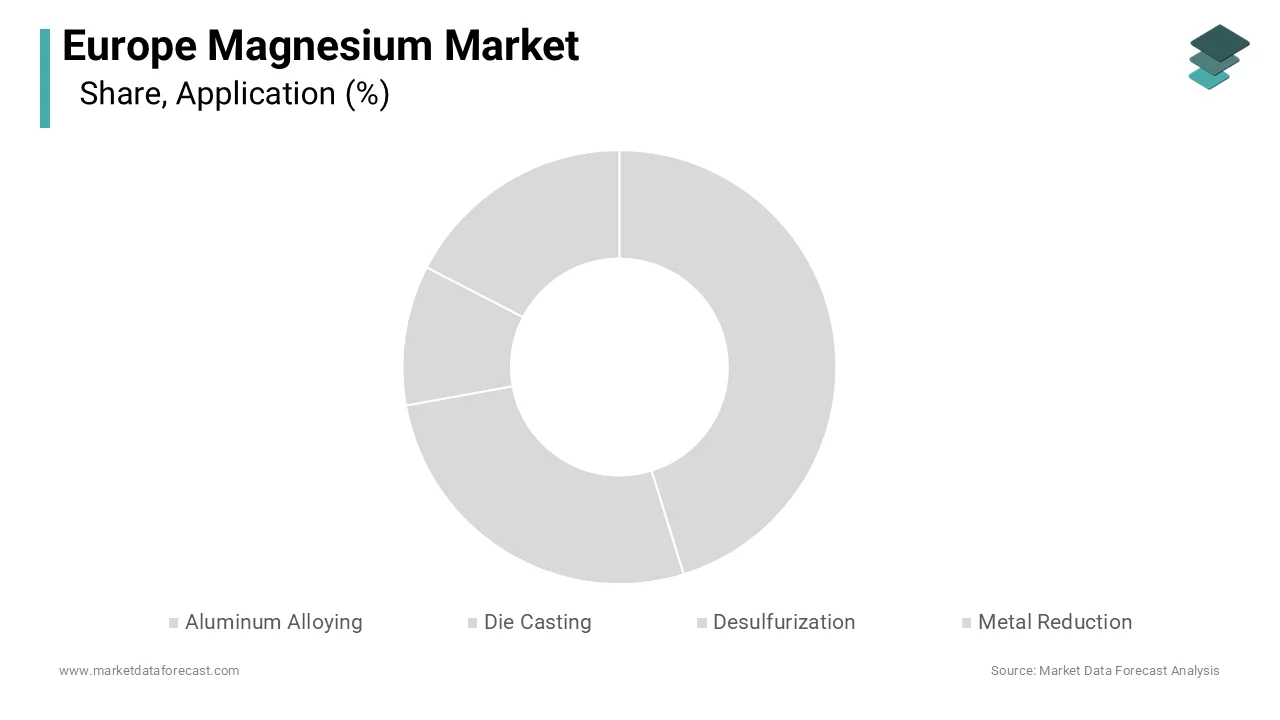
The die casting segment is predicted to witness the highest CAGR of 6.4% from 2026 to 2034 due to the automotive industry’s shift toward complex, lightweight structural components that require high dimensional accuracy and thin-wall capabilities, precisely where magnesium excels. Unlike aluminum, magnesium’s low melting point and high fluidity enable faster cycle times and finer details in high-pressure die casting, reducing energy use. Electric vehicle manufacturers are increasingly adopting magnesium for structural components to offset battery weight, a trend supported by European supplier data and industry analyses. BMW’s Neue Klasse platform further highlights this trend by utilizing significant cast magnesium components to optimize vehicle efficiency. Additionally, the rise of 5G infrastructure and data centers is driving demand for magnesium housings in telecom equipment due to its electromagnetic shielding properties. The convergence of digital technology and electric mobility is transforming die casting into a strategic cornerstone for a decarbonized Europe.
COUNTRY LEVEL ANALYSIS
Germany Magnesium Market Analysis
Germany led the European magnesium market by capturing a 30.1% share in 2025. The supremacy of the German market is attributed to its world-class automotive and machinery industries. The country’s market status reflects deep integration of magnesium into lightweight manufacturing: automakers like BMW, Mercedes-Benz, and Volkswagen use magnesium alloys in steering columns, transmission cases, and seat frames to meet EU CO₂ targets. German automakers are increasing the adoption of magnesium alloys to reduce vehicle weight, particularly within electric mobility applications, in line with industry-wide efforts to improve efficiency. Moreover, Germany possesses a leading magnesium recycling infrastructure in Europe, with specialized firms focused on processing industrial scrap and end-of-life vehicle materials to support a circular economy. Stringent German enforcement of EU regulations requires comprehensive material recovery for end-of-life vehicles, encouraging closed-loop material cycles. Additionally, Germany’s Fraunhofer Institute pioneers R&D in magnesium-based batteries and hydrogen storage. This blend of industrial scale, circular economy practices, and technological innovation solidifies Germany’s position as the continent’s magnesium powerhouse.
Italy Magnesium Market Analysis
Italy was the second largest country in the European magnesium market by holding a 18.5% share in 2025. The growth of the Italian market is attributed to its advanced automotive and luxury goods sectors. The market status is defined by high-precision die-casting operations in the Emilia-Romagna region, where companies like Brembo and Marelli produce magnesium components for Ferrari, Lamborghini, and Ducati. Driven by the need for vehicle lightweighting and increased electric vehicle production, the Italian automotive industry is increasing its adoption of magnesium alloys for structural and high-performance components, with high-end manufacturers leading the trend to enhance efficiency. Simultaneously, Italian design firms incorporate magnesium alloys in high-end eyewear, watches, and electronics due to their aesthetic finish and lightness. The “Made in Italy” brand drives demand for quality materials that combine performance with elegance. Companies like Feralpi and Alfa Acciai operate secondary smelters that refine imported magnesium into certified alloys meeting EN 1753 standards. This fusion of engineering excellence, design heritage, and circular processing ensures Italy remains a high-value, specialized player in the European magnesium landscape.
France Magnesium Market Analysis
France maintains a significant share of the European magnesium market due to strong aerospace and defense applications alongside growing automotive adoption. The market status reflects the presence of Airbus and Safran, which use magnesium alloys in seat frames, gearboxes, and avionics housings to reduce aircraft weight and fuel consumption. The adoption of advanced composite materials and modern engines in the Airbus A350 structural design significantly reduces the aircraft's weight, leading to substantial improvements in fuel efficiency and lower operational carbon emissions. In the automotive sector, Renault and Stellantis are increasing magnesium use in electric vehicle platforms to offset battery mass. The French Alternative Energies and Atomic Energy Commission also researches magnesium for hydrogen storage and next-generation batteries. National policies under France 2030 allocate funding for lightweight material innovation, supporting domestic alloy development. This dual focus on aerospace leadership and automotive electrification sustains France’s dynamic and technologically advanced magnesium ecosystem.
United Kingdom Magnesium Market Analysis
The United Kingdom expands steadily in theEuropeane magnesium market, with a focus on aerospace, motorsport, and recycling. The market status is supported by the presence of Rolls-Royce, BAE Systems, and Formula 1 teams, which rely on high-performance magnesium alloys for engine blocks, gearbox casings, and suspension components. The UK aerospace sector continues to rely on high-purity magnesium alloys for specialized, high-stress components requiring exceptional durability and thermal stability, with industry demand for magnesium showing signs of recovery within the broader UK market. The UK also hosts advanced recycling facilities like Telford-based Magnesium Elektron, which produces high-purity alloys from aerospace and automotive scrap under Nadcap certification. Despite Brexit, the UK continues to align with EU material standards, ensuring seamless integration into continental supply chains. The government’s Jet Zero Council further promotes lightweight materials for sustainable aviation, reinforcing long-term demand. This combination of high-tech manufacturing, circular economy, and regulatory alignment sustains the UK’s resilient and specialized magnesium market.
Austria Magnesium Market Analysis
Austria is predicted to grow in the European magnesium market from 2026 to 2034 due to its leadership in primary recycling and high-purity alloy production. The market status is defined by AMAG Austria Metall, one of Europe’s largest integrated aluminum and magnesium recyclers, operating a state-of-the-art facility in Ranshofen that processes thousands of metric tons of magnesium scrap annually. According to research, the country recovers a significant share of magnesium from industrial waste streams, far exceeding the EU average. AMAG supplies certified alloys to automotive giants like BMW and Audi, meeting strict OEM requirements for trace element control. The nation’s abundant hydropower enables low-carbon remelting, aligning with EU Green Deal objectives. Additionally, Austrian research institutes collaborate on magnesium-based hydrogen storage projects under Horizon Europe. This focus on circularity, purity, and sustainability positions Austria as a quality benchmark and innovation hub in Europe’s evolving magnesium landscape.
COMPETITIVE LANDSCAPE
The EEuropeanmagnesium market features a concentrated yet specialized competitive landscape dominated by integrated recyclers and precision alloy producers with deep technical expertise. Companies like AMAG Diehl Metall and Magnesium Elektron compete on purity, reliability,y and application engineering rather than price alone. New entrants face high barriers, rs including capital intensity,ity safety protocols for molten magnesium handling, ling and stringent OEM certification requirements. The market is bifurcated between bulk alloy suppliers for automotive die casting, sting where volume and consistency matter, and specialty producers for aerospace and medical applications,s where performance and traceability are critical. Competition is not characterized by aggressive pricing but long-term partnerships with tier one suppliers and OEMs focused on lightweighting and circularity. Innovation centers on decarbonization through recycling and renewable-powered melting rather than primary production, which remains unviable in Europe. This environment rewards operational excellence,e regulatory foresight, and strategic alignment with EU climate and industrial policies over scale or marketing intensity.
KEY MARKET PLAYERS
Some of the companies that are playing a dominating role in the europe magnesium market include
- RZ Magnesium AG
- Magontec GmbH
- Euro Manganese Inc.
- WEBA Metallurgical Products GmbH
- Trimet Aluminium SE (magnesium division)
TOP LEADING PLAYERS IN THE MARKET
- AMAG Austria Metall AG is a leading European producer of aluminum and magnesium alloys headquartered in Ranshofen,n Austria. The company specializes in high-purity recycled magnesium for automotive and aerospace applications, serving global OEMs with certified EN 1753 compliant products. AMAG contributes to the worldwide market through its advanced closed-loop recycling technology that recovers a significant share of magnesium from industrial scrap. Recently, the company expanded its remelting capacity with a new hydropower-powered furnace line, reducing carbon intensity compared to conventional methods. It also launched a digital traceability platform for magnesium alloys, providing full chain-of-custody data to meet EU Battery Regulation and End-of-Life Vehicles Directive requirements, reinforcing its position as a sustainable and reliable partner in Europe’s lightweighting ecosystem.
- Magnesium Elektron Ltd, part of the Luxfer Group and based in the United Kingdom, is a key supplier of specialty magnesium alloys and powders for aerospace, defense, and medical markets globally. The company is renowned for its Elektron brand of high-performance alloys used in jet engines, racing cars, and biodegradable implants. In Europe, it serves premium automotive and aviation clients requiring stringent Nadcap certification. It also partnered with a German automaker to develop corrosion-resistant alloys for electric vehicle battery housings, strengthening its role in next-generation mobility and clean energy applications across the continent.
- Diehl Metall is a German multinational specializing in precision magnesium and aluminum components for automotive, electronics, and industrial sectors. The company operates integrated die-casting and alloying facilities in Germany and Eastern Europe, supplying structural parts to BMW, Mercedes-Benz, and Bosch. Diehl contributes globally through its innovation in thin-wall magnesium casting and surface treatment technologies that enhance corrosion resistance. Recently, it introduced a new magnesium-aluminum hybrid component for electric powertrains that reduces weight compared to steel alternatives. The company also implemented AI-driven quality control systems to ensure batch consistency in high-pressure die-cast parts, reinforcing its leadership in high-volume, high-reliability magnesium manufacturing aligned with EU decarbonization goals.
TOP STRATEGIES USED BY THE KEY MARKET PARTICIPANTS
Key players in thEuropeanpe magnesium market are investing in advanced recycling technologies to produce high-purity magnesium from industrial and end-of-life scrap, reducing reliance on imported primary metal. They are developing corrosion-resistant and high-strength alloys tailored for electric vehicle battery housings and aerospace components to meet stringent OEM specifications. Companies are integrating renewable energy sources like hydropower into remelting operations to lower their carbon footprint and comply with the EU Green Deal objectives. Strategic partnerships with automotive and aerospace manufacturers enable co-development of lightweight structural parts that support CO₂ reduction targets. Implementation of digital traceability platforms ensures compliance with EU regulations on material recovery and battery sustainability. Innovation in thin-wall high-pressure die casting improves production efficiency and part complexity for next-generation applications. Participation in Horizon Europe-funded projects focuses on magnesium-based hydrogen storage and solid-state batteries. Geographic expansion of secondary smelting capacity enhances supply security and reduces logistics emissions. Collaboration with vocational institutions addresses workforce shortages in magnesium handling and casting safety. Adoption of AI and machine learning optimizes alloy composition and quality control in high-volume production environments.
MARKET SEGMENTATION
This research report on the europe magnesium market is segmented and sub-segmented into the following categories.
By Application
- Aluminum Alloying
- Die Casting
- Desulfurization
- Metal Reduction
By Country
- Germany
- Italy
- France
- United Kingdom
- Austria
- Spain
- Netherlands
- Rest of Europe