- Product Description Description
- Table of Contents TOC
- List of Table & Figure LOT
- Get Free Sample PDF Sample PDF
Market Size, 2025
$76.49 MnMarket Estimate, 2026
$79.66 MnMarket Forecast, 2034
$110.20 MnCAGR, 2026–2034
4.14%Europe Malic Acid Market Size, Growth, Trends & Forecast (2026–2034)
The Europe malic acid market size was calculated at USD 76.49 million in 2025, is estimated to reach USD 79.66 million in 2026, and is anticipated to be worth USD 110.20 million by the end of 2034, registering a compound annual growth rate (CAGR) of 4.14% during the forecast period from 2026 to 2034. Driven by the rising demand for clean-label food ingredients, the expansion of bio-based production through advanced fermentation, and surging applications in sugar-reduced beverages and green personal care formulations, the market is poised for steady expansion across Europe.
Key Executive Metrics (At-a-Glance)
- 2025 Base Valuation: USD 76.49 Million
- 2026 Current Valuation: USD 79.66 Million
- 2034 Forecast Valuation: USD 110.20 Million
- Compound Annual Growth Rate (CAGR): 4.14% (2026–2034)
- Largest Type Segment: White Crystalline Powder (43.9% share in 2025)
- Fastest-Growing Type Segment: DL Malic Acid Solution (8.12% CAGR)
- Largest Application Segment: Food & Beverage (65.4% share in 2025)
- Fastest-Growing Application Segment: Cosmetics & Personal Care Products (8.12% CAGR)
- Largest Regional Market: Germany (23.4% share in 2025)
- Fastest-Growing Country Markets: Netherlands / United Kingdom / France
Core Market Drivers
- Clean Label Transformation: Strong consumer preference for transparent, fruit-derived ingredients over synthetic acidulants, aligning with EU sustainability mandates.
- Advanced Biorefermentation: Shift toward renewable feedstocks and engineered microbial strains (Corbion, Jungbunzlauer) for high-purity, sustainable bio-based malic acid.
Primary Market Restraints & Challenges
- Feedstock Price Volatility: Susceptibility of production economics to fluctuations in agricultural raw materials like wheat, corn, and sugar beet glucose.
- Intense Acid Competition: Pervasive market pressure from lower-cost citric and lactic acids dominating standard volume applications.
Europe Malic Acid Market Segmentation Breakdown
| Segment Category | Largest / Dominant Segment | Fastest-Growing Segment |
|---|---|---|
| By Type | White Crystalline Powder (43.9%) | DL Malic Acid Solution (8.12% CAGR) |
| By Application | Food & Beverage (65.4%) | Cosmetics & Personal Care (8.12% CAGR) |
| By Region | Germany (23.4%) | Netherlands / UK / France |
Major Industry Players Profiled
Key enterprises shaping the Europe malic acid market include Corbion N.V., Jungbunzlauer Suisse AG, Fuso Chemical Co. Ltd., Lonza Group Ltd, Thirumalai Chemicals, Bartek Ingredients, Polynt SpA, and Prinova Group.
Europe Malic Acid Market Size
The Europe malic acid market size was calculated at USD 76.49 million in 2025 and is anticipated to reach USD 110.20 million by 2034, from USD 79.66 million in 2026, growing at a CAGR of 4.14% during the forecast period.
Malic acid is a naturally occurring dicarboxylic acid found in fruits like apples and cherries and is widely utilized in Europe as an acidulant, flavor enhancer, and preservative across food, beverage, pharmaceutical, and personal care industries. In the European context, its relevance extends beyond functionality to align with clean label trends and regulatory frameworks that favor naturally derived ingredients over synthetic alternatives. The European Food Safety Authority permits malic acid as a food additive under E number E296 with established acceptable daily intake levels to ensure its safe use in a broad range of applications. According to Eurostat, the European Union produced approximately 11.5 million tonnes of apples in 2023. The region’s apple and other fruit/vegetable processing streams support feedstock for bio-based acid production. As per the Farm to Fork Strategy of the European Commission, which aims to accelerate a sustainable food system, there is a drive to reduce chemical dependency, which is promoting sustainable sourcing and innovations. Under Regulation (EC) No 1223/2009 on cosmetic products, the use of skin-safe and biodegradable substances is encouraged, broadening the use case for bio-based organic acids such as malic acid in dermo-cosmetic formulations. Malic acid occupies a strategic niche in Europe’s shift toward cleaner and more sustainable ingredient profiles due to the evolving consumer preferences, regulatory tailwinds, and innovation in fermentation technologies.
MARKET DRIVERS
Rising Demand for Clean Label and Natural Food Ingredients
The rising consumer preference for transparent and minimally processed food formulations is a primary driver of malic acid adoption across Europe. According to the Eurobarometer survey, 69% of EU consumers actively avoid products containing artificial additives, and 62% prioritise ingredients they recognise from everyday cooking. Malic acid is labelled as E 296 or simply “malic acid,” and is perceived as a natural alternative to citric or phosphoric acid due to its presence in common fruits and its role in the Krebs cycle. This perception has led major food manufacturers to reformulate products. For instance, Nestlé and Danone have replaced synthetic acidulants with malic acid in several yoghurt and beverage lines across Germany and France. As per the European Food Information Council, malic acid enhances fruit flavours more effectively than citric acid at lower pH levels, which is making it ideal for sugar-reduced beverages. Furthermore, the European Clean Label Platform certifies malic acid as compliant with its natural-ingredient criteria, which is facilitating its use in premium and organic products. As regulatory scrutiny on artificial additives intensifies, malic acid’s naturally-derived status and functional versatility solidify its position as a cornerstone of Europe’s clean-label transformation.
Expansion of Bio-Based Production Through Advanced Fermentation
The shift toward sustainable manufacturing using renewable feedstocks is significantly boosting malic acid production in Europe via biorefermentation, which is further boosting the expansion of the malic acid market in Europe. Unlike traditional petrochemical routes, modern biotechnological methods employ engineered strains of Aspergillus oryzae or Saccharomyces cerevisiae to convert glucose from wheat or corn starch into high-purity L-malic acid. According to European Bioplastics, global bioplastics production capacity was around 2.18 million tonnes in 2023, with malic acid among the fastest scaling molecules. Companies like Corbion and Jungbunzlauer have invested in fermentation facilities in the Netherlands and Austria that utilize non-GMO microbes and circular water systems, which are reducing carbon footprint compared to synthetic routes. The EU’s Circular Economy Action Plan further incentivizes such innovations by prioritizing bio-based chemicals in public procurement and R&D funding. In 2023, Horizon Europe-funded projects aimed at optimizing malic acid yields from lignocellulosic waste. As carbon pricing under the EU Emissions Trading System increases production costs for fossil-derived chemicals, bio-based malic acid gains both environmental and economic competitiveness, positioning Europe at the forefront of green acidulant manufacturing.
MARKET RESTRAINTS
Price Volatility of Raw Materials and Fermentation Feedstocks
The price instability of agricultural feedstocks used in fermentation processes, primarily glucose derived from wheat, corn, and sugar beet, is one of the major restraints to the European malic acid market growth. According to Eurostat, wheat and other cereals experienced price swings of around 20–30% in the EU between 2022 and 2023 due to climate disruptions in Eastern Europe and trade restrictions related to the Black Sea grain crisis. Since bio-based malic acid production requires approximately 1.8 kilograms of glucose per kilogram of acid, even moderate feedstock price fluctuations directly impact production economics. The European Commission’s Short Term Outlook for Arable Crops forecasts continued volatility through 2026 due to extreme weather events and shifting Common Agricultural Policy subsidies. For smaller producers without long-term grain contracts, this unpredictability limits capacity planning and investment in scale-up. Additionally, competition for starch from the bioethanol and bioplastic sectors intensifies pressure. According to ePURE, the European renewable ethanol association, around 23% of EU ethanol production in 2025 was derived from wheat. Until integrated biorefineries using non-food lignocellulosic biomass become commercially viable at scale, malic acid producers will remain exposed to agricultural market dynamics, constraining cost stability and downstream pricing strategies.
Stringent Regulatory Compliance for Food and Cosmetic Applications
Despite its natural origin, malic acid must navigate complex and evolving regulatory frameworks across European food, cosmetic, and pharmaceutical sectors, which is creating compliance burdens for manufacturers and limiting the expansion of the malic acid market in Europe. Under Regulation (EC) No 1333/2008, malic acid (E296) is authorized as a food additive and must comply with EU purity and traceability standards, including batch-specific quality and contaminant testing. The European Chemicals Agency classifies it under REACH Regulation (EC) No 1907/2006, requiring safety data sheets and exposure scenario documentation for industrial users. In cosmetics, malic acid is permitted under Regulation (EC) No 1223/2009, though higher concentrations in leave-on products require additional safety and clinical assessments under the Scientific Committee on Consumer Safety. According to Cosmetics Europe, regulatory documentation gaps caused delays in a portion of new cosmetic formulations containing malic acid in 2023. Moreover, national variations persist. For example, France’s ANSES requests supplementary ecotoxicity information for rinse-off products while Germany’s BfR requires isotopic verification to confirm natural origin for “bio” claims. These fragmented requirements increase administrative costs and time to market, particularly for SMEs lacking regulatory expertise, thereby limiting innovation and product diversification in the malic acid value chain.
MARKET OPPORTUNITIES
Growing Application in Sugar-Reduced and Functional Beverages
The surge in low-sugar and functional beverage consumption across Europe is a major opportunity for malic acid due to its superior sourness profile and metabolic compatibility. According to the UNESDA Soft Drinks Europe (European soft drinks association), no- and low-calorie soft drinks now account for up to 40% of sales at the EU level. Since bio-based malic acid production requires approximately 1.8 kg of glucose per kg of acid, even moderate feedstock price swings directly impact production economics. The EU’s sugar-reduction roadmap and rising consumer health awareness support the use of malic acid in low-sugar beverage formulations by providing smoother and more lingering tartness compared to citric acid, thereby enhancing perceived sweetness and enabling manufacturers to reduce sweetener content without compromising palatability. As health-oriented beverage innovation accelerates with probiotic sodas and plant-based tonics entering mainstream retail, malic acid’s dual functionality as a flavor modulator and metabolic aid positions it for sustained growth in Europe’s evolving liquid-nutrition landscape.
Emergence of Malic Acid in Green Personal Care Formulations
The personal care industry’s pivot toward biodegradable and skin-friendly actives is unlocking new demand for malic acid in European cosmetic and dermocosmetic products, which is another potential opportunity for the European malic acid market. Unlike harsher alpha hydroxy acids such as glycolic acid, malic acid offers milder exfoliation with humectant properties that support skin hydration, making it ideal for sensitive and daily use formulations. According to Cosmetics Europe, over 1,200 new skincare products containing malic acid were launched in the EU in 2023, which is a 22% increase from 2022. Brands like La Roche-Posay and Bioderma now incorporate it into pH-balanced cleansers and anti-ageing serums as part of multi-acid complexes compliant with the EU’s green claims directive. The European Commission’s Chemicals Strategy for Sustainability promotes the substitution of persistent and bio-accumulative ingredients with safer alternatives, and malic acid is readily biodegradable and non-toxic to aquatic life, as confirmed by European Chemicals Agency assessments, which fits this criterion. Additionally, the ISO 16128 standard for natural cosmetics recognizes bio-fermented malic acid as a natural-origin ingredient that enables premium positioning. With the EU personal care market projected to reach €95 billion by 2026, malic acid’s multifunctional profile in gentle yet effective formulations ensures expanding relevance in Europe’s clean-beauty revolution.
MARKET CHALLENGES
Competition from Lower Cost Citric and Lactic Acids
Malic acid faces persistent competitive pressure from citric and lactic acids that dominate the European acidulant market due to larger production scale and lower pricing, which is majorly challenging the growth of the European market. According to the European Organic Acids Producers Consortium, citric acid is available at an average price of €1.80 per kilogram compared to malic acid’s €3.20 per kilogram, which is making it the default choice for cost-sensitive applications like carbonated soft drinks and canned foods. According to sources, lactic acid is supported by large-scale biorefinery infrastructure for polylactic acid production that trades at approximately €2.10 per kilogram and benefits from dual use in food and bioplastics. This price differential limits malic acid’s adoption in bulk applications despite its functional advantages. According to a 2025 survey by FoodDrinkEurope, 57% of mid-tier beverage producers opt for citric acid blends even when flavor optimization favors malic acid, citing margin pressures. Furthermore, according to the European Commission, citric acid enjoys established supply chains with over 80% of EU demand met by domestic producers like Jungbunzlauer and Tate & Lyle, whereas malic acid relies more on imports for certain grades. Until bio-based malic acid achieves economies of scale or regulatory incentives favor its use in specific categories, cost competition will remain a structural barrier to broader market penetration.
Limited Consumer Awareness and Misconception as a Synthetic Additive
Despite its natural occurrence, malic acid suffers from low consumer recognition and is often misperceived as a synthetic chemical due to its E number designation, which is hindering brand adoption in clean label segments and further challenging the expansion of the European market. According to the European Consumer Organisation’s 2023 study, only 29% of surveyed consumers across five EU countries correctly identified malic acid as a fruit-derived ingredient, while 41% associated it with artificial preservatives. This perception gap discourages food and beverage companies from prominently featuring it on packaging, even when used as a clean-label alternative. In contrast, citric acid benefits from a strong brand association with citrus fruits, which gives it a marketing advantage. The lack of coordinated consumer education by industry bodies exacerbates the issue, which is unlike probiotics or omega-3s, and malic acid has no pan-European awareness campaign. Consequently, manufacturers often substitute it with more familiar acids or use vague terms like “natural fruit acids” to avoid consumer skepticism. Without strategic communication to clarify its origin and safety, malic acid’s potential in premium natural products will remain underutilised, which is further constraining market expansion despite its technical merits.
REPORT COVERAGE
| REPORT METRIC | DETAILS |
| Market Size Available | 2025 to 2034 |
| Base Year | 2025 |
| Forecast Period | 2026 to 2034 |
| CAGR | 4.14% |
| Segments Covered | By Type, Application, and Region |
| Various Analyses Covered | Global, Regional & Country Level Analysis; Segment-Level Analysis; DROC, PESTLE Analysis; Porter’s Five Forces Analysis; Competitive Landscape; Analyst Overview of Investment Opportunities |
| Regions Covered | UK, France, Spain, Germany, Italy, Russia, Sweden, Denmark, Switzerland, Netherlands, Turkey, and the Czech Republic |
| Market Leaders Profiled | Perfect Moment Ltd, Lonza Group Ltd, Thirumalai Chemicals, Bartek Ingredients, Fuso Chemical, Isegen South Africa, Anhui Anke Biotechnology (Group), Puyang Yongan Chemical, Prinova Group, Nacalai Tesque, Guangzhou Jointas Chemical, Polynt SpA, And The Chemical Company |
SEGMENTAL ANALYSIS
By Type Insights
The white crystalline powder segment accounted for 43.9% of the Europe malic acid market share in 2025 due to its superior stability, purity, and versatility across high-value applications. The powder form offers extended shelf-life, minimal moisture content, and precise dosing capabilities essential for pharmaceutical formulations and premium cosmetic products. In the food sector, it is preferred for dry beverage mixes, confectionery, and baking powders, where liquid solutions would cause clumping or premature reaction. According to the German Federal Institute for Risk Assessment, over 90% of malic acid used in EU-authorised dietary supplements is in crystalline form due to its compatibility with tablet compression and consistent active ingredient delivery. Leading producers such as Corbion and Jungbunzlauer operate dedicated crystallization lines in the Netherlands and Austria that achieve purity levels exceeding 99.5% and meet European Pharmacopoeia standards. Additionally, the European Cosmetics Regulation (EC) 1223/2009 requires strict particulate control for leave-on products, which is making a fine crystalline powder the only compliant format for many dermo-cosmetic actives. These technical and regulatory advantages ensure its continued leadership in performance-driven segments.
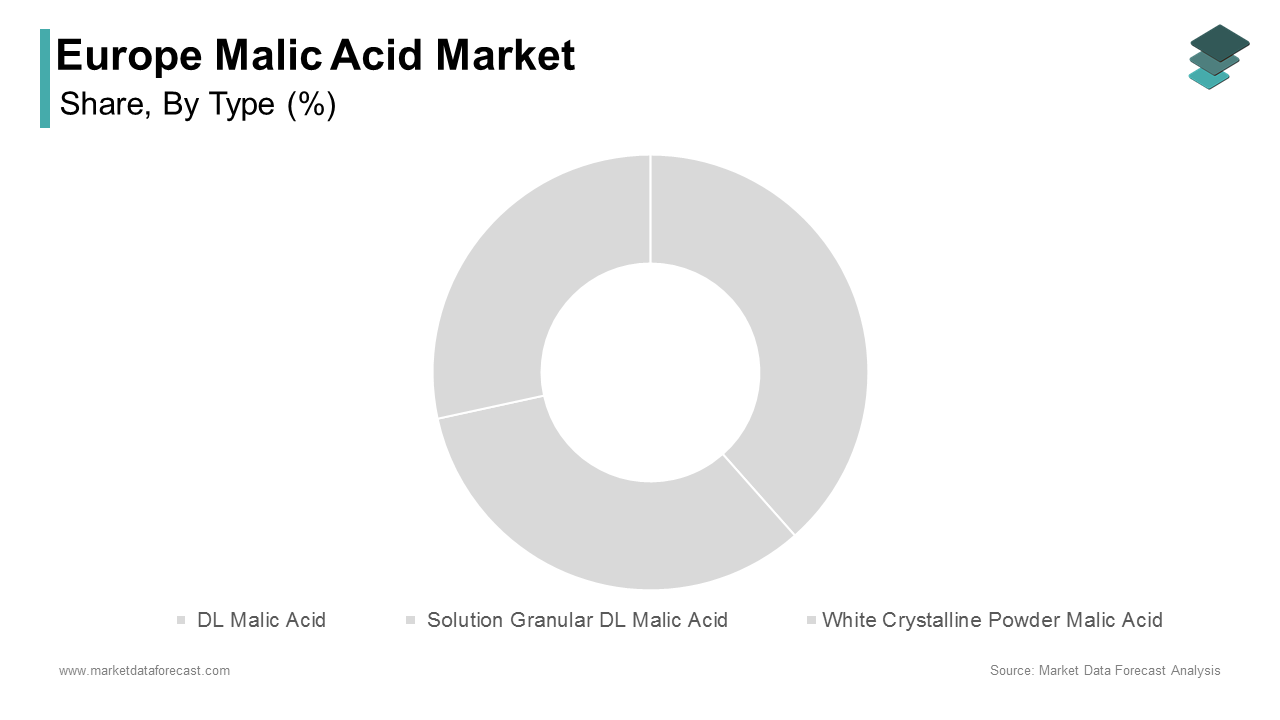
The DL malic acid solution segment is predicted to grow at a CAGR of 8.12% over the forecast period in the European market, owing to the rising demand in liquid food and beverage applications where ease of integration and rapid solubility are critical. Beverage manufacturers increasingly favour liquid acidulants to streamline production and reduce mixing time. Pre-diluted acid solutions support consistent pH and flavour profiles across batches and also help minimise dust exposure in processing environments, improving occupational safety. The liquid format is therefore seen as advantageous in high-volume beverage systems. Meanwhile, as the plant-based dairy alternatives sector records robust growth, particularly in Western Europe, where non-soy milks and plant-based yoghurts and cheeses are expanding with double-digit CAGRs, the Market by Application
By Application Insights
The food and beverage segment dominated the market by occupying a share of 65.4% of the European market in 2025. Factors such as malic acid’s irreplaceable role as a flavor enhancer, acidulant, and preservative in fruit-based and low-sugar products are majorly driving the domination of the F&B segment in the European market. Its ability to deliver a smooth lingering sourness that mimics natural fruit acidity makes it the preferred choice for apple, cherry, and berry flavored items, and these are the categories that dominate European confectionery and beverage innovation. According to UNESDA Soft Drinks Europe, the soft-drinks sector has committed to reducing average added sugars in soft drinks by 10% from 2019 to 2026 across the EU-27 + UK. Through this reformulation push, the trend toward sugar-reduced beverages is boosting demand for acidulants (such as Malic acid) in flavour balancing and sensory optimization. According to market research, the global malic acid market is growing in part because the food & beverage segment captured about 51.62% of malic acid applications in 2025. Malic acid is widely found in many fruits and berries and works well as a flavour-enhancer and acidulant. It also plays a role in storage stability: acids are commonly used to adjust pH and improve the microbial stability of processed fruit products. According to Eurostat, the EU’s production of apples in 2025 was approximately 11.6 million tonnes. Given that apple-acid (malic acid) profiles are culturally and industrially relevant in Europe, malic acid remains central to certain food-formulation strategies.
The cosmetics and personal care segment is likely to register the fastest CAGR of 8.12% over the forecast period in the European malic acid market. The dual functionality of malic acid as a gentle alpha hydroxy acid and natural humectant in formulations targeting sensitive and aging skin is primarily driving the growth of the cosmetics and personal care segment in the European market. Unlike glycolic acid, which can irritate, malic acid offers milder exfoliation while supporting skin barrier hydration properties validated by clinical studies from the University of Barcelona. According to the EU Chemicals Strategy for Sustainability, the EU is actively promoting safer and more sustainable chemicals, which is part of its transition toward a toxic-free environment. The strategy seeks to replace certain harsher synthetic substances with alternatives, which is a driver of innovation in chemical and materials design. According to the European Specialist Beauty Retailers Association, over 1,500 new skincare products containing malic acid were launched in 2025 from brands such as Bioderma, La Roche‑Posay, and Weleda. The ISO 16128 standard further enables clean-beauty positioning by recognising bio-fermented malic acid as having a natural origin. With the EU dermo-cosmetic market valued at EUR 28 billion and growing as per Statista, demand for multifunctional mild acids will continue to drive exceptional adoption in premium personal-care.
REGIONAL ANALYSIS
Germany Malic Acid Market Analysis
Germany led the European malic acid market with a 23.4% of the European market share in 2025, owing to its advanced food processing sector, stringent quality standards, and strong biotechnology base. As the EU’s largest producer of fruit juices, jams, and dietary supplements according to Destatis, German manufacturers prioritize high-purity malic acid for consistent flavor and regulatory compliance. The Federal Institute for Risk Assessment enforces rigorous purity thresholds for food additives, making white crystalline powder the dominant format in pharmaceutical and premium food applications. Companies such as Südzucker AG and Dr Oetker Gruppe are reformulating products with malic acid to meet national sugar-reduction goals, which is aligned with the German government’s strategy. According to the Nationale Reduktions‑ und Innovationsstrategie für Zucker, Fette und Salz, the ingredient industry committed to reducing the average added sugar content in certain processed foods, in particular beverages, by 15 % between 2015 and 2026 through voluntary measures. Germany also hosts key producers such as Jungbunzlauer AG’s fermentation facility in Kulmbach, which supplies bio-based malic acid across Europe. The country’s robust chemical regulatory framework under REACH and its leadership in the European Green Deal further incentivize sustainable production. With strong demand from both industrial food processors and dermo-cosmetic innovators, Germany’s integrated ecosystem secures its strong position in this market.
France Malic Acid Market Analysis
France had the second-largest share of the European malic acid market in 2025 due to its emphasis on natural taste profiles and clean label innovation in beverages and confectionery. According to FranceAgriMer, France’s apple production reached approximately 1.4 million tonnes in 2025. The country’s strong apple harvest provides cultural and industrial alignment with the sensory profile of malic acid, which is naturally present in apples. The French cosmetics sector also drives demand as major companies such as L’Oréal and Pierre Fabre incorporate malic acid into formulations for sensitive skin, leveraging its exfoliative qualities. According to the Agence nationale de sécurité sanitaire de l’alimentation, de l’environnement et du travail (ANSES), malic acid is listed among authorised organic acids for use as a food additive in the EU. National initiatives such as the France Relance plan support the development of bio-based chemical production, which is creating incentives for organic acid production, including malic acid. France’s fusion of gastronomic tradition and regulatory leadership, therefore, helps secure its influential role in shaping Europe’s malic acid demand.
United Kingdom Malic Acid Market Analysis
The United Kingdom is projected to register a promising CAGR in the European malic acid market over the forecast period. Companies such as the Food and Drink Federation (FDF) note that the introduction of the Soft Drinks Industry Levy (SDIL) in the UK in 2018 encouraged widespread adoption of alternative acidulants, including malic acid, to maintain flavour in lower sugar drinks. The SDIL applies to soft drinks with added sugar and was designed to drive reformulation and parts of production changes. In addition, companies like Innocent Drinks and Britvic reformulate smoothies and carbonated beverages to maintain tartness and sensory appeal even with reduced sugar content. The UK’s national dietary guidance, updated in 2025, which is further encourages lower sugar intake and reinforces manufacturer compliance with reformulation goals. The Food Standards Agency (FSA) continues to align with retained regulation of additives, including malic acid, under retained EC Regulation 1333/2008, ensuring that malic acid remains a permitted substance post-Brexit. With strong consumer awareness of ingredients, malic acid remains well placed to meet demand for recognizable and mild acids in reduced-sugar and clean-label formulations.
Italy Malic Acid Market Analysis
Italy is estimated to account for a notable share of the European market over the forecast period. The malic acid market growth in Italy is driven by its extensive fruit processing industry and tradition of artisanal food production. Italy is a major producer of kiwifruit and pears, and among the top three apple-growing countries in Europe, which is supported by data from ISTAT showing Italy’s apple sector remains large. According to ISTAT data, in 2021, apple production in the Trentino region alone was 5,100,100 quintals (510,010 tonnes), which represents about 23 % of national production. The abundance of fruit translates into strong alignment for the use of malic acid in juices, jams, and fruit fillings where authentic tartness is essential. Italy’s national bio-economy strategy, BIT II – A new Bioeconomy strategy for a sustainable Italy that supports the valorisation of renewable biological resources, which is relevant to fermentation-based chemical production.
Netherlands Malic Acid Market Analysis
The Netherlands is expected to exhibit a prominent CAGR during the forecast period in the European market. The Netherlands has a reputation as Europe’s hub for bio-based chemical production and ingredient distribution. Home to global producers like Corbion, the country leverages advanced fermentation technology to manufacture high-purity L-malic acid from renewable feedstocks. The facility of Corbion in Delfzijl operates at a significant scale, supplying food, pharmaceutical, and cosmetic customers across Europe. The Dutch government’s support for circular biorefineries under its national biomass and bio-economy programmes further accelerates organic-acid production. The Port of Rotterdam functions as a major import-export gateway for raw materials and finished goods, facilitating efficient distribution to neighbouring countries, which is a strategic logistics advantage. Dutch regulatory clarity—via organisations such as RIVM National Institute for Public Health and the Environment—ensures smooth compliance with EU food-additive and REACH requirements. Moreover, Dutch consumers show a strong preference for bio-based and clean-label ingredients: for example, a study indicated that a large proportion of Dutch respondents favour bio-based products. All these factors position the Netherlands as a strategic enabler of Europe’s malic acid supply chain.
COMPETITION OVERVIEW
Competition in the Europe malic acid market is characterized by a concentrated landscape of established bio-based producers and specialized chemical suppliers competing on purity, sustainability, and application expertise rather than price alone. The market is not highly fragmented, with only a handful of companies possessing the fermentation infrastructure and regulatory certifications required for food and pharmaceutical grades. Corbion and Jungbunzlauer dominate through integrated biorefineries and long-standing compliance with European Pharmacopoeia and EFSA standards, while Asian producers like Fuso focus on niche cosmetic and technical segments. Competition centers on innovation in feedstock diversification, such as using lignocellulosic waste and developing formats that meet formulation challenges in low sugar and clean beauty products. Regulatory alignment is a key differentiator as non-compliant suppliers face barriers under REACH and food additive legislation. With rising demand for natural acidulants and limited new entrants due to capital intensity, the market favors incumbents with proven sustainability credentials and deep customer co-development capabilities across food, beverage, and personal care industries.
KEY MARKET PLAYERS
A few major players of the Europe malic acid market include
- Perfect Moment Ltd
- Lonza Group Ltd
- Thirumalai Chemicals
- Bartek Ingredients
- Fuso Chemical
- Isegen South Africa
- Anhui Anke Biotechnology (Group)
- Puyang Yongan Chemical
- Prinova Group
- Nacalai Tesque
- Guangzhou Jointas Chemical
- Polynt SpA
- The Chemical Company
Top Strategies Used by the Key Market Participants
Key players in the Europe malic acid market primarily adopt four strategic approaches to strengthen competitiveness and meet evolving demand. First, they invest in bio-based fermentation technologies to produce malic acid from renewable feedstocks, aligning with EU sustainability mandates and clean label trends. Second, they ensure strict compliance with European food, cosmetic, and pharmaceutical regulations through certified production facilities and comprehensive documentation. Third, they develop application-specific formulations such as ready-to-use liquid solutions for beverages or ultrafine powders for dermo cosmetics to address customer technical needs. Fourth, they form strategic partnerships with research institutions and brand owners to co-innovate in sugar-reduced and functional product categories. These strategies collectively enhance product differentiation, regulatory credibility, and market responsiveness in a quality-driven ingredient segment.
Leading Players in the Market
Corbion N.V.
Corbion N.V. is a leading producer of bio-based malic acid in Europe, leveraging advanced fermentation technology to deliver high-purity L-malic acid for food, pharmaceutical, and personal care applications. The company sources renewable feedstocks such as non-GMO glucose and operates a state-of-the-art biorefinery in the Netherlands that aligns with EU circular economy principles. Globally, Corbion supplies malic acid to over 60 countries and collaborates with major food and cosmetic brands to develop clean-label formulations. In 2025, Corbion expanded its R&D partnership with Wageningen University to optimize yield from second-generation biomass, enhancing sustainability and cost efficiency. These initiatives reinforce its reputation as an innovation-driven supplier of green organic acids across international markets.
Jungbunzlauer Suisse AG
Jungbunzlauer Suisse AG plays a pivotal role in the Europe malic acid market through its production of high-quality crystalline and granular forms derived from natural fermentation processes. The company emphasizes compliance with European Pharmacopoeia and food safety standards, making its products suitable for sensitive applications in dietary supplements and premium confectionery. Jungbunzlauer supplies malic acid to manufacturers across the EU and North America and is recognized for its transparent sourcing and carbon footprint reduction initiatives. In 2023, the company upgraded its Austrian production facility to increase energy efficiency and reduce water usage by 20 percent. This commitment to sustainable manufacturing strengthens its position as a trusted provider of natural acidulants in global supply chains.
Fuso Chemical Co., Ltd.
Fuso Chemical Co. Ltd. contributes significantly to the European malic acid market by offering both DL and L forms tailored for cosmetics and food applications with a focus on purity and stability. Although headquartered in Japan, the company maintains a strong distribution and technical support network across Germany, France, and the UK, serving dermo cosmetic and beverage innovators. Fuso adheres to EU regulatory frameworks, including REACH and EC 1223 2009, ensuring its products meet stringent safety requirements. In 2025, Fuso launched a bio-based DL malic acid solution specifically formulated for low-sugar beverage manufacturers seeking clean-label compliance. This strategic product development enhances its relevance in Europe’s evolving ingredient landscape and supports its global expansion in green specialty chemicals.
MARKET SEGMENTATION
This research report on the Europe malic acid market has been segmented and sub-segmented based on type, application, and region.
By Type
- DL Malic Acid
- Solution Granular DL Malic Acid
- White Crystalline Powder Malic Acid
By Application
- Food & Beverage
- Cosmetics & Personal Care Products
- Pharmaceuticals
By Region
- UK
- France
- Spain
- Germany
- Italy
- Russia
- Sweden
- Denmark
- Switzerland
- Netherlands
- Turkey
- Czech Republic
- Rest of Europe