- Product Description Description
- Table of Contents TOC
- List of Table & Figure LOT
- Get Free Sample PDF Sample PDF
Global Malic Acid Market Summary
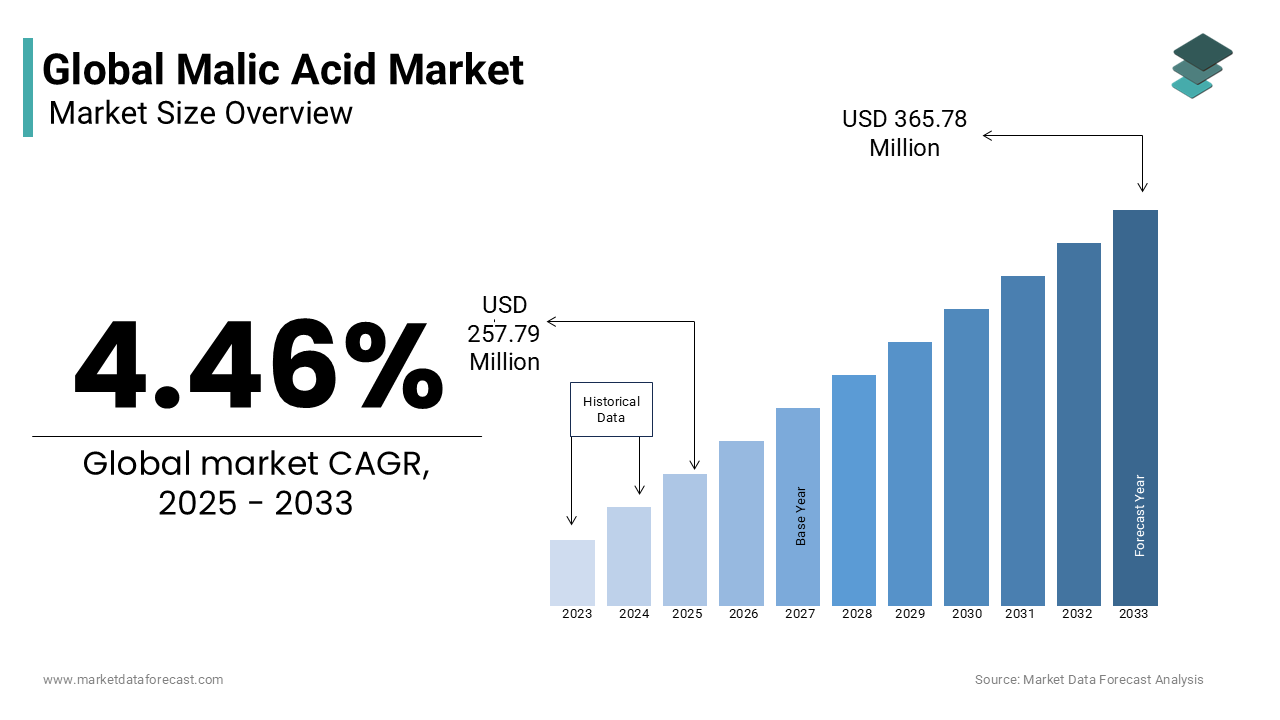
The global malic acid market was valued at USD 246.79 million in 2024, is estimated to reach USD 257.79 million in 2025, and is projected to grow significantly to USD 365.48 million by 2033, expanding at a CAGR of 4.46% from 2025 to 2033. The growth of the global malic acid market is attributed to its increasing use as a flavor enhancer in the food and beverage industry, rising adoption in personal care and cosmetics, and expanding demand in pharmaceuticals and industrial applications.
Key Market Trends
- Growing incorporation of malic acid in processed foods and beverages for its sourness and flavor-balancing properties.
- Rising application in nutraceuticals and dietary supplements due to health benefits.
- Increasing demand from the cosmetics and personal care industry for skin care formulations.
- Expanding utilization in industrial and animal feed applications.
- Investments in sustainable production technologies and bio-based malic acid.
Segmental Insights
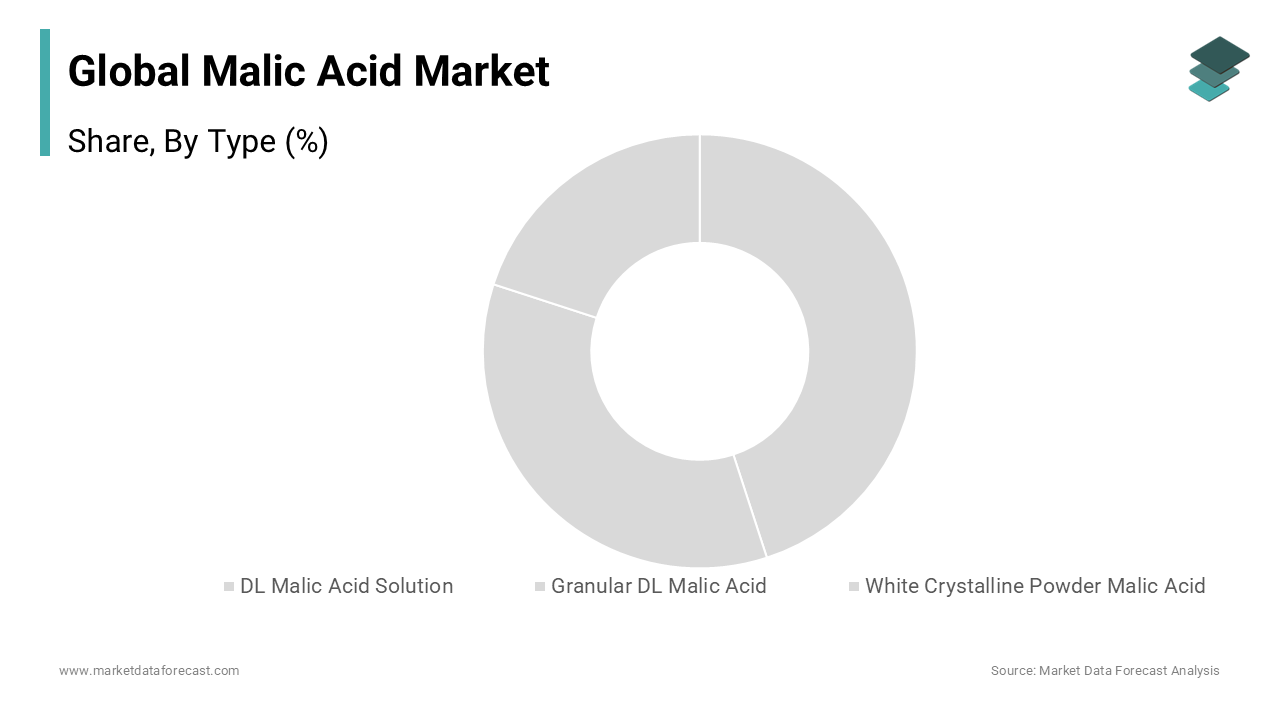
- Based on type, the DL Malic Acid Solution segment dominated the global market with 48.2% share in 2024, supported by its wide application in food, beverages, and industrial uses.
- Based on application, the food & beverage segment held the leading market share in 2024, driven by rising processed food consumption, soft drinks, and flavoring needs across global markets.
Regional Insights
- Asia-Pacific was the top-performing region in the global malic acid market, accounting for 38.5% share in 2024, owing to rapid urbanization, growing demand for packaged foods, and strong presence of chemical manufacturers.
- North America shows consistent growth, fueled by dietary supplements and clean-label beverage trends.
- Europe maintains a strong market base, backed by established food processing industries and cosmetic applications.
- Latin America is witnessing growth from rising processed food adoption.
- Middle East & Africa are gradually expanding with demand in beverages, cosmetics, and food formulations.
Competitive Landscape
Key companies operating in the global malic acid market include Bartek Ingredients Inc., Fuso Chemical Co., Ltd., Polynt S.p.A., Thirumalai Chemicals Ltd., Anhui Sealong Biotechnology Co., Ltd., Changmao Biochemical Engineering Co., Ltd., Miles Chemical, Yongsan Chemicals, Inc., Spectrum Chemical Manufacturing Corp., and Corbion N.V. These players focus on capacity expansion, partnerships, and sustainable production methods to strengthen their global presence.
Global Malic Acid Market Size
The global malic acid market size was valued at USD 246.79 million in 2024, is estimated to reach USD 257.79 million in 2025, and is projected to reach USD 365.48 million by 2033, growing at a CAGR of 4.46% from 2025 to 2033.
Malic acid is known as hydroxybutanedioic acid. It imparts a smooth and lingering tartness that closely mimics the natural acidity of fruits, which makes it indispensable in sugar-reduced and functional beverages. According to the study, malic acid is generally recognized as safe (GRAS) for use in many food categories, including confections, baked goods, and low-calorie drinks. As per the Joint FAO/WHO Expert Committee on Food Additives, the acceptable daily intake for malic acid is not limited due to its endogenous presence in human metabolism and rapid clearance through the Krebs cycle.
MARKET DRIVERS
Surge in Demand for Sugar-Reduced and Functional Beverages
The rising consumer shift toward low-sugar and functionally enhanced beverages drives the growth of malic acid market. Unlike citric acid, malic acid delivers a sharper, longer-lasting sourness at lower concentrations, which enables manufacturers to maintain taste intensity while reducing sugar content. According to the research, global production of sugar-free beverages expanded, with North America and Western Europe leading adoption. In these regions, a portion of new soft drink launches contain organic acids as flavor modulators, with malic acid featured in a portion of such products. As per the study, malic acid is particularly effective in plant-based beverages, where it counteracts inherent bitterness without increasing caloric load. Furthermore, its solubility in cold water makes it ideal for ready-to-drink formats, which strengthens its strategic importance in modern beverage design.
Expansion of the Global Sour Candy and Chewable Supplement Market
The intense and sustained acidity of sour and tangy confectionery and chewable nutraceuticals enhances the sensory experience, which in turn propels the growth of the malic acid market. As per the study, sour candies accounted for a portion of all hard candy launches globally, with brands leveraging malic acid for their signature taste profiles. The compound’s hygroscopic nature allows it to adhere to candy surfaces by creating a progressive sour release that consumers find more engaging than citric acid-based alternatives.
MARKET RESTRAINTS
High Production Costs and Limited Fermentation-Based Supply
The high cost and technical complexity associated with bio-based production methods, which remain underdeveloped compared to petrochemical routes, restrains the growth of malic acid market. Currently, a portion of industrial malic acid is synthesized via the hydration of maleic anhydride, a process dependent on fossil-derived feedstocks, as per research. Fermentation using engineered Aspergillus strains offers a sustainable alternative.
Regulatory Hurdles in Emerging Markets for Food Additives
The approval and standardization of malic acid as a food additive remain inconsistent across emerging economies, which hampers the growth of malic acid market. The Codex Alimentarius permits malic acid in multiple food categories. The national regulatory frameworks in countries like Indonesia, Nigeria, and Pakistan either restrict its usage or lack clear guidelines. As per the study, only few of 54 African nations have established regulatory thresholds for organic acid additives, leading to import restrictions and compliance uncertainties. This fragmented landscape forces manufacturers to reformulate products regionally, which increases operational complexity and delaying product launches.
MARKET OPPORTUNITIES
Integration into Clean-Label and Organic Product Formulations
Clean-label food and beverage innovation is setting up new opportunities for the growth of malic acid market. It is increasingly positioned as a key enabler of clean-label and organic product formulations due to its natural origin and metabolic compatibility. Traditionally it is synthesized. But, advancements in biotechnological production using glucose fermentation are paving the way for certified organic malic acid. As per the research, demand for organic acidulants grew, with brands incorporating bio-malic acid into their ingredient decks. The U.S. National Organic Program allows malic acid derived from non-GMO fermentation to be used in products labeled organic if it meets carbon-14 testing standards for biobased content. Furthermore, the Horizon Europe initiative has funded projects related to bio-based chemicals, sustainable food ingredients, and sweeteners.
Growing Use in Cosmetic and Dermatological Applications
The rising application in the personal care sector, as a component of alpha-hydroxy acid (AHA) blends used in chemical exfoliants and anti-aging treatments, is setting new opportunities for the growth of malic acid market. The global business for AHA-based skincare has expanded, according to the research, with malic acid present in a portion of leave-on facial treatments. Its dual functionality as both an exfoliant and a pH adjuster enhances formulation stability, which reducing the need for additional additives. This expanding application base is diversifying demand beyond food and opening high-margin avenues in dermatologically tested and cosmeceutical products.
MARKET CHALLENGES
Dependence on Petrochemical Feedstocks and Sustainability burdens
The mounting burden of transitioning to sustainable production and increasing scrutiny on carbon intensity challenge the growth of the malic acid market. The current maleic anhydride-to-malic acid conversion process emits a portion of CO₂ per kilogram of product. Apart from these, major consumer brands have started work to renewable carbon in acidulants by 2030, as per the study. However, scaling bio-based production remains challenging due to low microbial efficiency and competition for fermentable sugars with biofuel industries.
Quality Variability and Purity Standards in Industrial-Grade Supply
Ensuring consistent purity and performance in industrial-grade malic acid challenges the growth of malic acid market. This is particularly in regions with underdeveloped quality control infrastructure. A portion of malic acid batches imported into Southeast Asia failed purity benchmarks, containing elevated levels of maleic acid impurities that affect flavor stability. Furthermore, hygroscopicity complicates storage and transportation, which requires hermetic packaging and climate-controlled logistics.
REPORT COVERAGE
| REPORT METRIC | DETAILS |
| Market Size Available | 2024 to 2033 |
| Base Year | 2024 |
| Forecast Period | 2025 to 2033 |
| Segments Covered | By Type, Application and Region |
| Various Analyses Covered | Global, Regional, & Country Level Analysis; Segment-Level Analysis, Drivers, Restraints, Opportunities, Challenges, PESTLE Analysis, Porter’s Five Forces Analysis, Competitive Landscape, Analyst Overview of Investment Opportunities |
| Regions Covered | North America, Europe, Asia Pacific, Latin America, Middle East, and Africa |
| Key Market Players | Bartek Ingredients Inc., Fuso Chemical Co., Ltd., Polynt S.p.A., Thirumalai Chemicals Ltd., Anhui Sealong, Biotechnology Co., Ltd., Changmao Biochemical Engineering Co., Ltd., Miles Chemical, Yongsan Chemicals, Inc., Spectrum Chemical Manufacturing Corp., Corbion N.V. |
SEGMENTAL ANALYSIS
By Type Insights
The DL Malic Acid Solution segment dominated the global malic acid market by capturing 48.2% of the global market share in 2024. The growth of the DL Malic Acid Solution segment is driven by its superior handling and integration properties in industrial applications, particularly in the beverage and food processing sectors. Unlike powdered or granular forms, the liquid solution offers seamless blending in large-scale production lines, reducing processing time and equipment wear. The U.S. Food and Drug Administration recognizes malic acid as a Generally Recognized As Safe (GRAS) substance, further supporting its widespread use in liquid formulations.
The Granular DL Malic Acid segment is estimated to register the fastest CAGR of 6.8% over the forecast period owing to its rising adoption in dry-mix applications such as powdered beverages, instant desserts, and chewing gums, where controlled release and longer shelf life are important. The granular form prevents caking and ensures uniform distribution, making it ideal for confectionery and bakery applications.
By Application Insights
The Food & Beverage segment led malic acid market by capturing a significant share in 2024. The growth of the Food & Beverage segment is propelled by malic acid’s role as a flavor enhancer and pH regulator in a wide range of consumables, particularly in sour-tasting products. Its tartness, which is perceived as sharper and more lingering than citric acid, makes it a preferred additive in candies, fruit-flavored beverages, and dairy-based desserts. Moreover, the rise of clean-label trends has led to increased substitution of synthetic acids with naturally derived organic acids like malic acid. Beverage giants have incorporated malic acid into their low-sugar and functional drink lines, including vitamin-enhanced waters and plant-based beverages.
The Cosmetics & Personal Care Products segment is estimated to register the fastest CAGR of 7.2% between 2025 and 2033 due to its role in alpha-hydroxy acid (AHA) formulations used in anti-aging and exfoliating skincare products. AHAs improve skin texture by promoting cell turnover, and malic acid’s dual function as both an exfoliant and a pH stabilizer makes it a valuable ingredient in serums, toners, and moisturizers. Furthermore, according to the research, malic acid, when combined with other AHAs like lactic acid, enhances dermal penetration without excessive irritation, making it suitable for sensitive skin formulations. Clean beauty trends are also amplifying demand, as consumers seek naturally derived and biodegradable ingredients. Brands have incorporated malic acid into their product lines, which reflects its growing prestige in dermatological skincare innovation.
REGIONAL ANALYSIS
Asia-Pacific Malic Acid Market Insights
Asia-Pacific was the top performer in the malic acid market in 2024 and accounted for 38.5% of the global market share in 2024. The domination of Asia Pacific in the global market is primarily driven by rapid industrialization, expanding food processing infrastructure, and rising consumer demand for flavored and functional foods. China and India are the primary growth engines, with China producing a portion of the world’s malic acid supply, as per the research. The country’s robust pharmaceutical and beverage manufacturing sectors, coupled with government support for domestic chemical production, have strengthened its export position. Meanwhile, India’s packaged food landscape is expected to rise in the coming years, driven by urbanization and a growing middle class, according to the study.
North America Malic Acid Market Insights
North America malic acid market was ranked second by capturing 26.7% of the share in 2024. The growth of North America in the global market is attributed to the region’s mature food and beverage industry, particularly in the United States, drives consistent demand for specialty acids in low-calorie and functional products. The U.S. accounts for a portion of North American consumption, supported by a well-established regulatory framework that facilitates the use of malic acid in GRAS-compliant applications. The Functional Food & Beverage business in the U.S expanded in 2023, with sour and tangy flavors gaining popularity among younger demographics, according to the research. .
Europe Malic Acid Market Insights
Europe malic acid market is likely to grow with Western European nations such as Germany, France, and the UK serving as key consumers. The region’s emphasis on clean-label and natural ingredients aligns well with malic acid’s status as a biodegradable, fermentation-derived acidulant. The confectionery sector alone relies heavily on malic acid for sour-coated candies and chewing gums. Apart from these, the cosmetics industry in Germany and France is increasingly formulating AHA-based skincare products by leveraging malic acid’s dermatological benefits.
Latin America Malic Acid Market Insights
Latin America malic acid market growth is likely to grow with Brazil and Mexico emerging as the primary demand centers. The region’s growth is closely tied to the expansion of its processed food and beverage industries, particularly in sugary drink reformulation efforts. Brazil, the largest economy in the region, consumed notable metric tons of malic acid, largely for use in fruit-flavored soft drinks and dairy desserts, as per the study. The country’s National Health Surveillance Agency (ANVISA) permits malic acid in a wide range of food categories, encouraging its adoption.
Middle East and Africa Malic Acid Market Insights
The Middle East and Africa malic acid market with South Africa, Saudi Arabia, and the UAE leading regional consumption. However, the market is less developed than in other regions. It is witnessing steady growth due to increasing urbanization and the proliferation of Western-style processed foods. The GCC food and beverage business expanded in 2023, with a growing appetite for imported confectionery and carbonated drinks, as per the study. In South Africa, the processed food sector contributes a portion of manufacturing GDP, according to research South Africa, which creates demand for flavor enhancers
COMPETITIVE LANDSCAPE
KEY MARKET PLAYERS
Some of the companies that are playing a dominating role in the global malic acid market include
- Bartek Ingredients Inc.
- Fuso Chemical Co., Ltd.
- Polynt S.p.A.
- Thirumalai Chemicals Ltd.
- Anhui Sealong Biotechnology Co., Ltd.
- Changmao Biochemical Engineering Co., Ltd.
- Miles Chemical
- Yongsan Chemicals, Inc.
- Spectrum Chemical Manufacturing Corp.
- Corbion N.V.
The malic acid market features a competitive landscape shaped by technological differentiation, regional supply chain strengths, and shifting consumer preferences. While large multinational firms emphasize quality, sustainability, and regulatory compliance, regional producers in China and India focus on cost efficiency and volume supply. Innovation in formulation, such as slow-release granular forms and synergistic acid blends, is a key differentiator among top players. Competition is intensifying as demand grows in functional foods, plant-based beverages, and skincare products. Companies are increasingly investing in application-specific technical support to strengthen customer loyalty. The Asia-Pacific region has become a strategic battleground due to rising domestic consumption and export potential. Mergers, capacity expansions, and partnerships with end-use industries are common tactics.
Top Players in the Malic acid Market
Musashino Chemical Laboratory Ltd.
Musashino Chemical Laboratory is headquartered in Japan, which is a leading innovator in organic acid production, with malic acid as a core offering. The company has maintained a strong footprint across Asia-Pacific by supplying high-purity malic acid to food, pharmaceutical, and cosmetic manufacturers. It operates advanced fermentation-based production facilities and has established long-term partnerships with beverage and confectionery giants. In recent years, Musashino has intensified R&D investments to develop customized acidulant blends for low-sugar products, aligning with regional health trends.
Foodchem International Corporation
Foodchem International, based in Shanghai, China, is a prominent supplier of food-grade chemicals, including malic acid, serving numerous countries. In the Asia-Pacific market, Foodchem plays a pivotal role as a cost-effective and reliable distributor, leveraging China’s robust chemical manufacturing ecosystem. The company specializes in bulk supply of crystalline and powdered malic acid to beverage and dairy processors across Southeast Asia and Oceania.
Jungbunzlauer Süssungsmittel GmbH
Jungbunzlauer, a Swiss specialty ingredients company with significant operations in Asia-Pacific, is renowned for its sustainable production of organic acids, including malic acid derived from fermentation. The company supplies high-purity, non-GMO malic acid to premium food and cosmetic brands. It has strategically positioned itself as a clean-label solutions provider by catering to health-conscious markets in the region.
Top Strategies Used by the Key Market Participants
Key players in the malic acid market are deploying strategic initiatives to enhance competitiveness and expand regional influence. Major strategies include vertical integration to control raw material supply and reduce production costs, particularly among Chinese manufacturers. Companies are investing heavily in R&D to develop specialized malic acid grades for functional foods, pharmaceuticals, and dermatological applications. Strategic partnerships with local distributors and food manufacturers are being leveraged to penetrate emerging markets in Southeast Asia and India. Capacity expansion is another prevalent tactic, with firms upgrading fermentation facilities to meet rising demand. Apart from these, compliance with international food safety and cosmetic regulations is being prioritized to access premium markets in Japan, Europe, and North America.
RECENT MARKET DEVELOPMENTS
- In February 2022, Bartek Ingredients, a global leader in organic acids, completed the expansion of its malic acid purification unit in Ontario, Canada, enabling higher purity grades for export to pharmaceutical and cosmetic clients in South Korea and China.
MARKET SEGMENTATION
The research report on the malic acid market has been segmented and sub-segmented based on categories.
By Type
- DL Malic Acid Solution
- Granular DL Malic Acid
- White Crystalline Powder Malic Acid
By Application
- Food & Beverage
- Cosmetics & Personal Care Products
- Pharmaceuticals
By Region
- North America
- Europe
- Asia-Pacific
- Latin America
- Middle East and Africa