- Product Description Description
- Table of Contents TOC
- List of Table & Figure LOT
- Get Free Sample PDF Sample PDF
Market Size, 2025
$1.15 BnMarket Estimate, 2026
$1.17 BnMarket Forecast, 2034
$1.36 BnCAGR, 2026–2034
1.89%Executive Summary: Europe Margarine Market
- Market Scope: Comprehensive Europe margarine market analysis covering product types, application segments, country-level leadership frameworks, and regulatory compliance trends.
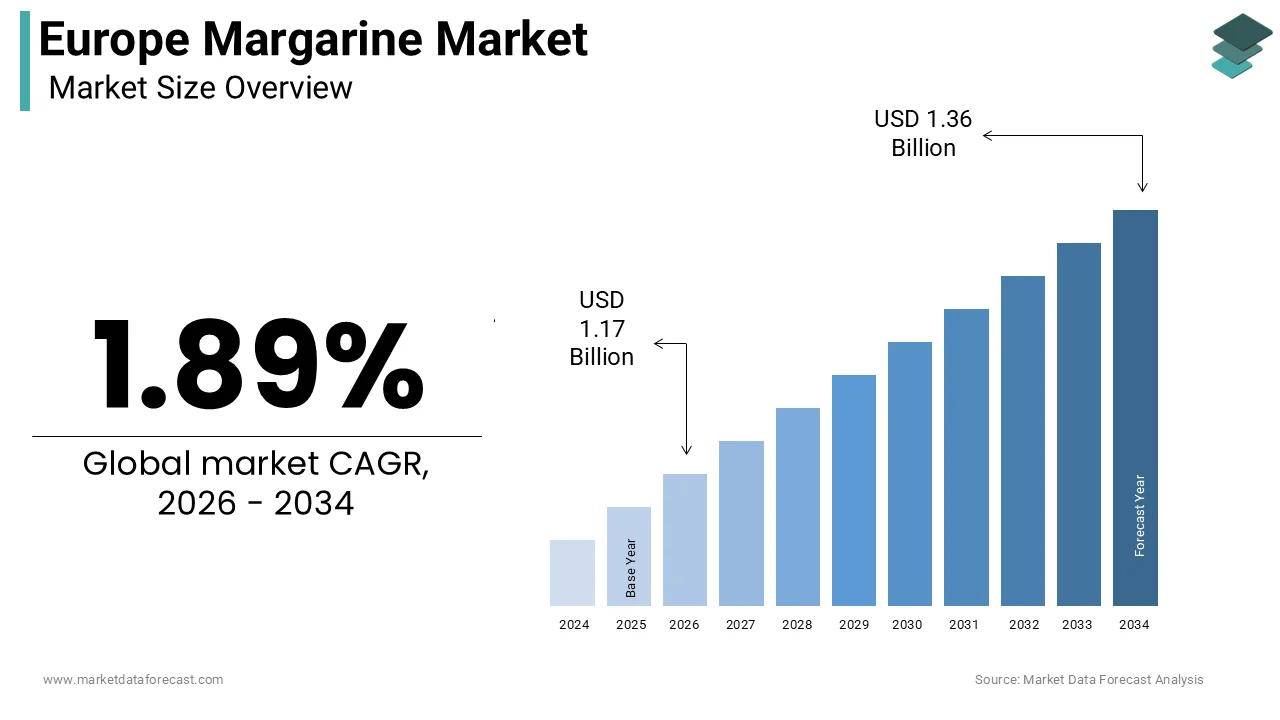
- Market Valuation: Valued at USD 1.15 billion (2025), estimated at USD 1.17 billion (2026), and projected to reach USD 1.36 billion by 2034, registering a steady CAGR of 1.89% (2026–2034).
- Primary Growth Drivers: EU's elimination of industrial trans fats, increasing demand for plant-based and dairy-free alternatives, functional and fortified products, and sustainable vegetable oils. Key challenges include consumer perception as a processed food, oil price volatility, and competition from oils and plant-based butters.
Key Market Segment Metrics (2026–2034)
| Category | Leading Segment (2025 Position) | Fastest-Growing Segment |
|---|---|---|
| By Product | Soft Margarine (dominated with 52.3% market share in 2025 due to ease of spreadability and clean-label alignment) | Liquid Margarine (expected to witness the fastest growth at a CAGR of 9.6%) |
| By Application | Household (accounted for 64.3% of the market in 2025, supported by domestic consumption and heart-health trends) | Commercial (projected to grow at a CAGR of 8.3% driven by plant-based menus and bakery applications) |
| By Country | Germany (led regional market with 21.3% share in 2025, supported by manufacturing capabilities and high per capita consumption) | United Kingdom, France, and emerging Eastern European markets |
Major Market Players & Market Structure
Market Structure: Highly competitive European food landscape featuring multinational producers and specialized fat refiners competing on continuous product reformulation for EU regulations, sustainable sourcing, plant-based and functional product innovation, and clean-label spreads.
Key Companies: Bunge Limited, Wilmar International Ltd., PURATOS, Conagra Brands, Inc., Richardson International Limited, FUJI OIL HOLDINGS INC., Currimjee Jeewanjee and Company Limited, NMGK Group, EFKO Group, Vandemoortele, Dairy Crest Limited, Unilever, LASENOR EMUL, SL, Sime Darby Oils Zwijndrecht Refinery BV, Walter Rau Lebensmittelwerke GmbH, and Cardowan Creameries Limited.
 Download Free Sample Report
Europe Margarine Market Size
The Europe Margarine Market size was calculated to be USD 1.15 billion in 2025 and is anticipated to be worth USD 1.36 billion by 2034, from USD 1.17 billion in 2026, growing at a CAGR of 1.89% during the forecast period.
The margarine is a range of vegetable oil-based spreads formulated as alternatives to butter for culinary baking and table use. These products are typically produced through the emulsification of refined oils such as sunflower, rapeseed, or palm with water and functional ingredients, including emulsifiers, vitamins, and salt. Margarine’s evolution in Europe has been shaped by shifting nutritional paradigms, regulatory interventions, and consumer perceptions of health.
MARKET DRIVERS
Reformulation Driven by EU Trans Fat Elimination Mandate
The mandatory elimination of industrially produced trans fatty acids is a major factor that is propelling the growth of the Europe margarine market. Manufacturers reformulated products using interesterification or non-hydrogenated oil blends primarily from rapeseed, sunflower, and high oleic oils. These changes not only ensured regulatory compliance but also improved the nutritional profile, enhancing public perception.
Rising Demand for Plant-Based and Dairy-Free Alternatives
The consumer shift toward plant-based diets has significantly amplified demand for margarine as a dairy-free butter substitute in European households and food service, which is accelerating the growth of the Europe margarine market. Margarine, by definition, contains no animal products, making it inherently suitable for these dietary preferences. Additionally, the European Commission’s Farm to Fork Strategy promotes plant-based food consumption to reduce environmental impact, further legitimizing margarine within sustainable eating frameworks.
MARKET RESTRAINTS
Persistent Consumer Perception of Margarine as Highly Processed
The entrenched perceptions of being an ultra-processed food laden with additives and artificial ingredients are hampering the growth of the Europe margarine market. This perception is reinforced by clean label movements, which prioritize short ingredient lists and recognizable components. Marketing efforts emphasizing natural oils and minimal processing have had limited success in Southern Europe, where culinary traditions favor single-ingredient fats.
Volatility in Vegetable Oil Supply Chains and Pricing
The margarine production is highly vulnerable to fluctuations in global vegetable oil markets, which directly impact cost stability and formulation consistency. This factor is likely to hamper the growth of the Europe margarine market. These supply chain instabilities not only inflate production costs but also complicate long-term product standardization and pricing strategies, thereby undermining market predictability.
MARKET OPPORTUNITIES
Expansion into Functional and Fortified Spread Categories
Margarine producers are capitalizing on the growing consumer interest in functional foods by developing fortified spreads that deliver added health benefits beyond basic nutrition, which is setting up new opportunities for the growth of the Europe margarine market. Brands such as Flora Proactiv have leveraged this by incorporating plant sterols proven to reduce LDL cholesterol.
Growth of Sustainable and Traceable Oil Sourcing Initiatives
The sustainability commitments for margarine brands that prioritize certified sustainable and regionally sourced oils are also to leverage the growth of the Europe margarine market in the coming years. Additionally, the EU Organic Regulation 2018/848 enables certified organic margarines made from organically farmed rapeseed, appealing to eco-conscious consumers.
MARKET CHALLENGES
Regulatory Divergence in Health Claim Approvals Across Member States
The harmonization, significant discrepancies persist in the interpretation and enforcement of nutrition and health claims for margarine products across national authorities, creating compliance complexity that is degrading the growth of the Europe margarine market. This regulatory fragmentation forces manufacturers to develop country-specific packaging and marketing strategies, increasing operational costs.
Competition from Alternative Spreading Fats and Culinary Oils
The widening array of alternative spreading fats and liquid oils that align more closely with contemporary dietary trends is anticipated to hamper the growth of the Europe margarine market. Extra virgin olive oil, avocado oil, and nut butters are increasingly used as direct substitutes, particularly in Southern Europe, where culinary traditions favor single-ingredient fats. Plant-based butter alternatives from brands like Naturli and Alpro further fragment the market by offering dairy-free options with cleaner labels than traditional margarine.
REPORT COVERAGE
| REPORT METRIC | DETAILS |
| Market Size Available | 2025 to 2034 |
| Base Year | 2025 |
| Forecast Period | 2026 to 2034 |
| CAGR | 1.89% |
| Segments Covered | By Product Type, Application, and Region |
| Various Analyses Covered | Global, Regional & Country Level Analysis; Segment-Level Analysis; DROC, PESTLE Analysis; Porter’s Five Forces Analysis; Competitive Landscape; Analyst Overview of Investment Opportunities |
| Regions Covered | UK, France, Spain, Germany, Italy, Russia, Sweden, Denmark, Switzerland, Netherlands, Turkey, and the Czech Republic |
| Market Leaders Profiled | Bunge Limited, Wilmar International Ltd, PURATOS, Conagra Brands, Inc., Richardson International Limited, FUJI OIL HOLDINGS INC., Currimjee Jeewanjee and Company Limited, NMGK Group, EFKO Group, Vandemoortele, Dairy Crest Limited, Unilever, LASENOR EMUL, Sime Darby Oils Zwijndrecht Refinery BV, Muez-Hest India Private Limited, SL, Silverson, Bonanza Megah, Walter Rau Lebensmittelwerke GmbH, and Cardowan Creameries Limited. |
SEGMENTAL ANALYSIS
By Product Type Insights
The soft margarine segment was the largest by accounting for 52.3% of the Europe margarine market share in 2025, with its immediate spreadability at refrigeration temperatures and alignment with modern clean label expectations. Additionally, retail packaging innovations such as tubs with easy scoop designs and resealable lids enhance user convenience, particularly among elderly and urban demographics.
The liquid margarine segment is lucratively growing with an anticipated CAGR of 9.6% during the forecast period, with its versatility in commercial food preparation and rising demand for pourable plant-based fats in home cooking. The growing demand for ready-to-eat meal kits that specify liquid margarine for convenience and portion control is escalating the segment’s growth.
By Application Insights
The household segment held 64.3% of the Europe margarine market share in 2025.
The growth of the segment is attributed to the deep integration of margarine into daily European eating habits, particularly in bread-centric diets. National dietary guidelines in Nordic countries actively recommend vegetable oil-based spreads over butter for cardiovascular health, reinforcing routine domestic use. Supermarkets further entrench this behavior through prominent shelf placement of private label offerings and multipack promotions.
The commercial application segment is likely to grow with a significant CAGR of 8.3% during the forecast period, with the expansion of plant-based menus in food service and reformulation mandates in institutional catering. In France, over 15,000 school canteens replaced butter with fortified soft margarine in 2022 under the National Nutrition and Health Program as per the French Ministry of Education. Major chains like Pret A Manger and Paul use liquid and soft margarines in croissants, pastries, and sauces to meet dairy-free labeling requirements. Additionally, industrial bakeries value margarine for its consistent performance in large-scale production with standardized melting points and emulsification properties.
REGIONAL ANALYSIS
Germany Margarine Market Analysis
Germany was the top performer of the Europe margarine market with 21.3% of the share in 2025, with high per capita consumption and advanced manufacturing infrastructure. Germany is home to leading producers like Upfield and RENATA, which operate integrated refineries using domestically sourced rapeseed. Retailers such as Edeka and REWE offer over 30 private-label margarine variants catering to organic, reduced salt, and omega-enriched preferences.
COMPETITION OVERVIEW
The Europe margarine market features a competitive landscape shaped by established multinational brands, agile private label producers, and specialized ingredient suppliers. Competition is primarily driven by formulation innovation, sustainability credentials, and alignment with evolving nutritional guidelines rather than price alone. Global players like Upfield leverage strong brand equity and pan-European distribution to maintain leadership, while retailers such as Carrefour and Aldi expand high-quality private label offerings that challenge branded premiums. Ingredient companies, including Loders Croklaan and AAK, provide technical support enabling trans-fat-free and clean-label transitions. Regulatory pressures, particularly the EU trans-fat ban and deforestation rules, have raised entry barriers favoring firms with integrated supply chains.
KEY MARKET PLAYERS
A few of the dominating players in the Europe margarine market include
- Bunge Limited
- Wilmar International Ltd
- PURATOS
- Conagra Brands, Inc
- Richardson International Limited
- FUJI OIL HOLDINGS INC
- Currimjee Jeewanjee and Company Limited
- NMGK Group
- EFKO Group
- Vandemoortele
- Dairy Crest Limited
- Unilever
- LASENOR EMUL
- Sime Darby Oils Zwijndrecht Refinery BV
- Muez-Hest India Private Limited
- SL, Silverson
- Bonanza Megah
- Walter Rau Lebensmittelwerke GmbH
- Cardowan Creameries Limited
Top Strategies Used by the Key Market Participants
Key players in the Europe margarine market focus on clean label reformulation by eliminating artificial additives and using non-hydrogenated oils such as high oleic sunflower or rapeseed. Companies prioritize sustainability through certified sustainable palm oil sourcing and recyclable packaging aligned with the EU Packaging and Packaging Waste Directive. Product diversification into functional variants fortified with plant sterols, omega-3s, or vitamins addresses preventive health trends. Strategic partnerships with oilseed farmers and certification bodies ensure traceable and deforestation-free supply chains. Brands also invest in consumer education campaigns to reposition margarine as a heart-healthy and environmentally responsible choice.
LEADING PLAYERS IN THE EUROPE MARGARINE MARKET
Upfield Group B.V.
Upfield Group B.V. is a global leader in plant-based spreads headquartered in the Netherlands with a strong legacy in the European margarine market. The company owns iconic brands such as Flora Rama and Becel, which are widely available across retail and food service channels. Upfield has actively driven the transition toward healthier formulations by eliminating trans fats and reducing saturated fat content across its portfolio. In 2023, the company launched Flora Plant Butter in recyclable packaging across Germany, France, and the UK, aligning with circular economy principles. Upfield also collaborates with the Roundtable on Sustainable Palm Oil to ensure full traceability of its oil supply chain.
Nestlé S.A.
Nestlé S.A. participates in the Europe margarine market through its extensive portfolio of dairy and plant-based nutritional products, including fortified spreads under regional brand adaptations. While not a traditional margarine manufacturer, Nestlé leverages its R&D capabilities to develop functional fat blends enriched with vitamins, omega fatty acids, and plant sterols. The company integrates margarine-type formulations into its medical nutrition and infant food segments, ensuring compliance with EU nutritional regulations.
Loders Croklaan
Loders Croklaan, a specialty fats and oils company and part of the Malaysian IOI Group, plays a crucial role in supplying structured lipids and non-hydrogenated bases for margarine production across Europe. The company provides tailored solutions to both branded manufacturers and private label producers, focusing on clean label texture stability and sustainability.
MARKET SEGMENTATION
This research report on the Europe margarine market has been segmented and sub-segmented based on product type, application, and region.
By Product Type
- Hard
- Soft
- Liquid product
By Application
- Residential
- Commercial
By Region
- UK
- France
- Spain
- Germany
- Italy
- Russia
- Sweden
- Denmark
- Switzerland
- Netherlands
- Turkey
- Czech Republic
- Rest of Europe