- Product Description Description
- Table of Contents TOC
- List of Table & Figure LOT
- Get Free Sample PDF Sample PDF
Market Size, 2025
$3.98 BnMarket Estimate, 2026
$4.26 BnMarket Forecast, 2034
$7.40 BnCAGR, 2026–2034
7.14%Europe Medical Tubing Market Report Summary
The Europe medical tubing market was valued at USD 3.98 billion in 2025, increased to USD 4.26 billion in 2026, and is projected to reach USD 7.40 billion by 2034, growing at a CAGR of 7.14% during the forecast period. Market growth is driven by rising demand for minimally invasive procedures, increasing healthcare expenditure, and the growing use of disposable medical devices to reduce infection risks. Technological advancements in polymer materials, expanding applications in catheters, drug delivery systems, and diagnostic equipment, and strict regulatory standards emphasizing patient safety are further fueling market expansion across Europe.
Key Market Trends
-
Increasing adoption of single-use and disposable medical tubing to improve hygiene and reduce hospital-acquired infections.
-
Growing demand for advanced polymer-based tubing with enhanced flexibility, chemical resistance, and biocompatibility.
-
Rising use of medical tubing in minimally invasive surgeries, infusion therapy, and diagnostic applications.
-
Strong focus on regulatory compliance and quality standards, including ISO and EU medical device regulations.
-
Ongoing innovation in lightweight, kink-resistant, and high-performance tubing materials for critical care applications.
Segmental Insights
-
By application, the bulk disposable tubing segment accounted for 38.3% of the Europe medical tubing market share in 2025, driven by its widespread use in hospitals, clinics, and diagnostic centers.
-
By product type, the polyvinyl chloride (PVC) segment was the largest, capturing 32.1% of the market share in 2025, owing to its cost-effectiveness, versatility, and ease of processing for medical-grade applications.
Regional Insights
-
Europe continues to experience strong demand for medical tubing due to advanced healthcare infrastructure, an aging population, and rising procedural volumes.
-
Germany emerged as the largest contributor, holding 26.3% of the Europe medical tubing market share in 2025, supported by its robust medical device manufacturing base, high healthcare spending, and strong presence of leading industry players.
Competitive Landscape
The European medical tubing market is moderately competitive, with global manufacturers and specialized material suppliers focusing on innovation, regulatory compliance, and expansion of medical-grade product portfolios. Companies are investing in advanced polymer technologies, strategic partnerships, and capacity expansions to strengthen their market position. Key players operating in the Europe medical tubing market include Nordson Corporation, ZARYS International Group sp. z o.o. sp.k., NewAge Industries, Inc., TE Connectivity Ltd., Freudenberg SE, Saint-Gobain Group, Trelleborg AB, Lubrizol Corporation (Berkshire Hathaway, Inc.), Elkem ASA (Bluestar Elkem International Co., Ltd. S.A.), and Teleflex Incorporated.
Europe Medical Tubing Market Size
The Europe medical tubing market size was valued at USD 3.98 billion in 2025 and is projected to reach USD 7.40 billion by 2034 from USD 4.26 billion in 2026, growing at a CAGR of 7.14%.
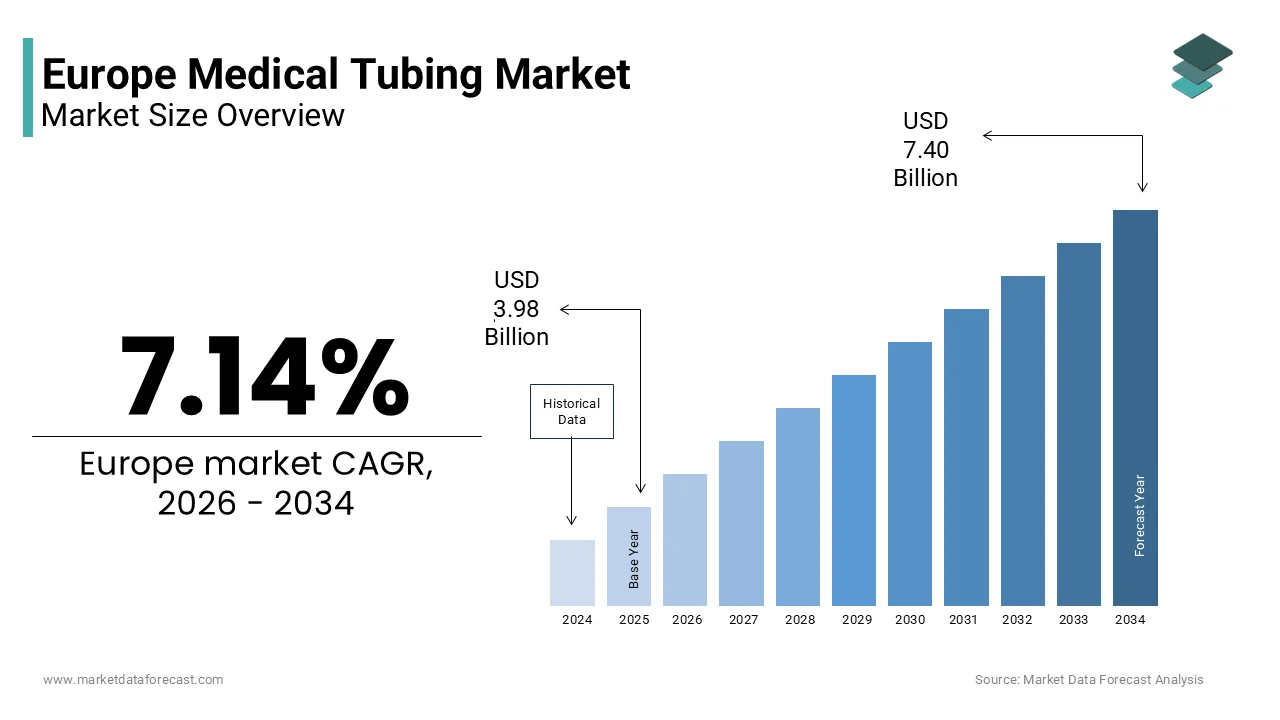
Medical tubing is a flexible or semi-rigid polymer based conduits engineered for diagnostic, therapeutic and life-supporting applications across hospitals, clinics and home care settings. These components serve as pathways in intravenous delivery, respiratory support catheterization and dialysis systems, where biocompatibility, dimensional precision and regulatory compliance are non-negotiable. As per Eurostat, over 210 million hospital discharges were recorded across the European Union in 2024, reflecting sustained procedural volume that directly underpins demand for single-use and reusable tubing assemblies. The European Medicines Agency approved 127 new active substances in the highest annual figure since 2019, indicating robust innovation in drug delivery modalities that often require specialised tubing configurations. Furthermore, according to the European Centre for Disease Prevention and Control, more than 57 million surgical procedures were performed in EU hospitals in 2024, creating a consistent need for sterile fluid management systems. This regulatory stringency shapes material selection, manufacturing protocols and supply chain validation across the region, distinguishing the European medical tubing landscape as one defined by clinical necessity, technological exactness and compliance intensity rather than mere volume.
MARKET DRIVERS
Ageing Population Intensifies Demand for Chronic Disease Management Infrastructure
The profound pressure on healthcare delivery systems with direct implications for medical tubing consumption is propelling the growth of Europe medical tubing market. According to the United Nations Population Division, 29.7% of the European Union population was aged 65 or older in 2024, and this figure is projected to exceed 32% by 2030. This ageing cohort disproportionately suffers from chronic conditions such as diabetes, cardiovascular disease and renal failure, which frequently use infusion sets, catheters, oxygen delivery lines and peritoneal dialysis tubing. The International Diabetes Federation estimates that 61 million adults in Europe were living with diabetes in 2024, a number expected to rise to 68 million by 204,5 requiring daily insulin administration via pen needles or pump-connected tubing. Similarly, as per the European Society of Cardiology, over 120 million Europeans suffer from cardiovascular diseases, leading to millions of annual interventions involving guidewires and vascular access catheters that rely on precision extruded tubing. Home-based care models further amplify demand as national health systems shift treatment from hospitals to residences to manage costs. Germany’s Federal Statistical Office reported that 78% of adults aged 75 and above received some form of outpatient care in 2024, creating a recurring need for disposable tubing in home infusion and respiratory therapy.
Expansion of Minimally Invasive Surgical Procedures Drives Speciality Tubing Adoption
The relentless advancement and adoption of minimally invasive surgery toward higher performance and miniaturisation is additionally elevating the growth of Europe medical tubing market. According to the survey, over 48 million minimally invasive procedures were performed in the region in 2024, representing a 6.2% year on year increase driven by faster recovery time,s reduced infection risk and lower hospitalisation costs. These interventions, from laparoscopic cholecystectomies to robotic-assisted prostatectomies, depend on microbore tubing for insufflation, irrigation and instrument channelling within endoscopic systems. The tubing must exhibit exceptional kink resistance, torque transmission and compatibility with sterilisation methods, such as ethylene oxide and gamma radiation. In neurovascular applications, the rise of mechanical thrombectomy for stroke treatment has intensified demand for ultra-thin yet robust catheter shafts. As per the European Stroke Organisation, approximately 1.2 million ischemic strokes occurred in Europe in 202,3 with endovascular intervention rates rising to 28% from 15% in 2019. This shift necessitates complex multi-lumen tubing with integrated wire braiding to navigate tortuous vasculature. Additionally, the European Commission’s Horizon Europe program allocated 340 million euros in 2024 to support medical device innovation, including next-generation surgical tools that integrate smart tubing with embedded sensors.
MARKET RESTRAINTS
Stringent Regulatory Compliance Increases Time and Cost of Market Entry
The most rigorous regulatory frameworks, which significantly constrain product development cycles and commercialisation timelines is ascribed to hindering the growth of Europe medical tubing market. Since the full application of the European Union Medical Device Regulation in May 2021, manufacturers must demonstrate comprehensive clinical evidence, biocompatibility data and post-market surveillance plans for every tubing configuration intended for medical use. This shortage of designated notified bodies, with only 22 entitiesauthorisedd for high-risk devices, across the entire EU, as of December 2024, according to the NANDO database. Material changes, such as switching from PVC to non-DEHP plasticisers, require full re-submission, even if functionality remains unchanged. Small and medium enterprises face disproportionate challenges, with 61% reporting delays exceeding 18 months for new tubing introductions in a 2024 industry survey. These structural barriers limit innovation velocity and deter new entrants despite growing clinical demand.
Volatility in Medical Grade Polymer Supply Chains Disrupts Production Continuity
The concentrated global supply base for medical-grade thermoplastics creates persistent vulnerability to material shortages and price fluctuations, which is solely impeding the growth of Europe medical tubing market. Key resins, such as polyurethane, silicone and cyclic olefin copolymer, are sourced from a limited number of speciality chemical producers primarily in the United States, Germany and Japan. According to Plastics Europe, medical-grade polymer imports into the EU declined by 9.3% in 2024 due to logistical bottlenecks and export restrictions following geopolitical tensions and energy constraints in key producing regions. The German Federal Institute for Materials Research reported that lead times for medical-grade silicone increased from 8 weeks in 2021 to over 22 weeks in 2024, disrupting just-in-time production models. Furthermore, the European Chemicals Agency’s REACH regulation added three phthalate alternatives to its candidate list for authorisation in early 2024, forcing rapid reformulation efforts. Companies like Trelleborg and Saint-Gobain had to qualify alternative suppliers across 17 material grades to maintain continuity. These supply chain instabilities not only inflate costs with medical-grade polyurethane prices rising 14% year on year in 2024 per ICIS, but also risk batch inconsistencies that can trigger regulatory non-conformity.
MARKET OPPORTUNITIES
Rising Investment in Home Healthcare Infrastructure Fuels Demand for Patient-Centric Tubing Solutions
The strategic pivot toward decentralised care models is generating unprecedented demand for medical tubing designed for safety, ease of use and long-term wearability in non-clinical settings. This factor is majorly boosting the growth of Europe medical tubing market. As per the Organisation for Economic Co-operation and Development, 22.4% of total health expenditure in EU countries was allocated to home-based care in 2024, reflecting deliberate policy shifts to alleviate hospital congestion and improve patient autonomy. This transition necessitates tubing systems that resist kinking, endure repeated handling, and integrate seamlessly with portable pumps, ps oxygen concentrators and wearable drug delivery devices. Similarly, in France, the government’s Ma Sante 2022 initiative expanded home dialysis coverage, leading to a 37% rise in peritoneal dialysis patients between 2021 and 2024, according to the French Renal Epidemiology and Information Network. These applications require tubing with antimicrobial coatings and smooth inner lumens to prevent protein adhesion and connectors that prevent misadministration. Companies are responding with soft-touch thermoplastic elastomers and colour-coded systems to enhance user confidence. This policy-driven care migration creates a fertile ground for innovation in patient-oriented tubing design.
Integration of Smart Technologies Opens Avenues for Functionalized Tubing
The emergence of medical tubing with sensing and connectivity capabilities of diagnostic and therapeutic functionality is certainly to level up new opportunities for the growth of Europe medical tubing market. As per the European Institute of Innovation and Technology, over 41 active projects in 2024 focused on embeddingmicrosensorss, strain gauges or RFID tags into polymer tubing to monitor pressure flow rate or drug concentration in real time. These smart conduits enable closed-loop systems such as insulin pumps that auto-adjust delivery based on glucose feedback or intravenous lines that alert clinicians to occlusion before complications arise. Similarly, the European Space Agency’s spin-off program supported the development of radiation-transparent tubing with integrated fibre optics for real-time dosimetry during brachytherapy. Regulatory pathways are adapting with the European Commission issuing a guidance document in November 2024, clarifying classification rules for tubing with embedded electronics.
MARKET CHALLENGES
Material Innovation Dilemma Between Performance, Sustainability, and Regulatory Acceptance
Manufacturers face a complex trilemma in material selection, where performance requirements, sustainability mandates and regulatory validation often conflict, which is one of the challenges for the growth of Europe medical tubing market. While healthcare systems increasingly demandeco-friendlyy alternatives to conventional PVC and DEHP plasticised formulations, viable substitutes must still meet exacting mechanical and biocompatibility standards. As per the European Environment Agency, only 12% of medical plastics in the EU were derived from recycled bio-based sources in 2024 due to stringent purity thresholds that reject post-consumer resins. Although polymers like thermoplastic elastomers and polyolefins offer improved environmental profilesthey often lack the clarity, flexibility or chemical resistance of legacy materials. For instance, polyethene-basedtubing exhibits higher gas permeability, which is unacceptable for oxygen delivery applications. The European Committee for Standardisation has yet to establishharmonisedd test methods for biodegradable medical polymers, creating uncertainty in validation protocols. A 2024 survey by the European Bioplastics Association found that 74% of tubing producers delayed bio-based product launches due to unpredictable notified body feedback. Simultaneously, hospitals under Green Public Procurement criteria pressure suppliers to disclose carbon footprints, yet lifecycle assessments for medical polymers remain inconsistent. This innovation impasse stifles the transition to sustainable materials despite strong policy intent and clinical interest.
Fragmentation of Reimbursement and Procurement Policies Across European Nations
The absence of a unified reimbursement and hospital procurement framework is expected to limit the growth of Europe medical tubing market. Each EU member state maintains distinct health technology assessment processes, hospital tender criteria and pricing mechanisms that dictate product adoption irrespective of clinical merit. As per the European Observatory on Health Systems and Policies, only 9 countries have formal reimbursement codes specifically for advanced tubing assemblies,s with the remainder bundling them into broader procedure payments. In Italy, regional health authorities issue over 200 separate tenders annually for infusion sets alone, creating administrative overhead that disadvantages smaller innovators. Germany’s Federal Joint Committee requires cost-utility evidence for new tubing types even for low-risk Class I devices, while France’s Haute Autorité de Santé evaluates them only within complete delivery systems. This fragmentation forces manufacturers to maintain multiple product configurations,s documentation packages and pricing strategies.
REPORT COVERAGE
| REPORT METRIC | DETAILS |
| Market Size Available | 2025 to 2034 |
| Base Year | 2025 |
| Forecast Period | 2026 to 2034 |
| CAGR | 7.14% |
| Segments Covered | By Application, Product Type, and Region |
| Various Analyses Covered | Global, Regional, & Country Level Analysis; Segment-Level Analysis; DROC, PESTLE Analysis; Porter’s Five Forces Analysis; Competitive Landscape; Analyst Overview of Investment Opportunities |
| Regions Covered | UK, France, Spain, Germany, Italy, Russia, Sweden, Denmark, Switzerland, Netherlands, Turkey, and the Czech Republic |
| Market Leaders Profiled | Nordson Corporation, ZARYS International Group sp. z o.o. sp.k., NewAge Industries Inc., TE Connectivity Ltd., Freudenberg SE, Saint-Gobain Group, Trelleborg AB, Lubrizol Corporation, Elkem ASA, and Teleflex Incorporated |
SEGMENTAL ANALYSIS
By Application Insights
The bulk disposable tubing segment accounted in holding 38.3% of the European medical tubing market share in 2025, with its foundational role across intravenous therapy, oxygen delivery and surgical suction systems, where single-use protocols are mandated to prevent cross-contamination. The European Centre for Disease Prevention and Control reported over 5.2 million healthcare-associated infections annually in EU hospitals, making disposable tubing essential to infection control strategies. National health systems have reinforced this trend with procurement policies favoring single use over reusable items. Germany’s Federal Ministry of Health updated its hygiene ordinance in 2024, requiring all peripheral IV lines to be replaced every 72 hours, which directly increases consumption. Additionally, the rise in outpatient and home care settings, where sterilisation infrastructure is limited, fuels reliance on pre-sterilised disposable tubing. As per Eurostat, 68 million Europeans received home-based medical treatment in 2024, necessitating standardised low-cost tubing solutions.
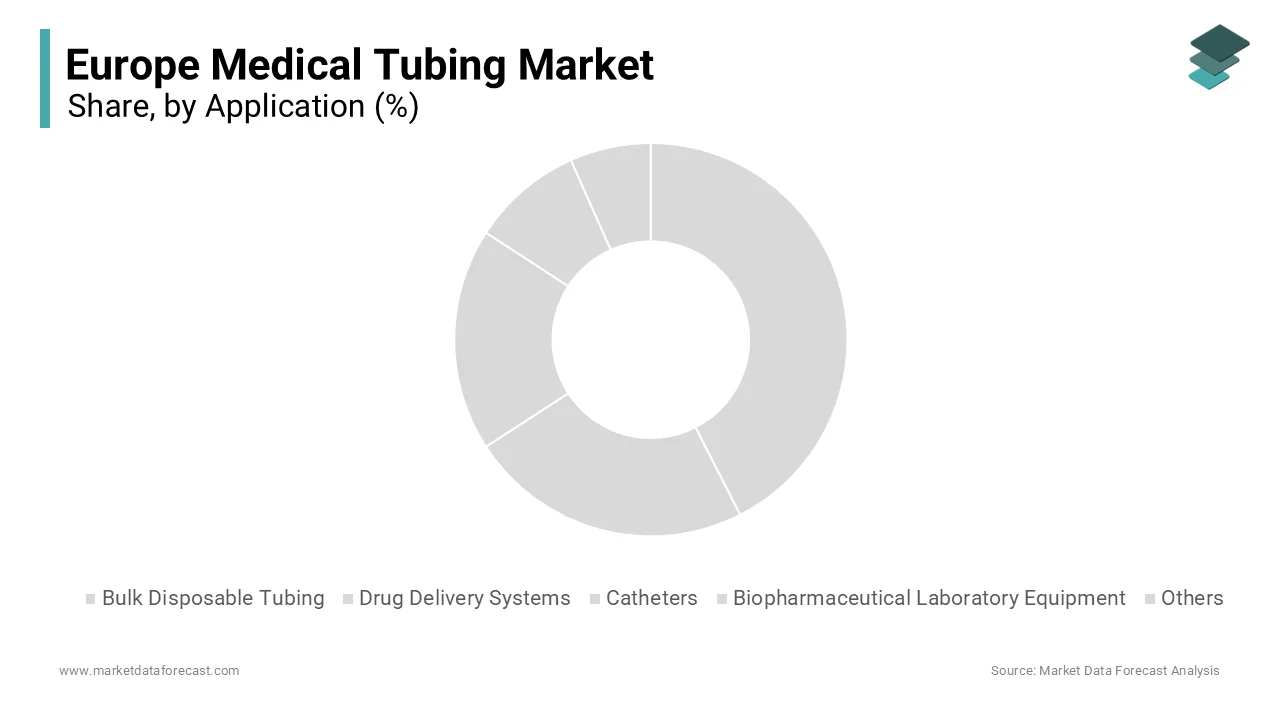
The drug delivery systems segment is anticipated to witness the fastest CAGR of 9.7% from 2025 to 2034, with the biologic and orphan drug development, which often require precise controlled administration via infusion pumps, patch injectors or implantable reservoirs. The European Medicines Agency approved 28 advanced therapy medicinal products in 2024, the highest number in a single year, reflecting growing reliance on complex delivery mechanisms. Tubing used in these systems must offer exceptional chemical resistance, low extractables, and consistent flow dynamics, driving adoption of high-performance polymers like FEP and polyimide. In Sweden, over 42% of new oncology protocols in 2025 incorporated continuous subcutaneous infusion using microbore tubing as per the Karolinska Institute’s treatment registry. Furthermore, the EU’s Innovative Health Initiative allocated 220 million euros in 2024 to support smart drug delivery platforms integrating tubing with real-time monitoring. These clinical and policy tailwinds position drug delivery tubing as the most dynamic growth vector in the market.
By Product Type Insights
The polyvinyl chloride segment was the largest by capturing 32.1% of the European medical tubing market share in 2025, owing to the unmatched balance of optical clarity, flexibility, cost efficiency and ease of sterilisation via gamma or ethylene oxide methods. PVC tubing is extensively deployed in blood bags, IV administration sets, and respiratory circuits, where visual fluid monitoring is important. Despite regulatory pressure to phase out DEHP plasticised formulations, the industry has successfully transitioned to non-phthalate alternatives, such as DINCH and TOTM, which now constitute 76% of medical-grade PVC production in Europe, as confirmed by the European Council of Vinyl Manufacturers in its 2025 sustainability report. Germany alone consumes over 28000 metric tons of medical PVC annually, primarily for hospital consumables, according to the German Plastics Institute. The material’s compatibility with existing high-speed extrusion lines and established recycling pathways under VinylPlus Med further cements its position. Moreover, PVC’s resistance to kinking during patient movement makes it clinically preferred in geriatric and home care applications where user handling is less controlled.
The polyimide segment is also projected to grow at the fastest CAGR of 12.3% from 2025 to 2034, owing to its exceptional mechanical strength, thermal stability and miniaturisation potential, which are indispensable in neurovascular and minimally invasive surgical applications. Polyimide tubing can be extruded with wall thicknesses below 0.05 millimetres, while maintaining burst pressures exceeding 2000 psi, making it ideal for microcatheters used in stroke thrombectomy and embolisation. As per some studies, over 210000 neurointerventional procedures were performed in Europe in 2024, a 14% increase from 2022, necessitating high-performance delivery conduits. Companies like SABIC and Solvay have expanded polyimide compounding capacity in the Netherlands and Belgium to meet rising demand from device OEMs. Additionally, the material’s radiolucency and compatibility with laser cutting enable integration of complex features such as side ports and tapered tips. The European Commission’s 2024 Critical Raw Materials Act identified high-performance polymers as strategic for medical device sovereignty, further accelerating R&D investments. These attributes position polyimide as the material of choice for next-generation precision interventional devices.
REGIONAL ANALYSIS
Germany Medical Tubing Market Analysis
Germany was the largest contributor of the European medical tubing market by holding 26.3% of the share in 2025, owing to its advanced manufacturing base, dense hospital network and stringent quality standards. The country hosts over 1700 medical device manufacturers, including global leaders like B. Braun and Fresenius, which vertically integrate tubing production for infusion and dialysis systems. The government’s MedTech Innovation Program allocated 180 million euros in 2024 to support domestic production of critical components, including medical tubing, to reduce import dependency. Additionally, Germany’s dual vocational training system produces over 8000 polymer processing technicians annually, ensuring a skilled workforce for high precision extrusion. Regulatory alignment with EU MDR is most rigorously enforced here, with notified bodies like TUV SUD processing 35% of all high-risk tubing certifications in Europe.
France Medical Tubing Market Analysis
The French medical tubing market was ranked second, by holding 18.2% strong public healthcare investment and biopharmaceutical activity. The French National Health Insurance Fund reimbursed over 1.2 billion outpatient medical procedures in 2024, directly driving consumption of disposable tubing in infusion and respiratory care. As per France’s Ministry of Health, the country performs more than 850000 cardiac catheterisations annually, requiring specialised vascular access tubing. Sanofi and Servier’s expansion in biologic drug manufacturing has increased demand for single-use fluid transfer assemblies in bioreactors and purification lines. The government’s France 2030 investment plan committed 1.5 billion euros to medtech resilience, including a dedicated polymer innovation cluster in Lyon focused on DEHP-free formulations. Moreover, France hosts Europe’s second-largest number of notified bodies, accelerating regulatory clearance for novel tubing products. This policy-driven ecosystem ensures sustained growth anchored in both clinical delivery and pharmaceutical production.
United Kingdom Medical Tubing Market Analysis
The United Kingdom medical tubing market is steadily growing with its world-class life sciences research and post Brexit regulatory autonomy. The National Health Service administered 38 million outpatient infusion episodes in 2024, according to NHS Digital, highlighting the scale of tubing utilisation. Cambridge and Oxford host leading polymer science institutes developing antimicrobial and bioresorbable tubing prototypes, with three startups securing MHRA Innovation Passport status in 2025. Additionally, the Life Sciences Vision initiative allocated 120 million pounds in 2024 to onshore medical component manufacturing, including extrusion lines for silicone and polyurethane tubing. The UK maintains mutual recognition agreements with EU-notified bodies, facilitating dual market access.
Italy Medical Tubing Market Analysis
Italy's medical tubing market growth is fueled by its extensive network of small and medium-sized medical device manufacturers and ageing population. Over 13 million Italians are aged 75 or older according to ISTAT, creating high demand for home care tubing in diabetes management and oxygen therapy. The country is home to more than 5000 medtech companies, where SMEs, many specialising in catheter and drainage tubing, are clustered in the Emilia Romagna region. The National Recovery and Resilience Plan allocated 450 million euros to modernise medical device production, including clean room extrusion facilities compliant with EU MDR. Additionally, Italy performs over 1.1 million urological procedures annually, requiring specialised catheter tubing as per the Italian Society of Urology.
Switzerland Medical Tubing Market Analysis
Switzerland's medical tubing market growth is likely to grow due to its concentration of high-precision medtech innovators and neutrality in regulatory frameworks. Companies like Medtronic’s Tolochenaz facility and Ypsomed produce millions of drug delivery pens annually, requiring microbore tubing with sub-micron tolerances. According to Swissmedic, over 90% of medical tubing produced in Switzerland is exported primarily tothe EU and US markets primarily, benefiting from mutual recognition agreements. The Swiss Federal Office of Public Health recorded 1.5 million hospital discharges in 202,3 with high per capita utilisation of advanced tubing in oncology and neurology. ETH Zurich and EPFL lead research in smart polymers with two 2025 spin offs commercializing pressure sensing tubing for critical care. Moreover, Switzerland’s stable energy grid and ultra-pure water infrastructure support ISO 13485-compliant manufacturing unmatched in consistency.
COMPETITIVE LANDSCAPE
Competition in the European medical tubing market is defined by a dual structure comprising global material specialists and agile regional extruders. Large players such as Saint Gobain, Freudenber,g and Trelleborg dominate high-performance segments requiring advanced polymers, stringent certifications and integrated development capabilities. Simultaneously, dozens of mid-sized European extruders compete on responsiveness, customisation, and niche expertise in legacy materials like PVC and silicone. The enforcement of EU MDR has raised technical and documentation barriers, favouring established firms with notified body relationships and quality infrastructure. However, demand for sustainable alternatives and smart tubing is creating openings for innovative startups, particularly in the Benelux and Nordic regions. Price competition remains limited in critical care applications where performance and compliance outweigh cost, but intensifies in bulk disposable categories.
KEY MARKET PLAYERS
Some of the notable key players in the European medical tubing market are
- Nordson Corporation
- ZARYS International Group spZoo sp.sp.k.
- NewAge Industries, Inc.
- TE Connectivity Ltd.
- Freudenberg SE
- Saint-Gobain Group
- Trelleborg AB
- Lubrizol Corporation (Berkshire Hathaway, Inc.)
- Elkem ASA (Bluestar Elkem International Co., Ltd. S.A.)
- Teleflex Incorporated
Top Players in the Market
- Saint Gobain Performance Plastics is a global leader in high-performance medical tubing with a strong footprint across Europe. The company supplies advanced polymer solutions, including silicone, polyurethane, and fluoropolymer tubing for drug delivery, catheters, and bioprocessing applications. It operates ISO 13485-certified extrusion facilities in France, Germany, and the United Kingdom, ensuring compliance with EU MDR requirements. Saint Gobain expanded its Charny Le Bac facility in France to increase capacity fornon-DEHPP tubing used in neonatal and oncology care. The company also launched a digital material traceability platform enabling real-time lot tracking across European supply chains. These initiatives reinforce its commitment to quality innovation and regulatory alignment in the European medical tubing ecosystem.
- Trelleborg Group is a Sweden-headquartered engineering firm with a specialised medical systems division producing precision extruded tubing for minimally invasive surgery and diagnostics. Its portfolio includes ultra-thin wall polyimide and multi-lumen thermoplastic elastomer tubes used in neurovascular and cardiovascular devices. The company serves major European OEMs through its facilities in Germany, the Netherlands and the Czech Republic. Trelleborg invested in a new clean room line in Malmö dedicated to bioresorbable polymer tubing for temporary implants. It also partnered with a Swiss medtech incubator to co-develop kink-resistant tubing for wearable infusion systems. These actions demonstrate its focus on high-value niche applications and regional collaboration.
- Freudenberg Medical is a German-based global manufacturer of medical components, including extruded andco-extrudedd tubing for biopharma and interventional devices. The company leverages its expertise in thermoplastic and silicone formulations to deliver tubing with tight tolerances and low protein-binding properties critical for biologics processing. It operates multiple EU MDR-compliant production sites in Germany, Switzerland and Ireland. In 2025, Freudenberg Medical inaugurated a dedicated fluoropolymer tubing line in Kaiserslautern to support European vaccine and cell therapy manufacturers. It also introduced a sustainability program offering tubing made from mass-balanced bio-based polymers certified under ISCC Plus. These efforts position the company at the intersection of regulatory rigor technological precision, and environmental responsibility.
Top Strategies Used by the Key Market Participants
Key players in the European medical tubing market focus on vertical integration of polymer compounding and extrusion to ensure material consistency and regulatory traceability. They invest in regional clean room manufacturing to comply with EU MDR and reduce supply chain vulnerability. Companies increasingly develop non-phthalate and bio-based formulations to align with European sustainability directives and hospital procurement criteria. Strategic collaborations with device OEMs and biopharma firms enable co-engineered tubing solutions tailored to specific drug or device requirements. Additionally, firms deploy digital quality management systems for real-time compliance monitoring and batch documentation across multi-country operations.
MARKET SEGMENTATION
This research report on the European medical tubing market has been segmented and sub-segmented based on categories.
By Application
- Bulk Disposable Tubing
- Drug Delivery Systems
- Catheters
- Biopharmaceutical Laboratory Equipment
- Others
By Product Type
- Polyvinyl Chloride
- Silicone
- Polyolefins
- Polyimide
- Polycarbonates
- Polytetrafluoroethylene (PTFE)
- Fluorinated Ethylene Propylene (FEP)
- Others
By Country
- UK
- France
- Spain
- Germany
- Italy
- Russia
- Sweden
- Denmark
- Switzerland
- Netherlands
- Turkey
- Czech Republic
- Rest of Europe