Global Medical Tubing Market Size, Share, Trends & Growth Forecast Report - Segmentation By Material (PVC, Polyolefin, TPE & TPU, And Silicone), Application, and Region (North America, Europe, Asia-Pacific, Latin America, Middle East and Africa) – Industry Analysis (2026 to 2034)
Market Size, 2025
$11.39 BnMarket Estimate, 2026
$12.34 BnMarket Forecast, 2034
$23.46 BnCAGR, 2026–2034
8.36%Global Medical Tubing Market Size
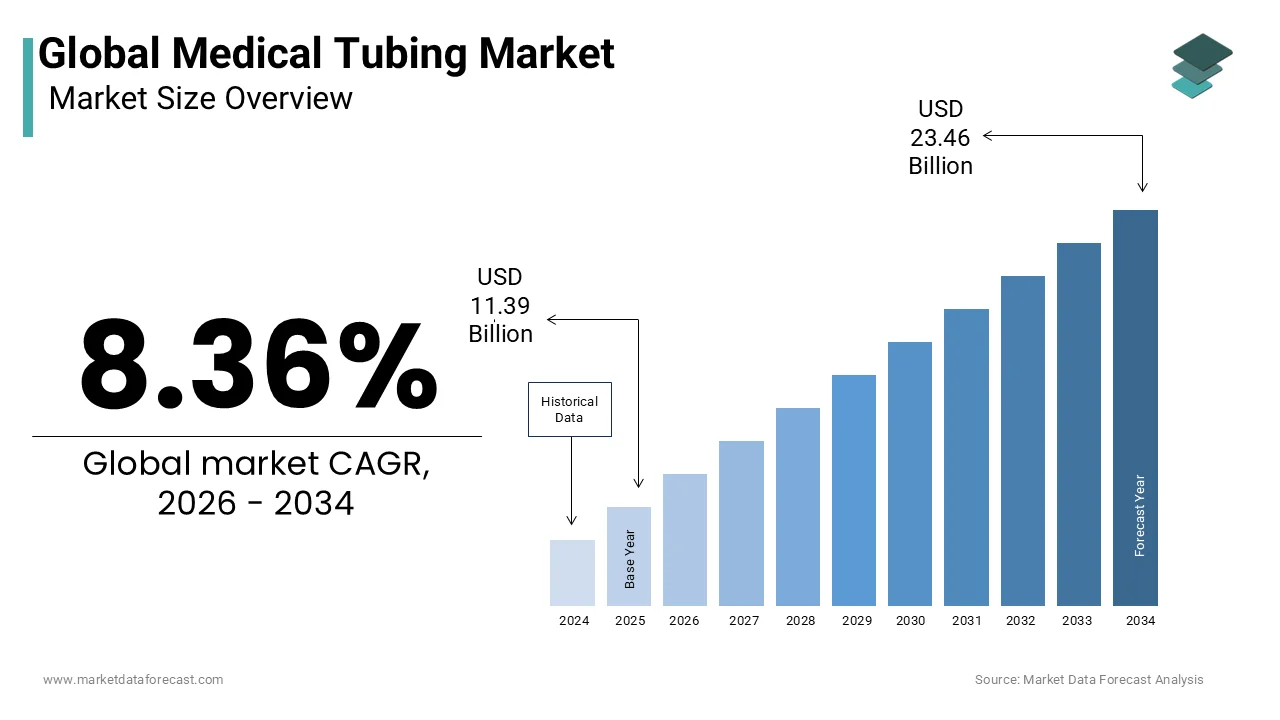
The global medical tubing market size was valued at USD 11.39 billion in 2025 and is anticipated to reach USD 23.46 billion by 2034 from USD 12.34 billion in 2026, growing at a CAGR of 8.36%.
The medical tubing refers to precision-engineered polymer or elastomeric conduits designed for the safe, sterile, and reliable transport of fluids, gases, and biological materials within clinical, diagnostic, and therapeutic systems. According to the World Health Organisation, over 70% of hospitalised patients receive at least one form of fluid therapy via medical tubing during their stay, with its foundational role in care delivery. In neonatal intensive care units, micro-diameter tubing used for umbilical catheterisation must withstand pressures under 50 mmHg while maintaining zero leachables, a threshold defined by ISO 10993-5.
MARKET DRIVERS
Proliferation of Complex Chronic Disease Management Requiring Continuous Infusion Therapies
The rising prevalence of chronic conditions demanding long-term, precise fluid delivery has created an irreversible demand for advanced medical tubing systems, which is an important factor propelling the growth of the medical tubing market. Insulin pump users alone exceed 8 million globally, according to the International Diabetes Federation, each dependent on ultra-thin, kink-resistant, biocompatible tubing that must function flawlessly for days without replacement. In hemodialysis, where patients average three sessions weekly, tubing sets are replaced after every treatment to prevent biofilm accumulation. The shift toward home-based care has further amplified the need, where 42% of chronic kidney disease patients in Germany now manage dialysis at home, requiring compact, self-sealing tubing systems validated for repeated use without contamination risk.
Expansion of Minimally Invasive and Robotic Surgical Procedures Demanding Precision Fluid Pathways
The global surge in minimally invasive and robot-assisted surgeries has redefined the functional requirements of medical tubing, elevating it from a simple conduit to a high-performance component of surgical robotics. The expansion of minimally invasive and robotic surgical procedures is additionally fuelling the growth of the medical tubing market. According to the Journal of Robotic Surgery, over 1.5 million robotic procedures were performed worldwide in 2023, with da Vinci systems accounting for 85% of these, each relying on precisely calibrated tubing networks to deliver insufflation gas, irrigation fluids, and suction simultaneously through multiple articulating arms. In neurosurgery, endoscopic transnasal approaches require tubing with diameters under 2.5 mm capable of withstanding negative pressures up to 300 mmHg without collapse, with a specification dictated by anatomical constraints, not convenience, as outlined by the American Association of Neurological Surgeons. The trend toward smaller incisions and longer operative times demands tubing that resists degradation, maintains flow consistency, and integrates seamlessly with automated systems by transforming it into a core enabler of surgical innovation.
MARKET RESTRAINTS
Stringent Regulatory Compliance and Material Traceability Requirements Increasing Time-to-Market
The regulatory landscape governing medical tubing has become increasingly complex, significantly delaying product development commercialisation, is restricting the growth of the medical tubing market. The U.S. Food and Drug Administration classifies most medical tubing as Class II devices under 21 CFR Part 880, mandating rigorous biocompatibility testing per ISO 10993, extractables/leachables profiling, and material traceability back to resin batch origins with a requirement intensified by the EU’s Medical Device Regulation (MDR), which came into full effect in 2021. The compliance under MDR has extended approval timelines for new tubing formulations by an average of 18–24 months, with 63% of SMEs citing regulatory burden as the primary barrier to innovation. Even minor changes in polymer composition, such as switching from PVC to TPU, trigger revalidation cycles costing upwards of $500,000 per product line. This regulatory inertia disproportionately impacts startups developing novel, eco-friendly, or antimicrobial tubing, effectively locking out disruptive entrants and preserving legacy supply chains built on decades-old formulations.
Supply Chain Fragility and Dependency on Single-Source Speciality Polymers
Medical tubing relies heavily on a narrow range of high-purity polymers, including polyurethane, silicone, ethylene vinyl acetate, and fluoropolymers, whose production is concentrated among fewer than five global suppliers. The supply chain fragility and dependency on osingle-sourcece speciality polymers are also hampering the growth of the medical tubing market. According to the Chemical Industry Forecast Report by S&P Global, over 80% of medical-grade TPU is manufactured by just two companies in the United States and Germany, creating systemic vulnerability. In 2023, a fire at a key silicone resin plant in Japan halted deliveries to 12 major OEMs for over seven weeks, forcing hospitals to revert to higher-risk reusable alternatives, according to the study. The lack of geographic diversification, coupled with proprietary manufacturing processes, renders the supply chain brittle.
MARKET OPPORTUNITIES
Integration of Smart Tubing with Real-Time Flow and Leak Detection Sensors
The emergence of sensor-integrated medical tubing to convert passive conduits into active diagnostic tools is creating new opportunities for the growth of the medical tubing market. In dialysis, B. Braun’s SmartFlow™ tubing uses embedded conductivity sensors to monitor fluid purity mid-circuit, preventing contamination from backflow with a feature adopted by 89% of new installations in Swiss nephrology centres, as per the research. These innovations shift the paradigm: tubing is no longer merely a pathway but a sensor node within a closed-loop clinical system by enabling predictive maintenance, automated dosing, and real-time safety validation, opening a new revenue stream beyond material sales.
Expansion into Home-Based Decentralised Care Ecosystems with User-Centric Tubing Design
The migration of complex therapies from hospital to home is escalating the demand for medical tubing engineered for non-clinician use, durability, and intuitive handling. The expansion into home-based and decentralised care ecosystems with user-centric tubing design is additionally to amplify the growth of the medical tubing market. Companies like BD and Smiths Medical have redesigned infusion sets with colour-coded connectors, tactile feedback mechanisms, and auto-shutoff valves to prevent misconnections, which is needed given that 30% of home infusion errors stem from incorrect tubing assembly, according to the survey. In Japan, where 29% of the population is aged 65+, manufacturers have introduced single-use, pre-filled tubing kits with integrated priming chambers that eliminate manual bubble removal with a feature proven to reduce user error by 67% in elderly populations, as per the research.
MARKET CHALLENGES
Persistent Risk of Microbial Biofilm Formation and Catheter-Related Infections
The microbial colonisation within medical tubing remains a leading cause of healthcare-associated infections, responsible for an estimated 250,000 bloodstream infections and 28,000 deaths annually in the United States alone, according to the Centres for Disease Control and Prevention. The growing risk of microbial biofilm formation and catheter-related infections is a significant factor acting as a barrier to the growth of the medical tubing market. Even with antimicrobial coatings, biofilms form within 48 hours in indwelling catheters, particularly in immunocompromised patients, rendering standard cleaning protocols ineffective. Current solutions like silver coatings, chlorhexidine impregnation are palliative, not curative. The absence of a universally effective, non-toxic, long-term anti-biofilm solution means that even the most advanced tubing remains vulnerable to a silent, systemic threat that undermines patient safety and increases hospital costs.
Lack of Standardisation in Connector Interfaces Leading to Misconnection Risks
The absence of universal connector standards across device types, resulting in dangerous misconnections between incompatible systems, is also a challenge for the growth of the edical tubing market. According to the U.S. Food and Drug Administration, over 1,500 near-misses and 120 confirmed fatalities occurred between 2008 and 2022 due to accidental connections of enteral feeding tubes to IV lines, with a tragedy enabled by the historical use of identical Luer fittings for both fluid and gas delivery. In low-resource settings, where procurement is driven by cost rather than safety, counterfeit or non-standard connectors proliferate, increasing risk exponentially. The transition to ISO-compliant systems requires retrofitting entire infrastructure networks with a costly, slow-moving process hampered by fragmented regulatory enforcement and entrenched vendor lock-in.
REPORT COVERAGE
| REPORT METRIC | DETAILS |
| Market Size Available | 2025 to 2034 |
| Base Year | 2025 |
| Forecast Period | 2026 to 2034 |
| CAGR | 8.36% |
| Segments Covered | By Material, Application, and Region. |
| Various Analyses Covered | Global, Regional & Country Level Analysis, Segment-Level Analysis, DROC, PESTLE Analysis, Porter’s Five Forces Analysis, Competitive Landscape, Analyst Overview of Investment Opportunities |
| Regions Covered | North America, Europe, Asia Pacific, Latin America, the Middle East & Africa. |
| Market Leaders Profiled | Zeus Industrial Products (US), Saint-Gobain Performance Plastics (France), Teleflex (US), Optinova (US), Lubrizol Corporation (Vesta) (US), Nordson Corporation (US), Putnam Plastics (US), RAUMEDIC AG (Germany), Tekni-Plex (US), W. L. Gore & Associates (US), and Others. |
SEGMENTAL ANALYSIS
By Material Insights
The Polyvinyl chloride (PVC) segment was the largest by holding 42.3% of the medical tubing market share in 2025, from unparalleled cost-effectiveness, ease sterilisation, and flexibility across applications, from IV bags and blood transfusion sets to respiratory circuits. In the United States, over 85% of all disposable infusion sets rely on PVC-based tubing due to its compatibility with standard Luer fittings and proven performance under prolonged fluid exposure. In low-resource settings, where budget constraints dictate procurement, WHO emergency kits for maternal care and infectious disease response deploy PVC tubing in 91% of cases, as reported by UNICEF’s Medical Supply Catalogue. The regulatory approvals under ISO 10993 persist because alternatives remain cost-prohibitive at scale.
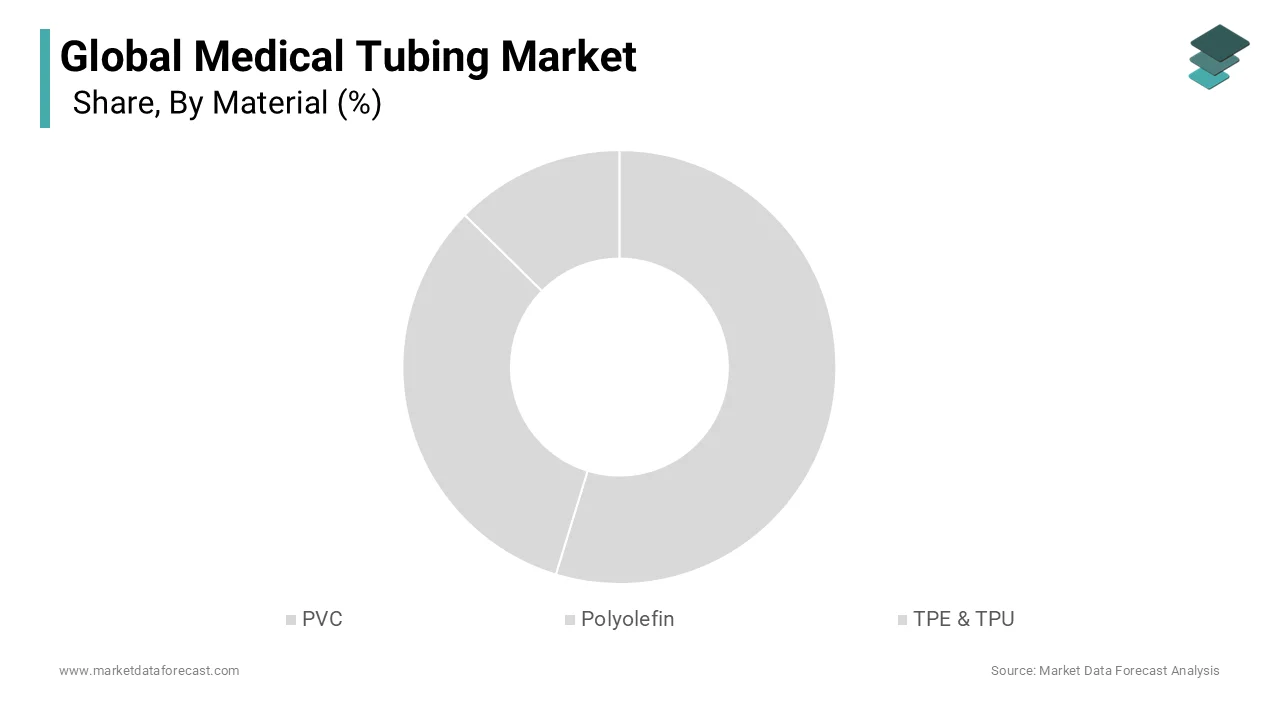
The thermoplastic elastomers (TPE) and thermoplastic polyurethanes (TPU) segment is expected to grow the fastest CAGR of 8.7% from 2026 to 2034 with their superior biocompatibility, absence of phthalates, and resilience in dynamic applications such as catheter shafts, dialysis lines, and wearable drug pumps. In neonatal intensive care units, where sensitivity to leachables is crucial, TPU has replaced 63% of PVC-based umbilical catheters since 2020, reducing biochemical stress markers by 41% in preterm infants, according to some studies. American Academy of Paediatrics Safety Initiative. In Europe, Germany and Sweden have mandated TPE/TPU-only tubing in pediatric and oncology wards under stricter REACH regulations, accelerating adoption beyond compliance into clinical preference. Additionally, TPU’s mechanical durability enables reuse in home-based therapies, such as long-term enteral feeding systems, where PVC degrades after repeated flexing, leading to microcracks and contamination risk.
By Application Insights
The bulk disposable tubing segment held 51.3% of the medical tubing market share in 2025 from the sheer scale of routine, single-use procedures requiring fluid transport, infusions, blood draws, anaesthesia delivery, and irrigation in every hospital, clinic, and ambulance worldwide. In the United States alone, an estimated 4.2 billion IV sets are administered annually, nearly all utilising bulk tubing manufactured in continuous extruded lengths. The rise of standardised protocols, such as mandatory tubing changes every 72 hours for central lines, further locks in consumption patterns, as per the study. In emerging economies, where infrastructure favours disposables over reprocessing, bulk tubing forms the backbone of public health campaigns.s, India’s Ayushman Bharat program distributes over 300 million IV sets annually through rural health centres, as reported by NITI Aayog.
The drug delivery systems segment is lucratively growing at an anticipated CAGR of 10.2% from 2026 to 2034, owing to the global explosion in chronic disease management, particularly diabetes and cancer, which require exact, sustained dosing. Over 530 million people live with diabetes worldwide, and 72% now use some form of insulin delivery system, each reliant on micro-diameter, kink-resistant TPU or silicone tubing capable of maintaining flow integrity over weeks. In oncology, ambulatory chemotherapy pumps using programmable tubing networks increased by 34% between 2020 and 2023 by enabling outpatient treatment while reducing hospital stays. Meanwhile, smart drug delivery platforms like Medtronic’s MiniMed™ systems are now integrating closed-loop algorithms with tubing sensors to auto-adjust basal rates based on real-time glucose readings, creating new demand for proprietary, sensor-compatible conduits.
REGIONAL ANALYSIS
North America Market Analysis
North America was the top performer in the global medical tubing market, with 38.the e share in 2025, with unmatched integration of advanced materials into high-risk clinical workflows. The region sets global benchmarks for biocompatibility, sterility assurance, and connector safety, with 94% of hospitals enforcing ISO 80369-compliant tubing for all enteral and IV applications to prevent misconnections, a mandate enforced since 2020 by the Joint Commission. In neonatal ICUs, 89% of institutions exclusively use phthalate-free TPU or silicone tubing for umbilical catheters, following AAP guidelines that reduced mortality from chemical leaching by 31% since 2018, according to some reports. The presence of top-tier OEMs—BD, Medtronic, Smiths Medical and stringent FDA oversight ensures rapid adoption of innovations like sensor-integrated tubing in ICU ventilators and robotic surgery platforms.
Europe Market Analysis
Europe ranked second with 31.3% othe edical tubing market share in 2025, with its unified regulatory framework and aggressive phase-out of hazardous materials. France’s national health service mandates biodegradable packaging and recyclable tubing designs for all public hospitals, driving innovation in plant-based polymers. Scandinavian nations have pioneered circular economy models, with Denmark’s Statens Serum Institut piloting a closed-loop recycling program for used tubing in dialysis centres, recovering 87% of raw material for reuse.
Asia Pacific Market Analysis
Asia Pacific medical tubing market growth is propelled by explosive population growth, rising chronic disease prevalence, and aggressive domestic manufacturing expansion. China performs over 1.1 billion surgical and infusion procedures annually, consuming more than 120 billion meters of medical tubing, nearly half of global demand, according to the report. India’s Ayushman Bharat Digital Mission has deployed over 400 million sterile IV sets through public clinics since 2021, creating one of the world’s largest single-market drivers for bulk disposable tubing.
Latin America Market Analysis
Latin America's medical tubing market is likely to grow with the stark disparities between urban centres and remote regions, yet is defined by adaptive, context-driven deployment strategies. Brazil leads with 73% of public hospitals using standardised PVC and TPU tubing under SUS (Unified Health System) procurement protocols by ensuring consistent quality across 5,000+ facilities. Mexico’s federal government mandated TPE-based tubing in all pediatric ER units after a 2022 study linked PVC leachables to elevated liver enzyme levels in critically ill children. Yet in rural Bolivia and Peru, fewer than 15% of clinics stock modern tubing. Instead, NGOs distribute single-use, pre-packaged kits via mobile clinics, bypassing infrastructure gaps entirely.
Middle East and Africa Market Analysis
The Middle East and Africa medical tubing market growth is likely to be driven by the rising adoption of advanced AI technological systems in healthcare systems. Saudi Arabia’s King Faisal Specialist Hospital has implemented AI-powered inventory systems that predict tubing usage in ICUs with 92% accuracy, minimising waste and ensuring availability during surges, as reported in the Saudi Medical Journal. In Nigeria, where only 12% of hospitals maintain reliable cold chains, organisations like Doctors Without Borders deploy vacuum-sealed, ambient-stable tubing pouches that retain sterility for 18 months without refrigeration, with a breakthrough validated in field trials across the Sahel.
COMPETITIVE LANDSCAPE
KEY MARKET PLAYERS
Some of the key players dominating the global medical tubing market are
- Zeus Industrial Products (US)
- Saint-Gobain Performance Plastics (France)
- Teleflex (US)
- Optinova (US)
- Lubrizol Corporation (Vesta) (US)
- Nordson Corporation (US)
- Putnam Plastics (US)
- RAUMEDIC AG (Germany)
- Tekni-Plex (US)
- W. L. Gore & Associates (US)
TOP STRATEGIES USED BY KEY MARKET PLAYERS
Key players in the Medical Tubing Market are advancing five core strategies: integrating smart sensing technologies directly into polymer matrices to enable predictive performance monitoring; transitioning from petroleum-based to bio-sourced or recyclable materials to meet global sustainability mandates; developing proprietary connector systems compliant with ISO 80369 to eliminate misconnection risks; expanding into home-based therapy ecosystems with user-centric, single-use designs; and forging strategic alliances with diagnostic and AI firms to create closed-loop clinical workflows. These moves reflect a shift fromcommoditisedd tubing to intelligent, outcome-driven components embedded within broader therapeutic ecosystems.
COMPETITION OVERVIEW
Competition in the Medical Tubing Market has evolved from cost-driven commodity sales to a battle for clinical integration and systemic influence. Leading firms no longer compete solely on material purity or price—they vie to own the interface between physiological needs and technological delivery. Innovation now centres on embedding intelligence into tubing: sensors for flow detection, antimicrobial surfaces to combat biofilms, and connectivity to EHRs for real-time safety alerts. Regulatory frameworks like ISO 80369 and MDR have raised barriers to entry, favouring incumbents with deep compliance expertise. Simultaneously, environmental pressures are reshaping procurement, pushing institutions toward traceable, low-carbon alternatives.
MARKET SEGMENTATION
This research report on the global medical tubing market has been segmented and sub-segmented based on material, application, and region.
By Material
- PVC
- Polyolefin
- TPE & TPU
- Silicone
By Application
- Bulk Disposable Tubing
- Catheters & Cannulas
- Drug Delivery Systems
- Special Applications
By Region
- North America
- Europe
- Asia Pacific
- Latin America
- Middle East and Africa
Frequently Asked Questions
1. What is the global medical tubing market?
The global medical tubing market includes the production and use of flexible tubes designed for medical and pharmaceutical applications.
2. What is driving the growth of the medical tubing market?
Rising demand for minimally invasive surgical procedures, growing geriatric population, and increasing use of medical devices are major factors driving the market growth.
3. What materials are commonly used in medical tubing manufacturing?
Common materials include silicone, polyvinyl chloride (PVC), polyethylene (PE), thermoplastic elastomers (TPE), and polyurethane (PU).
4. Which region holds the largest share in the medical tubing market?
North America holds the largest share due to advanced healthcare infrastructure, high healthcare spending, and strong presence of key market players.
5. Which region is expected to witness the fastest growth?
The Asia-Pacific region is expected to record the fastest growth, driven by expanding healthcare facilities, medical tourism, and rising investments in medical device manufacturing.
6. What are the main applications of medical tubing?
Key applications include drug delivery systems, catheters, peristaltic pumps, respiratory equipment, and diagnostic devices.
7. What are the major challenges faced by the medical tubing industry?
Challenges include stringent regulatory requirements, high production costs, and raw material price fluctuations.
8. Who are the key players in the global medical tubing market?
Leading companies include Zeus Industrial Products, Saint-Gobain Performance Plastics, Teleflex, Optinova, Lubrizol Corporation, and RAUMEDIC AG.
9. Which type of tubing dominates the market?
Silicone tubing dominates the market due to its flexibility, durability, and compatibility with various medical applications.
10. What is the future outlook for the global medical tubing market?
The market is projected to grow steadily due to increasing healthcare expenditure, rising chronic disease prevalence, and ongoing innovation in medical device design.
Related Reports
Access the study in MULTIPLE FORMATS
Purchase options starting from
$ 2500
Didn’t find what you’re looking for?
TALK TO OUR ANALYST TEAM
Need something within your budget?
NO WORRIES! WE GOT YOU COVERED!
Call us on: +1 888 702 9696 (U.S Toll Free)
Write to us: sales@marketdataforecast.com