- Product Description Description
- Table of Contents TOC
- List of Table & Figure LOT
- Get Free Sample PDF Sample PDF
Market Size, 2025
$32.71 BnMarket Estimate, 2026
$34.77 BnMarket Forecast, 2034
$56.68 BnCAGR, 2026–2034
6.3%Europe Meningococcal Vaccines Market Summary
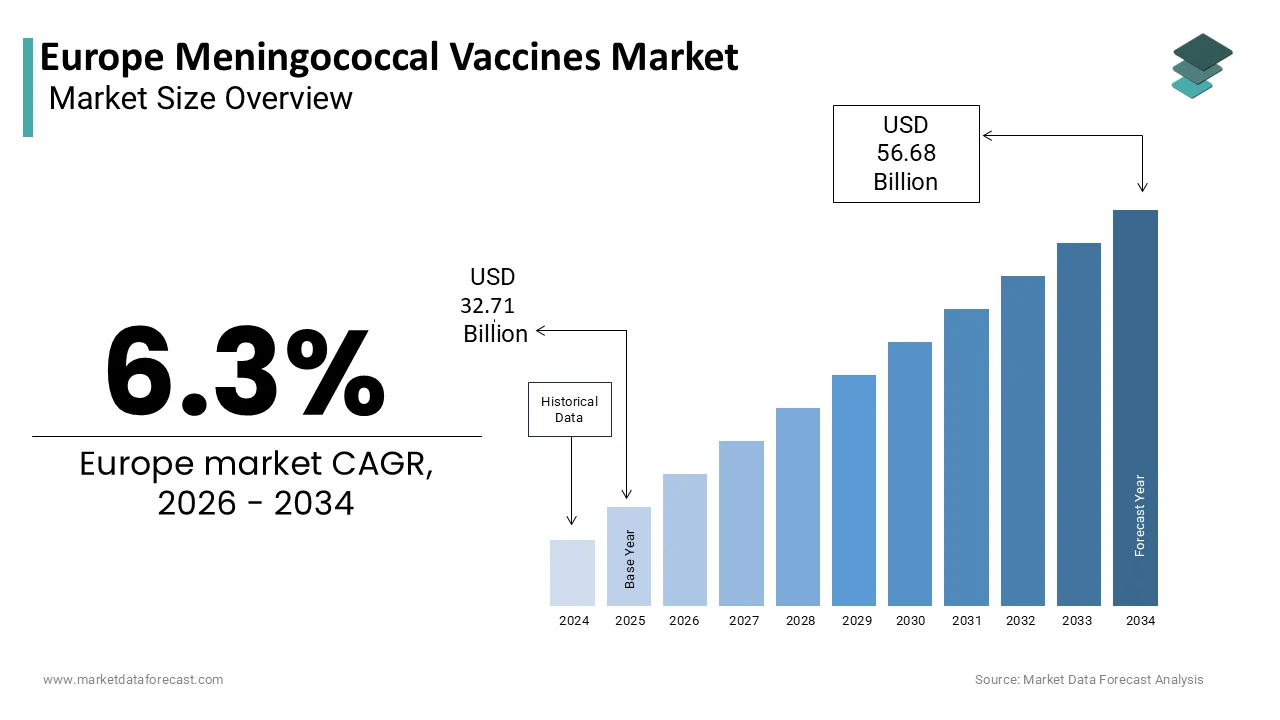
The Europe meningococcal vaccines market was valued at USD 32.71 billion in 2025, is estimated to reach USD 34.77 billion in 2026, and is projected to reach USD 56.68 billion by 2034, growing at a CAGR of 6.3% from 2026 to 2034.
Market Snapshot
- 2025 Market Size: USD 32.71 Billion
- 2034 Forecast: USD 56.68 Billion
- CAGR (2026–2034): 6.3%
- Largest Segment: MenACWY (Quadrivalent)
- Fastest Growing Segment: MenB Vaccines
- Primary Channel: Government/Public Procurement
- Leading Markets: UK, Germany, France
Quick Growth Drivers
- Rising incidence of MenW and MenY serogroups
- Adolescent vaccination policy expansion
- Travel medicine integration (Hajj, student mobility)
- School-based immunization campaigns
- Real-time genomic surveillance strengthening policy response
Principal Restraints
- Incomplete reimbursement for MenB vaccines
- Booster compliance challenges
- Budgetary pressure on national immunization programs
- Vaccine hesitancy in select regions
High-Value Opportunities
- Pan-meningococcal vaccine development
- Structure-based antigen innovation
- Digital vaccination registries and reminder systems
- Thermostable vaccine formulations
- Expanded adolescent booster strategies
Key Market Challenges
- Serogroup replacement and emerging strains
- Waning immunity and booster complexity
- Public misinformation and declining perceived risk
- Cost-effectiveness debates in high-income EU markets
Competitive Landscape
Companies playing a significant role in the European meningococcal vaccines market include:
- GlaxoSmithKline plc
- Pfizer Inc.
- Sanofi Pasteur
- Novartis AG
- Serum Institute of India
What Wins Commercially
- Inclusion in national immunization schedules
- Favorable tender pricing agreements
- Strong real-world effectiveness evidence
- Supply chain reliability
- Surveillance-backed policy alignment
Top Strategic Ask for Executives
- Expand multivalent vaccine R&D
- Strengthen health economics dossiers for MenB reimbursement
- Invest in digital adherence tools
- Build EU-based manufacturing resilience
- Support adolescent awareness programs
 Download Free Sample Report
Europe Meningococcal Vaccines Market Size
The europe meningococcal vaccines market was valued at USD 32.71 billion in 2025, is estimated to reach USD 34.77billion in 2026, and is projected to reach USD 56.68 billion by 2034, growing at a CAGR of 6.3% from 2026 to 2034.
The meningococcal vaccines are designed to prevent invasive disease caused by Neisseria meningitidis, a Gram-negative bacterium responsible for life-threatening meningitis and septicemia. These vaccines are classified by serogroup specificity, primarily targeting B, C, W, Y, and historically A with formulations ranging from polysaccharide conjugates to recombinant protein-based platforms. According to the European Centre for Disease Prevention and Control, 789 confirmed cases of invasive meningococcal disease were reported across the EU and European Economic Area in 2023, with a case fatality rate of 8.6% despite antibiotic treatment. As per the World Health Organization Regional Office for Europe, 24 out of 30 EU/EEA countries have incorporated at least one meningococcal vaccine into their national immunization programs as of 2024. The United Kingdom implements universal infant MenB vaccination while Germany recommends MenACWY for adolescents and high-risk groups.
MARKET DRIVERS
Rising Incidence of Non-BB Serogroups Prompting Policy Shifts Toward Multivalent Vaccination
The epidemiological shift toward non-B serogroups, particularly MenW and MenY, hasled to the widespread adoption of quadrivalent MenACWY vaccines, propelling the growth of Europe meningococcal vaccines market. According to the European Centre for Disease Prevention and Control, MenW cases increased by 138% between 2015 and 2023, driven by the hypervirulent ST 11 clonal complex, which spread rapidly through travel and social networks. In response, the United Kingdom introduced universal adolescent MenACWY vaccination in 2015 and documented a 92% decline in MenW cases by 2022 as per Public Health England surveillance data. In 2024, Italy expanded its program to include MenACWY for all children at 13 months, aligning with Spain and Belgium. These evidence based-policy transitions not only enhance population-level protection but also generate predictable large-scale demand for multivalent vaccines, replacing fragmented monovalent approaches and strengthening market fundamentals through sustained public procurement.
Integration of Meningococcal Vaccination into Adolescent Health and Travel Medicine Frameworks
Adolescents represent a high-risk demographic for meningococcal disease due to behavioral factors such as close social contact and dormitory living, yet remain under-vaccinated in many European regions. The integration of meningococcal vaccination into adolescent health and travel medicine frameworks is additionally fuelling the growth of Europe meningococcal vaccine market. Recognizing this public health gap several countries have embedded meningococcal vaccination into broader adolescent health platforms and travel medicine guidelines. As per the European Society of Travel Medicine ,meningococcal vaccination is now routinely recommended for students traveling to endemic regions, including the Hajj pilgrimage and university exchanges in the United States,, where MenACWY is mandated. France’s Haute Autorité de Santé updated its 2023 recommendations to include MenACWY for all adolescents aged 11 to 18, regardless of risk status. These institutionalized delivery channels reduce access barriers and leverage existing healthcare infrastructure,e transforming meningococcal vaccination from a reactive measure into a standard component of adolescent preventive care.
MARKET RESTRAINTS
Incomplete Reimbursement for MenB Vaccines in High-Income Markets
Despite robust clinical evidence and regulatory approval, the significant gaps in public funding for MenB vaccines persist across major European economies limiting equitable access and overall coverage. The incomplete reimbursement for MenB Vaccines is limiting the growth of Europe meningococcal vaccines market. According to the Vaccine European New Integrated Collaboration Effort, only 12 of 27 EU member states provide universal public reimbursement for MenB vaccines as of 2024. In Germany, the Standing Committee on Vaccination recommends MenB for all children, yet the Joint Federal Committee has not approved full cost coverage, leaving families to pay up to 320 euros per course. Similarly, in France, the MenB is available only for high-risk individuals or through private purchase at approximately 280 euros. This reimbursement fragmentation creates two-tierer system where protection is determined by socioeconomic status rather than public health need. Moreover, the absence of harmonized EU-level funding criteria discourages manufacturers from investing in localized health economic studies required for national reimbursement dossiers, thereby perpetuating access disparities and constraining market potential even in affluent regions.
Short Duration of Immune Response Necessitating Complex Booster Schedules
The waning immunity conferred by current meningococcal vaccines, especially protein based MenB formulations complicates long term protection and reduces real world effectiveness. The short duration of the immune response necessitating complex booster schedules is additionally escalating the growth of Europe meningococcal vaccines market. According to longitudinal studies published by the Norwegian Institute of Public Health, antibody titers against MenB decline below protective thresholds in over 60% of adolescents within 18 months of primary vaccination. However, most European countries have not adopted booster doses due to budget constraints and logistical complexity. This partial compliance undermines herd immunity and leaves adolescents vulnerable during peak exposure years. Consequently, public health authorities face difficult trade-offs between program feasibility and optimal protection, creating uncertainty in vaccine demand forecasting and limiting the public health return on investment.
MARKET OPPORTUNITIES
Advancement oStructure-Baseded Antigen Design for Broader Cross-Reactive Protection
The next generation vaccine development leveraging structural biology and reverse vaccinology offers a pathway to overcome serogroup limitations and achieve broader cross protective immunity. Companies and academic institutions are utilizing cryo-electron microscopy and genomic sequencing to identify conserved surface proteins shared across multiple meningococcal strains. The advancement of structure-based antigen design for broader cross-reactive protection is creating new opportunities for the growth of Europe meningococcal vaccine market. Similarly, a consortium led by the University of Oxford received 38 million euros from Horizon Europe to develop a pan meningococcal vaccine using nanoparticle display of multiple conserved antigens. Early data indicate immune responses against serogroups B, C, W, and Y in murine models. Success would eliminate the need for multiple vaccines, simplify national schedules, and prevent serogroup replacement.
Leveraging Digital Health Platforms for Vaccination Tracking and Reminder Systems
The proliferation of national electronic immunization registries and mobile health applications presents a scalable opportunity to improve meningococcal vaccine coverage and adherence. The leveraging of digital health platforms for vaccination tracking and reminder systems is also to leverage the growth of Europe meningococcal vaccine market. As per the European Commission’s 2023 Digital Health Action Plan, 21 EU member states now operate centralized digital vaccination records enabling real-time monitoring and recall functionalities. Similarly, Sweden’s “Vaccinationsboken” app integrates with national health records to provide personalized schedules and educational content, reducing missed opportunities. These digital tools not only enhance individual compliance but also generathigh-qualityty data for public health evaluation and resource allocation. Vaccine manufacturers can collaborate with ministries to co-design user-centered interfaces and integrate product-specific information, thereby strengthening both public health outcomes and sustainable market engagement.
MARKET CHALLENGES
Serogroup Replacement and Emergence of Rare or Atypical Strains
The dynamic evolution of Neisseria meningitidis populations poses a persistent threat to vaccine effectiveness through serogroup replacement and the emergence of non-vaccine types. Following the introduction of MenC conjugate vaccines in the early 2000s, several European countries observed compensatory increases in MenB and later MenW incidence as documented by the European Surveillance System. More recently, ly rare serogroups, such as MenX and MenE, have been detected in sporadic clusters in Eastern and Southern Europe, raising concerns about future epidemiological shifts. According to the European Centre for Disease Prevention and Control, serogroup distribution varies significantly by country, with MenY accounting for 48% of cases in Finland but only 9% in Portugal. This heterogeneity complicatespan-Europeann recommendations and forces national programs to rely on localized surveillance, which remains underfunded in lower-income regions. Real-time whole genome sequencing is not uniformly available, delaying detection of new clones. The vaccine strategies risk becoming outdated before full implementation, undermining public confidence and creating uncertainty for manufacturers in R&D prioritization and production planning.
Persistent Misinformation and Declining Trust in Preventive Vaccines Among Younger Cohorts
Despite high overall vaccine confidence in Europe,e localized awareness among parents of young children and adolescents threatens meningococcal vaccine uptake, ake especially for newer or non-mandatory formulations. The persistent misinformation and declining trust in preventive vaccines among younger cohorts are additionally restricting the growth of Europe meningococcal vaccines market. The post-pandemic information environment has amplified anecdotal claims linking MenB vaccines to high fever or fatigue, despite extensive safety data. As per the 2024 State of Vaccine Confidence in Europe report by the London School of Hygiene and Tropical Medicine, 24% of French parents and 19% of Italian parents believe MenB vaccination is unnecessary due to perceived low disease risk. Social media algorithms disproportionately promote emotionally charged narratives over scientific evidence with anti-vaccination content receiving 3.2 times more engagement than public health messaging, according to a study by the European Digital Media Observatory. In Germany, online forums have specifically targeted MenB as an “optional luxury,” influencing parental decisions. This hesitancy is particularly problematic for diseases like meningococcal infection, which are rare but catastrophic, creating a cognitive dissonance between statistical risk and emotional perception. Rebuilding trust requires sustained science communication and frontline provider training, which many national systems lack resources to implement effectively, thereby constraining market penetration even where vaccines are accessible.
REPORT COVERAGE
| REPORT METRIC | DETAILS |
| Market Size Available | 2025 to 2034 |
| Base Year | 2025 |
| Forecast Period | 2026 to 2034 |
| Segments Covered | By Molecule Type, Test Type, End-User, and Region. |
| Various Analyses Covered | Global, Regional, and Country-Level Analysis, Segment-Level Analysis, Drivers, Restraints, Opportunities, Challenges; PESTLE Analysis; Porter’s Five Forces Analysis, Competitive Landscape, Analyst Overview of Investment Opportunities |
| Countries Covered | UK, France, Spain, Germany, Italy, Russia, Sweden, Denmark, Switzerland, Netherlands, Turkey, Czech Republic, Rest of Europe |
| Market Leaders Profiled | GlaxoSmithKline plc, Pfizer Inc., Sanofi Pasteur, Novartis AG, Serum Institute of India |
SEGMENTAL ANALYSIS
By Technology Insights
The recombinant conjugate and subunit technologies segment accounted for a significant share of the European meningococcal vaccines market in 2024. Unlike inactivated whole cell approaches, these platforms enable precise targeting of capsular polysaccharides or surface proteins without live pathogen exposure. Conjugate vaccines, such as MenC and MenACW, Y link bacterial polysaccharides to carrier proteins like tetanus toxoid, id enhancing T-cell dependent immune responses and enabling long-lasting memory. Recombinant protein-based MenB vaccines utilize factor H binding protein and other outer membrane antigens identified through reverse vaccinology. According to the European Medicines Agency, all meningococcal vaccines authorized in the EU since 2010 employ recombinant or conjugate technology, es reflecting regulatory preference for defined molecular composition. Similarly, the Netherlands’ switch to MenACWY conjugate vaccine in 2018 led to a 78% reduction in carriage among adolescents within five years, ars according to the National Institute for Public Health and the Environment. This technological dominance is reinforced by robust clinical evidence, predictable manufacturing,,g and alignment with EU vaccine safety standards.
.

The recombinant conjugate and subunit segment is likely to witness a CAGR of 8.1% during the forecast period, owing to the continuous innovation in antigen design and expanded indications. Next-generation candidates now incorporate multiple conserved antigens in nanoparticle formats to broaden serogroup coverage. In 2024, the Statens Serum Institut in Denmark initiated Phase II trials for a hexavalent conjugate vaccine targeting MenA, B, C, W, Y, and X using novel carrier proteins that reduce immune interference. Additionally, the European Commission awarded a 42 million euro grant under Horizon Europe to the MENingitis VACcine Innovation consortium to develop thermostable conjugate formulations suitable for rural delivery. Regulatory pathways also favor these platforms; the European Medicines Agency’s PRIME scheme has fast-tracked three next-generation recombinant candidates since 2022.
By Type Insights
The MenACWY vaccines segment was the largest by accounting for 48.3% of the European meningococcal vaccines market share in 2024, owing to the widespread policy adoption in response to risingnon-BB serogroup incidence. The quadrivalent formulation addresses four major disease-causing serogroups in a single dose, making it operationally efficient for public health programs. According to the European Centre for Disease Prevention and Control, MenW and MenY together accounted for 62% of all reported cases in 2023, up from 38% in 2015. The Netherlands followed in 2018 with infant inclusion and observed a drop in pharyngeal carriage among teenagers. Furthermore, the European Society of Travel Medicine recommends MenACWY for all international students and pilgrims,ims aligning with global health requirements.
The MenB vaccines segment is projected to grow at a CAGR of 9.3% throughout the forecast period, owing to the increasing recognition of MenB’s persistent burden in infants and young children, where it remains the leading cause of bacterial meningitis in several countries. The United Kingdom’s universal infant MenB program using Bexsero has prevented over 1300 cases since 2015, as confirmed by Public Health England. In 2024, Ireland expanded its program to include all infants following a 40% rise in MenB cases between 2021 and 2023. These clinical public health and consumer drivers are converging to accelerate MenB adoption beyond initial pioneer markets.
By Distribution Channel Insights
The government suppliers segment held a dominant share of thEuropeanpe meningococcal vaccines market in 2024. Most EU countries deliver meningococcal vaccines through publicly funded schedules administered via municipal health centers, school nurses,s or designated vaccination clinics. According to the European Centre for Disease Prevention and Control, 24 out of 30 EU/EEA countries include at least one meningococcal vaccine in their routine childhood programs as of 2024. The United Kingdom’s National Health Service procures over 1.2 million doses of MenB and MenACWY annually through centralized tenders managed by the NHS Supply Chain. Similarly, Sweden’s Public Health Agency distributes vaccines to 21 regional councils, ensuring nationwide coverage. Centralized procurement ensures cold chain integrity,y batch traceability,, ty and equitable access, while enabling volume-based pricing negotiations. The European Commission’s Joint Procurement Agreement for Vaccines has further streamlined cross-border purchasing for pandemic preparedness, including stockpiling of meningococcal vaccines.
The hospital and retail pharmacy channel segment is expected to witness the fastest CAGR of 7.6% during the forecast period, owing to the partial reimbursement policies,s rising parental demand, and integration into travel and adolescent health services. In countries where MenB is not universally funded, such as Germany,,ny France, and Australia, families increasingly purchase vaccines through private clinics and pharmacies. According to the French National Health Insurance Fund, sales of MenB vaccines in retail pharmacies surged by 180% in 2023 following media coverage of local outbreaks. In Germany, approximately 38% of privately vaccinated children receive meningococcal vaccines through pediatric clinics as per the Robert Koch Institute. The European Association of Hospital Pharmacists reports that 65% of tertiary hospitals now stock meningococcal vaccines for high-risk inpatients and pre-splenectomy prophylaxis. Digital health platforms further enable this channel, where Estonia’s e-prescription system allows direct pharmacy dispensing following online physician consultation. These trends reflect a growing hybrid model where public programs set the baseline and private channels fill critical gaps in access and convenience.
COUNTRY LEVEL ANALYSIS
United Kingdom Meningococcal Vaccines Market Analysis
The United Kingdom was the largest contributor to the European meningococcal vaccines market by holding 22.5% of the market share in 2024, with its pioneering and comprehensive national immunization program. The country was the first globally to introduce universal infant MenB vaccination in 2015 and later added adolescent MenACWY in response to a hypervirulent MenW outbreak. According to Public Health England, these interventions have prevented over 1500 cases and reduced MenW incidence by 92% by 2022. The UK Health Security Agency maintains real-time genomic surveillance, enabling rapid policy adjustments. The National Health Service centrally procures all doses,s ensuring consistent supply and high coverage, over 95% fothe r primary MenB series in 2023. Additionally, the Joint Committee on Vaccination and Immunisation regularly reviews emerging evidence leading to timely updates, such as the 2024 recommendation for preschool MenB boosters.
Germany Meningococcal Vaccines Market Analysis
Germany's meningococcal vaccine market growth is driven by high clinical awareness, but fragmented public funding. While the Standing Committee on Vaccination recommends MenB for all children and MenACWY for adolescents, the Joint Federal Committee has not approved universal reimbursement,nt leaving families to bear costs of up to 320 euros per course. Germany hosts leading vaccine research institutions, including the Paul Ehrlich Institute, which plays a key role in EU regulatory assessments. Outbreaks in daycare centers and universities regularly trigger localized vaccination campaigns, often coordinated by municipal health offices. Bavaria launched a pilot program offering free MenACWY to all 12-year-olds following a cluster of cases in Munich schools. This blend of scientific rigor, partial public support, rt and active civil society creates a resilient though uneven demand landscape that sustains Germany’s position as a major market.
France Meningococcal Vaccines Market Analysis.
The French meningococcal vaccines market growth is likely to grow with the evolving policy and rising private demand amid incomplete public coverage. The Haute Autorité de Santé updated its 2023 recommendations to include MenACWY for all adolescents aged 11 to 18, yet MenB remains restricted to high-risk groups. France maintains robust surveillance through Sante Publique France, which reported 112 invasive cases in 202,3 with MenB representing 48% of infant cases. The government is investing in next-generation vaccines, where the Pasteur Institute received 18 million euros in 2024 to develop a pan-meningococcal candidate using structural vaccinology. Additionally, university health services increasingly offer vaccination during enrollment drives.
Netherlands Meningococcal Vaccines Market Analysis
The Netherlands meningococcal vaccines market is growing with its evidence-based and highly effective national program. The country implemented universal infant MenACWY vaccination in 2018, following a sharp rise in MenW cases, and has since documented a 78% reduction in pharyngeal carriage among teenagers, according to the National Institute for Public Health and the Environment. Although MenB is not routinely funded, ed it is available through private channels with moderate uptake. The Ministry of Health launched a pilot integrating meningococcal vaccination into adolescent well visits alongside HPV and Tdap. The country also serves as a clinical trial hub; Janssen and GSK conduct Phase III studies at Erasmus Medical Center,ter leveraging the nation’s dense electronic health records.
Italy Meningococcal Vaccines Market Analysis
Italy meningococcal vaccines market growth is likely to grow with the regional disparities and recent policy expansion. Historically, vaccination programs varied significantly between northern and southern regions, but in 202,4 the Ministry of Health mandated universal MenACWY for all children at 13 months, aligning with EU best practices. The Lazio region launched a school-based MenACWY campaign following a university outbreak, achieving 85% uptake in three months. Additionally, Italy participates in EU joint procurement for stockpiling. This transition from fragmented to harmonized poli,cy coupled with strong primary care engagement, positions Italy for accelerated growth and improved equity in meningococcal protection.
COMPETITIVE LANDSCAPE
The European meningococcal vaccines market features intense competition among a few established multinational pharmaceutical companies with deep expertise in vaccinology and public health engagement. GlaxoSmithKline, Pfizer,r and Sanofi dominate the landscape through differentiated portfolios, GSK with its MenB leadership, Pfizer with an established MenACWY presence,e and Sanofi with a newer high immunogenicity conjugate offering. Competition is not primarily price-based but revolves around clinical evidence, regulatory approval,s label bread,th and alignment with national immunization policies. The market is characterized by high barriers to entry due to complex manufacturing requirements, extensive clinical trial needs, and stringent European Medicines Agency oversight. Public health agencies act as gatekeepers with decisions driven by epidemiological data, cost-effectiveness analyses, and safety profiles. Innovation focuses on broadening serogroup coverage,,e improving thermostability, and reducing dosing schedules.
KEY MARKET PLAYERS
Companies playing a significant role in the European meningococcal vaccines market are
- GlaxoSmithKline plc,
- Pfizer InInc,
- Sanofi Pasteur,
- Novartis AG
- Serum Institute of India.
TOP LEADING PLAYERS IN THE MARKET
- GlaxoSmithKline is a global leader in meningococcal vaccines with its recombinant protein-based MenB vaccine Bexsero and quadrivalent conjugate vaccine Menveo playing pivotal roles across European immunization programs. The company pioneered the use of reverse vaccinology to develop Bexse foro, which remains the only broadly protective MenB vaccine authorized in the EU. GSK actively collaborates with public health agencies to generate real-world evidence demonstrating disease reduction and cost-effectiveness. The company partnered with the UK Health Security Agency to evaluate long term effectiveness of infant MenB vaccination, including the impact of preschool booster doses. It also expanded manufacturing capacity at its Sienaa, Italy, facility to ensure supply continuity for national programs and emergency stockpile, reinforcing its commitment to European public health resilience.
- Pfizer contributes significantly to the European meningococcal vaccines market through its quadrivalent conjugate vaccine Nimenr, ix which is widely used in adolescent and travel medicine programs across the continent. The company leverages its global clinical trial network to support regulatory submissions and label expansions, including recent data on co-administration with other adolescent vaccines. Pfizer has strengthened its position by engaging with national immunization technical advisory groups to advocate for broader MenACWY adoption. In 2024, the company initiated a post-authorization safety study across five EU countries to monitor long-term outcomes in adolescents receiving Nimenrix. Additionally, Pfizer supports surveillance initiatives through partnerships with the European Centre for Disease Prevention and Control to track serogroup shifts and inform future vaccine development strategies.
- Sanofi Pasteur supplies the conjugate vaccine MenQuadfi, which received European Medicines Agency approval in 2020 and has since been integrated into several national programs as an ext-generation MenACWY option. The vaccine uses a tetanus ttoxoidcarrier proteinenabling flexible co-administration and enhanced immunogenicity in adolescents and adults. Sanofi has prioritized accessibility by participating in the EU Joint Procurement Agreement for vaccine stockpiling against outbreaks. The company launched a digital education platform for healthcare professionals across Germany, France, and Spain to improve awareness of non-B serogroup risks and vaccination guidelines. It also expanded its pharmacovigilance collaboration with national health institutes to strengthen post marketing safety monitoring, thereby reinforcing trust in its meningococcal portfolio.
TOP STRATEGIES USED BY THE KEY MARKET PARTICIPANTS
Key players in the European meningococcal vaccines market pursue strategies centered on generating robust real-world evidence, strengthening public health partnerships, and expanding indications through clinical research. Companies invest heavily in post authorization safety and effectiveness studies to support national reimbursement decisions and address policy gaps. Strategic engagement with technical advisory bodies such as the European Technical Advisory Group of Experts on Immunization ensures alignment with evolving public health priorities. Manufacturing resilience is prioritized through multi-site production networks and participation in EU joint procurement mechanisms to guarantee supply during outbreaks. Digital health initiatives, including clinician education platforms and integration with national immunization registries, enhance vaccine uptake and adherence. Additionally, firms focus onnext-generationn antigen discovery using structural biology and genomics to develop broader coverage candidates that address serogroup replacement and emerging strains. These approaches collectively reinforce scientific credibility, market access, and long-term sustainability in a highly regulated and evidence-driven environment.
MARKET SEGMENTATION
This research report on the europe meningococcal vaccines market has been segmented and sub-segmented into the following categories.
By Type
- Polysaccharide Vaccines
- Conjugate Vaccines
- Combination Vaccines
- Others
By Brand Name
- Menactra
- Menveo
- Nimenrix
- Trumenba
- Bexsero
- Others
By End-User
- Hospitals
- Pharmacy Stores
- Others
By Country
- UK
- France
- Spain
- Germany
- Italy
- Russia
- Sweden
- Denmark
- Switzerland
- Netherlands
- Turkey
- Czech Republic
- Rest of Europe