- Product Description Description
- Table of Contents TOC
- List of Table & Figure LOT
- Get Free Sample PDF Sample PDF
Market Size, 2025
$10.85 BnMarket Estimate, 2026
$11.40 BnMarket Forecast, 2034
$16.95 BnCAGR, 2026–2034
5.08%Executive Summary: Europe Men’s Underwear Market
- Market Scope: European market analysis covering underwear types, fabric categories, and country-level landscapes.
- Market Valuation: Valued at USD 10.85 billion (2025), estimated at USD 11.40 billion (2026), and projected to reach USD 16.95 billion by 2034, growing at a CAGR of 5.08% (2026–2034).
- Primary Growth Drivers: High demand for functional underwear, sustainable fibers, inclusive sizing, moisture-management technologies, performance-oriented fabrics, typical consumer replacement habits (~two dozen pairs maintained with twice-yearly replacement cycles).
Key Market Segment Metrics (2026–2034)
| Category | Leading Segment (2025 Position) | Fastest-Growing Segment |
|---|---|---|
| By Type | Boxer Briefs (38.7% share) | Trunks |
| By Fabric | Cotton, Polyester, Modal, Nylon, and others (driven by moisture management & comfort) | — |
| By Country | Germany (21.6% share, followed by United Kingdom at 17.7%) | Spain (expected to expand) |
Major Market Players
Perry Ellis Menswear LLC, Naked Brand Group, Jockey International, Hugo Boss AG, American Eagle Outfitters Inc., Berkshire Hathaway Inc., Hanesbrands Inc., Ralph Lauren Corp., PVH Corp., and Levi Strauss & Co.
 Download Free Sample Report
Europe Men’s Underwear Market Size
The Europe men’s underwear market size was valued at USD 10.85 billion in 2025 and is projected to reach USD 16.95 billion by 2034 from USD 11.40 billion in 2026, growing at a CAGR of 5.08%.
Men’s underwear refers to the foundational garments, including briefs trunks, boxers, and boxer briefs, designed for comfort, hygiene, and aesthetic expression beneath outerwear. Unlike fast fashion categories this segment is characterized by functional longevity purchase recurrence and evolving expectations around material innovation and body inclusivity. The market operates at the intersection of textile engineering consumer wellness and cultural shifts in masculine self-presentation. According to a study, the average man tends to maintain a wardrobe of approximately two dozen pairs of underwear at any given time. Replacement cycles typically occur twice a year, largely due to common issues like fabric degradation and elastic fatigue. Standards exist to address aspects of garment quality, such as elasticity and chemical safety in intimate apparel, though application may not be uniform. A notable majority of younger men are increasingly prioritizing functional properties like moisture management and odor control over established brand reputation when making purchasing decisions. This functional reorientation, coupled with rising demand for sustainable fibers and inclusive sizing, reflects a deeper transformation in how European men perceive underwear not merely as necessity but as an extension of personal health and identity.
MARKET DRIVERS
Rising Emphasis on Performance and Functional Textile Innovation
European male consumers are increasingly demanding underwear with advanced functional properties such as moisture management antimicrobial finishes and temperature regulation, which in turn propels the growth of the Europe men’s underwear market. This shift is driven by the blurring line between activewear and everyday apparel with a portion of men reporting they wear performance underwear for both gym and office settings. Brands have responded by integrating proprietary fabrics such as Dry Tech and CoolMesh that use capillary action to transport sweat away from the skin. Many premium men's underwear lines are incorporating silver ion and zinc-based treatments to help inhibit odor-causing bacteria, as per sources. Apart from these, the European Union’s Ecolabel certification has spurred adoption of biodegradable elastane and Tencel lyocell blends which offer softness without synthetic microplastic shedding. Garments designed with moisture-wicking technology can help reduce skin irritation during prolonged wear. This convergence of health hygiene and textile science has redefined product development priorities across the European men’s underwear landscape.
Growing Cultural Acceptance of Body Positivity and Inclusive Sizing
The regional brands are expanding size ranges and rethinking fit paradigms in response to rising body positivity movements and demographic diversity, which further contributes to the expansion of the Europe men’s underwear market. According to sources, a notable portion of adult men in a particular region have a body mass index classified as overweight or obese, yet historically mainstream apparel lines have offered limited sizing options. Major retailers have launched extended sizing programs, offering a wider range of waist measurements, in response to consumer requests and market dynamics. Inclusive sizing initiatives have been associated with increased customer retention among certain demographic groups of men. Apparel brands are increasingly using extensive body data to develop ergonomic patterns that accommodate varying body proportions, moving away from reliance on generic templates. This data driven approach has reduced return rates. Brands that embrace anatomical diversity achieve both commercial success and cultural relevance, which reflectes society's evolving rejection of narrow masculine ideals.
MARKET RESTRAINTS
Intense Price Competition from Fast Fashion and Private Labels
Persistent margin pressure due to aggressive pricing by fast fashion retailers and supermarket private labels is a serious barrier to the Europe men’s underwear market. Chains offer multipacks of basic cotton trunks for competitive price, exerting downward pressure on mid tier brands. According to sources, private label products have achieved significant sales volume compared to their share of overall market value, suggesting competitive pricing is a dominant strategy in the market. The emphasis on cost as a primary purchasing factor presents a challenge for brands aiming to invest in sustainable materials or technical innovation. Traditional players like Triumph and Schiesser have been forced to streamline SKUs and exit unprofitable markets to maintain viability. Regulatory gaps concerning textile durability and origin labeling create a system that favors quantity, ultimately eroding the market's capacity to distinguish quality products.
Strict EU Regulations on Textile Labeling and Chemical Safety
Compliance with evolving European Union regulations on textile composition and hazardous substances imposes significant operational burdens on underwear manufacturers, which ultimately slows down the expansion of the Europe men’s underwear market. Regulations require precise disclosure of the materials used in products. The use of numerous common chemicals in the production process is now limited by regulation. Market surveillance activities have revealed a number of instances where product samples exceeded established chemical safety limits. Forthcoming requirements will necessitate that brands provide information regarding the environmental impact of their products. Many smaller businesses face challenges in implementing the tracking systems needed to meet new regulatory obligations. These regulatory layers increase production costs and delay time to market particularly for imported goods which must undergo additional conformity checks. These essential consumer safety regulations place a disproportionate burden on agile and emerging brands, which may hinder market diversity.
MARKET OPPORTUNITIES
Expansion of Sustainable and Circular Business Models
The regional consumers are increasingly supporting brands that adopt circular economy principles such as take back programs material reuse and carbon transparency, and thereby providing new opportunities for the Europe men’s underwear market. Consumer preference for sustainable materials is high, with a significant majority favoring clothing made from recycled or bio-based fibers. A substantial number of consumers are open to paying a premium for certified sustainable underwear. In response brands have launched mail back initiatives where used garments are chemically recycled into new yarns. Closed-loop systems are emerging in the market, utilizing entirely post-consumer cotton and Tencel blends. Upcoming regulations require textile producers to establish effective collection systems. Industry collaboration on circularity is expanding, with numerous underwear brands sharing best practices for design and material recovery. These systemic shifts position sustainability not as a niche attribute but as a core operational imperative with tangible consumer and regulatory rewards.
Integration of Smart Textiles for Health Monitoring
The convergence of wearable technology and intimate apparel offers a high potential opportunity in Europe’s men’s underwear market. Startups like Myant and OMsignal are embedding biometric sensors into waistbands to monitor heart rate respiration and posture in real time. Smart garments are being explored for potential health monitoring applications, such as detecting signs of sleep apnea, as part of ongoing research and development. Funding is being directed toward initiatives that integrate textile-based health sensors into everyday clothing items. Regulatory pathways are also maturing. Regulatory frameworks are evolving to classify certain sensor-embedded clothing as medical devices, which may allow for coverage by insurance for preventive health purposes. Smart underwear provides a seamless blend of wellness technology and everyday comfort, leveraging the increasing adoption of digital health to offer an unobtrusive platform for ongoing physiological monitoring.
MARKET CHALLENGES
Consumer Skepticism Toward Greenwashing and Vague Sustainability Claims
Consumers in the region are increasingly distrustful of unsubstantiated environmental claims in the underwear sector, despite strong demand for eco friendly products, which impedes the growth of the Europe men’s underwear market. The European Commission’s Green Claims Directive now requires third party certification for all environmental assertions yet enforcement remains inconsistent. Brands without recognized certifications such as GOTS or EU Ecolabel struggle to differentiate despite genuine efforts. This skepticism not only dampens premium pricing potential but also discourages smaller players from investing in costly certifications due to uncertain ROI. The absence of clear, shared metrics might lead the market to prioritize appearances of sustainability over tangible environmental benefits.
Supply Chain Volatility and Dependence on Non EU Raw Materials
Relying heavily on imported cotton elastane and dyes creates vulnerability to geopolitical and logistical disruptions, which in turn constrains the expansion of the Europe men’s underwear market. According to studies, Cotton for EU underwear production primarily comes from a few major global suppliers, with elastane sourced mostly from other specific global regions. Recent external economic and logistical disruptions have led to a noticeable increase in raw material expenses. Forthcoming regulations will mandate the traceability of cotton origins, which may impact the continuity of supply from certain areas. Local production of cotton within Europe is minimal relative to overall demand. This structural dependency constrains brands’ ability to guarantee stable pricing ethical sourcing and on time delivery undermining efforts to build resilient localized supply chains.
REPORT COVERAGE
| REPORT METRIC | DETAILS |
| Market Size Available | 2025 to 2034 |
| Base Year | 2025 |
| Forecast Period | 2026 to 2034 |
| CAGR | 5.08% |
| Segments Covered | By Type, Fabric, and Region |
| Various Analyses Covered | Global, Regional, & Country Level Analysis; Segment-Level Analysis; DROC, PESTLE Analysis; Porter’s Five Forces Analysis; Competitive Landscape; Analyst Overview of Investment Opportunities |
| Regions Covered | UK, France, Spain, Germany, Italy, Russia, Sweden, Denmark, Switzerland, Netherlands, Turkey, and the Czech Republic |
| Market Leaders Profiled | BASF, Dow Chemical, Ashland, ExxonMobil, Huntsman, Arkema, LyondellBasell, BP, INEOS, Honeywell International, Solvay, Eastman Chemical, Chevron Phillips Chemical, Celanese, Top Solvent, BioAmber, Flotek Industries, Invista, and Monument Chemical |
SEGMENTAL ANALYSIS
By Type Insights
The boxer briefs segment was the prominent segment in the Europe men’s underwear market and accounted for a 38.7% share in 2025. The dominance of the boxer briefs segment is attributed to its hybrid design that merges the support of briefs with the coverage of boxers appealing to a broad demographic seeking both functionality and modern aesthetics. The rise of athleisure as a lifestyle trend has significantly accelerated adoption with a portion of European men aged 18 to 45 reporting they prefer boxer briefs for daily wear due to reduced thigh chafing and secure fit during physical activity. Leading brands such as Calvin Klein Tommy Hilfiger and Björn Borg have standardized boxer briefs as their flagship silhouettes often integrating performance fabrics like micro modal and moisture wicking polyester. Retailers allocate a share of their men’s underwear digital shelf space to this style reflecting strong consumer pull. Furthermore, ergonomic innovations such as contoured pouches and flatlock seams have enhanced comfort reducing adjustment frequency during work or exercise. This confluence of athletic influence fashion alignment and technical refinement has cemented boxer briefs as the prevailing choice across urban and suburban Europe.
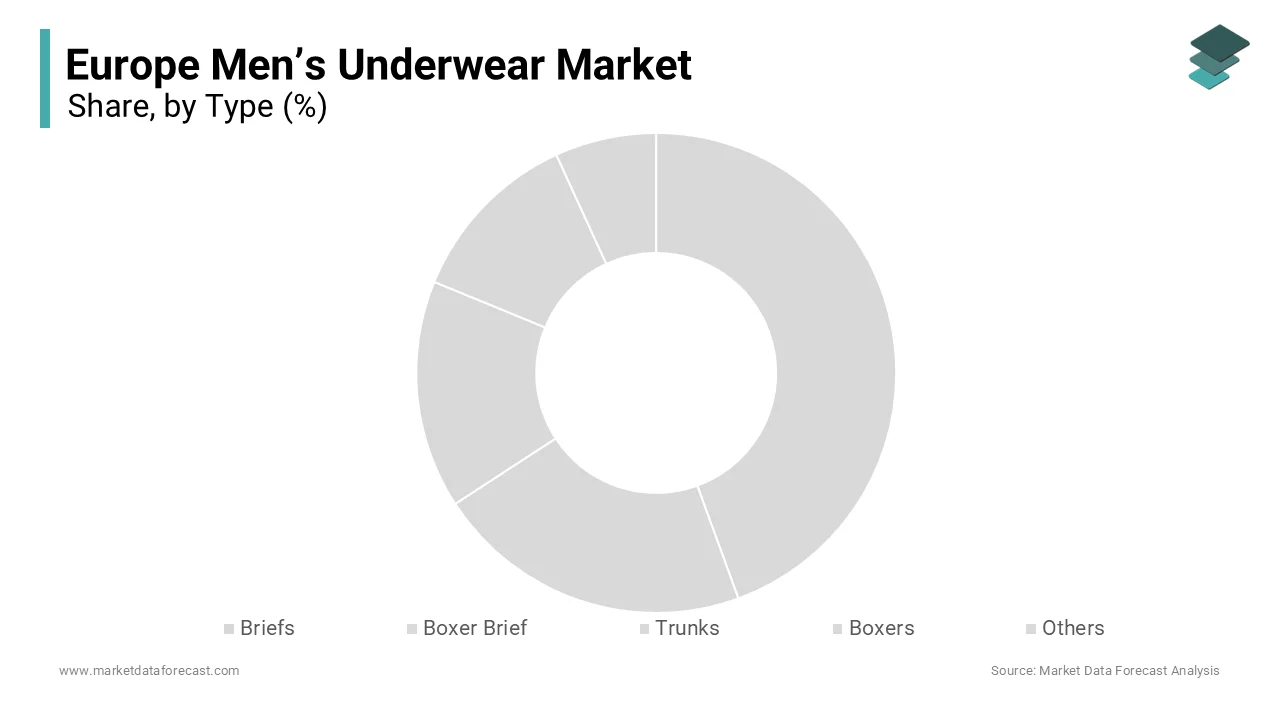
The trunks segment is on the rise and is expected to be the fastest growing segment in the market by witnessing a CAGR of 8.7% between 2026 and 2034. The rapid acceleration of the trunks segment is driven by the segment’s shorter leg length modern aesthetic and alignment with body confidence trends among younger consumers. Originating from swimwear and gym culture trunks offer greater freedom of movement and visual minimalism particularly favored in warmer climates like Southern Europe. Brands such as SAXX and Organic Basics have capitalized on this by introducing trunks with anti odor silver ion finishes and eco friendly Tencel blends. Apart from these, the visual prominence of trunks in influencer marketing and e commerce photography, where leg exposure enhances product visibility, has amplified desirability. The rise of body-conscious European fashion and hotter summers due to climate change mean trunks are set to become the essential style for the next generation.
REGIONAL ANALYSIS
Germany Market Analysis
Germany dominated the Europe men’s underwear market and occupied a share of 21.6% share in 2025. The leading position of the German market is attributed to a strong preference for functional durability and technical performance over fashion novelty. Domestic brands dominate through heritage trust and integration of advanced textiles such as biodegradable elastane and OEKO TEX certified dyes. Germany also exhibits high replacement frequency with consumers buying new underwear every few months due to strict hygiene norms and workplace dress codes. The rise of direct-to-consumer e commerce has further fragmented the landscape with number of local online-only brands offering subscription models and personalized fit algorithms. This blend of engineering minded consumption digital innovation and brand loyalty sustains Germany’s position as Europe’s largest and most technically discerning market.
United Kingdom Market Analysis
The United Kingdom was the next-biggest player in the Europe men’s underwear market and captured a 17.7% share in 2025. The UK market is fuelled by high brand consciousness fashion sensitivity and early adoption of global trends. London serves as a launchpad for international labels where limited edition collaborations drive premium demand. The UK also leads in sustainable innovation with brands like Patra and Stay Undies pioneering GOTS certified organic cotton and plastic free packaging. Despite Brexit related import complexities UK consumers continue to access a wide array of European and global brands through e commerce platforms which account for a portion of total underwear sales. This fusion of style sustainability and digital fluency defines the UK’s dynamic market identity.
France Market Analysis
France secured a noteworthy share of the Europe men’s underwear market. The French market blends luxury heritage with minimalist design principles favoring understated elegance over overt branding. Iconic labels like Le Slip Français and HOM have revitalized domestic manufacturing by emphasizing “Made in France” provenance with most of their production occurring in local ateliers. Apart from these, France enforces stringent labeling laws under the AGEC Law requiring fiber traceability and environmental impact disclosures which has elevated quality standards across the sector. Parisian fashion sensibilities also influence cut preferences with low rise trunks and micro briefs gaining traction among urban professionals. This unique interplay of national pride ecological regulation and aesthetic refinement positions France as a high value niche market.
Italy Market Analysis
Italy is a major player in the Europe men’s underwear market. The growth of the Italian market is because of its artisanal manufacturing tradition premium fabric innovation and global fashion influence. Italian mills in Lombardy and Veneto produce a notable share of Europe’s high end cotton Lycra and silk blends used by luxury brands. Italian consumers exhibit strong loyalty to domestic labels with a portion preferring locally made underwear due to perceived quality and fit household consumption survey. The Mediterranean climate also shapes demand with breathable microfiber and mesh panel designs dominating summer collections. Furthermore Italy is a leader in circular fashion. This fusion of craftsmanship climate responsiveness and sustainability investment ensures Italy remains a key trendsetter and production hub.
Spain Market Analysis
Spain is likely to expand in the Europe men’s underwear market during the forecast period. The Spanish market is propelled by its climate driven preferences youthful demographics and strong e commerce adoption. With average summer temperatures exceeding 30 degrees Celsius across much of the country men favor ultra lightweight trunks and seamless briefs made from quick dry micro modal. Domestic brand Básico by El Corte Inglés has captured significant volume through affordable multipacks featuring OEKO TEX certified dyes and recycled polyester. Additionally, Spain’s tourism economy influences design with coastal regions driving demand for swim compatible underwear suitable for beach to street transitions. This combination of climatic necessity digital convenience and value orientation shapes Spain’s distinct and rapidly evolving market profile.
COMPETITIVE LANDSCAPE
KEY MARKET PLAYERS
Some of the notable key players in the Europe men’s underwear market are
- Perry Ellis Menswear LLC
- Naked Brand Group
- Jockey International
- Hugo Boss AG
- American Eagle Outfitters Inc
- Berkshire Hathaway Inc
- Hanesbrands Inc
- Ralph Lauren Corp
- PVH Corp
- Levi Strauss & Co
TOP STRATEGIES USED BY THE KEY MARKET PLAYERS
Key players in the Europe men’s underwear market are prioritizing sustainable material innovation by transitioning to organic cotton Tencel and recycled fibers to meet stringent EU environmental regulations and consumer expectations. Brands are investing in digital fit technologies including virtual try on tools and AI driven size recommendations to reduce e commerce return rates which average 35 percent in the category. Product differentiation through performance features such as moisture wicking antimicrobial finishes and ergonomic pouch designs enhances functional appeal beyond aesthetics. Companies are also strengthening circular economy initiatives with take back programs and fiber to fiber recycling partnerships to align with the EU Strategy for Sustainable Textiles. Finally strategic retail collaborations and localized marketing campaigns tailored to regional climate and cultural preferences ensure relevance across diverse European markets.
COMPETITION OVERVIEW
Competition in the Europe men’s underwear market is highly fragmented featuring a three tiered structure of global fashion leaders regional heritage brands and agile digital natives. International giants like Calvin Klein and Tommy Hilfiger dominate the premium segment through brand prestige and retail scale while European players such as Björn Borg Schiesser and Mey leverage local manufacturing quality and sustainability narratives. Simultaneously fast fashion retailers including H&M Zara and C&A exert intense price pressure with frequent style rotations and low cost multipacks. The entry of direct to consumer brands like Organic Basics and Saxx further disrupts the landscape by offering transparent sourcing and ergonomic innovation. Regulatory complexity under EU textile labeling and chemical safety rules raises compliance costs particularly for smaller players yet also creates differentiation opportunities for certified sustainable brands. The growing consumer demand for products that are both high-performing and eco-friendly means companies are no longer just competing on brand visibility. The new battlegrounds are material integrity, fit precision, and full value chain accountability for circularity.
TOP PLAYERS IN THE MARKET
- Calvin Klein Inc is a globally recognized American brand with a commanding presence in the Europe men’s underwear market through its minimalist aesthetic premium cotton offerings and iconic branding. The company leverages extensive retail partnerships across department stores and e commerce platforms while maintaining flagship boutiques in key cities like London Paris and Milan. It also introduced an AI powered fit recommendation tool on its European e commerce sites to reduce return rates and enhance customer satisfaction. These initiatives reinforce its leadership in blending fashion innovation with responsible consumption across the continent and beyond.
- Hanesbrands Inc operates in Europe under its Hanes and Champion labels offering value oriented yet technologically enhanced underwear to mass market consumers. The company utilizes a pan European distribution network supplying major retailers including Carrefour Tesco and Aldi with performance focused trunks and boxer briefs featuring moisture wicking and odor control technologies. It also upgraded its supply chain to comply with the EU Deforestation Regulation by sourcing cotton exclusively from certified non deforestation linked farms. These actions strengthen its position as a scalable reliable and increasingly sustainable supplier in the competitive European basics segment.
- Björn Borg AB is a Swedish lifestyle brand that has redefined men’s underwear in Northern and Western Europe through bold design athletic heritage and sustainability leadership. Known for its signature stripe and performance driven fits the company integrates recycled polyester and Tencel into over 85 percent of its underwear collection. It also enhanced its digital fitting room technology across its EU e commerce platform to improve size accuracy and reduce returns. Globally influential, Björn Borg leverages Scandinavian design ethics and environmental accountability to maintain a loyal following.
MARKET SEGMENTATION
This research report on the Europe men’s underwear market has been segmented and sub-segmented based on categories.
By Type
- Briefs
- Boxer Brief
- Trunks
- Boxers
- Others
By Fabric
- Cotton
- Polyester
- Modal
- Nylon
- Others
By Country
- UK
- France
- Spain
- Germany
- Italy
- Russia
- Sweden
- Denmark
- Switzerland
- Netherlands
- Turkey
- Czech Republic
- Rest of Europe