- Product Description Description
- Table of Contents TOC
- List of Table & Figure LOT
- Get Free Sample PDF Sample PDF
Market Size, 2025
$256 BnMarket Estimate, 2026
$267 BnMarket Forecast, 2034
$366 BnCAGR, 2026–2034
4.02%Europe Metal Recycling Market Size
The Europe metal recycling market size was valued at USD 256.73 billion in 2025 and is projected to reach USD 366.04 billion by 2034 from USD 267.05 billion in 2026, growing at a CAGR of 4.02%.
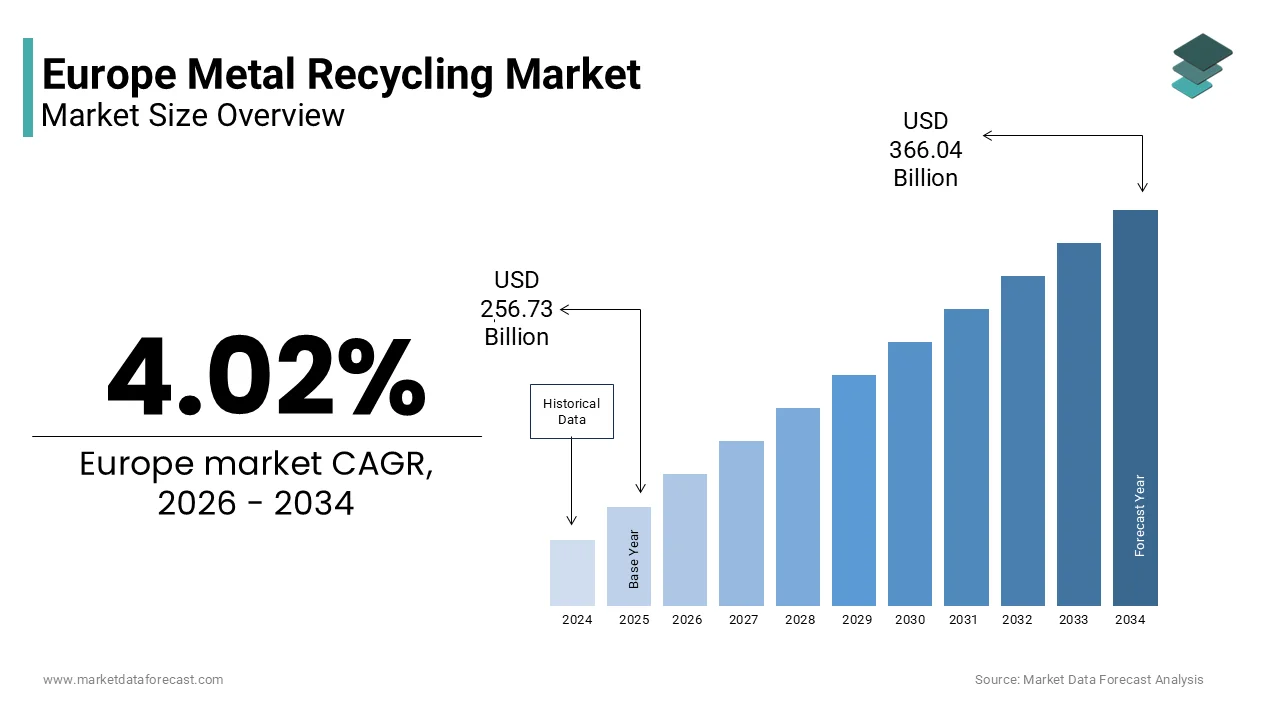
Metal recycling is the systematic process of recovering scrap metal from end-of-life products or manufacturing waste and reprocessing it into high-quality raw materials for new production. This circular activity is foundational to the European Union’s resource efficiency strategy and industrial decarbonization goals. European steel manufacturing increasingly relies on recycled scrap, with a large share of production originating from circular processes, cementing the region as a leader in ferrous metal recovery. The region also recovers significant volumes of copper aluminum and nickel. The European construction and transport sectors exhibit high sustainability through exceptional end-of-life recycling rates for aluminum, ensuring long-term material reuse. Unlike generic waste streams metal recycling in Europe operates under stringent environmental permits and traceability protocols governed by the Industrial Emissions Directive and Waste Framework Directive. A vast network of specialized facilities across Europe efficiently processes massive quantities of metal scrap, driving a mature, high-volume secondary raw materials market. This system not only conserves finite geological reserves but also reduces energy consumption compared to primary production.
MARKET DRIVERS
Stringent Environmental Regulations Accelerate Circular Material Flows
The European Union’s regulatory architecture serves as a primary growth enabler for the Europe metal recycling market. This is achieved by mandating extended producer responsibility and setting binding recovery targets across multiple directives. The End of Life Vehicles Directive requires member states to achieve a reuse and recycling rate of at least 85 percent by weight for each vehicle scrapped a threshold that has driven consistent demand for automotive shredder residue processing. Similarly the Waste Electrical and Electronic Equipment Directive compels producers to finance the collection and environmentally sound treatment of e waste which contains valuable non ferrous metals such as copper gold and palladium. Legislative frameworks focusing on electronic waste have established structures that encourage the recovery of valuable materials from end-of-life products. Policy initiatives designed to improve the circular economy are encouraging product designs that make disassembly and material recovery more straightforward. Regulatory measures are influencing the supply chain by ensuring a consistent flow of materials for recycling processes. Disposal regulations are increasing the costs associated with landfilling, which drives waste streams toward alternative processing methods. Stricter, long-term bans on the disposal of untreated waste have resulted in the redirection of industrial materials toward recycling rather than disposal. Such policy coherence ensures sustained input volumes and incentivizes investment in advanced sorting and refining technologies across the value chain.
Industrial Decarbonization Pressures Boost Demand for Secondary Metals
The region’s commitment to climate neutrality under the European Green Deal has intensified pressure on heavy industries to reduce carbon footprints, which further propels the expansion of the Europe metal recycling market. This shift has elevated the strategic value of recycled metals. Secondary aluminum production, utilizing scrap materials, significantly reduces carbon emissions compared to primary production, driving a shift in procurement strategies. Major automotive manufacturers are increasingly specifying high recycled content for aluminum components to meet sustainability goals. New vehicle architectures are incorporating high percentages of recycled aluminum, often sourced from closed-loop systems to ensure quality. The steel industry is undergoing a transition towards lower-carbon production, with a focus on utilizing scrap-based electric arc furnaces powered by renewable energy. Increasing the share of recycled material in metal production is being implemented as a key strategy to avoid significant carbon dioxide emissions. These industrial shifts are amplified by the Carbon Border Adjustment Mechanism which indirectly favors low carbon inputs like recycled metal by imposing tariffs on high emission imports. Consequently, secondary metals are no longer merely cost saving alternatives but essential enablers of regulatory compliance and brand sustainability.
MARKET RESTRAINTS
Fragmented Collection Infrastructure Limits Feedstock Quality and Volume
Inconsistent collection systems, which vary significantly across municipalities and member states, hinder the region's metal recycling ecosystem, despite its advanced processing capabilities. This restricts the growth of the European metal recycling market. Urban areas often operate efficient separate collection schemes for bulky waste and e waste yet rural regions rely on infrequent drop off points leading to suboptimal recovery rates. A significant portion of municipal waste containing metal fractions is not collected separately, which can lead to reduced recyclability when it enters mixed waste streams. The separation of metals from general waste remains a challenge in various regions, often limiting their recovery potential. Collection rates for specific types of metals from consumer goods are generally lower in certain geographic areas, in part due to infrastructural limitations and resource constraints for local waste management authorities. This fragmentation results in heterogeneous scrap quality that complicates downstream processing. For instance, copper recovered from mixed demolition waste often contains plastic insulation or brass alloys requiring costly eddy current separation and spectroscopic sorting. Moreover, informal scavenging in some regions diverts high value metals like copper wiring into unregulated channels bypassing certified recyclers and compromising material traceability. The absence of unified EU collection mandates and standard labeling hinders the supply of clean feedstock, limiting high-yield recycling.
Energy Intensity and Grid Dependency Constrain Operational Scalability
Metal recycling, particularly for non-ferrous varieties, remains highly dependent on stable, affordable electricity, which poses a structural limitation in the region’s current energy landscape and thereby limits the expansion of the Europe metal recycling market. Secondary aluminum remelting is a significantly more energy-intensive process per unit of material compared to the electric arc furnace recycling of steel. The overall energy consumption for remelting aluminum scrap is roughly an order of magnitude higher than the electrical energy required for recycling steel in arc furnaces. Substantial increases in industrial electricity prices caused by regional energy volatility prompted a reduction in capacity and operational hours for metal recycling operations. High-cost energy environments resulted in reduced secondary aluminum production within key European manufacturing regions due to challenging economic conditions for smelting. Grid instability stemming from increased renewable penetration in Iberia and the Balkans creates scheduling risks for constant-load melting processes. Furthermore, the lack of dedicated grid connections for recycling parks in peripheral regions increases transmission losses and costs. While some facilities have installed on site solar or battery storage these investments remain capital intensive and insufficient to offset wholesale price volatility. Recycling expansion will remain tied to macro energy market volatility until these operations secure priority status in energy allocation or benefit from long-term power purchase agreements.
MARKET OPPORTUNITIES
Urban Mining of Legacy Infrastructure Unlocks Strategic Metal Reserves
The region’s aging built environment represents a vast reservoir of embedded metals offering a compelling opportunity through urban mining initiatives to the Europe metal recycling market. Buildings constructed between the 1960s and 1990s contain an estimated 350 kilograms of copper per residential unit primarily in wiring and plumbing as calculated by the Copper Alliance Europe. Similarly the continent’s retired rail networks and decommissioned power grids hold millions of metric tons of high purity copper and aluminum conductors. Policy-driven building renovations are projected to produce significant quantities of waste containing high-value, recoverable metals. Selective deconstruction practices offer higher recovery rates for metals, such as copper from building components, compared to traditional demolition methods. The phase-out of fossil fuel infrastructure is increasing the availability of high-grade materials, including stainless steel and nickel alloys from decommissioned energy assets. A substantial volume of metal-rich assets from the energy sector is anticipated to reach the end of its service life in the coming years. Implementing the revised Energy Performance of Buildings Directive's requirement for pre-demolition audits and digital material passports enables recyclers to access quality materials, thereby lowering geopolitical exposure and enhancing supply chain stability.
Integration of AI Driven Sorting Technologies Enhances Purity and Yield
Advancements in artificial intelligence and sensor based sorting present a transformative opportunity to elevate the efficiency and economic viability of metal recycling in the region. This is expected to boost the Europe metal recycling market. Next generation optical sorters equipped with hyperspectral imaging and laser induced breakdown spectroscopy can identify and separate metal alloys with high accuracy even in complex mixed streams. Advanced sorting technologies are increasingly being deployed in European recycling facilities to enhance the purification of metals derived from electronic waste, often enabling materials to meet the high standards required for reuse in advanced manufacturing applications. The implementation of artificial intelligence-driven sorting lines has resulted in increased processing speed and decreased reliance on manual labor for material handling in mid-sized recycling operations. Machine learning algorithms are being integrated with automated robotic systems to improve the efficiency and rate of recovery for valuable materials, such as cobalt, nickel, and copper, from complex waste sources like lithium-ion batteries. Automated, intelligent technologies are playing a significant role in the recovery of critical raw materials, including rare earth elements, from specialized applications like wind turbines and electric vehicles. Tightening regulations for recycled content, particularly the new Battery Regulation, make precise sorting necessary to meet quality and compliance benchmarks.
MARKET CHALLENGES
Cross Border Regulatory Disparities Increase Compliance Complexity
Pan-European recyclers face operational inconsistencies due to the high degree of autonomy member states have in implementing EU waste legislation, which challenges the growth of the Europe metal recycling market. Differences in permitting timelines waste classification codes and shipment documentation create administrative bottlenecks that delay material flows and inflate compliance costs. For example, France categorizes certain mixed metal residues as hazardous under its national nomenclature while Germany classifies the same material as non hazardous requiring dual testing regimes for companies operating in both markets. Variations in how national authorities interpret regulations for shipping waste materials create administrative challenges for recycling companies. The implementation of international agreements designed to restrict the movement of electronic waste differs across regions, with some areas allowing transit shipments while others ban them. This fragmented regulatory environment hampers the ability to achieve operational efficiencies and discourages investment in centralized, cross-border recycling facilities. Despite being part of a unified market, recyclers face a complex landscape of diverse environmental reporting systems, each with its own specific formats and auditing procedures. These systemic inefficiencies will continue to obstruct seamless market operations until the European Commission implements delegated acts or establishes technical standards through the Digital Product Passport (DPP) initiative.
Contamination from Emerging Composite Materials Compromises Recyclability
The proliferation of multi-material products in consumer electronics, electric vehicles, and lightweight packaging introduces complex contamination challenges that existing recycling infrastructure struggles to address, and thereby negatively impacts the expansion of the Europe metal recycling market. Modern smartphones for instance integrate copper circuits with adhesive bonded aluminum frames and rare earth magnet arrays encased in polymer composites making mechanical separation inefficient and chemically intensive. Similarly, the automotive industry’s shift toward aluminum intensive bodies using self piercing rivets and structural adhesives reduces the liberation efficiency of shredder plants. In the construction sector fiber reinforced polymer rebar and insulated metal panels further dilute scrap purity when commingled with traditional demolition waste. These contaminants either downgrade the recycled output to lower value applications or necessitate costly pre treatment steps such as cryogenic freezing or solvent washing. Absent mandatory eco-design standards for mono-material construction or standardized fasteners, traditional separation technologies are becoming increasingly less economically viable for recyclers. This technical barrier threatens to erode the quality premium historically associated with European secondary metals in global markets.
REPORT COVERAGE
| REPORT METRIC | DETAILS |
| Market Size Available | 2025 to 2034 |
| Base Year | 2025 |
| Forecast Period | 2026 to 2034 |
| CAGR | 4.02% |
| Segments Covered | By Metal, End User, and Region |
| Various Analyses Covered | Global, Regional, & Country Level Analysis; Segment-Level Analysis; DROC, PESTLE Analysis; Porter’s Five Forces Analysis; Competitive Landscape; Analyst Overview of Investment Opportunities |
| Regions Covered | UK, France, Spain, Germany, Italy, Russia, Sweden, Denmark, Switzerland, Netherlands, Turkey, and the Czech Republic |
| Market Leaders Profiled | Aurubis AG, Commercial Metals Company, European Metal Recycling, GFG Alliance, Norsk Hydro ASA, Sims Limited, Gerdau S.A., Radius Recycling, Inc., Nucor Corporation, Sadoff Iron & Metal Company, and Kimmel Scrap Iron & Metal Co., Inc. |
SEGMENTAL ANALYSIS
By End User Insights
The building and construction segment held the majority share of 38.1% of the Europe metal recycling market in 2025. The dominance of the building and construction segment is driven by the extensive use of structural steel rebar and copper wiring in both residential and commercial infrastructure. Demolition activities across aging urban stock generate massive volumes of recoverable ferrous scrap. Structural steel from demolished buildings is frequently recovered during demolition processes, often driven by its ease of separation and economic value. Initiatives aimed at increasing building renovations are creating a consistent flow of materials that contain metal components. Significant amounts of construction and demolition waste are processed, with a high proportion of metal recovered for reuse. The sector’s reliance on circular material loops is further reinforced by green public procurement policies that mandate minimum recycled content in public infrastructure projects thereby institutionalizing demand for secondary metals.
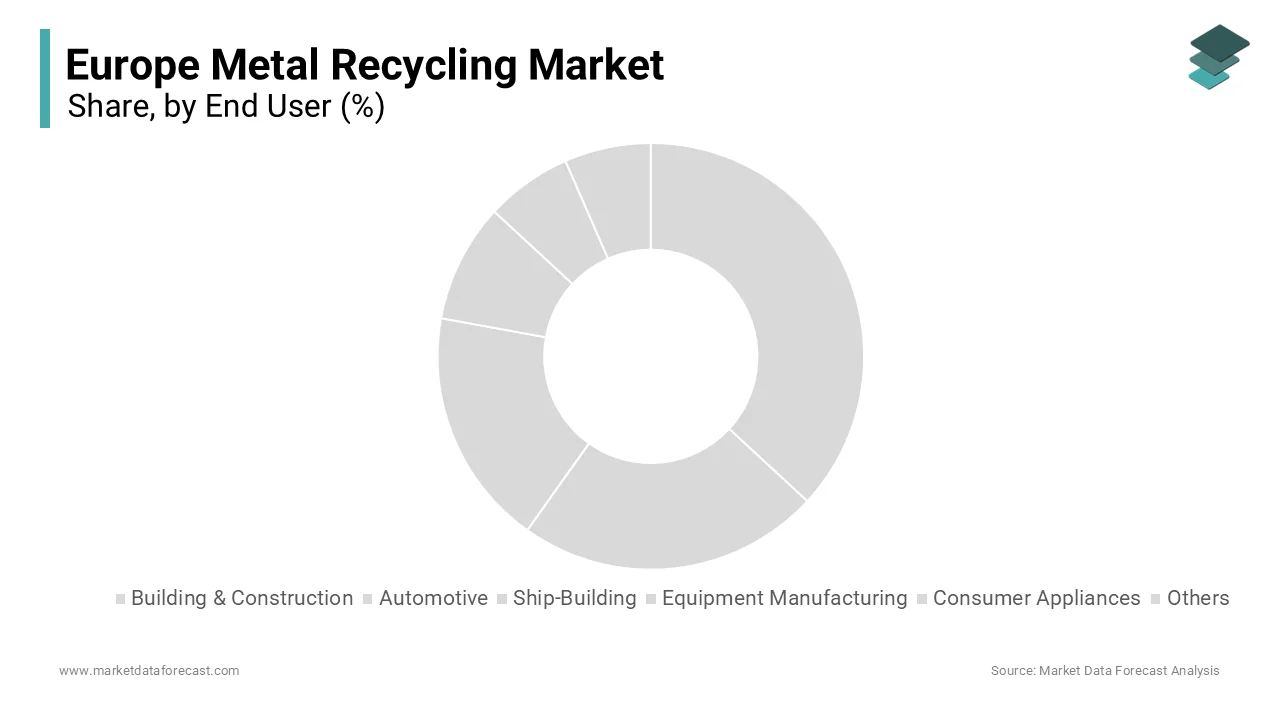
The automotive segment is expected to exhibit a noteworthy CAGR of 6.8% from 2026 to 2034 due to stringent end of life vehicle regulations and the electrification of transport which increases the density of high value non ferrous metals per unit. Electric vehicles generally utilize a higher volume of copper in their construction compared to traditional internal combustion engine vehicles. The battery packs within electric vehicles are composed of various materials, including nickel and cobalt. Methods exist for recovering specific materials from electric vehicle batteries, making the recycling process a potential economic consideration. Regulatory frameworks are evolving to require that new vehicle designs facilitate easier dismantling at the end of their service life. Policy proposals are increasingly pushing for higher, mandatory, weight-based reuse and recycling rates for vehicles. France and Sweden have already implemented deposit return schemes for traction batteries ensuring traceability and channeling them into certified recycling streams. Automakers are partnering with recycling experts to establish circular, car-to-car systems, effectively replacing linear disposal with sustainable, integrated metal recovery, boosting sector growth.
REGIONAL ANALYSIS
Germany Metal Recycling Market Analysis
Germany led the Europe metal recycling market by accounting for a 22.3% share in 2025. The growth of the German market in 2025. The country’s advanced industrial base generates vast quantities of manufacturing scrap while its dual system of public and private waste management ensures high collection efficiency. Germany’s Circular Economy Act enforces strict landfill bans on metallic waste and incentivizes material substitution through eco design requirements. The Ruhr region hosts Europe’s densest cluster of electric arc furnace steel mills which rely almost exclusively on domestic scrap reducing reliance on imported iron ore. Moreover, the country leads in research and development with institutions like Fraunhoauer IWKS pioneering sensor based sorting for complex alloy separation. These structural advantages combined with stable regulatory support solidify Germany’s role as the backbone of continental metal circularity.
France Metal Recycling Market Analysis
France was second largest country in the European metal recycling market by holding a 16.5% share in 2025. The growth of the French market is credited to its aggressive urban mining agenda targeting metals embedded in obsolete infrastructure and consumer goods. Legislative measures prohibiting the destruction of unsold non-food items have encouraged the collection and repurposing of electrical goods. Producer responsibility initiatives have strengthened the recovery of metals from electronic waste, resulting in increased collection efforts and high per capita performance. Furthermore, advanced automated processing technologies have improved the purity of recovered metals, enabling their direct reintegration into high-performance manufacturing supply chains. France is becoming a key hub for high-value non-ferrous recycling as the state-owned Orano group develops advanced hydrometallurgical circuits for critical metals.
Italy Metal Recycling Market Analysis
Italy is steadily growing in the Europe metal recycling market due to a dense network of small and medium enterprises specializing in non ferrous metal refining according to Confindustria Federacciai. The nation holds a leading position within Europe for processing aluminum scrap, with significant volume sourced from the packaging and automotive industries. Specialized foundries, concentrated in northern regions, transform shredded cable and extrusion offcuts into billets for international markets. Proximity to Mediterranean shipping routes facilitates the import of clean scrap from North Africa, complementing the high domestic recycling rate of household appliances. Advancements in separation technology within regional hubs have enhanced the purity of aluminum streams, improving compliance with industry standards. Despite challenges in regulatory harmonization within the EU Italy’s entrepreneurial recycling culture and metallurgical expertise sustain its competitive edge in secondary metal production.
United Kingdom Metal Recycling Market Analysis
The United Kingdom is also a key player in the European metal recycling market. Despite exiting the EU the UK maintains alignment with core circular economy principles through its Resources and Waste Strategy which targets zero avoidable waste by 2050. A significant portion of the nation's annual steel scrap supply is recovered through construction and demolition activities. The steel recycling industry demonstrates a high rate of material recovery. Major metropolitan areas and regional centers act as primary hubs for the recycling of copper and brass, supported by large-scale infrastructure and utility projects. Regulatory oversight is maintained for metal treatment sites to manage emissions compliance. New producer responsibility fees have provided increased funding for the improvement of collection infrastructure. Domestic demand for scrap by EAF operators such as Liberty Steel continues to absorb local supply, notwithstanding the logistical delays at the border caused by Brexit. Strategic investments in AI powered sorting at facilities like EMR’s Willesden plant are enhancing yield and purity supporting long term market resilience.
Turkey Metal Recycling Market Analysis
Turkey is anticipated to expand in the Europe metal recycling market from 2026 to 2034. The nation maintains a significant annual importation of ferrous scrap, positioning itself as a major global steel producer heavily dependent on recycled feedstock. Large-scale processing and melting facilities, particularly concentrated near key coastal cities, refine mixed scrap into products like rebar and wire rod intended for international markets. Competitive operational costs and flexible labor regulations provide an advantage for quickly scaling production capacity. Electric arc furnace mills consume a substantial portion of the total steel production, highlighting a reliance on scrap-based manufacturing. Governmental initiatives aimed at greener steel encourage the modernization of electric arc furnaces and the adoption of emission-reduction technologies. However reliance on imported scrap exposes the sector to global price volatility and geopolitical risks. Nonetheless Turkey’s strategic location and growing integration with European supply chains ensure its continued prominence in the regional recycling ecosystem.
COMPETITIVE LANDSCAPE
Competition in the Europe metal recycling market is characterized by a mix of large integrated recyclers regional specialists and emerging technology providers vying for dominance in both ferrous and non ferrous segments. Established players leverage scale advanced infrastructure and regulatory expertise to process millions of metric tons of scrap annually while smaller firms compete through niche capabilities in specific alloys or waste categories. The market is highly fragmented in collection but consolidated in refining where capital intensity and permitting barriers limit new entrants. Differentiation arises from technological sophistication feedstock security and sustainability credentials with leaders increasingly offering certified low carbon recycled metals. Regulatory pressures under the EU Green Deal and Industrial Emissions Directive compel continuous investment in emission control and resource efficiency. Cross border consolidation is accelerating as companies seek to harmonize operations across national jurisdictions and access diversified input streams. This dynamic landscape fosters innovation but also intensifies pressure on margins and compliance rigor.
KEY MARKET PLAYERS
Some of the notable key players in the Europe metal recycling market are
- Aurubis AG
- Commercial Metals Company
- European Metal Recycling
- GFG Alliance
- Norsk Hydro ASA
- Sims Limited
- Gerdau S.A.
- Radius Recycling, Inc.
- Nucor Corporation
- Sadoff Iron & Metal Company
- Kimmel Scrap Iron & Metal Co., Inc.
Top Players in the Market
- Aurubis AG is a leading integrated copper recycler headquartered in Germany with extensive operations across Europe. The company specializes in recovering copper and precious metals from complex scrap streams including electronic waste and industrial residues. Aurubis supplies high purity copper cathodes and rods to global electronics and automotive manufacturers enabling circular material flows. Its facility enhances its ability to extract cobalt nickel and rare earth elements while meeting stringent EU environmental standards. Aurubis also collaborates with OEMs on closed loop programs ensuring traceable metal recovery and reinforcing its role as a cornerstone of Europe’s critical raw material strategy.
- Sims Limited operates one of the largest ferrous and non ferrous metal recycling networks in Europe with major facilities in the United Kingdom Netherlands and Sweden. The company processes end of life vehicles construction debris and obsolete electronics into specification grade scrap for steel mills and foundries worldwide. Sims plays a vital role in global supply chains by exporting certified recycled metal to Asia and North America. The company also launched a digital scrap tracking platform that provides real time chain of custody data to customers aligning with EU due diligence requirements. These innovations strengthen its position as a technology driven recycler committed to transparency and efficiency.
- Umicore SA is a Belgian materials technology group renowned for its expertise in precious and specialty metal recycling particularly from automotive catalysts and lithium ion batteries. The company operates state of the art smelting and refining complexes in Hoboken Belgium and Hanau Germany that recover platinum palladium rhodium cobalt and nickel with yields exceeding 95 percent. Umicore supplies these refined metals to battery cell producers and chemical manufacturers globally supporting the clean energy transition. Its initiative secures feedstock from end of life electric vehicles and positions Umicore at the forefront of urban mining for critical battery metals in alignment with EU battery regulation mandates.
Top Strategies Used by the Key Market Participants
Key players in the Europe metal recycling market prioritize vertical integration to control feedstock quality and downstream output consistency. They invest heavily in advanced sorting and metallurgical technologies such as sensor based separation and hydrometallurgy to recover high purity metals from complex waste streams. Strategic partnerships with original equipment manufacturers and automotive producers enable closed loop recycling systems that ensure traceability and compliance. Companies also focus on digitalization by deploying blockchain and AI driven platforms for real time material tracking and regulatory reporting. Additionally they align operations with evolving EU policies including the Circular Economy Action Plan and Battery Regulation to secure long term licensing and funding advantages.
MARKET SEGMENTATION
This research report on the European metal recycling market has been segmented and sub-segmented based on categories.
By Metal
- Ferrous
- Non-ferrous
By End User
- Building & Construction
- Automotive
- Ship-Building
- Equipment Manufacturing
- Consumer Appliances
- Others
By Country
- UK
- France
- Spain
- Germany
- Italy
- Russia
- Sweden
- Denmark
- Switzerland
- Netherlands
- Turkey
- Czech Republic
- Rest of Europe