- Product Description Description
- Table of Contents TOC
- List of Table & Figure LOT
- Get Free Sample PDF Sample PDF
Market Size, 2025
$1.87 BnMarket Estimate, 2026
$1.98 BnMarket Forecast, 2034
$3.13 BnCAGR, 2026–2034
5.90%Europe Microscopy Market Report Summary
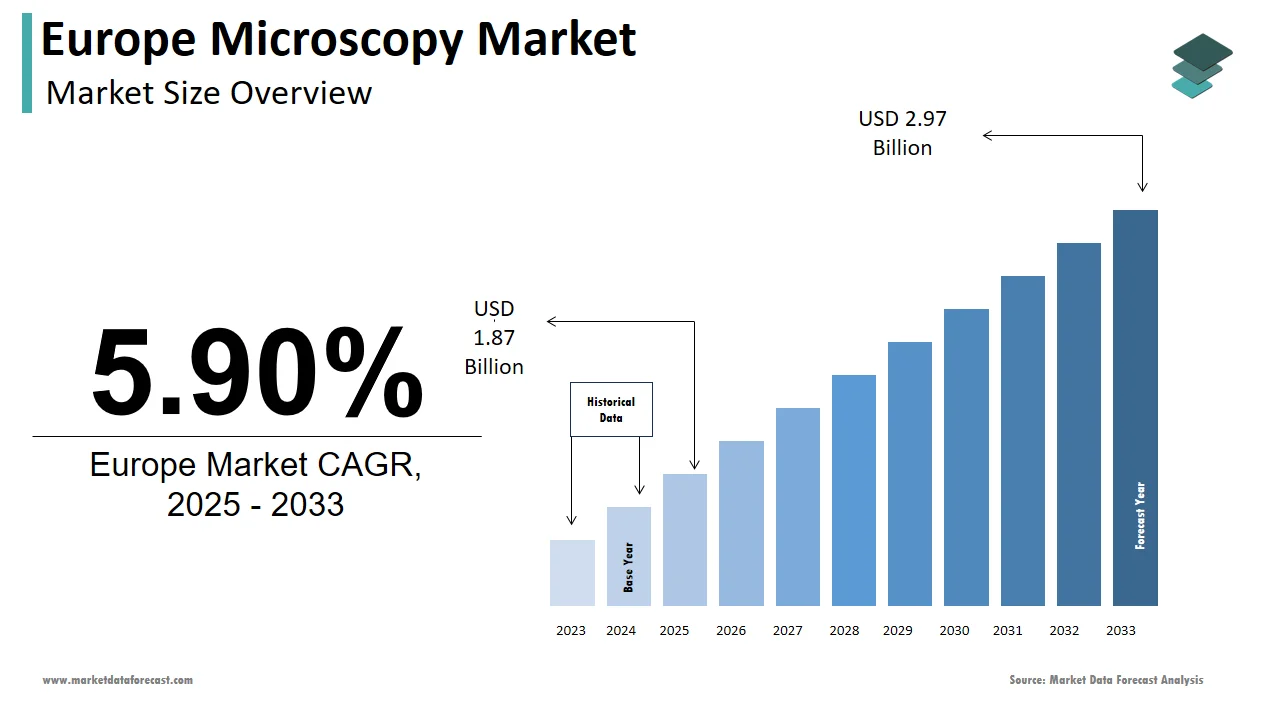
The Europe microscopy market was valued at USD 1.87 billion in 2025, is estimated to reach USD 1.98 billion in 2026, and is projected to reach USD 3.13 billion by 2034, growing at a CAGR of 5.90% during the forecast period from 2026 to 2034.
The growth of the European microscopy market is driven by rising investment in life sciences research, advancements in imaging technologies, and increasing demand for high-resolution analytical tools in material science and nanotechnology. Expanding applications in healthcare diagnostics, pharmaceutical R&D, and industrial quality control are further accelerating market expansion across the region.
Key Market Trends
- Growing adoption of super-resolution and electron microscopy for nanoscale imaging and advanced material analysis.
- Rising government and academic funding for biomedical and life science research programs.
- Increasing use of digital and automated microscopy systems to enhance imaging precision and workflow efficiency.
- Integration of AI and image analytics software improving microscopy data interpretation and reproducibility.
- Expanding use of microscopy in drug discovery, semiconductor inspection, and environmental sciences across Europe.
Segmental Insights
- Based on product, the microscopes segment remained the largest in the Europe microscopy market, holding a substantial share in 2024, driven by the continuous demand for advanced optical, electron, and scanning probe microscopes across research and industrial sectors.
- Based on type, the optical microscopes segment led the Europe microscopy market in 2024, accounting for 52.3% of the total share, supported by its broad application range, cost efficiency, and continued innovation in fluorescence and confocal imaging technologies.
- Based on end user, the research institutes segment dominated the Europe microscopy market, capturing a 63.7% share in 2024, fueled by strong public research funding, academic collaborations, and the region’s leadership in biomedical and material sciences.
Regional Insights
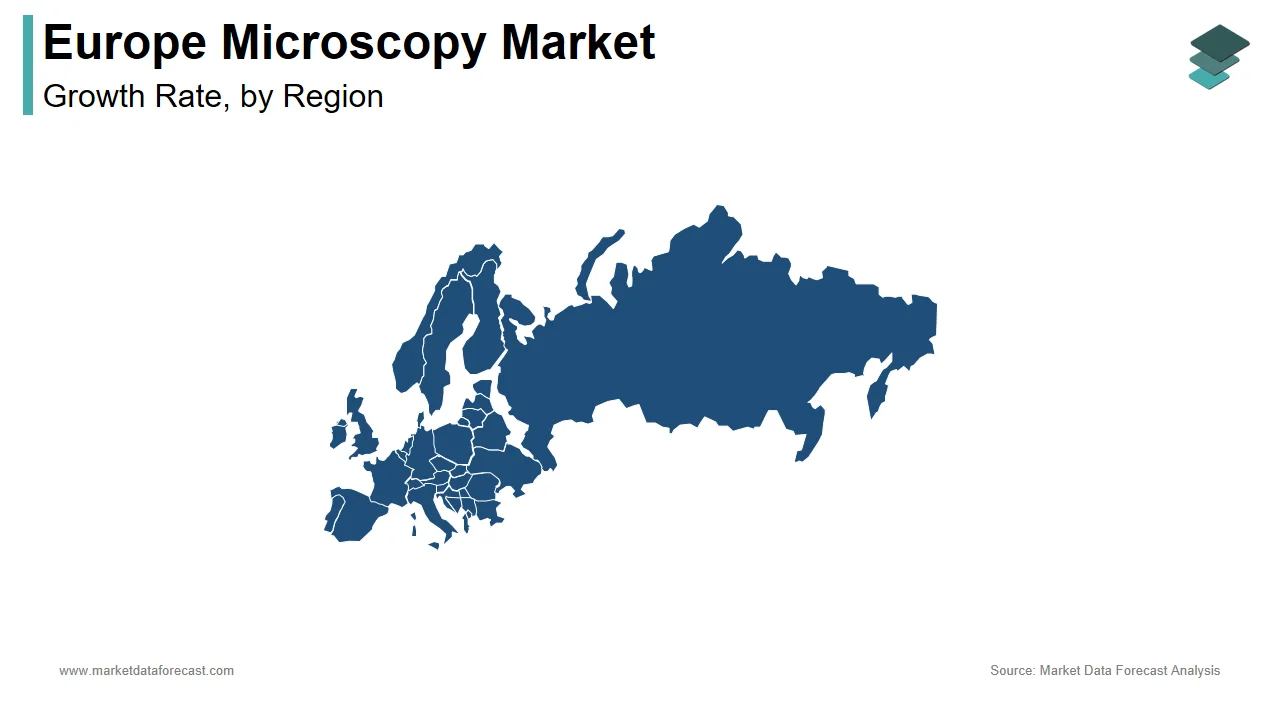
The European microscopy market is witnessing steady growth across major economies, supported by technological advancement, academic excellence, and increased R&D spending.
- Germany outperformed other regions, accounting for a 24% share in 2024, driven by world-class research infrastructure and strong industrial microscopy applications.
- France followed as the second-largest market with a 16.2% share in 2024, supported by active government funding in life sciences and nanotechnology research.
- The United Kingdom grew consistently, supported by its globally recognized academic institutions and biotechnology innovation cluster.
- Switzerland is expected to grow between 2025 and 2033, propelled by its elite research institutions, strong pharmaceutical presence, and focus on precision imaging technologies.
Competitive Landscape
The European microscopy market is moderately consolidated, with key players focusing on technological innovation, digital imaging integration, and automation to improve visualization and analytical capabilities. Companies are investing in AI-powered image processing, advanced optics, and modular microscope systems to enhance performance and user experience across scientific and industrial settings. Prominent players include, Carl Zeiss, Danaher, Thermo Fisher, Nikon, Bruker Corporation, Olympus, Oxford Instruments, JEOL Hitachi High-Technologies, Keyence, Vision Engineering, Leica Microsystems, and Helmut Hund.
Europe Microscopy Market Size
The microscopy market size in Europe was valued at USD 1.87 billion in 2025. The European market is estimated to be worth USD 3.13 billion by 2034 from USD 1.98 billion in 2026, growing at a CAGR of 5.90% from 2026 to 2034.
Microscopy refers to the field of using instruments called microscopes to observe, analyze, and magnify objects that are invisible to the naked eye, encompassing optical, electron, and scanning probe techniques. In 2025, microscopy remains a foundational tool for nanoscale and cellular level investigation, critical to progress in life sciences, materials engineering, and semiconductor development. Europe possesses a vast and diverse higher education and research landscape, with close to 5,000 higher education institutions and numerous public and private research organisations, as per sources. The continent hosts globally recognized institutions such as the Max Planck Society in Germany and the CNRS in France, both of which operate numerous microscopy core facilities. Apart from these, the European Strategy Forum on Research Infrastructures lists advanced imaging platforms among its priority investments, reflecting sustained institutional demand. This ecosystem of academic depth, policy support, and translational research creates a distinctive environment for microscopy adoption that extends beyond mere commercial dynamics.
MARKET DRIVERS
Rising Investment in Life Sciences and Biomedical Research
The region’s robust public and private funding for biomedical discovery serves as a key accelerator for the growth of the Europe microscopy market. National governments and the European Union consistently channel resources into health-related research, with life sciences forming a major component of Horizon Europe’s Cluster 1 Health. In 2023, the European Union's total expenditure on all research and development (R&D) was €381.4 billion, with a focus on general health challenges and digital solutions within larger programs like Horizon Europe and Digital Europe. In 2023, total public and private R&D spending in Germany reached approximately €129 billion, representing 3.1% of GDP, demonstrating a continued high level of investment in research and innovation, as per sources. France's ANR funds various biomedical and health research projects, with the general trend in the EU being increased investment in AI and digital health, including imaging technologies, through broad research programs. This sustained multi-level investment ensures that microscopy remains integral to Europe’s scientific output and therapeutic innovation pipeline.
Expansion of Nanotechnology and Advanced Materials Development
Strategic focus on nanotechnology and functional materials has significantly elevated the expansion of the Europe microscopy market. As per sources, there has been a significant increase in the number of European research clusters actively engaged in nanomaterials innovation. Major European collaborative research initiatives have successfully secured substantial follow-on funding to continue their work. According to studies, more national laboratories are establishing dedicated, advanced centers for characterizing nanomaterials. Moreover, specialized European agencies are increasingly using advanced microscopy techniques to evaluate material integrity. Such cross-sectoral applications, rooted in Europe’s industrial and scientific priorities, sustain consistent demand for high-end microscopy instrumentation beyond conventional biological use cases.
MARKET RESTRAINTS
High Cost and Complexity of Advanced Microscopy Systems
The acquisition and operational expenses associated with cutting-edge microscopy platforms pose a barrier, particularly for smaller academic institutions and startups, which restrain the growth of the Europe microscopy market. The acquisition cost of advanced microscopy systems varies significantly, with state-of-the-art cryo-electron microscopes commanding a substantially higher price than super-resolution fluorescence systems, as per sources. Beyond capital expenditure, Ongoing annual maintenance expenses for scientific instruments typically represent a notable percentage of their initial purchase price. As per studies, a significant number of microscopy core facilities in certain regions operate using outdated equipment. Moreover, the installation of electron microscopes demands vibration-free rooms, electromagnetic shielding, and stable power supplies, adding a notable amount to facility modifications. Training personnel to operate these systems further compounds the challenge, as proficiency in techniques like correlative light and electron microscopy requires months of hands-on instruction. These compounded financial and infrastructural hurdles restrict equitable access to advanced imaging and create a technology gap between Western European hubs and emerging research centers in the EU periphery.
Stringent Regulatory and Ethical Oversight in Clinical Applications
Rigorous regulatory frameworks delay deployment and increase compliance costs, and thereby hinder the expansion of the Europe microscopy market. The European Union's In Vitro Diagnostic Regulation (IVDR) has established a requirement for extensive clinical evidence for imaging-based diagnostic tools, impacting the regulatory landscape for these products. The average review timeline for diagnostic workflows that utilize microscopy has increased under the current European Medicines Agency (EMA) procedures compared to previous directives. Furthermore, the General Data Protection Regulation imposes strict controls on the handling of patient-derived tissue images, especially when used in artificial intelligence training datasets. Ethical review boards across member states also require separate approvals for research involving human tissue. These overlapping layers of oversight, while essential for patient safety and data integrity, substantially slow the adoption of innovative microscopy applications in clinical settings and discourage private sector investment in diagnostic imaging startups.
MARKET OPPORTUNITIES
Integration of Artificial Intelligence with Microscopy Platforms
The convergence of artificial intelligence and microscopy is setting up new opportunities for the growth of the Europe microscopy market. This unlocks unprecedented capabilities in image analysis, automation, and diagnostic accuracy, creating a transformative growth vector across Europe. Deep learning algorithms enable real-time segmentation of subcellular structures, reducing manual annotation time, as per research. This synergy between open science infrastructure and machine learning innovation positions Europe to lead in intelligent microscopy, where automation enhances both research throughput and clinical decision support without expanding human resource requirements.
Growth of Collaborative Research Infrastructures Across Borders
The region’s unique model of multinational scientific cooperation is fostering shared access to high-end microscopy facilities, which provide fresh opportunities for the expansion of the Europe microscopy market. This, in turn, democratizes advanced imaging capabilities. The Euro-BioImaging consortium is expanding access to advanced microscopy platforms across numerous countries through a network of operational nodes. The consortium has significantly increased the facilitation of research projects, particularly benefiting institutions that lack local imaging infrastructure. This ecosystem of pooled resources reduces duplication of capital investment and ensures that researchers from less-endowed regions can compete globally. The scalability of this model, supported by sustained EU policy frameworks, presents a structural opportunity for microscopy vendors to engage with centralized procurement and service contracts across national boundaries.
MARKET CHALLENGES
Shortage of Skilled Personnel in Advanced Imaging Techniques
Persistent gap in personnel trained to operate and interpret data from sophisticated microscopy systems continues to hamper the growth of the Europe microscopy market. This shortfall is particularly acute in techniques such as cryo-electron tomography and live-cell super-resolution imaging, which require interdisciplinary expertise in physics, biology, and computational analysis. Consequently, many core facilities operate below capacity, with instruments underutilized due to a lack of qualified staff. Industry faces parallel challenges, with semiconductor manufacturers in Belgium and the Netherlands citing imaging technician shortages as a bottleneck in failure analysis workflows. The human capital deficit, not technology or funding, will constrain the effective use of next-generation microscopy systems without essential educational reforms and standardized training.
Fragmentation of Procurement and Funding Mechanisms Across Member States
The absence of a harmonized approach to research infrastructure procurement in the region creates inefficiencies that constrain the expansion of the Europe microscopy market. Each of the 27 EU member states maintains distinct funding cycles, eligibility criteria, and tendering rules for scientific equipment, leading to project delays and vendor uncertainty. Furthermore, national research councils often prioritize short-term project-based grants over long-term infrastructure investments, which discourages institutions from committing to high-cost microscopy systems. This fragmentation not only increases transaction costs for vendors but also prevents economies of scale that could lower system prices and service costs across the region. Europe will fail to maximize its collective scientific potential in advanced imaging unless policy coordination is improved.
REPORT COVERAGE
| REPORT METRIC | DETAILS |
| Market Size Available | 2025 to 2034 |
| Base Year | 2025 |
| Forecast Period | 2026 to 2034 |
| Segments Covered | By Product, Type, Application, End Use, and Country. |
| Various Analyses Covered | Global, Regional and Country-Level Analysis, Segment-Level Analysis, Drivers, Restraints, Opportunities, Challenges; PESTLE Analysis; Porter’s Five Forces Analysis, Competitive Landscape, Analyst Overview of Investment Opportunities |
| Countries Covered | UK, France, Spain, Germany, Italy, Russia, Sweden, Denmark, Switzerland, Netherlands, Turkey, Czech Republic, and the Rest of Europe. |
| Market Leaders Profiled | Carl Zeiss, Danaher, Thermo Fisher, Nikon, Bruker Corporation, Olympus, Oxford Instruments, JEOL Hitachi High-Technologies, Keyence, Vision Engineering, Leica Microsystems, and Helmut Hund. |
SEGMENTAL ANALYSIS
By Product Insights
The microscopes segment remained the largest segment in the Europe microscopy market by holding a substantial share in 2024. The dominance of the microscopes segment is primarily driven by their foundational role across research, diagnostics, and industrial quality control. Unlike accessories, which support functionality, microscopes represent the core capital investment in imaging workflows. The continuous modernization of academic and clinical facilities under the EU science policy also drives the growth of this segment. Apart from these, national health agencies increasingly mandate digital pathology adoption, a process requiring high-throughput slide scanners based on optical microscopy. This institutional anchoring of microscopes as non-substitutable scientific tools ensures their overwhelming market presence.
The accessories segment is predicted to witness the highest CAGR of 9.2% from 2026 to 2034. The rapid growth of the accessories segment is propelled by the rising adoption of modular and application-specific imaging configurations that require complementary components such as precision stages, environmental chambers, and high-sensitivity detectors. A major factor is the shift toward live cell and dynamic process imaging in European biopharma R&D. As per sources, a portion of large molecule drug developers in Europe use time-lapse fluorescence microscopy for mechanism of action studies, which requires temperature-controlled incubation chambers and autofocus stabilization systems. A further driver of this segment is the proliferation of correlative microscopy workflows that integrate data from multiple platforms by necessitating specialized sample holders and alignment adapters. Furthermore, the European Union’s push for open science has increased demand for standardized, interoperable components that enable equipment sharing across labs. These trends reflect a maturing market where performance enhancement through accessories, not just base instruments, defines research capability.
By Type Insights
In 2024, the optical microscopes segment led the Europe microscopy market by accounting for 52.3% of the Europe Microscopy Market in 2024. The prominence of the optical microscopes segment is propelled by their versatility, cost efficiency, and entrenched use in education, clinical diagnostics, and industrial inspection. The widespread deployment in histopathology and hematology labs across national healthcare systems further propels the growth of this segment. A different growth factor is the integration of digital imaging and AI. Apart from these, optical microscopes are the only type permitted in many teaching laboratories due to safety and simplicity. This combination of clinical indispensability, digital transformation, and educational ubiquity solidifies optical microscopy as the market’s backbone.
The atomic force microscopy segment is estimated to register the fastest CAGR of 11.4% from 2026 to 2034 due to factors such as its unique capability to characterize nanoscale surface topography and mechanical properties without vacuum requirements. Europe’s strategic investment in semiconductor miniaturization is also a factor boosting the growth of this segment. A different key driver is the expansion of biomaterials research. Unlike electron microscopy, AFM operates in ambient or liquid environments, enabling real-time observation of biological processes, a feature increasingly leveraged in EU-funded projects on protein aggregation and cell membrane dynamics. These dual industrial and life science applications position AFM for sustained high growth.
By End User Insights
The research institutes segment dominated the Europe microscopy market and captured a 63.7% share in 2024. The growth of the research institutes segment is propelled by their role as the primary hub for fundamental and applied scientific inquiry. These entities include national laboratories, university core facilities, and EU-funded research infrastructures that collectively drive high-end instrumentation demand. A further growth factor is the concentration of large-scale microscopy platforms within publicly funded networks. A different contributor is the centralized procurement model used by research consortia, which enables bulk acquisition of microscopes not feasible for individual hospitals or small companies. This institutional density, combined with stable public funding and long-term scientific mandates, ensures research institutes remain the dominant end-user segment.
The industrial end-user segment is anticipated to witness the fastest CAGR of 10.1% from 2026 to 2034, owing to quality control demands in semiconductors, pharmaceuticals, and advanced manufacturing. A different growth factor is the European Union’s push for technological sovereignty in microelectronics. According to research, European manufacturers are increasing their investments in microscopy-based metrology to meet rigorous cleanroom standards and achieve stricter defect detection thresholds. This shift shows a broader push for enhanced quality control and compliance within the sector. Companies operate dedicated in-line microscopy units for real-time monitoring of bioreactor cultures. Moreover, the rise of Industry 4.0 has integrated microscopy into automated production lines. These cross-industry imperatives transform microscopy from a research tool into a critical element of industrial compliance and innovation.
COUNTRY LEVEL ANALYSIS
Germany Microscopy Market Analysis
Germany outperformed other regions in the Europe microscopy market and accounted for a 24% share in 2024. The prominence of Germany in the regional market is attributed to its world-class research ecosystem and advanced industrial base. The country hosts multiple Max Planck and Helmholtz institutes, all of which operate high-end microscopy facilities supported by consistent federal funding. Industrial demand is equally robust, driven by semiconductor giants like Infineon and Bosch, which require electron and probe microscopy for failure analysis in automotive and power electronics. Apart from these, Germany’s dual education system trains technical specialists annually in laboratory instrumentation, ensuring skilled operation of advanced systems. This synergy between public science, private industry, and technical education cements Germany’s leadership position.
France Microscopy Market Analysis
France is the next-biggest player in the Europe microscopy market and held a 16.2% share in 2024. Its centralized national research strategy and strong public health infrastructure have propelled the demand for microscopy in France. Industrial contributions come from the aerospace and cosmetics sectors. L’Oréal’s R&D center in Paris employs confocal microscopy for skin penetration studies, while Safran uses scanning electron microscopy for turbine blade inspection. The Ministry of Higher Education also mandates microscopy training in all life science undergraduate programs, creating a steady pipeline of users. This blend of public coordination and sectoral diversity sustains France’s prominent market role.
United Kingdom Microscopy Market Analysis
The United Kingdom grew consistently in the Europe microscopy market, with its globally influential academic institutions and biotechnology cluster. Despite Brexit, UK research remains deeply integrated into European science, with institutions like the Francis Crick Institute and University of Cambridge operating some of the continent’s most advanced cryo EM facilities. The NHS Long Term Plan has accelerated digital pathology adoption. The UK also hosts Europe’s densest concentration of cell and gene therapy developers—companies routinely use high content screening microscopes for product characterization. This convergence of academic prestige, clinical digitization, and biotech dynamism maintains the UK’s strong market presence.
Netherlands Microscopy Market Analysis
The Netherlands expanded gradually in the European microscopy market, with its size, its concentration of high technology industries, and its collaborative science policy. The country is home to ASML, the world’s sole manufacturer of extreme ultraviolet lithography machines, which relies on electron and optical microscopy for component validation and failure analysis. Academic excellence is equally notable. Moreover, the Netherlands hosts the European Molecular Biology Laboratory’s cryo EM node in collaboration with Utrecht University, serving researchers from many countries. This unique fusion of semiconductor leadership, open science infrastructure, and cross-border collaboration drives outsized market influence.
Switzerland Microscopy Market Analysis
Switzerland is likely to grow in the Europe Microscopy Market from 2026 to 2034 due to its elite research institutions and global pharmaceutical dominance. Home to ETH Zurich and EPFL, both ranked among the world’s top 20 universities for materials science, Switzerland operates some of Europe’s most sophisticated AFM and cryo EM facilities. The country’s pharmaceutical industry, led by Novartis and Roche, heavily utilizes high-content screening and super-resolution microscopy for drug discovery. Roche’s Basel Innovation Center alone runs many automated microscopy platforms for phenotypic screening of compound libraries. Besides, Switzerland’s non-EU status does not impede scientific integration; it participates fully in Horizon Europe and hosts CERN, where microscopy supports detector material analysis. The Swiss government also funds the National Center of Competence in Research on Molecular Systems Engineering, which deploys multimodal imaging for synthetic biology. This rare combination of academic rigor, pharmaceutical scale, and international scientific engagement ensures Switzerland’s outsized role in the microscopy landscape.
COMPETITIVE LANDSCAPE
The Europe microscopy market features intense competition among global technology leaders and specialized regional innovators. Established players leverage decades of optical engineering expertise while newer entrants focus on software-driven differentiation through AI and cloud analytics. Competition is less about price and more about system performance, service responsiveness, and integration into broader research or clinical ecosystems. Academic partnerships act as both validation channels and demand generators, with vendors often embedding engineers within university core facilities. Regulatory alignment with EU medical device and data privacy frameworks further raises entry barriers for non-compliant firms. Differentiation also occurs through domain-specific customization, such as live cell imaging for pharma or defect metrology for semiconductors. This multifaceted competitive landscape rewards companies that combine technological precision with deep scientific engagement and agile support infrastructure across diverse European markets.
KEY MARKET PLAYERS
Some of the companies that are playing a dominating role in the Europe microscopy market include
- Carl Zeiss
- Danaher
- Thermo Fisher
- Nikon
- Bruker Corporation
- Olympus
- Oxford Instruments
- JEOL
- Hitachi High-Technologies
- Keyence
- Vision Engineering
- Leica Microsystems
- Helmut Hund
TOP PLAYERS IN THE EUROPE MICROSCOPY MARKET
- Thermo Fisher Scientific maintains a strong presence in the Europe Microscopy Market through its comprehensive portfolio of electron microscopes, cryo imaging systems, and correlative microscopy solutions. The company actively supports academic and industrial research by integrating artificial intelligence into its imaging platforms to enhance data analysis. In recent years, Thermo Fisher has expanded its European service network with new application centers in Berlin and Lyon to provide localized technical training and instrument validation. It also collaborates with the European Molecular Biology Laboratory to advance structural biology workflows. These initiatives reinforce its role as a technology enabler in high-end microscopy across life sciences and materials research domains in Europe.
- Carl Zeiss Microscopy leverages its German engineering heritage to deliver advanced optical and electron microscopy systems tailored for European research and industrial needs. The company emphasizes innovation in super-resolution and light-sheet microscopy with systems widely adopted in neuroscience and developmental biology. Recently, Zeiss strengthened its footprint by launching the ZEISS Atlas 5 platform in partnership with European semiconductor firms for defect analysis. It also inaugurated a new digital imaging academy in Jena to train researchers on AI-powered image processing. Through sustained R and D investment and deep integration with European scientific institutions, Zeiss continues to shape microscopy standards across the continent.
- Leica Microsystems is a key contributor to Europe’s microscopy ecosystem with a focus on surgical visualization, digital pathology, and life science imaging. The company has intensified its commitment to clinical translation by enhancing its THUNDER imaging systems for real-time tissue analysis during oncology procedures. It also introduced cloud-based image management solutions compliant with European data sovereignty regulations.
TOP STRATEGIES USED BY THE KEY MARKET PARTICIPANTS
Key players in the Europe Microscopy Market focus on strategic collaborations with academic and clinical institutions to co-develop application-specific solutions. They invest heavily in integrating artificial intelligence and machine learning to automate image analysis and improve diagnostic accuracy. Expansion of regional service and training centers ensures localized support and user proficiency. Companies also prioritize modular system designs, allowing customers to upgrade components without full replacement. Apart from these, they pursue regulatory compliance with European data protection and medical device standards to facilitate clinical adoption and cross-border deployment of digital imaging workflows.
MARKET SEGMENTATION
This Europe microscopy market research report is segmented and sub-segmented into the following categories.
By Product
- Microscopes
- Accessories
By Type
- Optical Microscope
- Electron Microscope
- AFM
- STM
- NSOM
By Application
- Semiconductor
- Nanotechnology
- Electronics
By End User
- Industrial
- Research Institutes
- Blood Bank
By Country
- UK
- France
- Spain
- Germany
- Italy
- Russia
- Sweden
- Denmark
- Switzerland
- Netherlands
- Turkey
- Czech Republic
- Rest of Europe