- Product Description Description
- Table of Contents TOC
- List of Table & Figure LOT
- Get Free Sample PDF Sample PDF
Market Size, 2025
$1.84 BnMarket Estimate, 2026
$1.97 BnMarket Forecast, 2034
$3.42 BnCAGR, 2026–2034
7.13%Executive Summary: Europe Monosodium Glutamate Market
- Market Scope: European regional market analysis covering product forms, application sectors, health policy sodium reduction drivers, and country-level market leadership.
- Market Valuation: Valued at USD 1.84 billion (2025), estimated at USD 1.97 billion (2026), and projected to reach USD 3.42 billion by 2034, growing at a CAGR of 7.13% (2026–2034).
- Primary Growth Drivers: Public health policy measures addressing excessive sodium intake (which contributes to >1.5 million annual deaths across the WHO Europe region, prompting action plans in 28 member states) alongside culinary functionality, as MSG enables sodium reductions of up to 40% without compromising umami. Studies show replacing 30% of table salt with MSG reduces sodium by 1.2 grams per serving while maintaining sensory acceptance among 92% of panelists. Plant-based market expansion also fuels demand, with EU plant-based sales hitting EUR 4.2 billion and meat alternatives growing 18% YoY. Average daily MSG exposure across EU member states stands at 0.7 grams per person.
Key Market Segment Metrics (2026–2034)
| Category | Leading Segment (2025 Position) | Fastest-Growing Segment |
|---|---|---|
| By Product Form | Powder/Crystalline MSG (held largest share in 2025; food-grade powder achieves 99.5% purity and dissolves within 15 seconds at 70°C) | Micro-Encapsulated MSG (projected to register the fastest 9.7% CAGR, with >40% of new savory snack launches in Germany and the Netherlands using encapsulated MSG) |
| By Application | Food Processing (held significant share in 2025, supported by EU production exceeding 45 million tonnes of prepared meals and soups) | Food Service (projected to grow at an 11.2% CAGR; 61% of professional kitchens surveyed in France, Spain, and Italy keep MSG in their spice stations) |
| By Region / Country | Germany (led Europe with 25.4% market share in 2025; hosts >6,000 food manufacturing facilities), followed by France (16.2%; MSG use in French plant-based meat analogues increased 38% YoY) | — |
Major Market Players & Market Structure
Market Structure: Highly competitive global food ingredients and flavor-enhancer landscape featuring 10 major profiled market leaders competing on high-purity crystalline formats, functional micro-encapsulation technologies, sodium-reduction solution partnerships, and compliance with stringent European food safety standards.
Key Companies: Meihua Holdings Group, B&G Foods, R.M. Chemicals, Linghua Group, Puramate India, Tate & Lyle, Foodchem International, Ajinomoto, Cargill, and Kerry Group.
Europe Monosodium Glutamate Market Size
The Europe monosodium glutamate market size was valued at USD 1.84 billion in 2025 and is projected to reach USD 3.42 billion by 2034 from USD 1.97 billion in 2026, growing at a CAGR of 7.13%.
Monosodium glutamate (MSG) is a sodium salt of glutamic acid widely used as a flavour enhancer to impart umami taste in processed and prepared foods. In Europe, its application spans soup, sauces, ready meals, snack seasonings and meat alternatives, where clean label and taste optimisation are increasingly prioritised. Despite historical consumer scepticism, scientific consensus has reaffirmed MSG’s safety, which is leading to gradual reacceptance in professional and industrial kitchens. According to the European Food Safety Authority, MSG is authorised as a food additive under E number E621 and is subject to rigorous purity and usage level assessments under Regulation EC 1333 2008. As per the European Commission’s 2025 Food Additive Re-evaluation Program, no adverse health effects were identified at current exposure levels, which average 0.7 grams per person per day across EU member states. This evolving scientific and culinary perspective, combined with the rise of plant-based and convenience foods, is reshaping MSG’s role from a controversial additive to a strategic tool in flavour innovation across the European food system.
MARKET DRIVERS
Growing Demand for Clean Label Sodium Reduction Solutions in Processed Foods
The food manufacturers are under mounting pressure to lower sodium content in response to public health initiatives, which is surging the growth of the European monosodium glutamate market. Monosodium glutamate offers a scientifically validated solution by enabling sodium reduction of up to 40% without compromising umami perception. According to the World Health Organisation’s European Regional Office, excessive sodium intake contributes to over 1.5 million deaths annually in the WHO Europe region by prompting national action plans in 28 member states. A 2025 study published by the European Journal of Clinical Nutrition demonstrated that replacing 30% of table salt with MSG in tomato soup reduced sodium by 1.2 grams per serving while maintaining sensory acceptance among 92% of panellists. Major food processors such as Nestlé and Unilever have incorporated MSG into reformulation strategies for bouillons and ready meals sold in Germany and the Netherlands.
Rise of oPlant-Baseded and Alternative Protein Products Driving Umami Enhancement Needs.
The rapid expansion of plant-based meat and dairy alternatives has intensified demand for umami intensifiers to compensate for the bland or beany notes inherent in legume and soy proteins, which is solely levelling up the growth of the European monosodium glutamate market. According to the Good Food Institute Europe, retail sales of plant-based foods reached 4.2 billion euros in 2023, with meat alternatives growing by 18% year on year. However, consumer surveys by the European Consumer Organisation revealed that over 35% of first-time buyers cited “lack of savoury depth” as a reason for not repurchasing. Beyond Meat’s European product line now includes MSG in its burger formulations to mimic the glutamate naturally present in animal tissue. Similarly, German startup LikeMeat uses MSG in its pea protein sausages to achieve a meat-like savoriness.
MARKET RESTRAINTS
Persistent Consumer Misperceptions and “No MSG” Labelling Trends
The lingering negative perceptions of monosodium glutamate continue to constrain its adoption in retail packaged goods is degrading the growth of the European monosodium glutamate market. Many consumers still associate MSG with “Chinese Restaurant Syndrome” or artificiality by leading retailers to avoid the ingredient to meet clean label expectations. This sentiment has fueled a proliferation of “No MSG” claims that over 22% of new savoury snack launches in Western Europe in 2023 carried such labels, as per a recent survey. Major supermarket chains like Carrefour and Tesco have implemented internal guidelines restricting MSG in private label products by forcing suppliers to seek alternative umami sources such as yeast extracts or hydrolysed vegetable protein, which are often less effective and more expensive.
Stringent Regulatory Classification and Labelling Requirements
The specific labellingand purity mandates under European Union food additive legislation, which, while not prohibitive, create administrative and formulation complexities for manufacturers. The growing stringent action to label accurately is also restricting the growth of the European monosodium glutamate market. This explicit labelling heightens consumer awareness and can trigger avoidance behaviour. Additionally, the European Food Safety Authority requires that industrial-grade MSG meet a minimum purity of 99%, with strict limits on arsenic, lead and other contaminants. These regulatory hurdles increase compliance costs and favour large manufacturers with in-house quality control by limiting market access for smaller players and slowing innovation in MSG based formulations across artisanal and regional food sectors.
MARKET OPPORTUNITIES
Integration into Professional Culinary and Food Service Innovation
The re-evaluation of monosodium glutamate by scientific and culinary authorities has opened new avenues for its use in Europe’s food service sector, where chefs seek authentic umami without relying on meat or fish stocks. Therefore, the integration into professional culinary and food service innovation is anticipated to promote new opportunities for the growth of the European monosodium glutamate market. Leading culinary institutions such as the Institut Paul Bocuse in France and ALMA in Italy now include MSG in their curriculum as a tool for sodium reduction and flavour layering. According to the European Culinary Federation, 68% of Michelin-starred restaurants in Spain and Portugal used MSG in at least one signature dish in 2023, often in vegetable-based or seafood preparations to deepen natural savoriness.
Expansion of Fermentation-Based Sustainable MSG Production in the EU
Europe’s push toward circular bioeconomy principles is fostering investment in locally produced, fermentation-derived monosodium glutamate by reducing reliance on imported synthetic variants. This is another attribute to escalate the growth of the European monosodium glutamate market. Unlike traditional MSG made from petrochemical precursors, modern European producers use glucose from non-GMO corn or wheat starch as feedstock in microbial fermentation with a process aligned with the EU Farm to Fork Strategy. These facilities emphasise carbon-neutral production and water recycling, meeting stringent environmental standards under the EU Eco Management and Audit Scheme. Companies like DSM and CJ Europe are marketing this “bio MSG” to food manufacturers seeking sustainable and traceable ingredients. This green manufacturing shift not only enhances supply chain resilience but also appeals to brands targeting eco-conscious consumers, creating a premium segment within the broader market.
MARKET CHALLENGES
Competition from Natural Umami Alternatives and Consumer Preference for Whole Ingredients
Monosodium glutamate faces intensifying competition from naturally derived umami sources such as tomato paste, mushroom powder, seaweed extract, ts and enzymatically hydrolysed proteins, which are perceived as more “whole” and less processed. The competition from natural umami alternatives ,with the increasing preference for whole ingredients, is expected to significantly challenge the growth of the European monosodium glutamate market. Retailers like Edeka in Germany and Sainsbury’s in the UK actively promote products using “tomato-rich” or “mushroom-infused” claims instead of E621 by aligning with clean-label trends. A 2025 consumer study by Mintel found that 64% of European shoppers preferred “umami from vegetables” over “added MSG,” even when the glutamate content was identical. This perceptual bias pressures food manufacturers to reformulate, despite MSG’s cost and efficacy advantages. For instance, Knorr replaced MSG with yeast extract in its European bouillon cubes in 2022 by accepting a 15% increase in ingredient cost to maintain brand trust.
Inconsistent Regulatory Approaches Across Non-EU European Markets
While the European Union maintains a harmonised stance on monosodium glutamate, neighbouring non-EU countries exhibit divergent regulatory and labelling practices that complicate pan-European distribution strategies, which is one of the factors thainhibitsng the growth of the European monosodium glutamate market. According to the Eurasian Economic Commission, this rule discouraged multinational food companies from using MSG in products exported to the Russian market. These inconsistencies increase compliance costs and limit economies of scale, particularly for SMEs seeking to expand beyond the EU.
REPORT COVERAGE
| REPORT METRIC | DETAILS |
| Market Size Available | 2025 to 2034 |
| Base Year | 2025 |
| Forecast Period | 2026 to 2034 |
| CAGR | 7.13% |
| Segments Covered | By Product Form, Application, and Region |
| Various Analyses Covered | Global, Regional, & Country Level Analysis; Segment-Level Analysis; DROC, PESTLE Analysis; Porter’s Five Forces Analysis; Competitive Landscape; Analyst Overview of Investment Opportunities |
| Regions Covered | UK, France, Spain, Germany, Italy, Russia, Sweden, Denmark, Switzerland, Netherlands, Turkey, and the Czech Republic |
| Market Leaders Profiled | Meihua Holdings Group Co, Ltd, B&G Foods, Inc., R.M Chemicals Pvt. Ltd, Linghua Group Limited, Puramate India Pvt Ltd, Tate & Lyle PLC, Foodchem International Corporation, Ajinomoto Co., Inc., Cargill, Incorporated, and Kerry Group plc |
SEGMENTAL ANALYSIS
By Product Form Insights
The powder and crystalline segment was the largest by accounting for a dominant share of the European monosodium glutamate market in 2025, with its cost efficiency, ease of handling, and compatibility with high-speed industrial mixing systems used in soup, seasoning, and bouillon production. As per the European Food Research Institute, crystalline MSG dissolves completely within 15 seconds in hot water at 70 degrees Celsius, which makes it ideal for instant products like stock cubes and dehydrated sauces. European MSG producers such as DSM and Fermentalg have optimised crystallisation and drying lines to deliver food-grade powder with 99.5% purity, meeting EU Regulation EC 1333 2008 standards.
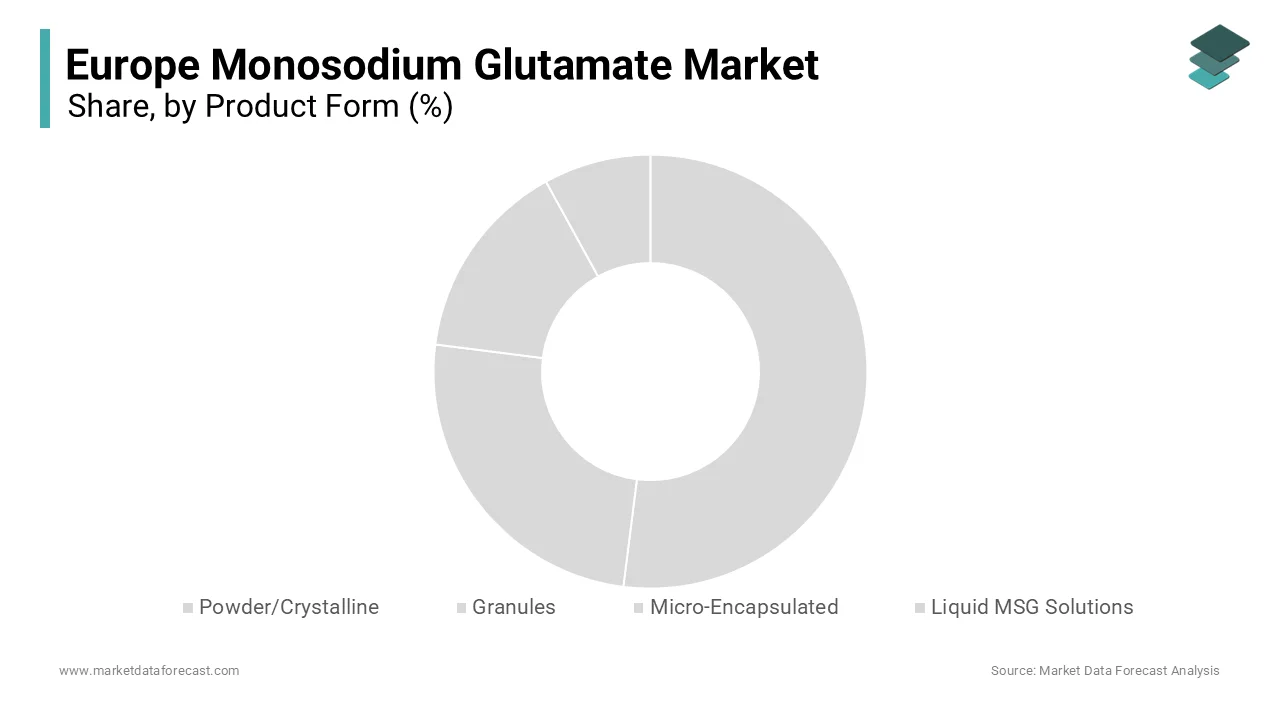
The micro encapsulated segment is anticipated to grow at the fastest CAGR of 9.7% throughout the forecast period, with its application in extruded snacks and baked goods, where free MSG can react with reducing sugars during high temperature processing, causing browning or off notes. As per the European Snacks Association, over 40% of new savoury snack launches in Germany and the Netherlands in 2023 used encapsulated MSG to maintain clean flavour profiles in cheese and herb variants. This technology also enables salt reduction without taste compromise, aligning with EU sodium targets.
By Application Insights
The food processing segment held a significant share of the European monosodium glutamate market in 2025, with MSG’s integral role in industrial formulations for soups, sauces, ready meals, and seasonings, where consistent umami intensity is non-negotiable. The scale standardisation of European processed food manufacturing is additionally to fuel the growth of the European monosodium glutamate market. According to Eurostat, the EU produced over 45 million tonnes of prepared meals and soups in 2023, with companies like Nestlé, Unilever, and Heinz relying on MSG to ensure batch-to-batch flavour consistency across pan-European distribution. The European Commission’s 2023 Salt Reduction Framework mandates up to 30% sodium cuts in 16 food categories.
The food service segment is expected to grow at the fastest CAGR of 11.2% in next coming years. This acceleration reflects a professional re-evaluation of MSG as a precision culinary tool rather than an industrial additive.
The adoption by chefs seeking to enhance plant-based and low-sodium menus is also prompting the growth of the segment. As per the Institut Paul Bocuse’s 2025 Chef Survey, 61% of professional kitchens in France, Spain, and Italy now keep MSG in their spice stations for use in vegetable stocks, vegan gravies, and seafood broths. Renowned chefs like Massimo Bottura have publicly endorsed MSG for its ability to amplify natural glutamates in tomatoes and mushrooms without artificiality. The rise of centralised QSR commissaries is leveraging the growth of the European monosodium glutamate market. Chains like McDonald’s and Leon in the UK use MSG in standardised sauce and seasoning blends to ensure consistent taste across hundreds of outlets.
REGIONAL ANALYSIS
Germany Market Analysis
Germany was the largest contributor by holding 25.4% of Europe's monosodium glutamate market share in 2025, owing to its status as the continent’s leading food processing hub. The country hosts over 6000 food manufacturing facilities, including global giants like Nestlé, Dr Oetker, and Unilever Germany, all of which use MSG in soups, seasonings, and ready meals. Germany’s strong industrial fermentation sector, led by companies like Evonik and BASF, ensures a steady domestic supply of high-purity MSG derived from non-GMO wheat starch. Additionally, the federal government’s National Reduction and Innovation Strategy for Sugar, Salt, and Fat has incentivised sodium reduction, with MSG recognised as a key enabler.
France Market Analysis
France occupied second position by capturing 16.2% of the European monosodium glutamate market share in 2025 by blending traditional culinary arts with modern flavour science. While consumer scepticism persists in retail, professional kitchens have embraced MSG as a tool for umami enhancement in reduced salt preparations. France is also home to major seasoning producers like Lesaffre and Amora, which incorporate MSG into industrial blends for charcuterie and sauces. The Institut National de la Recherche Agronomique confirmed in 2025 that MSG use in plant-based meat analogues grew by 38% year on year, driven by startups in Lyon and Toulouse.
Italy Market Analysis
Italy's monosodium glutamate market growth is expected to grow with its robust processed food sector and evolving approach to traditional cuisine. The country’s pasta sauce, bouillon, and ready meal industries rely heavily on MSG for consistent flavour across export markets. Interestingly, MSG is increasingly used in plant-based versions of classic dishes, such as vegan rag,ù to replicate the umami depth of oslow-cookeded meat. Additionally, southern regions like Campania are integrating MSG into seafood broths to enhance natural glutamates in anchovies and shellfish. This fusion of heritage and innovation ensures steady industrial demand despite consumer ambivalence in retail.
United Kingdom Market Analysis
The United Kingdom monosodium glutamate market growth is likely to grow with its large ready meal and QSR sectors. According to the Food and Drink Federation, the UK produced over 1.8 billion ready meals in 2023, with major brands like Birds Eye and Heinz using MSG to maintain savoury intensity during freezing and reheating. The UK’s Food Standards Agency reaffirmed MSG’s safety in 2023 by noting the average daily intake of 0.6 grams per capita, well below the acceptable daily intake. Additionally, UK-based plant-based companies such as THIS and Meatless Farm incorporate MSG to improve the mouthfeel of meat alternatives.
Spain Market Analysis
Spain's monosodium glutamate market growth is likely to be driven by the industrial applications and shifting culinary perceptions. According to the Spanish Food Industry Association, exports of processed savoury foods grew by 14% in 2023, with MSG listed in over 50% of new product formulations. Spain’s hospitality sector is also evolving, where a 2025 survey by the Spanish Culinary Federation found that 48% Michelin-recommended restaurants in Madrid and Barcelona now use MSG in vegetable consommés and vegan tapas. Furthermore, the government’s NAOS Strategy for nutrition includes MSG as a permitted tool for sodium reduction in public catering. This blend of export-driven processing and professional culinary adoption positions Spain as a rising force in the regional MSG landscape.
COMPETITIVE LANDSCAPE
KEY MARKET PLAYERS
Some of the notable key players in the European monosodium glutamate market are
- Meihua Holdings Group Co, Ltd
- B&G Foods, Inc.
- R.M. Chemicals Pvt. Ltd
- Linghua Group Limited
- Puramate India Pvt Ltd
- Tate & Lyle PLC
- Foodchem International Corporation
- Ajinomoto Co., Inc.
- Cargill, Incorporated
- Kerry Group plc
TOP STRATEGIES USED BY THE KEY MARKET PLAYERS
Key players in the European monosodium glutamate market prioritise scientific communication to counter consumer misconceptions and highlight MSG’s role in sodium reduction. They invest in sustainable and bio-based production methods to align with EU environmental regulations and clean label demands. Companies develop customised umami blends that combine MSG with natural ingredients to meet reformulation goals. Strategic collaborations with food processors and chefs help demonstrate practical applications in plant-based and reduced salt products. Additionally, they enhance traceability and carbon footprint transparency to comply with the EU Farm to Fork and Green Deal initiatives.
COMPETITION OVERVIEW
Competition in the European monosodium glutamate market is characterised by a mix of global speciality ingredient leaders and regional producers focusing on quality compliance and application support. The market features high regulatory barriers due to EU food additive legislation and stringent purity requirements, ts favour established players with robust quality control systems. While price competition exists in the commodity segment, differentiation occurs through sustainability credentials, technical service, and integration into broader taste solutions. Ajinomoto, D, M, Firmenich and CJ dominate through scientific credibility formulation expertise and local production. Smaller European producers compete in niche areas such as organic or non-GMO MSG but lack scale. The ongoing tension between consumer scepticism and professional acceptance creates a dual-track market where industrial and food service demand remains strong despite retail hesitancy. Innovation in encapsulation fermentation and clean label positioning defines the competitive frontier.
TOP PLAYERS IN THE MARKET
- Ajinomoto Co., Inc. isis the globalioneer and leading innovator in monosodium glutamate, having introduced the ingredient over a century ago. In Europe, the company supplies high-purity MSG to food processors, food service operators, and seasoning manufacturers through its regional hubs in Germany and the Netherlands. Ajinomoto actively engages with European scientific bodies to disseminate research on umami and sodium reduction, reinforcing MSG’s safety and functionality. In recent years, the company has expanded its sustainable production initiatives by sourcing glucose from European non-GMO feedstocks and promoting its “AminoScience” platform that highlights MSG’s role in healthy ageing and plant-based nutrition. These efforts position Ajinomoto as both a supplier and a scientific advocate within the European market.
- DSM Firmenich AG plays a significant role in the European monosodium glutamate market through its integrated taste and nutrition solutions. The company combines MSG with natural extracts and fermentation technologies to create clean-label umami blends tailored for European reformulation needs. DSM Firmenich leverages its extensive application labs in Switzerland and the UK to support clients in reducing sodium while maintaining palatability in soups, ready meals, and meat alternatives. In 20,23, the company launched a bio-based MSG derived from wheat starch fermentation that meets EU organic and sustainability standards.
- CJ Europe G,mbH, a subsidiary of South Korea’s CJ CheilJedang, is a major MSG supplier to the European food industry with production and distribution capabilities centred in the Netherlands and Poland. The company focuses on delivering consistent quality MSG for industrial applications, bouillon, snacks and plant-based proteins. CJ Europe actively collaborates with European food manufacturers to develop customised umami solutions that comply with regional regulations and consumer preferences. In 2025, the company enhanced its traceability systems to meet EU Farm to Fork requirements and introduced a carbon-neutral GG variant produced using renewable energy. These initiatives reflect CJ’s commitment to sustainability compliance and long-term partnership building in one of the world’s most regulated food markets.
MARKET SEGMENTATION
This research report on the European monosodium glutamate market has been segmented and sub-segmented based on categories.
By Product Form
- Powder/Crystalline
- Granules
- Micro-Encapsulated
- Liquid MSG Solutions
By Application
- Food Processing
- Food-service/QSR & Catering
- Household/Retail
- Animal Feed & Pet Food
- Pharmaceuticals
By Country
- UK
- France
- Spain
- Germany
- Italy
- Russia
- Sweden
- Denmark
- Switzerland
- Netherlands
- Turkey
- Czech Republic
- Rest of Europe