Europe Motion Control Market Size, Share, Trends & Growth Forecast Report By System, By Component, By End User, and By Country (Germany, United Kingdom, France, Russia, Spain, Italy & Rest of Europe) – Industry Analysis and Forecast, 2026 to 2034
Europe Motion Control Market Summary
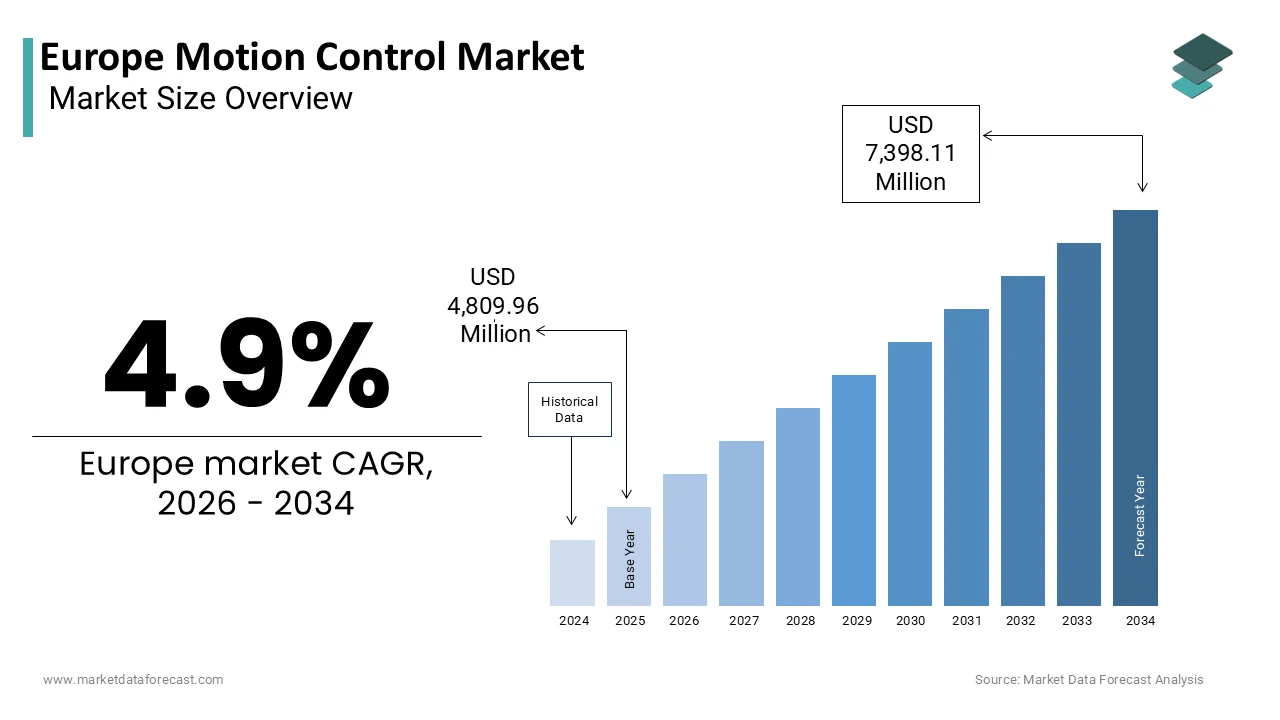
The Europe motion control market was valued at USD 4,809.96 million in 2025, is estimated to reach USD 5,045.65 million in 2026, and is projected to reach USD 7,398.11 million by 2034, expanding at a CAGR of 4.9% from 2026 to 2034.
Market Snapshot
- 2025 Market Size: USD 4,809.96 Million
- 2026 Estimate: USD 5,045.65 Million
- 2034 Forecast: USD 7,398.11 Million
- CAGR (2026–2034): 4.9%
- Largest System Segment: Closed-Loop Systems
- Largest Component Segment: Motors (32.1%)
- Largest End-User: Automotive (28.3%)
- Leading Country: Germany (27.3%)
Quick Growth Drivers
- EU Digital Strategy & Smart Factory expansion
- Electrification of automotive manufacturing
- IE4 & IE5 motor efficiency mandates
- Semiconductor fab expansion under EU Chips Act
- AI-driven predictive maintenance adoption
Principal Restraints
- Semiconductor & IGBT supply bottlenecks
- Rare earth magnet sourcing risks
- Industrial Ethernet protocol fragmentation
- Integration complexity across legacy systems
High-Value Opportunities
- AI-enabled adaptive motion systems
- Digital twin-based motion simulation
- Energy-optimized servo drive upgrades
- Cleanroom-compatible semiconductor motion modules
- Software-defined & interoperable control architectures
Key Market Challenges
- Vendor lock-in due to protocol incompatibility
- High commissioning timelines (3–6 months delays)
- Magnet & power electronics import dependency
- Engineering talent shortages in mechatronics
What Wins Commercially
- IE5 energy-compliant motor systems
- AI-enabled predictive diagnostics
- Multi-protocol interoperability (EtherCAT, PROFINET, OPC UA)
- Digital twin simulation capabilities
- Cleanroom & high-reliability certification
Top Strategic Ask for Executives
- Localize power electronics & magnet sourcing
- Invest in AI-driven adaptive control software
- Expand semiconductor-ready motion portfolios
- Develop open-standard interoperability layers
- Align energy dashboards with EU Taxonomy reporting
Leading Players
Some of the companies that are playing a dominating role in the Europe motion control market include:
- Siemens AG
- ABB Ltd.
- Schneider Electric SE
- Bosch Rexroth AG
- KUKA AG
- Beckhoff Automation GmbH & Co. KG
- Danfoss A/S
Europe Motion Control Market Size
The europe motion control market was valued at USD 4,809.96 million in 2025, is estimated to reach USD 5,045.65 million in 2026, and is projected to reach USD 7,398.11 million by 2034, growing at a CAGR of 4.9% from 2026 to 2034.
The motion control is the design, integration, and deployment of systems that precisely regulate the movement of machinery and automated equipment across industrial, medical, and transportation applications. Core components include servo motors, stepper motors, drives, controllers, feedback devices, and associated software that enable coordinated, high-accuracy motion in robotics, CNC machines, packaging lines, and semiconductor manufacturing tools. The emphasis on energy efficiency, interoperability under industrial communication standards like EtherCAT and PROFINET, and compliance with the EU Machinery Regulation (EU) 2023/1230, which mandates safety-related control functions. According to Eurostat, the European Union’s manufacturing sector invested 287 billion euros in machinery and equipment in 2025, much of it requiring advanced motion control for automation. As per the European Commission’s Digital Europe Programme, over 65% of large industrial facilities now deploy some form of coordinated motion systems to support Industry 4.0 initiatives. Furthermore, the European Environment Agency notes that precision motion control contributes to up to 18% energy savings in automated production lines by minimizing mechanical waste and optimizing motor performance.
MARKET DRIVERS
Industrial Automation and Smart Factory Adoption Under EU Digital Strategy
The European Union’s aggressive push toward smart manufacturing for advanced motion control systems is propelling the growth of Europe's motion control market. The Digital Europe Programme and the EU Industrial Strategy collectively aim to equip 75% of large enterprises with AI, IoT, and robotics by 2030, all of which rely on high-precision motion coordination. According to the European Commission, over 12,000 smart factory projects received public co-funding between 2022 and 2025, with motion control cited as a critical enabler in 89% of cases. Germany’s “Industrie 4.0” platform reports that 71% of automotive and machinery manufacturers have upgraded legacy production lines with servo-driven robotic arms and synchronized conveyor systems to improve throughput and reduce defects. Similarly, France’s “France 2030” plan allocates 5.4 billion euros to robotics and automation, directly stimulating demand for integrated motion solutions. The European Association of Automotive Suppliers notes that electric vehicle assembly requires 30% more coordinated motion axes than conventional vehicles due to battery module handling and precision welding.
Stringent Energy Efficiency and Ecodesign Mandates
Europe’s binding energy regulations are compelling manufacturers to adopt high-efficiency motion control technologies to comply with sustainability targets. The stringent energy efficiency and ecodesign mandates are accelerating the growth of Europe motion control market. The EU Ecodesign Directive for Electric Motors (EU) 2019/1781 mandates IE4 efficiency levels for motors above 75 kW from 2023 and extends to smaller units by 2025, effectively phasing out standard induction motors in favor of servo and permanent magnet systems. According to the European Environment Agency, industrial motors consume 65% of the EU’s total electricity used in manufacturing, making them a focal point for decarbonization. A 2025 study by the Fraunhofer Institute found that replacing conventional drives with closed-loop servo systems in packaging lines reduced energy consumption by 22% without sacrificing speed. Additionally, the EU Taxonomy for Sustainable Activities classifies investments in high-efficiency motion systems as environmentally sustainable, unlocking green financing. Companies like Siemens and ABB now offer “energy dashboards” that quantify CO₂ savings from motion upgrades, aligning technical performance with ESG reporting.
MARKET RESTRAINTS
Supply Chain Volatility for Critical Electronic Components
The persistent shortages and price instability of semiconductors, rare earth magnets, and power electronics are essential for drives and motors. This is one of the major factors hampering the growth of Europe motion control market. The European Semiconductor Alliance reports that lead times for insulated-gate bipolar transistors (IGBTs), key components in servo drives, remained above 40 weeks in 2025 due to concentrated Asian production and export controls. Similarly, neodymium and dysprosium, used in high-performance permanent magnet motors, face supply concentration risks. A 2025 survey by the VDMA (German Engineering Federation) found that 63% of motion control integrators delayed project deliveries due to component unavailability, with costs rising by 18 to 30%. While the EU Chips Act aims to boost domestic semiconductor capacity, power electronics and magnet supply chains remain vulnerable.
Fragmented Industrial Communication Protocols Across Sectors
The lack of universal interoperability standards for motion control systems creates significant integration barriers, which is also degrading the growth of Europe motion control market. While EtherCAT dominates in machine tools and PROFINET in automotive, sectors like food processing and pharmaceuticals often use Modbus TCP or CANopen, requiring costly gateways and custom engineering for cross-platform coordination. According to the European Committee for Standardization, fewer than 40% of motion control vendors support all major industrial Ethernet protocols out of the box, forcing end users to lock into single-vendor ecosystems. A 2025 study by the Technical University of Munich found that protocol fragmentation increased system integration costs and extended commissioning timelines by three to six months. Although the EU’s Common European Data Spaces initiative promotes interoperability, motion control remains excluded fromthe initial scope. Until binding harmonization occurs, perhaps through the upcoming Machinery Regulation Annex,x IoT-enabled motion systems will struggle to achieve seamless plug-and-play functionality across Europe’s diverse industrial landscape.
MARKET OPPORTUNITIES
Integration of AI-Driven Predictive Maintenance and Adaptive Control
The fusion of artificial intelligence with motion control systems is enabling real-time performance optimization and failure prevention, which is contributing to bolstering the growth of Europe's motion control market. Modern controllers now use machine learning algorithms to analyze vibration, current draw, and positional error data to predict bearing wear or misalignment before catastrophic failure. According to a pilot by Bosch Rexroth in a German hydraulic press facility, AI-enhanced motion systems reduced unplanned downtime and extended component life. The European Commission’s Horizon Europe program has funded the “MOTIONAI” consortium to develop self-tuning controllers that adapt to load variations and environmental changes, with trials underway in Dutch packaging plants and Italian textile machinery. These systems also feed data into digital twins for simulation-based optimization.
REPORT COVERAGE
| REPORT METRIC | DETAILS |
| Market Size Available | 2025 to 2034 |
| Base Year | 2025 |
| Forecast Period | 2026 to 2034 |
| Segments Covered | By System, Component, End User, and Region. |
| Various Analyses Covered | Global, Regional, and Country-Level Analysis, Segment-Level Analysis, Drivers, Restraints, Opportunities, Challenges; PESTLE Analysis; Porter’s Five Forces Analysis, Competitive Landscape, Analyst Overview of Investment Opportunities |
| Countries Covered | UK, France, Spain, Germany, Italy, Russia, Sweden, Denmark, Switzerland, Netherlands, Turkey, Czech Republic, Rest of Europe |
| Market Leaders Profiled | |
SEGMENTAL ANALYSIS
By System Insights
The closed-loop motion control systems segment accounted for a significant share of the European motion control market in 2025, with its superior precision, real-time feedback capability, and compliance with stringent industrial safety and quality standards. In high-mix manufacturing environments, such as automotive assembly and semiconductor fabrication, even minor positional errors can lead to costly defects or safety incidents. According to the European Association of Automotive Suppliers, 92% of electric vehicle battery module handling systems now use closed-loop servo control to ensure micron-level accuracy during welding and stacking. Similarly, the European Semiconductor Equipment Association reports that advanced lithography and wafer inspection tools require closed-loop systems with sub-micron repeatability, driving near-universal adoption in cleanroom environments. The EU Machinery Regulation (EU) 2023/1230 further reinforces this trend by mandating performance-monitored safety functions that rely on continuous feedback from encoders and resolvers. As per the VDMA (German Engineering Federation), over 75% of new industrial robots installed in Europe in 2025 integrated closed-loop architectures to meet ISO 10218 safety requirements.
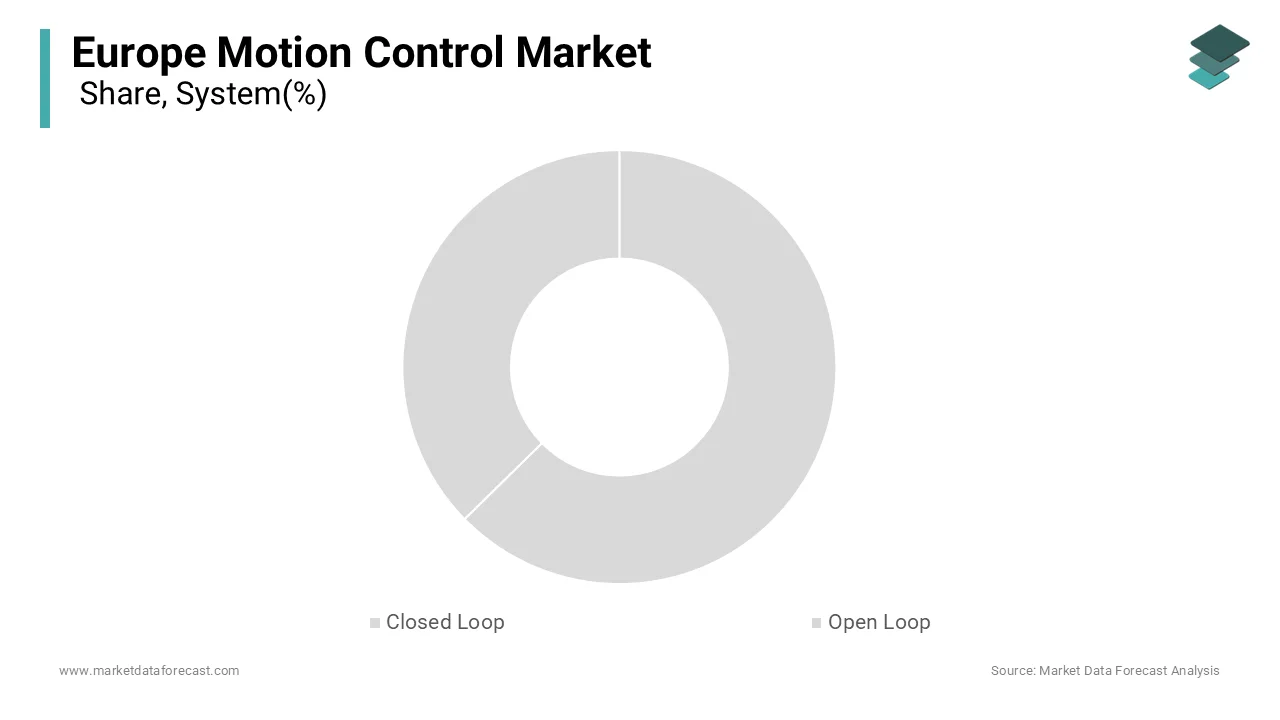
The closed-loop systems segment is expected to grow at the fastest CAGR of 8.9% from 2025 to 2033, owing to the emergence of AI-driven adaptive control, energy efficiency mandates, and the rise of collaborative robotics. Modern closed-loop systems now incorporate machine learning algorithms that adjust torque and speed in real time based on load variations for handling irregular objects in food packaging or delicate components in medical device assembly. According to a 2025 pilot by Siemens in a German pharmaceutical plant, AI-enhanced closed-loop drives reduced energy consumption while maintaining sterility compliance. The EU Ecodesign Directive’s phase-in of IE4 and IE5 motor efficiency classes further favors closed-loop architectures, which optimize power usage through dynamic response rather than fixed-speed operation. Additionally, the European Commission’s Horizon Europe program has funded the “ADAPT-MOTION” initiative to develop self-calibrating closed-loop systems for SMEs, lowering adoption barriers.
By Component Insights
The motors segment was the largest by occupying 32.1% of the European motion control market share in 2025, with the primary actuation source in virtually all automated systems,s from conveyor belts to robotic joints. The shift toward high-efficiency permanent magnet synchronous motors (PMSMs) and servo motors has intensified demand, driven by the EU Ecodesign Directive’s mandate for IE4 efficiency levels across industrial motors. According to the European Environment Agency, industrial motors account for 65% of electricity used in manufacturing, making them a focal point for decarbonization. Germany’s Federal Ministry for Economic Affairs reports that over 450,000 IE4-compliant motors were installed in 2025 alone, primarily in the automotive and machinery sectors. Leading manufacturers like Bosch Rexroth and ABB have localized production of rare-earth-based motors in Eastern Europe to mitigate supply chain risks. Furthermore, the integration of motors with integrated drives and feedback sensors, so-called “smart motors,” enhances system compactness and reduces wiring complexity.
The sensor and feedback devices segment is expected to grow atthea fastest CAGR of 10.3% throughout the forecast period, with the increasing demand for real-time positional accuracy, predictive maintenance, and safety compliance in advanced automation. High-resolution encoders, resolvers, and linear scales are essential for closed-loop systems in semiconductor lithography, surgical robotics, and aerospace actuation applications, where micrometer-level precision is non-negotiable. According to the European Semiconductor Equipment Association, each new EUV lithography tool requires over 200 high-accuracy feedback sensors, creating consistent demand from ASML’s European supply chain. The EU Machinery Regulation’s emphasis on monitored safety functions also mandates redundant feedback for emergency stops and force limiting in collaborative robots. Companies like Heidenhain and Sick have expanded production in Germany and Sweden to meet rising demand for IP67-rated optical encoders. As Industry 4.0 prioritizes data-driven control and zero-failure operations, sensors transition from passive components to intelligent data sources, fueling exceptional growth in this high-value segment.
By End User Insights
The automotive sector was the largest by occupying 28.3% of the European motion control market share in 2025 for premium and electric vehicle manufacturing, with over 15 million vehicles produced annually across Germany, France, and Italy. Modern vehicle assembly requires hundreds of coordinated motion axes for tasks, such as battery module insertion, laser welding, and paint booth robotics, all demanding high-torque servo systems with millisecond response times. The shift to electric vehicles intensifies this need, where EV production lines require 30% more motion control points than internal combustion engine plants due to complex battery and power electronics handling. According to VDA (German Automotive Industry Association), 87% of Tier 1 suppliers in Europe upgraded their assembly lines with closed-loop motion systems in 2025 to meet OEM quality standards.
The semiconductor and electronics sector is projected to expand at a CAGR of 12.6% from 2025 to 2033, with Europe’s strategic push to achieve semiconductor sovereignty under the European Chips Act, which aims to double the continent’s global chip production share to 20% by 2030. Building and operating advanced fabs requires ultra-precise motion control for wafer handling, photolithography, and metrology tasks demanding nanometer-level repeatability and vibration-free operation. According to the European Semiconductor Equipment Association, each new 300mm fab installation requires over 10,000 high-accuracy motion axes, with feedback systems accounting for 40% of the motion control bill of materials. ASML’s expansion in the Netherlands and Intel’s new facilities in Germany and Poland are driving massive demand for vacuum-compatible linear motors and air-bearing stages. The European Commission allocated 6.3 billion euros in public funding for semiconductor infrastructure in 2025 alone, directly stimulating motion control procurement.
COUNTRY LEVEL ANALYSIS
Germany Motion Control Market Analysis
Germany was the top performer of the European motion control market by holding 27.3% of the market share in 2025, with its world-leading machinery and automotive industries. Home to Siemens, Bosch Rexroth,h and Fes, the country sets global benchmarks for industrial automation and precision engineering. According to the VDMA, over 1,200 machinery builders in Germany integrate advanced motion control into their equipment, ent serving global markets. The federal government’s “Industrie 4.0” initiative has accelerated adoption with 78% of large manufacturers deploying synchronized servo systems in 2025. The EU Chips Act further boosts demand as Infineon and Bosch expand semiconductor fabs requiring nanometer-precision motion stages. Germany’s dual vocational training system ensures a steady supply of mechatronics engineers capable of commissioning complex systems.
France Motion Control Market Analysis
The French motion control market was positioned second by accounting for 18.3% of the market share in 2025, with its aerospace leadership and state-backed industrial modernization. Airbus and Safran rely on high-reliability motion systems for wing assembly and engine testing with strict compliance to EN 9100 aerospace standards. According to the French Aerospace Industries Association, over 600 motion control upgrades were implemented in 2025 across Toulouse and Bordeaux facilities to support next-generation aircraft programs. The “France 2030” investment plan allocates some amount to robotics and automation,n including grants for SMEs adopting precision motion technologies. Nuclear energy operator EDF also drives demand for radiation-hardened actuators in reactor maintenance robotics.
Italy Motion Control Market Analysis
Italy's motion control market growth is likely to grow with the specialization in high-precision machinery for packaging, food processing, and textiles. The country hosts over 400 machine builders in the Emilia-Romagna region,n producing automated lines that require synchronized stepper and servo systems for tasks like pasta shaping and bottle labeling. According to UCIMA (Italian Packaging Machinery Association), many Italian packaging machines exported in 2025 featured integrated motion control compliant with the EU Machinery Regulation. The fashion industry also contributes through automated cutting and sewing systems from companies like Lectra.
Netherlands Motion Control Market Analysis
The Netherlands motion control market growth is likely to grow with its role as Europe’s semiconductor epicenter. ASML’s headquarters in Veldhoven drives unparalleled demand for ultra-precise motion systems with sub-nanometer accuracy used in EUV lithography machines. Each ASML tool contains over 500 custom motion axes sourced from Dutch and German suppliers like Technolution and Physik Instrumente. According to the Dutch Semiconductor Equipment Association, the sector generated 18 billion euros in exports in 2025, with motion control as a critical subsystem. The government’s National Growth Fund allocated 2.5 billion euros to high-tech systems development,t reinforcing this niche.
UK Motion Control Market Analysis
The United Kingdom motion control market growth is propelled by the aerospace, defense, and life sciences automation. Rolls-Royce and BAE Systems require fault-tolerant motion systems for jet engine testing and drone assembly governed by the stringent UK Defence Standard 00-56. According to the Society of Motor Manufacturers and Traders, the UK’s growing EV battery gigafactories, including Britishvolt and Envision AESC, deploy thousands of servo axes for electrode stacking and cell formation. The Medicines and Healthcare products Regulatory Agency also drives demand for sterile motion systems in pharmaceutical filling lines.
COMPETITIVE LANDSCAPE
The competition in the European motion control market is characterized by a mix of global industrial giants, specialized European engineering firms,s and emerging technology providers. Dominant players like Sieme, ns Bosch Rexr,oth and ABB leverage scale integration and regulatory expertise to serve large automotive and machinery OEMs across the continent. At the same time, niche vendors such as Kollmorgen and Parker Hannifin differentiate thrultra-high high precision components for semiconductor and medical applications. The market is highly technical with competition centered on accuracy, energy efficiency,y and interoperability rather than price alone. Regulatory alignment with EU directives acts as both a barrier and differentiator, favoring established players with certified product lines. Innovation is increasingly focused on software-defined motion, AI-driven optimization, and sustainable design.
KEY MARKET PLAYERS
Some of the companies that are playing a dominating role in the global Europe motion control market include
- Siemens AG
- ABB Ltd.
- Schneider Electric SE
- Rockwell Automation, Inc.
- Bosch Rexroth AG
- Mitsubishi Electric Corporation
- Yaskawa Electric Corporation
- Fanuc Corporation
- KUKA AG
- Omron Corporation
- Emerson Electric Co.
- Beckhoff Automation GmbH & Co. KG
- Parker Hannifin Corporation
- Yamaha Motor Co., Ltd. (machine automation)
- Danfoss A/S
- Honeywell International Inc.
- Nidec Corporation
- B&R Industrial Automation (a part of ABB)
- Delta Electronics, Inc.
TOP LEADING PLAYERS IN THE MARKET
- Siemens AG is a cornerstone of the European motion control market through its comprehensive portfolio of servo motors, drives, controllers,s and automation software under the Siemens Automation brand. Headquartered in Germany,ny the company integrates motion control into its broader digital enterprise ecosys,tem enabling seamless data flow from design to production. Siemens has strengthened its position by launching the Sinamics S210 servo drive family wbuilt-in AI-basedased diagnostics and IE5 efficiency compliance aligned with EU Ecodesign mandates. The company expanded its digital twin capabilities in NX Mechatronics, allowing engineers to simulate and optimize motion systems before physical deployment. Its deep integration with TIA Portal and support for open industrial protocols like OPC UA ensure interoperability across European manufacturing environments.
- Bosch Rexroth AG plays a pivotal role in the European motion control market by delivering high-precision hydraulic, electric, and linear motion systems for automotive machinery and semiconductor applications. The company’s IndraDrive and MS2N servo platforms are widely adopted in German and French industrial plants for their robustness and energy efficiency. Bosch Rexroth has reinforced its leadership by introducing the ctrlX AUTOMATION platform,m which unifies motion control, PLC, and IoT functions on a single scalable architecture. It launchedAI-poweredered predictive maintenance module that analyzes motor current signatures to forecast bearing failures. Its commitment to open standards and sustainability, including carbon-neutral production in Lohr, Germany, enhances its appeal across regulated European sectors.
- ABB Ltd contributes significantly to theEuropeane motion control market through its advanced robotics and discrete automation solutions featuring integrated servo systems and motion controllers. The company’s Ability platform enables real-time monitoring of motor performance across thousands of axes in automotive and food processing facilities. ABB has strengthened its European footprint by expanding its IE5 ultra-premium efficiency motor range and achieving full compliance with the EU Machinery Regulation 2023/1230. ABB partnered with semiconductor equipment makers in the Netherlands to develop cleanroom-compatible motion modules for wafer handling. Its focus on energy efficiency, digital integration, and sector-specific engineering solidifies its role as a strategic partner for Europe’s advanced manufacturing transformation.
MARKET SEGMENTATION
This research report on the europe motion control market is segmented and sub-segmented into the following categories.
By System
- Closed Loop
- Open Loop
By Component
- Motors
- Actuators & Mechanical Systems
- Motion Controllers
- Sensor & Feedback Devices
- Drives
- Others
By End User
- Automotive
- Food & Beverage
- Semiconductor & Electronics
- Medical, Pharmaceuticals & Cosmetics
- Metal & Machinery Manufacturing
- Aerospace & Defense
- Others
By Country
- Germany
- UK
- France
- Russia
- Spain
- Italy
- Rest of Europe
Frequently Asked Questions
1. What are the key components in the Europe Motion Control Market?
.
Key components in the Europe Motion Control Market include servo motors, stepper motors, AC/DC drives, motion controllers, encoders, and linear actuators. These elements work together to provide accurate feedback and control in automated systems. Software for programming and simulation also plays a vital role in optimizing performance for robotics and machinery applications
2. Which industries drive the Europe Motion Control Market?
The Europe Motion Control Market is primarily driven by industries such as automotive manufacturing, robotics, packaging, aerospace, and machine tools. These sectors rely on precise motion systems to enhance productivity and quality in assembly lines and CNC machines. Emerging applications in electronics and pharmaceuticals further boost adoption.
3. Who are the major players in the Europe Motion Control Market?
Major players in the Europe Motion Control Market include Rockwell Automation, Parker Hannifin, Siemens, ABB, and Yaskawa Europe. These companies lead in developing advanced servo drives, controllers, and integrated solutions tailored for European industrial needs. Innovation in energy-efficient technologies strengthens their positions.
4. What technologies are trending in the Europe Motion Control Market?
Trending technologies in the Europe Motion Control Market include AI integration, IoT connectivity, and advanced robotics for predictive maintenance. EtherCAT and other real-time communication protocols enable seamless multi-axis synchronization. Energy regenerative drives and modular systems support sustainable automation trends.
5. How does automation impact the Europe Motion Control Market?
Automation significantly impacts the Europe Motion Control Market by increasing demand for high-precision systems in smart factories. It enables faster production cycles, reduced downtime, and flexible manufacturing processes. Collaborative robots (cobots) and adaptive control algorithms are key enablers in this shift.
6. What role do servo drives play in the Europe Motion Control Market?
Servo drives are central to the Europe Motion Control Market, providing closed-loop control for high accuracy in speed and position. They integrate with encoders for real-time feedback, ideal for dynamic applications like robotics and CNC. Compact, high-power density designs meet European efficiency standards.
7. Why is Germany leading the Europe Motion Control Market?
Germany leads the Europe Motion Control Market due to its strong automotive and machine-building sectors, coupled with Industry 4.0 leadership. Advanced engineering and R&D investments foster innovation in precision motion technologies. Export-oriented manufacturing amplifies demand for reliable systems.
8. What are motion controllers in the Europe Motion Control Market?
Motion controllers in the Europe Motion Control Market are devices or software that coordinate multiple axes for complex trajectories. They process inputs from sensors and PLCs to execute programmed paths. Programmable logic controllers (PLCs) with motion modules are widely used for scalability.
9. How is Industry 4.0 shaping the Europe Motion Control Market?
Industry 4.0 is shaping the Europe Motion Control Market through cyber-physical systems, digital twins, and edge computing for real-time optimization. Interconnected motion platforms enable predictive analytics and remote monitoring. This fosters resilient, data-driven manufacturing ecosystems.
10. What applications use motion control in Europe Market?
Key applications in the Europe Motion Control Market include robotic arms, conveyor systems, pick-and-place machines, and wind turbine positioning. Medical devices and semiconductor equipment also utilize precise motion for handling delicate processes. Multi-axis synchronization is common in these uses
Related Reports
Access the study in MULTIPLE FORMATS
Purchase options starting from
$ 2000
Didn’t find what you’re looking for?
TALK TO OUR ANALYST TEAM
Need something within your budget?
NO WORRIES! WE GOT YOU COVERED!
Call us on: +1 888 702 9696 (U.S Toll Free)
Write to us: sales@marketdataforecast.com