- Product Description Description
- Table of Contents TOC
- List of Table & Figure LOT
- Get Free Sample PDF Sample PDF
Market Size, 2025
$8.19 BnMarket Estimate, 2026
$9.11 BnMarket Forecast, 2034
$21.44 BnCAGR, 2026–2034
11.29%Europe Brushless DC Motors Market Size, Growth, Trends & Forecast (2026–2034)
The Europe brushless DC motors market size was estimated to be USD 8.19 billion in 2025, is projected to reach USD 9.11 billion in 2026, and is expected to scale up to USD 21.44 billion by 2034, registering a compound annual growth rate (CAGR) of 11.29% during the forecast period from 2026 to 2034. Driven by stringent EU Ecodesign energy efficiency mandates, rapid urban mobility electrification, and widespread industrial automation modernization, brushless DC motors are cementing their role as fundamental enablers of Europe's clean energy and industrial transition.
Key Executive Metrics (At-a-Glance)
- 2025 Base Valuation: USD 8.19 Billion
- 2026 Current Valuation: USD 9.11 Billion
- 2034 Forecast Valuation: USD 21.44 Billion
- Compound Annual Growth Rate (CAGR): 11.29% (2026–2034)
- Dominant Product Type Segment: Inner Rotor Segment
- Fastest-Growing Product Type Segment: Outer Rotor Segment (CAGR of 9.2%)
- Dominant Power Rating Segment: 0 to 750 Watts Segment (49.3% share in 2025)
- Fastest-Growing Power Rating Segment: 750 Watts to 3 kW Segment (CAGR of 8.7%)
- Dominant End-Use Industry Segment: Industrial Machinery Sector (38.2% share in 2025)
- Fastest-Growing End-Use Industry Segment: Healthcare End-Use Segment (CAGR of 10.3%)
- Dominant Regional Market: Germany (24.3% share in 2025)
- Second-Largest Regional Market: France (15.2% share in 2025)
Core Market Drivers
- Urban Mobility Electrification: Rapid shift towards zero-emission transport, light commercial vehicles, and micromobility solutions utilizing compact, high-torque brushless DC motors.
- Strict Industrial Energy Efficiency Regulations: Enforcement of the EU Ecodesign Directive (Commission Regulation EU 2019/1781) compelling the replacement of conventional motors with IE3/IE4 ultra-efficient drive systems.
Primary Market Restraints & Challenges
- High Acquisition Costs & Rare-Earth Supply Volatility: Significant upfront price premiums and heavy reliance on critical raw materials like neodymium, exposing producers to supply chain disruption and high capital entry barriers for SMEs.
- Technical & Skilled Labor Fragmentation: Persistent cross-border standard variations across EU member states and a severe deficit of technicians skilled in power electronics and digital motor control.
Europe Brushless DC Motors Market Classification Breakdown
| Segment Category | Largest (Dominant) Segment | Fastest-Growing Segment |
|---|---|---|
| By Product Type | Inner Rotor | Outer Rotor (CAGR: 9.2%) |
| By Power Rating | 0 to 750 Watts (49.3%) | 750 Watts to 3 kW (CAGR: 8.7%) |
| By End Use Industry | Industrial Machinery (38.2%) | Healthcare (CAGR: 10.3%) |
| By Region | Germany (24.3%) | France / UK / Italy / Sweden |
Major Industry Players Profiled
Key industrial automation leaders, electric drive giants, and precision miniature specialists leading the European brushless DC motors market include ABB, Siemens, Bosch, Nidec, Schneider Electric, Johnson Electric, Maxon Motor, Faulhaber Group, Regal Rexnord, Allied Motion Technologies, Dunkermotoren, Portescap, MinebeaMitsumi, Bühler Motor, and Ametek.
Europe Brushless DC Motors Market Size
The Europe brushless DC motors market size was estimated to be USD 8.19 billion in 2025 and is projected to reach USD 21.44 billion by 2034, growing from USD 9.11 billion in 2026 at a CAGR of 11.29% during the forecast period.
Brushless DC motors are a class of electronically commutated electric motors that leverage permanent magnets and semiconductor switching to deliver high efficiency, precise speed control, and extended operational life. In Europe, these motors have become integral to applications demanding performance, reliability, and energy conservation in industrial automation, electric mobility, and building systems. The architecture of these motors aligns with Europe’s stringent energy efficiency mandates under the Ecodesign Directive, which has progressively tightened minimum performance thresholds for electric motors since 2011. According to Eurostat, industrial electricity consumption across the European Union accounted for approximately 26% of total final electricity use in 2023, underlining the urgency for energy-optimized drive systems. Furthermore, the European Environment Agency states that motor-driven systems consume nearly 65% of industrial electricity, making efficiency upgrades a strategic priority. This regulatory and operational context positions brushless DC motor technology not merely as a component innovation but as a systemic enabler of Europe’s decarbonization and industrial modernization ambitions.
MARKET DRIVERS
Electrification of Urban Mobility Accelerates Brushless DC Motor Adoption
The rapid electrification of urban transportation is solely boosting the growth of Europe brushless DC motors market. Municipal policies prioritizing zero-emission zones and phasing out internal combustion engines have directly stimulated the production of electric two-wheelers, light commercial vehicles, and micromobility solutions. According to the International Energy Agency, over 2.5 million electric light-duty vehicles were registered in Europe in 2023, representing a 25% increase from the previous year. Crucially, many of these vehicles utilize brushless DC motors for traction and auxiliary systems due to their compact form factor, high torque density, and compatibility with battery-powered architectures. In micromobility, over 12 million e-scooters and e-bikes were in active use across the EU by the end of 2023, as per the European Cyclists’ Federation, with more than 90% employing brushless DC motor technology. Urban logistics is also transforming, with companies like Amazon and DHL deploying thousands of electric delivery vans equipped with efficient motor systems. The European Commission’s Alternative Fuels Infrastructure Regulation mandates the deployment of one fast charging point every 60 kilometers on major EU roads by 2026, by creating downstream demand for reliable and efficient motor technologies. This mobility transition, reinforced by binding urban air quality standards under the EU Ambient Air Quality Directives, ensures sustained demand for brushless DC motors across light electric vehicle segments.
Stringent Industrial Energy Efficiency Regulations Drive System Modernization
Europe’s comprehensive regulatory framework mandating energy efficiency in industrial motor systems has significantly intensified the uptake of brushless DC motors in automation and process control applications. The EU Ecodesign Directive, as updated under Commission Regulation EU 2019 1781, requires electric motors between 0.12 and 1000 kilowatts to meet IE3 or IE4 efficiency levels, depending on power rating. Brushless DC motors inherently surpass IE4 thresholds in many applications due to their absence of brush friction losses and superior controllability. According to the European Commission, industrial motor systems account for about 70% of total industrial electricity consumption in the bloc. A study by the Fraunhofer Institute for Systems and Innovation Research revealed that replacing standard induction motors with high-efficiency alternatives such as brushless DC variants in conveyor systems and robotic arms can yield energy savings of 20 to 35%. Germany alone reported over 180000 industrial robot installations in operation by 2023, as stated by the International Federation of Robotics, nearly all of which rely on brushless servo motors for precision motion control. Moreover, the EU’s Industrial Emissions Directive compels large installations to adopt Best Available Techniques, which increasingly include high-efficiency motor drives. These regulatory and operational imperatives compel manufacturers to retrofit legacy systems, thereby establishing brushless DC motors as a cornerstone of Europe’s industrial energy transition.
MARKET RESTRAINTS
High Initial Acquisition Costs Constrain Widespread Deployment
The elevated upfront cost of brushless DC motors to adoption across cost-sensitive sectors in Europe, particularly among small and medium-sized enterprises, is one of the major factors hampering the growth of Europe brushless DC motors market. These motors require sophisticated electronic controllers, rare-earth permanent magnets, and precision manufacturing, all of which contribute to a price premium of 30 to 50% compared to standard AC induction motors of equivalent power rating. As per the German Engineering Federation VDMA, over 60% of European SMEs cite capital expenditure constraints as the primary obstacle to implementing energy-efficient technologies. In agricultural machinery and light industrial equipment, where margins are tight and production cycles are seasonal, the payback period for brushless solutions often exceeds three to five years, deterring investment. While lifecycle cost analyses demonstrate long-term savings, the absence of standardized financing mechanisms or targeted subsidies for motor system modernization at the EU level exacerbates this constraint. Unlike heat pumps or solar panels, brushless DC motors are rarely eligible for national green investment schemes, despite their energy-saving potential. This pricing asymmetry disproportionately affects industries such as food processing and textile manufacturing, where motor systems operate intermittently and financial justification for premium technology becomes more complex.
Supply Chain Vulnerabilities in Rare Earth Materials Disrupt Production Stability
The dependence of brushless DC motors on rare earth elements, such as neodymium and dysprosium, for high-performance permanent magnets exposes European manufacturers to significant supply chain volatility. This factor is also degrading the growth of Europe brushless DC motors market. In 2023, the European Commission identified neodymium as a raw material with a supply risk index of 0.78 on a scale, where 1 denotes extreme vulnerability. Geopolitical tensions and export restrictions, such as China’s 2023 imposition of gallium and germanium controls, have heightened concerns about potential spillover to magnet supply chains. The European Environment Agency notes that permanent magnet motors contain up to 300 grams of rare earth materials per kilowatt of output, making them particularly susceptible to price swings. Between January 2021 and December 2022, neodymium oxide prices surged by over 200% before normalizing, causing significant cost uncertainty for motor producers. Although recycling initiatives are emerging, the Fraunhofer Institute estimates that less than 5% of rare earths in end-of-life products are currently recovered in Europe due to technical and logistical hurdles. This material not only inflates production costs but also complicates compliance with the EU’s upcoming Battery and Critical Raw Materials Acts, which mandate enhanced traceability and circularity.
MARKET OPPORTUNITIES
Expansion of Collaborative Robotics Fuels Niche Motor Demand
The accelerating deployment of collaborative robots, or cobots, across European manufacturing and laboratory environments is attributed to creating new growth opportunities for the brushless DC motors market. Unlike traditional industrial robots, cobots are designed for direct human interaction, necessitating motors that deliver smooth torque control, compact dimensions, and intrinsic safety. Brushless DC motors meet these requirements through low cogging torque, high power density, and precise electronic commutation. The automotive sector leads adoption, where cobots perform tasks such as assembly, quality inspection, and material handling alongside human workers. In pharmaceuticals, the European Medicines Agency reported a 28% increase in automated laboratory workflows between 2021 and 2023, driven by demand for sterile and repeatable process applications, where brushless motors excel due to minimal electromagnetic interference and particle generation. Furthermore, the EU’s Horizon Europe program has allocated over 1.2 billion euros to robotics innovation through 2027, explicitly supporting human-centric automation. This funding ecosystem, combined with labor shortages in skilled manufacturing, where Eurofound estimates a shortfall of 2 million technicians by 2030, creates sustained demand for cobot-integrated motor systems.
Integration into Smart Building HVAC Systems Unlocks Scalable Applications
The modernization of heating, ventilation, and air conditioning systems in commercial and residential buildings is expected to leverage the growth of Europe brushless DC motors market. European building codes, including the revised Energy Performance of Buildings Directive, now mandate continuous monitoring and optimization of energy use in structures over 1000 square meters. Brushless DC motors in electronically commutated fan and pump applications that enable variable speed operation that aligns airflow or water flow precisely with real time demand, thereby reducing energy consumption by 40 to 60% compared to fixed speed alternatives. As per the European Commission, buildings account for 40% of final energy consumption in the EU, with HVAC systems representing nearly half of that load. In 2023, Germany alone retrofitted over 120000 ventilation units with high-efficiency fan motors under its Federal Efficiency Program, with brushless DC technology featured in 75% of upgraded units. The European Heat Pump Association states that more than 80% of new air source heat pumps installed in the Nordics and Benelux regions in 2023 utilized brushless DC compressors for enhanced coefficient of performance. Additionally, the EU’s upcoming Ecodesign requirements for ventilation units, effective 2026, will enforce minimum seasonal energy performance standards that effectively exclude less efficient motor types.
MARKET CHALLENGES
Fragmented Technical Standards Across European Countries Impede Interoperability
The absence of fully harmonized technical and safety standards for motor control systems across European member states introduces complexity and cost inefficiencies for brushless DC motor manufacturers and integrators. This factor is likely to be a challenge for the expansion of Europe brushless DC motors market. While the EU Machinery Directive and Low Voltage Directive provide overarching safety frameworks, specific implementation norms for motor drives vary significantly in countries such as France, Poland, and Greece, particularly concerning electromagnetic compatibility and functional safety protocols. As per the European Committee for Electrotechnical Standardization, over 15 national deviations from IEC 60349 and IEC 61800 standards persisted in 2023, requiring manufacturers to develop region-specific firmware or hardware configurations. This fragmentation increases validation timelines by up to six weeks per market entry, according to a VDMA industry survey involving 87 motor system suppliers. In industrial IoT deployments, where brushless motors interface with diverse control architectures, interoperability gaps can delay automation projects by 15 to 20% on average. The European Commission’s 2023 Single Market Scoreboard reported that the inconsistent application of CE marking requirements for drive systems remains a top barrier to cross-border trade in industrial equipment. Moreover, certification bodies in Southern Europe often impose additional testing for thermal resilience and voltage fluctuation tolerance not mandated in Northern jurisdictions, despite identical grid specifications under EN 50160.
Skilled Workforce Shortage Hinders Installation and Maintenance Capabilities
The shortage of technicians trained in power electronics and digital motor control systems, with the operational deployment and serviceability, is additionally hampering the growth of Europe brushless DC motors market. Unlike conventional AC motors, brushless variants require specialized knowledge for programming, diagnostics, and troubleshooting due to their integrated drive electronics and communication protocols, such as CANopen or EtherCAT. According to Eurofound, the EU faces a deficit of over 700000 automation and mechatronics technicians by 2026, with manufacturing hubs in Italy, Spain, and Eastern Europe reporting vacancy rates exceeding 30% in relevant engineering roles. Vocational training programs remain misaligned with industry needs, as the European Centre for the Development of Vocational Training observed that fewer than 25% of technical curricula in 2023 included modules on modern motor drive systems. This skills gap manifests in extended commissioning times. Industry data from the German Electrical and Electronic Manufacturers’ Association shows that motor system installations with brushless drives take 22% longer to commission than traditional setups due to controller tuning complexities. Furthermore, unplanned downtime increases when local service teams lack diagnostic tools or firmware update capabilities, reducing end-user confidence in adopting advanced motor technologies. Although initiatives like the EU Pact for Skills aim to bridge this divide, the pipeline of qualified personnel remains insufficient to support the projected 12% annual growth in automated equipment requiring brushless motor integration.
REPORT COVERAGE
| REPORT METRIC | DETAILS |
| Market Size Available | 2025 to 2034 |
| Base Year | 2025 |
| Forecast Period | 2026 to 2034 |
| CAGR | 11.29% |
| Segments Covered | By Product Type, Power Rating, End Use Industry, And Region |
| Various Analyses Covered | Global, Regional & Country Level Analysis; Segment-Level Analysis; DROC, PESTLE Analysis; Porter’s Five Forces Analysis; Competitive Landscape; Analyst Overview of Investment Opportunities |
| Regions Covered | UK, France, Spain, Germany, Italy, Russia, Sweden, Denmark, Switzerland, Netherlands, Turkey, and the Czech Republic |
| Market Leaders Profiled | ABB, Siemens, Bosch, Nidec, Schneider Electric, Johnson Electric, Maxon Motor, Faulhaber Group, Regal Rexnord, Allied Motion Technologies, Dunkermotoren, Portescap, MinebeaMitsumi, Bühler Motor, Ametek |
SEGMENTAL ANALYSIS
By Product Type Insights
The inner rotor segment was the largest by capturing a dominant share of the Europe brushless DC motors market in 2025 with their superior thermal management, higher rotational speeds, and compatibility with high precision applications, such as robotics and CNC machinery. The widespread adoption in industrial automation, where inner rotor motors deliver the torque consistency and positional accuracy required for servo applications. As per the International Federation of Robotics, Europe installed over 210000 industrial robots in 2023, with Germany alone accounting for 35% of these installations. Nearly all modern industrial robots utilize inner rotor brushless DC motors in their joint actuators due to their low moment of inertia and rapid acceleration capabilities. The high-speed spindle requirements in precision manufacturing are also escalating the growth of Europe brushless DC motors market. In metalworking and electronics assembly, spindle speeds exceeding 20000 revolutions per minute are increasingly common.
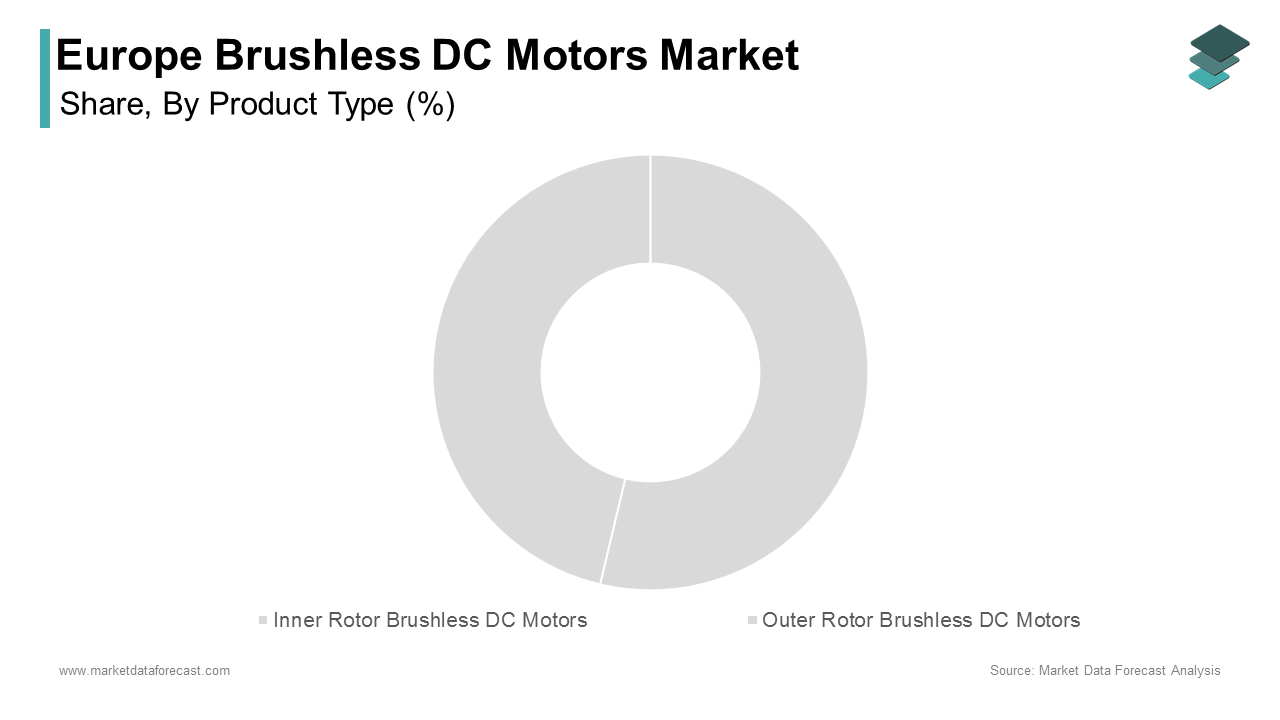
The outer rotor segment is expanding at the fastest CAGR of 9.2% during the forecast period. The growth of the segment is primarily driven by the rising demand in direct drive applications, such as ceiling fans, HVAC blowers, and wheel electric motors for micromobility. Unlike inner rotor variants, outer rotor designs position the rotating magnetic field on the exterior by enabling higher torque at lower speeds without the need for gearboxes, with an advantage in noise-sensitive and space-constrained environments. The transformation of residential and commercial ventilation systems, under the revised Energy Performance of Buildings Directive, is also leveraging the growth of Europe brushless DC motors market. Outer rotor motors are inherently suited for fan applications due to their large diameter and direct coupling with impellers. The Danish Technological Institute reports that these motors reduce fan energy consumption by up to 55% compared to shaded pole alternatives, accelerating retrofits in Nordic housing stocks.
By Power Rating Insights
The 0 to 750 Watts power rating segment was the largest by capturing 49.3% of the Europe brushless DC motors market share in 2025, with the ubiquitous presence in consumer appliances, small industrial automation modules, and light electric vehicles, where compact size, low noise, and energy efficiency are paramount. The proliferation of smart home appliances across Western and Northern Europe. Brushless DC motors in this power range are standard in washing machines, refrigerators, and vacuum cleaners due to their precise speed control and reduced acoustic emissions. The Swiss Federal Office of Energy notes that brushless DC compressors in refrigerators cut annual electricity use by 25 to 30% compared to conventional induction motors, reinforcing consumer and manufacturer preference. The expansion of collaborative robotics and laboratory automation is also expected to leverage the growth of Europe's brushless DC motors market. Cobots used in electronics assembly and pharmaceutical packaging typically employ motors under 500 Watts to ensure safe human interaction and fine motion control. In diagnostic labs, automated sample handlers from companies like Roche and Siemens Healthineers rely on 200 to 400 Watt brushless motors for pipetting and carousel rotation applications, demanding repeatability and contamination-free operation.
The 750 Watts to 3 kW power rating category segment is likely to witness the fastest CAGR of 8.7% from 2026 to 2034, with the gap between low-power consumer devices and heavy industrial machinery, making it pivotal for electric mobility and mid-scale automation. The surge in light commercial electric vehicles, including delivery vans and last-mile cargo bikes, is also expected to boost the growth of the segment. These vehicles require motors in the 1 to 3 kW range for efficient urban operation with adequate payload capacity. As per the European Automobile Manufacturers’ Association, over 420000 light commercial electric vehicles were registered in the EU in 2023, a 31% increase from 2022. Companies like Stellantis and Ford now equip their electric Transit and Berlingo models with 2.5 kW brushless traction motors optimized for stop-and-go city driving. The modernization of factory conveyor and material handling systems is also elevating the growth of Europe brushless DC motors market. Medium-sized automated guided vehicles and pallet shuttles increasingly adopt 1.5 to 2.8 kW brushless motors for their balance of torque and controllability.
By End Use Industry Insights
The industrial machinery sector accounted in holding 38.2% of the Europe brushless DC motors market share in 2025, with the ongoing deployment of industrial robots in discrete and process manufacturing. Brushless DC motors serve as the core actuation technology in robotic joints, CNC spindles, and pick and place systems due to their high dynamic response and maintenance-free operation. The International Federation of Robotics confirms that Europe hosted over 550000 operational industrial robots by the end of 2023, with annual installations growing at 7%. Germany, Italy, and Sweden together accounted for 60% of new deployments, primarily in automotive and machinery production. Brushless DC motors in this sector routinely achieve efficiency levels above 90%, far exceeding standard induction motors. A 2023 study by the Fraunhofer Institute demonstrated that replacing legacy motors with brushless alternatives in injection molding machines reduced energy use by 22% without sacrificing cycle time.
The healthcare end-use segment is likely to register the fastest CAGR of 10.3% from 2026 to 2034 with the proliferation of minimally invasive surgical robots. These systems rely on sub 200-Watt brushless DC motors for articulating end effectors with micron-level accuracy and zero backlash. Companies like Medtronic and CMR Surgical deploy dozens of miniature brushless motors per unit, with sterility and reliability non-negotiable. The modernization of diagnostic imaging and laboratory automation is also fuelling the growth of Europe brushless DC motors market. MRI table positioners, CT gantry drives, and automated blood analyzers all utilize brushless motors for silent, vibration-free operation.
REGIONAL ANALYSIS
Germany Brushless DC Motors Market Analysis
Germany was the top performer of the Europe brushless DC motors market by holding 24.3% of the market share in 2025 with its world-leading machinery and automotive manufacturing base, which demands high-performance, reliable motor systems for automation and electric drivetrains. Germany operates over 180000 industrial robots as per the International Federation of Robotics, the highest density globally, with nearly all utilizing brushless servo motors. The automotive sector alone accounts for 32% of domestic motor demand, driven by the electrification strategies of Volkswagen, BMW, and Mercedes-Benz. In 2023, Germany produced over 450000 battery electric vehicles, each incorporating multiple brushless motors for pumps, fans, and auxiliary drives. Furthermore, the federal government’s Industrie 4.0 initiative has accelerated the adoption of smart factories, where precise motion control is essential.
France Brushless DC Motors Market Analysis
France was positioned next to Germany with 15.2% of the Europe brushless DC motors market share in 2025, owing to its diversified industrial base and aggressive public investment in green mobility and aerospace. According to France Industries, the national manufacturing council, the country produced over 180000 electric vehicles in 2023, including passenger cars and light commercial vans from Stellantis and Renault. Each vehicle integrates 5 to 8 brushless DC motors for thermal management and powertrain support systems. The aerospace sector, centered in Toulouse, further bolsters demand through actuators and fuel pumps in next-generation aircraft like the Airbus A320neo family. The French Environment and Energy Management Agency reports that over 40% of new HVAC installations in non-residential buildings in 2023 used brushless DC fan motors to comply with updated thermal regulations. Additionally, the government’s France 2030 investment plan allocates 8 billion euros to robotics and automation, directly stimulating motor demand in logistics and food processing.
United Kingdom Brushless DC Motors Market Analysis
The United Kingdom's brushless DC motors market growth is likely to grow with its advanced healthcare technology sector and growing focus on energy-efficient building systems. According to the Office for National Statistics, the UK’s medical technology exports reached 8.2 billion pounds in 2023, with companies like Oxford Instruments and Smith & Nephew relying heavily on miniature brushless motors for surgical and diagnostic devices. The UK’s updated Building Regulations Part L mandate significant reductions in non-domestic energy use, which is driving the replacement of legacy fan motors with brushless DC variants in ventilation units.
Italy Brushless DC Motors Market Analysis
Italy's brushless DC motors market growth is driven by its specialization in textile machinery automation and high-end consumer appliances. In industrial textiles, companies like Itema and Santoni deploy brushless motors in high-speed weaving and knitting machines, where torque ripple must be minimized to prevent yarn breakage. Confindustria notes that Italy exported 4.3 billion euros worth of automated textile equipment in 2023, much of it featuring integrated brushless drive systems. Moreover, the southern regions are experiencing a surge in food and beverage automation, with over 1200 packaging lines modernized in 2023, according to Federalimentare. This blend of consumer and niche industrial demand, rooted in artisanal manufacturing heritage, secures Italy’s steady contribution to the regional market.
Sweden Brushless DC Motors Market Analysis
Sweden's brushless DC motors market growth is likely to grow with sustainable industrial innovation and clean technology. According to the Swedish Energy Agency, over 96% of the country’s electricity comes from low-carbon sources, enabling manufacturers to prioritize high-efficiency motor systems without grid constraints. ABB Robotics, headquartered in Vasteras, alone accounts for a significant portion of domestic brushless motor consumption through its global robot shipments. Additionally, Sweden’s commitment to fossil-free transportation has spurred the development of electric buses and trucks, with Scania and Volvo integrating 2 to 5 kW brushless motors in auxiliary systems.
COMPETITION OVERVIEW
The Europe brushless DC motors market features intense competition characterized by a blend of global industrial giants and specialized European engineering firms. Established players like ABB Siemens and Bosch Rexroth dominate high-power industrial applications through vertically integrated automation ecosystems, while niche manufacturers such as Maxon and FAULHABER lead in precision miniature motors for medical and aerospace sectors. Competition centers on technological differentiation, energy efficiency, compliance, and digital service capabilities rather than price alone. Continuous innovation in motor control algorithms, thermal management, and material science defines market leadership. Regulatory alignment with EU sustainability directives acts as both a barrier to entry and a catalyst for incumbents to refine their offerings. The market also sees growing collaboration between motor suppliers and software platforms to deliver intelligent motion solutions by accelerating the convergence of hardware and digital services across industrial and mobility domains.
KEY MARKET PLAYERS
A few major players of the Europe brushless DC motors market include
- ABB
- Siemens
- Bosch
- Nidec
- Schneider Electric
- Johnson Electric
- Maxon Motor
- Faulhaber Group
- Regal Rexnord
- Allied Motion Technologies
- Dunkermotoren
- Portescap
- MinebeaMitsumi
- Bühler Motor
- Ametek
Top Strategies Used by the Key Market Participants
Key players in the Europe brushless DC motors market prioritize product innovation through the development of high-efficiency IE4 and IE5 rated motors compliant with Ecodesign regulations. They invest heavily in digital integration by embedding IoT connectivity and predictive maintenance features into motor drives. Strategic partnerships with automation system integrators and robotics OEMs enable co-engineered solutions tailored to end-user needs. Companies are also localizing production and service networks across Western and Northern Europe to ensure supply chain resilience and rapid technical support. Additionally, they focus on material diversification to reduce reliance on rare earth elements and mitigate geopolitical supply risks while advancing circular economy initiatives through motor remanufacturing and recycling programs.
Leading Players in the Europe Brushless DC Motors Market
- ABB is a pivotal participant in the Europe brushless DC motors market with deep integration across industrial automation and robotics. The company leverages its advanced motion control technologies to deliver high-precision brushless motors for manufacturing and logistics applications. In recent years, ABB has intensified its focus on energy-efficient motor systems, aligning with EU Ecodesign mandates. The company launched its latest generation of servo motors in early 202,4 featuring enhanced thermal stability and digital twin compatibility, enabling predictive maintenance. These innovations reinforce ABB’s position in smart factory ecosystems across Germany, Sweden, and Italy while supporting its broader global portfolio in electrification and automation solutions that serve over 100 countries.
- Siemens plays a crucial role in advancing brushless DC motor adoption through its drive technology and digital automation platforms. The company integrates these motors into its Simotics and Sinamics product families, which are widely deployed in European industrial and building infrastructure. Siemens has recently expanded its motor portfolio with IE5 efficiency-rated brushless variants supporting the EU’s push for ultra-high efficiency systems. In 2023, Siemens inaugurated a new eMobility component testing center in Germany dedicated to validating auxiliary drive motors for electric vehicles. This facility accelerates development cycles and ensures compliance with evolving European safety and performance standards. Siemens continues to strengthen its global footprint by embedding brushless motor intelligence into its Xcelerator digital ecosystem, serving industries worldwide.
- Maxon Motor has established itself as a specialist in high-performance miniature brushless DC motors essential for medical robotics, aerospace, and precision automation. Headquartered in Switzerland, the company supplies mission-critical actuators to European surgical robot developers and satellite system integrators. Maxon’s recent strategic emphasis centers on sustainability and miniaturization with the 2025 introduction of a rare-earth-reduced motor platform using alternative magnetic materials. The company also expanded its production capacity in Sachseln to meet rising demand from the healthcare and defense sectors. Maxon’s motors are integral to space missions, including European Space Agency projects, underscoring its technical leadership.
MARKET SEGMENTATION
This research report on the Europe brushless DC motors market has been segmented and sub-segmented based on product type, power rating, end-use industry, and region.
By Product Type
- Inner Rotor Brushless DC Motors
- Outer Rotor Brushless DC Motors
By Power Rating
- 0-750 Watts
- 750 Watts to 3 kW
- 3 kW-75 kW
- Above 75 kW
By End Use Industry
- Industrial Machinery
- Automotive
- Consumer Electronics
- Healthcare
- Aerospace and Defense
- Others
By Region
- UK
- France
- Spain
- Germany
- Italy
- Russia
- Sweden
- Denmark
- Switzerland
- Netherlands
- Turkey
- Czech Republic
- Rest of Europe