- Product Description Description
- Table of Contents TOC
- List of Table & Figure LOT
- Get Free Sample PDF Sample PDF
Market Size, 2025
$5.87 BnMarket Estimate, 2026
$6.06 BnMarket Forecast, 2034
$7.79 BnCAGR, 2026–2034
3.20%Executive Summary: European Mushroom Cultivation Market
- Market Scope: Comprehensive regional assessment of the European mushroom cultivation sector, covering standard white button varieties, specialty mushrooms, circular agricultural methods, and country-level production dynamics.
- Market Valuation: Valued at USD 5.87 billion in 2025, reaching USD 6.06 billion in 2026, and projected to scale up to USD 7.79 billion by 2034, expanding at a steady CAGR of 3.20% from 2026 to 2034.
- Primary Growth Drivers: Escalating consumer preference for plant-based and functional health foods, integration of circular agriculture and agro-industrial waste valorization policies, and regulatory approvals for mycelium-derived alternative proteins.
Key Market Segment Metrics (2026–2034)
| Category | Leading Segment (2025 Position) | Fastest-Growing Segment |
|---|---|---|
| By Mushroom Type | Button mushroom segment (captured a major 62.4% share in 2024, deeply integrated into mainstream retail supply chains and processed foods) | Oyster mushroom segment (anticipated to witness the fastest CAGR of 11.7%, driven by plant-based protein demand and culinary versatility) |
| By Cultivation Practice | Climate-regulated indoor farming (maintaining continental dominance via Phase III compost systems and year-round sterile environments) | Closed-loop circular and vertical urban farming (surging via waste valorization and energy-efficient heat exchange tech) |
| By Application | Fresh culinary retail market (anchoring the largest share across supermarket chains and institutional food services) | Mycelium-derived alternative protein & nutraceuticals (growing fast under EU Novel Food frameworks) |
| By Country / Region | Poland (led the regional market with a 28.6% share in 2024 through cost-efficient large-scale operations and exports) and the Netherlands (19.3%) | United Kingdom & Western Europe (accelerating via sustainable protein innovations and urban vertical farming programs) |
Major Market Players & Market Structure
Market Structure: Highly competitive European market featuring large integrated producers commanding scale advantages in button mushroom compost, alongside agile regional growers targeting gourmet varieties, organic certifications, and biotech alternative protein innovations.
Key Companies: Italian (Italy), Mushroom SAS (Italy), Monaghan Mushrooms (Ireland), Walsh Mushrooms Group (Ireland), Rheinische Pilz Zentrale GmbH (Germany), Mycelia (Belgium), and Smithy Mushrooms Ltd. (UK).
 Download Free Sample Report
Europe Mushroom Cultivation Market Size
The European mushroom cultivation market was valued at USD 5.87 billion in 2025 and is anticipated to reach USD 6.06 billion in 2026 from USD 7.79 billion by 2034, growing at a CAGR of 3.20% during the forecast period from 2026 to 2034.
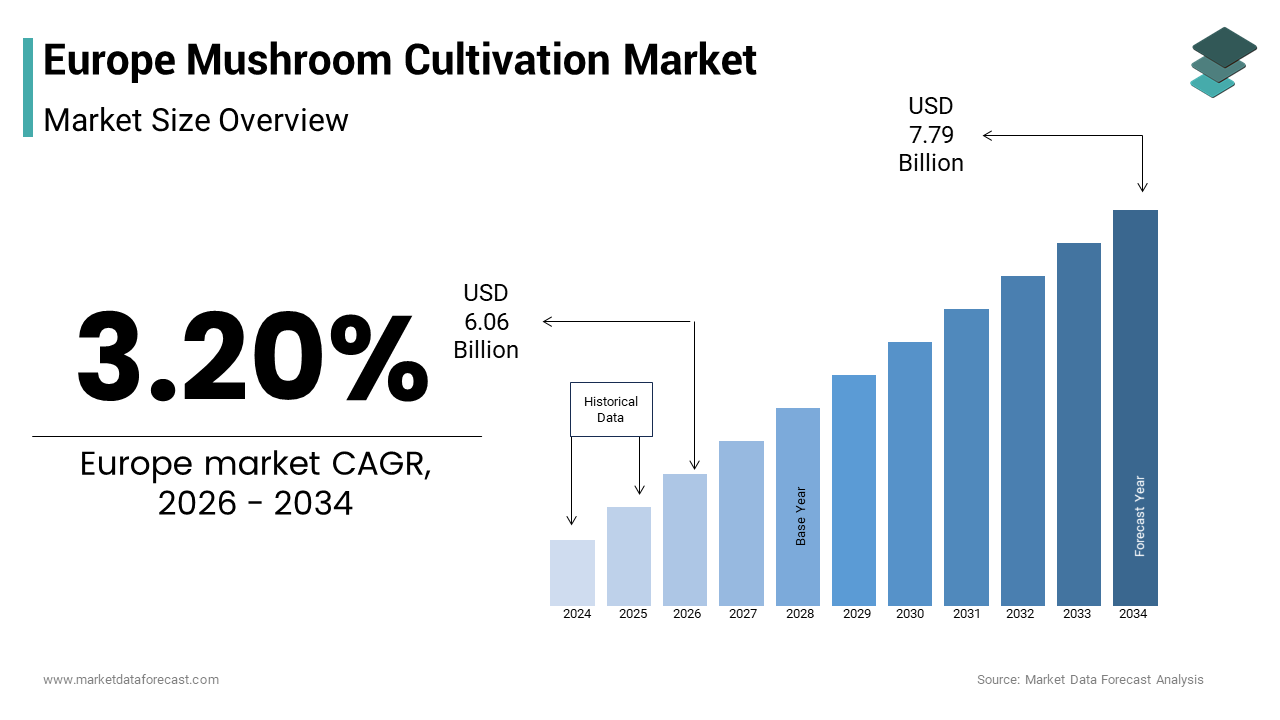
Mushroom Cultivation refers to edible fungi, primarily white button, oyster, shiitake,ke, and specialty varieties, climate-regulated indoor facilities across the continent. Unlike field crops, mushroom farming operates year-round in sealed environments using sterilized substrates such as composted wheat straw or sawdust inoculated with mycelium. As per the European Food Safety Authority, mushrooms are classified as a low-risk food category with minimal pesticide residues due to their substrate-based growth, which aligns with consumer demand for clean-label produce. The European Commission’s Farm to Fork Strategy has further incentivized circular agricultural models, and mushroom cultivation exemplifies this through the use of agro-industrial byproducts like coffee grounds and cereal husks as growth media. Apart from these, the European Union’s Novel Food Catalogue includes mycelium-derived ingredients, opening regulatory pathways for next-generation fungal proteins. These ecological and regulatory dynamics position mushroom cultivation not only as a food production system but as a pillar of sustainable bioeconomy innovation in Europe.
MARKET DRIVERS
Rising Consumer Preference for Plant-Based and Functional Foods
European consumers are increasingly adopting diets centered on plant-derived nutrition and functional health benefits, which surges the growth rate of the European mushroom cultivation market. According to research, a portion of adults in Western Europe actively seek foods with immune-boosting or gut health properties, and mushrooms are rich in beta-glucans, ergothioneine, and prebiotic fiber. Furthermore, as per sources, mushrooms are a source of bioavailable vitamin D2 when UV-exposed, with clinical trials at the University of Surrey confirming that a single serving can provide 100 percent of the daily requirement. This convergence of nutritional science, dietary shifts, and retail innovation sustains robust demand for both culinary and functional mushroom varieties.
Integration of Circular Agriculture and Waste Valorization Policies
It aligns intrinsically with the European Union’s circular economy objectives by transforming agricultural and food processing waste into high-value food, which further fuels the expansion of the European mushroom cultivation market. As per studies, the use of agricultural residues like cereal straw and spent coffee grounds as low-cost substrates is increasing in the EU mushroom industry, in line with circular economy principles. The Netherlands leads in this domain with a portion of commercial mushroom growers using compost blends containing recycled bakery waste and cocoa husks, as per sources. Besides, spent mushroom compost is repurposed as an organic soil conditioner with significant tons reused annually in horticulture, according to research. These systemic synergies position mushroom farming as a model of resource efficiency within the EU’s green transition.
MARKET RESTRAINS
Stringent Biosecurity and Contamination Control Requirements
It is highly vulnerable to microbial contamination, which restrains the growth of the European mushroom cultivation market. This is due to the sterile conditions required for mycelium growth, and European regulations impose rigorous hygiene protocols that increase operational complexity. Compliance costs are substantial, with Dutch growers reporting notable annual expenditures per facility on air filtration and sanitation, as per studies. Furthermore, outbreaks of Dry bubble disease, caused by Verticillium fungicola, are a well-documented pathogen in mushroom cultivation and are a concern for Belgian food producers, according to sources. Unlike open field crops, mushrooms cannot be treated with conventional fungicides post-contamination, making prevention the only viable strategy. These biological and regulatory constraints create significant barriers to entry and scalability, particularly for small producers lacking capital for advanced climate control systems.
Volatility in Substrate Raw Material Availability and Pricing
The economic viability of mushroom farming in the region also affects the expansion of the European mushroom cultivation market. It is heavily dependent on consistent access to affordable agricultural byproducts such as wheat straw, raw poultry manure, and cottonseed hulls, which are subject to supply chain fluctuations. According to sources, the price of wheat straw in the EU experienced volatility between 2020 and 2023, driven by competition from bioenergy and livestock sectors. Furthermore, the war in Ukraine disrupted sunflower hull imports used in Eastern European substrate blends, causing Polish growers to reformulate media at added cost. As per the European Compost Network confirmed in 2023, only a portion of member states have formal agreements ensuring priority access to agro waste for food production over energy use. When mushroom farms lack a reliable supply of substrate, they experience fluctuating input costs and product inconsistencies, directly eroding both yield and profitability.
MARKET OPPORTUNITIES
Expansion into Mycelium-Based Alternative Protein and Food Ingredients
The regulatory approval and commercial scaling of mycelium-derived ingredients give a new opportunity for the European mushroom cultivation market. As per the European Commission in 2024, mycoprotein from Fusarium venenatum (strain NRRL 22628) was classified as a traditional food. Companies have secured EFSA safety opinions enabling product launches across the EU. According to research, Mycelium-based protein production has demonstrated environmental benefits, including reduced land and water usage and a lower carbon footprint compared to animal protein sources. Investment is accelerating. Traditional mushroom farms are repurposing idle growing rooms for liquid state fermentation, creating new revenue streams. This pivot leverages existing fungal expertise while aligning with the EU’s target.
Development of Climate Resilient and Energy Efficient Cultivation Technologies
Advancements in low-energy mushroom farming systems offer growth prospects for the expansion of the European mushroom cultivation market. This is done by reducing dependence on fossil fuel-based climate control. However, innovations such as geothermal heat exchange and phase change materials are cutting energy demand, as per research. The Netherlands has pioneered closed-loop water recycling in compost preparation, reducing freshwater use by 75 percent per cycle, according to Wageningen Environmental Research. In Sweden, mushroom farms are coupling production with district heating networks using waste heat from urban systems. These technologies not only lower operational costs but also qualify for green subsidies under the EU Taxonomy for Sustainable Activities, enabling long-term competitiveness in a carbon-constrained economy.
MARKET CHALLENGES
Labor Intensity and Workforce Shortages in Harvesting Operations
Mushroom harvesting remains predominantly manual, which challenges the growth of the European mushroom cultivation market. This is due to the delicate nature of fruiting bodies and the need for selective picking based on cap maturity. Attempts at mechanization have been limited as robotic grippers struggle with variable mushroom shapes and densities, a challenge. Furthermore, the EU’s Seasonal Workers Directive restricts non-EU labor recruitment in several member states, reducing access to traditional migrant workforces from Eastern Europe and North Africa. The sector's economic sustainability is threatened by rising labor costs and stagnating productivity, a problem that will persist absent breakthroughs in soft robotics or standardized modular growing systems.
Competition from Low-Cost Imports and Price Burden in Retail Channels
The intensifying competition from imports, particularly from China and Eastern Europe, where production costs are significantly lower, holds back the expansion of the European mushroom cultivation market. According to sources, the European Union imported approximately 26,475 metric tons (or 26,474,600 kg) of fresh or chilled mushrooms in 2023. These imports often enter at prices below domestic wholesale rates, as per studies. Retailers under margin burden increasingly favor cheaper alternatives, with discount chains sourcing a portion of button mushrooms from non-EEU suppliers. "Inconsistent enforcement of EU phytosanitary rules, which require traceability and residue testing, has created an environment where fraud can thrive. This import influx suppresses farm gate prices, making it difficult for local growers to invest in sustainability or innovation despite consumer preference for regional produce. The domestic industry will face a gradual decline unless origin labeling is enforced more strongly and tariffs are adjusted.
REPORT COVERAGE
| REPORT METRIC | DETAILS |
| Market Size Available | 2025 to 2034 |
| Base Year | 2025 |
| Forecast Period | 2026 to 2034 |
| CAGR | 3.20% |
| Segments Covered | By Type and Country |
| Various Analyses Covered | Regional & Country Level Analysis, Segment-Level Analysis, DROC, PESTLE Analysis, Porter’s Five Forces Analysis, Competitive Landscape, Analyst Overview of Investment Opportunities |
| Regions Covered | UK, France, Spain, Germany, Italy, Russia, Sweden, Denmark, Switzerland, Netherlands, Turkey, Czech Republic, and the Rest of Europe |
| Market Leaders Profiled | Italian (Italy), Mushroom SAS (Italy), Monaghan Mushrooms (Ireland), Walsh Mushrooms Group (Ireland), Rheinische Pilz Zentrale GmbH (Germany), Mycelia (Belgium), Smithy Mushrooms Ltd. (UK). |
SEGMENTAL ANALYSIS
By Type Insights
The button mushroom segment dominated the European Mushroom Cultivation Market and captured a 62.4% share in 2024. The dominance of the button mushroom segment is mainly because of its deep integration into mainstream European cuisine retail supply chains and institutional food service. As per sources, significant metric tons of button mushrooms were produced in the EU with consistent year-round availability due to highly optimized indoor cultivation protocols. The segment benefits from standardized growing techniques using Phase III compost, which achieves yields of notable kilograms per square meter, as per studies. Retailers favor button mushrooms for their uniform size, shelf stability, and consumer familiarity with major chains like Carrefour and Tesco, dedicating prime shelf space across all store formats. Its neutral flavor also makes it ideal for processed foods such as soups, sauces, and frozen meals. These structural advantages ensure continued market dominance.
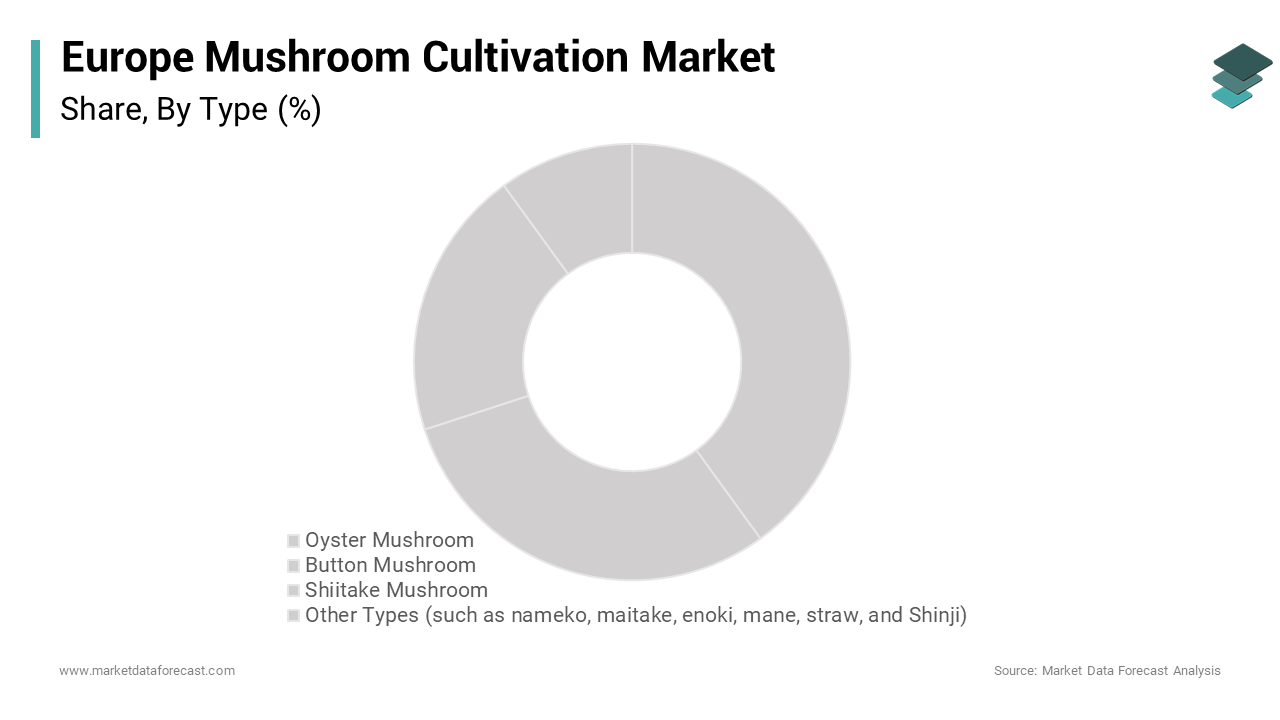
The oyster mushroom segment is anticipated to witness the fastest CAGR of 11.7% share in 2024. The swift expansion of the oyster mushroom segment is driven by rising demand for sustainable protein sources and culinary versatility among health-conscious consumers. Urban farms have scaled oyster production using vertical racks and coffee ground substrates, achieving harvest cycles, as per sources. Retail innovation has also played a role with plant-based meat brands incorporating oyster mushroom mycelium into sausages and nuggets available in stores. These nutritional, ecological, and commercial tailwinds position oyster mushrooms as the highest growth category.
COUNTRY ANALYSIS
Poland Mushroom Cultivation Market Analysis
Poland outperformed other regions in the European Mushroom Cultivation Market by holding 28.6% of the regional market in 2024. Cost-efficient large-scale operations and strategic export orientation are among the key accelerators of Poland's dominance of Poland. According to studies, the country harvested large metric tons of mushrooms, primarily button and oyster varieties, destined for Germany, France, and the United Kingdom. Polish farms benefit from access to abundant cereal straw and poultry manure, enabling low substrate cost, while EU structural funds have modernized a portion of growing facilities, as per the sources. The sector employs people in rural regions where alternative agricultural opportunities are limited. Besides, Poland hosts Europe’s largest mushroom compost production, er supplying sterilized substrate to many countries. Poland’s combination of scale logistics and EU integration ensures its continued dominance in continental supply.
Netherlands Mushroom Cultivation Market Analysis
The Netherlands is the second largest in theEuropeane Mushroom Cultivation Market by accounting for 19.3% share in 2024. The growth of the Netherlands is fuelled by technological sophistication and circular production models. As per research, the country produced notable metric tons with a notable share of farms using climate-controlled systems that minimize contamination and maximize yield. Dutch growers lead in sustainability. The Netherlands is also a hub for innovation, hosting the world’s first mycelium-based food pilot plant. Export remains vital. These advances position the Netherlands as Europe’s technology and sustainability benchmark in fungal agriculture.
Italy Mushroom Cultivation Market Analysis
Italy is witnessing moderate growth in the European Mushroom Cultivation Market, with strong domestic consumption and specialty variety production. The country produces significant metric tons annually, with Emilia Romagna and Lombardy serving as key clusters integrating mushroom farms with cheese and cured meat supply chains. Italy also leads in organic mushroom certification with a portion of its cultivated area under EU organic standards, as per studies. Urban initiatives have spurred micro farms producing oyster and lion’s mane mushrooms for high-end restaurants, with sales growing. These cultural and agronomic factors sustain Italy’s robust and diversified market presence.
France Mushroom Cultivation Market Analysis
France expanded gradually in the European Mushroom Cultivation Market, with demand shaped by gastronomic heritage and public health nutrition policies. French consumers rank mushrooms among the top five vegetables for weekly consumption,n with a portion citing umami flavor and low calorie content as key motivators, according to sources. The national PNNS nutrition program promotes mushrooms as meat substitutes in school canteens, with institutions incorporating them into menus reaching a large number of children annually, as per studies. Besides, France leads in agroecological integration. The government’s Ecophyto Plan also restricts chemical disinfectants, favoring biocontrol agents, which have increased production costs but enhanced organic certification rates. These cultural and regulatory dynamics support steady market growth.
United Kingdom Mushroom Cultivation Market Analysis
The United Kingdom is predicted to grow in the European Mushroom Cultivation Market from 2025 to 2033, owing to innovation in alternative proteins and urban agriculture. The country hosts leading mycoprotein companies such as Enough Foods, which uses fermentation-derived fungal biomass to produce meat analogs now sold in major retailers, including Sainsbury’s and Waitrose. Urban vertical farms in London and Manchester have scaled oyster mushroom output using coffee waste from local cafes, achieving many harvest cycles per year, as per research. Furthermore, the National Health Service includes mushrooms in dietary guidelines for vitamin D sufficiency, especially during winter months when sunlight exposure is limited. Post Brexit, the UK has maintained alignment with EU food safety standards, ensuring continued export access while investing in domestic resilience through the Farming Innovation Programme, which allocated a notable amount to sustainable mushroom projects. These forward-looking initiatives position the UK as a dynamic and evolving player in the European landscape.
COMPETITIVE LANDSCAPE
The competition in the European Mushroom Cultivation Market is characterized by a mix of large integrated producers and agile regional growers competing on quality, sustainability, and innovation rather than price alone. While button mushroom production is highly consolidated due to economies of scale in compost and climate control, smaller players gain an advantage through specialty varieties such as oyster shiitake and lion’s mane, targeting health-conscious and gourmet segments. Differentiation arises through certifications, including organic carbon-neutral and Fair Trade labels, which resonate with European consumers. Regulatory compliance with EU food safety, ty nitrogen emission, and waste management rules creates barriers that favor established operators with capital for infrastructure upgrades. The rise of mycelium-based alternative proteins is also attracting new entrants from the biotech sector, intensifying innovation rivalry. Despite a moderate pricing burden from imports, domestic producers leverage traceability, local sourcing, and circular practices to maintain loyalty among retailers and food service partners. The market remains dynamic with competition increasingly centered on environmental performance and product diversification.
KEY MARKET PLAYERS
A few of the market players in the European mushroom cultivation market include
- Italian (Italy)
- Mushroom SAS (Italy)
- Monaghan Mushrooms (Ireland)
- Walsh Mushrooms Group (Ireland)
- Rheinische Pilz Zentrale GmbH (Germany)
- Mycelia (Belgium)
- Smithy Mushrooms Ltd. (UK)
MARKET SEGMENTATION
This research report on the European mushroom cultivation market is segmented and sub-segmented into the following categories.
By Type
- Oyster Mushroom
- Button Mushroom
- Shiitake Mushroom
- Other Types (such as nameko, maitake, enoki, mane, straw, and Shinji)
By Country
- UK
- Russia
- Germany
- Italy
- France
- Spain
- Sweden
- Denmark
- Poland
- Switzerland
- Netherlands
- Rest of Europe