- Product Description Description
- Table of Contents TOC
- List of Table & Figure LOT
- Get Free Sample PDF Sample PDF
Market Size, 2025
$179 BnMarket Estimate, 2026
$212 BnMarket Forecast, 2034
$842 BnCAGR, 2026–2034
18.75%Europe Nanocellulose Market Size
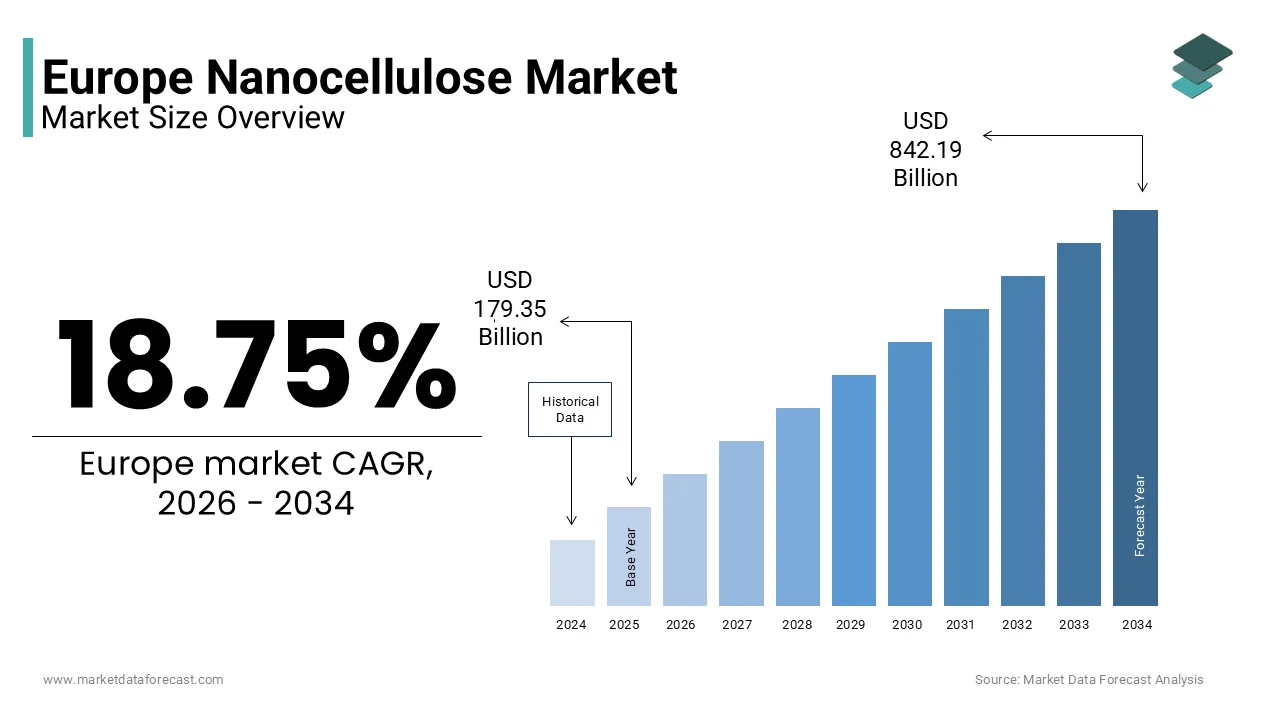
The Europe nanocellulose market size was valued at USD 179.35 billion in 2025, and is expected to be worth USD 842.19 billion by 2034 from USD 212.98 billion by 2026. The market is growing at a CAGR of 18.75% during the forecast period.
Europe is a hub for various production industries and construction and the growth of the nano cellulose market is driven primarily because of the various research and development activities taking part in Europe. This growth in the industry can also be attributed to the growth in the petrochemical sector. Products such as packaging materials, plastics, composites, etc., are in high demand from various manufacturing industries in Europe and thus contribute to the growing demand for nanocellulose market. The paper industry is still going strong, and with the advancement in technology such as the introduction of nanocellulose materials, the paper industry is now able to produce high-quality paper with superior properties.
Nanocellulose materials are found to be toxic on many occasions and thus it inhibits its growth opportunities. Also, at high concentrations, these materials can also induce inflammatory effects on the human lungs, thus the usage should be limited and there are austere norms present in Europe regarding the usage of nanocellulose materials.
REPORT COVERAGE
| REPORT METRIC | DETAILS |
| Market Size Available | 2025 to 2034 |
| Base Year | 2025 |
| Forecast Period | 2026 to 2034 |
| CAGR | 18.75% |
| Segments Covered | By Type, Application, and Region. |
| Various Analyses Covered | Global, Regional & Country Level Analysis, Segment-Level Analysis, DROC, PESTLE Analysis, Porter’s Five Forces Analysis, Competitive Landscape, Analyst Overview of Investment Opportunities |
| Regions Covered | UK, France, Spain, Germany, Italy, Russia, Sweden, Denmark, Switzerland, Netherlands, Turkey, Czech Republic and Rest of Europe |
| Market Leaders Profiled | Celluforce INC, Kruger INC, American Process INC, Borregard, Stora Enso, VTT |
SEGMENTAL ANALYSIS
By Application Insights
The packaging industry has the most extensive application of nanocellulose. These materials are used to produce lighter and stronger packaging materials that are widely used throughout the Europe industries. On top of this, it also helps in the reduction of costs. The properties such as robustness, longevity, etc., are higher when produced with the help of nanocellulose.
The Biomedicals segment is likely to account for a prominent share of the nanocellulose market. They also contribute to the highest revenue generated compared to other end-user segments. Composites, especially Bio-based nanocomposites are also in demand due to their advanced properties on top of being environment friendly.
KEY MARKET PLAYERS
Celluforce INC, Kruger INC, American Process INC, Borregard, Stora Enso, VTT are some of the notable companies in the Europe Nanocellulose market.
MARKET SEGMENTATION
This research report on the Europe nanocellulose market has been segmented and sub-segmented based on the following categories.
By Type
- Microfibrillated Cellulose (MFC)
- Cellulose Nanocrystals
By Application
- Pulp and Paper
- Composites and Packaging
- Biomedical and Pharmaceutical
- Electronics & Sensors
By Country
- United Kingdom
- France
- Spain
- Germany
- Italy
- Russia
- Sweden
- Denmark
- Switzerland
- Netherlands
- Rest of Europe