- Product Description Description
- Table of Contents TOC
- List of Table & Figure LOT
- Get Free Sample PDF Sample PDF
Market Size, 2025
$104.83 BnMarket Estimate, 2026
$108.16 BnMarket Forecast, 2034
$138.85 BnCAGR, 2026–2034
3.17%Europe Natural Gas Market Report Summary
The Europe natural gas market was valued at USD 104.83 billion in 2025, is estimated to reach USD 108.16 billion in 2026, and is projected to reach USD 138.85 billion by 2034, growing at a CAGR of 3.17% during the forecast period. The growth of the Europe natural gas market is driven by increasing demand for cleaner energy sources, the transition from coal based power generation, and rising consumption of natural gas in industrial and residential applications. Natural gas plays a critical role in supporting Europe’s energy transition due to its lower carbon emissions compared to conventional fossil fuels. In addition, investments in gas infrastructure, expansion of liquefied natural gas import terminals, and cross border pipeline networks are supporting the steady development of the natural gas market across the region.
Key Market Trends
- Growing shift toward natural gas as a transitional energy source supporting Europe’s decarbonization and energy transition strategies.
- Increasing investments in liquefied natural gas infrastructure to strengthen energy security and diversify gas supply sources.
- Rising demand for natural gas in power generation as countries move away from coal based energy production.
- Expansion of cross border pipeline networks and gas storage facilities to enhance regional energy connectivity and supply stability.
- Growing focus on integrating renewable energy with gas based power systems to ensure reliable and flexible electricity generation.
Segmental Insights
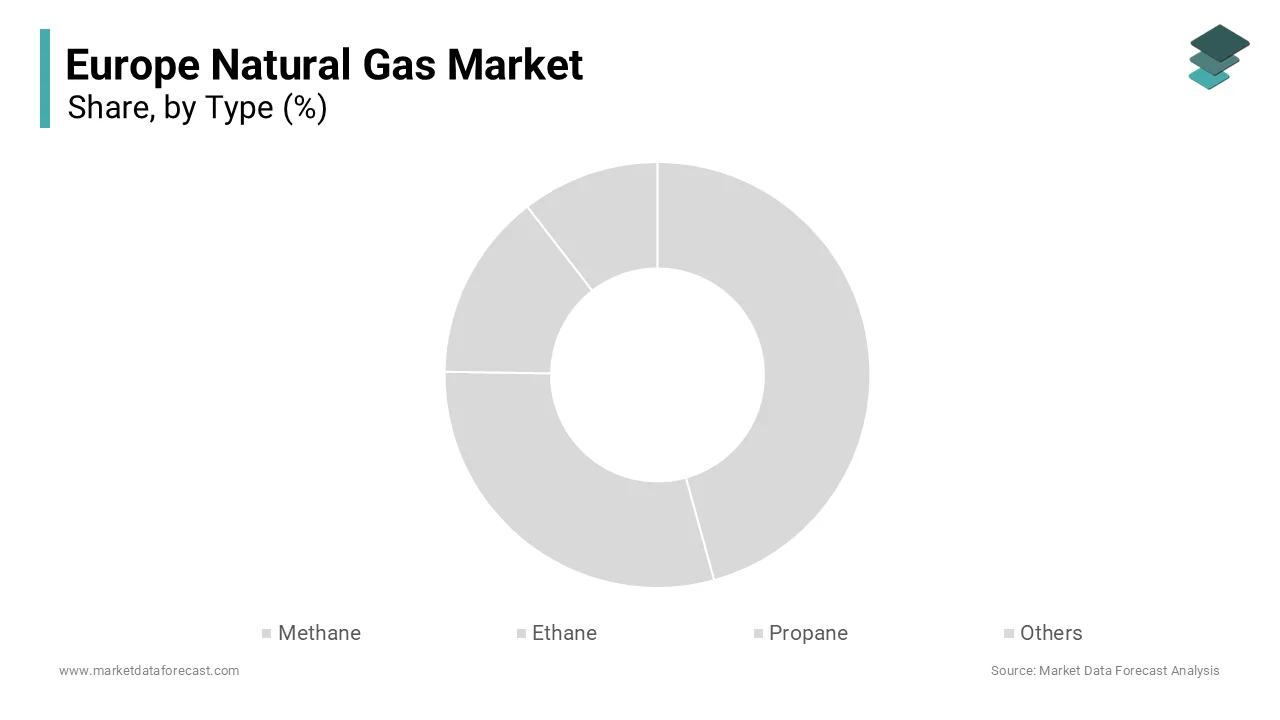
- Based on type, the methane segment held the largest share of the Europe natural gas market in 2024. Methane is the primary component of natural gas and is widely used for power generation, industrial fuel applications, residential heating, and electricity production due to its high energy efficiency and relatively lower carbon emissions.
Regional Insights
- The Europe natural gas market is experiencing steady demand across major economies due to increasing energy consumption and the ongoing transition toward cleaner energy sources.
- Germany accounted for the largest share of the Europe natural gas market and held 22.3% of the regional market share in 2024. The country’s large industrial base, strong energy demand, and well developed gas infrastructure are key factors supporting the dominance of Germany in the regional natural gas market.
- Other European countries are also expanding natural gas usage supported by investments in energy infrastructure, increasing adoption of cleaner fuels, and the growing need for reliable energy supply.
Competitive Landscape
The Europe natural gas market is characterized by the presence of major energy companies involved in natural gas exploration, production, distribution, and trading activities. Market participants are focusing on expanding liquefied natural gas import capabilities, strengthening pipeline networks, and investing in cleaner energy technologies to support long term energy transition goals. Strategic partnerships, supply agreements, and infrastructure development projects are helping companies strengthen their position in the European natural gas market. Prominent players in the Europe natural gas market include Shell plc, BP plc, TotalEnergies SE, Equinor ASA, Gazprom, Eni S.p.A., ENGIE SA, RWE AG, Uniper SE, and OMV Group.
 Download Free Sample Report
Europe Natural Gas Market Size
The Europe natural gas market size was valued at USD 104.83 billion in 2025 and is projected to reach USD 138.85 billion by 2034 from USD 108.16 billion in 2026, growing at a CAGR of 3.17%.
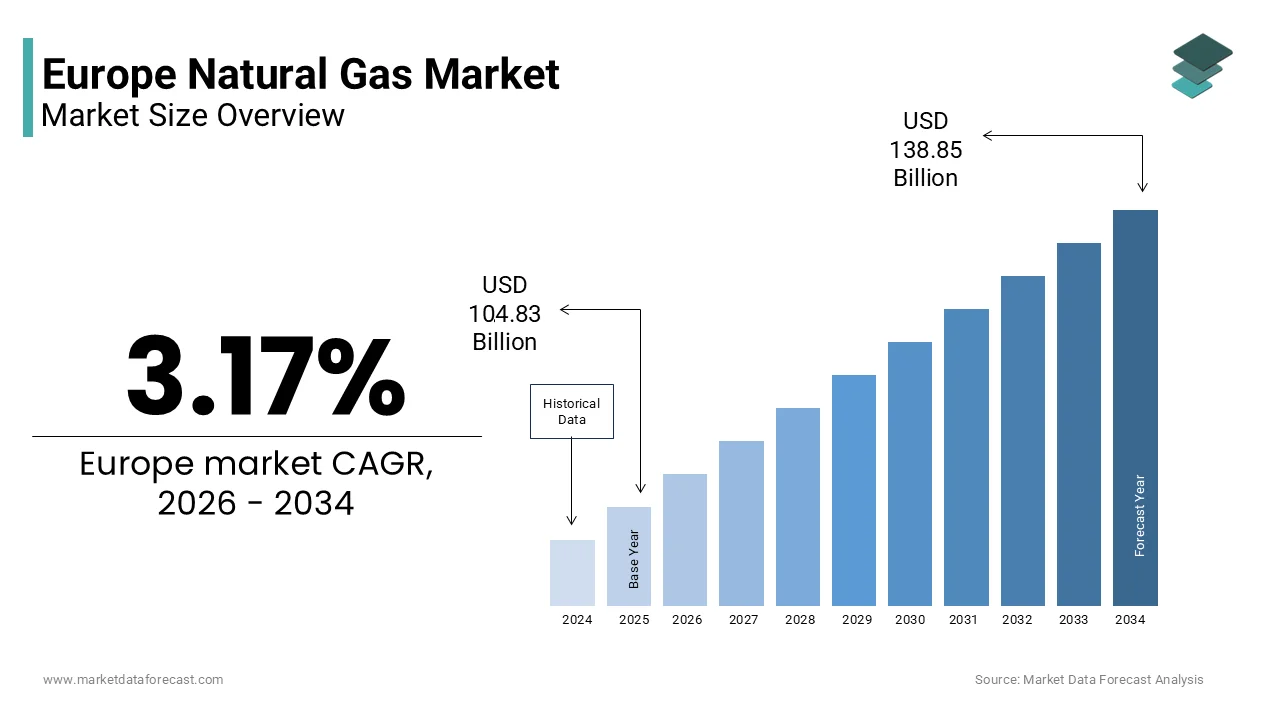
Natural gas, functions as a transitional energy vector within a rapidly decarbonizing power and industrial system, characterized by declining domestic production, diversified import dependencies, and evolving regulatory frameworks. Indigenous output has contracted significantly, with the Groningen field in the Netherlands, once Europe’s largest onshore reservoir fully decommissioned in October 2023 after decades of seismic activity linked to extraction. According to the European Environment Agency, EU domestic natural gas production fell to 38 billion cubic meters in 2025, meeting less than 10% of regional demand. The remainder is sourced via seaborne LNG from the United States Qatar and increasingly West Africa, and pipeline imports from Norway, Azerbaijan and North Africa. This structural reconfiguration has elevated the role of gas as a dispatchable backup for intermittent renewables rather than a baseload fuel, which is embedding it within Europe’s net zero architecture as a diminishing but balancing asset.
MARKET DRIVERS
Industrial Process Heat Requirements Sustain Baseload Gas Demand
The natural gas remains irreplaceable in high temperature industrial processes across Europe’s core manufacturing sectors, particularly in chemicals steel cement and glass. This factor is attributed in fuelling the growth of Europe natural gas market. These industries require consistent thermal energy exceeding 800 degrees Celsius, a threshold where electric alternatives remain technologically immature or economically unviable at scale. According to the European Commission’s Industrial Decarbonisation Roadmap, natural gas supplies approximately 62% of process heat in the EU chemical sector and 48% in non-metallic minerals as of 2025. BASF alone consumes over 90 terawatt hours of natural gas annually at its Ludwigshafen complex, equivalent to the residential consumption of 7 million German households. The European Cement Association confirms that many clinker kilns still rely on gas or gas derived fuels due to combustion stability and low impurity profiles. The European Chemicals Agency estimates that full conversion to green hydrogen would require capital expenditures exceeding 120 billion euros, across heavy industry.
Seasonal Heating Load in Residential and Commercial Buildings Drives Winter Peaks
Space and water heating in Europe’s built environment continues to generate substantial seasonal demand for natural gas, particularly in Central and Eastern Europe where district heating networks and gas fired boilers dominate. The seasonal heating load in residential and commercial buildings is greatly influencing the growth of Europe natural gas market. As per the European Building Performance Institute, nearly 42% of residential heating systems in the EU still rely directly on natural gas, with penetration exceeding 60% in countries like Italy Hungary and the Netherlands. The EU’s existing housing stock includes more than 220 million buildings, of which 75% were constructed before 1990 and lack adequate insulation for efficient electrified heating. Retrofitting these structures at scale is projected to take until 2050 under current renovation rates of 1.2% annually, as noted by the European Climate Foundation.
MARKET RESTRAINTS
Accelerated Phaseout of Fossil Fuel Subsidies Increases Cost Volatility
The policy trajectory toward eliminating implicit and explicit support for fossil fuels has intensified price exposure for natural gas consumers, undermining investment certainty and demand stability. The accelerated phaseout of fossil fuel subsidies increases cost volatility, which is oen of the factor hampering the growth of Europe natural gas market. The European Union committed under the Glasgow Climate Pact to end inefficient fossil fuel subsidies by 2025, prompting member states to dismantle regulated tariffs and tax exemptions previously shielding households and industries from market fluctuations. In Germany, the abolition of the natural gas surcharge in 2023 was followed by a 34% increase in wholesale procurement costs passed directly to industrial buyers. Similarly, France terminated regulated gas tariffs for large enterprises in January 2024 by exposing them ahead volatility. This policy shift, while aligned with climate goals, amplifies financial risk for gas intensive sectors already grappling with global competition. Without compensatory mechanisms such as carbon contracts for difference, companies face unpredictable input costs that discourage long term gas infrastructure commitments, thereby constraining market development despite physical supply adequacy.
Public Opposition to New Pipeline and Storage Infrastructure Delays Critical Projects
The expansion of natural gas transmission and storage capacity faces mounting resistance from local communities and environmental groups, stalling projects essential for supply security and market flexibility. The public opposition to new pipeline and storage infrastructure delays is additionally hindering the growth of Europe natural gas market. Despite the EU’s recognition of gas as a transitional fuel, permitting for new pipelines compressor stations and underground storage facilities encounters protracted legal challenges and social protests. The Baltic Pipe extension project faced over 18 months of delays due to coastal land use disputes in Poland, while the Haidach storage expansion in Austria was halted in 2024 following groundwater contamination concerns raised by regional authorities. According to the European Network of Transmission System Operators for Gas, only 37% of planned gas infrastructure projects received final investment decisions in 2025, down from 68% in 2021. The European Court of Justice ruled in February 2025 that member states must conduct enhanced biodiversity impact assessments for all subsurface energy projects, adding an average of 14 months to approval timelines.
MARKET OPPORTUNITIES
Expansion of Floating LNG Import Terminals Enhances Supply Diversification
The deployment of floating storage and regasification units has fundamentally reshaped its import architecture, reducing reliance on fixed pipeline corridors and enabling agile sourcing from global suppliers. The expansion of floating LNG import terminals enhances supply diversification, which is Since 2022 over 15 floating LNG terminals have been commissioned across Germany, Finland, Poland and the Netherlands, adding more than 70 billion cubic meters of annual regasification capacity. According to the European Maritime Safety Agency, floating terminals now account for 58% of total EU LNG import capability by offering deployment speed and scalability unattainable with onshore facilities. The Wilhelmshaven terminal in Germany began operations in December 2022 and processed 11 billion cubic meters of LNG in its first full year, primarily from the United States and Qatar. This modular approach allows countries without coastal access to lease capacity via cross border interconnectors, as demonstrated by Czechia’s virtual access to the Lubmin terminal. The European Commission’s Short Term Energy Security Plan explicitly endorsed floating infrastructure as a key resilience tool, accelerating permitting under emergency provisions.
Integration of Renewable Gas into Existing Grids Creates Hybrid Energy Pathways
The injection of biomethane and green hydrogen into natural gas transmission network presents a viable decarbonization corridor that leverages trillions of euros in existing pipeline assets. The integration of renewable gas into existing grids with hybrid energy pathways is significantly bolstering the growth of Europe natural gas market. The European Hydrogen Backbone initiative, supported by 23 transmission system operators, plans to repurpose 28000 kilometers of natural gas pipelines for pure hydrogen transport by 2030. Crucially, current regulations permit up to 20% hydrogen blending in distribution networks without appliance modifications, creating immediate demand for low carbon gases. In the Netherlands, Gasunie launched the HyStock project in 2024 to store green hydrogen in depleted gas fields, utilizing the same geological formations once used for Groningen production. This hybrid model transforms the gas grid from a fossil conduit into a multi energy carrier system, preserving infrastructure value while advancing climate neutrality.
MARKET CHALLENGES
Geopolitical Fragmentation Undermines Coordinated Supply Security Mechanisms
The inability to maintain unified gas procurement strategies among member states weakens collective bargaining power and fosters internal competition that inflates global prices. The geopolitical fragmentation undermines coordinated supply security mechanisms is acting as a big barrier for the growth of Europe natural gas market. According to the Bruegel Institute, divergent national policies led to a 22% price variance for identical US LNG cargoes delivered to Rotterdam versus Barcelona in early 2025. Countries like Hungary and Serbia maintain direct pipeline deals with non-Western suppliers, bypassing EU solidarity mechanisms and creating physical bottlenecks at interconnectors. The European Court of Auditors reported in March 2025 that only 11 of 27 member states fully complied with the voluntary joint purchasing framework, citing sovereignty concerns and industrial lobbying. This fragmentation prevents the formation of a true European buyer bloc capable of negotiating long term contracts with favorable terms, leaving the market exposed to spot market volatility and supplier opportunism.
Decarbonization Mandates Accelerate Stranded Asset Risks for Midstream Infrastructure
The tightening of EU climate legislation, particularly the inclusion of methane emissions under the revised Industrial Emissions Directive, threatens the economic viability of existing gas transmission and storage assets. Operators must now monitor and report methane leakage with 95% accuracy using satellite and drone-based detection, as mandated by the European Environment Agency starting in 2025. Data from the International Methane Emissions Observatory indicates that Europe’s gas network emits approximately 2.1 million tons of methane annually, equivalent to 60 million tons of CO₂ in warming potential. Simultaneously, the Carbon Border Adjustment Mechanism indirectly penalizes gas intensive products by reducing industrial demand and lowering throughput revenues. With the EU targeting an 80% reduction in gas consumption by 2050, midstream operators face declining utilization rates that may render pipelines and storage sites economically obsolete well before their technical lifespan ends by creating significant financial and systemic risks for the energy transition.
REPORT COVERAGE
| REPORT METRIC | DETAILS |
| Market Size Available | 2025 to 2034 |
| Base Year | 2025 |
| Forecast Period | 2026 to 2034 |
| CAGR | 3.17% |
| Segments Covered | By Type, Application, and Region |
| Various Analyses Covered | Global, Regional, & Country Level Analysis; Segment-Level Analysis; DROC, PESTLE Analysis; Porter’s Five Forces Analysis; Competitive Landscape; Analyst Overview of Investment Opportunities |
| Regions Covered | UK, France, Spain, Germany, Italy, Russia, Sweden, Denmark, Switzerland, Netherlands, Turkey, and the Czech Republic |
| Market Leaders Profiled | Shell plc, BP plc, TotalEnergies SE, Equinor ASA, Gazprom, Eni S.p.A., ENGIE SA, RWE AG, Uniper SE, and OMV Group |
SEGMENTAL ANALYSIS
By Type Insights
The methane segment was the largest by holding a prominent share of the Europe natural gas market in 2024 with the principal constituent of pipeline and liquefied natural gas imported and distributed across the continent. According to the European Network of Transmission System Operators for Gas, over 98% of gas injected into the EU’s interconnected grid meets ISO 13686 specifications requiring methane content above 90%. The dominance is further reinforced by policy frameworks that treat “natural gas” synonymously with methane in emissions accounting and decarbonization planning. Power plants such as Uniper’s facility in Germany and Engie’s combined cycle units in France are calibrated for methane combustion efficiency exceeding 62%, making substitution impractical. Additionally, the phaseout of associated gas flaring under the EU Methane Regulation mandates capture and reinjection of methane rather than venting, preserving its centrality in the energy mix. Thus, methane’s technical, regulatory, and infrastructural entrenchment ensures its continued preeminence despite broader energy transition pressures.
The renewable methane sub segment is projected to expand at a CAGR of 18.3% from 2026 to 2034. The revised Renewable Energy Directive II establishes binding national targets for renewable gas in final energy consumption, requiring member states to achieve at least 11% biomethane in gas grids by 2030. As per the European Commission, this translates to an annual production target of 35 billion cubic meters up from 4.2 billion in 2022. Germany’s Biomethane Strategy allocates 1.8 billion euros in subsidies for upgrading anaerobic digestion facilities to grid injection standards. Biomethane qualifies for Guarantees of Origin under EU legislation by enabling corporations like Nestle and Heineken to claim Scope 1 emission reductions without altering burners or boilers. Industrial consumers facing stringent carbon compliance obligations are increasingly procuring biomethane via long term power purchase agreements to meet near term climate goals. In 2025, BASF signed a 10 year deal with VERBIO to source 1.2 terawatt hours of biomethane annually for its Ludwigshafen steam crackers, avoiding 280000 tons of CO₂ per year. These offtake agreements de risk capital expenditure for project developers, accelerating plant construction cycles.
REGIONAL ANALYSIS
Germany Natural Gas Market Analysis
Germany was the largest contributor of the Europe natural gas market by holding 22.3% of share in 2024 owing to its energy intensive manufacturing base and transitional reliance on gas fired power generation. The chemical sector alone consumes over 30 billion cubic meters annually, with BASF Covestro and Evonik operating integrated steam cracker complexes dependent on stable gas supply. Germany’s strategic pivot toward LNG culminated in the commissioning of three floating terminals, where Wilhelmshaven Brunsbuttel and Stade by adding 22 billion cubic meters of regasification capacity within 18 months. Germany’s dual role as industrial anchor and infrastructure pioneer solidifies its position as the central node in Europe’s evolving gas landscape.
Italy Natural Gas Market Analysis
Italy natural gas market growth is expected to grow with the southern entry point for non-Russian pipeline gas and LNG. Italy, also operates three LNG terminals Panigaglia Rovigo and Livorno with combined capacity of 16 billion cubic meters, importing cargoes from Nigeria Egypt and the United States. Recent investments in the Poseidon pipeline extension aim to double Greek Albanian interconnector capacity by 2027 by enhancing Italy’s role as a Balkan distribution hub. This geographic and contractual diversification insulates Italy from single source disruptions and reinforces its strategic importance in EU energy security architecture.
France Natural Gas Market Analysis
France natural gas market growth is anticipated to have steady pace with its unique energy mix where natural gas serves as a flexible complement to nuclear baseload rather than a primary power source. The residential sector drives consistent demand with 11.4 million gas heated homes as per the Ministry of Ecological Transition. However, France’s most significant contribution lies in renewable gas leadership. It produced 3.1 billion cubic meters of biomethane in 2025, where the highest in Europe, as confirmed by the French Environment and Energy Management Agency, sourced primarily from agricultural waste in Brittany and Normandy.
Netherlands Natural Gas Market Analysis
The Netherlands natural gas market growth is esteemed to grow with a historic transformation from net exporter to net importer, following the Groningen field closure. The Gate terminal at Rotterdam handled 18.5 billion cubic meters of LNG primarily from the United States and Australia. Industrial clusters in the Port of Rotterdam including Shell and Dow continue to depend on gas for steam and feedstock. The Netherlands is also pioneering hydrogen conversion with the HyWay 2030 program repurposing 1200 kilometers of pipelines. This strategic shift from production to logistics and innovation ensures the Netherlands retains outsized influence despite declining domestic output.
Spain Natural Gas Market Analysis
Spain natural gas market growth is with its geographic advantage as Europe’s primary LNG gateway with six operational terminals along the Atlantic and Mediterranean coasts. According to survey, the Spanish TSO these facilities handled 52.3 billion cubic meters of LNG in 2025 representing nearly 40% of all EU LNG imports. Key suppliers included the United States, Qatar, and Trinidad and Tobago, with growing volumes from Angola and Equatorial Guinea. The government’s Integrated National Energy and Climate Plan targets 100% renewable gas injection by 2050 with pilot projects already blending green hydrogen in Andalusia. Spain’s combination of import capacity grid connectivity and storage flexibility makes it indispensable to European supply resilience.
COMPETITIVE LANDSCAPE
Competition in the Europe natural gas market has evolved from price-based rivalry among traditional suppliers to a multidimensional contest centered on sustainability credentials supply chain resilience and service integration. Incumbent energy majors like Shell TotalEnergies and Eni compete not only on volume but on their ability to deliver verifiable low carbon gas through Guarantees of Origin and blockchain traceability. New entrants including renewable gas developers and hydrogen startups challenge incumbents by offering niche decarbonization solutions. State owned transmission system operators such as Snam and Gasunie exert influence through infrastructure access policies that can favor or hinder market participants. Meanwhile national champions like Engie and Iberdrola leverage regulated retail bases to bundle gas with electricity and efficiency services. The absence of Russian pipeline gas has intensified competition for LNG cargoes driving innovation in portfolio optimization and virtual pipeline solutions.
KEY MARKET PLAYERS
Some of the notable key players in the Europe natural gas market are
- Shell plc
- BP plc
- TotalEnergies SE
- Equinor ASA
- Gazprom
- Eni S.p.A.
- ENGIE SA
- RWE AG
- Uniper SE
- OMV Group
Top Players in the Market
- Shell plc maintains a commanding presence in the Europe natural gas market through its integrated LNG portfolio, trading operations, and downstream retail networks. The company supplies gas to power generators industrial consumers and residential customers, across the United Kingdom Germany and the Netherlands. Shell has strategically expanded its LNG import capacity by securing long term regasification rights at terminals in Germany and Spain. Shell also co-developed the Hydrogen Valley project in the Port of Rotterdam to blend green hydrogen into existing gas infrastructure. These initiatives reinforce its transition from a pure fossil supplier to an integrated energy solutions provider aligned with EU decarbonization timelines.
- TotalEnergies SE plays a pivotal role in Europe’s natural gas landscape through diversified supply contracts, upstream equity in global LNG projects, and leadership in renewable gas development. The company sources LNG from its stakes in ventures in Qatar, the United States, and Mozambique, ensuring flexible delivery to European terminals. TotalEnergies operates gas retail businesses in France Spain and Belgium serving over 8 million customers. It inaugurated France’s largest biomethane production cluster in partnership with agricultural cooperatives targeting 1.2 terawatt hours annually. The firm also invested in carbon capture pilots at its Grandpuits refinery to produce blue hydrogen from natural gas. These actions position TotalEnergies at the intersection of security of supply and low carbon innovation within the European energy transition.
- Eni SpA leverages its Mediterranean footprint to secure alternative gas routes into Europe reducing reliance on northern corridors. The company holds significant stakes in the Trans Adriatic Pipeline and imports volumes from Egypt Algeria and Azerbaijan. Eni supplies gas to Italian industrial complexes and manages a vast retail network across Southern Europe. Eni launched Plenitude a subsidiary dedicated to renewable gases including biomethane and green hydrogen with plans to inject 3 billion cubic meters annually by 2030. It also converted its Porto Marghera refinery into a bio-LNG production facility using waste feedstocks. Eni’s strategy emphasizes geographic diversification and circular feedstocks enabling it to meet both energy security and sustainability mandates simultaneously.
Top Strategies Used by the Key Market Participants
Key players in the Europe natural gas market are prioritizing portfolio diversification by integrating LNG biomethane and hydrogen into their offerings to align with regulatory decarbonization pathways. They are securing long term import agreements with non-Russian suppliers particularly from the United States, Qatar, and West Africa to ensure supply security. Companies are investing in floating regasification terminals and cross border interconnectors to enhance infrastructure flexibility. Strategic partnerships with agricultural and waste management firms enable scalable biomethane production. Additionally, firms are launching certified renewable gas products for corporate buyers seeking Scope 1 emission reductions. Digital platforms for real time trading and demand forecasting optimize asset utilization while compliance with EU methane monitoring rules strengthens environmental credibility.
MARKET SEGMENTATION
This research report on the European natural gas market has been segmented and sub-segmented based on categories.
By Type
- Methane
- Ethane
- Propane
- Others
By Application
- Industrial
- Electric Power
- Transportation
- Residential
- Commercial
- Others
By Country
- UK
- France
- Spain
- Germany
- Italy
- Russia
- Sweden
- Denmark
- Switzerland
- Netherlands
- Turkey
- Czech Republic
- Rest of Europe