- Product Description Description
- Table of Contents TOC
- List of Table & Figure LOT
- Get Free Sample PDF Sample PDF
Market Size, 2025
$38.08 BnMarket Estimate, 2026
$40.42 BnMarket Forecast, 2034
$65.16 BnCAGR, 2026–2034
6.15%Europe Network Switches Market Size, Growth, Trends & Forecast (2026–2034)
The Europe network switches market size was calculated to be USD 38.08 billion in 2025, is anticipated to reach USD 40.42 billion in 2026, and is projected to scale up to USD 65.16 billion by 2034, registering a compound annual growth rate (CAGR) of 6.15% during the forecast period from 2026 to 2034. Driven by the accelerated deployment of the Industrial Internet of Things (IIoT), Industry 4.0 automation, and surging data center modernization for artificial intelligence workloads, the network switches industry continues to expand steadily across the European continent.
Key Executive Metrics (At-a-Glance)
- 2025 Base Valuation: USD 38.08 Billion
- 2026 Current Valuation: USD 40.42 Billion
- 2034 Forecast Valuation: USD 65.16 Billion
- Compound Annual Growth Rate (CAGR): 6.15% (2026–2034)
- Dominant Type Segment: Managed Switches (accounting for 52.3% of the market share in 2025, driven by granular control and security)
- Fastest-Growing Type Segment: PoE (Power over Ethernet) Switches (projected to record the fastest CAGR of 13.8% from 2026 to 2034)
- Dominant Application Segment: Enterprise Networking (occupying 44.3% of the market share in 2025, supported by digital transformation initiatives)
- Fastest-Growing Application Segment: Industrial Automation (emerging as the fastest-growing segment with a CAGR of 15.2% over the forecast period)
- Dominant Port Speed Segment: 1 Gbps (capturing 48.3% of the market share in 2025, backed by extensive fiber-to-the-home and SME installations)
- Fastest-Growing Port Speed Segment: 100 Gbps (projected to grow at the fastest CAGR of 24.5% from 2026 to 2034 due to AI and hyperscale data center demands)
- Dominant Region: Germany (holding 26.3% of the market share in 2025, driven by its advanced industrial and manufacturing base)
Core Market Drivers
- Accelerated Deployment of Industrial IoT and Industry 4.0: Rapid integration of automated guided vehicles, robotics, and smart sensors requiring ruggedized, deterministic low-latency industrial switches.
- Surging Data Center Modernization for Artificial Intelligence Workloads: Training and inference processes of large language models generating massive east-west traffic, accelerating the adoption of leaf-spine architectures and 400G/800G switches.
Primary Market Restraints & Challenges
- Prolonged Supply Chain Volatility and Semiconductor Shortages: Heavy dependence on imported application-specific integrated circuits (ASICs) exposing the region to supply shocks and extended chip lead times.
- High Energy Consumption and Stringent Environmental Regulations: High power draw of continuous networking equipment facing strict scrutiny under the European Green Deal and EU Ecodesign Directive.
- Escalating Cybersecurity Threats Targeting Network Infrastructure: Network switches increasingly becoming primary entry points for sophisticated attacks, raising stakes under the NIS2 Directive.
Europe Network Switches Market Segmentation Breakdown
| Segment Category | Leading Sub-Segment (2025 Base) | Fastest-Growing Sub-Segment (2026–2034) |
|---|---|---|
| By Type | Managed Switches (52.3% share in 2025, offering granular control, QoS, and enhanced security) | PoE Switches (13.8% CAGR driven by IoT, IP surveillance, and Wi-Fi 6/7 access point rollouts) |
| By Application | Enterprise Networking (44.3% share in 2025, driven by SME digital transformation and hybrid work) | Industrial Automation (15.2% CAGR driven by Industry 4.0 and OT/IT convergence) |
| By Port Speed | 1 Gbps (48.3% share in 2025, supported by residential broadband and SME installed bases) | 100 Gbps (24.5% CAGR driven by AI training clusters and hyperscale data centers) |
| By Region | Germany (26.3% market share in 2025, anchored by its robust manufacturing and Industrie 4.0 strategies) | Europe-wide expansion driven by coordinated digital and green mandates |
Major Industry Players Profiled
Key enterprises shaping the competitive Europe network switches market include Cisco Systems, Huawei Technologies, Arista Networks, Juniper Networks, Hewlett Packard Enterprise, Dell Technologies, Extreme Networks, Nokia, ZTE Corporation, D-Link Corporation, NETGEAR, TP-Link Technologies, Fortinet, Allied Telesis, and Alcatel-Lucent Enterprise.
Europe Network Switches Market Size
The Europe network switches market size was calculated to be USD 38.08 billion in 2025 and is anticipated to be worth USD 65.16 billion by 2034, from USD 40.42 billion in 2026, growing at a CAGR of 6.15% during the forecast period.
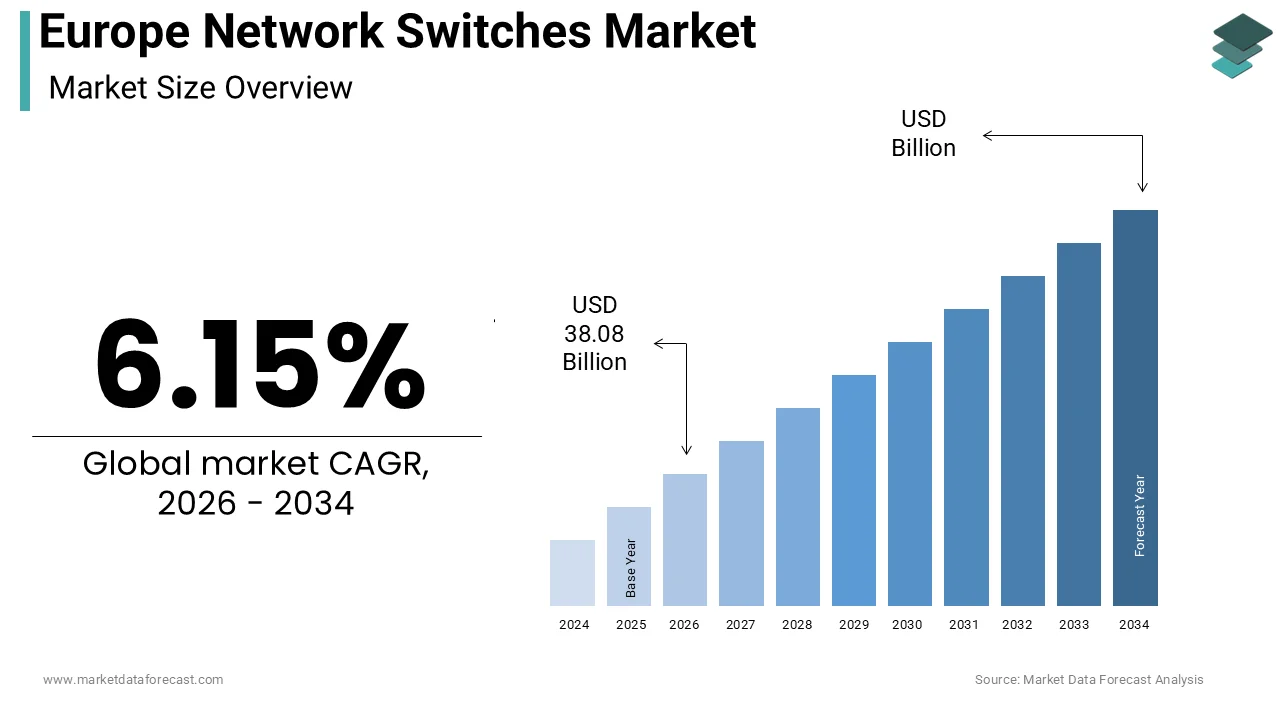
The network switches are essential hardware infrastructure responsible for directing data traffic within local area networks, serving as the interconnection node for servers, storage systems, and end-user devices across the continent. These devices operate at various layers of the Open Systems Interconnection model to ensure efficient packet forwarding, network segmentation, and security enforcement within enterprise, industrial, and carrier environments. According to Eurostat, 92% of enterprises in the European Union with ten or more persons employed had broadband internet access in 2024, creating a massive installed base that requires continuous upgrading to multi-gigabit switching infrastructure. Furthermore, the European Commission's Digital Decade policy targets all main terrestrial paths to be covered by very high-capacity networks by 2030, which is a mandate that drives substantial investment in backbone and edge switching equipment capable of handling 100 Gigabit and 400 Gigabit speeds. The region also faces unique energy efficiency mandates, with the EU Code of Conduct on Energy Efficiency in Data Centres pushing operators to replace legacy copper-based switching fabrics with energy-efficient silicon photonics and advanced power management systems. As per the Body of European Regulators for Electronic Communications, the proliferation of Internet of Things devices in smart cities and industrial settings necessitates robust switching layers that can manage massive device densities while maintaining low latency.
MARKET DRIVERS
Accelerated Deployment of Industrial Internet of Things and Industry 4.0
The accelerated deployment of the Industrial Internet of Things and the broader Industry 4.0 initiative is driving demand for specialized industrial-grade networking hardware that is solely attributed to fuelling the growth of Europe network switches market. European manufacturing hubs are rapidly integrating sensors, robotics, and automated guided vehicles into their production lines, requiring switches that can withstand extreme temperatures, vibrations, and electromagnetic interference while providing deterministic low-latency communication. According to the European Commission, the industrial sector accounts for approximately 20% of the European Union's gross value added, and the strategic push to digitize this sector has led to a surge in connected industrial assets. Data from the International Federation of Robotics indicates that Europe remains the second-largest market for industrial robots globally, with an operational stock exceeding 650000 units in 2024, each requiring reliable Ethernet connectivity for real-time control and data exchange. Traditional commercial switches fail in these harsh environments, necessitating the adoption of hardened switches with features like Time Sensitive Networking to synchronize machine operations with microsecond precision. Furthermore, the shift toward decentralized production control architectures increases the number of network nodes on the factory floor, directly boosting the volume of port deployments. As per the Association for Electrical, Electronic & Information Technologies, German manufacturing alone plans to invest over 40 billion euros in digital infrastructure by 2026, a significant portion of which is allocated to industrial networking equipment, including ruggedized network switches.
Surging Data Center Modernization for Artificial Intelligence Workloads
The surging modernization of data centers to accommodate artificial intelligence workloads is leading to the adoption of high-port density and ultra-high-speed switching platforms, which is positively impacting the growth of Europe network switches market. The training and inference processes of large language models require massive parallel computing clusters that generate unprecedented volumes of east-west traffic, rendering legacy 10 Gigabit and 25 Gigabit switches inadequate. According to the Synergy Research Group, Europe added over 15 new hyperscale data center facilities in 2024, with major expansions occurring in Frankfurt, London, and Paris to meet the soaring demand for cloud and AI services. These new facilities are predominantly built around leaf-spine architectures utilizing 400 Gigabit and emerging 800 Gigabit network switches to prevent bottlenecks and ensure efficient GPU utilization. The European High Performance Computing Joint Undertaking has also committed to deploying several exascale supercomputers across the continent, each relying on advanced InfiniBand and high-speed Ethernet switching fabrics to interconnect thousands of processing nodes. Furthermore, the trend toward liquid cooling in high-density racks influences switch design, prompting vendors to develop models optimized for thermal efficiency in constrained spaces.
MARKET RESTRAINTS
Prolonged Supply Chain Volatility and Semiconductor Shortages
The prolonged supply chain volatility and persistent semiconductor shortages are substantially limiting the growth of Europe network switches market. Network switches rely heavily on specialized application-specific integrated circuits and PHY transceivers, components that have faced global allocation challenges due to geopolitical tensions and production capacity constraints. According to the European Semiconductor Industry Association, the EU's share of global semiconductor production remains below 10%, making the region heavily dependent on imports from Asia and the Americas, thereby exposing it to external supply shocks. Lead times for networking chips have extended from standard 12 weeks to over 50 weeks in some cases, which is causing project delays for enterprise upgrades and data center expansions. The complexity of logistics within Europe, exacerbated by border controls and transport disruptions, further complicates the timely delivery of finished goods.
High Energy Consumption and Stringent Environmental Regulations
The high energy consumption of networking equipment, coupled with stringent environmental regulations, is also a major factor limiting the growth of Europe network switches market. Network switches operate continuously, and in large-scale deployments, their cumulative power draw contributes significantly to operational expenditures and carbon footprints, drawing scrutiny under the European Green Deal. According to the European Environment Agency, the information and communication technology sector is responsible for approximately 4% of the EU's total greenhouse gas emissions, prompting regulators to impose stricter energy efficiency standards on data centers and enterprise networks. The EU Ecodesign Directive and various national energy taxes have increased the cost of running inefficient hardware by forcing many potential buyers to delay upgrades until they can afford premium energy-efficient models, which often carry higher upfront price tags. Data from the Climate Neutral Data Centre Pact indicates that failing to meet specific power usage effectiveness targets can result in penalties or loss of government contracts, creating a barrier for smaller players unable to invest in green technology. As per the European Network and Information Security Agency, the lack of standardized metrics for measuring switch energy efficiency complicates procurement decisions, slowing down the replacement cycle of older, power-hungry devices.
MARKET OPPORTUNITIES
Integration of Time Sensitive Networking for Critical Applications
The integration of Time Sensitive Networking (TSN) standards by enabling deterministic data transmission essential for critical real-time applications is solely to create new opportunities for the growth of Europe network switches market. TSN allows standard Ethernet to guarantee latency and jitter performance by making it viable for safety-critical systems in autonomous vehicles, smart grids, and live broadcast environments, sectors where Europe holds a strong industrial presence. According to the IEEE Standards Association, the adoption of TSN is accelerating, with over 50% of new industrial automation projects in Europe specifying TSN-capable switches to ensure synchronized machine control. The automotive sector, a cornerstone of the European economy, is increasingly utilizing Ethernet backbones for in-vehicle networks to support advanced driver assistance systems, creating a massive demand for automotive-grade TSN switches. The media and entertainment industry is transitioning to IP-based workflows using TSN to replace traditional SDI infrastructure, offering another lucrative vertical for switch vendors. The ability of TSN to converge operational technology and information technology networks on a single fabric reduces cabling costs and complexity by appealing to cost-conscious enterprises.
Expansion of Power over Ethernet Solutions for Smart Building Infrastructure
The expansion of Power over Ethernet (PoE) technologies by simplifying the deployment of connected devices in smart buildings and urban infrastructure is expected to boost the growth of Europe network switches market. PoE allows switches to deliver both data and electrical power over a single cable by eliminating the need for separate electrical wiring and outlets, which aligns perfectly with Europe's aggressive sustainability and smart city agendas. According to the European Committee for Electrotechnical Standardization, the latest PoE standards can deliver up to 90 watts of power, enabling the connection of high-demand devices such as LED lighting systems, PTZ cameras, and thin client computers directly to the network. The European Union's Energy Performance of Buildings Directive mandates that all new public buildings must be nearly zero-energy, driving architects and facility managers to adopt PoE-led lighting and sensor networks that offer granular energy monitoring and control. Additionally, the reduction in copper usage and installation labor costs makes PoE an economically attractive option for retrofitting historical European structures where running new power lines is difficult or prohibited.
MARKET CHALLENGES
Escalating Cybersecurity Threats Targeting Network Infrastructure
The escalating cybersecurity threats targeting network infrastructure, as switches increasingly become the primary entry points for sophisticated cyberattacks aiming to disrupt critical services, is one of the challenges for the growth of Europe network switches market. As networks become more distributed and connected to the public internet, the attack surface expands, exposing switches to vulnerabilities such as unauthorized access, malware injection, and denial-of-service attacks. The challenge is compounded by the prevalence of legacy switches in operation that lack modern security features like secure boot, hardware-based encryption, and automated threat detection, making them easy targets for exploitation. Data from ENISA indicates that supply chain attacks involving compromised firmware in networking equipment are on the rise, forcing organizations to scrutinize the provenance and integrity of every switch they deploy. Furthermore, the shortage of skilled cybersecurity professionals in Europe exacerbates the problem, leaving many networks poorly configured and monitored. The implementation of the NIS2 Directive imposes strict liability on organizations for network security breaches, raising the stakes for switch manufacturers to embed robust security-by-design principles.
Complexity of Managing Heterogeneous Multi-Vendor Environments
The complexity of managing heterogeneous multi-vendor environments arises as organizations struggle to integrate and orchestrate networking equipment from diverse suppliers into a cohesive operational framework. This attribute is also to impede the growth of Europe network switches market. Most European enterprises and service providers operate networks comprising switches from multiple generations and manufacturers, leading to interoperability issues, inconsistent management interfaces, and fragmented visibility. According to the European Telecommunications Standards Institute, the lack of universal standardization in software-defined networking controllers often results in vendor lock-in, preventing organizations from freely mixing and matching hardware to optimize costs and performance. This fragmentation forces IT teams to maintain multiple management tools and specialized skill sets, significantly increasing operational overhead and the risk of configuration errors. The difficulty in correlating telemetry data across different proprietary formats hinders effective troubleshooting and performance optimization by leading to longer mean time to resolution during outages. Furthermore, the rapid pace of innovation means that newer switches may not seamlessly communicate with older legacy devices, creating silos within the network architecture.
REPORT COVERAGE
| REPORT METRIC | DETAILS |
| Market Size Available | 2025 to 2034 |
| Base Year | 2025 |
| Forecast Period | 2026 to 2034 |
| CAGR | 6.15% |
| Segments Covered | By Type, Application, Port Speed, And Region |
| Various Analyses Covered | Global, Regional & Country Level Analysis; Segment-Level Analysis; DROC, PESTLE Analysis; Porter’s Five Forces Analysis; Competitive Landscape; Analyst Overview of Investment Opportunities |
| Regions Covered | UK, France, Spain, Germany, Italy, Russia, Sweden, Denmark, Switzerland, Netherlands, Turkey, and the Czech Republic |
| Market Leaders Profiled | Cisco Systems, Huawei Technologies, Arista Networks, Juniper Networks, Hewlett Packard Enterprise, Dell Technologies, Extreme Networks, Nokia, ZTE Corporation, D-Link Corporation, NETGEAR, TP-Link Technologies, Fortinet, Allied Telesis, Alcatel-Lucent Enterprise |
SEGMENTAL ANALYSIS
By Type Insights
The managed switches segment was the largest by accounting for 52.3% of the Europe network switches market share in 2025, with the need for granular control over network traffic, enhanced security protocols, and robust Quality of Service (QoS) mechanisms required by modern European enterprises and service providers. Unlike unmanaged alternatives, managed switches allow administrators to configure Virtual Local Area Networks (VLANs), monitor port status via Simple Network Management Protocol (SNMP), and implement Access Control Lists (ACLs) to mitigate cyber threats. According to the European Union Agency for Cybersecurity, cyber incidents targeting critical infrastructure increased by 35% in 2024, compelling organizations to deploy intelligent switching hardware capable of detecting and isolating malicious traffic patterns automatically. Furthermore, the complexity of converging voice, video, and data onto single networks necessitates the traffic prioritization features inherent only in managed devices. The ability to perform remote diagnostics and firmware updates also reduces operational expenditures, making managed switches the preferred choice for distributed branch offices. The escalating cybersecurity threats, combined with stringent regulatory compliance mandates acts as the primary driver for the growth of the Managed Switches segment. European organizations face increasing pressure to secure their network perimeters and internal segments against sophisticated attacks such as ransomware, DDoS, and lateral movement exploits. Managed switches provide essential security features like 802.1X authentication, port security, and encrypted management interfaces that are absent in unmanaged counterparts. The implementation of the NIS2 Directive across the EU imposes strict liability on entities for network breaches, requiring demonstrable controls over who and what connects to the network. Furthermore, industries such as finance and healthcare must comply with sector-specific regulations like PSD2 and GDPR, which mandate rigorous audit trails and data protection measures achievable only through managed switching platforms.
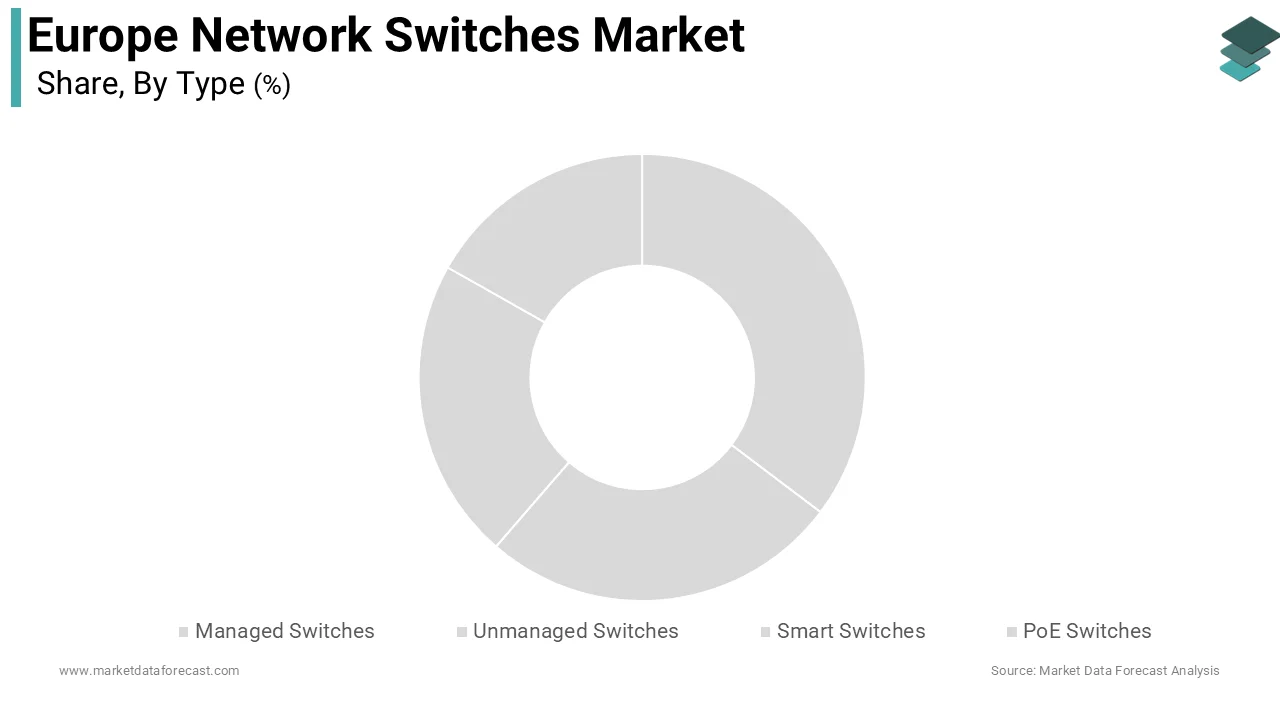
The PoE (Power over Ethernet) Switches segment is projected to be the fastest CAGR of 13.8% from 2026 to 2034, with the rapid proliferation of Internet of Things devices, the widespread adoption of IP-based surveillance systems, and the aggressive rollout of Wi-Fi 6 and Wi-Fi 7 access points that require higher power delivery. The expansion is the emergence of power and data transmission over a single cable, which significantly reduces installation costs and simplifies infrastructure deployment in both new constructions and retrofit projects. The explosive proliferation of Internet of Things devices and the strategic push for smart building initiatives stand as the foremost drivers propelling the exceptional growth rate of the PoE Switches segment. Modern facilities are increasingly populated with connected sensors, actuators, and controllers that require both data connectivity and electrical power, making PoE switches the ideal infrastructure solution.
By Application Insights
The Enterprise Networking segment was the largest by occupying 44.3% of the Europe network switches market share in 2025, owing to the ongoing digital transformation initiatives undertaken by small and medium-sized enterprises as well as large corporations to enhance productivity and enable hybrid work models. The shift towards unified communications, integrating voice, video, and collaboration tools, has further amplified the need for intelligent switches capable of managing Quality of Service and ensuring low-latency connections. Furthermore, the expansion of branch offices and remote working hubs requires decentralized yet secure networking solutions, driving the adoption of managed and smart switches tailored for distributed environments. As per the Confederation of European Business, over 60% of European SMEs plan to upgrade their network infrastructure by 2026 to support emerging technologies like augmented reality and virtual meetings.
The industrial automation segment is swiftly emerging at a fastest CAGR of 15.2% throughout the forecast period, owing to the aggressive implementation of Industry 4.0 strategies, the proliferation of Industrial Internet of Things sensors, and the transition towards operational technology and information technology convergence. The adoption of Time Sensitive Networking standards enables standard Ethernet to meet the rigorous latency requirements of motion control and safety systems, opening new avenues for switch deployments in factories. Furthermore, the shift towards predictive maintenance and digital twins requires high-bandwidth networks to transmit vast amounts of sensor data to analytics platforms, driving the replacement of legacy fieldbus systems with industrial Ethernet switches. Historically, isolated OT networks are now being integrated with IT systems to enable holistic data analytics, supply chain visibility, and remote monitoring capabilities. This integration requires industrial switches that can bridge the gap between legacy control systems and modern enterprise networks while maintaining strict security boundaries to prevent cyber threats from penetrating critical infrastructure.
By Port Speed Insights
The 1 Gbps segment was the largest by capturing 48.3% of the Europe network switches market share in 2025, owing to the sheer volume of installed base in small and medium enterprises, educational institutions, and residential broadband networks, where gigabit speeds remain sufficient for standard office applications and internet access. The extensive deployment of fiber to the home initiatives across Europe, which often terminate at 1 G customer premises equipment requiring compatible switching infrastructure. Furthermore, the cost sensitivity of many European public sector projects and smaller businesses favors 1 G solutions, which offer a balanced price-performance ratio for non-data-intensive tasks. The ubiquitous expansion of Fiber to the Home networks across Europe serves as the fundamental force driving the sustained dominance of the 1G Ethernet switch segment. National broadband plans in countries like Germany, France, and Spain prioritize connecting every household with high-speed fiber, which typically delivers symmetric 1 Gbps services to the end user, requiring corresponding 1G switching capabilities in distribution nodes and customer premises. Telecommunications operators are deploying millions of optical network terminals and associated switching gear that operate primarily at 1G to match the service tiers offered to residential and small business customers.
The 100 Gbps segment is projected to grow at the fastest CAGR of 24.5% from 2026 to 2034 with the insatiable demand for bandwidth in hyperscale data centers, artificial intelligence training clusters, and high-performance computing facilities. The rise of generative AI applications necessitates massive data throughput for GPU communication, making 100 G the minimum standard for new AI infrastructure deployments. Furthermore, the consolidation of telecommunications networks and the rollout of 5G standalone cores require backhaul links capable of handling aggregated traffic from thousands of cell sites, driving demand for high-speed carrier Ethernet switches. The rapid expansion of hyperscale data centers dedicated to artificial intelligence and cloud services stands as the foremost driver propelling the exceptional growth rate of the 100 Gbps segment. Major cloud providers are aggressively building new regions in Europe, with each facility requiring thousands of high-speed ports to interconnect tens of thousands of GPUs and storage nodes. The European Commission's strategy for a data economy encourages the development of sovereign cloud infrastructure, further stimulating investments in state-of-the-art networking hardware capable of terabit-scale throughput. Additionally, the adoption of disaggregated rack designs allows for more flexible scaling of high-speed networks, making 100 G switches essential for modernizing legacy data halls.
REGIONAL ANALYSIS
Germany Network Switches Market Analysis
Germany was the largest contributor to the Europe network switches market with 26.3% of the market share in 2025, owing to a highly advanced industrial base that drives immense demand for ruggedized and high-performance switching solutions for manufacturing automation and Industry 4.0 applications. A primary driving factor is the "Industrie 4.0" strategy, which has led to the digitization of over 40% of German manufacturing plants, each requiring sophisticated Ethernet infrastructure to connect robots, sensors, and control systems. The presence of major global switch manufacturers and a strong ecosystem of system integrators further amplifies Germany's position as a hub for innovation and deployment. Additionally, the government's push for gigabit connectivity in rural areas has spurred investments in access layer switches to bridge the digital divide.
United Kingdom Network Switches Market Analysis
The United Kingdom network switches market held 19.3% of the market share in 2025, owing to a major financial and technology hub that drives demand for high-speed data center and enterprise networking. The market status in the UK is defined by a mature cloud computing sector and aggressive investments in artificial intelligence infrastructure, necessitating upgrades to 100 G and 400 G switching fabrics. The financial services sector, a cornerstone of the British economy, also contributes significantly by requiring low-latency, highly secure switching solutions for high-frequency trading and real-time transaction processing. Furthermore, the government's Project Gigabit initiative aims to deliver fast and reliable broadband to hard-to-reach areas, driving procurement of access switches for last-mile connectivity.
France Network Switches Market Analysis
The French network switches market is likely to have significant growth opportunities in the coming years, with the strong state-led initiatives to modernize public sector infrastructure and promote digital sovereignty. The "France 2030" investment plan, which allocates substantial funds for the development of trusted cloud services and the modernization of healthcare and education networks. The country's vibrant aerospace and automotive industries also contribute to demand, particularly for specialized switches capable of handling real-time data in design and production environments. The push for energy-efficient networking solutions aligns with France's ambitious climate goals, encouraging the replacement of legacy hardware with green-certified switches. Additionally, the expansion of submarine cable landing stations in France enhances its role as a gateway for international data traffic, boosting demand for high-capacity core switches.
Italy Network Switches Market Analysis
Italy's network switches market growth is accelerating with the growing focus on modernizing its SME sector and tourism infrastructure through digital technologies. The National Recovery and Resilience Plan, which includes significant funding for digital innovation and broadband expansion, is stimulating demand for Ethernet switches in both private and public sectors. Furthermore, the manufacturing hubs in Northern Italy are embracing automation, leading to increased purchases of industrial-grade switches for factory floors. The government's incentives for energy efficiency also encourage the replacement of old networking equipment with newer, low-power models.
Netherlands Network Switches Market Analysis
The Netherlands network switches market growth is likely to grow in the coming years, with the presence of major internet exchange points and a high concentration of colocation facilities that serve as the digital entry point for the continent. According to Statistics Netherlands, the ICT sector contributed 7.5% to the national GDP in 2024, reflecting the country's deep reliance on digital infrastructure and continuous investment in networking hardware. The logistics and port of Rotterdam also drive demand for ruggedized switches to support automated terminal operations and supply chain visibility systems. Additionally, the strong presence of multinational corporations headquartered in the Netherlands fosters a culture of early technology adoption, making it a key testbed for new switching innovations.
COMPETITION OVERVIEW
The competition in the Europe network switches market is intense and characterized by the presence of established global giants alongside specialized regional vendors who compete on technology innovation and service quality. Large multinational corporations leverage their extensive product portfolios and strong brand recognition to offer end-to-end networking solutions that lock in enterprise customers through ecosystem integration. In contrast, niche players differentiate themselves by providing highly customized industrial switches or superior price-performance ratios for small and medium-sized businesses. The market sees frequent product launches featuring advanced capabilities like Time Sensitive Networking and Power over Ethernet to address emerging use cases in automation and smart buildings. Price competition remains moderate as buyers prioritize reliability, security, and energy efficiency over initial cost savings, given the critical nature of network infrastructure. Innovation speed and the ability to demonstrate tangible return on investment through sustainability metrics are becoming key differentiators in this evolving competitive arena.
KEY MARKET PLAYERS
A few major players of the Europe network switches market include
- Cisco Systems
- Huawei Technologies
- Arista Networks
- Juniper Networks
- Hewlett-Packard Enterprise
- Dell Technologies
- Extreme Networks
- Nokia
- ZTE Corporation
- D-Link Corporation
- NETGEAR
- TP-Link Technologies
- Fortinet
- Allied Telesis
- Alcatel-Lucent Enterprise
Top Strategies Used by Key Market Participants
Key players in the Europe network switches market primarily focus on developing energy-efficient hardware architectures that comply with stringent European Union environmental regulations and reduce the total cost of ownership for customers. Companies are increasingly integrating artificial intelligence and machine learning capabilities into their switching platforms to enable predictive maintenance and automated traffic optimization. Strategic acquisitions of specialized software firms are essential to enhance cloud management interfaces and provide unified visibility across hybrid network environments. Vendors are also prioritizing the expansion of industrial-grade product lines to capture growth opportunities in manufacturing automation and smart city initiatives. Furthermore, market participants are investing heavily in silicon innovation to deliver higher port densities and faster speeds, such as 400 Gigabit Ethernet, while maintaining thermal efficiency.
Leading Players in the Market
- Cisco Systems Inc stands as a preeminent force in the Europe network switches market by delivering comprehensive networking solutions that span enterprise, industrial, and service provider segments globally. The company contributes to the worldwide ecosystem through its Catalyst and Nexus portfolios, which set industry standards for security and automation. Cisco recently strengthened its European market position by launching new AI-ready switching platforms designed to handle massive data flows from generative artificial intelligence workloads. Their strategic focus includes expanding silicon photonics technology to reduce energy consumption in data centers while enhancing throughput. Cisco continues to invest heavily in software-defined networking capabilities that allow European customers to manage complex hybrid cloud environments seamlessly. These innovations reinforce their leadership by addressing critical needs for sustainability and operational agility across diverse verticals.
- Huawei Technologies Co Ltd maintains a significant presence in the Europe network switches market despite regulatory challenges by offering high-performance and cost-effective networking hardware for various sectors. The company influences the global market through its CloudEngine series, which provides ultra-high density and low-latency switching for modern data centers. Huawei has recently focused on strengthening its position by introducing advanced energy-saving features that align with strict European Union environmental regulations. Their strategy involves deepening partnerships with local enterprises to deploy smart campus solutions that integrate artificial intelligence for predictive maintenance. Huawei also emphasizes research and development in silicon technologies to ensure supply chain resilience and product innovation.
- Hewlett Packard Enterprise operates as a key player in the Europe network switches market by leveraging its Aruba Networks division to deliver intelligent edge solutions tailored for dynamic business environments. The firm contributes globally by pioneering cloud-native management platforms that simplify network operations and enhance security posture for distributed enterprises. HPE recently strengthened its European footprint by expanding its GreenLake edge-to-cloud platform to include automated switching services that optimize performance and reduce costs. Their commitment to sustainability is evident in new switch models designed with recycled materials and superior power efficiency ratings. HPE actively collaborates with European channel partners to accelerate the adoption of Wi-Fi 7 and multi-gigabit switching technologies.
MARKET SEGMENTATION
This research report on the Europe network switches market has been segmented and sub-segmented based on type, application, port speed & region.
By Type
- Managed Switches
- Unmanaged Switches
- Smart Switches
- PoE Switches
By Application
- Data Center
- Enterprise Networking
- Telecommunications
- Industrial Automation
By Port Speed
- 10/100 Mbps
- 1 Gbps
- 10 Gbps
- 40 Gbps
- 100 Gbps
By Region
- UK
- France
- Spain
- Germany
- Italy
- Russia
- Sweden
- Denmark
- Switzerland
- Netherlands
- Turkey
- Czech Republic
- Rest of Europe