- Product Description Description
- Table of Contents TOC
- List of Table & Figure LOT
- Get Free Sample PDF Sample PDF
Market Size, 2025
$9.82 BnMarket Estimate, 2026
$11.86 BnMarket Forecast, 2034
$53.55 BnCAGR, 2026–2034
20.74%Executive Summary: Global Security Testing Market
- Market Scope: Comprehensive global security testing market analysis covering testing types, tool categories, deployment modes, organization sizes, industry verticals, and regional adoption dynamics.
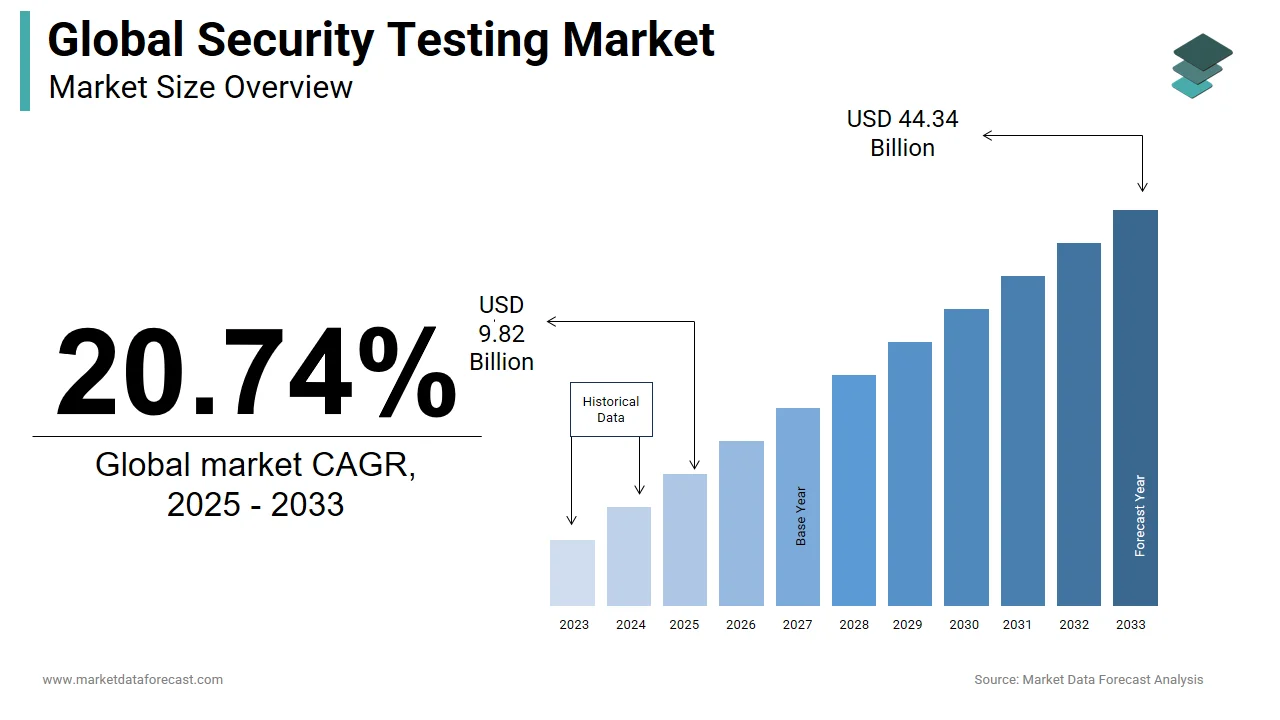
- Market Valuation: Valued at USD 9.82 billion (2025), estimated at USD 11.86 billion (2026), and projected to reach USD 53.55 billion by 2034, registering a strong CAGR of 20.74% (2026–2034).
- Primary Growth Drivers: Strict and mandatory government regulations enforcing compliance testing, increasing adoption of cloud-based web and mobile applications, and the rising need to safeguard digital interfaces from third-party cyber threats.
Key Market Segment Metrics (2026–2034)
| Category | Leading Segment (2025 Position) | Fastest-Growing Segment |
|---|---|---|
| By Type | Application Testing (accounted for the highest share of the market due to widespread web/mobile vulnerabilities) | Application Security Testing (driven by agile software development pipelines and continuous integration) |
| By Tool | Web Penetration Testing Tools (largest share in terms of value and volume for critical hardware/software apps) | Automated Testing & Code Review Tools (surging alongside DevSecOps adoption) |
| By Deployment Mode | On-Premises Solutions (historically held robust deployment across highly regulated legacy enterprises) | Cloud-Based Deployment (fastest-growing segment due to high scalability and operational convenience) |
| By Organization Size | Large Enterprises (traditionally dominated security budgets and comprehensive testing infrastructure) | Small and Medium Enterprises (SMEs) (anticipated to lead market adoption driven by affordable cloud-delivered models) |
| By Industry | BFSI & IT & Telecom (top-leading segments due to critical financial asset protection and massive data processing) | Healthcare & E-commerce (expanding rapidly as digital patient portals and online transaction points multiply) |
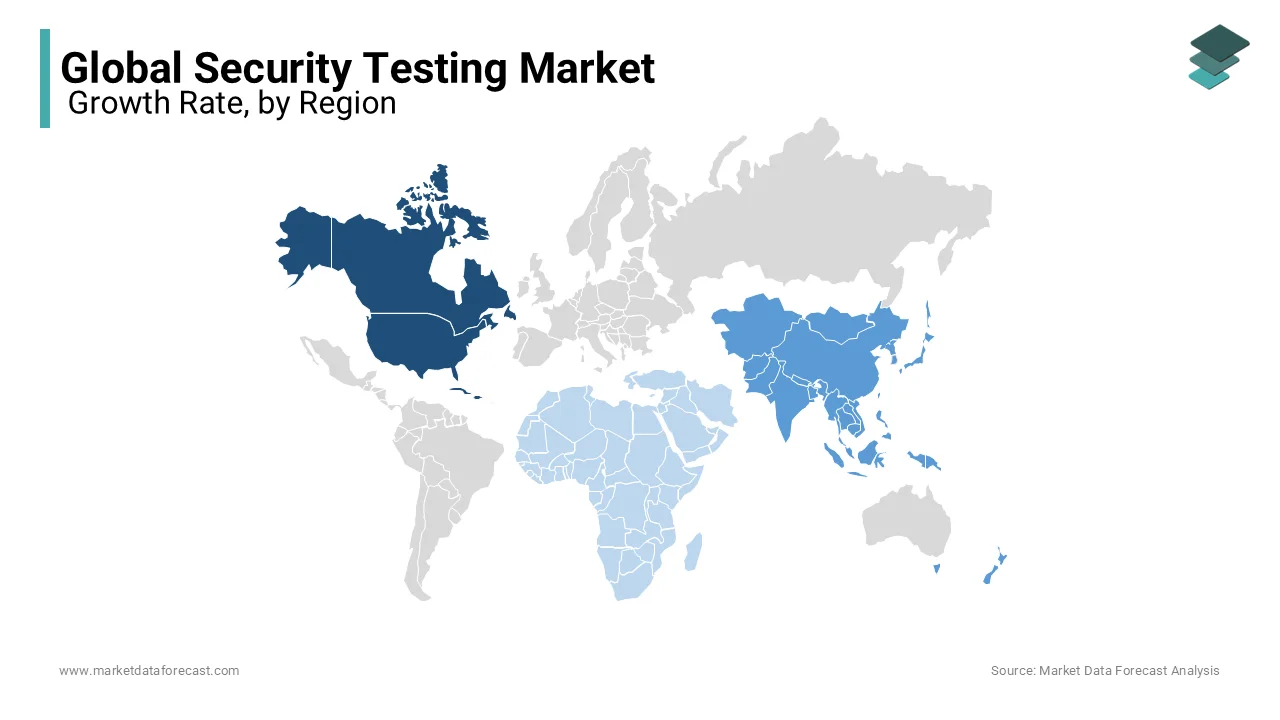
| By Region | North America (leads the global market by value and volume backed by heavy tech concentration) | Asia-Pacific (fastest-growing regional market driven by rapid digitalization, economic development, and skilled tech talent) |
Major Market Players & Market Structure
Market Structure: Highly competitive global cybersecurity and testing ecosystem featuring major IT service conglomerates, specialized security vendors, and tech giants competing on automated vulnerability detection, AI integrations, and cloud flexibility.
Key Companies: Capgemini SE, Cisco Systems Inc., Wipro Limited, Hewlett Packard Enterprise, IBM Corporation, Qualys Inc., Accenture, Cognizant, Infosys Limited, Tata Consultancy Services Limited, McAfee, Veracode, Checkmarx, and Intertek Group Plc.
 Download Free Sample Report
Global Security Testing Market Size
The global security testing market was worth USD 9.82 billion in 2025. The global market is predicted to reach USD 11.86 billion in 2026 and USD 53.55 billion by 2034, growing at a CAGR of 20.74% from 2026 to 2034.
Security testing is the systematic evaluation of software applications and network infrastructures to identify vulnerabilities before malicious exploitation occurs. This discipline integrates automated scanning with manual penetration testing to ensure comprehensive threat detection across digital ecosystems. According to the European Union Agency for Cybersecurity, nearly 4,900 cybersecurity incidents were documented across the European Union between July 2024 and June 2025, which underscores the critical necessity for robust security validation protocols. According to the International Organization for Standardization, global enterprises maintain varying degrees of security testing frameworks as per ISO 27001 standards, indicating substantial gaps in current protective measures. These statistics reveal an urgent demand for specialized testing services that address both regulatory compliance and practical threat mitigation needs. Organizations increasingly recognize that traditional perimeter defenses prove insufficient against sophisticated attack vectors targeting application layers. The market responds by offering continuous integration security testing that aligns with modern DevOps practices. Enterprises require solutions that detect zero-day vulnerabilities while maintaining operational efficiency during development cycles. Security testing thus serves as a fundamental component of digital risk management strategies rather than merely a compliance checkbox. The evolving threat landscape necessitates adaptive testing methodologies that evolve alongside emerging technologies and attack techniques.
MARKET DRIVERS
Escalating Regulatory Compliance Requirements
Regulatory mandates compel organizations to implement rigorous security testing protocols to avoid severe financial penalties and reputational damage, which primarily fuels the security testing market expansion. The General Data Protection Regulation imposes fines reaching 20 million euros or 4% of annual global turnover, whichever is higher, for non-compliant entities handling personal data. The European Banking Authority mandated that all financial institutions operating within the European Economic Area conduct rigorous security assessments to ensure resilience against evolving cyber threats. These stringent requirements force enterprises to invest heavily in automated and manual security testing solutions that provide documented evidence of compliance. Organizations cannot rely on ad hoc testing approaches when facing audits from multiple regulatory bodies simultaneously. The healthcare sector faces additional pressure as the European Medicines Agency requires medical device manufacturers to demonstrate cybersecurity validation through penetration testing before granting market approval. Insurance companies now demand proof of regular security testing before issuing cyber liability policies, which creates another layer of market demand. Legal departments increasingly collaborate with IT security teams to ensure testing protocols satisfy both technical and legal standards. The complexity of overlapping regulations across different jurisdictions necessitates specialized testing platforms that can generate jurisdiction-specific compliance reports. This regulatory pressure transforms security testing from an optional best practice into a mandatory business requirement that drives consistent market growth regardless of economic conditions.
Rising Frequency of Sophisticated Cyber Attacks Accelerates Market Demand
The increasing sophistication and frequency of cyberattacks create an imperative for continuous security testing that identifies vulnerabilities before attackers exploit them, which is further boosting the global security testing market expansion. According to the European Union Agency for Cybersecurity, distributed denial-of-service attacks accounted for 77% of reported threat cases, while ransomware remained a highly damaging threat during the 2024 to 2025 reporting period. According to the ENISA Threat Landscape report, supply chain vulnerabilities and third-party software dependencies emerged as primary channels as attackers increasingly targeted vendors to gain access to larger organizational networks. These trends render periodic annual testing insufficient as vulnerabilities emerge daily within complex software ecosystems. Organizations recognize that static security measures fail against dynamic attack techniques that evolve rapidly. Financial institutions report that successful breaches incur massive remediation expenses and regulatory fines, making preventive testing economically advantageous. The rise of artificial intelligence-powered attack tools enables criminals to identify and exploit vulnerabilities faster than traditional manual testing can detect them. This acceleration forces enterprises to adopt automated security testing integrated within continuous deployment pipelines. Development teams require real-time feedback on security flaws to prevent vulnerable code from reaching production environments. The competitive advantage shifts toward organizations that can release secure software rapidly while maintaining robust protection against advanced persistent threats. Security testing thus becomes a strategic capability rather than merely a technical function, driving sustained investment in advanced testing platforms and skilled personnel.
MARKET RESTRAINTS
Shortage of Qualified Security Testing Professionals
The acute shortage of qualified security testing professionals severely limits the ability of organizations to implement comprehensive security validation programs effectively, which is impeding global market growth. According to the European Centre for Cybersecurity Competence, European organizations frequently report severe skills shortages and struggle to fill specialized security testing positions despite offering competitive compensation packages. According to the International Information System Security Certification Consortium annual survey, the global cybersecurity workforce gap remains substantial, with security testing specialists representing some of the most difficult roles to fill. This talent scarcity forces enterprises to delay security testing initiatives or rely on incomplete automated solutions that lack human expertise for complex vulnerability identification. Junior testers often miss nuanced logical flaws that experienced professionals detect through manual exploration of application behavior. Training programs require 18 to 24 months to produce competent security testers capable of handling enterprise-level applications, which slows market expansion. Organizations face high employee turnover rates as trained professionals receive frequent recruitment offers from competitors. The knowledge transfer process becomes challenging when senior testers depart, taking institutional knowledge about specific application architectures with them. Small and medium enterprises particularly suffer as they cannot compete with large corporations offering premium salaries and benefits. This constraint forces many organizations to outsource security testing, but introduces additional risks related to data confidentiality and quality control. The talent shortage thus creates a bottleneck that prevents the security testing market from achieving its full potential despite strong demand drivers.
High Implementation Costs Deter Small and Medium Enterprise Adoption
Prohibitive implementation costs prevent small and medium enterprises from adopting comprehensive security testing solutions despite facing similar threat landscapes as larger organizations, which is further hampering the security testing market expansion. According to the European Commission Small Business Survey, a significant majority of small and medium enterprises consider security testing expenses unaffordable relative to their annual IT budgets. According to pricing data published by the European Software Testing Association, enterprise-grade security testing platforms require substantial initial investments for software licensing plus ongoing annual maintenance costs. These costs include not only software licenses, but also hardware infrastructure upgrades necessary to support resource-intensive scanning operations. Small businesses typically allocate less than 5% of their total IT budget to security measures, which proves insufficient for proper testing coverage. The return on investment remains difficult to quantify for smaller organizations that lack dedicated security teams to interpret test results and implement remediation measures. Many small and medium enterprises resort to free or low-cost scanning tools that provide limited coverage and generate excessive false positives requiring manual verification. The complexity of integrating security testing into existing development workflows demands additional consulting services that further increase total cost of ownership. Budget constraints force prioritization decisions that often deprioritize security testing in favor of immediate business functionality improvements. This financial barrier creates a significant market segment that remains underserved despite growing awareness of cybersecurity risks among smaller enterprises.
MARKET OPPORTUNITIES
Integration of Artificial Intelligence Creates New Testing Capabilities
Artificial intelligence integration presents promising opportunities for security testing markets by enabling predictive vulnerability detection and automated remediation suggestions that surpass traditional testing limitations. According to trials evaluated across European enterprise deployment studies, artificial intelligence-powered security testing tools significantly reduce vulnerability detection time compared to conventional methods. Machine learning algorithms analyze historical vulnerability patterns to predict likely weakness locations within new code deployments before traditional scanners identify them. This predictive capability allows development teams to address security flaws during the coding phase rather than after deployment when remediation costs increase exponentially. Natural language processing enables security testing platforms to interpret developer comments and documentation to understand intended application behavior and identify deviations that may indicate security flaws. According to European Research Council-funded digital projects, advanced code analysis systems achieve high accuracy in identifying vulnerabilities by analyzing code structure patterns across open-source repositories. Automated remediation suggestions reduce the burden on security teams by providing specific code fixes rather than merely flagging potential issues. Continuous learning capabilities enable these systems to adapt to new attack techniques without requiring manual rule updates from vendors. Organizations gain the ability to scale security testing efforts without proportionally increasing staff requirements as artificial intelligence handles routine scanning tasks. This technological advancement opens new market segments, including continuous security monitoring services that operate alongside traditional periodic testing engagements.
Expansion of Cloud-Native Application Development Opens Testing Markets
The rapid expansion of cloud-native application development creates substantial opportunities for security testing providers specializing in containerized and microservices architectures. According to the European Cloud Computing Association, a vast majority of new enterprise applications deployed in Europe utilize cloud-native architectures requiring specialized security testing approaches distinct from traditional monolithic application testing. Container orchestration platforms introduce unique vulnerability surfaces, including misconfigured permissions, insecure image registries, and inter-service communication weaknesses that traditional testing tools fail to address adequately. Security testing providers develop specialized modules for Kubernetes environments that validate network policies, pod security contexts, and runtime behavior dynamically. The shift toward serverless computing eliminates traditional perimeter defenses, requiring testing focused on function-level permissions and event-driven attack vectors. Multi-cloud deployments complicate security testing as each cloud provider implements different security controls and configuration options, requiring testing platforms with broad compatibility. According to the European Digital Innovation Hub network, organizations migrating to cloud-native architectures experience notable security incidents during the first year unless they implement continuous security testing specifically designed for distributed systems. Testing providers offer managed services that monitor cloud configurations continuously, detecting drift from secure baselines automatically. This market expansion includes opportunities for compliance testing, ensuring cloud deployments meet industry-specific regulatory requirements across different geographic regions. The complexity of cloud-native security creates demand for specialized expertise that generalist security testing firms cannot provide easily.
MARKET CHALLENGES
Rapid Evolution of Attack Techniques Challenges Testing Methodologies
The rapid evolution of attack techniques continuously challenges security testing methodologies, requiring constant adaptation that strains organizational resources and testing tool capabilities. According to the European Union Agency for Cybersecurity, numerous new attack vectors targeting web applications emerge regularly, requiring security testing platforms to update detection signatures frequently to remain effective. Traditional signature-based testing approaches fail against novel attack techniques that do not match known patterns, leaving organizations vulnerable until testing vendors release updates. Zero-day exploits targeting popular frameworks emerge frequently, with widespread components harboring critical flaws undetected for years. Security testing teams struggle to maintain expertise across the expanding array of technologies, including blockchain smart contracts, Internet of Things protocols, and quantum-resistant cryptography implementations. According to the ENISA Threat Intelligence Report, the average time between vulnerability discovery and weaponization remains compressed, limiting the window available for testing and remediation. Automated testing tools generate overwhelming volumes of findings requiring manual triage that delays critical vulnerability resolution. False positive rates exceeding 40% in some testing platforms waste valuable analyst time investigating non-issues while genuine threats remain unaddressed. The complexity of modern application architectures combining legacy systems with new technologies creates integration challenges that testing tools handle inconsistently. Organizations face difficulty validating whether their testing coverage remains adequate against emerging threats without conducting expensive red team exercises regularly.
Complexity of Modern Application Architectures Complicates Testing Coverage
The increasing complexity of modern application architectures complicates comprehensive security testing coverage, which is creating blind spots that attackers exploit successfully. According to the European Software Architecture Forum, typical enterprise applications integrate numerous different third-party application programming interfaces, each introducing potential security weaknesses that testing must validate individually. Microservices architectures distribute functionality across hundreds of independent services communicating through various protocols, making it difficult to trace data flows and identify injection points comprehensively. Legacy system integration adds further complexity as older applications lack modern security controls yet remain critical to business operations, requiring careful testing to prevent exposure. According to the European Information Systems Security Journal, a majority of successful breaches exploit vulnerabilities in integration points between systems rather than within individual applications themselves. Testing tools struggle to maintain context across distributed systems, leading to incomplete vulnerability identification, especially for business logic flaws that require understanding of multi-step transaction flows. Containerized environments introduce ephemeral components that exist briefly, making traditional scanning approaches ineffective for capturing transient vulnerabilities. Application programming interface security testing requires understanding of authentication mechanisms, rate limiting, and data validation rules that vary significantly across different service implementations. The sheer volume of code dependencies in modern applications exceeds human capacity for manual review, forcing reliance on automated tools that lack contextual understanding. Organizations face difficulty prioritizing remediation efforts when testing reveals thousands of potential vulnerabilities across complex interconnected systems without clear visibility into actual exploitability.
REPORT COVERAGE
| REPORT METRIC | DETAILS |
| Market Size Available | 2025 to 2034 |
| Base Year | 2025 |
| Forecast Period | 2026 to 2034 |
| Segments Covered | By Type, Tool, Deployment Mode, Organization Size, Vertical, Region. |
| Various Analyses Covered | Global, Regional, and Country-Level Analysis, Segment-Level Analysis, Drivers, Restraints, Opportunities, Challenges; PESTLE Analysis; Porter’s Five Forces Analysis, Competitive Landscape, Analyst Overview of Investment Opportunities |
| Regions Covered |
|
| Market Leaders Profiled | Capgemini SE, Cisco Systems Inc., Wipro Limited, Hewlett Packard Enterprise, Valency Networks Pvt Ltd, IBM Corporation, Hexaware Technologies Limited, Qualys Inc., Symetrics, WhiteHat Security, Rapid7, Beyond Security, TraceSecurity, Applause App Quality Inc., Accenture, Cognizant Technology Solutions Corp, Rohde & Schwarz UK Ltd, Infosys Limited, CloudBees, Tata Consultancy Services Limited, McAfee, Veracode, Zensar Technologies Limited, Checkmarx, PortSwigger, UL LLC, Cenzic, Intertek Group Plc, and others. |
SEGMENTAL ANALYSIS
By Type Insights
The application security testing segment dominated by holding the major share of the global market in 2025 due to the critical vulnerability of software interfaces in modern digital ecosystems. According to the European Union Agency for Cybersecurity, a significant share of successful cyber breaches originates from application layer vulnerabilities rather than network perimeter failures. This statistic highlights the urgent need for specialized testing tools that scrutinize code logic and data handling processes within web and mobile applications. According to the International Organization for Standardization, enterprises deploying continuous application security testing significantly reduced their mean time to remediate critical flaws compared to those relying on periodic assessments. These figures demonstrate the operational efficiency gained through integrated application testing frameworks. Organizations prioritize this segment because applications serve as the primary interaction point for customers and partners, making them attractive targets for data theft and service disruption. The complexity of modern application architectures involving multiple third-party application programming interfaces and microservices necessitates rigorous validation protocols that network scanning alone cannot provide. Regulatory mandates such as the General Data Protection Regulation impose strict requirements on data processing integrity, which application testing directly addresses by identifying insecure coding practices. The shift toward DevSecOps methodologies further accelerates adoption as development teams require automated testing tools that integrate seamlessly into continuous integration pipelines. This segment leads because it offers proactive defense mechanisms that prevent vulnerabilities from reaching production environments, thereby reducing overall risk exposure and compliance liabilities for enterprises across various industries.

On the other hand, the device security testing segment is estimated to exhibit the highest CAGR of 17.7% over the forecast period in the global market owing to the exponential proliferation of Internet of Things devices in industrial and consumer sectors. According to the European Telecommunications Standards Institute, the number of connected devices in Europe surpassed billions of units, creating an expanded attack surface that requires specialized validation protocols. This massive deployment volume necessitates robust testing frameworks capable of identifying firmware vulnerabilities and insecure communication protocols inherent in embedded systems. According to the Industrial Internet Consortium, many industrial Internet of Things deployments lack adequate security testing, leading to significant operational risks in critical infrastructure sectors. These statistics underscore the urgent demand for device-specific testing solutions that address unique hardware constraints and real-time operating system requirements. The expansion of smart city initiatives and autonomous vehicle technologies further accelerates growth as these systems rely heavily on secure device interactions to ensure public safety and service reliability. Manufacturers face increasing pressure from regulatory bodies to demonstrate device security compliance before market entry, which drives investment in comprehensive testing services. The emergence of 5G networks enables faster data transmission, but also introduces new vulnerability vectors that device testing must address to prevent unauthorized access and data interception. This segment grows rapidly because traditional application and network testing methods fail to account for the physical and firmware-level weaknesses present in connected hardware ecosystems.
By Tool Insights
The automated testing segment led the market by capturing the largest share of the global market in 2025 due to its ability to provide rapid and scalable vulnerability detection across complex software environments. According to the European Software Testing Association, organizations utilizing automated testing tools achieved significantly faster identification of common vulnerabilities compared to manual testing methods. This efficiency gain is crucial for enterprises managing large codebases and frequent release cycles where manual inspection proves impractical and cost-prohibitive. According to the International Information System Security Certification Consortium, a vast majority of high-volume development teams rely primarily on automated scanners to maintain baseline security standards during continuous integration processes. These figures illustrate the indispensable role of automation in modern software development lifecycles. Automated tools offer consistent coverage by executing predefined test cases repeatedly without human fatigue, ensuring that regression issues are caught early in the development phase. The integration of artificial intelligence enhances these tools by reducing false positive rates and prioritizing findings based on exploitability potential, which improves analyst productivity. Enterprises favor automated solutions because they provide measurable metrics and detailed reports that satisfy audit requirements and facilitate compliance documentation. The scalability of automated platforms allows organizations to test thousands of endpoints simultaneously, which is essential for cloud-native architectures and distributed systems. This segment leads because it balances speed, accuracy, and cost-effectiveness, making it the foundational tool for most enterprise security programs seeking to manage risk efficiently.
On the other end, the code review tools segment is predicted to register the fastest CAGR of 20.3% over the forecast period in the global market owing to the shift-left security movement and developer-centric security practices. According to the European DevOps Alliance, a large percentage of software development teams integrated static code analysis into their integrated development environments to detect security flaws before compilation. This trend reflects the growing recognition that fixing vulnerabilities during the coding phase is significantly cheaper and less disruptive than post-deployment remediation. According to the Open Web Application Security Project, early code review interventions reduce the cost of vulnerability remediation significantly compared to addressing issues in production environments. These statistics highlight the economic incentive driving adoption of advanced code review platforms. Modern code review tools leverage machine learning to understand context and intent, enabling them to identify logical flaws and business logic errors that traditional pattern-matching scanners miss. The rise of open-source software usage necessitates rigorous code review to ensure that third-party libraries do not introduce hidden vulnerabilities into proprietary applications. Developers prefer these tools because they provide immediate feedback within their workflow, reducing context switching and improving code quality overall. Regulatory requirements for software bill of materials further accelerate growth as organizations need detailed code provenance and vulnerability tracking capabilities. This segment grows rapidly because it empowers developers to take ownership of security while providing security teams with higher-quality code for subsequent testing stages.
By Deployment Mode Insights
The cloud deployment segment led the market by holding the leading share of the global market in 2025 due to its scalability, ease of maintenance, and alignment with modern hybrid infrastructure strategies. According to the European Cloud Computing Association, a strong majority of enterprises preferred cloud-based security testing solutions to avoid the capital expenditure associated with on-premises hardware upgrades. This preference stems from the ability of cloud platforms to offer instant access to the latest threat intelligence updates and testing signatures without requiring manual patching or version management. According to industry data provider metrics, cloud-deployed security testing tools reduced total cost of ownership for mid-sized organizations by eliminating the need for dedicated server infrastructure and specialized IT staff. These financial benefits make cloud solutions particularly attractive for organizations seeking to optimize operational budgets while maintaining robust security postures. Cloud platforms enable seamless collaboration among distributed security teams by providing centralized dashboards and shared reporting capabilities accessible from any location. The elasticity of cloud resources allows organizations to scale testing capacity dynamically during peak development periods or major release cycles without performance degradation. Integration with other cloud-native services, such as container registries and serverless functions, simplifies the security testing workflow for modern application architectures. Regulatory concerns regarding data sovereignty are increasingly addressed through region-specific cloud data centers that comply with local privacy laws. This segment leads because it offers flexibility, cost efficiency, and continuous innovation that on-premises solutions struggle to match in terms of update frequency and feature availability.
However, the on-premises deployment segment experiences significant growth and is projected to grow at a CAGR of 13.3% over the forecast period in the global market owing to the stringent data sovereignty requirements and security concerns in highly regulated industries. The European Banking Authority mandated that financial institutions handling sensitive customer data maintain full control over security testing infrastructure, including data storage and processing locations. This regulatory pressure forces banks and insurance companies to invest in robust on-premises testing solutions that ensure no data leaves their controlled environment during vulnerability assessments. According to the European Healthcare Data Protection Forum, a vast majority of hospitals and healthcare providers prefer on-premises security testing tools to comply with strict patient privacy regulations and avoid potential cloud data breach liabilities. These statistics highlight the critical role of data control in driving on-premises adoption. Organizations in defense and government sectors also prioritize on-premises deployments to protect classified information from potential external threats associated with cloud connectivity. Advances in virtualization technology have improved the performance and manageability of on-premises solutions, making them more competitive with cloud alternatives in terms of resource utilization. The desire for customized testing configurations and integration with legacy systems that cannot easily connect to cloud platforms further supports this growth. This segment grows because it provides the highest level of data security and regulatory compliance assurance for organizations operating in sectors where data leakage poses existential risks.
REGIONAL ANALYSIS
North America Security Testing Market Analysis
North America dominated the market by capturing the highest share of the global market in 2025 and is expected to maintain its position as the largest regional market for security testing due to advanced technological infrastructure and high awareness of cybersecurity risks among enterprises. According to the National Institute of Standards and Technology, a vast majority of large corporations in the United States implemented continuous security testing protocols to comply with federal cybersecurity directives and industry standards. This high adoption rate is driven by the presence of major technology companies and financial institutions that face sophisticated cyber threats targeting intellectual property and customer data. According to cybersecurity incident summaries, ransomware attacks against North American organizations increased notably, prompting greater investment in proactive security validation measures. These statistics reflect the urgent need for robust testing capabilities to mitigate financial and reputational damage from successful breaches. The region benefits from a mature ecosystem of security vendors, research institutions, and skilled professionals who drive innovation in testing methodologies and tools. Regulatory frameworks such as the California Consumer Privacy Act impose strict penalties for data mishandling, which encourages organizations to adopt comprehensive testing programs. The widespread adoption of cloud computing and DevOps practices in North America further accelerates demand for automated and integrated security testing solutions. Government initiatives promoting cybersecurity workforce development help address talent shortages and support market growth. This region leads due to its early adoption of advanced security practices and substantial investment in research and development activities.
Europe Security Testing Market Analysis
Europe represents a significant and rapidly evolving market for security testing characterized by strict regulatory frameworks and a strong emphasis on data privacy protection. According to the European Union Agency for Cybersecurity, a substantial percentage of organizations in the European Union experienced significant cyber incidents, highlighting the pervasive nature of digital threats across the region. This high incidence rate drives demand for comprehensive security testing services that ensure compliance with the General Data Protection Regulation and other sector-specific mandates. According to European supervisory banking findings, financial institutions in Europe increased their security testing budgets to meet enhanced supervisory expectations and protect against sophisticated financial fraud schemes. These investments reflect the critical importance of security validation in maintaining trust in digital financial services. The region benefits from collaborative initiatives such as the European Cybersecurity Competence Centre and various national digital innovation hubs that support secure digital transformation.
COMPETITIVE LANDSCAPE
The Security Testing Market exhibits intense competition characterized by rapid technological innovation and frequent strategic consolidations among established vendors and emerging specialists. Large enterprise software companies leverage their existing customer bases to cross-sell security testing modules while specialized firms differentiate through superior detection accuracy and developer-friendly interfaces. Competition intensifies as vendors integrate artificial intelligence capabilities to automate vulnerability prioritization and remediation suggestions, reducing reliance on scarce human expertise. Price pressure increases due to the proliferation of open-source security testing tools that offer basic functionality without licensing costs, forcing commercial vendors to demonstrate clear value advantages. Regional competitors gain traction by offering localized compliance support and language-specific documentation appealing to organizations operating under strict data sovereignty regulations. The barrier to entry remains moderate for basic scanning tools but high for comprehensive platforms requiring extensive threat intelligence databases and multi-protocol support. Customer retention depends heavily on integration ease with existing development workflows and the ability to provide actionable insights rather than overwhelming vulnerability lists. Strategic alliances with DevOps tool providers become critical differentiators as organizations seek seamless security integration within continuous delivery pipelines. Innovation cycles accelerate as vendors respond to emerging attack vectors targeting cloud native architectures and application programming interfaces, requiring constant feature updates.
KEY MARKET PLAYERS
The leading companies operating in the global security testing market include:
- Capgemini SE
- Cisco Systems Inc.
- Wipro Limited
- Hewlett Packard Enterprise
- Valency Networks Pvt Ltd
- IBM Corporation
- Hexaware Technologies Limited
- Qualys Inc.
- Symetrics
- WhiteHat Security
- Rapid7
- Beyond Security
- TraceSecurity
- Applause App Quality Inc.
- Accenture
- Cognizant Technology Solutions Corp.
- Rohde & Schwarz UK Ltd
- Infosys Limited
- CloudBees
- Tata Consultancy Services Limited
- McAfee
- Veracode
- Zensar Technologies Limited
- Checkmarx
- PortSwigger
- UL LLC
- Cenzic
- Intertek Group Plc
TOP PLAYERS IN THE MARKET
- Rapid7 maintains a dominant position through its comprehensive vulnerability management platform that integrates asset discovery with continuous security testing capabilities. The company recently enhanced its InsightVM solution with advanced threat intelligence feeds that prioritize vulnerabilities based on real-world exploitability rather than theoretical risk scores. Rapid7 expanded its global partner ecosystem by collaborating with major cloud service providers to offer native security testing integrations for hybrid infrastructure environments. Their commitment to open standards allows seamless integration with existing development tools, which appeals to enterprises seeking flexible security architectures. The organization invests heavily in research and development to automate remediation workflows, reducing the burden on security teams while accelerating patch deployment cycles across complex networks.
- Veracode specializes in application security testing with a strong focus on static and dynamic analysis integrated directly into software development pipelines. The company launched enhanced software composition analysis features that detect open-source vulnerabilities early in the coding process, preventing downstream security issues. Veracode strengthened its market presence by introducing machine learning-powered fix recommendations that help developers resolve security flaws without extensive manual intervention. Their platform supports multiple programming languages and frameworks, ensuring broad compatibility for diverse enterprise development environments. Recent partnerships with leading DevOps tool vendors enable automated security gates within continuous integration workflows, promoting shift-left security practices among engineering teams globally.
- Qualys delivers cloud-based security and compliance solutions with robust web application scanning and penetration testing capabilities tailored for large enterprises. The company introduced artificial intelligence-driven prioritization engines that correlate vulnerability data with threat intelligence to highlight critical risks requiring immediate attention. Qualys expanded its container security offerings to address the growing adoption of Kubernetes and microservices architectures in modern application deployments. Their unified platform approach consolidates vulnerability management, compliance monitoring, and policy enforcement into a single interface, simplifying security operations for distributed organizations. Recent enhancements include automated API security testing modules that validate authentication mechanisms and data exposure risks across complex service-oriented architectures.
TOP STRATEGIES USED BY KEY MARKET PARTICIPANTS
Key players in the Security Testing Market employ strategic acquisitions to expand their technological capabilities and broaden their service portfolios rapidly. Companies actively invest in artificial intelligence and machine learning technologies to enhance automated vulnerability detection accuracy and reduce false positive rates significantly. Partnerships with cloud service providers enable seamless integration of security testing tools into native development environments, facilitating continuous security validation processes. Organizations focus on developing unified platforms that consolidate multiple testing methodologies, including static analysis, dynamic scanning, and interactive application security testing, into cohesive solutions. Expansion into emerging markets through localized support centers and region-specific compliance features helps vendors capture growth opportunities in underserved geographic segments. Continuous innovation in application programming interface security testing addresses the rising demand for protecting distributed microservices architectures. Investment in professional services and managed security testing offerings provides additional revenue streams while addressing the global shortage of qualified security personnel. These strategies collectively strengthen competitive positioning by delivering comprehensive, scalable, and efficient security validation solutions that meet evolving enterprise requirements.
MARKET SEGMENTATION
This research report on the global security testing market has been segmented and sub-segmented based on the type, tool, deployment mode, organization size, industry, and region.
By Type
- Network
- Application
- Device
By Tool
- Penetration Testing
- Web Testing
- Automated Testing
- Code Review
By Deployment Mode
- Cloud
- On-Premises
By Organization Size
- SMEs
- Large Enterprises
By Industry
- Government and Public Utilities
- BFSI
- Healthcare
- IT & Telecom
- Others.
By Region
- Latin America
- Europe
- Asia Pacific
- North America
- Middle East & Africa.