- Product Description Description
- Table of Contents TOC
- List of Table & Figure LOT
- Get Free Sample PDF Sample PDF
Market Size, 2025
$9.94 BnMarket Estimate, 2026
$10.45 BnMarket Forecast, 2034
$15.63 BnCAGR, 2026–2034
5.16%Europe Nickel Market Size
The Europe nickel market size was valued at USD 9.94 billion in 2025 and is projected to reach USD 15.63 billion by 2034 from USD 10.45 billion in 2026, growing at a CAGR of 5.16%.
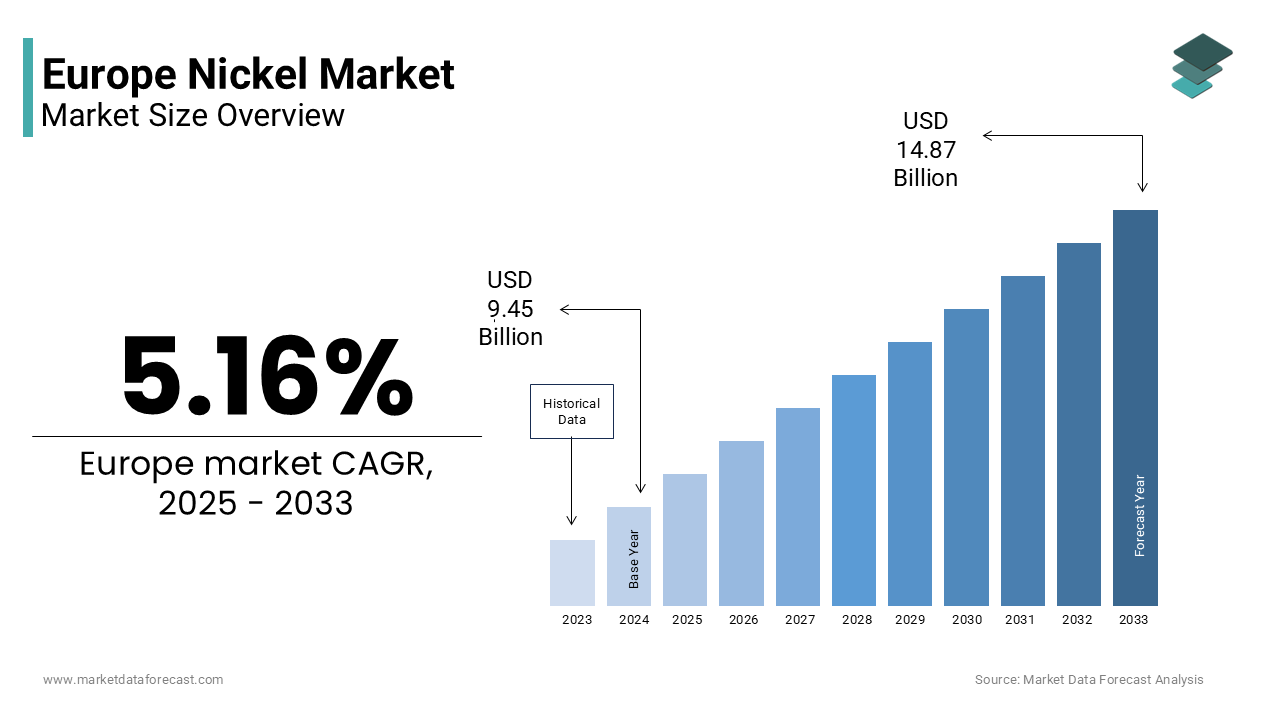
Nickel is used across industrial sectors including stainless steel production, electric vehicle batteries, aerospace alloys and electroplating. Nickel is a lustrous silvery white metal valued for its corrosion resistance high temperature stability and catalytic properties. Within Europe it serves as a critical enabler of both traditional manufacturing and the clean energy transition. In 2023, the European Union consumed large volumes of refined nickel, which indicates its entrenched role in industrial value chains. The region does not possess significant primary nickel reserves and relies heavily on imports, with the majority of its nickel raw materials sourced from third countries according to the European Commission’s Critical Raw Materials Act assessment. Environmental and social governance concerns in major supplying nations such as Indonesia and the Philippines have intensified scrutiny over supplychain integrity. Concurrently, the European Battery Regulation mandates traceability and sustainability criteria for battery metals including nickel, placing new compliance burdens on downstream users. Against this backdrop nickel has been formally designated a critical raw material under EU legislation due to its economic importance and supply vulnerability, underscoring its strategic relevance to Europe’s industrial sovereignty and decarbonization objectives.
MARKET DRIVERS
Surge in ElectricVehicle Battery Production Drives Nickel Demand
Europe’s rapid EV rollout has sharply increased demand for highpurity nickel used in lithiumion cathodes, especially nickelrich chemistries, which is primarily driving the growth of the Europe nickel market. EU production of battery electric and plugin hybrid vehicles reached 2.3 million units in 2023, roughly three times the 2020 level. Typical battery packs require about 13 kg of nickel per vehicle, with larger models using up to 20 kg. New gigafactories are scaling toward a combined capacity exceeding 500 GWh by 2030, which implies an annual nickel requirement in the tens of thousands of tonnes (Benchmark estimates exceed 65,000 t by 2026 for cell production alone). Policy levers such as the Net Zero Industry Act further incentivise local cell manufacturing tied to responsibly sourced inputs. Nickel has therefore become a strategic raw material for Europe’s electrified mobility transition, making supplychain resilience a core industrial priority.
StainlessSteel Industry Remains a Structural Pillar of Nickel Consumption
Beyond batteries, stainless steel continues to underpin the largest and most stable share of nickel demand in Europe, which is further boosting the expansion of the Europe nickel market. Europe’s annual stainlesssteel output is about 9 million tonnes, concentrated in hubs such as Germany, Italy and Finland, and dominated by austenitic grades that rely on nickel for ductility and corrosion resistance. These grades are essential to construction, food processing and chemical sectors where performance cannot be easily compromised. In 2023 the stainless sector consumed an estimated ~400,000 tonnes of nickel, creating a durable baseline demand that cushions market volatility and cements nickel’s role as both a legacy industrial metal and a strategic resource for future technologies.
MARKET RESTRAINTS
Geopolitical Concentration of Global Nickel Supply Chains
Europe’s nickel security is exposed by the geographic concentration of global mining and refining, which is hindering the growth of the Europe nickel market. Indonesia supplied about 52% of mined nickel in 2023 and has tightened ore exports to favour domestic processing, which is disrupting traditional supply routes. China controls a majority of nickelsulfate refining capacity, which is leaving Europe dependent on intermediates with higher carbon footprints and limited battery suitability. The EU’s Critical Raw Materials assessments flag nickel as a highvulnerability commodity, and trade measures such as carbonadjustment mechanisms could further complicate sourcing. Without diversified, nearshore refining and strategic stockpiles, Europe remains vulnerable to export restrictions, logistical shocks and geopolitical leverage from dominant producer nations.
Stringent Environmental and Permitting Constraints on Primary Production
Ambitious environmental standards and lengthy permitting processes limit Europe’s ability to expand domestic nickel mining and refining, which is further hampering the nickel market expansion in Europe. Nickel extraction from sulfide and laterite ores generates sulfur emissions, acid drainage and large tailings volumes, all subject to strict oversight under EU environmental directives. Highprofile closures and protracted permitting indicate regulatory and social hurdles. The EU taxonomy and emissions thresholds further restrict green financing for conventional upstream projects unless very low CO₂ footprints are demonstrated. These constraints deter upstream investment, forcing continued reliance on imports that may not satisfy forthcoming duediligence and sustainability requirements.
MARKET OPPORTUNITIES
Development of Nickel Recycling Infrastructure Under Circular Economy Mandates
The EU’s Circular Economy Action Plan creates a clear pathway to reduce reliance on primary nickel through advanced endoflife recovery systems, which is a notable opportunity in the Europe nickel market. Nickel’s recyclability without loss of properties enables repeated reuse across stainless steel and battery applications. In 2023 the EU recovered roughly 320,000 tonnes of nickel, largely from stainless scrap, and forthcoming rules such as the EndofLife Vehicles and Battery Regulations set minimum recycledcontent targets (16% nickel in new batteries by 2031). Industrial actors are scaling closedloop capabilities: hydrometallurgical plants under development in Belgium and Germany aim to recover over 95% of nickel from battery black mass, and publicprivate initiatives are funding recycling R&D and capacity expansion. With millions of EVs reaching endoflife over the next decade, Europe’s urban mine could supply a material share of future battery nickel demand, strengthen resource sovereignty while lower lifecycle emissions.
Integration of Nickel into Green Hydrogen Catalyst Technologies
Nickel is emerging as a key material for green hydrogen systems, which is expanding demand beyond batteries and alloys and is a major opportunity in the Europe nickel market. Nickelbased catalysts and electrode components are attractive for alkaline and anionexchange membrane electrolyzers because they offer high activity, stability and cost advantages versus platinumgroup metals. Largescale electrolyzer deployment targets and public funding for hydrogen infrastructure are driving demand for nickel mesh, foam and alloy components, while nickel alloys are also specified for highpressure hydrogen storage and transport due to favourable resistance to hydrogen embrittlement. As green hydrogen scales to decarbonize heavy industry and longhaul transport, nickel’s role broadens into a multivector strategic material that supports both energy transition and industrial diversification.
MARKET CHALLENGES
Escalating Pressure to Decarbonize Nickel Refining Processes
Europe faces mounting pressure to align nickel refining with netzero commitments because conventional smelting is carbonintensive, which is challenging the expansion of the Europe nickel market. Pyrometallurgical processing of laterite ores produces very high CO₂ emissions per tonne of nickel, and even sulfide processing carries substantial emissions from energy and reductants. Buyers and regulators increasingly demand transparent carbon footprints and lowcarbon inputs, while frameworks such as the EU Battery Passport and corporate sustainability reporting raise the bar for acceptable supply. Lowcarbon hydrometallurgical and bioleaching routes can materially cut emissions but remain at pilot scale and require significant capital and industrial coordination to reach commercial volumes. Without targeted publicprivate investment to commercialise green refining, Europe risks carbon leakage and competitive disadvantage in nickelintensive sectors.
Complexity of Ethical Sourcing and Supply Chain Due Diligence
New humanrights and environmental duediligence obligations impose substantial operational burdens on nickel users, which is further challenging the growth of the Europe nickel market. Companies must identify, mitigate and report adverse impacts across multitier supply chains—risks that include artisanal mining abuses, water contamination and ecosystem damage in producing regions. Verifying mineoforigin and processing conditions across traders, processors and smelters requires robust digital traceability and independent assurance, capabilities that are not yet widespread. Many producers currently cannot fully trace nickel back to the mine, exposing them to reputational, legal and procurement risks under evolving EU procurement and sustainability rules. Building transparent, accountable supply chains will demand coordinated investment in traceability systems, supplier engagement and crossjurisdictional cooperation to meet regulatory expectations and secure longterm access to responsibly sourced nickel.
REPORT COVERAGE
| REPORT METRIC | DETAILS |
| Market Size Available | 2025 to 2034 |
| Base Year | 2025 |
| Forecast Period | 2026 to 2034 |
| CAGR | 5.16% |
| Segments Covered | By Application, Nickle Type, and Region |
| Various Analyses Covered | Global, Regional, & Country Level Analysis; Segment-Level Analysis; DROC, PESTLE Analysis; Porter’s Five Forces Analysis; Competitive Landscape; Analyst Overview of Investment Opportunities |
| Regions Covered | UK, France, Spain, Germany, Italy, Russia, Sweden, Denmark, Switzerland, Netherlands, Turkey, and the Czech Republic |
| Market Leaders Profiled | Glencore Plc, Vale S.A., Norilsk Nickel, BHP Group, Eramet, Anglo American Plc, Jinchuan Group International Resources Co. Ltd., South32 Limited, Sumitomo Metal Mining Co., Ltd., and Sherritt International Corporation |
SEGMENTAL ANALYSIS
By Application Insights
The stainless-steel segment was the dominant application segment in the Europe nickel market and captured 70.1% of the Europe nickel market share in 2025. The dominance of stainless-steel segment in this regional market is driven by the nickel’s irreplaceable role in stabilizing the austenitic structure of stainless steel which delivers superior corrosion resistance, ductility and performance at extreme temperatures. The segment is sustained by consistent demand from construction, food and beverage processing, chemical engineering and renewableenergy infrastructure sectors across the European Union. Germany, Italy and Sweden serve as key stainlesssteel production hubs with integrated mills relying on consistent nickel feedstock to meet European quality and safety standards. Nickel cannot be economically or technically substituted in austenitic stainlesssteel grades such as 304 and 316 which constitute the bulk of Europe’s stainless output. These grades require a minimum of roughly 8–10.5% nickel by weight to maintain their facecentred cubic crystal structure which ensures formability, weldability and resistance to stresscorrosion cracking. In the food and pharmaceutical industries where hygiene and material integrity are nonnegotiable, austenitic stainless steel is mandated under EU rules on materials in contact with food. Similarly, offshore wind turbine foundations in the North Sea commonly specify 316L stainless steel with elevated nickel content to withstand saline environments and meet long design lifespans as required by industry standards. The European stainless sector consumes a large, stable volume of nickel annually with limited shortterm elasticity. Unlike emerging applications where chemistry can be altered, nickel remains a fixed input in stainless steel, ensuring longterm demand stability regardless of price volatility or technological shifts in other sectors.
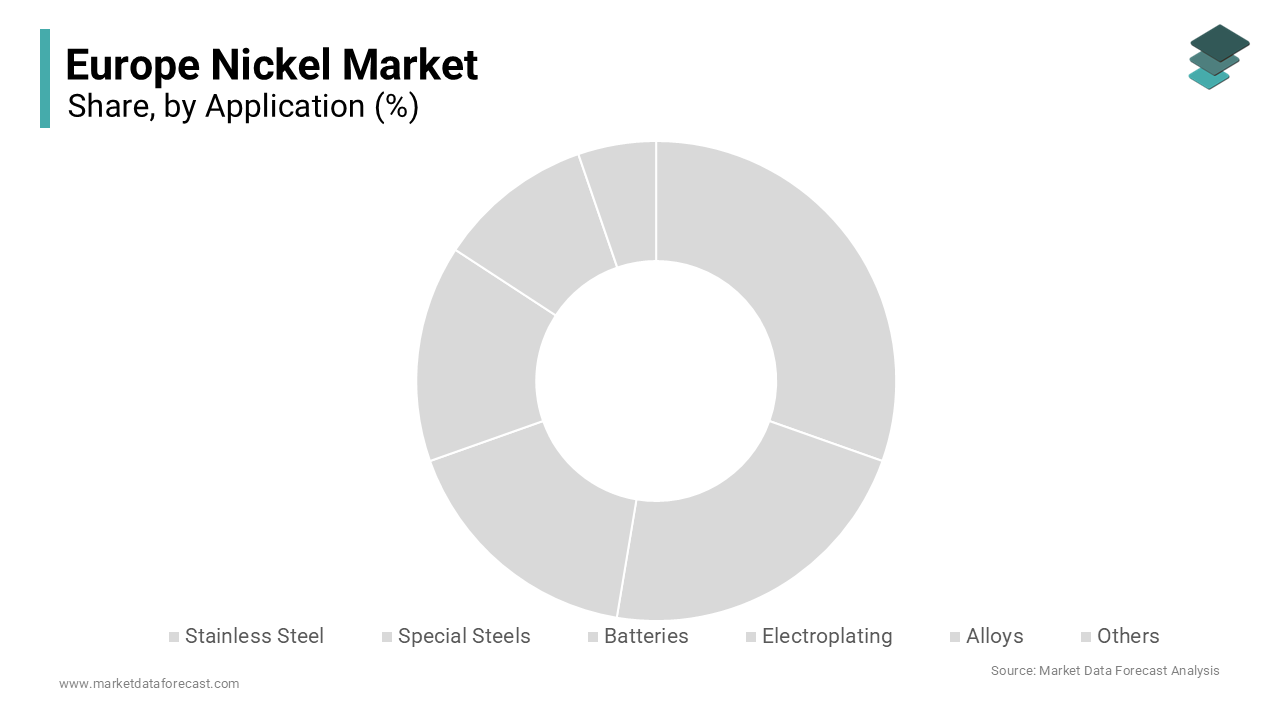
The batteries segment is the fastest growing application in the Europe nickel market and is estimated to grow at a CAGR of 22.7% over the forecast period owing to the region’s aggressive electrification of transport and energy storage coupled with the shift toward nickelrich cathode chemistries in lithiumion batteries. European battery manufacturers are increasingly adopting nickelrich cathode formulations such as highnickel NMC and NCA variants to maximize energy density and vehicle range. For instance, a marked rise in the share of new EVs and highenergy battery systems using nickelintensive chemistries in recent years. Highernickel cathodes materially increase nickel intensity per unit of battery capacity compared with older formulations, and industry massbalance studies and commercial reports quantify substantially higher nickel feedstock requirements for modern highnickel cells. Cellmaker capacity expansions and company supplychain disclosures indicate major new European facilities will require significant additional nickel volumes as they scale. The European Union’s Battery Regulation mandates carbonfootprint declarations for new EV batteries and sets minimum recycledcontent targets in coming years, creating dual pressure for both volume and sustainability. This technical and regulatory push is making nickel not just a performance enhancer but a compliance necessity in the European battery value chain.
REGIONAL ANALYSIS
Germany Nickel Market Analysis
Germany held the leading position in the European nickel market in 2025 by holding 23.2% of the regional market share. The dominance of Germany in the European market is attributed to its role as the continent’s industrial and automotive manufacturing hub. The German Raw Materials Agency reports over 125,000 metric tons of nickel consumed in 2023, primarily for stainless steel, batteryprecursor manufacture and highperformance alloy casting. Major integrated producers and specialty alloy makers such as ThyssenKrupp and VDM Metals supply aerospace and chemical processing sectors, while CATL’s Arnstadt gigafactory and BASF’s Schwarzheide cathode plant form a critical batterymaterials corridor. Federal support under the Battery Initiative and investments in closedloop recycling reinforce Germany’s central role in the European nickel value chain.
Finland Nickel Market Analysis
Finland commanded for a prominent share of the Europe nickel market in 2025. France is the EU’s primary source of mined and refined nickel. The Geological Survey of Finland records roughly 72,000 metric tons of refined nickel output in 2023 from operations such as Kevitsa and Terrafame. Lowcarbon hydropower enables some of the continent’s greenest nickel production, attracting battery investments and closedloop ecosystems that include recycling and precursor facilities. Finland’s permitting reforms and proximity to Nordic EV markets strengthen its position as a reliable, sustainabilityfocused nickel supplier.
Italy Nickel Market Analysis
Italy accounts for a notable share of the European nickel market over the forecast period. The growth of Italy in the European is likely to be driven by a worldleading stainlesssteel industry concentrated in Lombardy and Tuscany. Industry reporting indicates around 95,000 metric tons of nickel consumption in 2023, with the majority directed to stainless mills such as Acciaierie d’Italia and Outokumpu’s Terni plant. Lacking domestic ore, Italy relies on imported scrap and ferronickel but has developed advanced scrapsorting and refining capabilities. Public modernization funding and strong demand from motorsport, marine and luxury manufacturing sustain Italy’s strategic role in nickel use and circular processing.
Sweden Nickel Market Analysis
Sweden is expected to grow at a healthy CAGR in the Europe nickel market during the forecast period. Sweden is combining sustainable primary production with batterysector innovation. National production was approximately 48,000 metric tons in 2023, largely from Boliden’s Aitik operations and powered predominantly by renewable electricity. Sweden reports among the lowest carbon intensities for nickel production and hosts major battery projects while policy measures to mandate recycled content and pilots for urbanmining technologies accelerate circular supplychain development.
France Nickel Market Analysis
France is a prominent regional segment in the European nickel market. Reported consumption in 2023 was about 52,000 metric tons, with rapid growth in battery applications. The ACC gigafactory in Douvrin and France 2030 investments aim to develop domestic refining and precursor capabilities, supported by longterm supply agreements and regulatory measures that favor lowemission sourcing. France’s stainlesssteel specialty producers and coordinated industrial policy secure its place among Europe’s top nickel demand centers.
COMPETITIVE LANDSCAPE
Competition in the Europe nickel market is defined by a strategic race to secure low carbon ethically sourced nickel amid tightening regulatory and industrial demands. The landscape features a mix of integrated refiners specialty alloy producers and emerging recyclers all vying to align with the European Union’s green industrial policies. Traditional players leverage decades of metallurgical expertise and established supply networks while new entrants focus on battery grade material and digital traceability. Differentiation centers on carbon footprint certification recycling yields and supply chain transparency rather than price alone. The entry of gigafactories and automakers as direct offtakers has intensified competition for high purity nickel sulfate creating a bifurcation between bulk and advanced materials. Simultaneously stainless-steel producers maintain steady demand creating dual market dynamics. Regulatory compliance under the Critical Raw Materials Act Battery Regulation and CSDDD has raised barriers to entry favoring incumbents with robust ESG infrastructure. This complex interplay of sustainability policy industrial strategy and technological capability shapes a highly strategic and policy sensitive competitive environment
KEY MARKET PLAYERS
Some of the notable key players in the Europe nickel market are
- Glencore Plc
- Vale S.A.
- Norilsk Nickel
- BHP Group
- Eramet
- Anglo American Plc
- Jinchuan Group International Resources Co. Ltd.
- South32 Limited
- Sumitomo Metal Mining Co., Ltd.
- Sherritt International Corporation
Top Players in the Market
- Aurubis AG is a leading integrated copper and nickel recycler in Europe with a significant footprint in nickel refining and specialty metal production. Headquartered in Germany the company operates one of the continent’s largest nickel refineries in Hamburg capable of processing over 120 000 metric tons of nickel annually from complex scrap and intermediate feedstocks. Aurubis supplies high purity nickel to stainless steel producers and battery material developers across Europe. In 2025 the company commissioned a new nickel sulfate purification line to support the growing demand from electric vehicle battery manufacturers. Aurubis also expanded its partnership with Northvolt to recycle black mass from spent batteries into battery grade nickel sulfate. These actions reinforce its role as a circular economy enabler and secure its position in Europe’s low carbon metal supply chain.
- Boliden AB is a Swedish mining and smelting company and the only European producer of primary nickel from sulfide ores with operations at its Aitik and Rönnskär sites. The company produces low carbon nickel with a verified footprint of less than 4 kilograms of CO2 per kilogram of metal powered predominantly by renewable hydropower. Boliden supplies nickel to both stainless steel and battery sectors and has intensified its focus on green metal certification under the EU Battery Regulation. In early 2025 Boliden launched a pilot project to recover nickel from end-of-life lithium-ion batteries using hydrometallurgical leaching. It also signed a long-term offtake agreement with a major European automaker for responsibly sourced nickel. These initiatives solidify Boliden’s strategic relevance in Europe’s ethical raw materials ecosystem.
- VDM Metals GmbH is a German specialty alloy manufacturer producing high performance nickel-based superalloys for aerospace chemical processing and energy applications. The company operates advanced melting and rolling facilities in Germany and supplies critical components to global OEMs including Rolls Royce Siemens Energy and BASF. VDM’s alloys often contain 40 to 70% nickel enabling operation in extreme temperatures and corrosive environments. In 2025 the company invested in digital twin technology to optimize nickel usage and reduce scrap in precision forging. It also launched a certified low emission nickel alloy portfolio aligned with the EU Taxonomy for Sustainable Activities. Through material innovation and sustainability certification VDM strengthens Europe’s technological sovereignty in high value nickel applications beyond bulk consumption.
Top Strategies Used by the Key Market Participants
Key players in the Europe nickel market are prioritizing vertical integration from recycling to refining to secure feedstock and meet traceability requirements. They are investing in low carbon production technologies powered by renewable energy to comply with the EU Battery Regulation and Carbon Border Adjustment Mechanism. Strategic partnerships with battery cell manufacturers and automakers ensure long term offtake agreements and co development of sustainable nickel products. Companies are also enhancing digital traceability systems to verify ethical sourcing and enable compliance with the Corporate Sustainability Due Diligence Directive. Additionally, they are expanding urban mining capabilities to recover nickel from end-of-life batteries and stainless scrap supporting circular economy mandates and reducing import dependency.
MARKET SEGMENTATION
This research report on the Europe nickel market has been segmented and sub-segmented based on categories.
By Application
- Stainless Steel
- Special Steels
- Batteries
- Electroplating
- Alloys
- Others
By Nickle Type
- Ferronickel
- Nickel Pig Iron
- Refined Nickel
- Nickel Alloys
- Nickel Chemicals
By Country
- UK
- France
- Spain
- Germany
- Italy
- Russia
- Sweden
- Denmark
- Switzerland
- Netherlands
- Turkey
- Czech Republic
- Rest of Europe