Europe Offshore Support Vessels (OSVs) Market Size, Share, Trends, & Growth Forecast Report Segmented By Type (Anchor Handling Towing Supply Vessel, Platform Supply Vessel, Fast Supply Intervention Vessel, Multi-Purpose Service Vessel, and Others), Water Depth, Fuel, Service Type, Application, Country (UK, France, Spain, Germany, Italy, Russia, Sweden, Denmark, Switzerland, Netherlands, Turkey, Czech Republic & Rest of Europe), Industry Analysis From 2026 to 2034
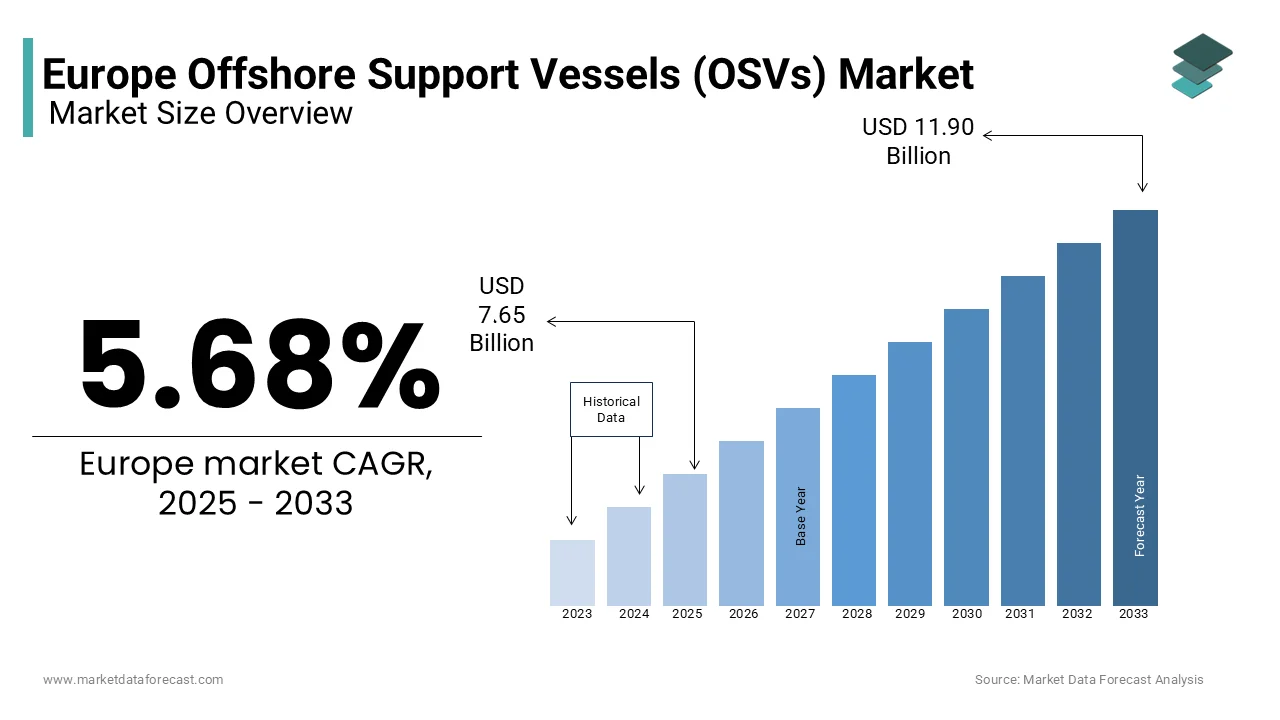
Market Size, 2025
$7.65 BnMarket Estimate, 2026
$8.08 BnMarket Forecast, 2034
$12.58 BnCAGR, 2026–2034
5.68%Europe Offshore Support Vessels (OSVs) Market Size
The Europe offshore support vessels market size was valued USD 7.65 billion in 2025 and is anticipated to reach USD 8.08 billion in 2026 to reach USD 12.58 billion by 2034, growing at a CAGR of 5.68% from 2026 to 2034.
Current Introduction of the Europe Offshore Support Vessels (OSVs) Market
Offshore support vessels encompass a specialized maritime sector dedicated to providing logistical, construction, and maintenance support for offshore energy infrastructure across the Atlantic, North Sea, Baltic Sea, and Mediterranean waters. This domain includes platform supply vessels, anchor handling tug supply units, and increasingly sophisticated construction service operation vessels designed to service both hydrocarbon and renewable energy assets. According to Eurostat, the European Union manages a vast maritime exclusive economic zone, creating an immense operational theater that necessitates a robust fleet of specialized vessels for continuous monitoring and supply. As per the European Wind Energy Association, the region hosts significant installed offshore wind capacity, requiring dedicated marine assets for turbine installation and ongoing maintenance operations. According to the International Maritime Organization, the North Sea remains one of the busiest maritime corridors globally, with strict environmental regulations governing vessel emissions and ballast water management. Furthermore, the European Commission's REPowerEU plan aims to accelerate renewable energy deployment, which is fundamentally shifting the demand profile from traditional oil and gas support to green energy logistics. These geographical vastness, regulatory strictness, and energy transition imperatives define the current scope of the European OSV industry, which is positioning it as a critical enabler of continental energy security and decarbonization goals.
MARKET DRIVERS
Accelerated Deployment of Offshore Wind Farms and Renewable Infrastructure
The aggressive expansion of offshore wind energy projects is a major factor driving the growth of the European offshore support vessels market. According to the European Commission, the region has set ambitious offshore wind capacity targets to meet climate neutrality objectives, which is requiring a massive surge in marine installation and maintenance activities. As per WindEurope, the average distance of new wind farms from the coast is increasing, with many projects located in deep waters beyond the reach of standard transfer boats, which requires the use of large service operation vessels with walk-to-work capabilities. The North Sea alone creates a dense operational hub where weather windows are narrow and vessel reliability is paramount. Developers are increasingly chartering vessels equipped with dynamic positioning systems and active heave compensation to ensure safe personnel transfer in harsh sea states. Furthermore, the complexity of maintaining floating wind structures in deeper Atlantic waters demands advanced multi-purpose support vessels capable of carrying heavy spare parts and specialized repair crews.
Revitalization of Oil and Gas Exploration for Energy Security
The urgent need to enhance energy security following geopolitical disruptions has triggered a revitalization of oil and gas exploration activities, which is driving renewed demand for traditional platform supply and anchor handling vessels and further boosting the regional market expansion. According to the International Energy Agency, European natural gas production has shown signs of increase as nations sought to reduce reliance on imported pipeline gas, which is leading to extended life-of-field projects in the Norwegian Continental Shelf and the UK North Sea. As per the European Defence Agency, ensuring stable domestic energy supplies has become a national security priority, which is prompting governments to approve new drilling licenses and maintain existing infrastructure that was previously slated for decommissioning. As per the data from the Norwegian Petroleum Directorate, investment in upstream oil and gas activities in Norway has risen, which is directly translating into higher utilization rates for standby safety vessels and supply boats. The maintenance of aging platforms requires frequent delivery of drilling muds, cement and consumables, which is sustaining the operational tempo for legacy OSV fleets. Furthermore, the decommissioning of obsolete rigs, while part of the energy transition, itself generates significant demand for heavy-lift support vessels and environmental protection ships.
MARKET RESTRAINTS
Stringent Environmental Regulations and Decarbonization Mandates
Rigid environmental standards and the pressing mandate to decarbonize the maritime sector is hampering the growth of the European offshore support vessels market. According to the European Union Emissions Trading System, the inclusion of maritime transport means that OSV operators must now surrender allowances for their carbon dioxide emissions, increasing operational costs for older, less efficient vessels. As per the International Maritime Organization, the Energy Efficiency Existing Ship Index requires vessels to meet progressively stricter carbon intensity targets, forcing many aging PSVs and AHTS units to undergo costly retrofits or face early scrapping. Major ports in the Netherlands and Germany have imposed restrictions on sulfur oxide and nitrogen oxide emissions, limiting the operational zones for non-compliant ships and disrupting established supply chains. Data from the European Environment Agency indicates that the push for zero-emission zones in sensitive marine areas further constrains where traditional diesel-powered OSVs can operate. The high cost of developing and deploying alternative fuel technologies such as methanol or ammonia-ready engines discourages smaller operators from upgrading their fleets, leading to market consolidation.
Volatility in Fuel Prices and Operational Cost Instability
The substantial financial burden associated with fluctuating marine fuel prices and the overall instability of operational costs are further hindering the regional market expansion. According to the Baltic and International Maritime Council, marine gas oil prices in European waters have experienced significant volatility in recent years, driven by geopolitical tensions and refining capacity constraints. As per financial reports from major OSV operators, fuel costs often account for a large share of total voyage expenses, making budget forecasting extremely difficult and squeezing profit margins on fixed-rate contracts. The scarcity of low-sulfur compliant fuels in certain remote offshore locations further exacerbates cost pressures and logistical challenges for vessel managers. According to the data from the European Commission, inflationary pressures on crew wages, insurance premiums, and spare parts have compounded the financial strain on operators already grappling with high energy costs. The capital intensity required to replace aging fleets with fuel-efficient models is prohibitive for many small to medium-sized enterprises, leading to a reduction in available fleet capacity. These economic pressures force operators to defer maintenance or lay-up vessels, thereby constraining the overall supply availability and slowing the modernization pace of the European offshore support sector.
MARKET OPPORTUNITIES
Emergence of Hybrid and Zero-Emission Vessel Technologies
The development and integration of hybrid electric and zero-emission propulsion systems offer a promising opportunity for the European OSV market to lead the global transition toward sustainable maritime operations. According to the Clean Hydrogen Partnership, hybrid diesel-electric architectures can reduce fuel consumption and emissions compared to conventional engines, aligning with European Green Deal objectives. As per prototype testing from shipyards in Norway and the Netherlands, battery-assisted propulsion enables silent operation modes essential for near-shore wind farm maintenance and seismic surveying without disturbing marine life. The European Union Aviation Safety Agency and maritime bodies are working on certification pathways for electrified and hydrogen-powered vessels, which is signalling strong regulatory support for this technological shift. Data from energy analysts suggests that the declining cost of high-density batteries and the expanding infrastructure for green hydrogen production will make these systems economically attractive for commercial operators. Furthermore, the ability to operate in emission-free zones using electric power opens up new contractual opportunities with environmentally conscious energy majors who have net-zero commitments.
Expansion of Decommissioning Services and Circular Economy Initiatives
The impending wave of offshore infrastructure decommissioning offers a lucrative opportunity for the European offshore support vessels market. According to Oil and Gas UK, a large number of offshore installations in the North Sea are expected to be decommissioned over the next decade, creating demand for heavy-lift vessels, rock dumping ships, and environmental monitoring units. As per the European Commission, there is growing emphasis on recovering and recycling materials from retired platforms, requiring sophisticated marine logistics to transport large structural components to shore-based processing facilities. The complexity of removing subsea pipelines and foundations in protected marine areas necessitates vessels equipped with advanced dynamic positioning and low-impact intervention tools. For instance, the decommissioning market could be valued significantly by 2030, offering a stable revenue stream independent of new exploration cycles. Furthermore, the repurposing of old oil and gas infrastructure for carbon capture and storage or hydrogen production creates a niche for conversion support vessels.
MARKET CHALLENGES
Integration of Autonomous Systems and Digital Twin Technologies
Safely integrating autonomous navigation systems and digital twin technologies into offshore operations while maintaining human oversight is a significant challenge to the European offshore support vessels market. According to the European Maritime Safety Agency, the proliferation of unmanned surface vehicles and automated docking systems creates cybersecurity risks and complicates liability frameworks in the event of collisions or operational failures. As per the Digital Transport and Logistics Forum, progress toward a unified digital maritime space has been slower than anticipated, resulting in fragmented data standards that hinder seamless communication between vessels and offshore platforms. The lack of standardized protocols for remote control centers that manage semi-autonomous OSVs hinders scalability of operations in congested offshore wind farms. Data from navigation service providers indicates that coordinating drones and autonomous boats amidst traditional manned traffic requires advanced digital infrastructure that is not yet fully deployed. Furthermore, differing national interpretations of international maritime laws regarding autonomous vessels create administrative burdens for operators conducting cross-border missions.
Securing Supply Chains for Specialized Marine Components and Green Fuels
Ensuring a resilient supply chain for specialized marine components, rare earth magnets for electric motors, and sustainable marine fuels presents a persistent challenge for European OSV manufacturers and operators striving for operational stability. According to the European Raw Materials Alliance, the continent remains dependent on imports for critical minerals essential for building high-performance batteries and electric propulsion systems, creating vulnerabilities to global shortages and geopolitical leverage. As per the Community of European Shipyards Associations, disruptions in the supply of dual-fuel engines and scrubber systems can delay the delivery of new eco-friendly vessels and increase manufacturing costs. The concentration of green methanol and ammonia production facilities outside Europe exposes the sector to fluctuating commodity prices and trade barriers. For instance, export controls imposed by other global powers can restrict access to dual-use technologies, hindering the development of autonomous and green platforms. Furthermore, the fragmentation of the European industrial base means that no single country possesses the complete value chain for building next-generation OSVs, necessitating complex cross-border collaborations. Building a self-sufficient ecosystem requires massive investment in local fabrication facilities and fuel production, which is a long-term endeavour that conflicts with immediate market demands and decarbonization targets.
REPORT COVERAGE
| REPORT METRIC | DETAILS |
| Market Size Available | 2025 to 2034 |
| Base Year | 2025 |
| Forecast Period | 2026 to 2034 |
| CAGR | 5.68% |
| Segments Covered | By Type, Water Depth, Fuel, Service Type, Application, and Country |
| Various Analyses Covered | Regional & Country Level Analysis, Segment-Level Analysis, DROC, PESTLE Analysis, Porter’s Five Forces Analysis, Competitive Landscape, Analyst Overview on Investment Opportunities |
| Countries Covered | UK, France, Spain, Germany, Italy, Russia, Sweden, Denmark, Switzerland, Netherlands, Turkey, Czech Republic, and the Rest of Europe |
| Market Leaders Profiled | Bourbon, Grupo CBO, Gulfmark, Havila, Maersk, Seacor Marine, SIEM Offshore, Solstad, Swire, Tayrona Offshore, Tidewater, and Vroon Group. |
SEGMENTAL ANALYSIS
By Type Insights
The platform supply vessel segment led the market by accounting for the highest share of the European offshore support vessels market in 2025. The dominance of platform supply vessel segment in the European market is majorly driven by its indispensable role as the primary logistical lifeline for both offshore hydrocarbon platforms and increasingly complex wind farm installations. The sheer volume of routine supply missions required to transport drilling muds, cement, bulk liquids, and deck cargo to maintain continuous operations in remote marine environments is further contributing to the expansion of the platform supply vessel segment in the European market. According to the Norwegian Petroleum Directorate, platform supply vessels account for the majority of vessel movements on the Norwegian Continental Shelf, highlighting their critical frequency in daily offshore logistics. As per operational reports from wind farm operators in the North Sea, these vessels are uniquely capable of carrying large volumes of spare turbine components and specialized tools that smaller crew transfer boats cannot accommodate, making them essential for major maintenance campaigns. The versatility of modern platform supply vessels, which often feature dynamic positioning systems and large open deck spaces, allows them to serve dual purposes in oil and gas and renewable sectors, maximizing their utilization rates. Furthermore, the extended life-of-field projects in mature basins require consistent resupply schedules that only this vessel class can efficiently provide.
On the other hand, the multi-purpose service vessel segment is anticipated to record a CAGR of 9.2% over the forecast period owing to the evolving complexity of offshore wind farm construction and maintenance, which demands vessels capable of performing diverse tasks such as cable laying, rock dumping, subsea intervention, and personnel transfer within a single mission. According to WindEurope, the shift toward floating wind farms in deeper waters requires highly specialized units that can handle heavy lifting and precise subsea operations that standard supply vessels cannot execute. As per contract awards data from energy developers, there is growing demand for vessels equipped with advanced dynamic positioning systems and large moon pools to facilitate remote operated vehicle deployments for inspection and repair. The ability of multi-purpose service vessels to switch between construction support, decommissioning assistance, and routine maintenance makes them economically attractive for operators seeking to reduce fleet size while maximizing capability. Furthermore, the integration of hybrid propulsion systems in new builds of this category aligns with European emission regulations, making them the preferred choice for future-proof contracts.
By Fuel Insights
The fuel oil segment led the market by holding the major share of the European offshore support vessels market in 2025 due to the extensive existing fleet of legacy vessels that rely on conventional marine gas oil and diesel engines for propulsion and power generation. The massive installed base of older platform supply vessels and anchor handling tug supply units that were constructed before the advent of strict alternative fuel mandates and continue to operate under current regulatory frameworks are further contributing to the dominance of fuel oil segment in the European market. According to the International Maritime Organization, a majority of the global offshore support fleet still operates on traditional distillate fuels, reflecting the slow turnover rate of maritime assets which often have service lives exceeding decades. As per bunkering infrastructure reports from European ports such as Rotterdam and Aberdeen, the availability and established distribution networks for marine gas oil remain far superior to those for liquefied natural gas or methanol, ensuring reliable refueling options for operators in remote offshore locations. The high capital cost associated with retrofitting existing engines or building new dual-fuel vessels discourages immediate transitions for many small to medium-sized operators. Furthermore, the energy density of traditional fuel oil provides proven reliability in harsh North Sea conditions where engine failure is not an option.
However, the liquefied natural gas segment is emerging as the fastest growing sector in the European market and is estimated to witness a CAGR of 13.3% over the forecast period owing to the aggressive regulatory pressures to reduce sulfur oxide and nitrogen oxide emissions in Emission Control Areas. The implementation of the European Union Emissions Trading System that now includes maritime transport, which is making the lower carbon intensity of liquefied natural gas a financially attractive option for operators seeking to minimize allowance costs is further boosting the expansion of the LNG segment in the European market. According to order book data from European shipyards, a significant portion of new build offshore support vessels contracted in recent years specify liquefied natural gas ready or dual-fuel engines, signaling a decisive shift in procurement strategies. As per environmental compliance studies, vessels powered by liquefied natural gas can reduce sulfur and nitrogen oxide emissions substantially compared to conventional fuel oil, allowing them unrestricted access to sensitive coastal zones and green port initiatives. The expanding bunkering infrastructure along the Norwegian coast and in the Baltic Sea is reducing range anxiety and operational risks associated with adopting this cleaner fuel. Furthermore, major energy companies are increasingly mandating the use of low-emission vessels in their chartering policies, creating a premium market for liquefied natural gas-powered tonnage.
By Service Insights
The logistics & cargo management segment accounted for the majority share of the Europe Offshore Support Vessels Market in 2025. The growth of the logistics and cargo management segment in the European market is driven by the fundamental and continuous requirement to transport vast quantities of materials, equipment, and consumables to sustain offshore operations. The sheer scale of material flow needed for both drilling campaigns and wind farm maintenance, where any disruption in supply can lead to costly downtime for assets worth billions of euros is further propelling the growth of the logistics and cargo management segment in this regional market. According to the UK Oil and Gas Authority, logistics vessels perform extensive round trips annually to deliver everything from drill pipes and chemicals to food and water, forming the backbone of offshore supply chains. As per industry benchmarks, delays in delivering materials can result in significant financial losses, making reliable cargo management the highest priority for asset owners. The complexity of managing just-in-time deliveries in unpredictable weather conditions requires sophisticated planning and a robust fleet of supply vessels, ensuring steady demand for this service type. Furthermore, the rise of large-scale wind farm projects has increased the volume of oversized cargo such as transformer modules and blade sections that require specialized logistical coordination.
On the other side, the inspection & survey segment is expected to exhibit a CAGR of 10.2% over the forecast period during the forecast period. Factors such as the increasing regulatory mandate for structural integrity monitoring, the aging profile of offshore infrastructure and the stringent requirement from safety authorities for frequent and detailed underwater inspections of pipeline networks, platform jackets, and wind turbine foundations to prevent catastrophic failures and environmental disasters are propelling the rapid growth of the inspection and survey segment in this regional market. According to the European Maritime Safety Agency, the frequency of mandatory surveys for offshore assets has increased, driving demand for vessels equipped with advanced remotely operated vehicles and high-resolution sonar systems. As per decommissioning forecasts, the upcoming wave of platform retirements in the North Sea requires extensive pre-decommissioning surveys to assess structural conditions and plan safe removal strategies, creating a surge in survey campaigns. The adoption of digital twin technologies further amplifies this trend, as operators seek high-fidelity data to create accurate virtual models of their assets for predictive maintenance. Additionally, the expansion of offshore wind farms necessitates regular seabed scour monitoring and cable route inspections to ensure stability.
By Application Insights
The oil and gas segment held the largest share of the Europe offshore support vessels market in 2025 due to the mature yet persistent activity levels in the North Sea and other hydrocarbon basins that continue to rely heavily on marine support for exploration and production. The growth of the oil and gas segment in this regional market is also driven by the strategic decision by European nations to extend the life of existing oil and gas fields to enhance energy security amidst global supply volatility, thereby maintaining a high baseline demand for support vessels. According to the Norwegian Petroleum Directorate, the Norwegian Continental Shelf continues to produce large volumes of oil equivalents, requiring a constant fleet of vessels for drilling support, well intervention, and platform maintenance. As per investment reports from major energy operators, significant funds are being committed to brownfield developments and enhanced oil recovery techniques, which are intensely vessel-dependent activities. The complexity of operating in deepwater and harsh environments necessitates specialized high-specification vessels that are predominantly dedicated to hydrocarbon applications. Furthermore, the ongoing decommissioning of obsolete oil and gas infrastructure, while part of the transition, still falls under this application umbrella and generates vessel demand.
However, the offshore segment is anticipated to witness a promising CAGR of 12.2% over the forecast period in this regional market owing to the unprecedented rollout of offshore wind projects mandated by the European Green Deal and REPowerEU strategy, which aims to multiply offshore wind capacity by 2030. According to the European Commission, the region has set ambitious deployment targets for offshore wind capacity, requiring a massive influx of vessels for foundation installation, cable laying, and commissioning. As per project pipelines tracked by industry analysts, the shift toward floating wind technology in deeper Atlantic waters creates demand for entirely new classes of support vessels capable of operating in previously inaccessible areas. The lifecycle of wind farms also introduces long-term operation and maintenance contracts that provide stable revenue streams for service vessels over decades. Furthermore, the emergence of offshore hydrogen production hubs and carbon capture storage sites adds new layers of demand for specialized marine support.
COUNTRY LEVEL ANALYSIS
Norway Offshore Support Vessels Market Analysis
Norway led the offshore support vessels market in Europe in 2025 with 28.3% of the regional market. Norway is performing strongly due to its role as the continent’s largest oil and gas producer and a pioneer in offshore wind technology. The Norwegian market is expected to maintain its dominance with advanced fleet innovation and strict environmental regulations. The market status in this nation is characterized by the world's most advanced and environmentally regulated fleet, with a high concentration of modern dual fuel and battery hybrid vessels operating in the North Sea and Barents Sea. According to data from the Norwegian Petroleum Directorate, the country maintains over 70 active oil and gas fields alongside a rapidly expanding portfolio of offshore wind projects, creating a unique dual demand environment for support vessels. A key driving factor is the government's aggressive push for electrification of offshore platforms and the requirement for zero emission operations in sensitive fjords, which has spurred local shipyards to lead global innovation in green vessel technology. As per reports from the Norwegian Shipowners' Association, the nation's maritime cluster benefits from strong state backing and research grants that accelerate the adoption of autonomous and remote-controlled vessel systems. The presence of major international energy companies headquartered in Stavanger ensures a steady stream of high value contracts for sophisticated support services. Furthermore, Norway's extensive coastline and deep-water expertise make it the ideal testbed for floating wind innovations.
United Kingdom Offshore Support Vessels Market Analysis
The United Kingdom is performing as a critical player in the European offshore support vessels market. The UK market is balancing its legacy oil and gas sector with ambitious offshore wind expansion. The UK market is expected to grow further as renewable energy projects scale up alongside continued hydrocarbon activity. The market status reflects a dynamic transition phase where legacy oil and gas support activities are increasingly complemented by a booming renewable energy service industry centred around the world's largest installed offshore wind capacity. According to statistics from the UK Department for Energy Security and Net Zero, the country aims to deploy 50 gigawatts of offshore wind by 2030, driving massive demand for installation and maintenance vessels. A primary driving factor is the strategic location of the UK in the windy North Sea, which hosts numerous giant wind farms requiring constant logistical support and specialized crew transfer operations. As per data from Oil and Gas UK, the maximization of economic recovery from mature oil fields continues to generate substantial work for platform supply and anchor handling vessels, ensuring a balanced market portfolio. The government's commitment to becoming a net zero nation has led to favorable policies and subsidies that attract investment in new green vessel builds. Furthermore, the presence of leading engineering firms and a skilled maritime workforce in regions like Aberdeen and Hull fosters a robust service ecosystem.
Netherlands Offshore Support Vessels Market Analysis
The Netherlands is performing strongly in the European offshore support vessels market. Netherlands is recognized for its maritime innovation and central role in North Sea wind farm development. The Dutch market is expected to expand steadily with its specialized fleet and strong industrial base. The market status is defined by a highly specialized fleet focused on construction support, cable laying, and heavy lift operations, leveraging the country's renowned dredging and maritime engineering heritage. According to data from the Netherlands Enterprise Agency, the Dutch offshore wind sector is expanding rapidly with several gigawatt scale projects in various stages of development, creating intense demand for multi-purpose service vessels. A major driving factor is the presence of world leading shipyards and maritime technology companies that specialize in building state of the art eco-friendly offshore support vessels, exporting expertise and hardware across the continent. As per reports from the Port of Rotterdam Authority, the port serves as a critical logistics base and staging area for major offshore projects, generating significant ancillary demand for harbour tugs and supply boats. The Dutch government's strong support for the hydrogen economy and offshore energy islands further diversifies the application scope for support vessels.
Denmark Offshore Support Vessels Market Analysis
Denmark is performing as a pioneering market in offshore support vessels due to its early leadership in wind energy and efficient maritime ecosystem. The Danish market is expected to grow further with ambitious climate goals and innovative vessel solutions. The market status is influenced by the country's early adoption of offshore wind technology, which has created a mature and sophisticated demand for specialized service operation vessels and crew transfer crafts. According to data from the Danish Energy Agency, Denmark aims to increase its offshore wind capacity significantly by 2030, including the development of artificial energy islands that will serve as hubs for massive wind farms, requiring novel vessel solutions. A key driving factor is the presence of global wind turbine manufacturers and developers headquartered in Denmark, who drive the standardization and optimization of offshore logistics and maintenance procedures. As per economic reports from Statistics Denmark, the maritime sector is a cornerstone of the national economy, with a strong emphasis on sustainability and digitalization driving the renewal of the support fleet. The country's geographical position in the Baltic and North Seas makes it a strategic base for servicing wind farms across Northern Europe.
Germany Offshore Support Vessels Market Analysis
Germany is performing as a vital market in the European offshore support vessels sector owing to its industrial strength and aggressive offshore wind expansion. The German market is expected to grow steadily with rising demand for advanced multi-purpose vessels and technological integration. The market status is characterized by a rapid scaling up of vessel requirements to support the construction of huge wind farms in the German Bight and the ongoing maintenance of existing assets. According to data from the Federal Ministry for Economic Affairs and Climate Action, Germany has set targets to achieve 30 gigawatts of offshore wind capacity by 2030, necessitating a substantial increase in the availability of installation and service vessels. A primary driving factor is the country's powerful engineering and manufacturing sector, which produces high tech components for both the energy and maritime industries, fostering close collaboration between shipbuilders and energy developers. As per reports from the German Wind Energy Association, the shift toward larger turbines and deeper waters is driving demand for next generation multi-purpose vessels with higher load capacities and advanced dynamic positioning. The German government's support for research into autonomous shipping and alternative fuels further stimulates innovation in the support vessel segment. Additionally, the need to integrate offshore wind power into the national grid drives activities related to cable laying and substation installation.
COMPETITIVE LANDSCAPE
The competition within the Europe Offshore Support Vessels Market is characterized by intense rivalry among established global shipping giants and specialized regional operators striving for technological superiority and contract dominance. Market participants constantly vie for leadership through continuous innovation in vessel design, focusing on hybrid propulsion systems and automated operations to meet stringent European Green Deal objectives. The landscape features high barriers to entry due to substantial capital requirements for building modern compliant fleets and the need for extensive operational experience in harsh North Sea conditions. Companies differentiate themselves by offering integrated service packages that combine logistics, construction support, and decommissioning capabilities under single contracts. Strategic alliances with renewable energy developers play a crucial role in securing lucrative long-term charters for offshore wind farm projects. The shift toward sustainability has intensified competition as firms race to deploy the first fully zero-emission support vessels. Price pressure from energy operators forces suppliers to optimize operational efficiency while maintaining high safety standards. This dynamic environment fosters rapid advancement in maritime technology ensuring that only the most adaptable and environmentally conscious companies thrive in the region.
KEY MARKET PLAYERS
The major players in the Europe offshore support vessels market include
- Bourbon
- Grupo CBO
- Gulfmark
- Havila
- Edison Chouest Offshore
- Maersk
- Seacor Marine
- SIEM Offshore
- Solstad, Swire
- Tayrona Offshore
- Tidewater
- Vroon Group.
Top Players In The Market
- Solstad Offshore stands as a premier global provider of offshore marine services, operating one of the largest and most modern fleets of platform supply vessels and subsea construction ships. The company contributes significantly to the international market by delivering high-specification vessels equipped with dynamic positioning systems for complex operations in harsh environments. Recent strategic actions include the aggressive expansion of its fleet with new builds featuring hybrid electric propulsion and battery systems to meet stringent European emission standards. Solstad has strengthened its position by securing long-term contracts with major energy companies for wind farm installation and decommissioning projects across the North Sea. The firm actively invests in digitalization to optimize vessel performance and fuel efficiency through advanced data analytics. By focusing on sustainability and operational excellence, Solstad reinforces its reputation as a leading partner for both traditional hydrocarbon and renewable energy sectors worldwide.
- Bourbon Offshore is a dominant force in the global offshore support sector, renowned for its extensive fleet of anchor handling tug supply vessels and multi-purpose service units tailored for diverse marine applications. The company plays a pivotal role internationally by offering comprehensive solutions for drilling support, seismic surveying, and offshore wind farm maintenance. Recent efforts to solidify its market standing involve the launch of next-generation vessels designed with reduced carbon footprints and enhanced manoeuvrability for shallow water operations. Bourbon has strengthened its position through strategic partnerships with European shipyards to accelerate the delivery of eco-friendly tonnage capable of operating in emission control areas. The firm focuses on integrating advanced automation technologies to improve crew safety and operational precision during complex subsea interventions. Additionally, Bourbon expands its service portfolio to include specialized decommissioning support, addressing the growing needs of aging infrastructure. These continuous innovations in fleet modernization and service diversification maintain Bourbon at the forefront of the competitive global offshore landscape.
- Edison Chouest Offshore serves as a key player in the European market by leveraging its vast global experience in building and operating highly specialized offshore support vessels for demanding energy projects. The company contributes to the international arena by providing custom-built solutions that address unique logistical challenges in deepwater and near-shore environments. Recent strategic moves include the deployment of innovative vessels powered by liquefied natural gas and hybrid systems to align with European decarbonization goals. Edison Chouest has invested heavily in expanding its European operational footprint to better serve the burgeoning offshore wind sector with dedicated construction and maintenance assets. The firm actively collaborates with energy developers to design bespoke vessels that maximize efficiency for specific project requirements. By prioritizing vertical integration in vessel construction and crew management, the company ensures unparalleled control over quality and service delivery. These initiatives reinforce its status as a reliable and adaptable partner capable of meeting the evolving demands of the global offshore industry.
Top Strategies Used By Key Market Participants
Key players in the Europe Offshore Support Vessels Market primarily focus on fleet modernization strategies by investing in new builds featuring hybrid electric propulsion and dual-fuel capabilities to comply with strict environmental regulations. Companies heavily engage in securing long-term charter agreements with major energy operators to ensure revenue stability amidst market volatility. Manufacturers are increasingly adopting digital transformation initiatives such as predictive maintenance systems and real-time data analytics to optimize vessel performance and reduce fuel consumption. Another prevalent approach involves strategic mergers and acquisitions to consolidate market presence and expand service portfolios into emerging sectors like offshore wind and decommissioning. Firms also prioritize sustainability by developing zero-emission vessel concepts and participating in green hydrogen pilot projects. Expanding operational bases in key maritime hubs enhances logistical efficiency and responsiveness to client needs. These combined strategies enable market participants to navigate regulatory complexities and capture growth opportunities in the transitioning energy landscape.
MARKET SEGMENTATION
This research report on the Europe offshore support vessels market is segmented and sub-segmented into the following categories.
By Type Insights
- Anchor Handling Towing Supply Vessel
- Platform Supply Vessel
- Fast Supply Intervention Vessel
- Multi-Purpose Service Vessel
- Others
By Water Depth Insights
- Shallow Water
- Deepwater
By Fuel Insights
- Fuel Oil
- LNG
By Service Type Insights
- Technical Services
- Inspection & Survey
- Crew Management
- Logistics & Cargo Management
- Anchor Handling & Seismic Support
- Others
By Application Insights
- Oil and Gas Applications
- Offshore Applications
By Country
- UK
- France
- Spain
- Germany
- Italy
- Russia
- Sweden
- Denmark
- Switzerland
- Netherlands
- Turkey
- Czech Republic
- Rest of Europe
Frequently Asked Questions
How do offshore support vessels enable offshore operations in Europe?
Offshore support vessels assist in transporting materials, equipment, and crew to offshore energy sites.
What key factors are increasing demand for OSVs in Europe?
Expansion of offshore wind farms and ongoing oil and gas activities are driving vessel demand.
Which types of offshore support vessels are commonly deployed in this market?
Platform supply vessels, anchor handling vessels, and service operation vessels are widely used.
Why are offshore renewable energy projects boosting OSV utilization?
They require specialized vessels for installation, maintenance, and logistics support.
How do OSVs improve efficiency in offshore energy projects?
They ensure timely delivery of resources and support continuous offshore operations.
Which industries primarily depend on offshore support vessels in Europe?
The offshore wind and oil and gas industries are the main users of OSVs.
What challenges affect the Europe OSVs market?
High operating costs and fluctuating energy investments can impact vessel demand.
How is technology improving offshore support vessel performance?
Advanced navigation systems and fuel-efficient designs are enhancing operational efficiency.
Which regions in Europe show strong demand for OSVs?
The North Sea region is a major hub due to extensive offshore energy activities.
What future trend is expected in the Europe offshore support vessels market?
Increasing focus on renewable energy support vessels and sustainable ship designs is expected to drive market growth.
Related Reports
Access the study in MULTIPLE FORMATS
Purchase options starting from
$ 2000
Didn’t find what you’re looking for?
TALK TO OUR ANALYST TEAM
Need something within your budget?
NO WORRIES! WE GOT YOU COVERED!
Call us on: +1 888 702 9696 (U.S Toll Free)
Write to us: sales@marketdataforecast.com