- Product Description Description
- Table of Contents TOC
- List of Table & Figure LOT
- Get Free Sample PDF Sample PDF
Market Size, 2025
$11.65 BnMarket Estimate, 2026
$12.26 BnMarket Forecast, 2034
$18.41 BnCAGR, 2026–2034
5.21%Europe Oilfield Chemicals Market Size
The Europe oilfield chemicals market size was valued at USD 11.65 billion in 2025 and is projected to reach USD 18.41 billion by 2034 from USD 12.26 billion in 2026, growing at a CAGR of 5.21%.

The oilfield chemicals are a specialised class of chemical formulations deployed across upstream oil and gas operations to enhance drilling performance, maintain wellbore integrity, and optimise hydrocarbon recovery from mature and increasingly complex reservoirs. These include corrosion inhibitors, scale inhibitors, demulsifiers, biocides, and surfactants engineered to meet the region’s operational and regulatory demands. According to the European Environment Agency, offshore operations in the North Sea contributed roughly 72% of the European Union’s domestic crude oil output in 2023. Concurrently, Eurostat data indicates an 18% drop in European natural gas production between 2020 and 2025, intensifying reliance on chemical enhanced recovery methods. Regulatory frameworks under the EU Industrial Emissions Directive further dictate stringent discharge limits for produced water, compelling operators to adopt environmentally compliant chemical solutions.
MARKET DRIVERS
Demand for Enhanced Oil Recovery in Mature North Sea Fields
The North Sea’s extensive portfolio of mature fields constitutes an engine of chemical is propelling the growth of Europe's oilfield chemicals market. The operators increasingly depend on chemical enhanced oil recovery to extract residual hydrocarbons, with many reservoirs operating beyond their economic plateau. As per the Norwegian Offshore Directorate, Norway achieved an average recovery factor by 2025, significantly surpassing the global norm through sustained use of polymer and surfactant flooding. This dependency translates into steady procurement of high-performance chemicals such as alkyl sulfonates and ethoxylated alcohols, which reduce interfacial tension and mobilise trapped oil droplets. The economic rationale is compelling; even modest incremental recovery from ageing assets can offset declining production from discoveries. Consequently, chemical efficacy directly influences field life extension strategies, ensuring robust and continuous demand despite broader energy transition trends.
Strategic Emphasis on Offshore Decommissioning and Well Integrity Management
The accelerating offshore decommissioning cycle fuels short-term chemical consumption, and is additionally escalating the growth of the European oilfield chemicals market. Although decommissioning signifies the cessation of production, preparatory well plugging and abandonment operations demand rigorous chemical intervention to ensure structural integrity and environmental compliance. These expenditures are driven by binding obligations under the OSPAR Convention, which prohibits post-abandonment hydrocarbon leakage. Thus, even as upstream investment wanes, end-of-life operational protocols generate a distinct demand vector, compelling sustained chemical procurement to fulfil safety and regulatory mandates during asset retirement.
MARKET RESTRAINTS
Stringent Environmental Regulations Governing Chemical Discharge
The comprehensive regulatory framework severely restricts the use of conventional oilfield chemicals is restricting the growth of the European oilfield chemicals market. The REACH regulation and OSPAR Convention jointly impose strict criteria on toxicity, persistence, and bioaccumulation, effectively banning or restricting over 320 substances commonly used elsewhere, as confirmed by the European Chemicals Agency. Additionally, the European Maritime Safety Agency enforces zero discharge policies for oil-bearing produced water in ecologically sensitive zones, such as the Baltic Sea, requiring advanced separation chemistries that leave no hazardous residuals. These constraints not only inflate operational budgets but also prolong chemical approval timelines for small and medium chemical suppliers lacking regulatory expertise. The cumulative effect is a constrained product portfolio and diminished market agility in price-sensitive offshore projects.
Geopolitical Realignment and Reduced Domestic Exploration Licensing
A structural decline in new hydrocarbon exploration directly undermines long-term chemical demand. Countries including Denmark, the Netherlands, and France have enacted full or partial bans on new oil and gas activities. This policy trajectory starves the greenfield drilling and completion projects, which traditionally consume high volumes of drilling fluids, cementing additives, and fracturing chemicals. Consequently, chemical suppliers face a shrinking project pipeline, forcing overreliance on brownfield maintenance in declining fields. The resulting demand contraction, compounded by capital reallocation toward renewables, imposes severe growth limitations and pressures suppliers to diversify or exit the region.
MARKET OPPORTUNITIES
Rising Adoption of Green Chemistry in Mature Field Operations
Sustainability-driven innovation is unlocking new market potential through bio-based and readily biodegradable formulations. The rising adoption of green chemistry in mature field operations is one of the major opportunities for the growth of the European oilfield chemicals market. Incentivised by the EU Green Deal and the Chemicals Strategy for Sustainability, operators are adopting eco-friendly alternatives that satisfy regulatory thresholds without compromising performance. According to the European Bioplastics Association, bio-derived additives of North Sea chemical procurement in 2025, up from 4% in 2020. Leading suppliers, such as BASF and Clariant, have introduced enzymatic demulsifiers sugar-based surfactants that fully degrade within 28 days in marine environments. The Norwegian Environment Agency verified that operators using such green chemistries reduced chemical discharge compliance fees by up to 40%. This emergence of environmental compliance and cost efficiency is reshaping procurement preferences, fostering co-development partnerships between national oil companies and chemical innovators.
Digitalisation and Predictive Chemical Dosing Systems
The integration of digital oilfield technologies with chemical management is revolutionising treatment precision and efficiency. The digitalisation and predictive chemical dosing systems are additionally amplifying the growth of the European oilfield chemicals market. Real-time sensor networks and AI-enabled analytics now permit dynamic adjustment of chemical injection based on actual downhole conditions, replacing fixed dosing schedules. Equinor’s adoption of digital twins for well integrity has embedded chemical performance metrics into reservoir models by enabling proactive intervention. As digital infrastructure becomes standard, chemical suppliers embedding data analytics into their service offerings will shift from commodity vendors to strategic technology partners, unlocking premium value in an otherwise cost-constrained market.
MARKET CHALLENGES
Supply Chain Fragmentation Amid Divergent National Policies
The national regulatory divergence fragments the chemical supply chain and inflates compliance burdens is a challenge for the growth of the European oilfield chemicals market. As per the European Commission’s 2025 Chemicals Compliance Review, countries like Germany impose supplementary ecotoxicity testing beyond EU requirements, while the UK enforces separate registration under its post-Brexit UK REACH system. This patchwork mandates duplicate dossiers, redundant testing, and parallel inventories, raising operational costs, according to the European Chemical Industry Council. Customs inconsistencies at internal borders further delay shipments, extending lead times by up to nine days for North Sea platforms. Such inefficiencies disrupt just-in-time logistics essential for continuous operations, and standardisation of distribution networks.
Technological Obsolescence in Legacy Chemical Formulations
Escalating reservoir severity in ageing European fields is rendering conventional chemical formulations ineffective is another attribute to degrade the growth of the European oilfield chemicals market. Downhole conditions now routinely exceed 130 degrees Celsius with salinities above 200000 parts per million, causing thermal degradation and solubility failure in legacy products. Reformulating thermostable alternatives requires 18 to 24 months and investment exceeding 5 million euros per product, as reported by the European Federation of Corrosion Engineers. Barrierss are prohibitive for mid-tier suppliers. Operators thus face a narrowing solution set, often resorting to suboptimal treatments that increase equipment wear or require frequent reapplication. This technological gap jeopardises recovery efficiency and economic viability unless innovation accelerates in step with reservoir complexity.
REPORT COVERAGE
| REPORT METRIC | DETAILS |
| Market Size Available | 2025 to 2034 |
| Base Year | 2025 |
| Forecast Period | 2026 to 2034 |
| CAGR | 5.21% |
| Segments Covered | By Chemical Type, Application, and Region |
| Various Analyses Covered | Global, Regional, & Country Level Analysis; Segment-Level Analysis; DROC, PESTLE Analysis; Porter’s Five Forces Analysis; Competitive Landscape; Analyst Overview of Investment Opportunities |
| Regions Covered | UK, France, Spain, Germany, Italy, Russia, Sweden, Denmark, Switzerland, Netherlands, Turkey, and the Czech Republic |
| Market Leaders Profiled | Nouryon, Albemarle Corporation, Huntsman International LLC, Solvay, Chevron Phillips Chemical Company, BASF SE, Clariant, Exxon Mobil Corporation, Halliburton, DowDuPont and others |
SEGMENTAL ANALYSIS
By Chemical Type Insights
The corrosion and scale inhibitors segment held a dominant share of the European oilfield chemicals market in 2025, primarily driven by the region’s ageing offshore infrastructure and harsh downhole conditions. These formulations are critical to mitigating mineral deposition and metal degradation in high salinity and high temperature North Sea reservoirs. The Norwegian Petroleum Safety Authority documented corrosion-related integrity failures of all unplanned production shutdowns in Norwegian Continental Shelf operations that same year. This operational vulnerability compels operators to maintain rigorous inhibitor injection regimes in mature fields where water cut conditions accelerate both scaling and electrochemical corrosion. Furthermore, regulatory frameworks under the EU Industrial Emissions Directive mandate zero tolerance for pipeline leaks by reinforcing preventive chemical treatment as a non-negotiable operational cost.
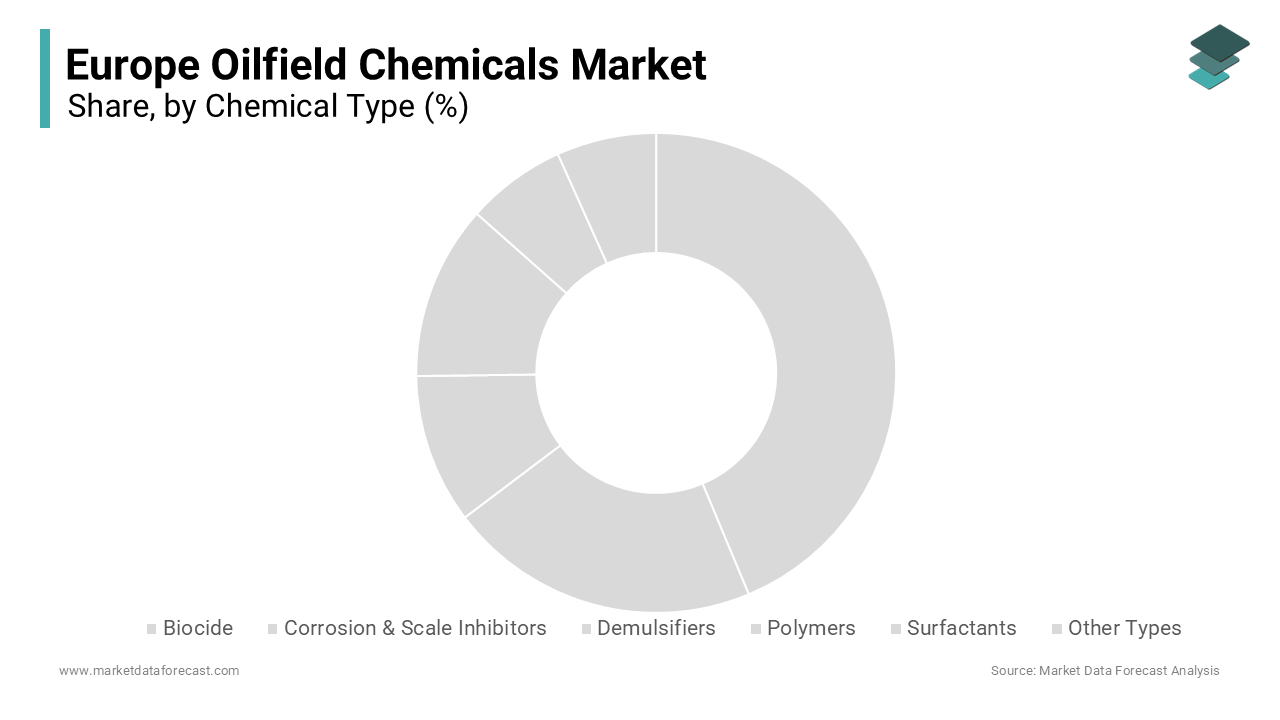
The biocides segment is expected to grow at the fastest CAGR of 5.8% from 2026 to 2034, by escalating microbial-induced corrosion and reservoir souring caused by sulfate-reducing bacteria in high water cut wells are escalating. The UK Oil and Gas Authority confirmed that biocide expenditures in British offshore fields increased between 2022 and 2025 to combat biofilm formation in injection and production tubing. Compounding this trend, the EU’s Biocidal Products Regulation now requires all oilfield biocides to demonstrate rapid marine biodegradability without toxic residuals, spurring innovation in quaternary ammonium compounds and glutaraldehyde alternatives that meet both performance and environmental criteria. Additionally, digital monitoring systems that detect microbial activity in real time have enabled targeted biocide dosing, improving efficacy while reducing volumes. This convergence of biological threat escalation, regulatory evolution, and precision delivery is driving unprecedented adoption across ageing European assets.
By Application Insights
The production application segment accounted in holding 41.2% of the European oilfield chemicals market share in 2025. Unlike drilling or completion, which are project-bound and episodic, production operations necessitate uninterrupted chemical injection to manage emulsions, scaling, corrosion, and bacterial growth throughout a well’s life cycle. Furthermore, as reservoir pressures decline, operators increasingly rely on continuous chemical injection to prevent formation damage and equipment failure, which is making production the most chemically intensive phase. Regulatory mandates under the OSPAR Convention further require chemical efficacy data for every treatment batch, institutionalising chemical use as a compliance necessity. This operational permanence, coupled with regulatory entrenchment, ensures the production segment’s sustained dominance in the European market landscape.
The enhanced oil recovery segment is likely to grow at the fastest CAGR of 9.2% from 2026 to 2034 to the urgent need to maximise recovery from fields where primary and secondary methods have plateaued. As per the International Energy Agency, Europe’s average oil recovery factor remained below 42% in 2025, leaving vast volumes of technically recoverable oil stranded without tertiary intervention. Norway’s extensive deployment of polymer flooding in fields such as Troll and Oseberg has set a regional precedent. Similarly, the UK’s Oil and Gas Authority approved seven new chemical EOR pilot programs in 2025 alone, which are focusing on surfactant polymer combinations for chalk reservoirs. These initiatives are further incentivised by the EU’s Energy Security Strategy, which prioritises domestic hydrocarbon maximisation amid import volatility.
REGIONAL ANALYSIS
Norway Oilfield Chemicals Market Analysis
Norway's oilfield chemicals market was the top performer by accounting for 28.3% of share in 2025 from its status as the largest oil and gas producer in Western Europe and the most active operator in the North Sea. The country produced 1.8 million barrels of oil equivalent per day in 2025, with over 90% originating from offshore fields requiring extensive chemical treatment. Furthermore, stringent national regulations under the Pollution Control Act mandate chemical performance verification and environmental risk assessments for every injection, institutionalising high treatment standards.
United Kingdom Oilfield Chemicals Market Analysis
The United Kingdom oilfield chemicals market was positioned second by holding 22.3% of share in 2025. The UK Continental Shelf remains a hydrocarbon basin, where chemical intervention is essential to prolong field viability. The authority also noted that over 70% of active platforms implemented chemical-enhanced oil recovery pilots in 2023 and 2025, signalling strategic shifts toward tertiary methods. Additionally, the UK’spost-Brexitt regulatory regime under UK REACH requires chemical suppliers to revalidate all offshore products, elevating demand for compliant formulations. These factors, like ageing infrastructure, regulatory stringency, and EOR adoption,on escalate the UK’s role as a high-intensity, high-compliance chemical market.
Netherlands Oilfield Chemicals Market Analysis
The Netherlands oilfield chemicals market growth is likely to be driven by its onshore and offshore gas operations in the Groningen and North Sea sectors. Although the government ceased Groningen gas production in 2023 due to seismic risks, offshore fields, such as L10 and K13 continue to require chemical maintenance. According to the Netherlands Ministry of Economic Affairs, offshore gas condensate production in 2025 necessitated daily chemical injection to manage hydrate formation and corrosion in high pressure lines. Moreover, the country’s commitment to circular economy principles under the National Chemical Strategy has accelerated adoption of biodegradable corrosion inhibitors.
Denmark Oilfield Chemicals Market Analysis
Denmark's oilfield chemicals market growth is expected to be driven by its planned phase-out of oil and gas production by 2050. Current operations in the Danish North Sea, centred on the Tyra and Halfdan fields, remain chemically intensive due to high reservoir complexity and ongoing redevelopment efforts. According to the Danish Energy Agency, the Tyra field redevelopment project, completed in 2025, increased chemical consumption by 45% during recommissioning to address sulfate scaling and microbiological fouling in new pipelines. Additionally, Denmark’s alignment with EU marine protection directives requires all chemicals to pass OECD 306 biodegradability tests by creating a premium market for certified green formulations. Although future demand is capped by policy, the current technical overhaul of legacy infrastructure ensures robust short-term chemical consumption, maintaining Denmark’s relevance in the regional market.
Germany Oilfield Chemicals Market Analysis
Germany's oilfield chemicals market growth is likely to grow with the onshore mature field operations in Lower Saxony and offshore activities in the German North Sea. Offshore, the limited but technically complex Mittelplate Dolphin development requires speciality surfactants to manage emulsion stability in high viscosity crude. Germany’s strict implementation of the EU Water Framework Directive further mandates zero chemical discharge into groundwater, which is compelling operators to use fully recoverable or biodegradable formulations.
COMPETITIVE LANDSCAPE
Competition in the European oilfield chemicals market is characterised by intense technological differentiation and regulatory alignment rather than price-based rivalry. Leading global players dominate through advanced formulation science and robust compliance with Europe’s environmental standards, while regional specialists compete via niche applications and localised service models. The market exhibits high entry barriers due to stringent chemical authorisation processes, lengthy product validation cycle, and the necessity for offshore operational experience. Innovation is concentrated on enhancing chemical efficacy under extreme reservoir conditions while simultaneously ensuring rapid marine biodegradability. Customer relationships are increasingly strategic,ic with operators seeking integrated chemical and digital solutions rather than standalone products.
KEY MARKET PLAYERS
Some of the notable key players in the European oilfield chemicals market are
- Nouryon
- Albemarle Corporation
- Huntsman International LLC
- Solvay
- Chevron Phillips Chemical Company
- BASF SE
- Clariant
- Exxon Mobil Corporation
- Halliburton
- DowDuPont
Top Players in the Market
- BASF SE maintains a prominent role through its Performance Chemicals division, which delivers advanced formulations for drilling production and enhanced oil recovery applications. The company leverages its extensive R and D infrastructure to develop environmentally compliant solutions tailored to North Sea operational challenges. In recent years, BASF has intensified its focus on biodegradable surfactants and scale inhibitors that meet OSPAR and REACH standards. It launched its ChemEOR platform in 2023 to support chemical enhanced oil recovery projects across mature European fields. Additionally, the company strengthened its technical service network in Norway and the UK to provide real-time chemical performance analytics, thereby enhancing customer retention and operational integration in the region.
- Clariant AG is a key contributor to the European oilfield chemicals landscape with a strategic emphasis on sustainable and high-performance speciality chemicals. Its Oil and Mining Services business unit offers a comprehensive portfolio, including corrosion inhibis,ors demulsifiers, and biocides engineered for harsh subsea environments. Clariant has hasprioritisedd green chemistry innovation, launching its Enviroscale and Envirotech product lines, which feature readily biodegradable molecules validated under OECD protocols. The company expanded its collaboration with Equinor to co-develop low-toxicity scale inhibitors for high-temperature Norwegian wells. This partnership underscores Clariant’s commitment to aligning technical performance with Europe’s stringent environmental regulations while reinforcing its field-level presence through joint development agreements.
- Solenis LLC plays a significant role in the European oilfield chemicals market by delivering customised production and water treatment chemistries for offshore and onshore operations. The company has invested heavily in digital chemical management platforms that enable predictive dosing and real-time reservoir monitoring. Solenis established a dedicated oilfield applications laboratory in Rotterdam in 2023 to accelerate formulation testing for North Sea conditions. Its recent integration of AI-driven analytics into chemical delivery systems has improved treatment efficiency for clients in the UK and Denmark. Furthermore, Solenis enhanced its sustainability credentials by achieving full biodegradability certification for its core demulsifier range under EU Ecolabel criteria, reinforcing its alignment with regional regulatory trends and operator preferences.
Top Strategies Used by the Key Market Participants
Key players in the European oilfield chemicals market prioritise regulatory-compliant product innovation through investment in green chemistry and biodegradable formulations that satisfy OSPAR and REACH requirements. They strengthen technical service capabilities by deploying digital monitoring platforms for real-time chemical performance tracking and predictive dosing. Strategic partnerships with national oil companies facilitate co-development of tailored solutions for mature field challenges. Geographic consolidation focuses on deepening presence in core North Sea jurisdictions through localised laboratories and field support teams. Additionally, companies pursue vertical integration of sustainability metrics into product design, ensuring environmental certification becomes a baseline rather than a differentiator in competitive bidding.
MARKET SEGMENTATION
This research report on the European oilfield chemicals market has been segmented and sub-segmented based on categories.
By Chemical Type
- Biocide
- Corrosion & Scale Inhibitors
- Demulsifiers
- Polymers
- Surfactants
- Other Types
By Application
- Drilling & Cementing
- Work-over & Completion
- Well Stimulation
- Production
- Enhanced Oil Recovery
By Country
- UK
- France
- Spain
- Germany
- Italy
- Russia
- Sweden
- Denmark
- Switzerland
- Netherlands
- Turkey
- Czech Republic
- Rest of Europe