- Product Description Description
- Table of Contents TOC
- List of Table & Figure LOT
- Get Free Sample PDF Sample PDF
Market Size, 2025
$57.18 BnMarket Estimate, 2026
$61.96 BnMarket Forecast, 2034
$117.78 BnCAGR, 2026–2034
8.36%Europe Online Courses Market Report Summary
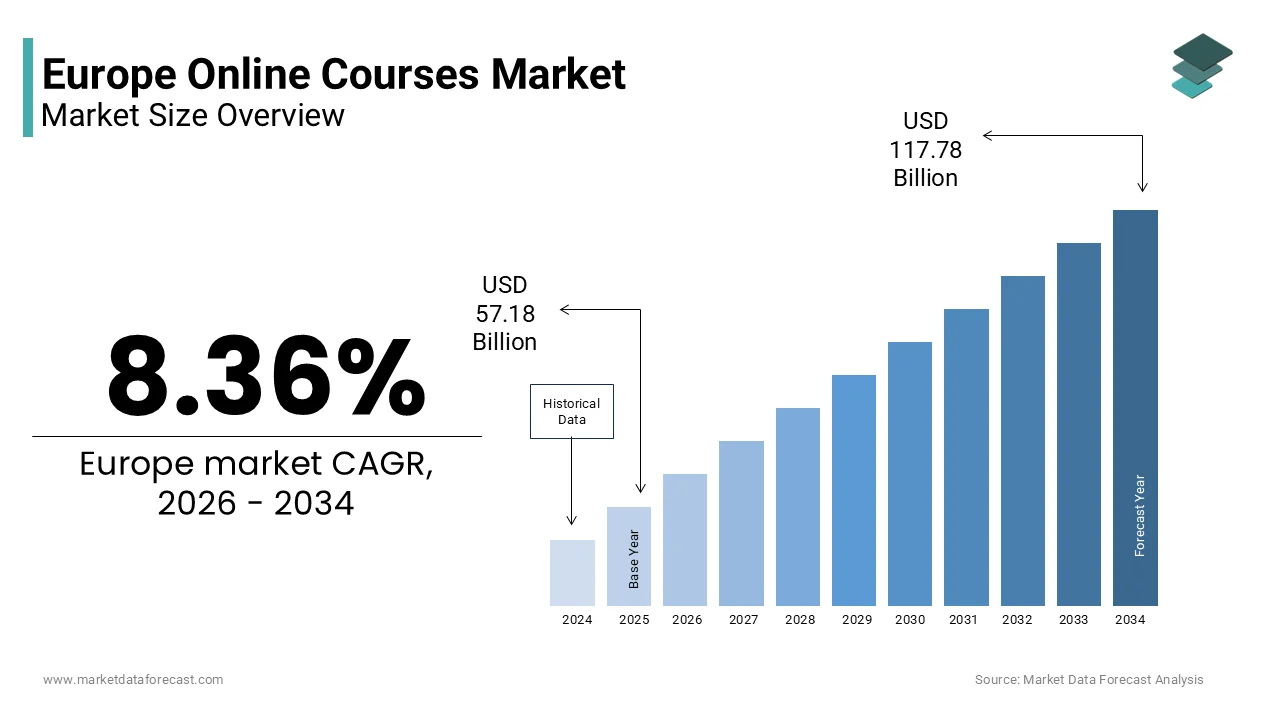
The Europe online courses market was valued at USD 57.18 billion in 2025, is estimated to reach USD 61.96 billion in 2026, and is projected to reach USD 117.78 billion by 2034, growing at a CAGR of 8.36% during the forecast period. The growth of the Europe online courses market is driven by the rising demand for flexible learning solutions, increasing adoption of digital education platforms, and the growing need for continuous skill development across industries. Organizations and educational institutions are increasingly integrating online learning platforms to enhance workforce productivity and academic accessibility. The expansion of digital infrastructure, widespread internet penetration, and the rising popularity of remote learning models are further accelerating the adoption of online courses across Europe.
Key Market Trends
- Growing adoption of digital learning platforms by corporations to provide employee training, professional development, and certification programs.
- Increasing popularity of self paced online courses that allow learners to acquire new skills and qualifications with flexible schedules.
- Rising use of artificial intelligence, analytics, and personalized learning technologies to improve course delivery and learner engagement.
- Expansion of partnerships between universities and online learning platforms to offer accredited online degrees and professional programs.
- Growing demand for technology focused courses such as data science, artificial intelligence, cybersecurity, and digital marketing.
Segmental Insights
- Based on type, the corporate segment dominated the Europe online courses market and accounted for 56.6% of the market share in 2025. The dominance of this segment is attributed to the growing adoption of online learning platforms by companies to upskill employees, improve productivity, and support workforce development initiatives.
- Based on technology, the Learning Management Systems segment led the Europe online courses market and captured a 42.5% share in 2025. Learning management systems are widely adopted by educational institutions and corporate organizations to manage digital learning content, track learner performance, and deliver structured training programs efficiently.
- Based on end user, the higher education institutions segment was the largest in the Europe online courses market and held a 48.7% share in 2025. Universities and colleges are increasingly integrating online courses and hybrid learning models to expand their reach and improve access to quality education for students across Europe.
Regional Insights
- The Europe online courses market is experiencing strong growth across several countries due to the increasing adoption of digital education technologies and rising demand for flexible learning environments.
- The United Kingdom was the leading country in the Europe online courses market and accounted for 24.6% of the regional market share in 2025. The country’s strong digital infrastructure, growing number of online learning platforms, and high demand for professional skill development are major factors supporting market expansion.
- Other European countries are also witnessing significant adoption of online learning platforms due to increasing investments in digital education, growing remote learning trends, and rising demand for lifelong learning opportunities.
Competitive Landscape
The Europe online courses market is highly competitive with the presence of global online learning platforms and specialized education technology providers. Companies are focusing on expanding course libraries, introducing industry recognized certifications, and integrating advanced technologies such as artificial intelligence driven learning tools to enhance the learning experience. Strategic collaborations with universities, enterprises, and training organizations are helping companies broaden their market presence and deliver diverse educational programs across Europe. Prominent players in the Europe online courses market include Coursera, Udemy, edX, LinkedIn Learning, Pluralsight, Skillsoft, FutureLearn, Khan Academy, OpenClassrooms, and Instructure (Canvas).
Europe Online Courses Market Size
The Europe online courses market size was valued at USD 57.18 billion in 2025 and is projected to reach USD 117.78 billion by 2034 from USD 61.96 billion in 2026, growing at a CAGR of 8.36%.
Online courses are educational programs delivered over the internet, allowing you to learn a new skill, hobby, or academic subject using a computer or mobile device. This sector transcends traditional classroom boundaries by offering asynchronous and synchronous learning experiences that cater to diverse demographics ranging from school students to senior professionals. The landscape is uniquely shaped by the European Union's strategic push for digital sovereignty and lifelong learning initiatives. As per sources, participation in online education among European citizens has shown a steady increase over recent years, although the majority of the population has not yet engaged in these digital learning activities. Furthermore, there is a significant and growing demand for digital proficiency across nearly all sectors of the European labor market, making digital literacy a core requirement for modern employment. Internet connectivity has become nearly universal across European households, although minor disparities remain between different member states and between urban and rural regions. This connectivity enables the seamless delivery of high-definition video lectures and interactive simulations. Unlike mere content repositories, modern online course platforms in Europe integrate artificial intelligence to personalize learning paths and validate competencies through blockchain-based certification. The market thus functions as a critical infrastructure for human capital development, aligning individual career aspirations with the evolving economic needs of the region while adhering to strict data privacy standards.
MARKET DRIVERS
Accelerated Corporate Upskilling Initiatives Driven by Digital Transformation
The rapid pace of digital transformation across European industries is a major accelerator for the growth of the Europe online courses market. This transformation is driving a surge in demand for online professional courses. Organizations are increasingly recognizing that traditional training methods cannot keep pace with the obsolescence of technical skills, necessitating agile, on-demand learning solutions. According to research, European businesses are increasingly identifying a mismatch between the digital competencies of the workforce and the evolving technical demands of the modern economy. This demand is particularly acute in sectors like finance, healthcare, and manufacturing where automation and artificial intelligence are reshaping job roles. Companies are investing heavily in subscription-based learning management systems that offer curated pathways in data analytics, cybersecurity, and cloud computing. As per a study, investment in digital training resources has become a core component of corporate strategy as organizations seek to maintain a competitive and adaptable workforce. The flexibility of online courses allows employees to learn without disrupting operational workflows, a critical factor for large enterprises with distributed teams across multiple time zones. Furthermore, the integration of micro-credentials allows organizations to verify specific skill acquisitions rapidly, aligning training outcomes with immediate business needs. This corporate imperative transforms online courses from optional perks into essential operational tools, driving sustained market growth as businesses strive to maintain competitiveness in a digitized economy.
Government Mandates for Lifelong Learning and Digital Literacy
Stringent government mandates and robust public funding for lifelong learning act as a formidable driver for the expansion of the Europe online courses market. National governments and the European Union have institutionalized the concept of continuous education to mitigate unemployment and foster social inclusion in an aging demographic landscape. The European Union is implementing broad policy frameworks to ensure that the vast majority of its citizens can navigate and participate in a digital-first society. Countries like France and Germany have introduced individual learning accounts that provide citizens with state-funded credits specifically for purchasing accredited online courses. Individualized training accounts in France have become a major vehicle for adult education, though recent regulatory adjustments have impacted overall participation rates. This financial support lowers the barrier to entry for learners who might otherwise be unable to afford professional development. Additionally, public universities are increasingly mandated to offer hybrid or fully online degree programs to widen access for non-traditional students. Higher education across Europe is undergoing a structural shift toward hybrid and online models to improve accessibility and modernize the student experience. These policy frameworks create a stable and growing demand base, ensuring that online education remains a priority for public expenditure and individual investment alike.
MARKET RESTRAINTS
Persistent Disparities in Digital Infrastructure Across Regions
Significant disparities in digital infrastructure across different European regions pose a substantial restraint on the growth of the Europe online courses market. Western and Northern Europe boast near-universal high-speed connectivity. However, several areas in Eastern and Southern Europe still struggle with inadequate broadband penetration and unreliable internet speeds. The digital divide is narrowing. However, rural areas in Europe still consistently trail urban centers in the deployment of high-speed (Gigabit and 5G) infrastructure. This digital divide creates a two-tiered education system where learners in urban centers enjoy seamless access to high-definition lectures and interactive simulations, while those in remote locations face buffering issues and disconnected sessions that hinder effective learning. The inconsistency in infrastructure also affects the deployment of advanced technologies like virtual reality and real-time collaborative tools, which require low-latency connections. Reliable internet connectivity remains a prerequisite for effective digital learning, with students in unconnected areas facing significant barriers to engagement and retention in online programs. This geographic inequality restricts the total addressable market for premium online course providers who rely on robust technical environments to deliver their value proposition. Until infrastructure gaps are bridged through targeted public investment, the market will remain fragmented, with significant potential remaining untapped in underserved communities.
Lack of Standardized Accreditation and Employer Recognition
The absence of a unified framework for accrediting online courses and recognizing digital credentials across European borders acts as a critical limitation for the Europe online courses market. Employers often remain skeptical of certificates issued by various online platforms due to the lack of standardized quality assurance mechanisms and varying rigor in assessment methods. Employers are increasingly shifting toward skills-based hiring, though the validation and trust in non-traditional credentials vary significantly by industry and region. This skepticism stems from the proliferation of unregulated providers offering courses with minimal academic oversight, leading to a dilution of perceived value. The fragmentation of national qualification frameworks further complicates the portability of credentials, as a certificate recognized in one member state may hold little weight in another. Recognition of micro-credentials is improving, yet many job seekers still face challenges in having non-formal digital education formally recognized by traditional employer screening processes. This lack of recognition discourages learners from investing time and money into online education, fearing that the returns in terms of career advancement will be negligible. The market lacks a harmonized European system for validating digital skills and micro-credentials. Consequently, it struggles to reach its full potential as a credible alternative to traditional education.
MARKET OPPORTUNITIES
Integration of Artificial Intelligence for Personalized Learning Pathways
The integration of artificial intelligence to create hyper-personalized learning pathways opens up major possibilities for the Europe online courses market. AI algorithms can analyze individual learner behaviors, performance metrics, and knowledge gaps to dynamically adjust content difficulty and suggest tailored resources, thereby enhancing engagement and completion rates. As per sources, the integration of adaptive software into educational curricula is accelerating rapidly as institutions seek to provide more personalized and responsive learning experiences for a diverse student body. This technology enables platforms to move away from one-size-fits-all curricula to bespoke educational journeys that respect the unique pace and style of each learner. For instance, an AI system can identify that a student struggles with a specific coding concept and automatically provide additional practice exercises or alternative explanatory videos before allowing progression. Pedagogical research suggests that learning environments tailored to individual student needs can significantly enhance how effectively learners absorb and maintain new information over time. Furthermore, AI facilitates real-time feedback and automated grading, reducing the administrative burden on instructors and allowing them to focus on mentorship. The ability to predict dropout risks and intervene proactively also adds significant value for corporate clients seeking to maximize their training investments. This shift toward intelligent, responsive education systems opens new revenue streams for providers who can demonstrate superior efficacy through data-driven personalization.
Expansion of Micro-Credentials and Stackable Degree Programs
The burgeoning demand for micro-credentials and stackable degree programs offers a substantial opportunity for the Europe online courses market expansion. This growth is driven by learners seeking flexible and modular education options. Professional workers increasingly prefer acquiring specific, verified skills through short-term courses that can be accumulated over time to form a comprehensive qualification, rather than committing to multi-year traditional degrees. European nations are working toward a unified system to validate short-term learning experiences, aiming to make skills more portable and recognizable across different borders and industries. This modularity appeals to the modern workforce that requires continuous upskilling without career interruptions, allowing individuals to build a portfolio of certified competencies relevant to evolving job markets. Modern learners are increasingly favouring modular, bite-sized educational formats that can be combined and immediately applied to their specific career requirements. Universities and private providers are responding by unbundling their curricula into discrete, credit-bearing courses that can be combined flexibly. This trend democratizes access to higher education by lowering the initial cost and time commitment, attracting a broader demographic of lifelong learners. The opportunity lies in creating interoperable systems where credits earned from different providers can be seamlessly aggregated, fostering a liquid and dynamic educational ecosystem that aligns with the fluid nature of the contemporary European labor market.
MARKET CHALLENGES
Ensuring Data Privacy and Compliance with Stringent Regulations
Navigating the complex landscape of data privacy and ensuring strict compliance with the General Data Protection Regulation is a serious challenge for the Europe online courses market. Educational platforms collect vast amounts of sensitive personal data, including learning histories, performance metrics, and sometimes biometric information for proctoring, all of which fall under rigorous regulatory scrutiny. Educational institutions are facing an escalating volume of cyber threats as they become increasingly attractive targets for data-driven attacks due to the sensitive information they manage. Providers must implement robust encryption, access controls, and data minimization practices to avoid severe penalties and reputational damage. The challenge is compounded by the need to transfer data across borders for multinational courses while adhering to varying national interpretations of EU laws. Navigating complex data protection regulations remains a primary concern for digital education providers, often necessitating significant resource allocation to ensure legal and technical compliance. Furthermore, the use of third-party analytics tools and AI algorithms raises concerns about algorithmic bias and transparent data usage, necessitating clear consent mechanisms that do not degrade the user experience. Balancing the need for detailed data to personalize learning with the imperative of privacy protection creates a delicate operational tightrope that many providers struggle to walk effectively.
Maintaining Learner Engagement and High Completion Rates
Sustaining learner engagement and achieving high completion rates remain persistent challenges that undermine the perceived effectiveness of the Europe online courses market. The inherent isolation of self-paced online learning often leads to procrastination and dropout, particularly when courses lack interactive elements or social connectivity. Completion rates for open online courses remain relatively low compared to traditional education, leading stakeholders to re-evaluate how they measure the success and impact of digital learning initiatives. The absence of physical accountability and the ease of distraction in home environments contribute significantly to this attrition. Providers face the difficult task of designing compelling content that rivals the immediacy of social media and entertainment platforms while maintaining academic rigor. The absence of meaningful social interaction and consistent personal drive are frequently identified as the primary barriers to persistence in self-paced digital learning environments. Gamification and virtual classrooms offer partial solutions, but implementing these features at scale without increasing costs is technically demanding. Additionally, the varying levels of digital literacy among learners affect their ability to navigate complex platforms, further exacerbating disengagement. Overcoming this inertia requires innovative pedagogical approaches and technological interventions that foster a sense of community and purpose, a goal that continues to elude many market participants.
REPORT COVERAGE
| REPORT METRIC | DETAILS |
| Market Size Available | 2025 to 2034 |
| Base Year | 2025 |
| Forecast Period | 2026 to 2034 |
| CAGR | 8.36% |
| Segments Covered | By Type, Technology, Vendor, End User, Delivery, Subject Area, and Region |
| Various Analyses Covered | Global, Regional, & Country Level Analysis; Segment-Level Analysis; DROC, PESTLE Analysis; Porter’s Five Forces Analysis; Competitive Landscape; Analyst Overview of Investment Opportunities |
| Regions Covered | UK, France, Spain, Germany, Italy, Russia, Sweden, Denmark, Switzerland, Netherlands, Turkey, and the Czech Republic |
| Market Leaders Profiled | Coursera, Udemy, edX, LinkedIn Learning, Pluralsight, Skillsoft, FutureLearn, Khan Academy, OpenClassrooms, and Instructure (Canvas) |
SEGMENTAL ANALYSIS
By Type Insights
The corporate segment dominated the Europe online courses market and accounted for a 56.6% share in 2025. The dominance of the segment is mainly driven by the urgent need for organizations to bridge widening skills gaps caused by rapid technological advancements and digital transformation initiatives. Apart from these, a key factor is the shift toward continuous professional development where companies prefer scalable, on-demand learning solutions over traditional classroom training to minimize operational downtime. A substantial majority of European businesses are struggling to find employees with sufficient digital expertise, leading to a surge in internal corporate training and reskilling programs. Furthermore, the cost-effectiveness of online training allows large multinational corporations to standardize compliance and safety training across diverse geographic locations without incurring travel expenses. Corporate budgets are being increasingly reallocated toward digital education platforms as businesses prioritize the development of their existing workforce to improve retention and competitiveness. The ability to track employee progress through integrated analytics provides human resource departments with tangible metrics on return on investment, further solidifying the preference for corporate-led online education. This strategic alignment between business goals and workforce development ensures the corporate segment remains the primary revenue generator in the market.
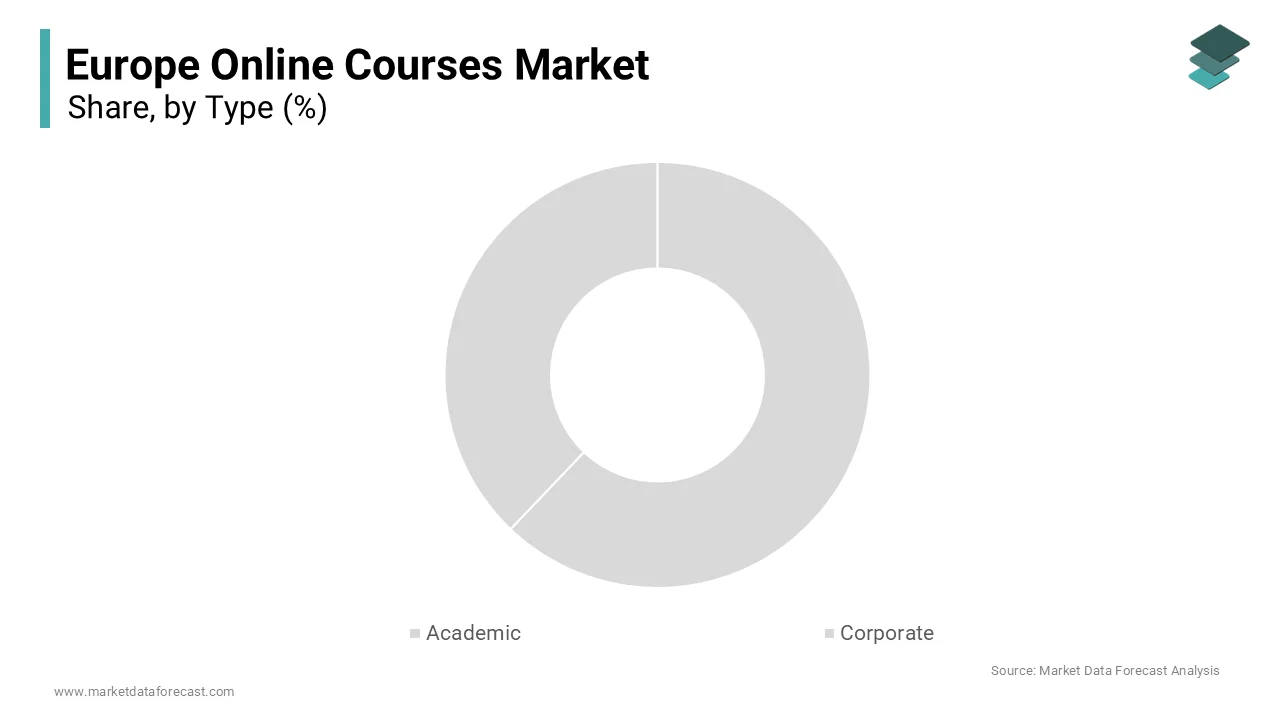
The academic segment is estimated to register the fastest CAGR of 15.2% from 2026 to 2034 due to the widespread adoption of blended learning models in universities and the increasing demand for flexible degree programs among non-traditional students. A further reason for this growth is the institutional push to democratize access to higher education, allowing students from remote areas or those balancing work and study to pursue qualifications remotely. Universities across the continent are continuing to evolve their delivery models, moving away from purely physical classrooms toward more flexible, technology-enhanced instructional methods. Additionally, government initiatives promoting lifelong learning have encouraged universities to offer micro-credentials and short-term online certificates that cater to professionals seeking specific skill upgrades. More European adults are turning to digital platforms to pursue formal academic qualifications, signaling a broader societal move toward lifelong learning through remote channels. The integration of advanced technologies like virtual laboratories and interactive simulations has also enhanced the quality of online academic experiences, making them more comparable to on-campus learning. This convergence of policy support, technological enhancement, and changing student demographics propels the academic segment to outpace other types in growth velocity.
By Technology Insights
The Learning Management Systems segment led the Europe online courses market and captured a 42.5% share in 2025. The leading position of the segment is attributed to the essential role these platforms play in centralizing course administration, content delivery, and performance tracking for both educational institutions and corporations. In addition, this area is supported by the requirement for robust data management and compliance reporting, which LMS platforms provide through detailed analytics and secure user authentication. Schools and universities across the European Union have integrated digital management platforms at a nearly universal rate following the rapid digital transformation prompted by recent global events. Furthermore, the scalability of modern LMS solutions allows organizations to seamlessly integrate third-party tools and customize workflows to suit specific pedagogical or training needs. Large corporations are increasingly centralising their training and compliance monitoring through digital platforms to ensure a standardized level of certification across their workforces. The ability to support massive numbers of concurrent users while maintaining system stability makes LMS the backbone of digital education infrastructure. Continuous innovations in user interface design and mobile accessibility have further entrenched these systems as the default choice for delivering structured online learning experiences across the continent.
The virtual classrooms segment is anticipated to witness the fastest CAGR of 18.7% over the forecast period owing to the growing preference for synchronous learning experiences that replicate the interactivity and social presence of physical classrooms. A significant driving factor is the advancement in low-latency video streaming and real-time collaboration tools that enable seamless interaction between instructors and students regardless of location. High-speed internet access is becoming the standard across Europe, enabling more complex and interactive virtual education tools to operate effectively for a larger portion of the population. Additionally, the psychological need for social connection in learning environments has led educators to favor live sessions over purely asynchronous content to maintain student engagement and motivation. Most students express a clear preference for educational formats that combine the flexibility of digital tools with the social and academic engagement of real-time interaction. The integration of features like breakout rooms, whiteboards, and instant polling has transformed virtual classrooms into dynamic spaces for active learning. This shift toward interactive, real-time education drives the exceptional growth trajectory of the virtual classrooms segment.
By End User Insights
The higher education institutions segment was the largest segment in the Europe online courses market and held a 48.7% share in 2025. The prominence of the segment is supported by the massive scale of university operations and the strategic imperative to offer flexible learning pathways to a diverse global student body. The primary factor is the transition toward hybrid degree programs where core theoretical content is delivered online, freeing up campus resources for practical labs and seminars. Higher education institutions are increasingly expanding their digital catalogs to provide flexible degree options, aiming to reach a broader global student demographic without requiring physical relocation. Furthermore, the competitive landscape among higher education providers has forced institutions to invest in sophisticated online platforms to retain enrollment numbers amidst declining demographic trends in certain regions. Universities are consistently prioritizing the modernization of their technological assets to ensure they can provide stable and high-quality remote learning and assessment environments. The need to provide alumni with continuous professional development opportunities also contributes to the sustained demand for online learning solutions within this sector. The combination of scale, strategic necessity, and competitive pressure ensures that higher education institutions remain the primary consumers of online course technologies.
The K-12 schools segment is likely to experience the fastest CAGR of 16.4% between 2026 and 2034. The swift expansion of the segment is fueled by the increasing integration of digital tools into primary and secondary curricula and the post-pandemic normalization of remote learning supplements. Among these, a different driving factor is the governmental focus on digital literacy from an early age, leading to nationwide initiatives that equip schools with tablets and high-speed internet access. European school systems are moving toward a "one-to-one" device ratio for students, though significant disparities in school-funded hardware remain between different countries and economic regions. Additionally, the rise of personalized learning platforms that adapt to individual student pacing has made online courses an attractive supplement to traditional teaching methods for addressing learning gaps. Teachers are increasingly utilizing intelligent software that adjusts to individual student progress to better manage diverse classroom needs and improve learning outcomes. The involvement of parents in monitoring academic progress through digital portals has also reinforced the adoption of online learning tools at the school level. This alignment of policy, technology, and pedagogical innovation drives the rapid expansion of the K-12 segment.
REGIONAL ANALYSIS
United Kingdom Online Courses Market Analysis
The United Kingdom was the top performer in the Europe online courses market and occupied a share of 24.6% share in 2025. The dominance of the UK market is driven by the strong government support for digital skills training, exemplified by initiatives like the Lifetime Skills Guarantee which funds adult learners to access online qualifications. The nation serves as a global hub for edtech innovation, propelled by a dense concentration of world-renowned universities and a vibrant startup ecosystem focused on digital learning solutions. The number of UK adults utilizing digital platforms for academic and professional advancement is increasing as online modules become a more flexible and accepted alternative to traditional classroom settings. Furthermore, the presence of major global MOOC providers and corporate training firms headquartered in London creates a robust supply side that caters to both domestic and international demands. Investment in British educational technology continues to focus on innovative software and AI-driven platforms, though venture capital activity has moderated from its pandemic-era peaks. The cultural acceptance of online credentials by employers further accelerates adoption, making the UK a mature and highly active market for digital education services.
Germany Online Courses Market Analysis
Germany was the next biggest player in the Europe online courses market and held a 18.3% share in 2025. A major driving factor for the German market is the national strategy for continuing education, where the government subsidizes online upskilling programs to address labor shortages in technical sectors. The market position in Germany shows a strong emphasis on vocational training and the dual education system, which is increasingly incorporating digital modules to enhance flexibility. German vocational training is undergoing a significant transition toward digital delivery to ensure that apprentices gain the technical skills required by modern industrial and service sectors. Additionally, the high level of internet penetration and digital literacy among the German population facilitates the widespread uptake of online learning platforms across all age groups. A growing portion of the German public is utilizing online resources to supplement their knowledge, though formal online course enrollment remains a relatively niche activity compared to general internet use. The rigorous quality assurance frameworks established by German accreditation bodies also build trust in online certifications, encouraging both individuals and corporations to invest in digital learning solutions.
France Online Courses Market Analysis
France played a significant role in the Europe online courses market due to aggressive state-led digitalization policies and a growing culture of lifelong learning. The region is known for the successful implementation of the Personal Training Account scheme, which provides every worker with credits specifically for online education. An additional key driving factor is the government's push to reduce unemployment through reskilling, leading to a surge in demand for short-term, job-oriented online courses. Individual training accounts remain a pillar of the French adult education system, though recent regulatory changes and fraud-prevention measures have led to a moderation in the total volume of course enrollments. Furthermore, prestigious French institutions like Sorbonne University and HEC Paris have expanded their digital offerings, lending credibility and attracting a global audience to the domestic market. Publicly funded distance learning in France is experiencing steady, moderate growth as the state integrates more digital-first options into its traditional academic framework. The combination of financial incentives, institutional prestige, and policy support creates a fertile environment for the continued expansion of the online courses market in France.
Netherlands Online Courses Market Analysis
The Netherlands grew steadily in the Europe online courses market owing to the high proficiency in English among the Dutch population, which allows local providers to easily scale their online courses to international markets and attract global learners. The market dynamics in the Netherlands are heavily influenced by the country's advanced digital infrastructure and a progressive educational philosophy that embraces experimentation with new learning technologies. The Dutch population maintains one of the highest levels of digital proficiency in the world, with a majority of citizens capable of navigating complex online environments and services. Additionally, the strong collaboration between universities and the private sector has led to the development of industry-specific online programs that directly address market needs. Academic institutions and private enterprises are increasingly aligning their digital training goals, though the pace of new initiatives is currently constrained by broader sectoral funding challenges. The supportive regulatory environment and the prevalence of flexible work arrangements further encourage professionals to engage in continuous online learning, solidifying the Netherlands as a key growth market.
Sweden Online Courses Market Analysis
Sweden is anticipated to expand in the Europe online courses market over the forecast period due to the national commitment to equal access to education, which has driven extensive investments in broadband connectivity and digital learning resources for rural and urban areas alike. The country serves as a leader in digital innovation and egalitarian education, distinguished by its early adoption of technology in schools and workplaces. Sweden is re-evaluating the role of digital platforms in its primary education system, shifting from a digital-first mandate toward a more balanced, hybrid approach that prioritizes foundational analog skills. Furthermore, the strong culture of self-directed learning and high trust in digital credentials encourages adults to pursue online courses for personal and professional development. Swedish adults are among the most active participants in lifelong learning in Europe, with a high degree of comfort in using digital tools to supplement their professional and personal development. The presence of innovative edtech startups and a supportive ecosystem for digital experimentation further accelerate the deployment of advanced online learning solutions, establishing Sweden as a forward-looking market leader.
COMPETITIVE LANDSCAPE
The competition in the Europe online courses market is intense and characterized by a diverse mix of global giants regional specialists and traditional educational institutions transitioning to digital formats. Large multinational platforms compete aggressively on content breadth and technological sophistication while leveraging brand recognition to attract millions of users. Regional players differentiate themselves by offering localized content that adheres to specific national curricula and language preferences which global competitors often overlook. Traditional universities are increasingly entering the fray by launching their own proprietary platforms to retain control over their intellectual property and student data. The rivalry focuses heavily on securing exclusive partnerships with top tier industries to provide certified credentials that hold significant weight in the job market. Price wars are common in the consumer segment prompting providers to bundle services or offer freemium models to capture market share. Innovation in pedagogical methods such as gamification and virtual reality serves as a key battleground for engaging modern learners. Regulatory compliance regarding data privacy adds another layer of complexity forcing competitors to invest heavily in security infrastructure.
KEY MARKET PLAYERS
Some of the notable key players in the Europe online courses market are
- Coursera
- Udemy
- edX
- LinkedIn Learning
- Pluralsight
- Skillsoft
- FutureLearn
- Khan Academy
- OpenClassrooms
- Instructure (Canvas)
Top Players in the Market
- Coursera stands as a pivotal force in the Europe online courses market by partnering with leading universities and organizations to offer accessible high quality education globally. The company significantly contributes to the global landscape by democratizing access to degrees and professional certificates from institutions like Yale and Google. Recently Coursera strengthened its European position by launching localized content tailored to specific regional skill gaps and expanding its enterprise offerings for corporate upskilling. The firm actively collaborates with European governments to support national reskilling initiatives ensuring alignment with local labor market needs. Their platform integrates advanced artificial intelligence to personalize learning paths which enhances user engagement and completion rates across diverse demographics. Coursera continues to invest in mobile accessibility allowing learners to access content seamlessly on various devices. This commitment to flexibility and quality solidifies their reputation as a premier provider of digital education solutions worldwide.
- Udemy operates as a massive open marketplace for learning that connects expert instructors with millions of students across Europe and the rest of the world. Its global contribution lies in enabling anyone to teach or learn any skill thereby creating a vast library of on demand content ranging from coding to personal development. To strengthen its market position in Europe Udemy recently focused on enhancing its Udemy Business platform with curated learning paths designed for enterprise clients seeking workforce transformation. The company has also invested heavily in quality assurance mechanisms to ensure course content meets rigorous standards while maintaining diversity. Udemy frequently updates its technology stack to support interactive features like coding exercises and quizzes that improve the learning experience. Udemy fosters a community-driven model. This empowers individual creators to reach global audiences while providing learners with affordable and practical skills training.
- FutureLearn distinguishes itself in the Europe online courses market through its strong partnerships with UK and European universities and cultural institutions to deliver social learning experiences. The company contributes globally by promoting a pedagogical approach that emphasizes discussion and peer interaction within its digital classrooms. Recent actions to bolster its market presence include the expansion of its micro-credential and degree programs which offer recognized qualifications to professionals seeking career advancement. FutureLearn has also integrated innovative tools for assessment and feedback to ensure academic rigor matches traditional on campus standards. The platform actively supports government backed initiatives aimed at increasing digital literacy and employability across the continent. FutureLearn maintains a reputation for excellence by focusing on high-quality content from prestigious partners. This approach attracts learners seeking credible and transformative educational opportunities. Their strategic focus on short courses and flexible study options caters effectively to the needs of modern lifelong learners.
Top Strategies Used by Key Market Participants
Key players in the Europe online courses market primarily utilize strategic partnerships with prestigious universities and corporations to enhance content credibility and expand their course libraries. Companies frequently invest in artificial intelligence technologies to personalize learning experiences and improve student retention rates through adaptive pathways. Market participants actively pursue localization strategies by translating content and adapting curricula to meet specific regional regulatory and cultural requirements across different European nations. Expanding enterprise solutions remains a central tactic where vendors develop tailored platforms for corporate clients to manage workforce upskilling and compliance training efficiently. Providers also focus on acquiring smaller niche platforms to diversify their offerings and enter specialized subject markets rapidly. Offering flexible pricing models and subscription services helps attract a broader demographic of learners who seek cost effective educational options. Continuous innovation in user interface design ensures seamless accessibility across mobile and desktop devices to maximize user engagement.
MARKET SEGMENTATION
This research report on the European online courses market has been segmented and sub-segmented based on categories.
By Type
- Academic
- Corporate
By Technology
- E-Learning
- Learning Management System
- Application Simulation Tool
- Rapid E-Learning
- Podcasts
- Virtual Classrooms
By Vendor
- Service Provider
- Content Provider
By End-User
- Higher Education Institutions
- K-12 Schools
- K-5
- 6-8
- 9-12
- Others
By Delivery
- Online
- Blended
By Subject Area
- K-12
- Languages
- Maths, Science & Social Science
- Health & Fitness, Arts, Computers & Others
- Higher Education Institutions
- Undergraduate
- Post Graduate
- Specialization and Skill Enhancement
By Country
- UK
- France
- Spain
- Germany
- Italy
- Russia
- Sweden
- Denmark
- Switzerland
- Netherlands
- Turkey
- Czech Republic
- Rest of Europe