- Product Description Description
- Table of Contents TOC
- List of Table & Figure LOT
- Get Free Sample PDF Sample PDF
Market Size, 2025
$111.40 BnMarket Estimate, 2026
$122.99 BnMarket Forecast, 2034
$271.40 BnCAGR, 2026–2034
10.40%Europe E-Learning Market Report Summary
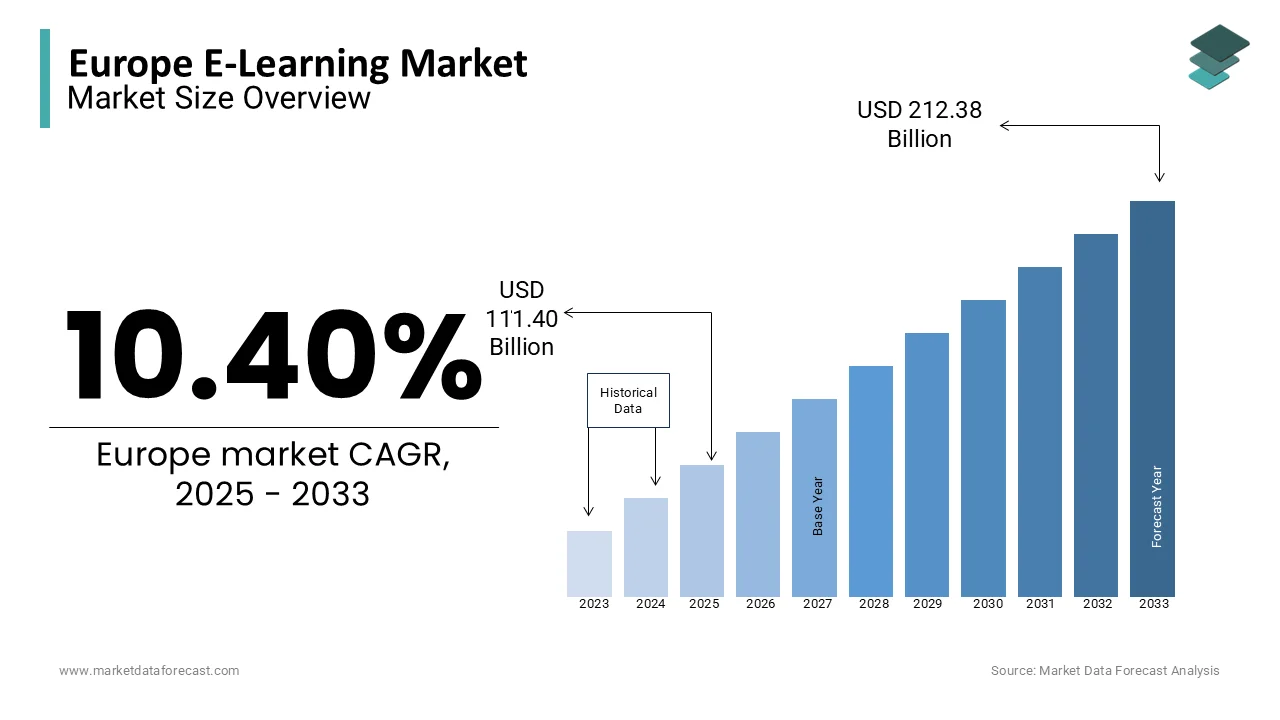
The Europe e-learning market was valued at USD 111.40 billion in 2025, is estimated to reach USD 122.99 billion in 2026, and is projected to reach USD 271.40 billion by 2034, growing at a CAGR of 10.40% from 2026 to 2034. Market growth is driven by increasing digital transformation in education, growing adoption of online learning platforms, and rising demand for flexible and accessible learning solutions. E-learning solutions are widely used across academic institutions, corporate training programs, and professional development courses. Advancements in digital learning technologies, the expansion of virtual classrooms, and government initiatives promoting digital education are further supporting the expansion of the e-learning market across Europe.
Key Market Trends
- Increasing adoption of online learning platforms and digital education technologies.
- Rising demand for self-paced and flexible learning solutions.
- Expansion of corporate training and professional development programs through e-learning platforms.
- Growing integration of AI, virtual reality, and interactive learning technologies.
- Increasing government initiatives promoting digital education infrastructure and remote learning accessibility.
Segmental Insights
- Based on delivery mode, the online segment dominated the Europe e-learning market by accounting for 58.4% share in 2025, driven by widespread internet penetration and increasing use of virtual learning platforms.
- Based on learning mode, the self-paced segment held the majority share of 62.3% in 2025, supported by the growing demand for flexible learning schedules and personalized education experiences.
- Based on end user, the academic segment led the market by capturing 54.2% share in 2025, driven by the adoption of digital learning tools by schools, universities, and higher education institutions.
Regional Insights
The Europe e-learning market is experiencing significant growth across major countries due to digital education initiatives, technological advancements, and expanding online learning ecosystems.
- Germany dominated the regional market in 2025 with 21.3% share, supported by strong investments in digital education infrastructure and growing adoption of online learning platforms.
- The United Kingdom ranked second with 17.8% share in 2025, driven by a mature online education ecosystem and increasing demand for professional and corporate training programs.
- France holds a notable position in the Europe e-learning market due to government-led initiatives to digitize the national curriculum and improve equal access to education across regions.
Competitive Landscape
The Europe e-learning market is characterized by strong competition among digital education technology providers, learning management system developers, and content providers. Market participants are focusing on enhancing learning platforms through AI-driven personalization, immersive learning technologies, and cloud-based delivery systems. Strategic partnerships with educational institutions and corporate training providers are shaping the competitive landscape across Europe.
Prominent companies operating in the Europe e-learning market include Adobe Inc., Articulate Global Inc., Cegos Group, Cengage Learning Inc., Cisco Systems Inc., City and Guilds Group, SAP SE, Pearson PLC, D2L Corp., Docebo Inc., Sanoma Learning, and Hive Learning Ltd.
Europe E-Learning Market Size
The Europe e-learning market was worth USD 111.40 billion in 2025. The European market is projected to reach USD 271.40 billion by 2034 from USD 122.99 billion in 2026, rising at a CAGR of 10.40% from 2026 to 2034.
E-learning (Electronic Learning) is the delivery of education and training through digital resources. This sector encompasses learning management systems, virtual classrooms, mobile learning applications, and massive open online courses designed for academic institutions, corporate enterprises, and individual learners. The definition extends beyond simple content digitization to include adaptive algorithms that personalize learning paths based on user performance and engagement metrics. Household internet connectivity has reached near-saturation levels across the European Union, providing a robust and nearly universal foundation for the delivery of digital services and online educational content. Furthermore, participation in digital education is steadily increasing across Europe as more citizens turn to the internet for flexible skill development and personal enrichment. Digital tools are becoming a standard component of the modern classroom, though the frequency and effectiveness of their use remain dependent on ongoing professional development and institutional support. The market is characterized by a strong emphasis on data privacy compliance with the General Data Protection Regulation, ensuring that learner information remains secure. This regulatory environment fosters trust while encouraging innovation in secure cloud-based learning platforms that cater to the diverse linguistic and cultural landscape of the continent without compromising user rights.
MARKET DRIVERS
Corporate Imperative for Continuous Upskilling and Reskilling
The urgent need for continuous workforce development driven by rapid technological disruption and the green transition contributes to the growth of the Europe E-Learning Market. Organizations across the continent are increasingly relying on digital platforms to efficiently upskill employees in emerging fields such as artificial intelligence, data analytics, and sustainable practices, without disrupting daily operations. Adult participation in education and training across the EU is on a gradual upward trajectory, though it currently remains well below the ambitious targets set for the end of the decade. A vast majority of European businesses are facing persistent challenges in finding qualified talent, leading to increased pressure on internal reskilling and the development of specialized corporate training programs. The rise of hybrid work models has further accelerated this trend as companies seek scalable solutions to train distributed teams consistently across different geographies. The European Union is implementing broad policy frameworks and investment strategies to significantly boost the frequency of adult training to meet the evolving demands of the digital and green transitions. This structural shift in human capital development ensures a robust and recurring demand for enterprise-grade learning solutions that offer certified and industry-aligned content.
Government-Led Digital Education Infrastructure Initiatives
Aggressive government mandates and substantial public funding are modernizing national education systems, which fuels the expansion of the Europe e-learning market. These initiatives act as a powerful driver for e-learning adoption across Europe. Nations throughout the region have recognized digital literacy as a cornerstone of future economic competitiveness, leading to massive state investments in broadband connectivity and digital learning tools for schools and universities. The European Union is significantly scaling up financial support across multiple programs to modernize its education systems and ensure that high-quality digital content reaches all learners. Germany is making massive, long-term investments in its school infrastructure to bridge the digital gap and embed technology-supported learning into the standard national curriculum. Similarly, the French government is implementing a multi-year digital roadmap to enhance student competencies and provide teachers with the necessary tools and training to lead modern classrooms. These financial injections significantly reduce the cost barrier for educational institutions to adopt sophisticated e-learning solutions, thereby accelerating market penetration. European nations are moving toward a standard of near-universal digital literacy, recognizing that basic technical proficiency is now a prerequisite for active citizenship and professional success.
MARKET RESTRAINTS
Persistent Digital Divide and Socioeconomic Disparities
A persistent digital divide based on socioeconomic status and geographic location remains a formidable restraint, which limits the growth of the Europe e-learning market. Students and professionals from low-income households and rural areas often lack access to high-speed internet and modern devices necessary to fully benefit from advanced digital learning tools. Disparities in home internet access remain a persistent challenge across Europe, with households in the lowest income brackets facing significantly higher barriers to connectivity than their more affluent counterparts. High-speed internet availability is expanding into remote parts of Europe, although residents in rural and southern regions continue to experience lower average connection speeds compared to those in metropolitan hubs. This disparity prevents equitable participation in online learning initiatives and limits the addressable market for premium e-learning services. A substantial number of children across the continent face significant hurdles in accessing digital learning environments due to the high cost of equipment and reliable data services. The socioeconomic divide is further exacerbated by varying levels of digital literacy among parents and educators in disadvantaged communities who struggle to facilitate effective online learning environments. The market’s capacity for truly inclusive growth will remain constrained until these infrastructure and economic barriers are resolved.
Fragmented Regulatory Landscape and Data Privacy Compliance Costs
The complex and often fragmented regulatory environment across European nations, particularly concerning data privacy and child safety, acts as a significant restraint on the scalability of e-learning solutions, and the overall expansion of the Europe e-learning market. The General Data Protection Regulation provides a unified framework. However, its implementation varies by country and sector, leading to high compliance costs and legal uncertainties for providers, especially small and medium-sized enterprises. Regulators are increasingly scrutinizing the processing of minors' data in educational settings and the data transfer practices of major technology firms, leading to a sharp rise in the severity and frequency of penalties in these areas. The requirement to localize data storage and adhere to strict consent mechanisms for minors creates technical hurdles that slow down the deployment of cloud-based learning platforms. A significant portion of European startups identify complex regulatory frameworks as a major hurdle to scaling across borders, prompting calls for simplified, harmonized rules to boost the continent's competitiveness. Furthermore, the varying national curricula and certification standards necessitate extensive customization of content, which dilutes economies of scale. The adoption of cross-border digital assessment tools in education is hindered by diverse national curricula and differing technical standards, making it difficult to implement unified testing platforms across member states. This regulatory fragmentation forces providers to navigate a labyrinth of local laws, increasing time to market and operational overhead.
MARKET OPPORTUNITIES
Integration of Artificial Intelligence for Hyper Personalized Learning
The incorporation of AI and machine learning algorithms into educational platforms offers a transformative opportunity for the Europe E-Learning Market. This is primarily achieved by enabling hyper-personalized learning experiences that adapt to individual student needs. AI-driven systems can analyze vast amounts of learner data to identify knowledge gaps, predict performance trends, and recommend customized content pathways in real time. Research indicates that personalized digital tutoring platforms can significantly enhance student performance levels by providing immediate feedback and tailoring content to individual learning speeds. This capability is particularly valuable in diverse European classrooms where students speak different native languages and possess varying learning paces. The integration of automated tools for grading and administrative management is increasingly viewed as a viable solution to alleviate the time pressures faced by teaching staff. The technology also supports inclusive education by providing real-time translation and accessibility features for students with disabilities. Educational systems across Europe are moving toward software that automatically adjusts to a learner's proficiency, aiming to optimize the use of classroom time and institutional funding. AI enables e-learning firms to create customized, high-impact learning solutions that significantly improve learner retention and engagement.
Expansion of Immersive Technologies for Vocational Training
The adoption of virtual reality and augmented reality technologies provides a potential prospect for the Europe E-Learning Market. This is particularly true in the realm of vocational and technical training, where hands-on experience is critical. These immersive tools allow learners to practice complex procedures in safe simulated environments, ranging from medical surgeries to industrial machinery operation, without the risks associated with real-world training. The implementation of immersive simulations allows workers to rehearse dangerous tasks in a risk-free environment, leading to significantly better hazard recognition and a measurable decrease in workplace injuries. The European Union's focus on green skills and the transition to renewable energy creates a specific demand for VR simulations that teach solar panel installation, wind turbine maintenance, and energy efficiency auditing. Financial backing for startups developing virtual training solutions is expanding as major industries seek to replace expensive and risky physical training setups with more cost-effective digital simulations. Furthermore, the ability to standardize training quality across borders makes VR an ideal solution for multinational corporations operating in multiple European countries. Technical and vocational institutions across Europe are increasingly adopting immersive technologies to modernize their teaching methods and ensure that students develop the practical skills required by the current labor landscape.
MARKET CHALLENGES
Teacher Resistance and Insufficient Digital Pedagogy Training
The resistance from educators who lack adequate training in digital pedagogy is a significant challenge confronting the Europe E-Learning Market. This deficiency leads to the underutilization of purchased technologies. Many teachers feel overwhelmed by the rapid pace of technological change and struggle to integrate new tools effectively into their existing teaching methods, resulting in low adoption rates. Access to digital hardware in European classrooms is high, yet a significant "preparedness gap" remains. Many teachers report needing more practical, hands-on training to effectively integrate these tools into their lessons. There is a persistent disconnect between the digital infrastructure available in schools and its actual daily usage, often due to a lack of teacher confidence and insufficient pedagogical support. The gap between technology provision and pedagogical competence creates a disconnect where expensive software licenses remain unused or are employed merely as digital substitutes for traditional methods. Education trade unions across Europe are prioritizing the demand for comprehensive, employer-funded professional training to ensure that the workforce can keep pace with the rapid digitalization of the sector. The return on investment for schools and corporations remains suboptimal. This is because comprehensive training initiatives are needed to empower teachers to leverage e-learning for enhanced learning outcomes. This human factor challenge requires a strategic shift from purely technology-centric sales approaches to holistic solutions.
Market Saturation and Interoperability Issues Among Platforms
Increasing saturation and severe interoperability issues among available platforms are hindering the expansion of the Europe e-learning market. These factors hinder seamless integration and the overall user experience. Schools and corporations often find themselves managing a fragmented ecosystem of disjointed tools that do not communicate effectively, leading to data silos and administrative inefficiencies. Educational institutions are increasingly seeking to harmonize their digital ecosystems, but the process of syncing diverse third-party applications with core management systems remains a complex technical and administrative task. The transition toward open technical specifications is helping to automate administrative tasks, though IT departments still dedicate considerable resources to maintaining security and data privacy across their integrated toolsets. The proliferation of niche solutions exacerbates the problem as users are forced to navigate multiple logins and interfaces, which diminishes engagement and increases cognitive load. Schools are gradually expanding their digital toolkits, though the primary focus for most institutions is currently on establishing a unified infrastructure rather than managing a vast array of specialized, unintegrated applications. This fragmentation creates friction for end users and raises switching costs, making it difficult for new entrants to gain traction unless they offer superior interoperability. The industry must move towards greater standardization to overcome this hurdle.
REPORT COVERAGE
| REPORT METRIC | DETAILS |
| Market Size Available | 2025 to 2034 |
| Base Year | 2025 |
| Forecast Period | 2026 to 2034 |
| Segments Covered | By Delivery Mode, Learning Mode, End-user, and Country. |
| Various Analyses Covered | Global, Regional, and Country-Level Analysis, Segment-Level Analysis, Drivers, Restraints, Opportunities, Challenges; PESTLE Analysis; Porter’s Five Forces Analysis, Competitive Landscape, Analyst Overview of Investment Opportunities |
| Countries Covered | UK, France, Spain, Germany, Italy, Russia, Sweden, Denmark, Switzerland, Netherlands, Turkey, Czech Republic, and the Rest of Europe. |
| Market Leaders Profiled | Adobe Inc., Articulate Global Inc., Cegos Group, Cengage Learning Inc, Cisco Systems Inc., City and Guilds Group, SAP SE, Pearson PLC, D2L Corp., Docebo Inc., Sanoma Learning, Hive Learning Ltd. |
SEGMENTAL ANALYSIS
By Delivery Mode Insights
The online segment dominated the Europe e-learning market and accounted for a 58.4% share in 2025. The dominance of the segment is driven by the universal necessity for broadband accessible content that serves as the backbone for both academic institutions and corporate training programs across the continent. The primary driver is the massive expansion of high-speed internet infrastructure, which has made web-based learning the default mode of delivery for formal education and professional development. High-speed internet connectivity is now available to the vast majority of European homes, providing a reliable foundation for the consumption of digital educational content and remote learning services. Furthermore, the flexibility offered by online platforms allows learners to access materials from any location, which is critical for working professionals balancing employment with education. Higher education institutions across Europe have widely adopted digital portals and hybrid teaching models to supplement traditional classroom instruction and improve student access to materials. The scalability of online solutions also enables providers to reach millions of users simultaneously without the logistical constraints of physical classrooms or specific device requirements. The shift toward remote work has normalized the use of browser-based learning tools, making the online segment the most entrenched and widely adopted delivery mechanism in the regional market.
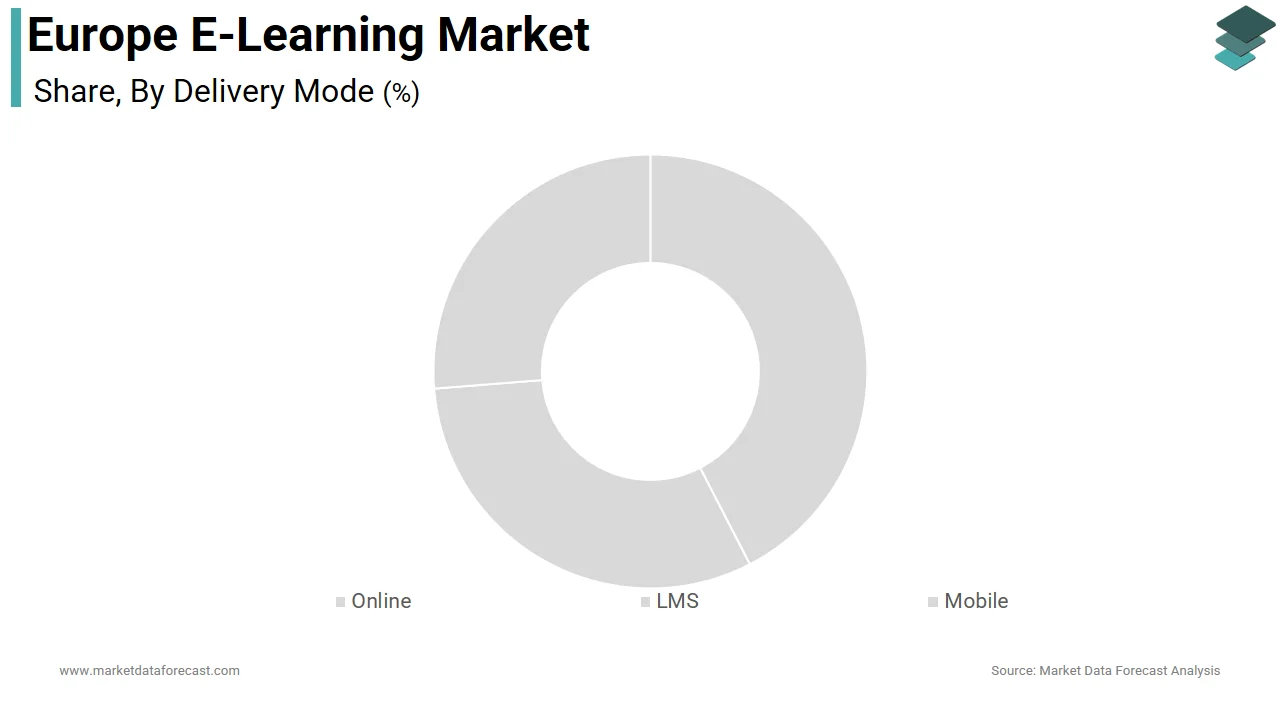
The mobile segment is estimated to register the fastest CAGR of 16.4% during the forecast period due to the proliferation of smartphones and the changing consumption habits of modern learners who prioritize on-the-go accessibility. This acceleration is fueled by the increasing capability of mobile devices to handle complex multimedia content and interactive assessments that were previously restricted to desktop computers. The proliferation of advanced mobile devices and the rollout of next-generation cellular networks are enabling more sophisticated and data-intensive educational tools to be used outside of traditional home or office settings. The trend toward microlearning, where content is consumed in short bursts, fits perfectly with mobile usage patterns, allowing users to learn during commutes or breaks. Mobile devices have become a preferred medium for supplemental learning, with developers increasingly focusing on mobile-first designs to enhance user engagement and accessibility. Additionally, the rise of gamified learning apps has attracted younger demographics who prefer engaging with educational content through their personal devices rather than traditional laptops. As per sources, the rollout of advanced mobile networks has reduced latency, enabling real-time virtual classrooms on handheld devices. The convenience and immediacy offered by mobile learning ensure this segment will outpace others as it aligns with the lifestyle of the digital native workforce and student body.
By Learning Mode Insights
The self-paced segment held the majority share 62.3% of the Europe E-Learning market in 2025. The supremacy of the segment is attributed to the inherent flexibility it offers learners to progress through materials at their own speed, which is highly valued by working professionals and students with irregular schedules. The main driver is the demand for asynchronous learning models that allow individuals to balance education with full-time employment and personal commitments without being tied to fixed class times. While adults increasingly value the flexibility of digital learning to balance work and life, significant structural barriers, such as caregiving duties and conflicting schedules, continue to hinder widespread participation. The cost-effectiveness of self-paced models also contributes significantly, as providers can serve unlimited students without the recurring expense of instructor hours for each session. European companies are adopting digital training tools primarily to standardize compliance and increase accessibility, though the direct financial impact varies widely by sector and implementation strategy. Furthermore, the availability of recorded lectures and modular content allows learners to revisit difficult concepts multiple times, enhancing retention rates. As per research, the push for lifelong learning encourages individuals to take ownership of their development journey, favoring autonomous learning modes that empower users to dictate their own educational trajectory.
The instructor-Led segment is anticipated to witness the fastest CAGR of 14.8% over the forecast period, owing to the rising demand for interactive live sessions that replicate the engagement of physical classrooms in a virtual setting. This surge is supported by the recognition that certain complex subjects and soft skills require real-time feedback, peer interaction, and direct mentorship, which self-paced modules cannot fully provide. Higher education institutions across Europe are settling into a hybrid model that blends physical presence with digital enhancements, rather than fully replacing on-campus interaction with live virtual teaching. The corporate sector is also driving this growth as organizations seek live workshops for leadership development and team building, where immediate dialogue and collaboration are essential. Employee satisfaction with corporate training is increasingly driven by the relevance and interactivity of the content, with a notable split in preference between those who value live guidance and those who prioritize schedule autonomy. Additionally, advancements in video conferencing technology and collaborative whiteboards have made live online sessions more immersive and effective. The demand for executive education is expanding steadily, with a clear shift toward flexible, technology-mediated formats that allow senior leaders to upskill without extended career interruptions. The need for human connection and dynamic interaction ensures that instructor-led learning will expand rapidly as a premium complement to self-study.
By End User Insights
The academic segment led the Europe e-learning market and occupied a 54.2% share in 2025. The prominence of the segment is credited to the massive scale of compulsory and higher education systems across Europe that have deeply integrated digital learning tools. This growth is driven by government mandates to digitize curricula and the widespread adoption of Learning Management Systems in schools and universities to support blended learning models. The sheer volume of students enrolled in primary, secondary, and tertiary education creates a consistent and large-scale demand for e-learning licenses and content subscriptions. Furthermore, the standardization of digital competencies in national curricula has forced educational authorities to procure comprehensive e-learning suites for millions of users. As per sources, the expectation among students for digital access to course materials has become universal, prompting institutions to prioritize e-learning investments. The foundational role of education in society, combined with strong public funding, ensures the Academic segment remains the largest consumer of e-learning solutions in the region.
The corporate segment is likely to experience the fastest CAGR of 15.2% between 2026 and 2034. The rapid expansion of the segment is propelled by the urgent need for rapid upskilling and reskilling in response to technological disruption and the green transition. Companies are increasingly viewing e-learning as a strategic asset to maintain competitiveness, leading to aggressive spending on digital training platforms that can deploy content instantly to global workforces. The shift toward hybrid work models has made centralized digital training hubs essential for maintaining culture and knowledge transfer across distributed teams. Additionally, the rise of the gig economy has created a market of independent contractors who purchase corporate-grade courses to enhance their employability. As per studies, the target for adult participation in training is pushing corporations to adopt scalable e-learning systems that offer certified micro-credentials. The direct link between e-learning investment and business performance ensures this segment will experience the most rapid expansion.
COUNTRY-LEVEL ANALYSIS
Germany E-Learning Market Analysis
Germany was the top performer in the Europe e-learning market and accounted for a 21.3% share in 2025. The dominance of the German market is driven by its robust industrial base and world-class university system that heavily invests in digital education. The country's dual education system is undergoing a digital transformation with vocational schools and corporations adopting sophisticated e-learning platforms to simulate complex engineering processes and teach Industry 4.0 skills. The manufacturing sector's urgent need to reskill workers for automation and robotics has led to a surge in corporate learning subscriptions and simulation software. Furthermore, the presence of numerous research institutes drives demand for advanced online collaboration tools and open-access educational resources. As per sources, the digital skills gap in Germany is a top priority for the economy, prompting both public and private sectors to accelerate e-learning procurement. The combination of strong government funding, industrial necessity, and a culture of precision ensures Germany remains the dominant force in the regional market.
United Kingdom E-Learning Market Analysis
The United Kingdom was the second largest player in the Europe e-learning market and captured a 17.8% share in 2025. The expansion of the UK market is fuelled by a vibrant startup ecosystem and a mature higher education sector that leads in online degree offerings. The UK is home to a disproportionate number of e-learning unicorns and innovators who develop cutting-edge solutions for language learning, coding, and professional certification. According to research, the UK government has launched several initiatives to promote digital skills, including the National Centre for Computing Education, which supports thousands of teachers in delivering high-quality computer science lessons. The financial services sector in London is a major driver of demand for compliance and fintech training platforms due to the rapidly evolving regulatory landscape. Additionally, the prevalence of English as a global language allows UK-based e-learning companies to scale rapidly and export their solutions globally, reinforcing domestic growth. The convergence of financial strength, academic excellence, and entrepreneurial spirit positions the UK as a critical hub for e-learning advancement.
France E-Learning Market Analysis
France holds a noteworthy share of the Europe E-Learning Market owing to aggressive state-led initiatives to digitize the national curriculum and reduce territorial inequalities in education access. The French government views e-learning as a tool for social mobility and has implemented nationwide programs to provide digital resources to every student, regardless of their geographic location. According to sources, the "Territoires Numériques Éducatifs" project has deployed digital tablets and interactive whiteboards in thousands of schools across rural and urban areas. The strong presence of Grandes Écoles and a competitive corporate environment fuels demand for executive education and specialized management training platforms. Furthermore, the French tech scene is thriving with a focus on artificial intelligence and adaptive learning algorithms tailored to the French language and pedagogy. As per research, the number of e-learning startups in France has doubled in the last three years, supported by generous tax credits and innovation grants. The centralized nature of the French education system allows for rapid scaling of successful pilots, making it a unique and powerful market for standardized e-learning solutions.
Netherlands E-Learning Market Analysis
The Netherlands expanded steadily in the Europe e-learning market due to its exceptionally high digital literacy rates and its role as a testing ground for international e-learning companies entering Europe. Dutch schools and universities are among the most digitally advanced in the world, with a long history of integrating technology into daily teaching practices. The country's progressive approach to personalized learning and student-centered pedagogy drives demand for adaptive learning platforms and data analytics solutions. Research indicates that the education technology sector is a key focus area for innovation subsidies, with significant funding available for projects that improve learning outcomes through technology. Furthermore, the widespread proficiency in English makes the Netherlands an ideal launchpad for global e-learning firms to refine their products before expanding to larger non-English speaking markets. The combination of a tech-savvy population, supportive government policies, and strategic geographic location ensures the Netherlands remains a high-value market for e-learning innovation.
Sweden E-Learning Market Analysis
Sweden is likely to grow in the Europe e-learning market during the forecast period owing to its unwavering commitment to digital equality and its status as a global leader in innovation and sustainability. The Swedish education system is fully digitized with a national strategy that ensures every student has access to high-quality digital learning resources regardless of socioeconomic background. The country's strong tradition of open source software and collaborative learning fosters a unique market for platforms that emphasize peer-to-peer interaction and transparency. Furthermore, the Swedish corporate sector is a pioneer in using virtual reality and gamification for employee training, particularly in the gaming and automotive industries. The holistic integration of technology into the fabric of society and the education system makes Sweden a mature and sophisticated market that sets trends for the rest of Europe.
COMPETITIVE LANDSCAPE
The competition in the Europe E-Learning Market is characterized by a dynamic mix of established publishing giants transitioning to digital models and agile startups introducing disruptive technologies. Rivalry is intense as companies vie for limited public sector budgets and the attention of diverse stakeholders, including teachers, students, and corporate training managers. Differentiation is increasingly achieved through the integration of artificial intelligence for personalization and the provision of comprehensive data analytics that demonstrate measurable learning outcomes. While global players leverage their scale and extensive content libraries, local competitors maintain an advantage through a deep understanding of national curricula and strong relationships with regional educational authorities. The market sees frequent mergers and acquisitions as larger entities seek to acquire innovative technologies and niche expertise to fill gaps in their offerings. Price competition exists but is often secondary to value propositions related to pedagogical effectiveness, ease of use, and regulatory compliance. The fragmented nature of the European education system requires competitors to be highly adaptable and culturally sensitive to succeed across multiple borders.
KEY MARKET PLAYERS
The leading companies operating in the Europe e-learning market include:
- Adobe Inc.
- Articulate Global Inc.
- Cegos Group
- Cengage Learning Inc.
- Cisco Systems Inc.
- City and Guilds Group
- SAP SE
- Pearson PLC
- D2L Corp.
- Docebo Inc.
- Sanoma Learning
- Hive Learning Ltd.
TOP PLAYERS IN THE MARKET
- Pearson PLC stands as a global leader in educational content and digital services with a profound impact on the Europe E-Learning Market through its comprehensive suite of online courses and assessment tools. The company contributes significantly to the global landscape by transitioning from traditional print publishing to becoming a purely digital learning provider focused on measurable outcomes. Recently, Pearson has strengthened its position by launching AI-powered study tools that offer personalized feedback to students across various subjects. They have also expanded their English language learning platforms to include virtual classrooms that connect learners with tutors worldwide. Their strategic focus on higher education partnerships ensures they remain integral to university curricula across Europe. Pearson drives engagement and raises academic standards through ongoing investment in adaptive learning tools, cementing its status as a premier provider of global, accredited digital education.
- SAP SE operates as a critical force in the corporate segment of the Europe E-Learning Market, leveraging its enterprise software expertise to deliver robust learning management systems. The German technology giant influences the global market by integrating learning solutions directly into human resource workflows, enabling seamless employee development within large organizations. Recent actions include the enhancement of their SAP SuccessFactors platform with machine learning capabilities that recommend tailored training paths based on individual skill gaps. SAP has also partnered with major European universities to offer micro-credentials that align with industry needs in cloud computing and data analytics. Their emphasis on mobile-first design ensures accessibility for distributed workforces across the continent. SAP’s focus on continuous upskilling makes it the go-to partner for businesses crushing digital transformation and winning through smarter knowledge management.
- Sanoma Learning is a premier provider of digital learning materials and services with deep roots in the European market, particularly in the Netherlands, Finland, and Belgium. The company contributes globally by setting high standards for curriculum-aligned digital content that blends pedagogical expertise with technological innovation. Recently, Sanoma has aggressively expanded its portfolio of adaptive learning platforms and data-driven assessment tools to support personalized education journeys. They have strengthened their position by acquiring niche edtech startups to integrate artificial intelligence capabilities into their core offerings. Their strategic focus on hybrid learning models ensures they remain indispensable to schools navigating the post pandemic educational landscape. Sanoma continues to drive engagement and improve learning outcomes across diverse European educational systems by prioritizing teacher empowerment through intuitive digital interfaces. Simultaneously, the company is expanding its footprint in international markets through strategic partnerships.
TOP STRATEGIES USED BY KEY MARKET PARTICIPANTS
Key players in the Europe E-Learning Market primarily employ strategies centered on strategic acquisitions and partnerships to rapidly expand their product portfolios and geographic reach. Companies are heavily investing in artificial intelligence and machine learning technologies to develop adaptive learning platforms that offer personalized educational experiences tailored to individual student needs. Another dominant strategy involves shifting from one-time software licenses to subscription-based recurring revenue models, which ensure financial stability and deeper customer engagement. Market participants are also focusing on content localization to address the diverse linguistic and cultural requirements of different European nations, ensuring relevance and compliance with local curricula. Furthermore, firms are increasingly collaborating with governments and educational institutions to co-create solutions that align with national digital education strategies and secure large-scale public sector contracts. Sustainability and data privacy compliance are also central to strategic planning as companies strive to build trust and meet stringent European regulatory standards.
MARKET SEGMENTATION
This research report on the European e-learning market is segmented and sub-segmented into the following categories.
By Delivery Mode
- Online
- LMS
- Mobile
By Learning Mode
- Self-Paced
- Instructor-Led
By End User
- Academic
- Corporate
By Country
- UK
- France
- Spain
- Germany
- Italy
- Russia
- Sweden
- Denmark
- Switzerland
- Netherlands
- Turkey
- Czech Republic
- Rest of Europe