- Product Description Description
- Table of Contents TOC
- List of Table & Figure LOT
- Get Free Sample PDF Sample PDF
Market Size, 2025
$319.97 BnMarket Estimate, 2026
$379.65 BnMarket Forecast, 2034
$1,491.16 BnCAGR, 2026–2034
18.65%Europe Online Grocery Shopping Market Report Summary
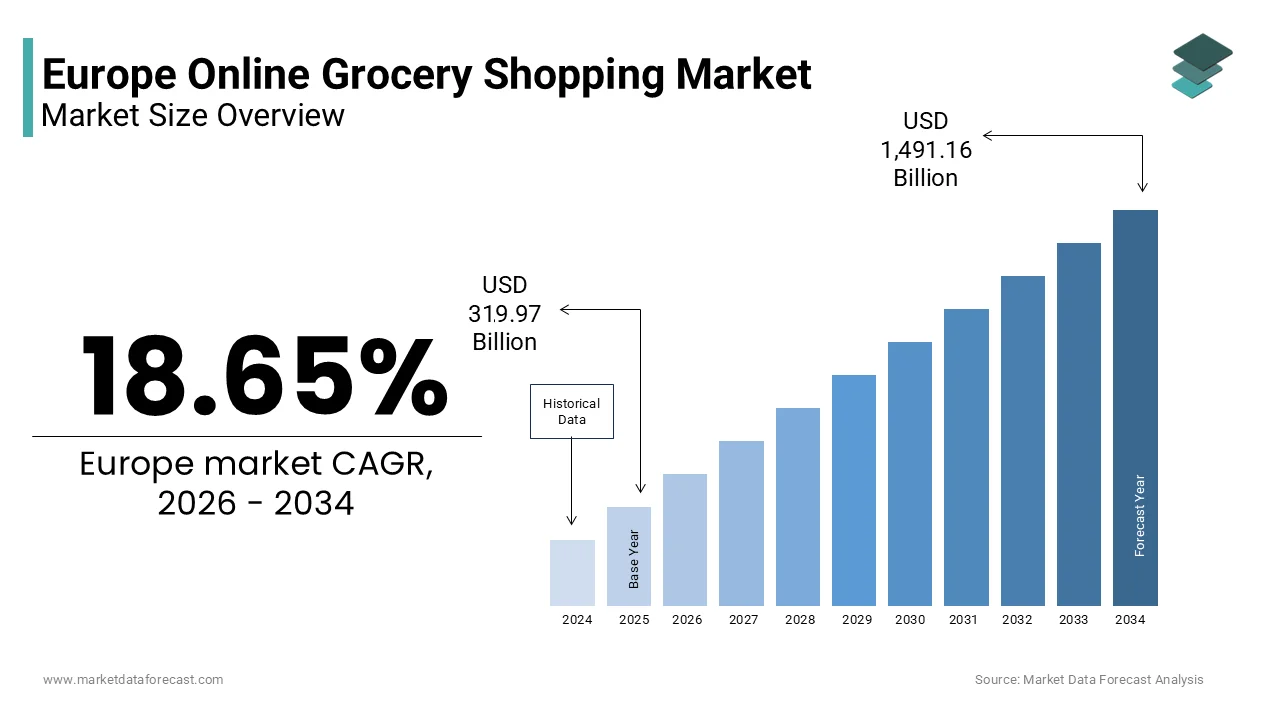
The Europe online grocery shopping market was valued at USD 319.97 billion in 2025, is estimated to reach USD 379.65 billion in 2026, and is projected to reach USD 1,491.16 billion by 2034, growing at a CAGR of 18.65% during the forecast period. The growth of the Europe online grocery shopping market is driven by increasing consumer preference for convenient shopping solutions, rising adoption of digital commerce platforms, and expanding home delivery services. Online grocery platforms enable consumers to purchase fresh produce, packaged foods, and household essentials through mobile applications and websites with doorstep delivery. The growing penetration of smartphones, advancements in logistics infrastructure, and increasing use of digital payment systems are further accelerating the adoption of online grocery shopping across Europe.
Key Market Trends
- Increasing consumer demand for convenient grocery shopping experiences supported by digital platforms and mobile applications.
- Rapid growth of quick commerce and last mile delivery networks enabling faster grocery deliveries.
- Rising adoption of subscription based grocery services and personalized product recommendations.
- Expansion of omnichannel retail strategies integrating online platforms with physical retail stores.
- Growing use of artificial intelligence and data analytics to optimize inventory management and customer experience.
Segmental Insights
- Based on delivery model, the retail delivery segment held the largest share of the Europe online grocery shopping market in 2025. Traditional retailers offering home delivery services through digital platforms are expanding their online grocery presence by leveraging existing store networks and distribution infrastructure.
- Based on platform type, the multi category marketplace segment accounted for 55.4% of the Europe online grocery shopping market share in 2025. These platforms offer a wide range of grocery products along with other consumer goods, providing customers with convenience and broader product availability.
- Based on delivery type, the scheduled deliveries segment dominated the Europe online grocery shopping market in 2025. Scheduled delivery options allow consumers to choose convenient delivery time slots, improving logistics efficiency and customer satisfaction.
Regional Insights
- The Europe online grocery shopping market is witnessing rapid expansion across several countries due to the increasing adoption of digital retail platforms and changing consumer shopping behavior.
- The United Kingdom accounted for the largest share of the Europe online grocery shopping market and held 23.3% of the regional market share in 2025. The country’s advanced e commerce infrastructure, high internet penetration, and strong presence of leading online grocery retailers are key factors supporting market growth.
- Other European countries are also experiencing significant growth in online grocery adoption supported by expanding delivery networks, increasing smartphone usage, and rising consumer demand for convenient shopping experiences.
Competitive Landscape
The Europe online grocery shopping market is highly competitive with the presence of major retail chains, e commerce platforms, and delivery service providers. Companies are focusing on strengthening logistics capabilities, expanding digital platforms, and enhancing customer experience through faster delivery services and broader product offerings. Strategic partnerships with technology providers and investments in warehouse automation are helping companies improve operational efficiency and expand their market presence across Europe. Prominent players in the Europe online grocery shopping market include Tesco Plc, Carrefour SA, ICA Gruppen AB, Auchan SA, Colruyt Group, REWE Group, Amazon Fresh, Delivery Hero SE, Flink SE, Just Eat Takeaway.com, Uber Eats, and Rakuten Group Inc.
 Download Free Sample Report
Europe Online Grocery Shopping Market Size
The Europe online grocery shopping market size was valued at USD 319.97 billion in 2025 and is projected to reach USD 1,491.16 billion by 2034 from USD 379.65 billion in 2026, growing at a CAGR of 18.65%.
The online grocery shopping is the digital procurement of food, beverages, and household essentials through dedicated e-commerce platforms, mobile applications, and third-party aggregators, fulfilled via home delivery or click-and-collect services. As per Eurostat, internet usage for ordering goods or services in the European Union reached 74% of individuals in 2024, establishing a robust digital foundation for retail expansion. According to the European Commission, the share of households with broadband access exceeds 90% across most member states, facilitating seamless transaction capabilities for perishable goods. The European Environment Agency notes that road transport accounts for 71% of total inland freight transport, highlighting the logistical intensity required to sustain direct-to-consumer grocery models. The General Data Protection Regulation continues to dictate strict protocols for handling consumer purchase history and personal data within these digital ecosystems. According to national statistics offices, the average time spent on mobile devices by Europeans exceeds 4 hours daily, creating ample opportunity for app-based grocery engagement. These contextual factors define an operational environment where digital convenience, logistical efficiency, and regulatory compliance converge to reshape traditional food retailing.
MARKET DRIVERS
Urbanization Density Enables Efficient Last Mile Logistics
The urbanization density is creating the population concentration necessary for economically viable last-mile delivery operations. This is majorly propelling the growth of Eurpe online grocery shopping market. High-density living arrangements in major metropolitan areas reduce the average distance between distribution hubs and end consumers, significantly lowering the cost per drop for logistics providers. According to the European Commission, over 75% of the EU population currently resides in cities, towns, and suburbs, providing a concentrated customer base that supports frequent and rapid delivery windows. As per logistical studies, delivery costs in dense urban environments can be up to 40% lower than in rural settings due to route optimization and reduced fuel consumption per order. The proliferation of micro-fulfillment centers located within city centers, allows retailers to offer same-day or even one-hour delivery slots, a service level that is financially unfeasible in dispersed regions. According to urban planning data, the average commute times in cities like London and Paris exceed 60 minutes, prompting residents to substitute physical shopping trips with online orders to reclaim leisure time. The infrastructure of apartment complexes often includes secure parcel lockers or concierge services, mitigating the risk of failed deliveries and theft. As per studies, the integration of electric cargo bikes for final delivery in congested zones further enhances efficiency and aligns with low emission zone regulations.
Dual Income Household Dynamics Drive Time Scarcity Solutions
The dual income household dynamics is creating acute time scarcity that necessitates the convenience of online grocery procurement. This factor is also escalating the growth of Europe online grocery shopping market. The increasing participation of women in the workforce and the prevalence of two-income families have fundamentally altered domestic labor allocation, reducing the time available for traditional weekly supermarket visits. According to Eurostat, the employment rate for women in the European Union reached 69.3% in 2024, reflecting a sustained trend toward dual-earner households that prioritize time efficiency over price sensitivity for routine tasks. As per research, the average working week in Europe often extends beyond contractual hours due to commuting and remote workoverlaps, leaving minimal windows for physical shopping during standard store operating times. The opportunity cost of spending hours navigating aisles and waiting in checkout lines has become prohibitive for many professionals by making the premium paid for delivery services a rational economic trade-off. According to consumer behavior surveys, 65% of online grocery users cite time saving as the primary motivation for switching from brick-and-mortar stores to digital platforms. The ability to schedule deliveries during evenings or weekends aligns perfectly with the irregular schedules of modern working families.
MARKET RESTRAINTS
Perishability Concerns Hinder Fresh Produce Adoption
The perishability concerns such as consumer hesitation regarding the quality and freshness of fruits, vegetables, and meat purchased without physical inspection is solely limiting the growth of Europe online grocery shopping market. The inability to personally select items based on texture, ripeness, or visual appeal remains a psychological barrier for many shoppers who distrust automated picking processes. According to consumer confidence surveys, nearly 50% of European shoppers express reluctance to buy fresh produce online due to fears of receiving damaged or near-expiry products. As per studies, return rates for fresh categories in online grocery are significantly higher than for dry goods, eroding profit margins and complicating reverse logistics operations. The complexity of maintaining an unbroken cold chain from the warehouse to the customer doorstep introduces multiple points of failure where temperature fluctuations can compromise food safety. According to food safety authorities, the liability for spoilage rests heavily on the retailer, leading to substantial waste costs that are often passed on to consumers in the form of higher prices. The variance in quality standards across different batches makes it difficult for algorithms to consistently replicate the selection criteria of a discerning human shopper. This inherent limitation of the digital medium regarding sensory evaluation continues to cap the penetration rate of online grocery for essential fresh categories.
High Operational Costs Impact Price Competitiveness
The high operational costs by forcing retailers to charge premiums that deter price-sensitive consumers from fully migrating to digital channels is limiting the growth of Europe online grocery shopping market. The economics of online grocery involve substantial expenditures on warehousing automation, specialized packaging, temperature-controlled vehicles, and last-mile delivery personnel, which are absent in traditional self-service models. As per reports, the volatility of energy prices in Europe has further inflated the cost of running refrigerated storage facilities and electric delivery fleets, squeezing already thin retail margins. Many retailers struggle to pass these full costs onto consumers without losing volume to discount supermarkets by leading to a scenario where online grocery operations frequently operate at a loss. According to the survey, a significant portion of European consumers remains unwilling to pay delivery fees exceeding 5 euros, forcing retailers to subsidize logistics to maintain competitiveness. The need for sophisticated technology infrastructure to manage real-time inventory and dynamic routing adds another layer of fixed cost burden. As per strategic assessments, the lack of economies of scale for smaller regional players makes it impossible to compete with large multinational chains on price, limiting market consolidation.
MARKET OPPORTUNITIES
Quick Commerce Models Unlock Impulse Buying Potential
The quick commerce models to the demand for ultra-fast delivery of essential items within minutes rather than days is majorly creating new opportunities for the growth of Europe online grocery shopping market. The networks of dark stores located in dense urban neighborhoods to fulfill orders in under 30 minutes, capturing impulse purchases and emergency needs that traditional e-commerce cannot address. As per urban mobility data, the use of electric scooters and bicycles for these deliveries aligns perfectly with European sustainability goals and traffic congestion challenges by offering a green logistics solution. The model expands the addressable market to include occasions such as last-minute dinner ingredients or forgotten household supplies, which is effectively competing with physical convenience stores. According to consumer trend analysis, younger demographics show a strong preference for speed over assortment breadth, willing to pay a premium for instant gratification. The integration of AI-driven demand forecasting allows dark stores to optimize stock levels for hyper-local preferences, reducing waste and increasing turnover.
Private Label Expansion Enhances Margin Structures
The private label expansion to improve profitability and build brand loyalty by offering exclusive products with higher margin profiles is also to enhance the growth of Europe online grocery shopping market. By developing their own brands for staple goods, organic lines, and specialty diets, online platforms can differentiate themselves from price comparison engines and reduce reliance on national brand manufacturers. According to a study, private label products typically offer margins that are 10% to 15% higher than branded equivalents, providing a crucial buffer against high logistics costs. As per consumer sentiment surveys, the perception of private label quality in Europe has improved dramatically, with over 60% of shoppers now considering them equal or superior to name brands. Online platforms possess unique data advantages, allowing them to identify gaps in the market and launch targeted private label products based on real-time search trends and purchasing patterns. The ability to bundle private label items with personalized recommendations increases basket size and encourages trial among digital-native consumers. According to the study, exclusive private label ranges create a moat against competitors, as customers cannot find these specific products on other platforms or in physical stores. The flexibility to adjust packaging sizes and formulations specifically for delivery durability further enhances the value proposition.
MARKET CHALLENGES
Labor Shortages Threaten Fulfillment Reliability
The labor shortages, as the reliance on human pickers and drivers clashes with tightening employment conditions and demographic shifts is attributed as a major challenge for the growth of Europe online grocery shopping market. The physically demanding nature of warehouse picking and the pressure of tight delivery windows make recruitment and retention increasingly difficult. According to Eurostat, the labor force participation rate in several key European logistics hubs has stagnated, while vacancy rates in the transportation and storage sector have reached record highs. The aging population in Europe exacerbates this issue, shrinking the pool of available workers for entry-level logistics roles essential to the online grocery ecosystem. The introduction of stricter labor laws regarding gig economy workers in countries like Spain and France, increases operational complexity and costs, forcing platforms to reclassify contractors as employees. According to operational analyses, staffing shortages during peak periods, such as holidays or extreme weather events frequently result in delayed deliveries and cancelled slots, damaging customer trust. The dependency on manual picking in many facilities, despite automation advances, means that labor availability directly dictates throughput capacity.
Cybersecurity Risks Compromise Consumer Data Trust
The cybersecurity risks, as the accumulation of vast amounts of personal and financial data makes these platforms attractive targets for cybercriminals, which is additionally hampering the growth of Europe online grocery shopping market. The integration of payment gateways, location tracking, and detailed purchase histories creates a rich dataset that, if breached, can lead to severe identity theft and fraud. According to the European Union Agency for Cybersecurity, the retail sector experienced a 30% increase in ransomware attacks in 2024, with grocery platforms being prime targets due to their high transaction volumes. The complexity of securing a fragmented IT landscape that includes mobile apps, web portals, and third-party logistics integrations increases the attack surface significantly. According to the studiess, a single high-profile data breach can result in a permanent loss of 20% of a platform's user base, as shoppers migrate to competitors perceived as more secure. The rise of sophisticated phishing campaigns targeting grocery app users further complicates the security landscape, requiring continuous investment in advanced threat detection systems.
REPORT COVERAGE
| REPORT METRIC | DETAILS |
| Market Size Available | 2025 to 2034 |
| Base Year | 2025 |
| Forecast Period | 2026 to 2034 |
| CAGR | 18.65% |
| Segments Covered | By Delivery Model, Platform Type, Product Category, Delivery Type, and Region |
| Various Analyses Covered | Global, Regional, & Country Level Analysis; Segment-Level Analysis; DROC, PESTLE Analysis; Porter’s Five Forces Analysis; Competitive Landscape; Analyst Overview of Investment Opportunities |
| Regions Covered | UK, France, Spain, Germany, Italy, Russia, Sweden, Denmark, Switzerland, Netherlands, Turkey, and the Czech Republic |
| Market Leaders Profiled | Tesco Plc, Carrefour SA, ICA Gruppen AB, Auchan SA, Colruyt Group, REWE Group, Amazon Fresh, Delivery Hero SE, Flink SE, Just Eat Takeaway.com, Uber Eats, and Rakuten Group Inc |
SEGMENTAL ANALYSIS
By Delivery Model Insights
The retail delivery segment was the largest by holding a dominant share of the Europe online grocery shopping market in 2025 with the established trust consumers place in traditional supermarket chains and the extensive existing infrastructure these retailers leverage for fulfillment. The ability of major retailers to utilize their physical store networks as micro-fulfillment centers allows them to offer a vast product assortment that pure-play competitors often cannot match. According to Eurostat, over 80% of European households live within a 15-minute drive of a major supermarket, enabling retailers to pivot quickly to click-and-collect or home delivery models using existing inventory. As per the studies, the average basket size for retail delivery orders is 35% larger than quick commerce orders, as consumers tend to perform their full weekly shop rather than impulse buys. According to logistical assessments, the cost per order for retail delivery is significantly lower due to optimized route planning from centralized stores compared to the fragmented dark store networks of newer entrants.
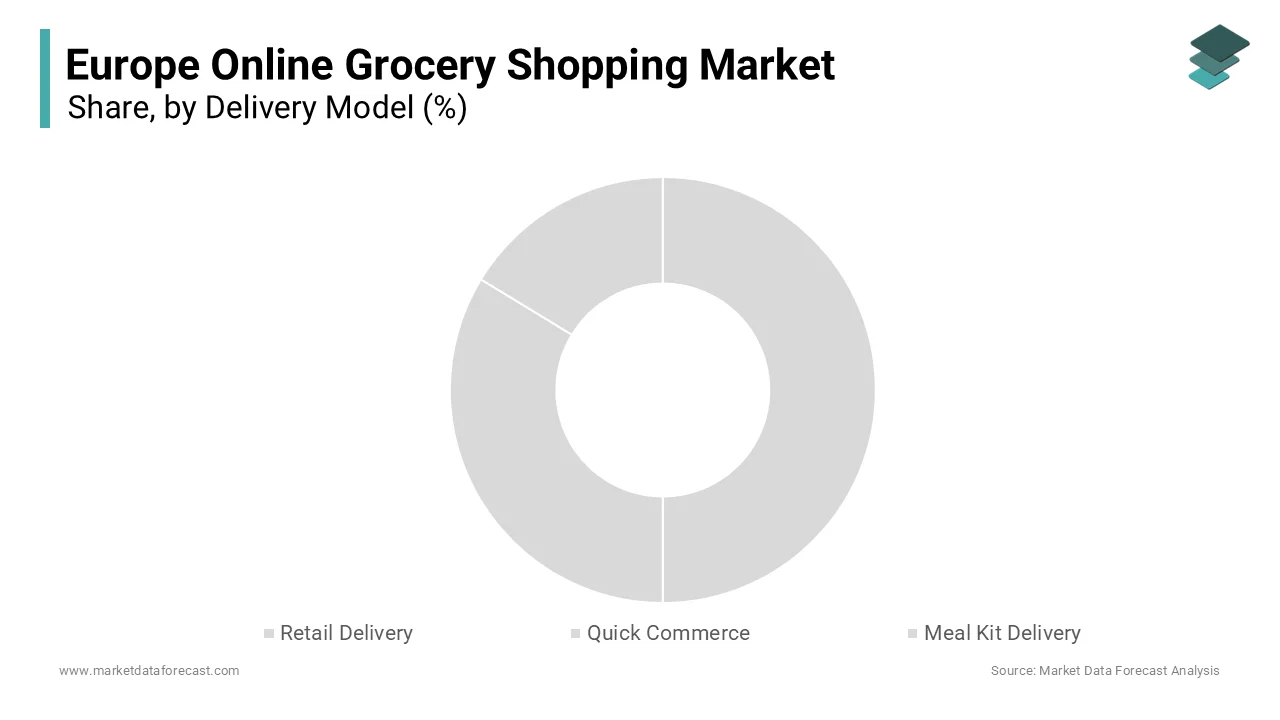
The quick commerce segment is swiftly growing at an anticipated CAGR of 24.5% throughout the forecast period with a fundamental shift in consumer expectations toward immediacy and the proliferation of ultra-fast delivery networks in dense urban areas. The model caters specifically to unplanned purchases and emergency needs, capturing a demand segment that traditional scheduled delivery cannot address effectively. According to urban mobility studies, the average delivery time for quick commerce operators in major European cities has dropped to under 20 minutes, a speed that resonates strongly with younger demographics accustomed to instant gratification. The adoption of electric cargo bikes and scooters allows these operators to navigate traffic congestion more efficiently than traditional vans by ensuring consistent service levels during peak hours.
By Platform Type Insights
The multi-category marketplace segment was accounted in holding 55.4% of the Europe online grocery shopping market share in 2025. The growth of the segment is likely to grow with the powerful network effects generated by platforms that offer groceries alongside electronics, fashion, and home goods by creating a one-stop-shop experience that maximizes user engagement. Consumers are drawn to the convenience of consolidating diverse shopping needs into a single application and delivery window, which reduces overall shipping costs and simplifies account management. As per strategic evaluations, the massive existing user bases of giants like Amazon and Allegro provide an immediate audience for grocery offerings without the need for prohibitive customer acquisition spending. The sophisticated recommendation algorithms employed by these marketplaces leverage purchase history across all categories to personalize grocery suggestions with high accuracy. The ability to aggregate demand from various sellers also ensures competitive pricing and wide product availability, even for niche items.
The pure-play e-grocery platform segment is projected to grow at a fastest CAGR of 18.2% from 2026 to 2034 with the specialized operational expertise these platforms possess in handling perishable goods and optimizing cold chain logistics, which generalist marketplaces often struggle to match. Pure-play operators focus exclusively on food retail by allowing them to develop superior quality control mechanisms and curated assortments that appeal to discerning shoppers seeking freshness and reliability. These platforms are pioneering the use of AI-driven demand forecasting specifically tuned to the volatility of fresh food demand, significantly reducing waste and improving margin profiles. The rise of subscription-based models offering unlimited free deliveries has created a sticky user base, with data showing that subscribers spend 3 times more annually than non-subscribers. The agility of pure-play players allows them to rapidly experiment with new formats such as hybrid dark stores and autonomous delivery robots. The focused brand identity centered on food safety and culinary inspiration fosters deep emotional connections with users.
By Delivery Type Insights
The scheduled deliveries segment was the largest by accounting for a dominant share of the Europe online grocery shopping market in 2025 with the habitual nature of grocery shopping, where consumers plan their weekly or bi-weekly meals and prefer to book specific time slots that fit their routines. The predictability of scheduled deliveries allows retailers to optimize warehouse picking schedules and delivery routes by resulting in lower operational costs and higher reliability. According to recent study, route density for scheduled deliveries is 50% higher than for on-demand services, as drivers can batch multiple orders in the same neighborhood within a defined window. As per surveys, 80% of families with children prefer knowing exactly when their groceries will arrive to ensure someone is home to receive perishable items. The ability to plan ahead also encourages larger basket sizes, as shoppers have time to browse full catalogs and compile comprehensive lists rather than rushing for immediate needs. According to the research, the lower cost structure of scheduled models enables retailers to offer free delivery thresholds that are accessible to a broader demographic. The integration of recurring order features further automates the process for staple items, locking in long-term customer loyalty.
The instant on-demand deliveries segment is projected to register a fastest CAGR of 26.8% throughout the forecast period. The growth of the segment is likely to grow with the changing lifestyle dynamics of urban Europeans, who increasingly value time over cost and seek solutions for immediate consumption needs. As per technology adoption reports, the widespread availability of real-time tracking maps allows customers to monitor their driver's location minute by minute, enhancing the sense of control and immediacy. The integration of seamless mobile payment options reduces friction at checkout, enabling transactions to be completed in seconds. According to research, the average order frequency for on-demand users is 4 times higher than for scheduled users, driving significant volume despite smaller individual basket sizes. The expansion of operating hours to include late nights and weekends further captures demand that traditional retail ignores. This shift toward immediacy and the normalization of ultra-fast logistics position on-demand delivery as the most dynamic growth frontier.
REGIONAL ANALYSIS
United Kingdom Online Grocery Shopping Market Analysis
The United Kingdom was the largest contributor of the Europe online grocery shopping market in 2025 with 23.3% of share due to its early adoption of digital retail technologies and highly competitive supermarket landscape. The saturation of online services, where almost every major retailer offers robust delivery or click-and-collect options, making online grocery a mainstream habit rather than a niche service. As per the study, the fierce competition between Tesco, Sainsbury's, and Asda has driven innovation in delivery slots, subscription models, and app usability, setting high standards for customer experience. The dense urban population in cities like London and Manchester provides an ideal environment for efficient last-mile logistics, supporting both large van deliveries and emerging quick commerce models. According to research, British shoppers exhibit high loyalty to online platforms once they establish a routine, driven by the convenience of saving time on commuting and parking. The regulatory environment supports fair competition, preventing monopolistic practices and encouraging continuous service improvement.
Germany Online Grocery Shopping Market Analysis
Germany online grocery shopping market was positioned second by capturing 19.4% of share in 2025 its robust logistics infrastructure and growing acceptance of digital food retail. The shift from traditional discount store visits to online channels, accelerated by the expansion of delivery networks into suburban and rural areas. As per some studies, the dominance of strong private label offerings by retailers like Rewe and Edeka has translated well to online platforms, where quality perception drives repeat purchases. The country's excellent road network and high vehicle ownership facilitate efficient home delivery services, while a strong culture of sustainability is pushing the adoption of electric delivery fleets. The click-and-collect model remains particularly popular in Germany, aligning with the consumer desire to combine grocery pickup with other errands. The presence of global logistics leaders headquartered in Germany ensures cutting-edge supply chain management and cold chain integrity. The aging population is increasingly turning to online grocery services for heavy item delivery, creating a sustained demand driver.
France Online Grocery Shopping Market Analysis
France online grocery market growth is likely to grow with a unique hybrid model that heavily favors click-and-collect services, alongside growing home delivery adoption. As per consumer surveys, the French preference for selecting fresh produce personally is partially satisfied by the click-and-collect model, which allows for some interaction while maintaining digital convenience. The strong presence of cooperatives and regional chains has fostered a localized approach to online grocery by ensuring relevant product assortments for diverse regional tastes. The integration of local farm products into online platforms has gained traction, which is appealing to the national emphasis on food sovereignty and quality. The government's support for digital transformation in retail has encouraged smaller merchants to join aggregator platforms by expanding the available choice for consumers.
Italy Online Grocery Shopping Market Analysis
Italy online grocery shopping market growth is likely to grow with traditional family-owned grocers are increasingly partnering with digital platforms to reach modern consumers. The transition phase, where urban centers like Milan and Rome are seeing surged adoption of quick commerce and scheduled delivery, while rural areas still rely heavily on traditional markets. According to ISTAT, online grocery penetration in Italy doubled in the last three years, driven by a younger demographic that is comfortable with mobile apps and seeks convenience amidst busy lifestyles. The cultural importance of fresh food means that platforms focusing on high-quality perishables and local specialties are gaining significant traction. The rise of dual-income households in northern Italy is a primary factor for the shift away from daily visits to weekly online orders. The government's digitalization incentives for small businesses are helping traditional stores establish an online presence, enriching the ecosystem.
Netherlands Online Grocery Shopping Market Analysis
The Netherlands online grocery shopping market growth is likely to grow with its exceptional population density and progressive approach to sustainable online grocery logistics. The highest concentration of online grocery users per capita in Europe, facilitated by compact geography that makes delivery highly efficient and cost-effective. According to Statistics Netherlands, nearly 40% of households order groceries online at least once a month, a figure that continues to climb as digital literacy remains universally high. Dutch retailers are global leaders in implementing circular economy principles, utilizing electric cargo bikes and reusable packaging systems for last-mile delivery to minimize environmental impact. The flat terrain and extensive cycling infrastructure make bicycle-based delivery a viable and fast option even for larger orders, reducing reliance on fossil fuel vehicles. Dutch shoppers are highly sensitive to sustainability credentials, often choosing platforms that demonstrate clear green commitments. The advanced digital payment ecosystem and widespread broadband access remove friction from the online shopping journey. As per market observations, the collaboration between retailers and municipalities to create low-emission zones is accelerating the transition to green fleets.
COMPETITIVE LANDSCAPE
The competition in the Europe online grocery shopping market is characterized by intense rivalry between established traditional supermarket chains and agile pure-play digital natives vying for dominance in a rapidly evolving landscape. Incumbent retailers leverage their vast physical store networks to offer convenient click and collect services and rapid last-mile delivery that pure-play competitors often struggle to match cost-effectively. Meanwhile specialized online-only operators differentiate themselves through superior technology platforms, automated fulfillment centers, and highly personalized customer experiences driven by advanced data analytics. The market witnesses frequent strategic collaborations and partnerships as companies seek to expand their delivery capabilities and geographic reach without incurring prohibitive infrastructure costs. Price sensitivity among European consumers forces all participants to constantly optimize their supply chains and offer competitive pricing while maintaining service quality. Regulatory pressures regarding labor rights and environmental sustainability add further complexity requiring operators to balance growth with responsible business practices.
KEY MARKET PLAYERS
Some of the notable key players in the Europe online grocery shopping market are
- Tesco Plc
- Carrefour SA
- ICA Gruppen AB
- Auchan SA
- Colruyt Group
- REWE Group
- Amazon Fresh
- Delivery Hero SE
- Flink SE
- Just Eat Takeaway.com
- Uber Eats
- Rakuten Group Inc.
Top Players in the Market
- Tesco PLC stands as a dominant force in the Europe online grocery shopping market, leveraging its extensive physical store network to power a highly efficient click and collect and home delivery system. The company utilizes its stores as local fulfillment hubs to ensure rapid order processing and fresh product availability across the United Kingdom and Ireland. Tesco recently invested heavily in automation technology within its distribution centers to increase picking speed and reduce operational costs significantly. Globally, the retailer shares its digital expertise through partnerships with other international chains seeking to optimize their own e-commerce operations. Their commitment to sustainability includes the deployment of electric delivery vehicles to lower carbon emissions in urban areas.
- Carrefour SA operates as a leading multi-format retailer in the Europe online grocery shopping market, offering a comprehensive digital platform that integrates hypermarkets, supermarkets, and convenience stores. The company has aggressively pursued an omnichannel strategy that allows customers to shop online and pick up in store or receive home deliveries with remarkable flexibility. Carrefour recently expanded its quick commerce capabilities by partnering with delivery platforms to offer ultra-fast service in major European cities. Their global contribution involves sharing best practices in food safety and digital transformation with partners in Latin America and Asia. The firm strengthens its market position by launching exclusive private label ranges tailored specifically for online shoppers to drive loyalty and margins. Investments in artificial intelligence help Carrefour optimize inventory management and predict consumer demand with high accuracy. These strategic initiatives ensure the company remains competitive against pure-play rivals while maintaining its reputation for quality and accessibility.
- Ocado Group plc distinguishes itself as a technology leader in the Europe online grocery shopping market, operating a unique model based on automated warehouses rather than physical retail stores. The company provides end-to-end solutions including robotics, software, and logistics services to grocery retailers worldwide, making it a significant global player beyond its domestic UK operations. Ocado recently upgraded its customer fulfillment centers with next-generation robots capable of handling a wider variety of products at faster speeds. Their global impact is evident through licensing agreements with major supermarkets in North America, Europe, and Asia who adopt the Ocado Smart Platform. The firm focuses intensely on reducing food waste and energy consumption through precise algorithmic control of its supply chain.
Top Strategies Used by Key Market Participants
Key players in the Europe online grocery shopping market primarily employ omnichannel integration strategies to leverage existing physical store networks for efficient order fulfillment and customer pickup. Companies frequently invest in automation and robotics within warehouses to reduce picking costs and improve speed while minimizing human error. Another dominant strategy involves forming strategic partnerships with third-party delivery platforms to expand reach and offer rapid delivery options without building entire fleets internally. Vendors actively develop exclusive private label products to differentiate their offerings and improve profit margins in a highly competitive pricing environment. Additionally, firms focus on data analytics and artificial intelligence to personalize user experiences and optimize inventory levels based on real-time demand patterns. These combined approaches enable market leaders to enhance operational efficiency and customer loyalty effectively.
MARKET SEGMENTATION
This research report on the European online grocery shopping market has been segmented and sub-segmented based on categories.
By Delivery Model
- Retail Delivery
- Quick Commerce
- Meal Kit Delivery
By Platform Type
- Pure Play E grocery Platforms
- Multi Category Marketplaces
- Omni Channel Retailers
By Product Category
- Meat and Seafood
- Breakfast and Dairy Products
- Snacks and Beverages
- Fresh Produce
- Staples and Cooking Essentials
By Delivery Type
- Scheduled Deliveries
- Instant or On demand Deliveries
By Country
- UK
- France
- Spain
- Germany
- Italy
- Russia
- Sweden
- Denmark
- Switzerland
- Netherlands
- Turkey
- Czech Republic
- Rest of Europe