- Product Description Description
- Table of Contents TOC
- List of Table & Figure LOT
- Get Free Sample PDF Sample PDF
Market Size, 2025
$1,165 BnMarket Estimate, 2026
$1,227.91 BnMarket Forecast, 2034
$1,870.21 BnCAGR, 2026–2034
5.40%Europe Online Shopping Market Report Summary
The Europe online shopping market was valued at USD 1,165 billion in 2025, is estimated to reach USD 1,227.91 billion in 2026, and is projected to reach USD 1,870.21 billion by 2034, growing at a CAGR of 5.40% from 2026 to 2034. Market growth is driven by increasing internet penetration, rising smartphone usage, and growing consumer preference for convenient digital purchasing channels. Online shopping platforms enable consumers to purchase a wide range of products including electronics, apparel, groceries, and household goods through e-commerce websites and mobile applications. The expansion of digital payment systems, improvements in logistics infrastructure, and increasing adoption of mobile commerce are further supporting market growth across Europe.
Key Market Trends
- Increasing adoption of mobile commerce and smartphone-based online shopping.
- Rising demand for fast delivery services and efficient logistics networks.
- Growing popularity of online marketplaces and multi-vendor e-commerce platforms.
- Expansion of digital payment solutions and secure checkout technologies.
- Increasing integration of AI-driven personalization and recommendation engines.
Segmental Insights
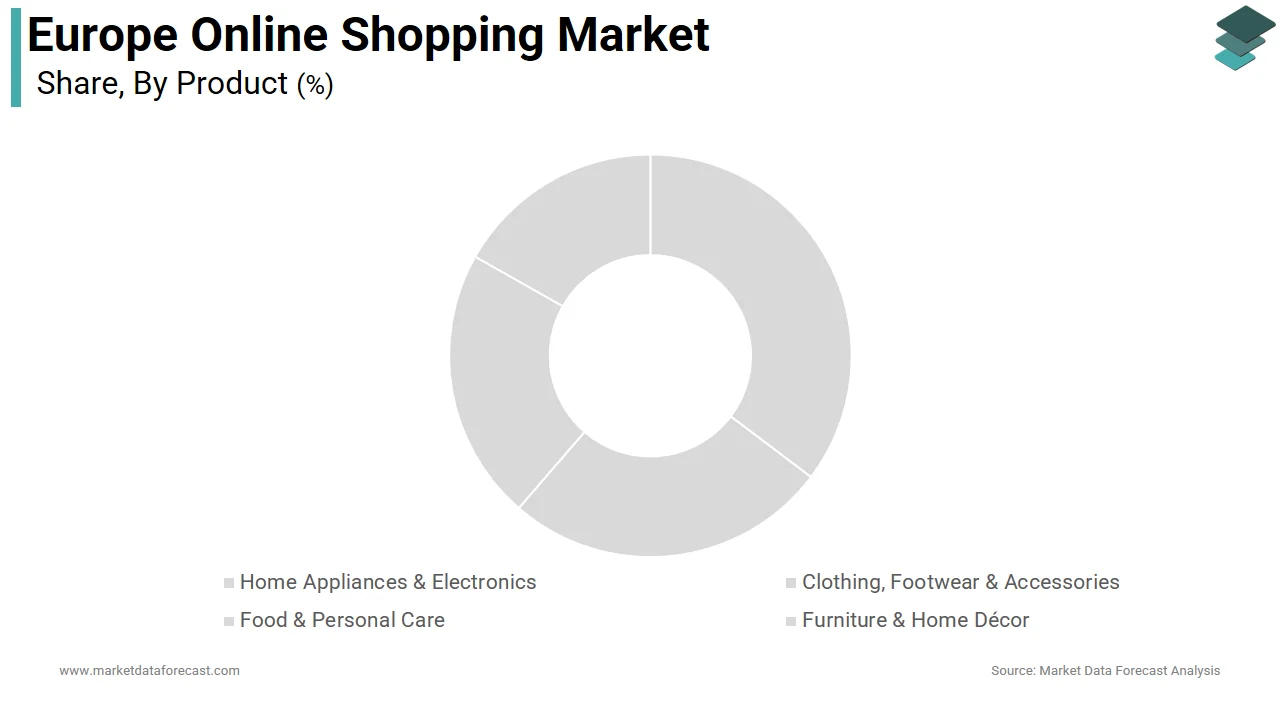
- Based on product, the home appliances and electronics segment dominated the Europe online shopping market by accounting for 26.5% share in 2025, driven by high consumer demand for electronics, gadgets, and household appliances.
- Based on platform type, the marketplace platforms segment led the market by capturing 56.4% share in 2025, supported by the popularity of multi-vendor platforms offering diverse product selections and competitive pricing.
- Based on device, the mobile device segment dominated the market by holding 68.1% share in 2025, driven by widespread smartphone adoption and the convenience of mobile shopping applications.
Regional Insights
The Europe online shopping market is witnessing steady growth across major countries due to increasing digital adoption, improved logistics networks, and expanding e-commerce ecosystems.
- The United Kingdom led the regional market in 2025 with 23.2% share, supported by high internet penetration and strong consumer adoption of e-commerce platforms.
- Germany maintained a strong presence in the market in 2025, driven by a large consumer base and well-developed e-commerce infrastructure.
- France is expected to register a notable CAGR over the forecast period due to increasing digital commerce adoption and expanding online retail platforms.
- Italy is anticipated to experience strong growth due to rapid digitization of small and medium enterprises, improving logistics infrastructure, and a young mobile-first consumer population.
Competitive Landscape
The Europe online shopping market is highly competitive and characterized by the presence of global e-commerce giants and regional online retail platforms competing through product variety, pricing strategies, and delivery efficiency. Market participants are focusing on expanding digital marketplaces, improving logistics capabilities, and enhancing customer experience through personalized shopping platforms. Strategic partnerships with logistics providers, digital payment companies, and retailers are shaping competitive dynamics across the region.
Prominent companies operating in the Europe online shopping market include Amazon.com Inc., Alibaba Group (including Taobao and Tmall), JD.com Inc., Allegro, Walmart Inc. (including Flipkart and Sam’s Club online), Pinduoduo Inc., and Zalando.
 Download Free Sample Report
Europe Online Shopping Market Size
The Europe online shopping market was valued at USD 1,165 billion in 2025, is estimated to reach USD 1,227.91 billion in 2026, and is projected to reach USD 1,870.21 billion by 2034, growing at a CAGR of 5.40% from 2026 to 2034.

Online shopping encompasses a vast digital ecosystem where consumers across the European Union and associated economies procure goods and services through internet-enabled platforms, ranging from dedicated e-commerce storefronts to social commerce interfaces and mobile applications. This domain transcends simple transactional exchanges to include complex logistics networks, digital payment gateways, and personalized customer engagement strategies that define the modern retail experience. The scope covers business-to-consumer interactions involving physical goods, digital downloads, and service bookings, fundamentally altering traditional brick-and-mortar dynamics. According to Eurostat, internet usage among individuals in the European Union was widespread in 2024, which is creating a foundational layer of digital literacy essential for e-commerce adoption. As per the European Commission, a large majority of EU internet users purchased goods or services online in the same year, which is reflecting a deep integration of digital channels into daily consumption habits. According to the European Central Bank, the volume of non-cash payments surged to support these transactions, with card and mobile payment methods becoming the preferred settlement mechanisms for remote purchases. Furthermore, according to the Organisation for Economic Co-operation and Development, cross-border online shopping within the single market has grown steadily, driven by regulatory harmonization and improved logistics infrastructure. This evolving landscape positions online shopping not merely as an alternative sales channel but as the primary engine of retail growth, reshaping supply chains and consumer expectations across the continent.
MARKET DRIVERS
Ubiquitous Smartphone Penetration and Mobile-First Consumer Behavior
The pervasive adoption of smartphones and the subsequent shift toward mobile-first shopping behaviours is majorly propelling the expansion of the Europe online shopping market. According to Eurostat, smartphone ownership in the European Union was widespread in 2024, with mobile devices becoming the primary internet access points for younger demographics. As per the Interactive Advertising Bureau Europe, mobile commerce represents a significant share of e-commerce traffic in key markets such as the United Kingdom, Germany, and France, driven by the convenience of shopping anytime and anywhere. The proliferation of high-speed mobile networks, including extensive fifth-generation coverage, enables seamless browsing, high-resolution product visualization, and instant checkout processes that reduce friction in the purchasing journey. According to the European Commission, mobile-optimized platforms and dedicated applications offer personalized experiences through push notifications and location-based services, significantly enhancing user engagement and conversion rates. Furthermore, the integration of digital wallets like Apple Pay and Google Pay on mobile devices simplifies the payment process, which is eliminating the need for manual data entry and reducing cart abandonment. This technological ubiquity transforms every smartphone into a potential point of sale, allowing retailers to reach consumers directly through social media platforms and messaging apps. The shift in consumer preference toward mobile channels forces retailers to prioritize responsive design and app development, ensuring that the shopping experience is optimized for smaller screens and touch interfaces, thereby driving sustained market growth.
Advanced Logistics Infrastructure and Same-Day Delivery Expectations
The continuous enhancement of logistics infrastructure and the rising consumer expectation for rapid fulfillment are further driving the Europe online shopping market forward. According to the European Logistics Association, investments in automated warehousing and last-mile delivery networks have increased substantially, enabling retailers to offer same-day and next-day delivery options across major urban centers. As per McKinsey and Company, a large proportion of European online shoppers consider delivery speed a critical factor in their purchasing decisions, with many willing to pay a premium for expedited shipping services. The development of micro-fulfillment centers located closer to urban populations allows retailers to drastically reduce transit times and optimize route planning using artificial intelligence. As per the European Investment Bank, funding for green logistics initiatives has also spurred the adoption of electric delivery vehicles and cargo bikes, addressed sustainability concerns while maintained efficiency. Furthermore, the integration of real-time tracking systems provides consumers with full visibility into their order status, building trust and reducing anxiety associated with online purchases. The ability to offer flexible delivery slots, including evening and weekend options, caters to the busy lifestyles of modern consumers. This logistical sophistication ensures that the immediacy of physical retail is replicated in the digital realm, removing one of the primary barriers to online adoption and encouraging higher frequency of purchases across diverse product categories.
MARKET RESTRAINTS
Complex Cross-Border Regulatory Fragmentation and Compliance Burdens
The fragmented regulatory landscape across European member states regarding consumer protection, value-added tax and product standards creates significant operational hurdles for online retailers attempting to scale cross-border operations and hampering the regional market growth. According to the European Court of Auditors, despite the Digital Single Market strategy, discrepancies in national implementation of directives such as the Consumer Rights Directive and General Data Protection Regulation persist, forcing merchants to navigate a labyrinth of varying legal requirements. As per the European Commission, differing rules on return policies, warranty periods, and labeling obligations increase compliance costs and administrative complexity, particularly for small and medium-sized enterprises lacking dedicated legal resources. The introduction of distinct value-added tax rates and reporting mechanisms for digital goods in different jurisdictions further complicates pricing strategies and financial planning. According to the Federation of European Direct Marketing, these regulatory inconsistencies discourage retailers from expanding beyond their domestic markets, which is limiting the variety of products available to consumers and stifling competition. Furthermore, the requirement to adhere to strict data localization laws in certain countries adds technical layers of complexity to platform architecture. This regulatory friction not only increases the cost of doing business but also slows down the pace of innovation and market entry for new players.
Persistent Cybersecurity Threats and Consumer Data Privacy Concerns
The escalating frequency of cyberattacks and heightened consumer awareness regarding data privacy pose substantial barriers to the growth of the Europe online shopping market. According to the European Union Agency for Cybersecurity, the retail sector remains a primary target for phishing scams, ransomware attacks, and data breaches, with incidents rising notably in 2024. As per Eurobarometer surveys, a significant proportion of European citizens cite security concerns as the main reason for hesitating to make online purchases, fearing the misuse of personal financial information and identity theft. The stringent requirements of the General Data Protection Regulation, while protecting consumers, impose heavy burdens on retailers to implement robust encryption, secure authentication, and transparent data handling practices, which can be costly and technically challenging. According to the European Data Protection Board, any breach of trust can lead to severe reputational damage and substantial fines, deterring smaller operators from entering the digital space. Furthermore, the rise of sophisticated fraud techniques such as account takeover and payment fraud necessitate continuous investment in advanced detection systems, which is adding to operational expenses. The psychological impact of high-profile data breaches often leads to consumer caution, resulting in abandoned carts and reduced spending. Until cybersecurity measures become more foolproof and consumer confidence is fully restored through demonstrable security standards, these threats will continue to restrain market expansion.
MARKET OPPORTUNITIES
Integration of Artificial Intelligence for Hyper-Personalization
The deployment of artificial intelligence technologies to deliver hyper-personalized shopping experiences offers a promising opportunity in the Europe online shopping market. According to Gartner, AI-driven recommendation engines can significantly increase e-commerce revenue by analysing vast amounts of consumer data to predict preferences and suggest relevant products in real time. As per the European Retail Round Table, retailers utilizing AI for dynamic pricing, inventory management, and personalized marketing campaigns report higher conversion rates and customer loyalty compared to those relying on traditional methods. The ability to create unique user journeys based on browsing history, purchase behavior, and demographic data allows brands to tailor promotions and content with precision. According to the International Data Corporation, generative AI tools are enabling the creation of virtual shopping assistants that provide instant, context-aware support, mimicking the in-store consultation experience. Furthermore, AI-powered visual search capabilities allow consumers to find products using images, streamlining the discovery process and reducing friction. The European Commission’s support for digital innovation encourages the adoption of these technologies, fostering an environment where data-driven insights become a competitive advantage.
Expansion of Social Commerce and Shoppable Content Ecosystems
The convergence of social media platforms and e-commerce functionalities offers a lucrative opportunity to tap into the massive engaged audiences of European social networks through seamless shoppable content. According to We Are Social, hundreds of millions of people in Europe actively use social media, with a growing segment discovering and purchasing products directly within these apps without leaving the platform. As per Meta and TikTok internal data, the introduction of in-app checkout features and live shopping events has revolutionized the discovery-to-purchase funnel, which is allowing brands to capitalize on impulse buying behaviours and influencer endorsements instantly. According to the European Interactive Digital Advertising Alliance, social commerce reduces the steps between product discovery and transaction, significantly lowering cart abandonment rates. Influencer marketing integrated with shoppable tags enables authentic storytelling that resonates with younger demographics, driving trust and engagement. Furthermore, the rise of user-generated content and community-driven reviews within social platforms provides social proof that influences purchasing decisions more effectively than traditional advertising. The ability to host virtual pop-up stores and exclusive launches on social media creates buzz and urgency, fostering a sense of community around brands.
MARKET CHALLENGES
Sustainability Pressures and Reverse Logistics Complexities
The intensifying demand for sustainable practices and the logistical nightmare of managing returns are challenging the expansion of the Europe online shopping market as it strives to balance growth with environmental responsibility. According to the European Environment Agency, the e-commerce sector generates significant waste through packaging materials and carbon emissions from delivery vehicles, which is prompting stricter regulations and heightened consumer scrutiny. As per the Ellen MacArthur Foundation, return rates in online fashion retail can be very high, which is creating a complex reverse logistics network that doubles transportation emissions and often results in unsellable inventory destined for landfills. The European Commission’s Green Deal and Circular Economy Action Plan mandate reductions in packaging waste and promote repairability, forcing retailers to rethink their supply chain strategies and invest in eco-friendly materials. According to the International Transport Forum, optimizing return processes to minimize environmental impact while maintaining customer satisfaction is a delicate balancing act that requires substantial investment in technology and infrastructure. Furthermore, consumers increasingly expect free and easy returns, which is putting pressure on margins and operational efficiency.
Intense Price Competition and Margin Erosion
The hyper-competitive nature of the European online shopping market, characterized by aggressive price wars and the dominance of large marketplaces, poses a significant challenge to profitability and long-term sustainability for many retailers. According to Euromonitor International, the presence of global giants with vast economies of scale allows them to undercut prices consistently, forcing smaller and mid-sized players into a race to the bottom that erodes profit margins. As per the European Retail Association, the transparency of online pricing enables consumers to compare costs instantly, increasing price sensitivity and reducing brand loyalty. The prevalence of discount codes, flash sales, and free shipping thresholds further compresses margins, which is making it difficult for retailers to invest in innovation or quality improvements. According to the Federation of European Direct Marketing, customer acquisition costs have soared due to saturated digital advertising channels, exacerbating the pressure on profitability. Furthermore, the reliance on third-party marketplaces often involves high commission fees that eat into already thin margins, which is limiting the financial viability of independent sellers. The constant need to match competitor pricing while managing rising operational costs creates a precarious financial environment. Retailers must find ways to differentiate through value-added services, exclusive products, or superior customer experiences to escape the trap of pure price competition.
REPORT COVERAGE
| REPORT METRIC | DETAILS |
| Market Size Available | 2025 to 2034 |
| Base Year | 2025 |
| Forecast Period | 2026 to 2034 |
| Segments Covered | By Product, Platform Type, Device, and Country. |
| Various Analyses Covered | Global, Regional, and Country-Level Analysis, Segment-Level Analysis, Drivers, Restraints, Opportunities, Challenges; PESTLE Analysis; Porter’s Five Forces Analysis, Competitive Landscape, Analyst Overview of Investment Opportunities |
| Countries Covered | UK, France, Spain, Germany, Italy, Russia, Sweden, Denmark, Switzerland, Netherlands, Turkey, Czech Republic, and the Rest of Europe. |
| Market Leaders Profiled | Amazon.com Inc., Alibaba Group (including Taobao & Tmall), JD.com Inc., Allegro, Walmart Inc. (including Flipkart and Sam’s Club online), Pinduoduo Inc., Zalando, and Others. |
SEGMENTAL ANALYSIS
By Product Insights
The home appliances and electronics segment dominated the market by holding 26.5% of the European online shopping market share in 2025 due to the high average order value of electronic goods, the standardized nature of these products which reduces purchase hesitation, and the extensive comparison tools available online that empower consumers to make informed technical decisions. The highly standardized nature of electronic products that allows consumers to confidently purchase items online without the need for physical inspection and the ease of price comparison across multiple retailers are further contributing to the dominance of home appliances and electronics segment in the European market. According to the European Consumer Organisation, most European shoppers research technical specifications and compare prices on multiple websites before purchasing electronics, which is a behavior facilitated by the uniform model numbering and feature sets provided by manufacturers. As per GfK data, the availability of detailed product information, user reviews, and expert ratings online has reduced the perceived risk of buying high-value items like smartphones, laptops, and home appliances remotely. The transparency of pricing in this category forces retailers to compete aggressively on cost and delivery speed, which is driving volume to online channels where overheads are lower than physical stores. Furthermore, the ability to access global inventories ensures that specific models or configurations unavailable locally can be sourced easily from other European markets.
By Platform Type Insights
The marketplace platforms segment led the market by capturing 56.4% of the regional market share in 2025. The growth of the marketplace platforms segment in the European market is attributed to the unparalleled convenience they offer by aggregating millions of products from thousands of sellers into a single searchable interface, which is effectively becoming the default starting point for European online shoppers. According to Kantar, most European consumers begin their product search on a marketplace rather than a search engine or brand website, valuing the ability to compare diverse brands, prices, and reviews side by side. As per the European Commission, the network effect of marketplaces attracts more buyers, which in turn draws more sellers, which is creating a self-reinforcing cycle that expands inventory depth and breadth continuously. Shoppers appreciate the efficiency of purchasing items from different categories or sellers in a single transaction with unified shipping and customer service protocols. The trust mechanisms built into these platforms, such as verified purchase reviews and buyer protection guarantees, reduce the perceived risk of buying from unknown third-party vendors. Furthermore, the sophisticated recommendation engines of marketplaces expose consumers to products they might not have discovered otherwise, which is increasing basket size.
The direct-to-consumer (DTC) brand stores segment is anticipated to record a CAGR of 15.4% over the forecast period in the European market. This acceleration is driven by brands seeking to own customer relationships, capture higher margins by bypassing intermediaries, and leverage first-party data for personalized marketing in a post-cookie digital world. The strategic imperative for brands to reclaim control over their customer experience and retain full profit margins is the primary catalyst for the rapid expansion of DTC stores in Europe. According to Deloitte, selling directly allows brands to avoid marketplace commission fees, significantly improving net profitability and enabling reinvestment in product development and marketing. As per the European Brand Association, owning the direct relationship with consumers provides invaluable first-party data on purchasing behavior, preferences, and feedback, which is crucial for tailoring products and marketing messages in an era of increasing data privacy restrictions. Brands can craft unique storytelling experiences, control packaging, and manage after-sales service without the constraints imposed by marketplace rules. The success of digitally native vertical brands across Europe has demonstrated the viability of this model, encouraging traditional manufacturers to launch their own e-commerce sites. Furthermore, DTC channels allow for faster experimentation with new products and pricing strategies without needing marketplace approval. This shift towards independence and data ownership empowers brands to build stronger emotional connections with their audience, driving loyal repeat business and fuelling the rapid growth of the DTC segment.
By Device Insights
The mobile device segment dominated the Europe online shopping market by accounting for approximately 68.1% of the regional market share in 2025. This supremacy is driven by the ubiquitous presence of smartphones, the refinement of mobile user interfaces, and the seamless integration of mobile payment solutions that facilitate impulse buying. The sheer prevalence of smartphones and the shift toward app-centric shopping behaviours are the fundamental drivers behind the dominance of the mobile segment in European e-commerce. According to Eurostat, smartphone penetration in the European Union was widespread in 2024, with users spending significant time daily on mobile devices, much of which is dedicated to browsing social media and shopping apps. As per App Annie data, retail apps account for the majority of mobile e-commerce time spent, offering smoother navigation, faster load times, and personalized push notifications that drive higher engagement than mobile websites. The European Mobile Marketing Association highlights that the intuitive touch interfaces and biometric authentication features of modern smartphones streamline the checkout process, reducing friction and cart abandonment. Furthermore, the integration of shopping features within social media apps creates a seamless path from discovery to purchase without switching devices. This constant connectivity and the superior user experience of dedicated apps make mobile the primary channel for online shopping, sustaining its leading position across all demographics.
COUNTRY LEVEL ANALYSIS
United Kingdom Online Shopping Market Analysis
The United Kingdom led the online shopping market in Europe in 2025 with 23.2% of the regional market share. The UK is serving as a global benchmark for e-commerce maturity and innovation. The nation's status is defined by its exceptionally high internet penetration, sophisticated logistics infrastructure, and a consumer culture that has fully embraced digital retail across all categories. According to the Office for National Statistics, the UK consistently records one of the highest ratios of online sales to total retail sales globally. As per the Centre for Retail Research, British consumers are early adopters of new shopping technologies, including mobile wallets, social commerce, and same-day delivery services, driving retailers to continuously innovate. The presence of major global marketplace headquarters and a vibrant ecosystem of digitally native brands fosters intense competition and high service standards. The well-developed transportation network and dense urban population facilitate efficient last-mile delivery, reducing costs and improving speed. Furthermore, the regulatory environment supports digital trade while maintaining strong consumer protections. This combination of advanced infrastructure, tech-savvy consumers, and a competitive retail landscape ensures the UK remains the primary engine of growth and the most developed online shopping market in Europe.
Germany Online Shopping Market Analysis
Germany had a promising share of the Europe online shopping market in 2025. The growth of Germany in the European market can be credited to a massive domestic consumer base, a strong preference for quality and reliability, and a rapidly evolving digital payment landscape. Historically cautious about online transactions, German consumers have shifted decisively toward e-commerce, driven by improved trust mechanisms and the convenience of diverse payment options. According to the German Federal Association of E-Commerce and Mail Order, online retail sales in Germany reached very high levels in 2024, with strong growth in categories like electronics, fashion, and home goods. As per Bitkom, the widespread adoption of invoice payments and direct debit, alongside growing acceptance of digital wallets, has removed previous barriers to entry for many shoppers. The country's robust logistics network, anchored by major postal and courier services, ensures reliable delivery even to rural areas. The strong manufacturing sector supports a thriving market for industrial and consumer goods sold online. Furthermore, the increasing mobile penetration and the rise of omnichannel strategies among traditional retailers are accelerating digital adoption.
France Online Shopping Market Analysis
France is estimated to witness a prominent CAGR in the Europe online shopping market over the forecast period. A dynamic blend of traditional retail strength and rapid digital transformation supported by government initiatives are propelling the French market expansion. The French market is notable for its strong local e-commerce players, a growing appetite for cross-border shopping, and a focus on sustainable and ethical online consumption. According to Fevad, online sales in France grew significantly in 2024, driven by the expansion of mobile commerce and the success of flash sale sites. As per INSEE, the number of active online buyers in France has reached record levels, with significant uptake among older demographics who were previously hesitant. The government's support for digital sovereignty and investment in broadband infrastructure has enhanced access across the country. French consumers show a strong preference for marketplaces that offer curated selections and reliable customer service. The rise of re-commerce and second-hand online platforms aligns with national sustainability goals, creating a unique niche within the broader market. The integration of online and offline channels by major French retailers offers a seamless customer experience.
Italy Online Shopping Market Analysis
Italy is anticipated to register a healthy CAGR in the Europe online shopping market during the forecast period owing to the rapid digitization of its SME sector, improving logistics in the south, and a young, mobile-first population. The Italian market has historically lagged in e-commerce adoption but is now experiencing a surge as infrastructure gaps close and consumer confidence rises. According to the National Chamber of Italian E-Commerce, online retail sales in Italy grew strongly in 2024, outpacing many mature Western European markets. As per ISTAT, the number of Italians making online purchases has increased significantly, particularly in fashion, design, and food sectors where Italian craftsmanship shines. The government's National Recovery and Resilience Plan includes substantial investments in digital infrastructure and skills, accelerating the transition. The popularity of marketplace platforms has provided small Italian artisans and manufacturers with access to broader European markets. Mobile commerce is the primary growth driver, with smartphones being the main device for internet access for many Italians.
Spain Online Shopping Market Analysis
Spain is estimated to hold a notable share of the Europe online shopping market during the forecast period. The high smartphone usage, a strong tourism-related online sector, and aggressive expansion by international retailers are contributing to the online shopping market expansion in Spain. The Spanish market is characterized by a young demographic that is highly receptive to new digital trends and social commerce. According to the National Commission on Markets and Competition, e-commerce turnover in Spain reached record highs in 2024, with strong contributions from cross-border transactions within the EU. As per ONTSI, mobile devices account for the majority of online traffic in Spain, driving the growth of app-based shopping. The country's strategic location as a logistics hub for Southern Europe and Latin America enhances its distribution capabilities. Spanish consumers are keen adopters of flash sales and discount platforms, driving high transaction volumes. The recovery of the tourism sector has also boosted online bookings and related retail spending. The government's digital agenda promotes connectivity and digital skills, supporting sustained growth. This energetic mix of demographic advantages, strategic logistics, and digital enthusiasm ensures Spain remains a critical and fast-growing component of the European online shopping landscape.
COMPETITIVE LANDSCAPE
The competition in the Europe online shopping market is intensely dynamic characterized by a fierce battle between global giants, strong local champions, and agile niche specialists. International conglomerates leverage their vast resources and sophisticated logistics infrastructure to dominate broad categories while facing stiff resistance from domestic platforms that possess deeper local knowledge and consumer trust. Local players often differentiate themselves through tailored payment methods, superior customer service in native languages, and curated product selections that resonate with regional cultural nuances. New entrants frequently disrupt the landscape by focusing on specific verticals such as sustainable fashion or quick commerce grocery delivery, forcing established players to innovate rapidly. Regulatory frameworks regarding data privacy and digital taxation create a complex operating environment where compliance becomes a competitive advantage. Companies constantly vie for customer loyalty through subscription models offering free shipping and exclusive deals. The landscape sees frequent consolidation as larger entities acquire smaller competitors to gain market share and technological edge. Price transparency empowers consumers to switch providers easily, making brand differentiation through service quality and speed critical for long-term survival in this saturated and evolving marketplace.
KEY MARKET PLAYERS
The leading companies operating in the Europe online shopping market include:
- Amazon.com Inc.
- Alibaba Group (incl. Taobao & Tmall)
- JD.com Inc.
- Allegro
- Walmart Inc. (incl. Flipkart, Sam’s Club online)
- Pinduoduo Inc.
- Zalando
TOP PLAYERS IN THE MARKET
- Amazon operates as the undisputed leader in the European e-commerce landscape, providing an extensive marketplace that connects millions of sellers with consumers across the continent. The company leverages its massive logistics network to offer rapid delivery services and a vast selection of products ranging from electronics to groceries. Amazon recently strengthened its market position by expanding its same-day delivery capabilities to more European cities and integrating advanced artificial intelligence tools to personalize the shopping experience. Its global contribution remains significant as it sets industry standards for cloud computing, digital streaming, and supply chain efficiency. The firm continues to invest heavily in sustainable delivery methods, including electric vehicles, to reduce its carbon footprint while maintaining operational speed. By constantly innovating in drone delivery and cashier-less store technology, Amazon ensures it remains at the forefront of retail evolution worldwide.
- Allegro stands as the dominant homegrown e-commerce platform in Poland and a major force in Central and Eastern Europe, offering a comprehensive marketplace for diverse product categories. The company focuses on creating a localized shopping experience that resonates deeply with regional consumer preferences and payment habits. Allegro recently enhanced its market position by launching innovative advertising solutions for sellers and expanding its logistics arm to ensure faster delivery times across the region. It plays a vital role globally by demonstrating the success of local platforms competing against international giants through superior customer understanding. The group continuously invests in mobile application features and smart checkout options to streamline the user journey. Furthermore, Allegro actively supports small and medium-sized enterprises by providing them with tools to grow their online presence, fostering a vibrant digital economy that serves as a model for other emerging European markets.
- Zalando functions as the leading online fashion and lifestyle platform in Europe, connecting customers with thousands of brands and retailers through a seamless digital interface. The company specializes in clothing, shoes, and accessories, offering extensive size ranges and flexible return policies that build strong consumer trust. Zalando recently accelerated its growth by integrating sustainability filters into its search engine and expanding its logistics network to support faster cross-border shipments. It contributes significantly to the global market by pioneering technologies in virtual fitting rooms and personalized style recommendations driven by data analytics. The firm remains committed to becoming a net-positive fashion platform by promoting circular economy initiatives such as pre-owned fashion marketplaces. Through strategic partnerships with luxury brands and continuous investment in automated warehousing, Zalando maintains its status as the go-to destination for fashion enthusiasts across Europe and beyond.
TOP STRATEGIES USED BY KEY MARKET PARTICIPANTS
Key players in the Europe online shopping market primarily employ aggressive expansion of logistics networks to ensure faster delivery times and reduce last-mile costs across diverse geographical regions. Companies frequently pursue strategic acquisitions of niche retailers or technology startups to broaden their product assortments and enhance their technical capabilities without internal development delays. Another dominant strategy involves heavy investment in artificial intelligence and machine learning to personalize user experiences and optimize inventory management for maximum efficiency. Market participants also focus on developing robust mobile applications with integrated payment solutions to capture the growing segment of smartphone-first shoppers. Furthermore firms actively implement sustainability initiatives such as eco-friendly packaging and carbon-neutral shipping options to appeal to environmentally conscious European consumers. Expanding into omnichannel services allows these entities to blend online and offline experiences thereby increasing customer loyalty and retention rates across various demographic groups.
MARKET SEGMENTATION
This research report on the Europe online shopping market has been segmented and sub-segmented into the following categories.
By Product
- Home Appliances & Electronics
- Clothing, Footwear & Accessories
- Food & Personal Care
- Furniture & Home Décor
- Other Products
By Platform Type
- Marketplace Platforms
- Direct-to-Consumer Brand Stores
- Omnichannel Retailer E-Stores
- Subscription & Flash-Sales Platforms
- Social-Commerce Platforms
By Device
- Mobile
- Desktop & Tablet
- Connected TV & Smart Devices
- Others
By Country
- United Kingdom
- France
- Spain
- Germany
- Italy
- Russia
- Sweden
- Denmark
- Switzerland
- Netherlands
- Rest of Europe