- Product Description Description
- Table of Contents TOC
- List of Table & Figure LOT
- Get Free Sample PDF Sample PDF
Market Size, 2025
$31 BnMarket Estimate, 2026
$40.23 BnMarket Forecast, 2034
$323.32 BnCAGR, 2026–2034
29.76%Europe Online Grocery Market Size
The Europe online grocery market was valued at USD 31 billion in 2025. The European market is estimated to reach USD 323.32 billion by 2034 from USD 40.23 billion in 2026, rising at a CAGR of 29.76% from 2026 to 2034.
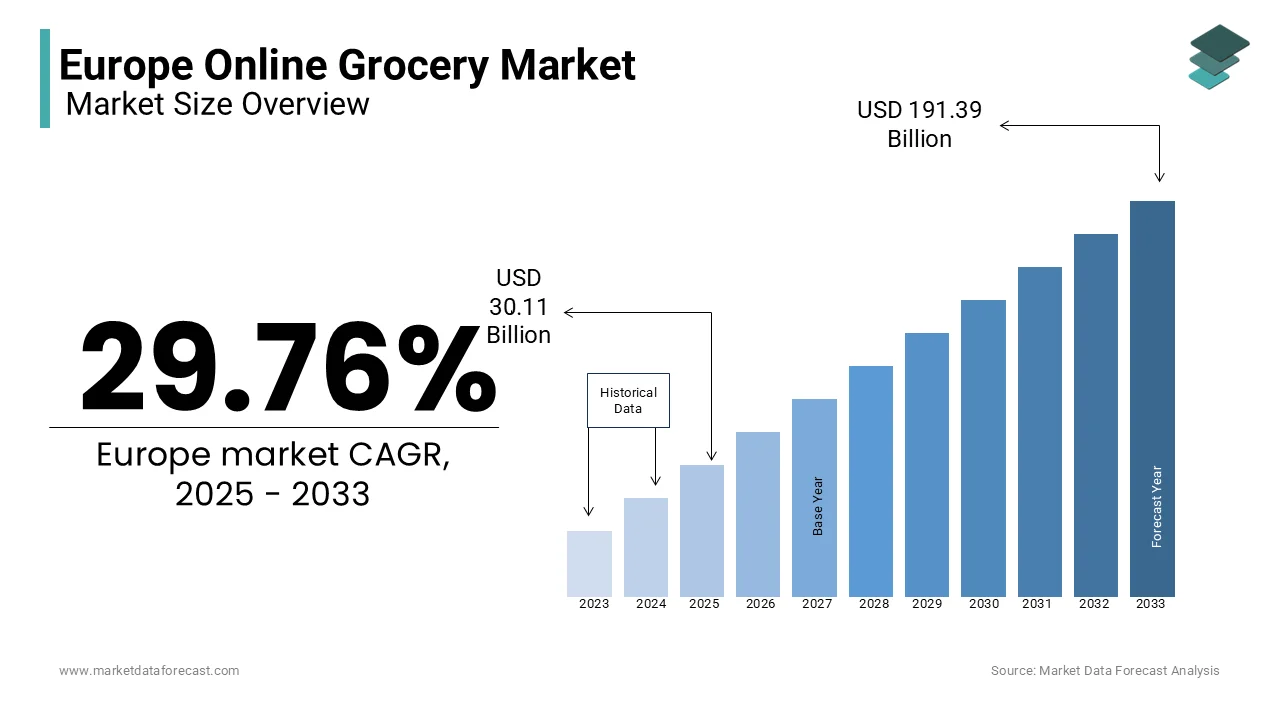
The online grocery is a place where consumers purchase food, beverages, and household essentials through digital platforms for home delivery or curbside pickup. The region is currently experiencing a structural shift in consumption patterns driven by urbanization and changing lifestyle dynamics. As per Eurostat data from 2023, approximately 74% of individuals in the European Union aged 16 to 74 purchased goods or services online, with food and grocery items showing the steepest adoption curve among previously offline categories. The European Commission notes that urban density in major metropolises like Paris and London has reached levels where last-mile logistics account for nearly 30% of total delivery costs. Furthermore, the General Data Protection Regulation continues to shape how retailers collect and utilize consumer data for personalized shopping experiences, setting a global benchmark for privacy-centric e-commerce. Governments across the continent are increasingly focusing on reducing food waste through digital inventory management, aligning commercial goals with sustainability mandates.
MARKET DRIVERS
Accelerated Urbanization and Time Scarcity Among Working Populations
The rapid pace of urbanization, combined with increasing time scarcity among the working demographic, which fundamentally alters shopping behaviors, is majorly propelling the growth of Europe online grocery market. As more individuals migrate to dense urban centers, the distance to large hypermarkets increases while the availability of time for traditional weekly shopping trips diminishes significantly. According to the Organisation for Economic Co-operation and Development, the average working hours per week in major European economies remain high, while commute times in cities like Berlin and Madrid have increased by 15% over the last decade. This dual pressure forces consumers to seek efficient alternatives that allow them to procure essentials without sacrificing leisure or family time. The rise of single-person households further amplifies this trend as smaller basket sizes make frequent trips to physical stores less economical and more time-consuming. The psychological shift towards valuing time as a premium asset ensures that the demand for immediate and reliable grocery delivery services will continue to surge.
Expansion of Cold Chain Infrastructure and Last Mile Logistics
The substantial investment in advanced cold chain infrastructure and sophisticated last-mile logistics networks that ensure product quality and timely delivery, which is additionally fuelling the growth of Europe online grocery market. The ability to maintain strict temperature controls from warehouse to doorstep is critical for perishable goods, which constitute a significant portion of grocery baskets. As per the European Logistics Association, investments in temperature-controlled logistics assets across the European Union grew by 22% in 2023 to meet the rising demand for fresh produce and dairy delivery. Innovations such as insulated packaging, real-time temperature monitoring sensors, and electric refrigerated vans have mitigated historical concerns regarding food spoilage during transit. These localized hubs allow retailers to stock high-turnover perishable items closer to consumers, ensuring freshness comparable to physical store selection. Furthermore, the integration of artificial intelligence in route optimization has enhanced delivery efficiency, reducing fuel costs and carbon emissions, which aligns with consumer preferences for sustainable logistics.
MARKET RESTRAINTS
High Operational Costs and Thin Profit Margins
The formidable challenge of achieving profitability due to high operational costs associated with picking, packing, and last-mile delivery is limiting the growth of Europe online grocery market. The economics of online grocery are inherently difficult because the average order value often fails to cover the substantial labor and logistics expenses required to fulfill individual household orders. According to a study by McKinsey and Company, the cost to serve for online grocery orders in Europe can be up to 30% higher than in-store shopping, primarily driven by the labor-intensive process of selecting fresh items and the complexity of home delivery. Many pure play operators struggle with thin margins typical of the grocery sector, which are further eroded by the need to offer free or subsidized delivery to remain competitive. The volatility of energy prices and fuel costs in Europe exacerbates these financial pressures by making fleet maintenance and warehouse operations increasingly expensive. Consumers remain highly price sensitive and often resist paying delivery fees, forcing retailers to absorb these costs to acquire and retain customers.
Consumer Preference for Physical Product Inspection
The persistent consumer preference for physically inspecting fresh produce, meat, and bakery items before purchase, which creates a psychological barrier to full migration to online channels. The consumer preference for physical product inspection is also degrading the growth of Europe online grocery market. Despite improvements in quality guarantees, many shoppers distrust the ability of remote pickers to select items that meet their specific standards for ripeness, texture, and appearance. As per a survey conducted by the European Consumer Organisation, over 55% of consumers in Southern and Eastern Europe cited the inability to choose fresh products personally as the primary reason for avoiding online grocery shopping. This hesitation is particularly pronounced among older demographics and in cultures where visiting local markets is a deeply ingrained social ritual. The fear of receiving substandard items leads to higher return rates and customer dissatisfaction, which increases operational costs for retailers who must manage replacements and refunds. While some retailers offer substitution algorithms and satisfaction guarantees, these measures often fail to fully replicate the sensory experience of in-store shopping.
MARKET OPPORTUNITIES
Integration of Artificial Intelligence for Hyper Personalization
The advanced integration of artificial intelligence to deliver hyper-personalized shopping experiences that anticipate consumer needs and optimize basket composition is creating new opportunities for the growth of Europe's online grocery market. According to a report by the Fraunhofer Institute, the implementation of AI-driven personalization engines in European retail could increase average order values by 20% and improve customer retention rates significantly. Machine learning algorithms can analyze dietary preferences, allergy information, and past behavior to suggest relevant products, thereby reducing decision fatigue for shoppers. The European Commission has highlighted the potential of AI to enhance consumer engagement while adhering to strict data privacy laws by creating a framework for ethical personalization. Furthermore, predictive analytics can optimize inventory levels at the local level, reducing food waste and ensuring the availability of fresh items. Startups and established players alike are developing voice-activated shopping assistants and visual search tools that make the ordering process more intuitive and engaging. The ability to create a unique and convenient journey for each user transforms the platform from a simple utility into an indispensable lifestyle partner.
Growth of Quick Commerce and Dark Store Networks
The rapid expansion of quick commerce models supported by dense networks of dark stores that promise delivery within minutes rather than days is another attribute lavishing the growth of Europe online grocery market. This model addresses the immediate needs of urban consumers, who require groceries for unplanned meals or urgent household requirements, capturing a segment of demand that traditional delivery windows miss. As per data from the European E-Commerce Association, the quick commerce sector in major European cities grew by over 50% in 2023, driven by the proliferation of micro fulfillment centers located in high-density residential areas. These dark stores operate without customer-facing fronts by allowing for optimized layouts and faster picking times, which are essential for meeting ultra-short delivery promises. The shift towards smaller, more frequent shopping trips aligns with modern urban lifestyles where refrigerator space is limited, and convenience is paramount. Retailers are partnering with local producers to stock regional specialties in these hubs, appealing to the growing consumer interest in locally sourced food. The scalability of this model allows operators to expand rapidly into new neighborhoods with relatively low capital expenditure compared to building full-sized supermarkets.
MARKET CHALLENGES
Navigating Complex Regulatory Landscapes and Labor Laws
The intricate web of varying national regulations regarding labor rights, gig economy classification, and environmental compliance is a major challenge for the growth of Europe's online grocery market. The classification of delivery drivers as employees versus independent contractors remains a contentious legal issue that impacts operational costs and business models significantly. According to analysis by Deloitte, recent court rulings in countries like Spain and France have mandated the reclassification of thousands of gig workers, forcing companies to absorb higher social security costs and provide benefits. This regulatory fragmentation creates a complex operating environment where a strategy successful in one country may be illegal or unsustainable in another. The European Union is also tightening regulations on packaging waste and carbon emissions, requiring retailers to invest heavily in sustainable materials and electric vehicle fleets. Data from the European Parliament indicates that new directives on digital services and platform work are expected to impose additional compliance burdens on online grocers in the coming years. The lack of harmonized rules across the single market hinders the ability of companies to scale efficient operations uniformly. Companies must maintain extensive legal teams and adapt their logistics strategies constantly to avoid penalties and reputational damage.
Managing Food Waste and Sustainability Expectations
The intense pressure to minimize food waste and meet ambitious sustainability targets, while maintaining the efficiency required for rapid delivery, is also impeding the growth of the Europe online grocery market. The online grocery model inherently risks higher waste levels due to the difficulty in predicting demand for perishable items and the potential for damaged goods during transit. As per the European Environment Agency, the retail sector is under increasing scrutiny to reduce its environmental footprint, with consumers demanding transparent reporting on sourcing and waste management practices. Balancing the need for abundant stock to ensure availability with the imperative to minimize spoilage is a delicate operational act that requires sophisticated forecasting tools. Data from the Waste and Resources Action Programme suggests that online grocery returns and rejected substitutions contribute significantly to overall food waste volumes if not managed through effective redistribution channels. Retailers face the challenge of establishing robust partnerships with food banks and charities to divert unsold items, which adds logistical complexity. Furthermore, the carbon footprint of multiple small deliveries versus consolidated shopping trips remains a point of criticism from environmental groups. Companies must invest in eco-friendly packaging and optimize delivery routes to mitigate these impacts, often at a higher cost.
REPORT COVERAGE
| REPORT METRIC | DETAILS |
| Market Size Available | 2025 to 2034 |
| Base Year | 2025 |
| Forecast Period | 2026 to 2034 |
| Segments Covered | By Product Type and Country. |
| Various Analyses Covered | Global, Regional, and Country-Level Analysis, Segment-Level Analysis, Drivers, Restraints, Opportunities, Challenges; PESTLE Analysis; Porter’s Five Forces Analysis, Competitive Landscape, Analyst Overview of Investment Opportunities |
| Countries Covered | UK, France, Spain, Germany, Italy, Russia, Sweden, Denmark, Switzerland, Netherlands, Turkey, Czech Republic, and the Rest of Europe. |
| Market Leaders Profiled | Cutera Inc., Cynosure Inc. and EL.En. S.p.A., Sciton, Inc., Alma Lasers Ltd, Lynton Lasers Ltd., Venus Concept Canada Corp., Fotona d.d., Solta Medical Inc., Lutronic Corporation, Strata Skin Sciences Inc., Lumenis Be Ltd. |
SEGMENTAL ANALYSIS
By Product Type Insights
The staples and cooking essentials segment was the largest by holding 32.1% of the Europe Online Grocery Market share in 2025, with the predictable nature of these purchases and the low risk associated with buying non-perishable items online compared to fresh produce. The high frequency of repeat purchases for items such as pasta, rice, canned goods, and cleaning supplies lends itself perfectly to subscription models and automated replenishment services. The ease of logistics and storage for retailers, as these products have long shelf lives and do not require complex cold chain infrastructure, allows for centralized fulfillment centers that operate with higher efficiency. This is also another attribute escalating the growth of the segment. Furthermore, consumers feel confident selecting these standardized products without physical inspection, reducing return rates and increasing overall satisfaction. The ability to bundle these items into large weekly or monthly shops also increases the average order value by making this category the financial backbone of most online grocery operations across the continent.

The fresh produce segment is gaining huge traction by swiftly emerging at a fastest CAGR of 18.4% throughout the forecast period, owing to the increasing consumer confidence in the quality of online-selected fruits and vegetables and the proliferation of ultra-fast delivery services that guarantee freshness. The technological advancement in supply chain visibility, where real-time tracking and smart packaging allow customers to monitor the condition of their perishable goods from farm to door. The shifting dietary preferences towards health and wellness have increased the demand for fresh organic and locally sourced produce, which is often more accessible via specialized online platforms than local supermarkets. Additionally, the rise of meal kit services integrated with grocery apps encourages the purchase of fresh ingredients by providing recipes and pre-portioned items.
COUNTRY-LEVEL ANALYSIS
United Kingdom Online Grocery Market Analysis
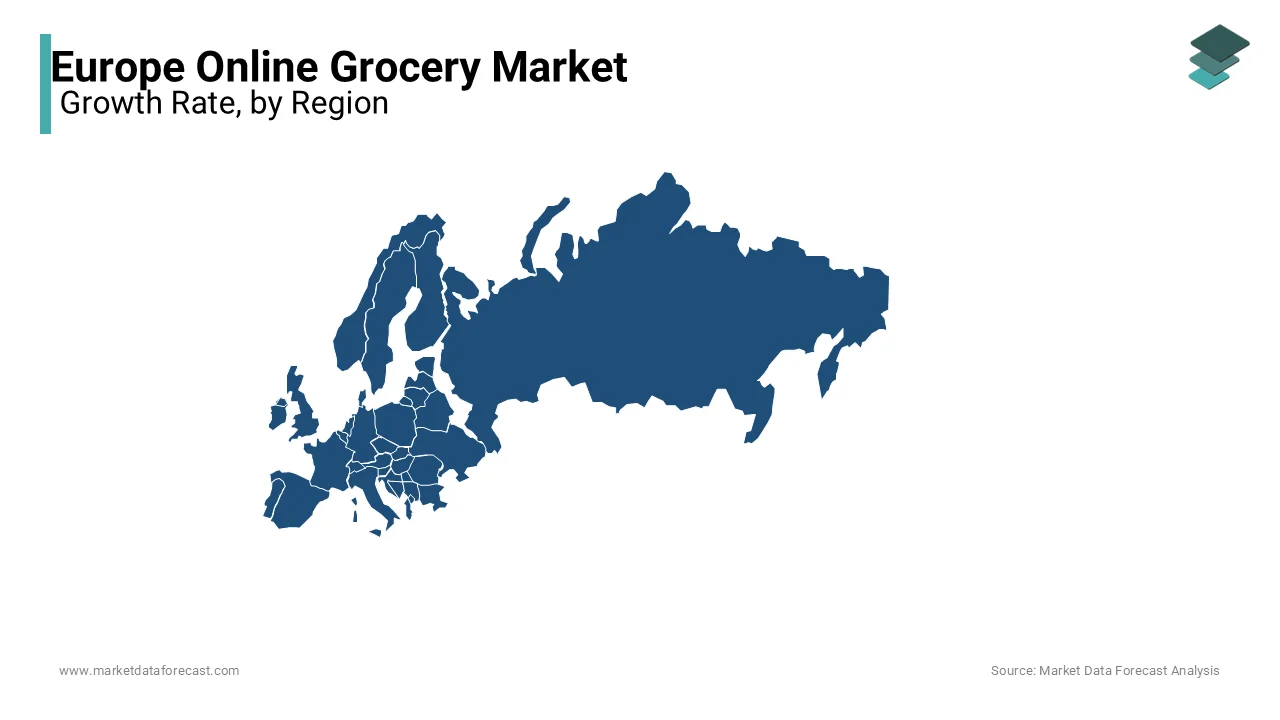
The United Kingdom was the largest contributor to the Europe online grocery market with 24.4% of the market share in 2025, with its mature e-commerce infrastructure and early adoption of click and collect models. According to the British Retail Consortium, online grocery penetration in the UK reached 14% of total grocery sales in 2023, the highest rate on the continent. The dense urban population and high smartphone penetration facilitate rapid adoption of mobile shopping apps and quick commerce services. The presence of major players like Tesco, Sainsbury's, and Ocado has created a sophisticated ecosystem offering same-day delivery and extensive product ranges. Government initiatives supporting digital skills and logistics innovation further bolster the sector. The cultural shift towards convenience and time-saving solutions among British consumers ensures sustained growth.
Germany Online Grocery Market Analysis
Germany online grocery market was positioned second by occupying 19.4% of the market share in 2025, with the rapid digital transformation of its dominant discount supermarket sector. The growth of the market in this country is also driven by the heavily influenced by the entry of traditional hard discounters into the online space, bringing their efficient supply chains to the digital realm. The strong logistics infrastructure and high internet connectivity support reliable delivery services even in rural areas. German consumers, historically cautious about online food shopping, are increasingly embracing digital channels due to improved quality guarantees and flexible delivery slots. The government focuses on sustainable logistics, which encourages the use of electric delivery vehicles, which appeals to environmentally conscious shoppers. The rising number of single-person households in urban centers like Berlin and Munich drives demand for smaller, more frequent online orders.
France Online Grocery Market Analysis
France online grocery market growth is driven by the unique preference for drive-through collection services. The widespread availability of dedicated pickup points located near major highways and residential areas, which cater to car-owning families, is also expected to elevate the growth of the market in this country. The strong presence of hypermarkets has facilitated this model by leveraging existing large store footprints as fulfillment hubs. French consumers value the ability to inspect goods upon pickup while avoiding the time spent walking through aisles. The government support for rural connectivity ensures that these pickup points are accessible to a broad demographic. The integration of local producer networks into online platforms appeals to the strong cultural emphasis on food quality and origin. Additionally, the rise of quick commerce in Paris and other major cities is diversifying the channel mix.
Netherlands Online Grocery Market Analysis
The Netherlands Online Grocery Market growth is exceptionally driven by the high population density and advanced digital literacy. The efficiency of last-mile delivery operations, which benefit from compact geography and excellent road networks. As per statistics from Statistics Netherlands, over 40% of households regularly purchase groceries online, one of the highest adoption rates globally. Dutch consumers are early adopters of new technologies, such as slot-based delivery and sustainable packaging options. The strong cooperative structure of major retailers like Albert Heijn that allows for the rapid deployment of innovative services, including automated picking stores. The government's active promotion of cycling and electric mobility influences the development of green last-mile solutions using cargo bikes for urban deliveries.
Italy Online Grocery Market Analysis
Italy online grocery market is anticipated to grow, with traditional shopping still dominating, but it is quickly changing. According to a study, the Italian National Institute of Statistics' online grocery usage in northern cities like Milan and Turin surged by 30% in 2023, driven by busy urban lifestyles and traffic congestion. The primary driver is the modernization of logistics infrastructure in the south, which is opening up new markets for national retailers. Italian consumers are increasingly attracted to the wide variety of international and specialty products available online that may not be present in local stores. The strong culture of food appreciation drives demand for high-quality fresh produce and gourmet items, which online platforms are beginning to deliver reliably. Government incentives for digital transformation in small and medium enterprises support the onboarding of local artisans onto digital marketplaces.
COMPETITIVE LANDSCAPE
The competition within the Europe Online Grocery Market is characterized by an intense rivalry between established traditional supermarket chains, agile pure play e-grocers, and emerging quick commerce startups vying for dominance in a rapidly evolving sector. Incumbent retailers leverage their vast physical store networks and existing supply chains to offer cost-effective click and collect services, while digital natives compete on speed, convenience, and superior user experience. The market landscape is fragmented yet consolidating as major entities acquire smaller niche players or form alliances to enhance their technological capabilities and geographic coverage. Differentiation increasingly relies on the ability to provide reliable same-day or even 15-minute delivery windows, while maintaining high-quality standards for fresh produce. Price competition exists but is often secondary to the value proposition of service reliability, product availability, and sustainable practices, which are critical for customer loyalty. Regulatory compliance regarding labor rights and environmental impact acts as a formidable factor influencing operational models and cost structures across different regions. Strategic investments in automation and data analytics have become common as firms seek to optimize margins and personalize the shopping journey.
KEY MARKET PLAYERS
The leading companies operating in the Europe online grocery market include:
- AEON CO., LTD.
- com
- com, Inc.
- Blink Commerce Private Limited
- Instacart
- com, Inc.
- Tesco PLC
- Nature’s Basket Limited
- Ebates Performance Marketing Inc.
- Ocado Group
- Reliance Retail
- Carrefour SA
- Supermarket Grocery Supplies Pvt. Ltd.
- Target Brands, Inc.
- The Kroger Co.
- Walmart
TOP PLAYERS IN THE MARKET
- Ocado Group operates as a global technology pioneer specializing in automated online grocery solutions and logistics infrastructure. The company contributes globally by licensing its proprietary robotic warehouse systems to international retailers, enabling them to launch or scale their own online grocery operations efficiently. Recently, Ocado has strengthened its market position by expanding its partnerships with major European supermarket chains to deploy advanced automation hubs that significantly reduce picking times and operational costs. The firm actively invests in artificial intelligence to optimize delivery routes and inventory management, ensuring fresh produce reaches customers with minimal waste. These strategic moves allow the company to drive innovation in supply chain efficiency while maintaining its leadership in the highly competitive European online grocery sector.
- Carrefour SA stands as a leading multinational retailer with a profound impact on the Europe Online Grocery Market through its extensive network of physical stores and robust digital platforms. The company contributes globally by pioneering hybrid retail models that seamlessly integrate online ordering with in-store pickup and rapid home delivery services. Recent actions include the aggressive expansion of its quick commerce offerings and the conversion of existing hypermarkets into localized fulfillment centers to meet surging demand for same-day delivery. Carrefour actively leverages data analytics to personalize customer experiences and optimize product assortments based on regional preferences. The firm also focuses on sustainability by promoting local sourcing and reducing plastic usage in its delivery packaging. These initiatives demonstrate how Carrefour strengthens its market position by adapting its vast physical footprint to serve the digital economy effectively.
- Tesco PLC is a premier British multinational grocer that maintains a significant foothold in the Europe Online Grocery Market via its sophisticated digital ecosystem and loyal customer base. The company delivers a wide array of online services, including scheduled home delivery, click and collect, and subscription models tailored to diverse consumer needs. Globally, Tesco contributes by setting benchmarks for operational excellence in large-scale online grocery fulfillment and customer service standards. Recent strategic initiatives involve the enhancement of its mobile application with features like smart substitution algorithms and real-time slot availability to improve user convenience. The firm has also strengthened its position by partnering with rapid delivery startups to offer ultra-fast grocery options in dense urban areas. Tesco focuses heavily on leveraging its Clubcard loyalty program to drive repeat purchases and gather valuable shopping insights.
TOP STRATEGIES USED BY KEY MARKET PARTICIPANTS
Key players in the Europe Online Grocery Market primarily employ the strategy of converting existing physical stores into micro fulfillment centers to leverage proximity to customers and reduce last-mile delivery costs. Companies frequently invest heavily in automation technologies such as robotic picking systems and artificial intelligence-driven inventory management to enhance operational efficiency and speed. Another dominant strategy involves forming strategic partnerships with third-party delivery platforms and rapid delivery startups to expand reach without incurring the full cost of building proprietary logistics networks. Retailers are increasingly focusing on hybrid models that offer both home delivery and click and collect options to cater to varying consumer preferences and budget constraints. Sustainability serves as a critical approach where firms adopt electric vehicle fleets and eco-friendly packaging to align with environmental regulations and consumer values. Furthermore, participants prioritize loyalty programs and personalized marketing campaigns to increase customer retention and average order value. These collective strategies aim to build resilience, drive profitability, and secure a competitive advantage in a market defined by thin margins and high service expectations.
MARKET SEGMENTATION
This research report on the European online grocery market is segmented and sub-segmented into the following categories.
By Product Type
- Fresh produce
- Breakfast & dairy
- Snacks & beverages
- Meat & seafood
- Staples & cooking essentials
- Others
By Country
- UK
- France
- Spain
- Germany
- Italy
- Russia
- Sweden
- Denmark
- Switzerland
- Netherlands
- Turkey
- Czech Republic
- Rest of Europe