- Product Description Description
- Table of Contents TOC
- List of Table & Figure LOT
- Get Free Sample PDF Sample PDF
Market Size, 2025
$54.90 BnMarket Estimate, 2026
$59.63 BnMarket Forecast, 2034
$115.40 BnCAGR, 2026–2034
8.60%Europe Quick Commerce Market Size, Growth, Trends & Forecast (2026–2034)
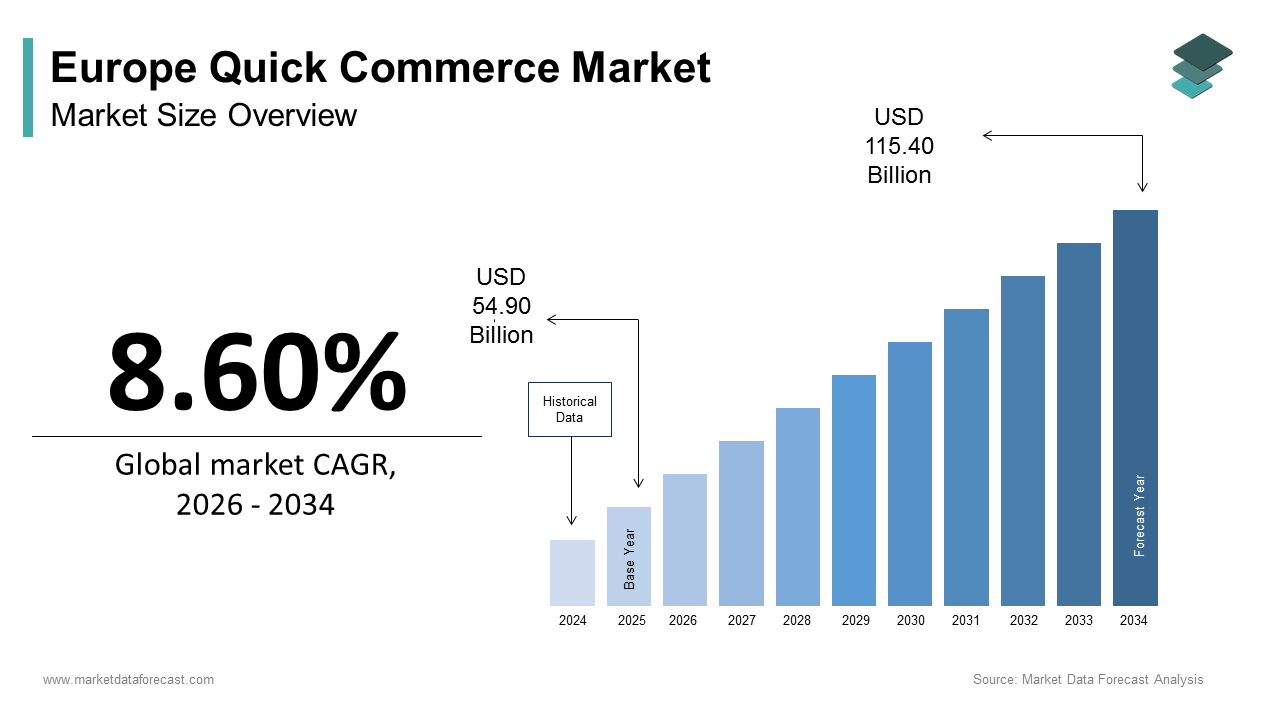
The Europe quick commerce market size was calculated at USD 54.90 billion in 2025, is anticipated to reach USD 59.63 billion in 2026, and is projected to reach USD 115.40 billion by 2034, registering a compound annual growth rate (CAGR) of 8.60% during the forecast period from 2026 to 2034. Driven by dense urban lifestyles, rising smartphone and digital wallet adoption, and a strategic diversification into higher-margin non-grocery categories, the market continues to expand steadily across the region.
Key Executive Metrics (At-a-Glance)
- 2025 Base Valuation: USD 54.90 Billion
- 2026 Current Valuation: USD 59.63 Billion
- 2034 Forecast Valuation: USD 115.40 Billion
- Compound Annual Growth Rate (CAGR): 8.60% (2026–2034)
- Dominant Mode of Payment Segment: Cashless Payments (holding 90.2% of the regional market share in 2024, supported by mature digital wallet infrastructure and high smartphone penetration)
- Dominant Product Segment: Groceries (capturing 56.5% of the regional market share in 2024, anchored by universal necessity and high-frequency purchasing)
- Fastest-Growing Product Segment: Beauty and Personal Care (projected at a CAGR of 7.14% over the forecast period, driven by high gross margins and spontaneous purchase behavior)
- Dominant Channel Type Segment: Mobile Applications (holding the leading share in 2024 owing to frictionless user experiences, one-tap reordering, and real-time tracking)
- Regional Highlights: The United Kingdom led the market in 2024, capturing 20.9% of the European share due to high urban density, tech-savvy consumers, and early adopter momentum.
Core Market Drivers
- Urbanization & Time Scarcity: High concentration of city dwellers facing chronic time poverty, amplifying demand for sub-30-minute delivery utility.
- Digital Infrastructure: Pervasive smartphone usage and widespread contactless/digital payment adoption reducing checkout friction.
- Category Diversification: Expansion beyond low-margin staples into higher-margin vertical sectors like beauty, electronics, and health items.
Primary Market Restraints & Challenges
- Regulatory & Labor Pressures: Stricter gig worker classification laws (e.g., Spain's Rider Law) and municipal dark store zoning bans or curfews.
- Fragile Unit Economics: High customer acquisition costs, low average basket values, and intensive operational burn rates straining pure-play operators.
- Intensifying Omnichannel Competition: Traditional supermarket giants (Carrefour, Tesco, REWE) leveraging store networks to replicate rapid delivery at lower structural costs.
Europe Quick Commerce Market Segmentation Breakdown
| Segment Category | Largest Segment in 2024/2025 | Fastest Growing Segment / Growth Rate |
|---|---|---|
| By Mode of Payment | Cashless Payments (90.2% share in 2024) | Cashless / Digital Wallets (Driven by mobile-first banking and SEPA integration) |
| By Product | Groceries (56.5% share in 2024) | Beauty & Personal Care (7.14% CAGR over forecast period) |
| By Channel Type | Mobile Application (Dominating share in 2024) | Mobile Application (Supported by native geolocation and quick-checkout frameworks) |
| By Region | United Kingdom (20.9% share in 2024) | Spain, France & Germany (Driven by metropolitan density, quick-commerce consolidation, and dark-store adaptation) |
Major Industry Players Profiled
Key prominent companies operating in the Europe quick commerce market include Getir, Gorillas, Flink, Bolt Market, Wolt Market, Glovo, Deliveroo Hop, and Zapp.
Europe Quick Commerce Market Size
The Europe quick commerce market size was calculated to be USD 54.90 billion in 2025 and is anticipated to be worth USD 115.40 billion by 2034, growing from USD 59.63 billion in 2026 at a CAGR of 8.60% during the forecast period.
Quick commerce (Q-Commerce) is an ecosystem of digital retail platforms that deliver everyday consumer goods within ultra-short timeframes, typically under 30 minutes. This model relies on a network of micro fulfillment centers or dark stores strategically located within dense urban neighbourhoods to minimize last-mile delivery distances. Unlike traditional e-commerce that prioritizes breadth of selection, quick commerce emphasizes speed, convenience, and reliability through hyperlocal inventory and proprietary logistics fleets. The segment has gained traction amid shifting urban lifestyles, rising consumer expectations for immediacy, and post pandemic digital adoption. In 2023, over 70.6% of European city dwellers lived in urban areas, according to Eurostat, which is increasing the addressable population for rapid delivery models. Furthermore, the average daily commute time in major European cities such as London, Paris, and Berlin exceeds 80 minutes, as per the OECD, which is making time saved through instant delivery a tangible utility. While the market remains concentrated in metropolitan zones, regulatory scrutiny over labor practices and urban congestion is intensifying, prompting operators to refine their sustainability and operational models in alignment with European social market principles.
MARKET DRIVERS
Urbanization and Time Scarcity Among City Dwellers
The accelerating concentration of Europe’s population in metropolitan areas has created fertile ground for quick commerce by amplifying demand for time-saving solutions, which is a key factor propelling the growth of the European quick commerce market. As of 2023, approximately 340 million people resided in urban centers across the European Union, representing about 75% of the total population, according to Eurostat. In cities like Madrid, Stockholm, and Amsterdam, over 80% of residents live within 500 meters of a public transport stop, yet many report chronic time poverty due to long working hours and caregiving responsibilities. As per Eurofound’s 2024 report, a significant share of urban workers in the EU report insufficient time for personal errands during weekdays. Quick commerce directly addresses this constraint by offering grocery and essentials delivery in under 30 minutes, often via bicycle couriers who navigate congested streets more efficiently than cars. In Berlin, for instance, Getir and Gorillas were once active. This alignment between service capability and urban lifestyle rhythms has driven repeat usage.
Rising Penetration of Smartphones and Digital Payment Infrastructure
The widespread adoption of smartphones and seamless digital payment systems has removed critical barriers to quick commerce adoption across Europe, which is further supporting the expansion of the quick commerce market in Europe. In 2023, smartphone penetration in the EU was estimated at over 87% among adults, according to the International Telecommunication Union. Simultaneously, contactless payments accounted for over 53% of all card-based transactions in the euro area, as per the European Central Bank. Quick commerce apps leverage these enablers by offering one-click reordering, real-time tracking, and integrated payment options that minimize friction. Moreover, the European Commission’s Digital Identity Wallet initiative, which is set to launch in 2026, will further streamline onboarding and age verification for age-restricted products like alcohol or tobacco. This digital readiness across devices, networks, and payment rails creates an invisible yet essential foundation that allows quick commerce to function as an ambient utility rather than a disruptive novelty.
MARKET RESTRAINTS
Regulatory Pushback on Labor Conditions and Urban Congestion
Quick commerce operators face mounting regulatory constraints in Europe stemming from concerns over gig worker rights and the impact of delivery fleets on urban environments. Spain’s Rider Law, introduced in 2021 and enforced in subsequent years, mandates that delivery platforms classify couriers as employees rather than independent contractors. Similar legislation is advancing in France and Italy, where courts have increasingly ruled in favor of employee status for platform workers. Concurrently, cities like Amsterdam and Brussels have imposed strict limits on the number of dark stores per square kilometer, citing noise, waste, and traffic disruption. Amsterdam, for example, banned dark stores from residential areas in 2023, which restricted them to industrial zones. According to the European Environment Agency, last-mile delivery accounts for a significant share of urban freight emissions. These dual pressures are compelling operators to restructure labor models, invest in electric cargo bikes, and consolidate micro warehouses.
Unsustainable Unit Economics and High Customer Acquisition Costs
The quick commerce model in Europe continues to grapple with fragile unit economics exacerbated by high customer acquisition costs and low order values, which further impede the growth of the European quick commerce market. In 2023, average basket sizes ranged between €25 and €30 per order, according to data from Glovo and DIA in Spain. Fulfillment and delivery costs typically average €6 to €8 per order. Customer acquisition costs in competitive cities like London and Paris often exceed €40, as reported in market analyses. Unlike traditional e-commerce, where scale drives down logistics costs, quick commerce requires dense dark store networks that cannot be easily optimized through consolidation without sacrificing speed. Consequently, burn rates remain high, with several European operators reporting gross merchandise value declines after initial subsidy-fuelled growth. The collapse of Getir’s UK operations in early 2024 and the merger of Gorillas with Getir in 2023 underscore the financial strain. Without a path to profitability through pricing discipline, basket size expansion, or operational automation, the long-term viability of pure-play quick commerce remains uncertain in Europe’s cost-conscious retail landscape.
MARKET OPPORTUNITIES
Expansion into Non-Grocery Categories with Higher Margins
Quick commerce platforms are diversifying beyond groceries into higher-margin categories such as pet supplies, electronics, over-the-counter pharmaceuticals, and premium beauty products to improve profitability and reduce basket dependency on low-margin staples, which is a promising opportunity in the European quick commerce market. For instance, Flink has expanded its assortment in Germany to include a growing share of non-grocery items. This shift is enabled by partnerships with brands like Nestlé Purina, L’Oréal, and Samsung, who view quick commerce as a high-engagement channel for impulse and replenishment purchases. Regulatory approvals also facilitate expansion, with several EU countries, including the Netherlands and Portugal, now permitting licensed pharmacists to operate within dark stores for OTC medicine delivery. By transforming from a grocery utility into a broader instant retail platform, operators can leverage existing logistics infrastructure to capture higher lifetime value per customer while smoothing demand volatility across product verticals.
Integration with Public Transport and Sustainable Logistics Hubs
A promising opportunity lies in aligning quick commerce logistics with municipal sustainability goals through integration with public transport networks and shared urban logistics infrastructure. Cities like Copenhagen and Vienna are piloting “cargo tram” and metro freight initiatives where goods are transported during off-peak hours using existing public transit rails. In 2024, the City of Paris launched the “Logistics Hotel” program, designating underground municipal facilities for last-mile consolidation. This initiative has been associated with reduced delivery vehicle kilometers in pilot districts. Additionally, the European Commission’s Urban Mobility Framework encourages public-private data sharing to optimize delivery routes and reduce congestion. Quick commerce firms collaborating with these initiatives gain regulatory goodwill, access to prime urban real estate, and lower emissions profiles. This convergence of private logistics innovation and public infrastructure strategy offers a pathway to operational legitimacy and long-term urban integration.
MARKET CHALLENGES
Intensifying Competition from Established Retailers with Omnichannel Capabilities
Traditional supermarket chains are leveraging their store networks and customer trust to replicate quick commerce delivery at lower cost, which is creating formidable competition for pure-play entrants and is one of the major challenges to the growth of the European quick commerce market. Retail giants like Carrefour, Tesco, and REWE offer 15 to 30-minute delivery in major European cities using in-store inventory and existing staff, thereby avoiding the capital intensity of dark stores. Carrefour’s “Livraison Express” service in Paris offers delivery within one hour, with some deliveries occurring in as little as 30 minutes. These retailers benefit from higher average basket sizes and stronger private label penetration, which boosts margins. Moreover, they enjoy established relationships with local authorities, easing regulatory approvals for delivery operations. As per the 2024 Kantar Retail Index, a significant share of European consumers prefer ordering quick delivery from brands they already trust for weekly shopping. This competitive pressure forces pure-play platforms to either differentiate through exclusive products or accept lower margins in a race where incumbents hold structural advantages in scale, real estate, and consumer loyalty.
Fragmented Urban Planning and Zoning Regulations Across Municipalities
The growth of the European quick commerce market is also hindered by a patchwork of local zoning laws, commercial licensing rules, and noise ordinances that vary significantly even within the same country. In Germany, for example, Berlin permits dark stores in mixed-use zones, while Munich restricts them to industrial districts, requiring operators to maintain separate logistics strategies for cities just 600 kilometers apart. Similarly, in Italy, Milan allows 24-hour dark store operations, but Rome enforces a 10 PM curfew on deliveries, citing residential disturbance. According to the European Urban Knowledge Network, many European cities lack standardized frameworks for micro-fulfillment centers, which is leading to unpredictable approval timelines and legal uncertainty. This fragmentation increases operational complexity and prevents economies of scale in real estate and logistics planning. Operators must navigate hundreds of municipal codes when expanding beyond initial launch cities, slowing continental growth, and inflating compliance costs. Without harmonized EU-level guidelines or national standardization efforts, the market remains a mosaic of local exceptions that undermine the scalability essential for long-term viability.
REPORT COVERAGE
| REPORT METRIC | DETAILS |
| Market Size Available | 2025 to 2034 |
| Base Year | 2025 |
| Forecast Period | 2026 to 2034 |
| CAGR | 8.60% |
| Segments Covered | By Mode of Payment, Product, Channel Type, And Region |
| Various Analyses Covered | Global, Regional & Country Level Analysis; Segment-Level Analysis; DROC, PESTLE Analysis; Porter’s Five Forces Analysis; Competitive Landscape; Analyst Overview of Investment Opportunities |
| Regions Covered | UK, France, Spain, Germany, Italy, Russia, Sweden, Denmark, Switzerland, Netherlands, Turkey, and the Czech Republic |
| Market Leaders Profiled | Getir, Gorillas, Flink, Bolt Market, Wolt Market, Glovo, Deliveroo Hop, Zapp |
SEGMENTAL ANALYSIS
By Mode of Payment Insights
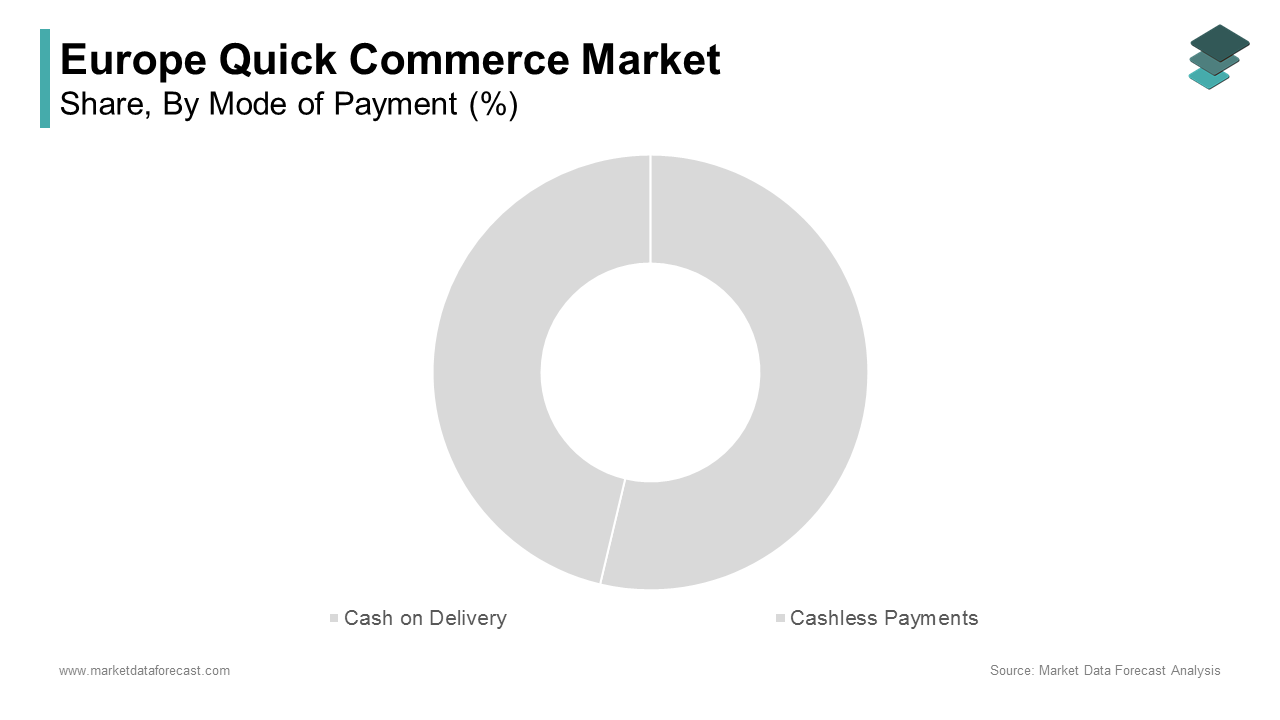
The cashless payments segment dominated the Europe quick commerce market by accounting for 90.2% of the regional market share in 2024. The dominance of the cashless payments segment in this regional market is driven by a mature digital payment infrastructure, widespread consumer trust in mobile wallets, and strong regulatory support for cashless ecosystems across the European Union. Contactless payments accounted for 53.8% of all card-based transactions in the euro area in 2023, as per the European Central Bank. Mobile wallets such as Apple Pay, Google Pay, and Bancontact are deeply embedded in daily commerce, which is supported by smartphone penetration exceeding 87% among EU adults, according to the International Telecommunication Union. In the Netherlands, iDEAL accounted for 70% of online purchases as of April 2023, which reflects the country’s strong preference for digital payments. Quick commerce apps capitalize on this readiness by integrating one-click payment options that eliminate checkout friction, which is critical for impulse and replenishment purchases. The Single Euro Payments Area (SEPA) continues to streamline real-time euro transactions across borders, with non-cash payments in the euro area reaching 361.1 billion in 2023, up 15.6% from the previous year.
By Product Insights
The groceries segment led the market by holding 56.5% of the regional market share in 2024. The leading position of groceries segment in this regional market can be attributed to the high purchase frequency, universal necessity, and the strategic use of staple items to anchor broader basket expansion. Urban European consumers show strong demand for immediate access to daily essentials due to limited home storage, smaller living spaces, and just-in-time consumption habits. For instance, quick commerce platforms capitalize on habitual purchasing by offering one-click reordering and rapid delivery of top-selling items. Moreover, the model aligns well with demographic trends. According to OECD housing data, dual-income and single-person households form a significant portion of urban residences in Germany and the Netherlands, which is reinforcing the appeal of quick commerce for time-constrained consumers.
The beauty and personal care segment is the fastest growing in the Europe quick commerce market and is anticipated to register a CAGR of 7.14% over the forecast period, owing to the growing demand for premium and niche beauty products. Quick commerce enables spontaneous beauty purchases by reducing the time from discovery to delivery to under 30 minutes. The beauty and personal care segment is known for high margins, with premium skincare and haircare products yielding gross margins of 45–60%, compared to lower-margin grocery staples. Brands like L’Oréal, Nivea, and Rituals have introduced exclusive SKUs for quick commerce channels, including travel-size bundles and limited-edition products that encourage impulse buying. According to Euromonitor and Eurodev, a strong shift toward online and mobile-first beauty shopping, especially among younger demographics.
By Channel Type Insights
The mobile applications segment held the dominating share of the Europe quick commerce market in 2024. This strong preference reflects the mobile-first behavior of urban consumers and the technical advantages of native apps in delivering speed, personalization, and reliability. Mobile applications offer a frictionless user journey optimized for speed with features such as one-tap reordering, geolocation-based store selection, and real-time courier tracking, as these are the capabilities difficult to replicate on web portals. Push notifications enable behavioral engagement by alerting users to flash sales, stock restocks, or delivery windows based on past behavior. Native apps also support biometric authentication, offline browsing, and background location services that enhance security and convenience. In cities like Madrid and Amsterdam, where average order lead time is under 25 minutes, the app’s ability to preload payment and address data reduces checkout to under eight seconds. This technical superiority ensures mobile applications remain the primary channel for quick commerce engagement across Europe.
REGIONAL ANALYSIS
United Kingdom Quick Commerce Market Analysis
The United Kingdom led the quick commerce market in Europe in 2024 by holding 20.9% of the European market share. The dominance of the UK in the European market is attributed to the high urban density, tech-savvy consumers, and early entrant advantage. The UK is widely recognized as one of the largest and most mature quick commerce markets in Europe. The market features intense competition between global players like Getir and domestic platforms such as Deliveroo Hop. The UK’s open financial infrastructure, near-universal contactless payment adoption, and strong mobile internet coverage support seamless transactions. Regulatory scrutiny has intensified, with the Competition and Markets Authority launching an inquiry in 2023 into dark store clustering and labor practices.
Germany Quick Commerce Market Analysis
Germany commands a significant share of the Europe quick commerce market owing to the dense urban centers, a strong logistics culture, and high disposable income. Germany was the birthplace of Gorillas, which catalyzed the segment’s expansion before merging with Getir. German consumers prioritize data privacy and product quality, which is prompting platforms to emphasize GDPR-compliant apps and locally sourced produce. The Federal Ministry for Digital Affairs has supported pilot projects in cities like Stuttgart and Cologne to integrate dark stores with municipal logistics hubs. Germany’s packaging waste laws have also encouraged the use of reusable containers.
France Quick Commerce Market Analysis
France held a strong position in the Europe quick commerce market in 2024 due to its centralized regulation and brand-conscious consumers. Flink and Carrefour Express lead through partnerships with national brands like Danone and L’Oréal. The 2023 Urban Commerce Decree regulates dark store density and mandates noise and waste management plans. France’s ban on single-use plastics has accelerated the shift to returnable packaging. The country’s robust public transport network supports efficient courier operations using electric cargo bikes.
Spain Quick Commerce Market Analysis
Spain is a growing quick-commerce market. The growth of Spain in the European market is driven by the late-night urban lifestyles, high smartphone penetration, and progressive labor reforms, and Spain is also recognized as a key emerging market. The 2023 Rider Law reclassified delivery personnel as employees, granting social protections while allowing pricing flexibility. Startups like Cajamar and Glovo’s Minuto offer localized assortments, including Iberian specialties. Spain’s warm climate supports year-round delivery, and cities like Valencia have introduced “urban logistics zones” to reduce congestion.
Netherlands Quick Commerce Market Analysis
The Netherlands is a compact and digitally advanced quick commerce market. The Netherlands is known for high delivery efficiency and sustainability leadership. Electric cargo bikes are used for the majority of deliveries, reducing emissions and noise. Dutch consumers are highly digital, with widespread use of iDEAL for payments and smart home integration. The Digital Delta initiative provides real-time traffic data to optimize delivery routes. Amsterdam’s “zero-emission last mile” policy by 2025 is accelerating investment in green logistics.
COMPETITION OVERVIEW
Competition in the Europe quick commerce market has evolved from a race for speed and funding into a strategic contest over sustainability, operational discipline, and integration with existing retail ecosystems. The initial wave of pure play startups that relied on venture capital subsidies has given way to consolidation and a focus on unit economics. Traditional supermarket chains like Carrefour and REWE now compete effectively by retrofitting stores into micro fulfillment centers, avoiding the capital intensity of dark stores. Meanwhile, surviving pure plays such as Flink and Getir have pivoted toward premium assortment and environmental responsibility to differentiate. Regulatory pressures on labor practices, urban congestion, and packaging waste have raised the bar for market entry, forcing players to align with European social market values. Consumer loyalty remains fluid with price, speed, and product range as key decision factors. This mature yet volatile environment rewards operators who combine logistical efficiency, brand trust, and regulatory compliance over those relying solely on delivery speed.
KEY MARKET PLAYERS
A few major players of the Europe quick commerce market include
- Getir
- Gorillas
- Flink
- Bolt Market
- Wolt Market
- Glovo
- Deliveroo Hop
- Zapp
Top Strategies Used by the Key Market Participants
Key players in the Europe quick commerce market are optimizing dark store density to balance delivery speed and operational cost while complying with municipal zoning laws. They are expanding into higher margin categories such as beauty electronics and pharmaceuticals to improve profitability beyond low margin groceries. Companies are investing in electric and bicycle-based last-mile fleets to meet urban sustainability mandates and reduce emissions. Strategic partnerships with national brands enable exclusive product offerings and co-funded marketing that boost basket size and loyalty. Additionally, they are shifting from customer acquisition subsidies toward value-based retention through loyalty programs, dynamic pricing, and personalized recommendations powered by on-device artificial intelligence.
Leading Players in the Market
- Getir is a Turkish-founded, but Europe-focused, quick commerce pioneer that played a defining role in popularizing the 10 to 15 minute grocery delivery model globally. The company established one of the first dark store networks in London, Pari,s and Berlin enabliultra-fastast fulfillment through micro warehousing. Getir’s early aggressive expansion introduced European consumers to the immediacy promise that now defines the sector. In 2024, the company consolidated its operations by merging with Gorillas to streamline logistics and reduce overhead. It also launched a sustainability initiative across its European footprint, featuring reusable packaging and electric cargo bikes in cities like Amsterdam and Vienna. These actions reflect a strategic pivot from growth at all costs toward operational efficiency and environmental responsibility while maintaining its position as a key innovator in the continent’s rapid delivery ecosystem.
- Flink is a Berlin-based quick commerce operator backed by Delivery Hero that has become a major force in Western and Central Europe through disciplined unit economics and premium product positioning. The company operates in over ten European countries with a strong presence in Germany, France, and the Netherlands, where it emphasizes fresh produce, beauty,y and branded goods. Unlike early competitors, Flink prioritized basket size expansion and operational discipline over customer acquisition subsidies. In 2024, Flink introduced AI-powered demand forecasting in its dark stores, reducing food waste by 22% and improving inventory turnover. It also partnered with L’Oréal and Nestlé to offer exclusive product bundles delivered in under 20 minutes. These initiatives demonstrate Flink’s focus on sustainable growth, brand collaboration, and data-driven logistics optimization within Europe’s evolving quick commerce landscape.
- Carrefour Express represents the strategic quick commerce arm of the Carrefour Group, leveraging its vast European retail footprint to deliver groceries in under 30 minutes. Unlike pure play startups, Carrefour converts existing supermarket backrooms into micro fulfillment centers, drastically reducing real estate and staffing costs. This omnichannel approach allows it to offer competitive pricing broader selection, and established consumer trust. In 2024, Carrefour expanded its Express service to over 150 locations across France, Spain, and Italy, integrating it with its loyalty program and private label portfolio. The company also launched acarbon-neutrall delivery option in Paris using fully electric trikes and reusable containers. By combining physical retail strength with digital immediacy, Carrefour Express exemplifies how traditional grocers are reshaping the competitive dynamics of Europe’s quick commerce market through asset reuse and customer retention.
MARKET SEGMENTATION
This research report on the Europe quick commerce market has been segmented and sub-segmented based on Mode of payment, product, channel type, and region.
By Mode of Payment
- Cash on Delivery
- Cashless Payments
By Product
- Groceries
- Beauty & Personal Care
- Fresh Food & Beverages
- Electronics & Toys
- Others
By Channel Type
- Mobile Application
- Web Portal
By Region
- UK
- France
- Spain
- Germany
- Italy
- Russia
- Sweden
- Denmark
- Switzerland
- Netherlands
- Turkey
- Czech Republic
- Rest of Europe