- Product Description Description
- Table of Contents TOC
- List of Table & Figure LOT
- Get Free Sample PDF Sample PDF
Market Size, 2025
$8.66 BnMarket Estimate, 2026
$9.76 BnMarket Forecast, 2034
$25.31 BnCAGR, 2026–2034
12.65%Europe Organic Beverage Market Size, Growth, Trends & Forecast (2026–2034)
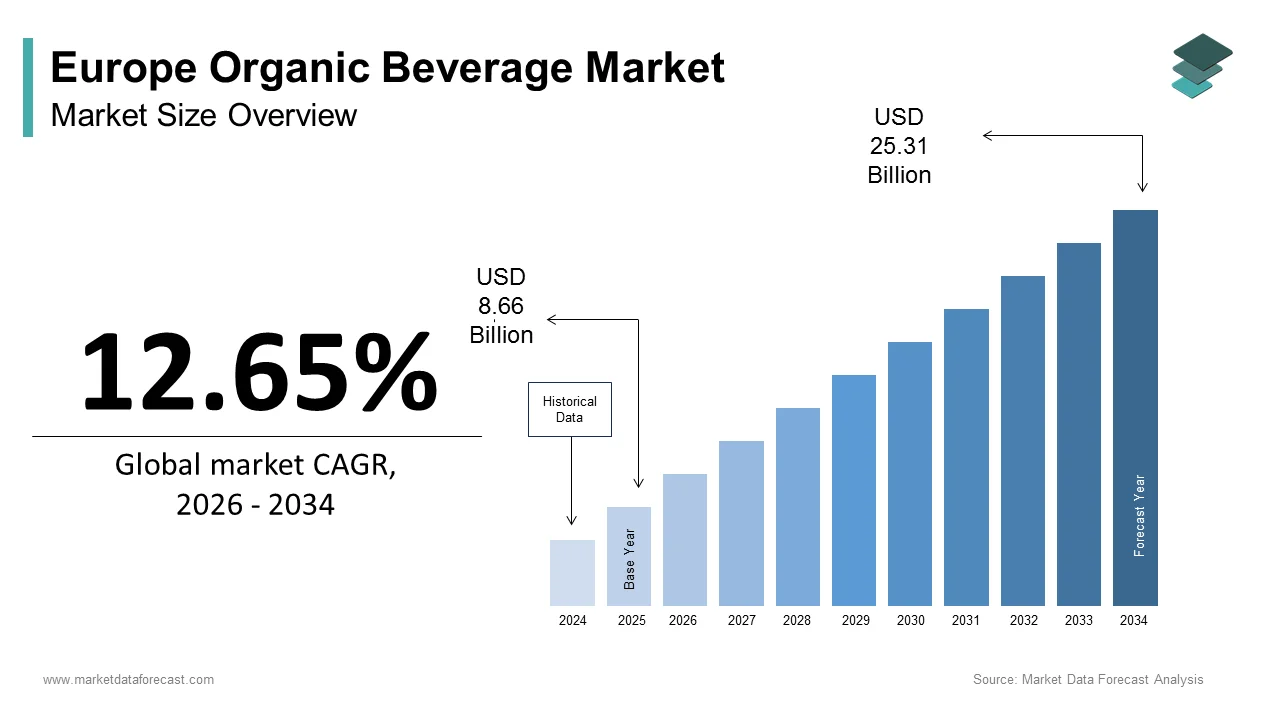
The European organic beverage market size was valued at USD 8.66 billion in 2025, is anticipated to be worth USD 9.76 billion in 2026, and is projected to scale up to USD 25.31 billion by 2034, registering a compound annual growth rate (CAGR) of 12.65% during the forecast period from 2026 to 2034. Driven by EU organic regulatory standards, rising health consciousness, clean-label demands, and supportive agricultural policies like the Farm to Fork Strategy, the organic beverage sector continues to experience dynamic mainstream expansion across Europe.
Key Executive Metrics (At-a-Glance)
- 2025 Base Valuation: USD 8.66 Billion
- 2026 Current Valuation: USD 9.76 Billion
- 2034 Forecast Valuation: USD 25.31 Billion
- Compound Annual Growth Rate (CAGR): 12.65% (2026–2034)
- Dominant Product Segment: Fruit Beverages (holding a dominant share due to high consumer familiarity, regulatory clarity, and wide retail availability)
- Dominant Distribution Channel: Offline Channels (leading market share driven by supermarket curation, physical store trust, and tactile shopping habits)
- Dominant Region / Country: Germany (largest regional contributor with a 24.3% market share backed by dense organic retail infrastructure and high consumer trust)
Core Market Drivers
- Demand for Clean Label & Transparency: Growing consumer preference for simple ingredients, strict EU organic certification, and full farm-to-bottle traceability free from synthetic chemicals.
- EU Policy Support & Farm to Fork Strategy: Institutional targets aiming for 25% of agricultural land under organic management by 2030, enhancing raw material supply and scalability.
Primary Market Restraints & Challenges
- Premium Pricing & Economic Sensitivity: A 30% to 60% price premium over conventional drinks, causing budget-conscious consumers in price-sensitive regions to scale back purchases.
- Fragmented Certifications Across Nations: Divergent national control rules and private standards (such as France's Agence Bio or German associations) increasing compliance complexity for cross-border brands.
Europe Organic Beverage Market Segmentation Breakdown
| Segment Category | Largest (Dominant) Sub-Segment | Fastest-Growing Sub-Segment |
|---|---|---|
| By Product Outlook | Fruit Beverages (Dominant share supported by high consumer familiarity, school fruit schemes, and clean-label appeal) | Non-Dairy Beverages (Fastest-growing at a 14.7% CAGR driven by plant-based diets, lactose awareness, and sustainability) |
| By Distribution Channel | Offline Channels (Leading share backed by supermarkets, organic specialty stores, and tactile grocery shopping) | Online Channels (Fastest-growing at an 18.3% CAGR powered by e-commerce expansion, subscriptions, and D2C brands) |
| By Region / Country | Germany (Largest market contributor with 24.3% share backed by specialty organic stores and national policy) | Sweden / UK (Lucrative hubs expanding via public health policy, functional wellness, and strong café integration) |
Major Industry Players Profiled
Key enterprises shaping the competitive European organic beverage market include Danone S.A., Oatly AB, Dr Pepper Snapple Group Europe, Boncafe International, Uncle Matt's Organic Inc., Hain Celestial, Parker Organic Juices, Belvoir Fruit Farms Ltd., Organic Bison Beer, The Coca-Cola Co., Whitewave Foods Company, and PepsiCo, Inc.
Europe Organic Beverage Market Size
The Size of the European Organic Beverage Market was expected to be worth USD 8.66 billion in 2025 and is anticipated to be worth USD 25.31 billion by 2034, from USD 9.76 billion in 2026, growing at a CAGR of 12.65% during the forecast period.
Organic beverages are drinks produced from ingredients cultivated without synthetic pesticides, genetically modified organisms, or artificial additives, and processed in compliance with the European Union’s Regulation (EU) 2018/848 on organic production. This category includes organic fruit juices, plant-based drinks, dairy alternatives, herbal infusions, organic wines, and functional beverages fortified with natural extracts. Unlike conventional beverages, organic variants must carry the EU organic logo and undergo certification by an approved control body to substantiate claims. The European market is shaped by heightened consumer awareness of health, environmental sustainability, and food transparency trends accelerated by digital access to ingredient sourcing and production ethics. As per Eurostat, over 78% of EU households purchased organic food or beverages at least once in 2023, with beverages ranking among the top three fastest-growing organic subcategories. Furthermore, the European Commission’s Farm to Fork Strategy targets 25% of total agricultural land under organic cultivation by 2030, directly expanding the supply of certified organic raw materials like apples, oats, and grapes. These regulatory, cultural, and agricultural dynamics position organic beverages as a mainstream yet premium segment within Europe’s evolving food and drink landscape.
MARKET DRIVERS
Strengthening Consumer Demand for Clean Label and Transparency
Consumers are prioritising ingredient simplicity and supply chain transparency, driving robust demand for organic beverages free from artificial preservatives, sweeteners, and synthetic additives, which is greatly influencing the growth of Europe organic beverages market. As per the European Food Safety Authority, over 65% of EU citizens express concern about chemical residues in food and drinks, prompting a shift toward certified organic options perceived as purer and safer. This trend is particularly pronounced among millennials and Gen Z Eurostat reports that 82% of adults aged 18 to 35 in Germany, France, and the Netherlands actively seek clean-label beverages with short ingredient lists. The EU organic certification serves as a trusted proxy for this transparency, requiring full traceability from farm to bottle and banning over 300 non-organic processing aids permitted in conventional production. Retailers like E.Leclerc in France and Alnatura in Germany, reinforce this demand by dedicating prominent shelf space to organic beverages with QR codes linking to farm origin and certification data, transforming organic drinks from niche wellness items into everyday staples of conscious consumption.
EU Policy Support and Expansion of Organic Agricultural Supply
The European Union’s institutional commitment to organic farming through the Farm to Fork Strategy is creating a structural tailwind for organic beverage availability and affordability. The EU policy support and expansion of organic agricultural supply is also propelling the growth of Europe organic beverages market. As per the European Commission, the strategy mandates that 25% of total EU agricultural land be under organic management by 2030, with a significant increase from 9.1% in 2020. This expansion directly boosts the supply of key beverage ingredients such as organic apples for juice, oats for plant-based drinks, and grapes for wine. Additionally, the Common Agricultural Policy allocates over 1.2 billion euros annually to support organic conversion premiums and infrastructure, stabilising input costs for beverage producers. National governments amplify this support; Germany’s Federal Organic Farming Scheme granted 220 million euros in 2023 to fruit growers transitioning to organic methods. This coordinated policy framework ensures a more resilient and scalable raw material base by enabling beverage brands to meet rising demand without compromising on certification integrity or shelf availability.
MARKET RESTRAINTS
Premium Pricing and Economic Sensitivity
The price premium of 30 to 60% over conventional counterparts is hindering the growth of Europe organic beverages market. A 2024 study by the European Consumer Organisation found that 48% of occasional organic buyers in Spain, Italy, and Greece reduced or discontinued purchases due to budget constraints, despite strong belief in organic benefits. The price gap from higher production costs: organic fruit yields are 20 to 30% lower than conventional, according to the European Commission’s Joint Research Centre, and certification compliance adds 10 to 15% to processing expenses. While affluent markets like Germany and Sweden sustain premium pricing, Southern and Eastern Europe remain highly price sensitive. Without economies of scale or public subsidies for organic processing, many small beverage brands struggle to compete on shelf price, limiting market penetration to niche or high-income segments despite broad aspirational interest.
Fragmented Certification and Labelling Requirements Across Member States
The national interpretations of organic certification rules create compliance complexity and access barriers for beverage producers operating, which is also limiting the growth of Europe organic beverages market. As per the European Commission’s 2023 Organic Control Report, while Regulation (EU) 2018/848 sets baseline standards, individual member states impose additional requirements for specific ingredients or processes. For instance, France’s Agence Bio mandates that organic fruit juices contain 100% organic fruit with no reconstituted concentrate, with a stricter rule than the EU minimum of 95% organic content. Similarly, Germany’s Bioland and Demeter associations enforce private standards that ban certain natural flavours permitted under EU law, requiring dual production lines for differentiated labelling. These discrepancies force brands to reformulate products or manage multiple SKUs, inflating costs and delaying pan-European launches. A survey by FoodDrinkEurope revealed that 60% of small organic beverage companies avoid exporting beyond two neighbouring countries due to certification overload. This fragmentation undermines the single market principle and stifles innovation among agile producers who lack resources for multi-jurisdictional compliance.
MARKET OPPORTUNITIES
Rise of Organic Functional and Adaptogenic Beverages
The combination of certified organic bases with functional botanicals, such as ashwagandha, turmeric, and reishi mushroom, to address stress, immunity, and cognitive wellness is expanding new opportunities for the growth of Europe's organic beverages market. As per the European Commission’s 2023 Health Claims Inventory, while specific disease claims remain restricted, general wellness messaging around “natural energy” or “daily balance” is permissible when supported by traditional use or compositional data. This regulatory window has enabled brands like Rasa in the UK and Erbology in Sweden to launch organic adaptogenic coffee alternatives and herbal tonics that resonate with health-conscious consumers. The European Botanical Forum reports that sales of organic functional beverages grew by 27% in 2023, far outpacing the 9% growth of standard organic juices. Retailers are responding. Carrefour’s Organic+ line in France now features turmeric ginger shots with certified organic and fair trade sourcing.
Expansion into Organic Alcohol Free and Low Alcohol Segments
The emergence of health-consciousness and social moderation is driving innovation in organic non-alcoholic and low-alcohol beverages, significantly boosting new opportunities for the growth of Europe organic beverages market. As per the European Commission’s Alcohol Report 2023, over 42% of adults aged 18 to 35 in Germany, the Netherlands, and the UK now participate in “sober curious” movements, seeking alternatives that maintain ritual without intoxication. Organic producers are capitalising on this shift by launching certified alcohol-free wines, beers, and botanical spirits made from organically grown grapes, barley, and juniper. The UK’s Thomson Organic and Germany’s Grüvi have gained traction with organic non-alcoholic sparkling wines using traditional fermentation stopped before alcohol formation, compliant with both EU organic and non-alcoholic beverage standards. Sales of organic alcohol-free drinks grew by 34% in 2023, compared to 12% for conventional counterparts, as pera recent study. National health agencies reinforce this trend, where the Dutch National Institute for Public Health promotes alcohol-free organic alcohol free options in workplace wellness programmes.
MARKET CHALLENGES
Limited Scalability of Organic Ingredient Sourcing
The persistent supply constraints for key ingredients due to the slow pace of agricultural conversion and climate vulnerability are likely to inhibit the growth of Europe's organic beverage market. As per Eurostat, while organic land area grew by 8% in 2023, organic fruit production, particularly citrus and tropical fruits, lagged at 3% due to longer conversion periods and higher pest pressure without synthetic controls. This imbalance creates dependency on imports, where many organic orange juice concentrates used in EU beverages are sourced from Brazil and Mexico, exposing brands to shipping delays and certification fraud risks. A 2024 European Commission audit found that 12% of imported organic fruit juices failed authenticity tests due to adulteration with conventional concentrate. Moreover, climate extremes like the 2023 drought in Southern Europe reduced domestic organic apple yields by 18%, forcing juice blenders to ration supply. Without accelerated investment in regional organic orchards and robust anti-fraud traceability, such as blockchain or isotopic testing, beverage brands cannot guarantee consistent volume or pricing, undermining long term growth.
Regulatory Ambiguity Around Fortification and Novel Ingredients
The integration of vitamins, minerals, or novel botanicals into organic beverages faces legal uncertainty under the EU’s dual regulatory framework for organic production and food supplements. This factor additionally impedes the growth of the Europe organic beverages market. Regulation (EU) 2018/848 generally prohibits synthetic nutrient fortification in organic products, yet allows certain natural mineral salts under strict conditions. As per the European Food Safety Authority, only 14 mineral compounds are permitted in organic processing, excluding common fortificants like synthetic vitamin D3 or iron bisglycinate. This restricts brands from enhancing organic plant milks with nutrients typically added to conventional versions, putting them at a nutritional disadvantage. Furthermore, novel ingredients like hemp seed protein or water lentils (duckweed) must undergo separate Novel Food authorisation before use, a process taking 18 to 24 months during which organic certification cannot be granted. This ambiguity stifles innovation in nutrient-dense organic drinks, limiting their appeal in health segments where fortified functionality is increasingly expected.
REPORT COVERAGE
| REPORT METRIC | DETAILS |
| Market Size Available | 2025 to 2034 |
| Base Year | 2025 |
| Forecast Period | 2026 to 2034 |
| CAGR | 12.65% |
| Segments Covered | By Product Outlook, Distribution Channel Outlook, And Region |
| Various Analyses Covered | Global, Regional & Country Level Analysis; Segment-Level Analysis; DROC, PESTLE Analysis; Porter’s Five Forces Analysis; Competitive Landscape; Analyst Overview of Investment Opportunities |
| Regions Covered | UK, France, Spain, Germany, Italy, Russia, Sweden, Denmark, Switzerland, Netherlands, Turkey, and the Czech Republic |
| Market Leaders Profiled | Boncafe International, Uncle Matt's Organic Inc., Hain Celestial, Parker Organic Juices, Belvoir Fruit Farms Ltd, Organic Bison Beer, The Coca-Cola Co, Whitewave Foods Company and PepsiCo, Inc. |
SEGMENTAL ANALYSIS
By Product Outlook Analysis
The fruit beverages segment was the largest by holding a dominant share of the Europe organic beverages market in 2024. The growth of the segment is propelled by the strong consumer familiarity, regulatory clarity, and widespread retail availability. Organic fruit juices and nectars benefit from clear EU organic certification rules that permit only natural fruit content without added sugars or concentrates beyond minimal thresholds by aligning perfectly with clean label expectations. As per Eurostat, over 72% of European households purchased organic fruit juice at least once in 2023, with apple, orange, and mixed berry blends leading consumption. Germany’s Federal Ministry of Food and Agriculture reports that organic juice sales grew by 12% in 2023 alone, outpacing overall beverage growth due to parental preference for additive-free options for children. Supermarkets like Edeka in Germany and Carrefour in France allocate dedicated organic juice aisles with prominent EU organic logo placement, reinforcing trust and accessibility. Additionally, EU school fruit schemes distribute over 150 million organic juice units annually to children in 20 member states, according to the European Commission, normalising early consumption habits. This combination of policy support, retail integration, and intergenerational appeal solidifies fruit beverages as the cornerstone of Europe’s organic drinks landscape.
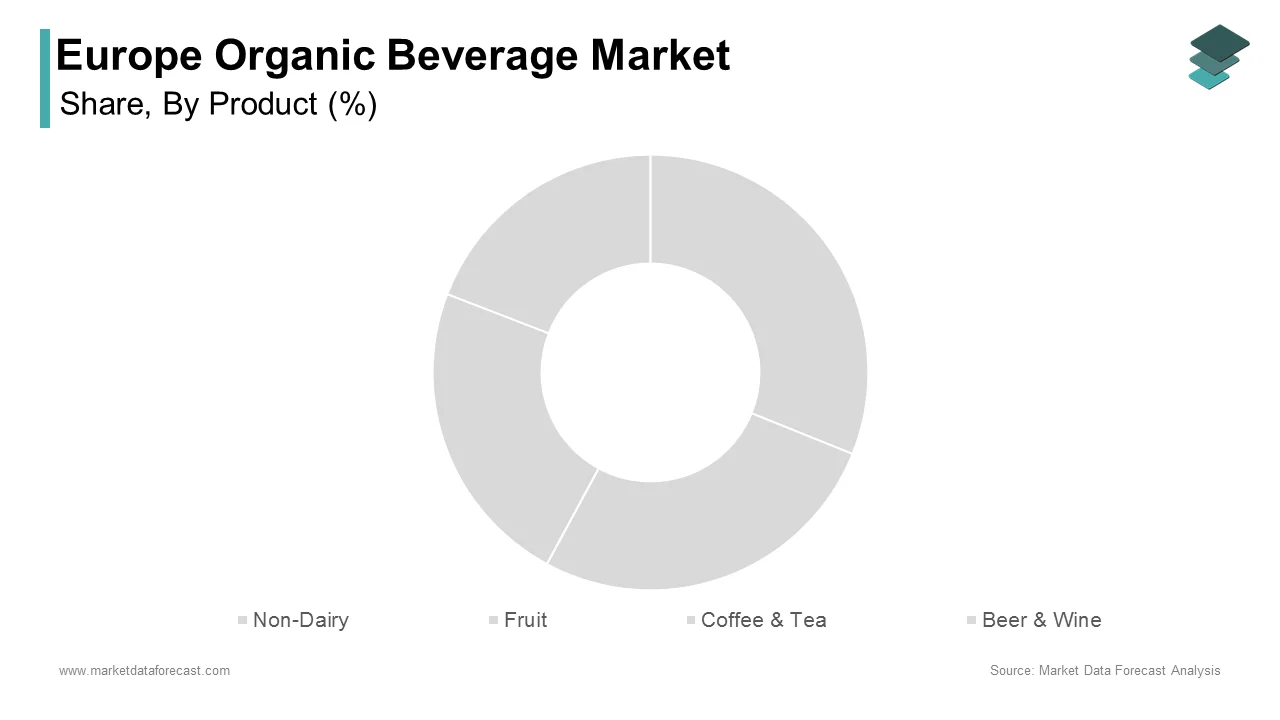
The non-dairy beverages segment is projected to witness the fastest CAGR of 14.7% during the forecast period, owing to the emergence of plant-based diets, lactose intolerance awareness, and sustainability concerns around dairy production. As per the European Commission’s Special Eurobarometer on Food, 28% of EU adults now actively limit dairy consumption, with oat, almond, and soy beverages serving as primary substitutes. Organic certification adds credibility by guaranteeing non-GMO crops and pesticide-free farming for ingredients like soy, which face consumer scepticism. In Sweden, the National Food Agency reports that organic oat drink sales surged by 31% in 2023, now outselling conventional variants in major retailers. The EU’s Farm to Fork Strategy further supports this shift by promoting legume and cereal diversification, expanding domestic organic oat and pea supply. Companies like Alpro and Provamel have responded by launching fortified organic plant milks with calcium and vitamins derived from natural sources, addressing nutritional parity concerns.
By Distribution Channel Outlook Analysis
The offline channels segment was the largest by holding a significant share of the Europe organic beverages market in 2024, driven by entrenched consumer shopping habits, trusted retail curation, and the sensory nature of beverage selection. Supermarkets, organic speciality stores, and convenience outlets remain primary touchpoints where consumers evaluate packaging, brand ethos, and ingredient transparency in real time. As per Eurostat, over 85% of Europeans aged 45 and above prefer purchasing beverages in physical stores where they can inspect labels and verify the EU organic logo. Major retailers like REWE in Germany and Monoprix in France have invested heavily in organic private label ranges, offering price-competitive options that drive trial and loyalty. Additionally, the EU’s Common Agricultural Policy supports farmers' markets and direct sales; over 12,000 certified organic markets operate across Europe, according to the European Network of Rural Development, enabling local beverage producers to build community trust. The tactile experience of selecting chilled juices or sampling new plant milks reinforces offline dominance, especially for premium and innovative products where trial influences repeat purchase.
The online distribution segment is expected to grow at a CAGR of 18.3% from 2025 to 2033, owing to the rise of direct-to-consumer brands, subscription models, and digital health communities that bypass traditional retail gatekeepers. As per the European Commission’s Digital Economy and Society Index, 82% of Europeans shopped online for groceries in 2023, with organic beverages among the top five fastest-growing categories. Startups like Plenish in the UK, and Dr Froh in Germany, leverage e-commerce to offer cold-pressed organic juices and functional blends with transparent sourcing and carbon-neutral delivery by appealing to urban, tech-savvy consumers. Subscription boxes enable consistent consumption habits in the Netherlands, 35% of organic plant milk buyers under 35 use recurring online deliveries, according to Statistics Netherlands. Furthermore, the EU’s Digital Services Act now requires large platforms to verify organic certification claims by enhancing consumer confidence in legitimate online vendors.
REGIONAL ANALYSIS
Germany Organic Beverages Market Analysis
Germany was the largest contributor to the Europe organic beverages market with 24.3% of the market share in 2024. The growth of the market in this country is majorly propelled by its organic retail infrastructure, high consumer trust in certification, and strong policy support. The country hosts over 10 000 organic speciality stores and mandates organic options in all public canteens under the National Organic Action Plan. As per the German Federal Statistical Office, 89% of households purchased organic beverages in 202,3 with fruit juices and plant milks leading demand. Germany’s strict enforcement of EU organic rules via control bodies like ABCERT ensures product integrity, reinforcing consumer confidence.
France Organic Beverages Market Analysis
France was ranked second by holding 18.3% of the Europe organic beverages market share in 2024, with its culinary tradition, wine heritage, and government-led organic promotion. The French National Organic Plan targets 100% organic food in school canteens by 2027, with a policy already driving demand for organic fruit juices and flavoured waters in institutional channels. As per Agence Bio, over 65% of French adults purchased organic beverages in 2023, with organic wine and herbal infusions showing the fastest growth. France is Europe’s largest producer of organic grapes with over 130,000 hectares under cultivation, enabling a robust domestic supply of certified organic wines and juices, as per the research. Retailers like Biocoop and Naturalia offer extensive organic beverage selections with emphasis on terroir and artisanal production.
United Kingdom Organic Beverages Market Analysis
The United Kingdom organic beverages market growth is driven by its direct-to-consumer ecosystem, functional beverage innovation, and strong café culture integration. The regulatory divergence the UK maintains alignment with EU organic standards through the Department for Environment, Food and Rural Affairs, which oversees the Organic Certification Body framework. As per the Soil Association, over 60% of UK adults purchased organic drinks in 2023, with cold-pressed juices, plant milks and organic alcohol-free beers leading growth. The UK is home to pioneering brands like Rasa and Plenish, which blend organic certification with adaptogenic and functional positioning, tapping into wellness trends. Additionally, organic beverage sales in coffee shops grew by 22% in 2023, according to the British Coffee Association, as chains like Pret A Manger introduced organic oat milk and cold brew options.
Sweden Organic Beverages Market Analysis
Sweden's organic beverages market growth is likely to grow with its public health focus, environmental consciousness and early adoption of plant-based lifestyles. The Swedish National Food Agency reports that 78% of households bought organic beverages in 2023, with oat drinks now outselling dairy milk in major retailers like ICA and Coop. Sweden’s ambitious climate policy, targeting fossil-free food systems by 2030, drives consumer preference for low-impact organic options. The government’s public procurement guidelines mandate that 60% of food and beverages in schools and hospitals be organic or climate certified. Additionally, Sweden leads in organic functional beverages with brands like Oatly and Ekoport offering fortified organic plant milks and berry shots backed by Nordic nutritional science. With one of Europe’s highest per capita organic expenditures and a culture of preventive wellness, Sweden represents a forward-looking market where organic beverages are integrated into national sustainability and health strategies.
Italy Organic Beverages Market Analysis
Italy's organic beverages market growth is likely to grow with its rich agricultural heritage, strong regional identities, and growing demand for organic wine and citrus juices. As per Italy’s Ministry of Agricultural Policies, the country ranks second in Europe for organic land area with over 2 million hectares under cultivation, including 50,000 hectares of organic citrus orchards. Italians view organic beverages through a lens of authenticity and terroir. Organic blood orange juice from Sicily and organic Prosecco from Veneto command premium positioning. The National Organic Plan allocates 180 million euros annually to support smallholder fruit farmers transitioning to organic methods, ensuring supply continuity. In urban centres like Milan and Rome, organic beverage bars and cold-pressed juice shops are proliferating among health-conscious millennials. According to ISMEA, over Italian households purchased organic drinks in 2023, with seasonal and locally sourced blends driving repeat purchases.
KEY MARKET PLAYERS
A few major players in the Europe Organic Beverages Market include
- Boncafe International
- Uncle Matt's Organic Inc
- Hain Celestial
- Parker Organic Juices
- Belvoir Fruit Farms Ltd
- Organic Bison Beer
- The Coca-Cola Co
- Whitewave Foods Company and PepsiCo, Inc
Top Strategies Used by the Key Market Participants
Competition in the Europe organic beverages market is characterised by a dynamic interplay between multinational giants and agile regional brands vying for consumer trust in a highly scrutinised category. Unlike conventional beverages, where price and branding dominate, organic competition revolves around certification credibility, ingredient provenance and environmental impact. Large players like Danone and Oatly benefit from scale retail partnerships and R&D capacity to navigate complex organic regulations and launch fortified or functional variants. Meanwhile, local brands such as Germany’s Voelkel or Italy’s Sant’Anna leverage regional agricultural heritage and direct farm relationships to appeal to terroir-conscious consumers.
Leading Players in the Market
- Danone SA is a leading force in the Europe organic beverages market through its Alpro and Horizon Organic plant-based drink portfolios, which are certified under EU organic standards and widely distributed across retail and food service channels. Headquartered in France, the company leverages its dairy heritage to produce organic oat, soy and almond beverages fortified with naturally sourced calcium and vitamins. Danone aligns its organic strategy with its “One Planet One Health” vision, integrating regenerative agriculture into its supply chain. Danone launched a new range of organic barista edition plant milks in Germany and the Netherlands, featuring climate-neutral certification and 100% recyclable packaging. It also partnered with organic oat farmers in Sweden to secure a traceable non-GMO supply under its Danone Organic Farming Programme. These initiatives reinforce Danone’s role as a mainstream enabler of accessible and sustainable organic beverages across Europe and globally.
- Oatly AB has established a dominant presence in the Europe organic beverages market by pioneering certified organic oat drinks that combine environmental messaging with functional nutrition. The Swedish company’s products are certified organic in over 15 European countries and are a staple in cafés, supermarkets and direct-to-consumer channels. Oatly differentiates through transparent climate labelling and advocacy for plant-based transitions in food systems. In early 2024, Oatly introduced a new line of organic functional oat drinks infused with vitamin D2 from UV-exposed mushrooms and iron from organic algae, addressing common nutrient gaps without synthetic additives. It also expanded its Malmö production facility to meet rising demand for organic variants in France and Italy. These actions position Oatly as an innovator that merges organic integrity with bold sustainability storytelling in global beverage markets.
- Dr Pepper Snapple Group Europe contributes to the organic beverages market through its acquisition and development of premium organic juice and functional drink brands such as R.W Knudsen and Copella. These brands offer cold-pressed organic fruit and vegetable blends compliant with EU organic certification and sold across the UK, Germany and Scandinavia. The company focuses on clean label formulations with no concentrates or added sugars, appealing to health-conscious European consumers. The company reformulated its entire Copella organic apple juice range to use 100% EU grown organic apples sourced from orchards in Herefordshire and Normandy. It also launched a direct-to-consumer subscription platform for R.W Knudsen organic juices with carbon-neutral delivery across Western Europe.
RECENT HAPPENINGS IN THE MARKET
In February 2024, Danone SA launched a new range of organic barista edition plant milks in Germany and the Netherlands, featuring climate-neutral certification and 100% recyclable packaging.
MARKET SEGMENTATION
This research report on the Europe organic beverages market has been segmented and sub-segmented based on product outlook, distribution channel outlook, and region.
By Product Outlook
- Non-Dairy
- Fruit
- Coffee & Tea
- Beer & Wine
By Distribution Channel Outlook
- Online
- Offline
By Region
- UK
- France
- Spain
- Germany
- Italy
- Russia
- Sweden
- Denmark
- Switzerland
- Netherlands
- Turkey
- Czech Republic
- Rest of Europe