- Product Description Description
- Table of Contents TOC
- List of Table & Figure LOT
- Get Free Sample PDF Sample PDF
Market Size, 2025
$37.56 BnMarket Estimate, 2026
$40.44 BnMarket Forecast, 2034
$73.09 BnCAGR, 2026–2034
7.68%Europe Organic Farming Market Size, Growth, Trends & Forecast (2026–2034)
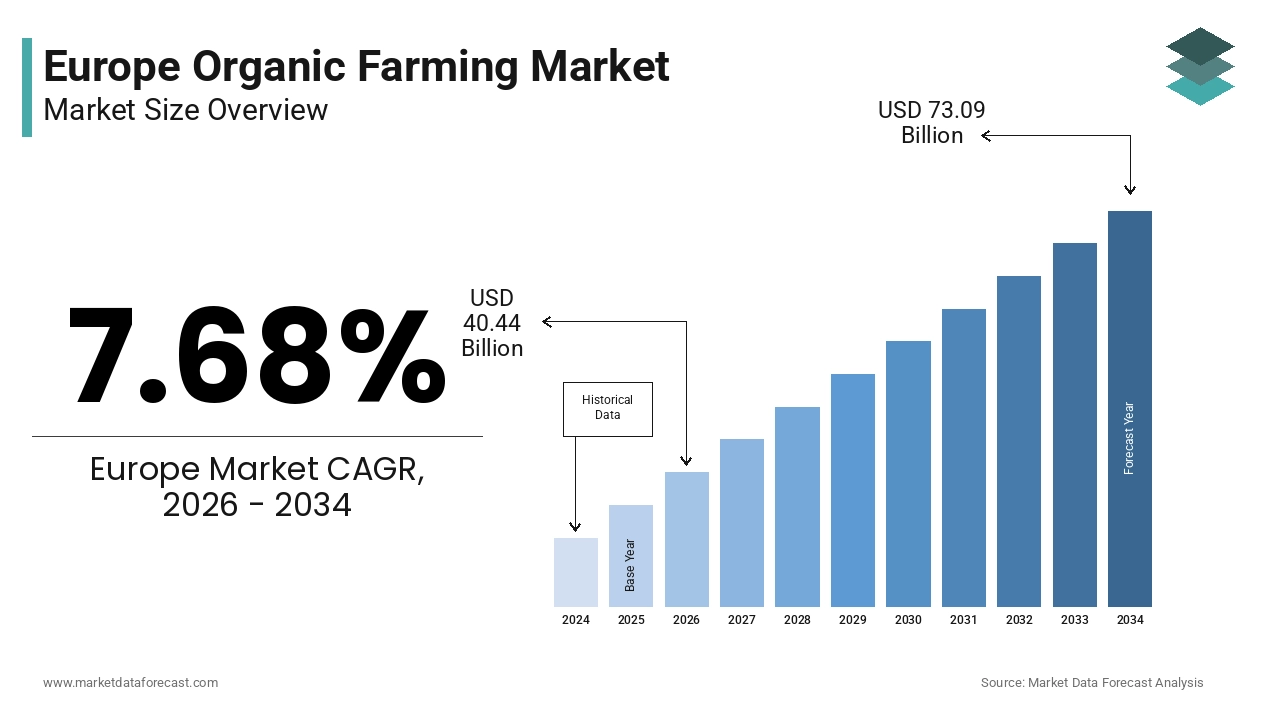
The Europe organic farming market size was calculated to be USD 37.56 billion in 2025, reached USD 40.44 billion in 2026, and is anticipated to be worth USD 73.09 billion by 2034, growing at a compound annual growth rate (CAGR) of 7.68% during the forecast period from 2026 to 2034. Driven by rigorous regulatory backing, the European Green Deal's Farm to Fork Strategy, and rising consumer demand for healthy and sustainable food, the market reflects an accelerating transformation toward ecological and traceable agricultural systems.
Key Executive Metrics (At-a-Glance)
- 2025 Base Valuation: USD 37.56 Billion
- 2026 Current Valuation: USD 40.44 Billion
- 2034 Forecast Valuation: USD 73.09 Billion
- Compound Annual Growth Rate (CAGR): 7.68% (2026–2034)
- Dominant Regional Market: France (holding a 22.3% share in 2025, anchored by robust government subsidies, public procurement mandates, and high consumer adoption)
- Key Growth Segments: Pure Organic Farming (Largest Market Share) and Integrated Organic Farming & Agriculture Companies (Fastest-Growing segments expanding at up to 9.2% CAGR)
Core Market Drivers & Growth Triggers
- Stringent Policy Mandates: The EU's Farm to Fork Strategy targeting 25% organic farmland by 2030, supported by conversion subsidies and public procurement initiatives.
- Consumer Health & Sustainability Awareness: Surging demand for clean-label, pesticide-free, and ethically produced food products across demographics.
Primary Market Restraints & Challenges
- High Production Costs & Yield Gaps: Labor-intensive weed and pest management paired with a temporary 10% to 25% yield reduction during the conversion phase.
- Logistical Bottlenecks & Climate Pressures: Fragmented supply chains requiring strict segregation, compounded by climate-induced pest outbreaks and skills shortages.
Europe Organic Farming Market Segmentation Breakdown
| Segment Category | Largest Segment / Leader | Fastest-Growing Segment |
|---|---|---|
| By Farming Type | Pure Organic Farming (Dominant market share anchored by strict EU regulations, consumer trust, and dedicated policy support) | Integrated Organic Farming (Projected at an 8.5% CAGR driven by transitional support and gradual risk mitigation) |
| By Application | Organic Farms (Significant market share due to direct consumer engagement, local short supply chains, and quality control) | Agriculture Companies (Projected at a 9.2% CAGR driven by corporate scale, agri-tech integration, and mass-retail supply chains) |
| By Region | France (Held 22.3% share in 2025, supported by the Ambition Bio plan and institutional organic procurement) | Spain & Italy (Rapid expansion via export growth, Mediterranean alignment, and robust conversion funding) |
Major Industry Players Profiled
Key corporations shaping the Europe organic farming market include Danone, Nestlé S.A., Unilever, HiPP GmbH & Co. Vertrieb KG, Amy's Kitchen, Alnatura Produktions- und Handels GmbH, Riverford Organic Farmers Ltd, Eosta B.V., Bio Company SE, and Dennree GmbH.
 Download Free Sample Report
Europe Organic Farming Market Size
The Europe organic farming market size was calculated to be USD 37.56 billion in 2025 and is anticipated to be worth USD 73.09 billion by 2034, from USD 40.44 billion in 2026, growing at a CAGR of 7.68% during the forecast period.
Organic farming is the agricultural production systems that strictly adhere to ecological processes, biodiversity, and cycles adapted to local conditions, while prohibiting the use of synthetic fertilizers, pesticides, genetically modified organisms, and antibiotics. As per Eurostat data from 2024, the total area under organic management in the European Union reached 16.9 million hectares, which accounts for approximately 10.7% of the total utilized agricultural area. This extensive land use reflects a deep structural transformation in European agriculture driven by policy mandates and consumer demand. According to the Research Institute of Organic Agriculture, the number of organic producers in Europe exceeded 350000 in 2023, demonstrating significant participation across the supply chain. The European Commission’s Farm to Fork Strategy aims to increase the share of organic farmland to 25% by 2030, providing a clear regulatory roadmap for expansion. In 2023, public procurement initiatives in countries like Denmark and Italy integrated organic food into school meals and hospitals, as reported by the International Federation of Organic Agriculture Movements. These institutional commitments reinforce the market's stability. The definition of this market extends beyond production to include certification, logistics, and retail channels that ensure traceability and integrity.
MARKET DRIVERS
Stringent Regulatory Support and Policy Mandates
The robust regulatory frameworks and ambitious policy targets set by the European Union are majorly fuelling the growth of Europe's organic farming market. The European Green Deal and its associated Farm to Fork Strategy provide a comprehensive legislative backbone that incentivizes the conversion to organic practices through financial subsidies and technical support. This substantial financial backing reduces the economic risk for farmers during the conversion period, which typically lasts two to three years. These policies not only encourage new entrants but also support existing organic farmers in maintaining certification standards. The regulatory environment also includes strict labeling requirements that protect the integrity of the organic logo, thereby enhancing consumer trust. In Germany, the federal government increased subsidies for organic livestock farming by 20% in 2023, as reported by the German Ministry of Food and Agriculture. Such targeted incentives address specific sectoral needs and promote balanced growth across crop and livestock segments. The harmonization of rules across member states facilitates cross-border trade and creates a unified market.
Growing Consumer Health Consciousness and Environmental Awareness
The escalating consumer preference for healthy and environmentally sustainable food products is significantly boosting the growth of Europe organic farming market. Modern consumers are increasingly aware of the potential health risks associated with pesticide residues and antibiotic resistance in conventional food, leading them to choose organic alternatives. As per a 2023 survey by the European Consumer Organisation, 65% of Europeans stated that they buy organic products at least occasionally due to health concerns. This demand is particularly strong among millennials and Generation Z, who prioritize sustainability and ethical production methods in their purchasing decisions. The willingness to pay a premium for organic goods has remained resilient despite inflationary pressures. Environmental awareness also drives demand as shoppers recognize the role of organic farming in preserving biodiversity and reducing water pollution. Social media and educational campaigns have amplified the message about the benefits of organic agriculture, creating an informed customer base. Retailers respond by expanding their organic assortments and promoting private-label organic brands. The trend toward clean-label products further supports the growth of organic ingredients in processed foods. This sustained consumer interest provides a reliable revenue stream for farmers and encourages continuous market expansion.
MARKET RESTRAINTS
High Production Costs and Lower Yields During Conversion
The elevated production costs and temporarily reduced yields during the conversion period are restricting the growth of Europe's organic farming market. Organic farming requires intensive labor for weed control, pest management, and soil maintenance, which increases operational expenses compared to conventional methods. As per the European Commission’s Joint Research Centre, organic farms typically experience a yield gap of 10 to 25% dependin,g on the crop type during the first few years of conversion. This reduction in output, combined with higher input costs such as organic feed and certified seeds, places financial strain on farmers. Many small and medium simedium-sizedck the capital reserves to withstand this initial income dip, leading to hesitation in adopting organic practices. Additionally, the price premium for organic products does not always fully compensate for the lower yields and higher costs, especially in competitive commodity markets. Fluctuations in consumer demand can further exacerbate financial instability. The complexity of organic certification processes also adds administrative burdens and costs.
Complex Supply Chain and Logistics Challenges
Inefficiencies and complexities within the organic supply chain are also hindering the growth of Europe organic farming market. The fragmented nature of organic production often involves numerous small-scale producers, which complicates aggregation processing and distribution. As per the European Logistics Association, the cost of transporting organic goods is 15 to 20% higher than that of conventional products due to the need for separate storage and handling to prevent contamination. This segregation requirement necessitates dedicated infrastructure, which i,s not always available, leading to bottlenecks and delays. In 2024, shortages of organic processing facilities in Eastern Europe resulted in the export of raw organic grains to Western Europe for processing according to the European Organic Processors Association. This dependency increases transportation emissions and reduces the profitability of local farmers. The lack of standardized digital tracking systems across member states further hinders traceability and efficiency. Small volumes of certain organic products make it difficult to achieve economies of scale in logistics. Retailers often face challenges in maintaining consistent supply levels, leading to stockouts that disappoint consumers. The limited number of specialized organic distributors restricts market access for smaller producers. These logistical hurdles increase the final price for consumers and reduce the competitiveness of organic products against conventional alternatives.
MARKET OPPORTUNITIES
Expansion of Organic Aquaculture and Blue Economy Integration
The emerging sector of organic aquaculture, as it diversifies production beyond terrestrial agriculture, is certain to set up new opportunities for the expansion of Europe's organic farming market. With the European Union promoting the blue economy, there i,s growing interest in sustainable seafood production that adheres to organic standards. This growth is driven by consumer demand for healthy and sustainably sourced protein alternatives. Organic aquaculture prohibits the use of synthetic chemicals and genetically modified feed, offering a cleaner product that appeals to health-conscious buyers. The integration of aquaculture with organic crop farming through aquaponics systems offers further innovation potential. These closed lclosed-loop minimize waste and maximize resource efficiency, aligning with circular economy principles. Government grants supporting sustainable fisheries encourage more farmers to explore this niche. The high value of organic seafood provides attractive margins for producers.
Technological Innovation in Precision Organic Agriculture
The adoption of advanced technologies in precision organic agriculture to enhance efficiency and productivity is another factor to leverage the growth of Europe's organic farming market in the coming years. Innovations such as robotic weeding drones for monitoring and artificial intelligence for pest prediction are transforming organic practices by reducing labor dependency and improving crop management. These technologies enable farmers to address weeds and pests mechanically without chemical inputs, thereby maintaining organic certification while boosting yields. Digital platforms facilitate better supply chain coordination and direct-to-consumer enhancing market access for smallholders. Blockchain technology improves traceability, ensuring transparency and building consumer trust. Investment in agri-tech startups focused on organic solutions is increasing with venture capital funding reaching 500 million euros in 2024, as reported by the European Investment Bank. These technological advancements make organic farming more scalable and economically viable.
MARKET CHALLENGES
Climate Change Induced Pest and Change-Induced
Climate change, by altering pest and disease dynamics, which are difficult to manage without synthetic chemicals, is a major challenge for the growth of Europe's organic farming market. Rising temperatures and changing precipitation patterns create favorable conditions for new pests and pathogens that threaten organic crops. Organic farmers rely on biological controls and crop rotation, which may be less effective against rapidly evolving threats. In 2024, severe infestations of the spotted wing drosophila affected organic berry production in Italy and Spain, causing yield losses of up to 30% according to the Coldiretti agricultural association. The limited availability of approved biological pesticides restricts the options for immediate intervention. Farmers must invest in research and adaptive strategies, which require time and resources. Extreme weather events such as droughts and floods further stress plants, making them more susceptible to diseases. The unpredictability of climate impacts makes long-term planning difficult. Long-term insurance products for organic farms are often expensive or unavailable due to perceived high risks. These environmental pressures threaten the stability of organic production and can lead to supply shortages.
Labor Shortages and Skills Gap in Organic Practices
The acute labor shortages and a lack of specialized skills in organic farming techniques are also expected to impede the growth of Europe organic farming market. Organic agriculture is labor-intensive, requiring manual weeding, harvesting, and careful animal husbandry, which cannot be easily automated. Finding workers with specific knowledge of organic protocols and biodiversity management is particularly difficult. This shortage leads to delayed operations and potential crop losses. The complexity of organic certification requires detailed record keeping and compliance monitoring, which demands skilled management. Many conventional farmers transitioning to organic farming lack the necessary expertise and face a steep learning curve. Training programs are insufficient to meet the growing demand for skilled organic practitioners. The reliance on migrant labor, which is subject to regulatory changes and mobility restrictions, adds vulnerability. Wa,ge inflation further increases operational costs, squeezing profit margins.
REPORT COVERAGE
| REPORT METRIC | DETAILS |
| Market Size Available | 2025 to 2034 |
| Base Year | 2025 |
| Forecast Period | 2026 to 2034 |
| CAGR | 7.68% |
| Segments Covered | By Farming Type, Application, And Region |
| Various Analyses Covered | Global, Regional & Country Level Analysis; Segment-Level Analysis; DROC, PESTLE Analysis; Porter’s Five Forces Analysis; Competitive Landscape; Analyst Overview of Investment Opportunities |
| Regions Covered | UK, France, Spain, Germany, Italy, Russia, Sweden, Denmark, Switzerland, Netherlands, Turkey, and the Czech Republic |
| Market Leaders Profiled | Danone, Nestlé S.A., Unilever, HiPP GmbH & Co. Vertrieb KG, Amy's Kitchen, Alnatura Produktions- und Handels GmbH, Riverford Organic Farmers Ltd, Eosta B.V., Bio Company SE, Dennree GmbH |
SEGMENTAL ANALYSIS
By Farming Type Insights
The pure organic farming segment was the largest by holding a dominant share of the Europe organic farming market in 2025, with the strict adherence to European Union regulations, which prohibit the use of synthetic inputs and genetically modified organisms, ensuring high consumer trust. As per Eurostat data from 2023, over 16 million hectares of agricultural land in the EU were fully converted to organic management, reflecting a strong commitment to pure organic principles. Consumers are willing to pay a premium for products bearing the EU organic logo because it guarantees compliance with rigorous standards. The clear distinction between conventional and pure organic farming simplifies marketing and labeling for retailers. Regulatory support, such as direct payments under the Common Agricultural Policy, favors fully converted farms providing financial stability. This segment benefits from established supply chains and dedicated processing facilities that prevent contamination. The cultural shift toward clean eating reinforces the preference for pure organic goods. Retailers exclusively stock pure organic lines in specialized sections, enhancing visibility. The long-term sustainability goals of the European Green Deal further incentivize pure organic practices. This regulatory and consumer alignment ensures the continued leadership of the pure organic segment.
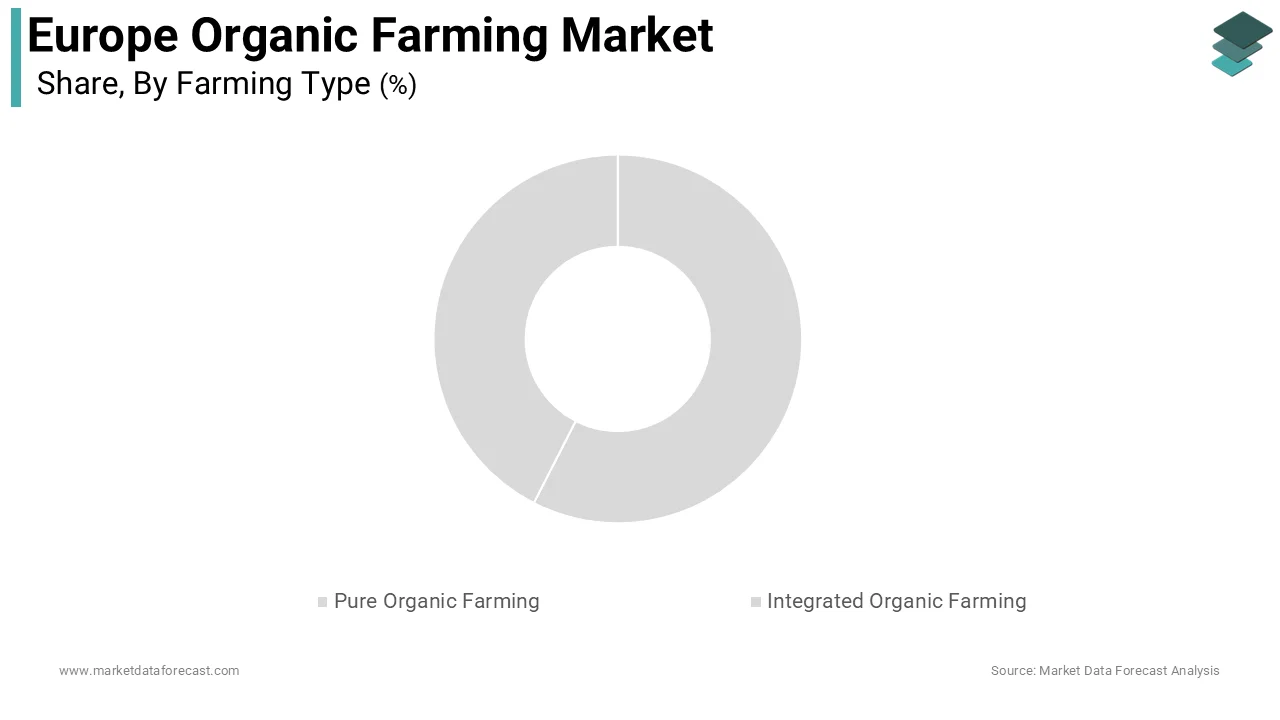
The integrated organic farming segment is projected to expand at a CAGR of 8.5% from 2026 to 2034, with the policy initiatives that support farmers during the transitional phase from conventional to pure organic systems. Integrated farming allows for reduced chemical usage while maintaining productivity, thereby mitigating financial risks. Integrated farming serves as a stepping stone, allowing producers to learn organic techniques gradually. The flexibility of integrated systems enables farmers to respond to pest pressures without losing certification progress. Retailers are beginning to accept integrated products as part of their sustainability portfolios. This pragmatic approach lowers barriers to entry and accelerates adoption. The supportive regulatory environment ensures steady growth for this segment.
By Application Insights
The organic farms segment accounted for a significant share of the Europe organic farming market in 2025, with the direct role of farms in cultivating organic crops and rearing livestock ensuring control over quality and certification. These farms directly engage with consumers through farmers' markets, community-supported agriculture, and box schemes, fostering trust and loyalty. The proximity to consumers reduces transportation costs and carbon footprints, enhancing sustainability. Organic farms often diversify their offerings, including agritourism and educational workshops, creating additional revenue streams. The personal connection between farmers and buyers strengthens brand identity. Local sourcing initiatives by restaurants and schools prefer dealing directly with farms to ensure freshness. This direct model bypasses intermediaries, improving profit margins for producers. The authenticity of farm-to-table experiences appeals to modern consumers. Regulatory support for short supply chains further encourages this structure. The centrality of farms in production ensures their market leadership.
The agriculture companies segment is projected to expand at a CAGR of 9.2% from 2026 to 2034, with the increased corporate investment in large-scale organic production to meet rising retail demand. Major agribusinesses are acquiring organic farms and investing in processing infrastructure to secure supply chains. Companies leverage economies of scale to reduce costs and improve distribution efficiency. These partnerships ensure consistent quality and availability across multiple locations. Corporate entities bring advanced technology and management expertise to organic farming, enhancing productivity. The ability to invest in research and development accelerates innovation in organic practices. International trade networks allow agriculture companies to balance supply and demand across borders. This professionalization of organic farming attracts institutional investors. The scalability of corporate operations meets the needs of mass market retailers.
REGIONAL ANALYSIS
France Organic Farming Market Analysis
France was the top performer in the Europe organic farming market by accounting for 22.3% of the share in 2025, with strong government support and high consumer demand for organic products. The Ambition Bio 2022 plan successfully boosted production and consumption levels. The presence of numerous small-scale organic farms contributes to diverse product offerings. Public procurement policies mandate organic food in schools and hospitals, driving institutional demand. French consumers prioritize local and seasonal organic produce, supporting regional economies. The well-developed retail network includes specialized organic stores and supermarket sections. Government subsidies for conversion and maintenance encourage farmer participation. The cultural emphasis on gastronomy enhances the value of organic ingredients. France leads in organic wine and dairy production, exporting to neighboring countries. The strong regulatory framework ensures high standards and consumer trust. Continued investment in research and education supports innovation.
Germany Organic Farming Market Analysis
Germany's organic farming market was the second largest by holding 18.4% of the share in 2025, with high consumer awareness and a robust retail infrastructure for organic goods. As per the German Ministry of Food and Agriculture, the organic farmland in Germany exceeded 1.6 million hectares in 2023. The presence of major discount supermarkets offering affordable organic lines has democratized access. German consumers are highly educated about environmental issues, driving demand for sustainable products. The country is a leader in organic livestock farming, particularly in the dairy and pork sectors. Strong labeling laws protect the integrity of organic claims. Cooperative structures among farmers facilitate collective marketing and processing. Investment in organic processing facilities enhances value addition. The demand for organic baby food and convenience products is rising.
Italy Organic Farming Market Analysis
Italy's organic farming market growth is likely to grow with favorable climatic conditions and a strong tradition of high-quality agricultural production. As per the Italian National Institute of Statistics, Italy had over 1.9 million hectares of organic farmland in 2023, making it a top producer in the EU. The country is a leading exporter of organic pasta, olive oil, and wine. In 2024, organic exports from Italy increased by 12% according to the Italian Trade Agency. Domestic consumption is growing, driven by health consciousness and culinary traditions. The Mediterranean diet aligns well with organic principles, emphasizing fresh and natural ingredients. Government incentives support conversion in southern regions where unemployment is higher. Organic tourism and agritourism are popular, adding value to farm operations. Italian consumers prefer local and traditional varieties preserving biodiversity. Retailers are expanding organic assortments in response to demand. The integration of organic farming with cultural heritage supports sustainability.
Spain Organic Farming Market Analysis
Spain's organic farming market growth is likely to have a significant CAGR in the coming years, with its vast land area suitable for organic cultivation, particularly for olive fruits and vegetables. However, domestic consumption is lower than in Northern Europe, leading to significant exports. In 2024, organic exports from Spain reached 3 billion euros, according to the Spanish Organic Food Observatory. The government is implementing strategies to boost domestic demand through education and promotion. Urban gardens and local markets are gaining popularity in cities like Madrid and Barcelona. Climate change adaptation drives interest in drought-resistant organic crops. The tourism sector increases demand for organic food in hotels and restaurants. Price sensitivity remains a challenge for broader adoption. Government subsidies support conversion in rural areas. The potential for growth in domestic consumption is high.
Sweden Organic Farming Market Analysis
Sweden's organic farming market growth is likely to be driven by the high per capita consumption and strong political commitment to organic agriculture. The government's target is to reach 60% organic food consumption by 2030. In 2024, public procurement of organic food in Sweden increased by 15% according to the Swedish National Food Agency. Schools and hospitals are major buyers, driving stable demand. Swedish consumers are highly environmentally conscious, preferring organic and local products. The retail sector offers extensive organic selections, including private labels. The country is a leader in organic dairy and meat production. Strong animal welfare standards align with organic principles. Innovation in organic processing and packaging is advanced. The cold climate presents challenges but also opportunities for specific crops. Education and awareness campaigns are effective.
COMPETITION OVERVIEW
The competition in the Europe organic farming market is characterized by a mix of large multinational corporations, specialized organic brands, and local cooperatives vying for dominance through quality and sustainability. Major players compete based on transparency, product authenticity, and environmental impact rather than price alone. The market sees intense rivalry among distributors who strive to differentiate themselves through unique storytelling and direct farmer partnerships. Established companies leverage their scale to invest in certification and logistics infrastructure, ensuring reliable delivery. Smaller niche players focus on regional specialties and heritage varieties appealing to conscious consumers. Regulatory compliance regarding organic labeling serves as a significant barrier to entry, ensuring that only verified firms can thrive. Collaborative efforts between retailers and producers are common to stabilize prices and secure long-term contracts. The rise of private-label organic products from supermarkets adds another layer of competition, pressuring branded manufacturers to innovate.
KEY MARKET PLAYERS
A few major players of the Europe organic farming market include
- Danone
- Nestlé S.A
- Unilever
- HiPP GmbH & Co. Vertrieb KG
- Amy's Kitchen
- Alnatura Produktions- und Handels GmbH
- Riverford Organic Farmers Ltd
- Eosta B.V
- Bio Company SE
- Dennree GmbH
Top Strategies Used by Key Market Participants
Key players in the Europe organic farming market primarily employ vertical integration and transparency initiatives to maintain a competitive advantage. Companies establish direct relationships with farmers to secure a consistent supply and ensure adherence to strict organic standards. This strategy reduces dependency on third-party suppliers and enhances traceability. Another major strategy involves investing in sustainability certifications and labeling to build consumer trust and brand loyalty. Manufacturers utilize digital platforms to share impact data and stories connecting buyers with producers. Strategic partnerships with research institutions help develop resilient crop varieties and innovative farming techniques. Additionally, companies focus on product diversification to cater to changing dietary preferences, such as plant-based options.
Leading Players in the Europe Organic Farming Market
- HiPP is a leading family-owned company specializing in organic baby food and children's nutrition with a strong presence in the Europe organic farming market. The company contributes to the global market by setting high standards for organic agriculture and sustainable sourcing practices. HiPP works directly with thousands of contracted organic farmers across Europe to ensure supply chain integrity. Recent actions include the expansion of its biodiversity programs and investment in regenerative farming techniques to enhance soil health. The company has also launched new product lines featuring climate-friendly ingredients to meet evolving consumer demands. These initiatives strengthen its market position by reinforcing brand trust and commitment to environmental stewardship. HiPP continues to lead through transparency and quality, ensuring long-term growth in the European organic sector.
- Danone is a multinational food products corporation with significant involvement in the Europe organic farming market through its dairy and plant-based brands. The company plays a vital role in promoting organic dairy farming and sustainable agricultural practices across the continent. Danone contributes to the global market by integrating organic principles into its broader sustainability strategy and supply chain management. Recent actions include increasing the volume of organic milk sourced from European farms and launching new organic plant-based alternatives. The company has also partnered with NGOs to support farmer transitions to organic methods. These efforts strengthen its market position by diversifying its portfolio and meeting rising demand for healthy options. Danone focuses on innovation and collaboration to drive industry standards.
- Eosta is a prominent distributor of organic fruits and vegetables with a strong footprint in the Europe organic farming market. The company is involved in connecting organic growers with retailers and consumers through its Nature and More transparency program. Eosta contributes to the global market by advocating for true cost accounting and fair pricing for organic producers. Recent actions include expanding its digital platform to provide detailed impact stories for each product enhancing consumer engagement. The company has also strengthened partnerships with local farmers to reduce transportation emissions. These strategies strengthen its market position by differentiating its offerings through transparency and sustainability.
MARKET SEGMENTATION
This research report on the Europe organic farming market has been segmented and sub-segmented based on farming type, application & region.
By Farming Type
- Pure Organic Farming
- Integrated Organic Farming
By Application
- Agriculture Companies
- Organic Farms
By Region
- UK
- France
- Spain
- Germany
- Italy
- Russia
- Sweden
- Denmark
- Switzerland
- Netherlands
- Turkey
- Czech Republic
- Rest of Europe