Europe Organic Fertilizers Market Segmented Size, Share, Trends, COVID-19 Impact & Growth Forecast Report, Segmented By Source, Crop Type, Form And By Country (UK, France, Spain, Germany, Italy, Russia, Sweden, Denmark, Switzerland, Netherlands, Turkey, Czech Republic & Rest of Europe), Industry Analysis From 2026 to 2034
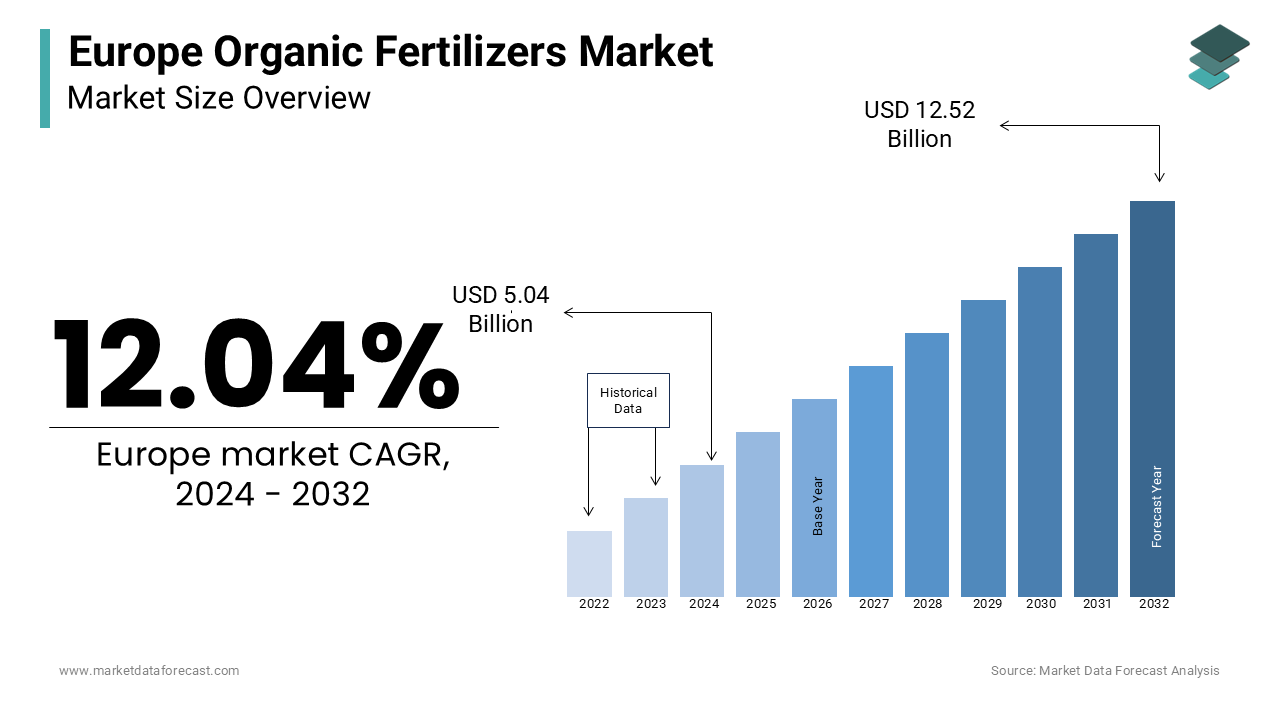
The European organic fertilizers market size was valued at USD 5.65 billion in 2025 and is anticipated to reach USD 6.33 billion in 2026 and USD 15.72 billion by 2034, growing at a CAGR of 12.04% during the forecast period from 2026 to 2034.

The organic fertiliarerient nutrient-rich inputs derived from plant, animal, or mineral origins that enhance soil fertility without synthetic chemical intervention. These include compost, manure, bomealmea, and bio-based formulations aligned with sustainable agronomic principles.
The organic fertilizer uptake by mandating reduced reliance on synthetic agrochemicals is leveraging the growth ofEuropeanurope organic fertilizers market. Germany’s 2020 Fertilizer Ordinance imposes strict nitrogen caps in water protection zones, compelling farmers to adopt slow-release organic nutrients. These measures are reinforced through financial incentives and penalties, creating a regulatory pull that transcends voluntary adoption.
Consumer behavior across Europe increasingly favors organic food, driving downstream demand for certified organic inputs, which will additionally fuel the growth of Europe's organic fertilizers market. EU Organic Regulation 2018/prohibits the use of 848 synthetic nitrogen fertilizers,ited necessitating the use of approved organic nutrient sources. Major retailers like Carrefour and Aldi have expandeprivate-labelel organic lines, institutionalizing consistent input demand.
The organic fertilizers suffer from significant cost disadvantages due to fragmented production and labor-intensive processing, which is restricting the growth of Europeanrope organic fertilizers market. Quality control to meet EU organic standards further increases expenses due to variable feedstock composition. Lower nutrient density also necessitates larger application volumes, raising transport costs.
The variable nutrient profiles and slow-release kinetics of organic fertilizers undermine their reliability in precision farming systems, which is hampering the growth of Europeanrope organic fertilizers market. This complicates compliance with the EU Nitrates Directive, which requires accurate nutrient accounting. Although certification bodies mandate composition documentation, enforcement remains inconsistent across member states.
The EU Circular Economy Action Plan enables the transformation of organic waste into certified fertilizers under the Fertilising Products Regulation 2019/, which1009 is ascribed to boost the growth of Europe's organic fertilizers market. CE marking now allows cross-border trade, eliminating previous national barriers.
The digital agronomic tools are overcoming historical limitations of organic fertilizers through real-time monitoring and site-specific application, which is also expected to elevate the growth of Europeanrope organic fertilizers market. Portable spectrometers from firms like AgroCares enable on-farm soil nutrient analysis within minutes, facilitating tailored organic prescriptions.
The physical characteristics of organic fertilizers impose severe logistical constraints across the European supply chain, additionally hindering the growth of Europeanrope organic fertilizers market. Moist bulky materials like slurry, compost, and digestate degrade rapidly during storage. Transport inefficiencies are acute as organic fertilizers have 60 to 70 % lower nutrient density, requiring 2.5 to 3 times more truckloads per hectare. Mountainous regions such as the Alps face seasonal access limitations, exacerbating delivery risks. The lack of standardized bulk handling equipment forces manual spreading, reducing uniformity.
The national divergences in organic fertilizer certification are acting as a barrier for the growofe f Europeanrope organic fertilizers market. Novel inputs like insect frass or algae extracts lack unified approval pathways, leaving innovators in regulatory uncertainty.
| REPORT METRIC | DETAILS |
| Market Size Available | 2025 to 2034 |
| Base Year | 2025 |
| Forecast Period | 2026 to 2034 |
| CAGR | 12.04% |
| Segments Covered | By Source, Crop Type, Form, And Country |
| Various Analyses Covered | Regional & Country Level Analysis, Segment-Level Analysis, DROC, PESTLE Analysis, Porter’s Five Forces Analysis, Competitive Landscape, Analyst Overview of Investment Opportunities |
| Regions Covered | UK, France, Spain, Germany, Italy, Russia, Sweden, Denmark, Switzerland, Netherlands, Turkey, Czech Republic, and the Rest of Europe |
| Market Leaders Profiled | Tata Chemicals Ltd (India), The Scotts Miracle-Gro Company (U.S.), Coromandel International Limited (India), National Fertilizers Limited (India), and Krishak Bharati Cooperative Limited (India). Other significant players include Midwestern BioAg (U.S.), Italpollina SpA (Italy), and ILSA S.p.A (Italy), Perfect Blend, LLC (U.S.), and Sustane Natural Fertilizer, Inc. (U.S.). |
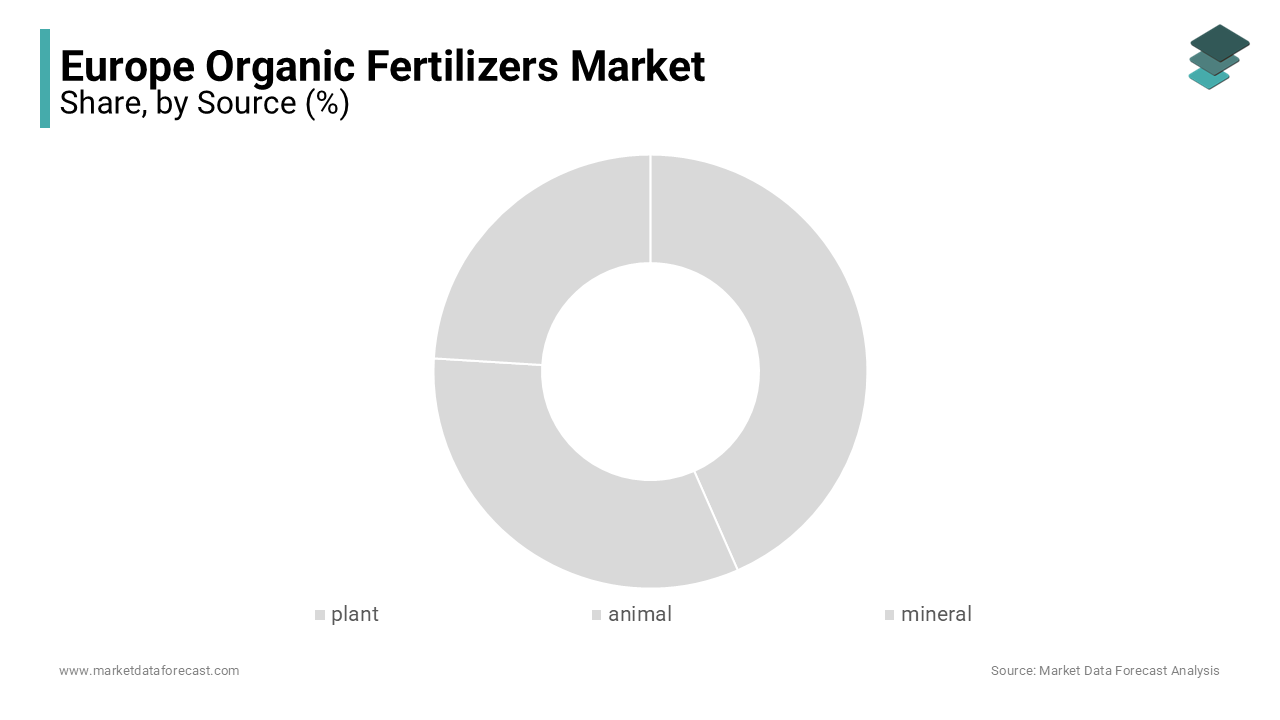
The plant-based segment was the largest by capturing 42.3% of Europeanrope organic fertilizers market share in 2025, with plant-derived organic fertilizers primarily propelled by EU policies that incentivize the reuse of agricultural residues and cover crops. This policy-driven circularity not only reduces waste but also ensures consistent quality and traceability, aligning with stringent EU organic certification standards. The scalability of plant sources such as alfalfa, fa seaw, eed, and vinasse from bioethanol production further cements this segment’s leadership.

The animal-derived fertilizers segmentely growlucratively ing with a CAGR of 6.8% during the forecast period, with integrated livestock crop systems and advanced manure processing technologies. Furthermore, the EU’s Nitrates Directive revision in 2022 encourages closed-loop nutrient cycling on livestock farms, reducing ammonia emissions by up to 30 % when using acidified slurry. These regulatory and technological synergies are transforming manure from a waste liability into a high-value nutrient stream, fueling rapid segment expansion.
The fruits and vegetables segment accounted in holding 48.2% of Europeanrope organic fertilizers market share in 2024 due to the premium value of horticultural produce and stringent retailer requirements for residue-free certification. Major supermarket chains, including Edeka in Germany and Carrefour in France, require suppliers to use certified organic inputs as part of their private label sustainability protocols.
The Oilseeds and pulses segment is expected to grow with a significant CAGR of 9.2% during the forecast period, with EU protein independence strategies and legume integration in crop rotations. These crops fix atmospheric nitrogen but still require phosphorus, potassium, and micronutrients best supplied through organic amendments like bone meal or composted manure. The EU’s Green Deal Industrial Plan identifies plant-based proteins as strategic for food security, reducing reliance on imported soy. Additionally, the rising demand for organic plant-based meat and dairy alternatives has spurred investment in pulse value chains, with companies like Oatly and Alpro sourcing certified organic ingredients.s
The dry form segment was the largest and held 32.1% of Europeanrope organic fertilizers market share in 2024. Dry organic fertilizers dominate due to their logistical advantages and seamless integration into conventional farming infrastructure. Granulated compo, st poultry manure pellets, and bone meal can be stored for over 12 months without significant nutrient loss, unlike liquid variants, which degrade within weeks. The EU Fertilising Products Regulation CE marking has standardized dry product labeling, enabling bulk trading across borders.
The liquid segment is anticipated to grow with an expected CAGR of 6.4% from 2025 to 2033 due to its compatibility with precision fertigation systems and rapid nutrient availability. Liquid digestate and fish emulsion can be injected directly into irrigation lines, enabling real-time nutrient delivery aligned with crop growth stages.
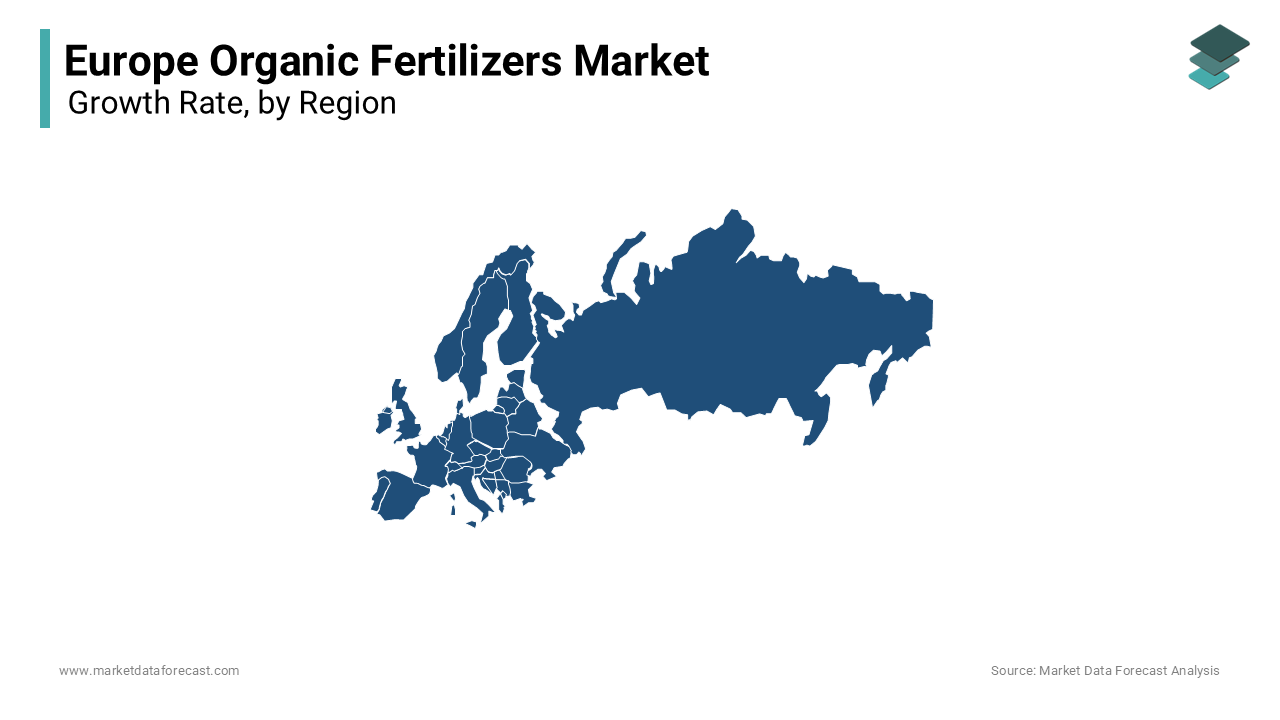
Germany was the top performer of Europeanrope organic fertilizers market by holding 22.3% of the share with its robust organic farming infrastructure and stringent environmental legislation. Retail demand is equally strong, with organic food sales reaching 15.9 billion euros in 2022 per FiBL. This policy of consumer and infrastructure synergy positions Germany as the undisputed market leader.

France was ranked second by occupying 19.2% of Europeanrope organic fertilizers market with its vast agricultural base and aggressive agroecological transition policies. France is also Europe’s top producer of organic wine and fruits, creating consistent demand for plant-based fertilizers like vinasse and composted pomace. The integration of organic fertilizers into national climate adaptation strategies ensures sustained growth.
Spain's organic fertilizers market growth is driven by its dominance in organic horticulture and a favorable Mediterranean climate for composting. Water scarcity has also driven the adoption of organic matter to improve soil water retention, with trials in Murcia showing a 25 % reduction in irrigation needs when using compost as per the Centre for Edaphology and Applied Biology.
Italy's organic fertilizers market growth is driven by its strong organic food culture and diversified farming systems. Italy is Europe’s largest producer of organic wine, tomatoes, and durum wheat, creating steady demand for tailored organic inputs.
The European organic fertilizers market features a moderately fragmented competitive landscape characterized by a mix of specialized regional producers and multinational agribusinesses expanding into bio-based solutions. Competition is primarily driven by product differentiation, regulatory compliance, and supply chain integration rather than price alone. Established players leverage advanced processing technologies such as pelletization, anaerobic digestion, and microbial enhancement to ensure consistent nutrient profiles and shelf stability. New entrants often focus on niche segments like seaweed extracts or insect frass but face barriers related to certification and scale. The absence of harmonized national standards and EU-level regulations creates both complexity and opportunity for agile firms.
A few of the market players in thEuropeanpe organic fertilizers market include
Key players in the European organic fertilizers market primarily adopt strategies centered on vertical integration,n product innovation, and regulatory compliance. Companies are investing in proprietary composting and anaerobic digestion facilities to secure a consistent raw material supply and ensure traceability. Strategic partnerships with agricultural cooperatives and biogas plants enable closed-loop nutrient systems aligned with circular economy principles. Product portfolios are being enhanced through bio-stimulation technologies such as microbial inoculants and enzymatic hydrolysates to improve nutrient efficiency. Firms are also pursuing CE certification under the EU Fertilising Products Regulation to facilitate cross-border trade.
This market research report on Europeanrope organic fertilizers market is segmented and sub-segmented into the following categories.
By Source Type
By Crop Type
By Form
By Country
Frequently Asked Questions
The EU’s Farm to Fork Strategy targets 25% organic farmland by 2030 and cuts synthetic fertilizer use by 20%, pushing farmers toward certified organic alternatives.
They release nutrients slower but improve long-term soil structure, water retention, and microbial health—making them ideal for sustainable crop rotation and regenerative farming.
Composted green waste, processed animal manure (e.g., poultry litter pellets), plant-based meals (like lupin or mustard cake), and emerging biochar blends.
Strict EC Regulation 2019/1009 governs “EU Fertilising Products,” requiring safety, traceability, and labeling—boosting trust but raising compliance costs for small producers.
Not yet—scaling production is limited by feedstock availability (e.g., clean organic waste) and permitting delays for composting/bio-processing facilities in some countries.
Germany, France, and the Netherlands lead in both production and use; Southern Europe (Spain, Italy) is rapidly adopting due to drought resilience benefits.
Yes—especially with precision application tech and blended formulations (e.g., organo-mineral fertilizers) that balance yield needs with soil health.
Through CAP (Common Agricultural Policy) eco-schemes, national subsidies, and premium prices for certified organic crops—plus reduced input costs over time.
Huge—food waste, agri-residues, and even sewage sludge (after strict treatment) are being upcycled into fertilizers, aligning with EU waste hierarchy goals.
Higher upfront cost, variable nutrient content, and lack of immediate yield response compared to synthetics—though education and demo farms are changing perceptions.
Related Reports
Access the study in MULTIPLE FORMATS
Purchase options starting from
$ 2000
Didn’t find what you’re looking for?
TALK TO OUR ANALYST TEAM
Need something within your budget?
NO WORRIES! WE GOT YOU COVERED!
Call us on: +1 888 702 9696 (U.S Toll Free)
Write to us: sales@marketdataforecast.com
Reports By Region