- Product Description Description
- Table of Contents TOC
- List of Table & Figure LOT
- Get Free Sample PDF Sample PDF
Market Size, 2025
$262.68 MnMarket Estimate, 2026
$275.16 MnMarket Forecast, 2034
$398.86 MnCAGR, 2026–2034
4.75%Europe Organic Rankine Cycle Market Size, Growth, Trends & Forecast (2026–2034)
The Europe organic Rankine cycle market size was calculated to be USD 262.68 million in 2025, is anticipated to be worth USD 275.16 million in 2026, and is projected to scale up to USD 398.86 million by 2034, registering a compound annual growth rate (CAGR) of 4.75% during the forecast period from 2026 to 2034. Driven by stringent EU industrial decarbonization mandates, energy efficiency directives, and a rising demand for clean energy conversion from low-to-medium-grade heat sources, Organic Rankine Cycle (ORC) technology is becoming a cornerstone for circular energy systems and waste heat valorization across the European continent.
Key Executive Metrics (At-a-Glance)
- 2025 Base Valuation: USD 262.68 Million
- 2026 Current Valuation: USD 275.16 Million
- 2034 Forecast Valuation: USD 398.86 Million
- Compound Annual Growth Rate (CAGR): 4.75% (2026–2034)
- Dominant Heat Source Segment: Waste Heat Recovery Segment (43.8% share in 2025)
- Fastest-Growing Heat Source Segment: Geothermal Energy Segment (CAGR of 12.8%, 2026–2034)
- Dominant Regional Market: Italy (21.4% share in 2025)
- Second-Largest Regional Market: Germany (18.7% share in 2025)
Core Market Drivers
- Stringent EU Industrial Decarbonization Mandates: The Industrial Emissions Directive and Energy Efficiency Directive elevate waste heat recovery and valorization into regulatory compliance necessities for energy-intensive sectors.
- Expansion of Geothermal & Biomass Projects: Growing regional focus on dispatchable renewable baseload sources creates steady technical synergies with ORC systems for efficient power conversion.
Primary Market Restraints & Challenges
- High Capital Intensity & Long Payback Periods: Substantial upfront investment costs create financial barriers, particularly for small and medium-sized industrial enterprises facing tight operating margins.
- Technical & Regulatory Complexities: Absence of universal design/interoperability standards, coupled with fluid degradation concerns and tightening environmental compliance restrictions (e.g., REACH guidelines), increases project risks.
Europe Organic Rankine Cycle Market Classification Breakdown
| Segment Category | Largest (Dominant) Segment | Fastest-Growing Segment |
|---|---|---|
| By Heat Source | Waste Heat Recovery (43.8% in 2025) | Geothermal Energy (CAGR: 12.8%) |
| By Region | Italy (21.4% in 2025) | Sweden, UK & Emerging Regional Hubs |
Major Industry Players Profiled
Key specialized thermodynamic engineering firms and energy systems leaders driving the European organic Rankine cycle market include Turboden S.p.A, Ormat Technologies, Exergy International Srl, Enertime, Bosch KWK Systeme, Againity AB, INTEC GMK, Zuccato Energia, Orcan Energy AG, Alfa Laval, Siemens Energy AG, Calnetix Technologies, Triogen, MAN Energy Solutions, Mitsubishi Heavy Industries, ABB Ltd, Atlas Copco AB, and Durr AG.
 Download Free Sample Report
Europe Organic Rankine Cycle Market Size
The Europe organic Rankine cycle market size was calculated to be USD 262.68 million in 2025 and is anticipated to be worth USD 398.86 million by 2034, growing from USD 275.16 million in 2026 at a CAGR of 4.75% during the forecast period.
The Organic Rankine Cycle (ORC) serves as a critical technology for converting low- to medium-grade heat into clean electricity. These systems are primarily integrated into industrial processes, geothermal installations, biomass combustion units, and concentrated solar power facilities across the European Union and associated nations. Unlike conventional steam cycles, the organic rankine cycle enables efficient power recovery from heat sources below three hundred degrees Celsius, making it uniquely suited for Europe’s diverse industrial and renewable energy landscape. According to multiple sources, a large amount of industrial energy consumption across the European Union is lost as recoverable waste heat, and only a small portion of this significant potential is currently captured or reused for other energy needs. The European Commission’s Industrial Emissions Directive and the Energy Efficiency Directive actively encourage waste heat valorization as a core decarbonization lever. Furthermore, the EU Taxonomy for Sustainable Activities classifies organic rankine cycle projects as environmentally sustainable when integrated with renewable or unavoidable waste heat streams. This regulatory endorsement, combined with rising carbon pricing, has intensified investment in organic rankine cycle technology as a strategic enabler of circular energy systems across the continent.
MARKET DRIVERS
Stringent EU Industrial Decarbonization Mandates Accelerate Waste Heat Recovery Adoption
European Union climate policy has systematically elevated waste heat recovery from an operational efficiency measure to a regulatory imperative, particularly for energy-intensive sectors, which contributes to the growth of the Europe organic rankine cycle market. The Industrial Emissions Directive requires large combustion plants and refineries to conduct Best Available Techniques assessments, which increasingly identify organic rankine cycle integration as a viable pathway to reduce specific emissions. The EU Emissions Trading System (EU ETS) covers a substantial number of large-scale industrial and power installations, with ongoing market analyses confirming that rising carbon prices align with market fundamentals and encourage emission reduction efforts. In response, companies such as ArcelorMittal and BASF have initiated pilot organic rankine cycle projects to convert exhaust gases from steelmaking and chemical reactors into onsite electricity. Data on the specific energy savings from the implementation of Organic Rankine Cycle (ORC) systems across German industrial facilities is not widely published in official government reports, but national efforts increasingly focus on general industrial energy efficiency and waste heat utilization to reduce emissions. Furthermore, the revised Energy Efficiency Directive (EED) indeed requires EU member states to develop comprehensive assessments and national plans for identifying and utilizing waste heat potentials, building upon existing initiatives and extensive prior research, such as the Heat Roadmap Europe projects. This top-down regulatory architecture transforms organic rankine cycle technology from a discretionary investment into a necessary component of industrial decarbonization compliance across Europe.
Expansion of Geothermal and Biomass Energy Projects Creates Dedicated Heat Source Infrastructure
The region’s renewable energy transition is increasingly reliant on dispatchable sources such as geothermal and biomass, which inherently produce consistent thermal output ideal for ORC integration, and thereby fuels the expansion of the Europe organic rankine cycle market. There is an observable upward trend in geothermal energy production across the European Union, characterized by a concentration of new facility developments in specific Western and Southern member states. The thermal profiles of emerging geothermal projects frequently fall within a specific medium-temperature range, creating a technical synergy with systems designed for low-to-moderate heat recovery. A notable shift in biomass facility management involves the integration of secondary power modules into existing combined heat and power plants to enhance energy conversion rates. Operational strategies for these retrofitted biomass plants prioritize increasing electrical output while maintaining consistent levels of raw material consumption. In regions with high geothermal dependency, there is a clear transition toward binary plant configurations for nearly all new infrastructural developments. Transnational policy frameworks are increasingly fostering an environment conducive to renewable baseload power through targeted financial support for thermal conversion technologies. Financial mechanisms are being directed toward projects that demonstrate advanced conversion capabilities, reinforcing the role of thermal renewables in the broader energy transition. This convergence of resource availability,y policy support, and technical suitability positions geothermal and biomass as stable and growing deployment platforms for organic rankine cycle systems across Europe.
MARKET RESTRAINTS
High Capital Intensity and Long Payback Periods Deter Widespread Industrial Implementation
The substantial upfront investment required for ORC systems remains a critical barrier, particularly for small and medium industrial enterprises, which in turn restricts the growth of the Europe organic rankine cycle market. This is despite regulatory encouragement. The installation cost per megawatt is observed to vary based on the complexity of integrating the heat source and the specific working fluid utilized, as per sources. For industries operating on a thin margin,s such as cement or glass manufacturing, this capital outlay translates into payback periods exceeding several years even with energy savings. A consistent trend has emerged where a minority of eligible industrial waste heat initiatives secure complete financing, with perceived risks and limited asset collateral value often cited as contributing factors. In regions characterized by restricted access to affordable green financing, such as Southern Europe, the adoption rate of specific thermal recovery technologies in non-utility industrial settings is notably lower, reflected in fewer recorded installations within those areas. This financial friction prevents scalable replication even where technical feasibility is proven, thereby limiting market penetration to large corporates with internal capital allocation flexibility or access to EU structural funds.
Lack of Standardized Integration Protocols Increases Engineering Complexity and Risk
The absence of universal design and interoperability standards for ORC systems introduces significant engineering uncertainty during retrofitting into existing industrial or energy infrastructure, which remains a barrier to the Europe Rankine Cycle market. Each installation requires custom engineering to match heat source temperature profile, flow rate and chemical composition with turbine sizing, working fluid selection, and control logic. Standardized technical guidelines have not been developed for the integration of energy recovery systems with typical industrial exhaust streams, such as those found in material production facilities. The absence of these standardized specifications means that the integration of energy recovery systems requires project-specific design. This requirement for customization typically extends the overall development schedules for projects, as initial assessments and planning stages are prolonged. Moreover, fluid selection involves trade-offs between efficiency, flammability, and environmental impact, with newer low global warming potential fluids often lacking long term operational data. Such technical unpredictability discourages risk-averse operators from adopting the technology despite favorable energy economics, thereby constraining market scalability across diverse European thermal sources.
MARKET OPPORTUNITIES
Repurposing of Decommissioned Fossil Fuel Infrastructure Offers Low-Cost Deployment Vectors
The region’s accelerating phase out of coal and aging gas plants offers a new opportunity to retrofit existing thermal infrastructure with ORC systems using residual heat or hybrid renewable inputs, which is anticipated to boost the growth of the Europe organic rankine cycle market. Observations indicate a pattern of repurposing industrial infrastructure, specifically former coal power generation sites, which retain valuable assets like grid interconnection and steam piping. A pilot program has commenced to convert retired coal units into geothermal energy hubs using local water sources for heat, suggesting that repurposing existing infrastructure offers substantial capital savings compared to new construction. Evaluations are also underway for deploying biomass-fueled energy systems on industrial land, leveraging existing heat distribution networks. The EU has allocated funds to support such thermal repurposing initiatives in coal-dependent regions. This strategy transforms stranded assets into clean energy platforms while minimizing land use and permitting delays, offering a pragmatic and economically attractive pathway for organic rankine cycle scale up acrosspost-fossill Europe.
Integration with Hydrogen and Green Steel Production Unlocks High-Grade Waste Heat Streams
Emerging industrial decarbonization pathways such as green hydrogen electrolysis and hydrogen-based steelmaking generate significant medium temperature waste heat ideal for ORC recovery, which creates fresh prospects for the Europe organic rankine cycle market. Contemporary electrolyzer technologies typically generate a consistent stream of heat as a byproduct of their operation. This thermal output is often released into the surrounding environment when local requirements for low-grade heat are absent. Industry planning indicates a substantial expansion of electrolysis infrastructure within the region. This anticipated scale-up suggests a significant opportunity for annual heat recovery. Similarly, hydrogen direct reduced iron plants like HYBRIT in Sweden operate at five hundred to seven hundred degrees Celsius,s but still yield substantially lower grade exhaust suitable for organic rankine cycle integration. An industrial research and development project has incorporated an organic Rankine cycle unit to produce auxiliary power from cooling circuits. The potential use of organic rankine cycle technology in European steel manufacturing appears substantial, indicating numerous future installation locations as the sector moves toward lower emissions. This synergy between next-generation clean industry and thermal recovery positions organic rankine cycle technology as a critical enabler of energy circularity in Europe’s net-zero industrial future.
MARKET CHALLENGES
Fluid Degradation and Environmental Compliance Risks Undermine Long-Term Operational Viability
The long term reliability of ORC systems is challenged by the chemical stability of working fluids when exposed to real-world heat source impurities over extended operational cycles, which limits the growth of the Europe organic rankine cycle market. Many high-efficiency fluids, such as hydrofluoroolefins or siloxanes, can degrade when trace contaminants like sulfur, nitrogen oxides, or particulates are present in industrial exhaust streams, leading to acid formation, turbine corrosion, and efficiency decay. Furthermore, the European Chemicals Agency has tightened restrictions on certain fluorinated fluids due to persistence and toxicity concerns, potentially rendering installed systems non-compliant with future REACH regulations. These technical and regulatory uncertainties increase lifecycle risk and deter operators from committing to long-term organic Rankine cycle investments despite initial performance promises.
Fragmented Grid Access and Ancillary Service Compensation Limit Revenue Streams
ORC projects in the region often face constrained economic viability due to limited grid integration pathways and insufficient compensation for grid balancing services, which acts as a major obstacle to the Europe organic rankine cycle market. The majority of generation units fall within an operational range that presents a challenge for clear market classification, making them simultaneously too small for participation in major markets and too large for simplified local metering schemes. A notable trend is the limited compensation provided for auxiliary services, such as grid stability support, despite the technical ability of specific distributed generation facilities to offer these dispatchable services. In some regions, the administrative processes for connecting generation facilities below a certain capacity to the main network are experiencing significant delays, leading to extended wait times. Regulatory shifts indicate a movement away from fixed, long-term payment structures for electricity derived from certain processes, causing project revenues to become entirely subject to the fluctuating dynamics of the open electricity market. Fragile economics for ORC deployment persist in Europe due to inconsistent ancillary revenues and complex interconnection, limiting expansion despite abundant heat sources.
REPORT COVERAGE
| REPORT METRIC | DETAILS |
| Market Size Available | 2025 to 2034 |
| Base Year | 2025 |
| Forecast Period | 2026 to 2034 |
| CAGR | 4.75% |
| Segments Covered | By Heat Source, And Region |
| Various Analyses Covered | Global, Regional & Country Level Analysis; Segment-Level Analysis; DROC, PESTLE Analysis; Porter’s Five Forces Analysis; Competitive Landscape; Analyst Overview of Investment Opportunities |
| Regions Covered | UK, France, Spain, Germany, Italy, Russia, Sweden, Denmark, Switzerland, Netherlands, Turkey, and the Czech Republic |
| Market Leaders Profiled | Turboden S.p.A, Ormat Technologies, Exergy International Srl, Enertime, Bosch KWK Systeme, Againity AB, INTEC GMK, Zuccato Energia, Orcan Energy AG, Alfa Laval, Siemens Energy AG, Calnetix Technologies, Triogen, MAN Energy Solutions, Mitsubishi Heavy Industries, ABB Ltd, Atlas Copco AB, Durr AG |
SEGMENTAL ANALYSIS
By Heat Source Insights
The waste heat recovery segment led the Europe organic rankine cycle market by accounting for a 43.8% share in 2025. The leading position of the waste heat recovery segment is attributed to the vast availability of industrial thermal streams and strong policy alignment with circular economy objectives. Large-scale manufacturing sectors, particularly those focused on primary material processing, represent a significant proportion of the available thermal energy currently lost during production. Industrial thermal byproducts, such as flue gases and cooling circuit outputs, provide consistent temperature ranges that are well-suited for secondary power generation technologies. The thermal output from heavy industries offers a more stable energy profile compared to the fluctuations often associated with certain renewable energy platforms. Thermal recovery systems are being integrated into various industrial facilities to transform high-temperature exhaust into supplemental electricity for on-site operations. The adoption of specialized heat-to-power cycles is increasingly observed at sites with continuous high-temperature thermal discharge to mitigate reliance on the external energy network.s This vast and underutilized thermal reservoir ensures that waste heat recovery remains the dominant deployment vector for organic rankine cycle systems across Europe. Regulatory requirements have established a recurring cycle for energy assessments within major organizations. Within these assessments, the capture and utilization of heat that would otherwise be lost is frequently identified as a primary strategy for achieving economic efficiency. There is an observable trend toward recommending the integration of specific thermodynamic cycles for the conversion of waste heat into power. The rising financial implications associated with carbon emissions are creating a stronger economic incentive for businesses to generate their own power from previously unused thermal energy sources. Financial support mechanisms established at the national level are reinforcing this shift by providing dedicated funding for projects that convert waste heat into electricity. This multi-layer policy ecosystem transforms organic rankine cycle deployment from a discretionary efficiency upgrade into a strategic compliance and competitiveness tool for European industry.
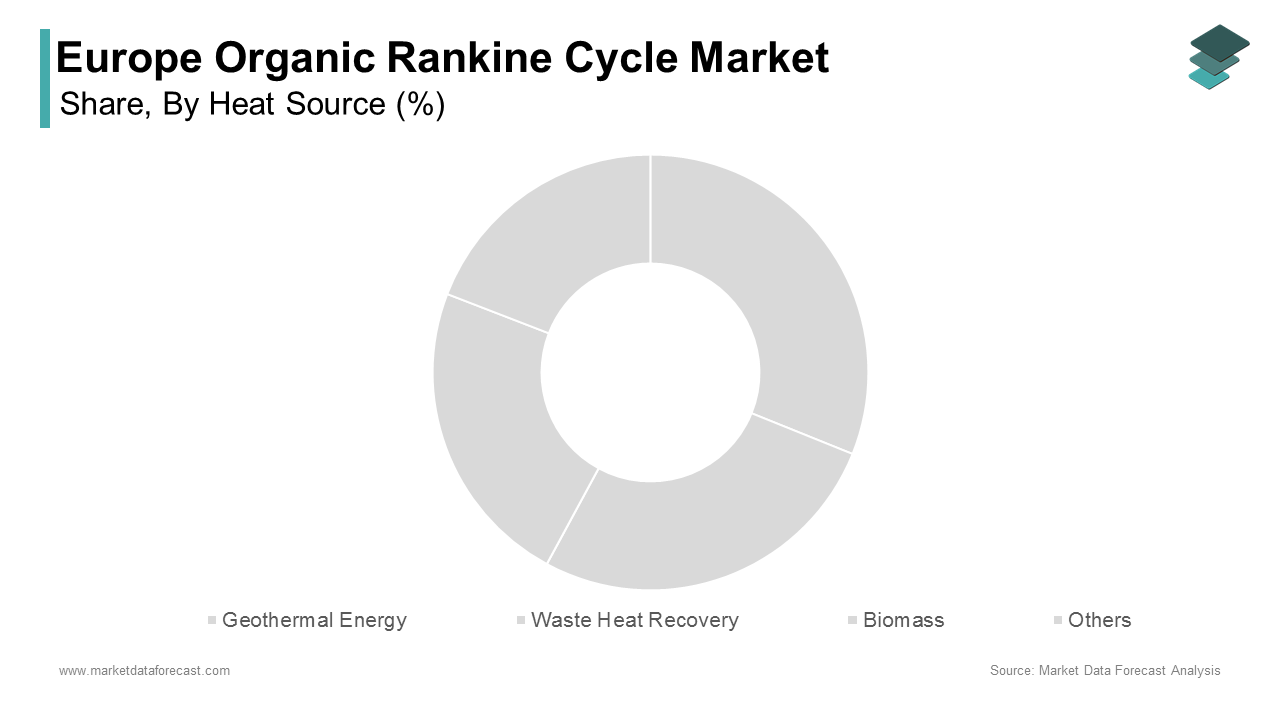
The geothermal energy segment is expected to exhibit a noteworthy CAGR of 12.8% from 2026 to 2034 due to baseload renewable demand and deep decarbonization strategies. Europe's move to eliminate fossil fuel peaker plants is accelerating interest in geothermal resources as a stable, weather-independent source of renewable electricity. The European Commission’s Net Zero Industry Act explicitly lists geothermal energy as a strategic clean tech sector eligible for streamlined permitting and state aid. Financial support from regional innovation funds has been directed toward the development of binary geothermal facilities utilizing advanced thermodynamic cycles within several European nations. Geothermal electricity production has demonstrated a notable upward trajectory, characterized by a substantial increase in total output. A significant majority of the newly established generation capacity relies on specific energy conversion systems designed for efficiency in varied thermal conditions. The widespread adoption of these systems is attributed to their technical suitability for extracting energy from resources with lower heat intensities. The shift toward these technologies reflects a strategic focus on diversifying geothermal energy applications through enhanced compatibility with diverse geological profiles. Countries are now developing district heating integrated power plants that use the same thermal source for both heating and electricity, maximizing resource efficiency. This policy-driven recognition of geothermal’s dual role in power and heat decarbonization accelerates organic rankine cycle deployment in regions with moderate geothermal potential previously considered subeconomic. Innovations in enhanced geothermal systems and directional drilling have significantly lowered exploration risk and capital intensity. A consistent downward shift has been observed in the economic benchmarks for establishing new power generation facilities that utilize a specific heat cycle technology. The general trend indicates an increase in the adoption rate of advanced plant designs within regions that already rely heavily on geothermal resources. A significant majority of new capacity additions are incorporating specific working fluids and achieving improved operational efficiency metrics. Across the industry, a pattern has emerged toward using modular equipment that allows for scalable deployment strategies, which helps in managing initial investment and risk. These technological and financial optimizations are unlocking geothermal potential across Central and Eastern Europe, where previously only high enthalpy sites were viable, thereby positioning geothermal as the highest growth heat source for organic rankine cycle systems in the European context.
REGIONAL ANALYSIS
Italy Organic Rankine Cycle Market Analysis
Italy dominated the Europe Organic Rankine Cycle market and captured a 21.4% share in 2025. The supremacy of the Italian market is credited to its century-long exploitation of geothermal resources in Tuscany, where significant megawatts of geothermal capacity operate primarily through Organic Rankine Cycle binary plants. This reflects its geothermal leadership and industrial thermal activity. Enel Green Power alone manages over sixty organic rankine cycle units across Larderello and Mount Amiata fields. Beyond geothermal, the country’s dense network of cement, steel, and ceramic manufacturers generates substantial waste heat. There has been an increase in the number of commissioned industrial organic Rankine cycle installations in recent periods. In addition, the prevalence of waste heat to power projects has been supported by a specific incentive scheme. This energy policy support translates to significant financial backing provided for thermal recovery initiatives. The policy framework, therefore, encourages greater adoption of technologies that convert waste heat into power. Furthermore, Italy’s seismic activity provides extensive low-enthalpy resources suitable for small-scale organic rankine cycle deployment in district heating networks. This unique combination of natural endowment, industrial structure, and targeted policy ensures Italy’s continued leadership in both installed base and new project pipeline across the European organic rankine cycle landscape.
Germany Organic Rankine Cycle Market Analysis
Germany followed closely in the Europe organic rankine cycle market and held a 18.7% share in 2025. The growth of the German market is driven by its industrial base and energy transition imperatives. Its strength lies in waste heat recovery from its extensive manufacturing and chemical sectors, with BASF, ThyssenKrupp, and Siemens Energy all operating pilot and commercial organic rankine cycle systems. The country hosts numerous industrial organic Rankine cycle installations. The Renewable Energy Sources Act includes provisions for feed-in premiums for electricity from unavoidable waste heat, supporting project economics. An increase has been observed in the commissioning of geothermal power plants in the southern and western regions of the country. These new facilities utilize deep underground water sources with elevated temperatures. A significant sum of funding has been allocated by a national development bank to support projects focused on capturing and reusing heat within industrial sectors. This dual focus on industrial decarbonization and renewable baseload ensures Germany remains a core market for organic rankine cycle technology deployment and innovation.
France Organic Rankine Cycle Market Analysis
France continues to be a major player in the Europe rankine cycle market because of nuclear waste heat utilization and biomass integration. It leverages its extensive nuclear fleet, which generates low-grade waste heat at over fifty sites suitable for organic rankine cycle integration. There is an observed shift in the approach to industrial thermal discharge, with the establishment of a systematic process to catalog high-temperature emissions across key facilities. A specific group of major energy production locations has been designated as initial focus areas for this new thermal mapping initiative. The established agricultural and forestry industries across different regions support numerous operational ORC facilities that use biomass as a fuel source. There is a clear pattern of financial incentives being directed towards projects focused on recovering and repurposing waste heat. One notable example of the funded initiatives includes a large-scale biomass ORC installation in a key region, indicating the tangible application of these financial programs. Research institutions like CEA and IFP Energies Nouvelles are developing next-generation working fluids optimized for French thermal profiles. This strategic diversification across nuclear residual heat, biomass, and emerging geothermal resources positions France as a technologically versatile and policy supportive market for organic rankine cycle expansion.
Sweden Organic Rankine Cycle Market Analysis
Sweden is steadily growing in the Europe organic rankine cycle market owing to its pioneering role in green steel and district heating integration. Its ORC deployment is uniquely tied to its fossil-free industrial agenda, with the HYBRIT and H2 Green Steel initiatives generating significant medium temperature waste heat from hydrogen-based direct reduction processes. A number of demonstration projects focused on recovering heat from industrial processes, such as electrolysis and steel cooling circuits, have been initiated. The prevalence of extensive district heating networks in urban areas provides effective thermal sinks, enabling the integration of cogeneration plants utilizing organic rankine cycles. Several operational units leveraging biomass or waste incineration within these district heating systems are currently in use, with heat-to-power ratios adjusted to meet local requirements. Funding has been specifically allocated for endeavors aimed at enhancing thermal recovery within the heavy industry sector. This fusion of industrial decarbonization infrastructure and heat utilization policy makes Sweden a high-value niche market with exceptional growth potential for advanced organic rankine cycle applications.
United Kingdom Organic Rankine Cycle Market Analysis
The United Kingdom is likely to expand in the Europe organic rankine cycle market during the forecast period due to waste-to-energy and geothermal exploration. Moreover, the UK’s ORC market centers on energy from waste facilities where many plants utilize the technology to boost electrical output from flue gas between two hundred and four hundred degrees Celsius. Moreover, the UK is reviving geothermal ambitions with projects in Cornwall leveraging abandoned tin mines as heat reservoirs. A recent project has successfully operationalized a medium-scale organic Rankine cycle (ORC) unit for geothermal power generation. This marks the first instance of such a unit being commissioned for this application within a significant timeframe, indicating a re-emergence of this technology. Government funding mechanisms are now explicitly supporting thermal recovery and integration of technologies like ORC within district heating frameworks. A notable amount of funding has been specifically allocated to accelerate the deployment of these heat network systems. The inclusion of ORC as an eligible technology within these funding guidelines indicates a strategic shift towards utilizing this specific approach for enhanced energy recovery. Despite regulatory uncertainty post Brexit, the UK’s focus on non-wind solar renewables and circular waste management sustains steady demand for organic rankine cycle systems, particularly in decentralized and thermal-intensive applications.
COMPETITION OVERVIEW
The Europe organic Rankine cycle market features a specialized competitive landscape dominated by engineering firms with deep thermodynamic expertise rather than mass manufacturers. Competition centers on system efficiency, integration complexity, and lifecycle reliability rather than unit cost alone. Established players like Exergy Turboden and Ormat leverage decades of field data to optimize designs for specific heat sources such as cement kilns, geothermal brines, or biomass combustion. New entrants face high barriers due to the need for custom engineering certification and long sales cycles tied to industrial capital budgets. Collaboration is common with technology providers partnering with EPC contractors, grid operators, and research institutes to de-risk projects. Regulatory alignment is critical as eligibility for EU green financing often dictates project viability. While the market remains niche, its strategic importance in industrial decarbonization and renewable baseload power ensures intense focus on innovation, performance, and policy responsiveness among participants across Europe.
KEY MARKET PLAYERS
A few major players of the Europe organic rankine cycle market include
- Turboden S.p.A
- Ormat Technologies
- Exergy International Srl
- Enertime
- Bosch KWK Systeme
- Againity AB
- INTEC GMK
- Zuccato Energia
- Orcan Energy AG
- Alfa Laval
- Siemens Energy AG
- Calnetix Technologies
- Triogen
- MAN Energy Solutions
- Mitsubishi Heavy Industries
- ABB Ltd
- Atlas Copco AB
- Durr AG
Top Strategies Used by the Key Market Participants
Key players in the Europe organic rankine cycle market pursue vertical integration by offering end-to-end solutions from feasibility studies to operation and maintenance. They invest heavily in proprietary turbine and working fluid technologies to enhance thermodynamic efficiency and environmental compliance. Strategic partnerships with industrial emitters, geothermal developers, and district heating operators secure long-term project pipelines. Companies actively align product development with European Union sustainability frameworks, including the EU Taxonomy and Industrial Emissions Directive. Geographic diversification within Europe focuses on countries with supportive regulatory schemes and high waste heat or geothermal potential to mitigate regional policy volatility.y
Leading Players in the Market
- Exergy SpA is an Italian engineering firm specializing in high-efficiency organic rankine cycle systems with a strong footprint across Europe and emerging markets in Asia and Latin America. The company is recognized for its proprietary Radial Outflow Turbine technology, which enhances thermodynamic efficiency, particularly in geothermal and biomass applications. Exergy actively collaborates with European research institutions to develop low global warming potential working fluids and modular plant designs. This project reinforces Exergy’s leadership in large-scale renewable thermal conversion and demonstrates its commitment to advancing closed-loop power generation aligned with EU sustainability standards.
- Ormat Technologies Inc contributes significantly to the Europe organic rankine cycle market through its integrated equipment and energy solutions business. Although headquartered in the United States, Ormat has executed over fifty projects across Europe, including geothermal plants in Germany and waste heat recovery systems for cement producers in Poland. The company leverages its global manufacturing scale to deliver standardized yet adaptable organic rankine cycle units with remote monitoring capabilities. Its initiative emphasizes Ormat’s strategy of targeting large industrial emitters seeking compliance with EU decarbonization mandates while expanding its service and maintenance network across Western Europe.
- Turboden SpA, a Mitsubishi Heavy Industries subsidiary headquartered in Italy, is a pioneer in biomass and geothermal organic rankine cycle technology with installations in over thirty countries. The company offers modular units ranging from one to ten megawatts, tailored for diverse thermal sources including industrial exhaust and solar thermal fields. Turboden emphasizes digital integration with its TurboLife monitoring platform, providing predictive maintenance and performance analytics. This project exemplifies the company’s focus on circular energy systems and strengthens its position in Northern Europe’s clean heat and power transition.
MARKET SEGMENTATION
This research report on the Europe organic rankine cycle market has been segmented and sub-segmented based on heat source and region.
By Heat Source
- Geothermal Energy
- Waste Heat Recovery
- Biomass
- Others
By Region
- UK
- France
- Spain
- Germany
- Italy
- Russia
- Sweden
- Denmark
- Switzerland
- Netherlands
- Turkey
- Czech Republic
- Rest of Europe