- Product Description Description
- Table of Contents TOC
- List of Table & Figure LOT
- Get Free Sample PDF Sample PDF
Market Size, 2025
$73.29 BnMarket Estimate, 2026
$79.74 BnMarket Forecast, 2034
$156.56 BnCAGR, 2026–2034
8.8%Global Waste Heat Recovery System Market Size
The global waste heat recovery system market was worth US$ 73.29 billion in 2025 and is anticipated to reach a valuation of US$ 156.56 billion by 2034 from US$ 79.74 billion in 2026, and it is predicted to register a CAGR of 8.8% 2026 to 2034.

MARKET SCENARIO
Waste heat recovery is a process of Heat Integration. It simply means reusing the heat energy that is otherwise to be disposed of into the air. Waste heat recovery methods include capturing and transferring the waste heat from gas and liquid to the system as energy. A waste heat recovery System helps in using waste heat, thus saving fuel and power consumption. Additionally, it helps reduce supercritical carbon dioxide (CO2) and other toxic gas emissions and helps minimize air pollution.
MARKET DRIVERS
Waste heat recovery systems are highly energy-efficient. They can produce on-site electricity and reduce overall operating costs by saving energy. Due to these factors, the waste heat recovery system market is expected to grow significantly during the forecast period.
The rankine cycle system and combined energy cycle system are the dominant segments of the global waste heat recovery system market's growth. The waste heat recovery system is highly applicable to petroleum refining, cement, chemicals, paper and pulp, district cooling, and other industries (food and beverages, metal refining, and glass). Europe will emerge as the largest Global Waste Heat Recovery System Market between 2024 and 2029. However, Asia-Pacific will also emerge as the fastest-growing global waste heat recovery system market.
The driving force of the waste heat recovery system market is energy conservation and the reduction of operational costs. In addition, industries' growing focus on reusing heat in other processes increases the demand for waste heat recovery technologies. The petrol refinery is vital in growing the waste heat recovery system market because of growing drilling activities. waste heat recovery system are used for refinement, catalytic treatment, and thermal cracking in the petroleum refinery sector.
The government's rising focus on energy conservation and reducing air pollution will drive the growth of the global waste heat recovery system market. The cement industry will also play a vital role in the growth of the global waste heat recovery system market. Many energy-intensive processes in the cement industry require a waste heat recovery system to reuse heat and save energy.
The Rankine cycle is the key driver of the global waste heat recovery system market.
It can reuse low-grade heat efficiently. Thus, the increasing demand for waste heat recovery systems to save energy, reduce costs, and reduce environmental pollution will drive the growth of the global waste heat recovery system market between 2024 and 2029.
MARKET RESTRAINTS
The major restraint on the global waste heat recovery system market's growth is the lack of efficient systems. In addition, the initial cost is huge, so companies are not ready to adopt them.
REPORT COVERAGE
| REPORT METRIC | DETAILS |
| Market Size Available | 2025 to 2034 |
| Base Year | 2025 |
| Forecast Period | 2026 to 2034 |
| Segments Covered | By Process, Application, End User, and Region. |
| Various Analyses Covered | Global, Regional & Country Level Analysis; Segment-Level Analysis, DROC, PESTLE Analysis, Porter’s Five Forces Analysis, Competitive Landscape, Analyst Overview of Investment Opportunities |
| Regions Covered | North America, Europe, APAC, Latin America, Middle East & Africa |
| Market Leaders Profiled | Siemens AG, Mitsubishi Heavy Industries, Ltd., General Electric, ABB, Boustead International Heaters, Forbes Marshall, Promec Engineering, Terrapin, Wood Plc (Amec Foster Wheeler), Climeon, BoschIndustriekessel GmbH, AURA GmbH & Co., Exergy S.p.A., IHI Corporation, and Others. |
SEGMENTAL ANALYSIS
By Process Insights
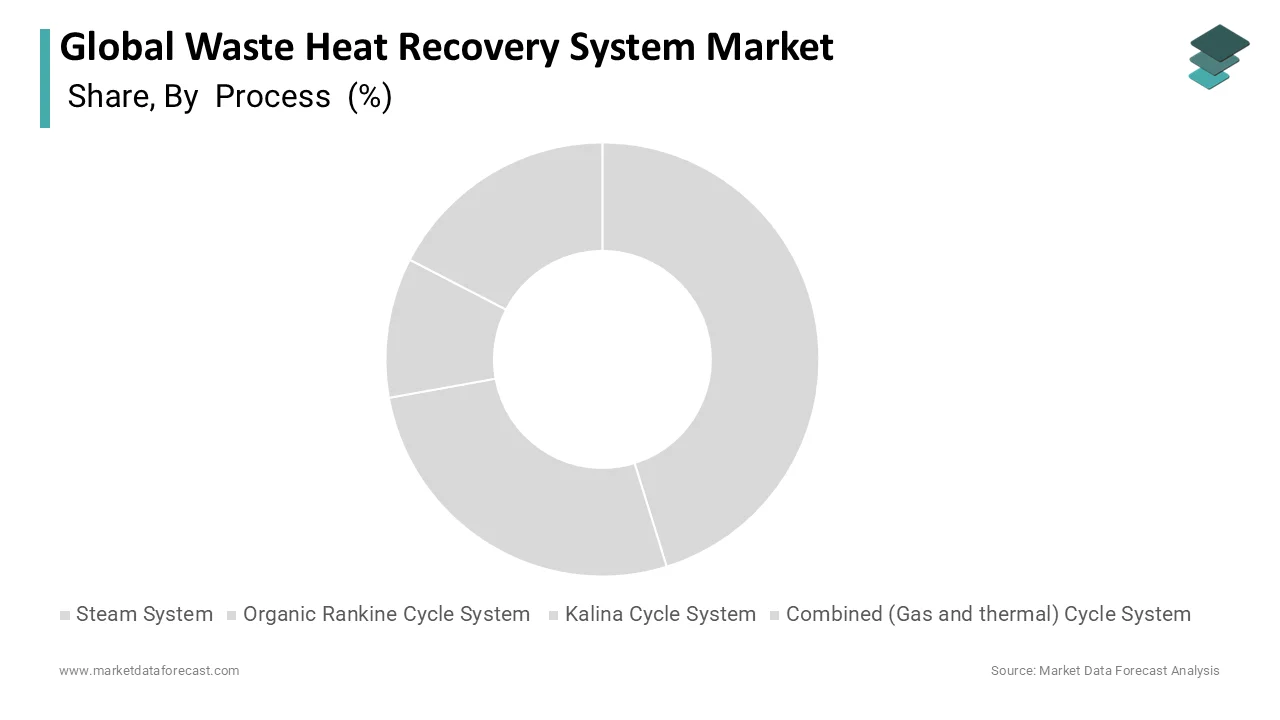
Based on Type, the global waste heat recovery system market is segmented into Steam Systems, Organic Rankine Cycle Systems, and Kalina Cycle Systems. The Rankine Cycle System is the dominant segment of the Waste Heat Recovery System because it converts thermal energy to mechanical work, commonly found in thermal energy power plants. Recently the rising focus on using the Rankine Cycle System to recover lower-grade waste heat drives the growth of the global waste heat recovery system market in the forecasted period between 2024 and 2029.
By Application Insights
Based on the application, the global waste heat recovery system market is segmented into preheating, steam, electricity, and other areas like space heating and chilling. Steam and electricity Generation is a dominant segment in the global waste heat recovery system market growth because of its growing global demand.
The pre-heating generators are likely to have the fastest growth between 2024 and 2029 because waste heat recovery system are majorly used for preheating combustion air, furnace loads, boiler feed water, furnace loads, and space heating.
By End Users' Insights
Based on the End users, the Waste Heat Recovery System is used in applications like Petroleum Refining, Metal Production, Cement, Chemical, Paper and Pulp, District Cooling, and others like Food and beverage, Glass, and Primary metal refining. Petroleum refinery is the dominant segment of the global waste heat recovery system market, and it is anticipated that Petroleum refinery will further expand the growth of the global waste heat recovery system market because of rising drilling activities.
The cement End-user segment is expected to play a significant role in the global waste heat recovery system market growth because of construction expansion. In addition, the increasing number of Plants fuels the growth of the global waste heat recovery system market in the forecasted period between 2024 and 2029.
REGIONAL ANALYSIS
North America region holds the largest market share of the global waste heat recovery system market. The United States will become the critical market for waste heat recovery solutions due to increasing investment in technical improvements to replace conventional systems. Additionally, the growing focus of the end-user industry on fuel efficiency and good economic return will drive future growth with a CAGR of 32% in the global waste heat recovery system market in the period between 2024 and 2029.
Europe is expected to hold the second-largest market share of the Global Waste Heat Recovery System. The increasing government initiatives to save energy and fuel by using waste heat recovery systems. Germany will become the largest contributor to this region because reducing toxic gas emissions drives the growth of the global waste heat recovery system market between 2024 and 2029.
Asia-Pacific is expected to become the fastest-growing global waste heat recovery system market with a CAGR of 10.2% because of the expansion of construction. In addition, India and China have started investing in construction, increasing the demand for waste heat recovery systems in the cement industry. Therefore, the cement industry will boost the growth future of the global waste heat recovery system market in this region.
KEY PLAYERS IN THE GLOBAL WASTE HEAT RECOVERY SYSTEM MARKET
Companies playing a prominent role in the global waste heat recovery system market include Siemens AG, Mitsubishi Heavy Industries, Ltd., General Electric, ABB, Boustead International Heaters, Forbes Marshall, Promec Engineering, Terrapin, Wood Plc (Amec Foster Wheeler), Climeon, BoschIndustriekessel GmbH, AURA GmbH & Co., Exergy S.p.A., IHI Corporation, and Others.
RECENT HAPPENINGS IN THE GLOBAL WASTE HEAT RECOVERY SYSTEM MARKET
- In November 2021, Mitsubishi Heavy Industries Environmental & Chemical Engineering Co., Ltd. (MHIEC) received an order from Sendai City to renovate its Matsumori Waste-to-Energy Plant (plant for burning municipal solid waste). The refurbishment of the Matsumori Waste-to-Energy Plant is to extend its service life, save energy, and reduce carbon dioxide emissions by 8% annually.
- The Renovation of stoker-type and related equipment will increase heat recovery, combustion and operation stability, and power generation ability.
- Siemens Energy and TC Energy Corporation agreed in February 2021 to construct an innovative waste heat-to-power pilot facility in Alberta, Canada. This innovative heat recovery is designed by Siemens and patented under Echogen Intellectual Property. This innovation helps capture waste heat from a gas turbine at pipeline compression and converts it into emission-free power. Heat recovery is based on an advanced Rankine Cycle and uses supercritical carbon dioxide (CO2) as the working fluid to convert waste heat into power.
MARKET SEGMENTATION
This research report on the global waste heat recovery system market has been segmented and sub-segmented into the following categories.
By Process
- Steam System
- Organic Rankine Cycle System
- Kalina Cycle System
- Combined (Gas and thermal) Cycle System
By Application
- Pre Heating
- Steam & Electricity Generation
- Others
- Space Heating
- Chilling
By End users
- Petroleum refining
- Metal production
- Cement
- Chemical
- Paper & pulp
- Others
By Region
- North America
- Europe
- Asia-Pacific
- Latin America
- Middle East and Africa