- Product Description Description
- Table of Contents TOC
- List of Table & Figure LOT
- Get Free Sample PDF Sample PDF
Market Size, 2025
$7.52 BnMarket Estimate, 2026
$7.96 BnMarket Forecast, 2034
$12.6 BnCAGR, 2026–2034
5.9%Executive Summary: Europe Oriented Strand Board (OSB) Market
- Market Scope: Comprehensive European oriented strand board industry analysis covering grade categories, end-user segments, country leadership frameworks, strategic corporate developments, and competitive landscapes.
- Market Valuation: Valued at USD 7.52 billion (2025), estimated at USD 7.96 billion (2026), and projected to reach USD 12.60 billion by 2034, registering a steady CAGR of 5.90% (2026–2034).
- Primary Growth Drivers: Accelerated adoption of timber frame construction (31% of new EU single-family dwellings), Nearly Zero Energy Building (NZEB) envelope standards, bio-based adhesive innovations, modular housing expansion, and the EU Renovation Wave Strategy. Restraints include softwood log supply volatility and stringent REACH formaldehyde emission regulations.
Key Market Segment Metrics (2026–2034)
| Category | Leading Segment (2025 Position) | Fastest-Growing Segment |
|---|---|---|
| By Grade | OSB/3 grade (dominated market with a 58.3% share in 2025 due to load-bearing humid conditions) | OSB/4 grade (projected to grow at a CAGR of 8.7% through 2033 via multi-story timber buildings) |
| By End-User Sector | Construction sector (largest end-user segment utilizing engineered wood panels) | Construction sector / Public social housing (registering fastest growth at 6.9% CAGR) |
| By Region / Country | Germany (led European market with 26.3% share in 2025 via modular housing plants and KfW subsidies) | France (RE2020 carbon compliance market) and Sweden (near-universal timber frame adoption) |
Major Market Players & Market Structure
Market Structure: Highly competitive European engineered wood panel sector driven by production line capacity expansions, carbon footprint-verified product lines, and investments in formaldehyde-free resin technologies to meet strict E1 emission standards.
Key Companies: Kronospan Limited, SWISS KRONO Group, Egger Group, Norbord Inc. (West Fraser), Sonae Industria, Arauco, Stora Enso Oyj, UPM-Kymmene Corporation, Binderholz GmbH, and Södra Wood Products.
Europe Oriented Strand Board Market Size
The Europe Oriented Strand Board Market is projected to grow from USD 7.52 billion in 2025 to USD 7.96 billion in 2026 and reach USD 12.60 billion by 2034, registering a CAGR of 5.90% from 2026 to 2034.
Oriented strand board is an engineered wood product formed by compressing layers of wood strands bonded with synthetic resins under heat and pressure, engineered for structural rigidity and dimensional stability. In Europe, oriented strand board serves as a critical material in residential and non-residential construction in flooring, sheathing, g-wall bracing, and roof decking applications. The European market operates under stringent environmental and performance standards, notably EN 300, which classifies oriented strand board into load-bearing and non-load-bearing grades based on moisture resistance and strength. According to Eurostat, the European Union consumed approximately 11.3 million cubic meters of structural wood panels in 2023, with oriented strand board representing a growing share due to timber shortages and rising demand for industrialized construction. This integration into low-carbon building practices aligns with the EU’s Renovation Wave Strategy, which targets a doubling of annual building renovation rates by 2030, indirectly reinforcing demand for efficient engineered wood solutions.
MARKET DRIVERS
Accelerated Adoption of Timber Frame Construction in Residential Buildings
The rapid expansion of timber frame construction across Western and Northern Europe for oriented strand board consumption, which is significantly boosting the growth of Europe oriented strand board market. This building method relies heavily on oriented strand board for structural sheathing due to its high-strength-to-weight ratio and ease of prefabrication. According to the European Federation of Woodworking Industries, timber frames accounted for 31% of all new single-family dwellings in the EU in 2023, up from 24% in 2019. In Sweden, over 85% of new houses are now built using timber frame systems with oriented strand board used in nearly all wall and roof assemblies, as per the survey. The material’s compatibility with off-site manufacturing also supports the EU’s Construction 2050 Alliance goals for industrialized building. Furthermore, national building codes in Finland and Austria now explicitly recognize oriented strand board as a load-bearing component in multi-story structures up to eight stories by expanding its application beyond low-rise housing. This regulatory endorsement, combined with contractor familiarity and supply chain maturity, ensures sustained demand irrespective of short-term market fluctuations in traditional materials.
Integration into Energy Efficient and Nearly Zero Energy Building Standards
Europe’s regulatory push toward nearly zero energy buildings has elevated oriented strand board as a key enabler of high-performance building envelopes. Its uniform density and air tightness contribute to thermal envelope integrity when used in structural insulated panels or as sheathing beneath exterior insulation. The integration into energy-efficient and nearly zero-energy building standards is also solely elevating the growth of Europe oriented strand board market. According to the European Commission’s Energy Performance of Buildings Directive implementation review, over 90% of new residential buildings in the EU must now comply with nearly zero energy standards as of 2021, requiring continuous insulation and minimal thermal bridging conditions, where oriented strand board excels. The Passive House Institute in Germany has certified more than 40,000 buildings using oriented strand board as part of their air barrier system, which is citing its low air permeability and dimensional stability under humidity variation. In France, the RE2020 environmental regulation mandates lifecycle carbon assessments for all new constructions, and oriented strand board’s low embodied energy, approximately 0.85 megajoules per kilogram,m makes it favorable over concrete or steel alternatives. Additionally, the material’s compatibility with wood fiber and mineral wool insulation allows seamless integration into low-carbon wall assemblies.
MARKET RESTRAINTS
Stringent Emissions Regulations on Formaldehyde and Adhesives
The European Union’s rigorous chemical safety framework imposes significant constraints on oriented strand board production through limits on formaldehyde emissions from bonding resins. The stringent emissions regulations on formaldehyde and adhesives are limiting the growth of Europe oriented strand board market. Under the E1 emission class mandated by EN 717 1, formaldehyde release must remain below 0.124 milligrams per cubic meter of air, a threshold that requires costly resin reformulation and continuous emission monitoring. According to the European Chemicals Agency, over 60% of small and medium-sized panel producers in Central and Eastern Europe incurred capital expenditures exceeding EUR 1.2 million between 2021 and 2023 to upgrade resin systems and install real-time air quality sensors. The EU’s REACH regulation further restricts the use of urea formaldehyde, historically the dominant binder, pushing manufacturers toward phenol formaldehyde or isocyanate-based alternatives that increase raw material costs by 18 to 25%, as per the European Panel Federation. These compliance burdens disproportionately affect regional mills with limited R and D budgets, reducing their competitiveness against larger integrated producers. Moreover, the European Commission’s 2025 proposal to classify formaldehyde as a substance of very great concern could trigger additional authorization requirements, further raising operational complexity.
Competition from Alternative Structural Panels and Material Substitution
Oriented strand board faces persistent substitution pressure from other engineered wood products and non-wood alternatives in specific applications. The competition from alternative structural plans is also declining the growth of Europe oriented strand board market. Plywood retains preference in moisture-prone environments such as roofing in Southern Europe due to its cross-laminated structure and historical code acceptance. According to the European Committee for Standardization, national deviations in France and Italy still favor plywood in certain structural applications despite EN 300 harmonization. Additionally, cement particle board and cross-laminated timber are gaining ground in mid-rise construction, where, supported by the EU’s New European Bauhaus initiative, is increasingly specified in public projects for their aesthetic and carbon sequestration benefits. In industrial flooring, steel deck systems remain dominant in Germany and the Netherlands due to fire resistance requirements. These material shifts reflect not only performance considerations but also evolving architectural preferences and public procurement criteria that prioritize visible timber or non-combustible solutions, thereby constraining oriented strand board’s expansion beyond its core sheathing niche.
MARKET OPPORTUNITIES
Expansion into Circular Construction and Bio-Based Adhesive Innovation
The transition toward circular economy principles in the European construction sector presents a strategic opening for next-generation oriented strand board. Innovations in bio-based resins derived from lignin tannins or soy offer pathways to reduce reliance on fossil fuel-derived adhesives while meeting emission standards. The expansion into circular construction is expected to create new opportunities for the growth of Europe oriented strand board market. According to the Bio-Based Industries Joint Undertaking, EU-funded projects such as BIOBUILD and WOODVETIA have demonstrated pilot-scale production of oriented strand board using formaldehyde-free binders with mechanical properties comparable to conventional grades. Switzerland’s EMPA research institute reported in 2023 that panels bonded with tannin-based resins achieved E0 emission levels below 0.062 milligrams per cubic meter, while maintaining EN 300 compliance. These advances align with the European Commission’s Circular Economy Action Plan, which mandates that all new buildings by 2030 incorporate reusable or recyclable components. Oriented strand board, when manufactured with reversible binders or designated for deconstruction, could qualify as a circular material under the upcoming Level(s) framework criteria. Furthermore, Dutch and Finnish municipalities now include bio-based content thresholds in public tenders, creating early adopter markets.
Growing Demand for Modular and Off-Site Construction in Urban Housing
The intensifying housing crisis in European cities is accelerating the adoption of modular and prefabricated building systems, where oriented strand board is a foundational component. The growing demand for modular and off-site construction in urban housing is expected to leverage new opportunities for the growth of Europe oriented strand board market. These systems rely on precision-cut panels for walls, floors,s and roofs, assembled in controlled factory environments to ensure quality and speed. In the Netherlands, 40% of new social housing units approved in 2023 utilized modular timber construction with oriented strand board used universally for structural sheathing. Similarly, Vienna’s municipal housing agency reported that 65% of its new developments since 2022 employ timber frame modules, which is citing 30% shorter construction timelines. The material’s dimensional stability and compatibility with automated cutting machinery make it ideal for digital fabrication workflows. Moreover, the EU’s New European Bauhaus funding stream has allocated EUR 220 million to scalable modular housing pilots, many specifying oriented strand board for its efficiency and renewability.
MARKET CHALLENGES
Volatility in Softwood Log Supply and Raw Material Sourcing Constraints
The acute pressure from tightening softwood log availability, driven by forest management reforms and competing biomass demand, is a challenge for the growth of Europe oriented strand board market. Unlike North America, Europe relies heavily on sawmill residues, such as chips and shavings, but declining sawnwood production in key regions has reduced this supply. According to the Food and Agriculture Organization of the United Nations, EU softwood harvest levels fell between 2020 and 2023 due to bark beetle infestations in Central Europe and stricter conservation policies in Scandinavia. In Germany alone, the Federal Ministry of Food and Agriculture recorded a 23% drop in sawmill residue generation over the same period, forcing oriented strand board mills to compete with pellet producers for limited feedstock. Additionally, the EU Timber Regulation requires a stringent chain of custody documentation, increasing administrative costs and limiting access to non-certified sources. This raw material scarcity not only inflates input costs but also constrains production scalability for mills without integrated sawmill operations, thereby threatening consistent supply to construction projects.
Carbon Accounting and Embodied Carbon Disclosure Requirements
While oriented strand board is often promoted as a low-carbon material, emerging mandatory environmental product declarations are exposing variability in its true carbon footprint, creating reputational and competitive risks. This factor is ascribed to slowing down the growth of Europe oriented strand board market. The EU’s upcoming Carbon Border Adjustment Mechanism and Level(s) reporting framework require detailed lifecycle assessments, including upstream emissions from resin production and transportation. According to the Joint Research Centre, the embodied carbon of oriented strand board ranges from 280 to 620 kilograms of CO2 equivalent per cubic meter, depending on resin type and log transport distance, significantly higher than previously assumed averages. Panels using fossil-based isocyanate resins can emit up to 40% more CO2 than those with bio-based alternatives, as verified in a 2023 study by VTT Technical Research Centre of Finland. Public and private clients are increasingly demanding Environmental Product Declarations with verified third-party reviews. Sweden’s Green Building Council reported that 78% of new public tenders in 2023 required such documentation. Manufacturers lacking transparent data or high emission profiles risk exclusion from green building certifications like BREEAM or DGNB. This pressure necessitates costly investments in carbon accounting systems and cleaner production technologies, particularly for smaller producers without access to renewable energy or bioresins, thereby fragmenting the market along sustainability lines.
REPORT COVERAGE
| REPORT METRIC | DETAILS |
| Market Size Available | 2025 to 2034 |
| Base Year | 2025 |
| Forecast Period | 2026 to 2034 |
| Segments Covered | By Grade, End-User Industry and Region. |
| Various Analyses Covered | Global, Regional, and Country-Level Analysis, Segment-Level Analysis, Drivers, Restraints, Opportunities, Challenges; PESTLE Analysis; Porter’s Five Forces Analysis, Competitive Landscape, Analyst Overview of Investment Opportunities |
| Countries Covered | UK, France, Spain, Germany, Italy, Russia, Sweden, Denmark, Switzerland, Netherlands, Turkey, Czech Republic, Rest of Europe |
| Market Leaders Profiled | Kronospan Limited, SWISS KRONO Group, Arauco, Norbord Inc. (a subsidiary of West Fraser Timber Co. Ltd.), Egger Group, Willow Wood Group (associated with Egger), SierraPine (West Fraser), Roseburg Forest Products Co., Georgia-Pacific LLC, Great Western Products, Kalesnikoff Lumber Company, Canfor Corporation, Tolko Industries Ltd., Roseburg Forest Products, Hizmet OSB & Timber Co., Södra Wood Products, Stora Enso Oyj, UPM-Kymmene Corporation, Binderholz GmbH, West Fraser Timber Co. Ltd. |
SEGMENTAL ANALYSIS
By Grade Insights
The OSB/3 segment was the largest by holding 58.3% of the Europe-oriented strand board market in 2025. This grade is specifically engineered for load-bearing applications in humid conditions by making it indispensable in structural construction. OSB/3’s mandatory role in modern timber frame construction across Northern and Central Europe, where it serves as sheathing for walls, roofs, and floors under humid service conditions. According to the study, over 70% of timber frame buildings in Germany, Austria, and the Nordic countries specify OSB/3 for structural sheathing due to its compliance with EN 300 requirements for strength and moisture resistance. Germany’s Federal Institute for Research on Building Urban Affairs and Spatial Development documented that 89% of new prefabricated housing units approved in 2023 used OSB/3 as the primary wall sheathing material. The material’s ability to maintain mechanical integrity at relative humidity levels up to 85% during construction phases before building envelope closure makes it irreplaceable in high-performance building systems. Additionally, national building codes in Sweden and Finland explicitly require OSB/3 for all external sheathing in residential structures. This regulatory and technical alignment with Europe’s low-carbon housing agenda ensures sustained and growing demand irrespective of economic cycles.
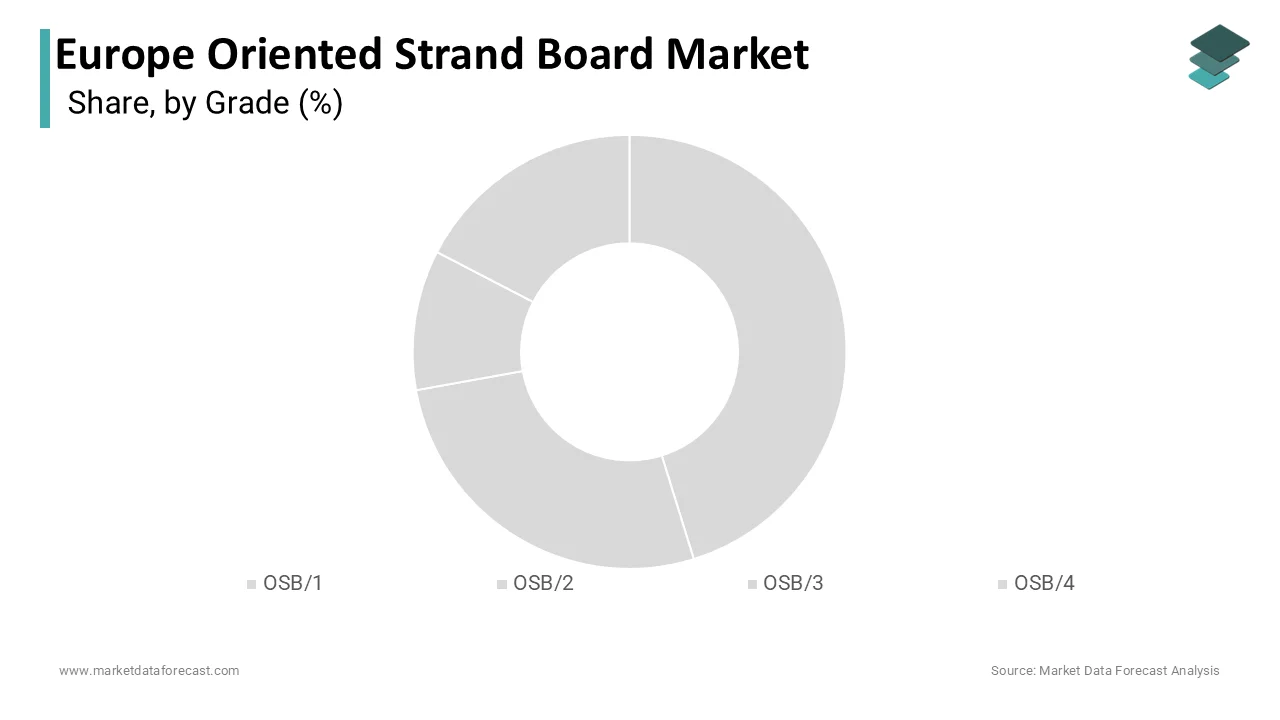
The OSB/4 segment is likely to witness the fastest CAGR of 8.7% from 2025 to 2033. OSB/4’s growth is propelled by its use in heavy-duty structural applications within multi-story timber buildings, particularly as diaphragms in floor and roof systems that must resist high wind and seismic loads. According to the European Commission’s Urban Agenda for the EU, European cities now promote timber construction for buildings up to eight stories to reduce urban carbon footprints. In Austria, the updated ONORM B 1995 1 1 standard explicitly permits OSB/4 in horizontal load-bearing elements of buildings exceeding four stories, a provision adopted in 2022. Switzerland’s EMPA research institute reported in 2023 that OSB/4 panels demonstrated shear strength exceeding 1.2 megapascals in cyclic loading tests, making them suitable for seismic zones in Southern Europe. Additionally, public infrastructure projects in the Netherlands, such as Amsterdam’s circular housing blocks, specify OSB/4 for its long-term dimensional stability under variable humidity.
By End User Industry Insights
The construction sector was the largest by occupying a prominent share of the Europe-oriented strand board market in 2025. The construction industry’s dominance is rooted in the material’s structural role in modern industrialized building systems, particularly timber frame and modular housing. Moreover, national renovation programs under the EU Renovation Wave are targeting 35 million building upgrades by 2030, which increasingly specify oriented strand board for roof and floor retrofits due to its lightweight nature and ease of installation in constrained urban sites. This systemic integration into both new build and refurbishment workflows ensures construction remains the anchor sector. The material’s uniform density eliminates warping issues common in particleboard by enhancing product longevity and assembly reliability. In Poland, the EU’s largest furniture exporter manufacturers reported a 19% reduction in warranty claims after switching from particleboard to OSB/2 for kitchen cabinet carcases, as per the Polish Chamber of Furniture Industry. Additionally, the rise of sustainable furniture brands in the Netherlands and Denmark has revived interest in OSB’s visible edge aesthetic, marketed as an industrial design feature. Although smaller than construction, the furniture sector provides a consistent baseline demand in Central and Eastern Europe, where manufacturing clusters thrive on cost-sensitive material solutions.
The construction segment is also growing at the fastest CAGR of 6.9% from 2025 to 2033. Public investment in social housing is accelerating oriented strand board demand across Europe, particularly in countries facing acute urban housing shortages. According to the European Commission’s Affordable Housing Initiative, EU member states committed to delivering 1.2 million new social dwellings by 2027, with over 60% utilizing timber frame systems. Similarly, Vienna’s municipal housing agency Wiener Wohnen mandated the use of engineered wood panels, including oriented strand board, in all new developments to meet carbon reduction targets, resulting in year on year increase in panel procurement. These publicly funded projects prioritize speed,d affordability, and sustainability, aligning perfectly with oriented strand board’s attributes. Public infrastructure projects across Europe are increasingly bound by green procurement rules that favor renewable materials with low embodied carbon. The EU’s Level(s) framework, adopted by public clients in Germany and Denmark since 2022, awards points for using bio-based structural panels, further incentivizing specification.
COUNTRY LEVEL ANALYSIS
Germany Oriented Strand Board Market Analysis
Germany was the top performer of the Europe-oriented strand board market by capturing 26.3% of the market share in 2025, with a mature timber construction sector and stringent energy efficiency regulations. The country hosts three of Europe’s largest panel mills, including those operated by Kronospan and Egger, which supply both domestic and export markets. The Federal Ministry of Housing’s KfW efficiency house program provides subsidies for timber frame builds, directly boosting oriented strand board demand. Additionally, Germany’s dense network of prefabrication factories, over 400 certified modular housing plants, creates consistent industrial consumption.
France Oriented Strand Board Market Analysis
France oriented strand board market growth is accelerated by the RE2020 environmental regulation that mandates carbon accounting for all new buildings. The regulation’s lifecycle assessment requirement favors materials like oriented strand board, which has a verified embodied carbon of approximately 320 kilograms of CO2 equivalent per cubic meter, as calculated by the French Environment and Energy Management Agency. Major producers such as Sonae Industria operatehigh-capacityy mills in southwestern France, sourcing local maritime pine residues. Urban housing initiatives in cities like Lyon and Bordeaux increasingly specify oriented strand board for modular social housing, supported by the Action Logement fund. Furthermore, France’s national timber promotion agency, France Bois Foret, allocates EUR 25 million annually to training carpenters in panelized construction by ensuring skilled labor availability. This combination of regulatory push, local production, and workforce development sustains France’s strong second position.
United Kingdom Oriented Strand Board Market Analysis
The United Kingdom-oriented strand board market growth is likely due to the rapid adoption of modern methods of construction to address housing shortages. Despite Brexit, the UK maintains technical alignment with EN 300 standards by ensuring product compatibility with European supply chains. The government’s Future Homes Standard, set to take effect in 2025, will require all new dwellings to produce 75 to 80% less carbon than current levels, which further favors timber frame systems. Leading housebuilders like Barratt and Taylor Wimpey have shifted over 50% of their product lines to timber frame, each consuming thousands of cubic meters of OSB annually.
Sweden Oriented Strand Board Market Analysis
Sweden's oriented strand board market growth is likely to have steady opportunities with its near-universal adoption of timber frame construction and advanced sustainable forestry practices. The Swedish National Board of Housing, Building, and Planning mandates that all new public buildings achieve a climate certification that rewards bio-based materials, directly benefiting oriented strand board. The country’s integrated forest industry,y led by companies like Holmen and Sod, ensures a steady supply of spruce and pine residues for panel production. Moreover, Sweden’s cold climate demands highly airtight building envelopes, and oriented strand board’s performance in blower door tests makes it the default choice for Passive House certified projects. Municipalities like Malmö and Gothenburg have adopted circular construction guidelines that prioritize demountable systems using standardized panels that further embed oriented strand board in future urban development.
Poland Oriented Strand Board Market Analysis
Poland-oriented strand board market growth is driven by the emergence as Central Europe’s key consumption and manufacturing hub. The country hosts major panel mills operated by Kronospan and Pfleiderer, which export across the EU but also serve a growing domestic furniture and construction sector. Poland’s National Housing Support Program, launched in 2022, provides subsidies for first-time homebuyers, indirectly boosting demand for cost-efficient building systems like timber frames. Additionally, Poland is the EU’s largest furniture exporter, and its flat pack industry consumes significant volumes of OSB/1 and OSB/2 for cabinet cores.
COMPETITIVE LANDSCAPE
The Europe-oriented strand board market features concentrated competition among a few large integrated producers who dominate due to scale, technological capability, and access to sustainable wood supply. Companies compete primarily on product certification, emission performance, and alignment with low-carbon building standards rather than price alone. Differentiation arises through resin innovation, production efficiency, and proximity to high-growth construction regions such as Germany, the Nordics, and the Netherlands. Smaller regional mills struggle to meet stringent EN 300 and E1 requirements, limiting their market reach. The entry of cross-laminated timber and other mass timber products creates substitution ppressuree et oriented strand board remains irreplaceable for sheathing and diaphragm applications. Strategic consolidation and sustainability investment define the competitive landscape.
KEY MARKET PLAYERS
Some of the companies that are playing a dominating role in the global europe oriented strand board market include
- Kronospan Limited
- SWISS KRONO Group
- Arauco
- Norbord Inc. (a subsidiary of West Fraser Timber Co. Ltd.)
- Egger Group
- Willow Wood Group (associated with Egger)
- SierraPine (West Fraser)
- Roseburg Forest Products Co.
- Georgia-Pacific LLC
- Great Western Products
- Kalesnikoff Lumber Company
- Canfor Corporation
- Tolko Industries Ltd.
- Roseburg Forest Products
- Hizmet OSB & Timber Co.
- Södra Wood Products
- Stora Enso Oyj
- UPM-Kymmene Corporation
- Binderholz GmbH
- West Fraser Timber Co. Ltd.
TOP LEADING PLAYERS IN THE MARKET
- Egger Group is a leading European manufacturer of wood-based panels with significant production capacity for oriented strand board across Germany, Austria, and the United Kingdom. The company supplies structural OSB/3 and OSB/4 grades to construction and industrial customers throughout the EU and exports to countries, including North America and Asia. Egger has strengthened its position by investing in emission-reducing resin technologies and achieving full compliance with EU E1 formaldehyde standards. In recent years, the company expanded its OSB production line in Wismar, German,y, to meet rising demand from modular housing and renewable energy infrastructure projects across Northern Europe.
- Kronospan operates one of the largest oriented strand board production networks in Europe with mills in the United Kingdom, Pol, and, Romania, and Germany. The company plays a pivotal role in supplying OSB to both the European construction sector and global furniture manufacturers. To enhance its sustainability credentials, Kronospan has implementedbiomass-poweredd energy systems at its OSB plants, reducing reliance on fossil fuels. The company recently upgraded its resin formulation to bio-based alternatives at its Chirk UK facility,y aligning with the UK’s Future Homes Standard and reinforcing its position in low-carbon building material supply chains across Western Europe.
- Sonae Industria is a major Iberian producer of engineered wood panels with a dedicated oriented strand board mill in Montijo, Portugal. The company serves Southern and Western EEuropewith OSB/2 and OSB/3 grades tailored for residential construction and packaging applications. Sonae Industria has reinforced its market presence by achieving full chain of custody certification under PEFC and integrating real-time quality control systems to ensure EN 300 compliance. The company launched a carbon footprint-verified OSB product line in collaboration with the French Environment and Energy Management Agency to support clients complying with France’s RE2020 regulation.
TOP STRATEGIES USED BY THE KEY MARKET PARTICIPANTS
Key players in the Europe-oriented strand board market pursue vertical integration to secure softwood residue supply from sawmills and reduce raw material volatility. They invest in formaldehyde-free and bio-based resin technologies to comply with EU E1 emission standards and enhance environmental product declarations. Companies expand production capacity in Central and Northern Europe to align with rising demand from timber frame construction and modular housing. Strategic partnerships with public housing agencies and green building certifiers ensure specification in low-carbon public projects. Additionally, manufacturers adopt digital quality monitoring and lifecycle assessment tools to meet the Level(s) framework requirements and differentiate products in sustainability-driven procurement tenders.
MARKET SEGMENTATION
This research report on the europe oriented strand board (osb) market is segmented and sub-segmented into the following categories.
By Grade
- OSB/1
- OSB/2
- OSB/3
- OSB/4
By End-User Industry
- Construction
- Furniture
- Packaging
- Others
By Country
- Germany
- France
- United Kingdom
- Sweden
- Poland
- Rest of Europe