- Product Description Description
- Table of Contents TOC
- List of Table & Figure LOT
- Get Free Sample PDF Sample PDF
Market Size, 2025
$56.66 BnMarket Estimate, 2026
$61.65 BnMarket Forecast, 2034
$121.04 BnCAGR, 2026–2034
8.8%Executive Summary: Europe Wood-Based Panel Market
- Market Scope: Comprehensive Europe wood-based panel market analysis covering product categories, applications, regional/country leadership, and competitive dynamics.
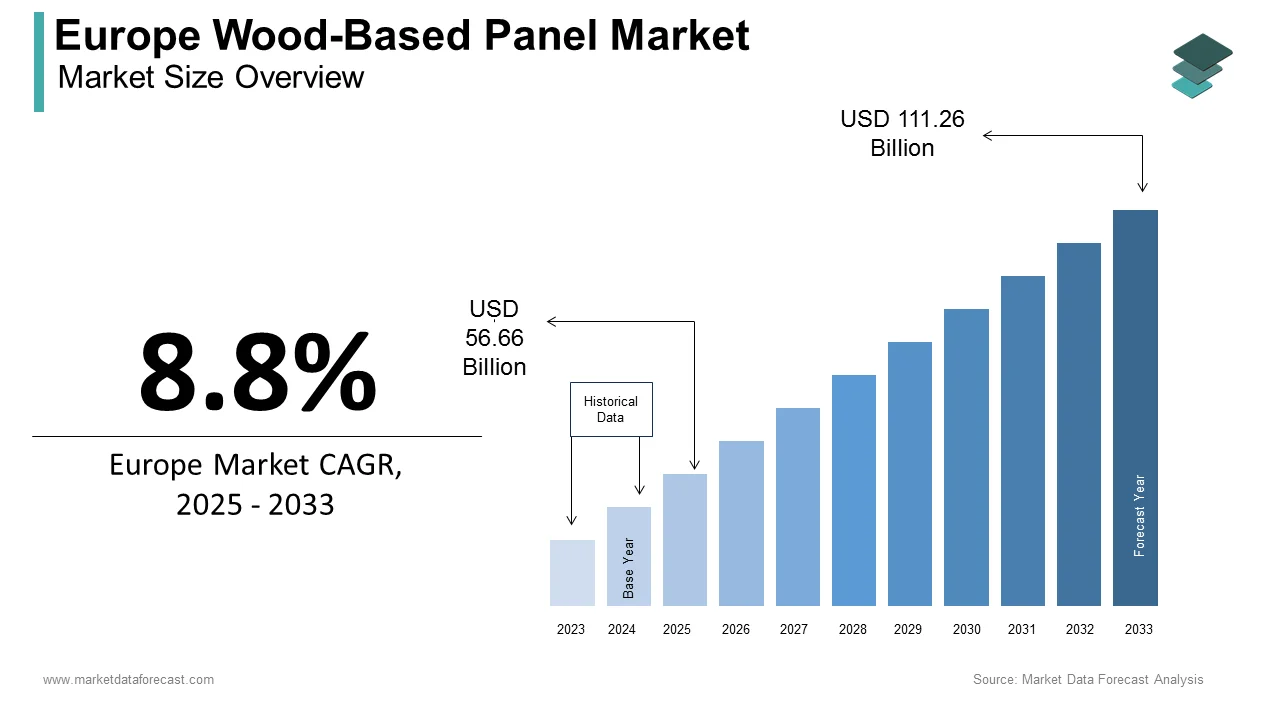
- Market Valuation: Valued at USD 56.66 billion (2025), estimated at USD 61.65 billion (2026), and projected to reach USD 121.04 billion by 2034, registering a steady CAGR of 8.8% (2026–2034).
- Primary Growth Drivers: Stringent sustainability regulations, green building standards across Europe, and rapid growth in modular construction and prefabricated housing solutions. Opportunities include bio-based/formaldehyde-free adhesives and cross-laminated timber (CLT)/mass timber expansion.
Key Market Segment Metrics (2026–2034)
| Category | Leading Segment (2025 Position) | Fastest-Growing Segment |
|---|---|---|
| By Product & Application | MDF / Medium-Density Fiberboard (largest product); Furniture (largest application) | OSB / Oriented Strand Board (fastest-growing product); Construction (fastest-growing application) |
| By Country & Region | Germany (largest country/regional market) | Not explicitly stated in the uploaded report |
Major Market Players & Strategic Developments
Market Structure: Highly competitive European panel manufacturing industry featuring key players focusing on sustainable forestry, certified sourcing, low-emission products, bio-based adhesives, digital manufacturing, and recycling initiatives.
Key Companies: Kronospan, Swiss Krono Group, Egger Group, Pfleiderer Group, Sonae Arauco, Finsa, Kastamonu Entegre, Norbord (West Fraser), Unilin, and Weyerhaeuser.
Recent Strategic Developments: (1) Kronospan expanded investments in sustainable forestry, certified sourcing, and advanced surface technologies. (2) Swiss Krono Group launched product lines featuring bio-based adhesives and implemented digital energy-monitoring systems. (3) Egger Group expanded production capacity for decorative panels and increased post-consumer wood recycling in manufacturing.
Europe Wood-based Panel Market Size
The wood-based panel market size in Europe was valued at USD 56.66 billion in 2025. The European market is estimated to be worth USD 121.04 billion by 2034 from USD 61.65 billion in 2026, growing at a CAGR of 8.8% from 2026 to 2034.
The wood-based panel market is integral to the European circular bioeconomy as it is transforming residual wood fibers and low-grade timber into high-value structural and decorative components. According to Eurostat, the wood-based industries in the European Union represented approximately 7.2% of the total manufacturing industry gross value added in 2020. The market operates within a stringent regulatory framework governed by the European Green Deal and the Construction Products Regulation, which mandate sustainability, low emissions, and fire safety standards. As per the Food and Agriculture Organization of the United Nations, Europe holds 25% of the world's total forest area, providing a robust domestic raw material base that supports regional self-sufficiency. Consumer preferences have shifted toward eco-friendly and certified products, driving demand for panels sourced from sustainably managed forests under schemes like the Programme for the Endorsement of Forest Certification. The industry faces evolving dynamics due to energy transition policies, supply chain restructuring, and the push for carbon-neutral building materials. Innovation in adhesive technologies and surface treatments continues to enhance product performance while reducing environmental impact, positioning wood-based panels as a preferred alternative to concrete and steel in sustainable architecture.
MARKET DRIVERS
Stringent Sustainability Regulations and Green Building Standards
The implementation of rigorous sustainability regulations and green building certifications is one of the major factors propelling the expansion of the European wood-based panel market. Policies such as the European Green Deal and the Energy Performance of Buildings Directive incentivize the use of renewable materials with low embodied carbon to achieve climate neutrality goals. As per the European Commission, buildings account for around 40% of Europe’s energy consumption and 36% of CO2 emissions, which is prompting a strategic shift toward bio-based construction materials. Wood-based panels offer a significant carbon storage benefit, sequestering carbon dioxide throughout their lifecycle, which aligns with national decarbonization targets. For instance, energy-efficient buildings can reduce energy consumption by 30% to 50% compared to conventional structures. This regulatory pressure drives architects and developers to specify medium density fibreboard and oriented strand board for insulation, flooring and wall systems. Furthermore, public procurement policies increasingly favor materials with Environmental Product Declarations, giving certified wood panels a competitive advantage over synthetic alternatives. The mandatory reporting of carbon footprints in large-scale projects further reinforces this trend, ensuring that wood-based panels remain central to sustainable urban development and infrastructure modernization efforts across the continent.
Growth in Modular Construction and Prefabricated Housing Solutions
The rapid expansion of modular construction and prefabricated housing solutions is further fuelling the growth of the Europe wood-based panel market, leveraging the material’s lightweight properties and ease of fabrication. Off-site construction methods require materials that are easy to transport, cut, and assemble, making oriented strand board and plywood ideal choices for structural walls, floors, and roofs. For instance, the demand for modular construction in Europe is growing significantly due to labor shortages and the need for faster project completion times. Wood-based panels enable precise manufacturing in controlled factory environments, reducing waste and improving quality control compared to traditional on-site building methods. As per Euroconstruct, the share of prefabricated wooden houses in new residential constructions in Northern Europe exceeds 30%, reflecting strong regional acceptance. The efficiency of panelized systems allows for quicker assembly, which is crucial for addressing housing shortages in major urban centers. Additionally, the thermal insulation properties of wood-based panels contribute to energy-efficient building envelopes, meeting strict energy codes without additional complex layers. This synergy between industrialized construction techniques and the versatility of wood-based panels ensures sustained demand, particularly in countries like Sweden, Germany, and Austria where prefab housing is well-established.
MARKET RESTRAINTS
Volatility in Raw Material Supply and Energy Costs
Fluctuations in the availability of wood residues and soaring energy costs present significant restraints on the wood-based panel market growth in Europe. The manufacturing process for medium density fiberboard and particleboard is energy-intensive, requiring substantial heat and electricity for drying and pressing operations. According to the European Central Bank, producer energy prices in the euro area increased by 93.4% between September 2021 and October 2022, severely impacting production margins. Simultaneously, the supply of raw materials such as sawdust and wood chips is constrained by competition from the biomass energy sector and pulp industry. As per the Confederation of European Paper Industries, the demand for wood fiber for bioenergy has risen sharply, diverting resources away from panel manufacturers and driving up input costs. Climate change-induced events such as bark beetle infestations and storms have also disrupted timber harvests in Central Europe, reducing the availability of low-grade wood suitable for panel production. These supply chain bottlenecks force manufacturers to operate below capacity or source materials from distant regions, increasing logistical expenses. The combination of high energy bills and scarce raw materials limits the ability of producers to scale operations or invest in innovation, creating a precarious economic environment that hinders long-term growth and competitiveness against alternative materials.
Strict Formaldehyde Emission Regulations and Compliance Costs
Rigorous regulations governing formaldehyde emissions from wood-based panels are further impeding the European wood-based panel market growth. Formaldehyde, used in urea-formaldehyde resins as a binding agent, is classified as a carcinogen, prompting strict limits under the European Construction Products Regulation and the Classification Labelling and Packaging Regulation. According to the European Chemicals Agency, manufacturers must ensure that panels meet the E1 or stricter E0 emission standards, which requires advanced production technologies and expensive low-emission adhesives. Transitioning from conventional resins to bio-based or formaldehyde-free alternatives involves significant research and development expenditures and potential compromises in product performance, such as moisture resistance. As per the European Panel Federation, compliance with these evolving standards necessitates continuous monitoring and testing, adding administrative burdens and operational costs. Small and medium-sized enterprises often struggle to afford the necessary upgrades, leading to market consolidation and reduced diversity. Furthermore, consumer awareness regarding indoor air quality has heightened scrutiny on building materials, forcing retailers to demand higher certification levels. While these regulations protect public health, they create barriers to entry and increase the final price of wood-based panels, potentially reducing their attractiveness compared to non-wood alternatives that do not face similar chemical restrictions, thereby limiting market expansion in price-sensitive segments.
MARKET OPPORTUNITIES
Development of Bio-Based and Formaldehyde-Free Adhesives
The innovation and adoption of bio-based and formaldehyde-free adhesives is a promising opportunity for the Europe wood-based panel market to enhance sustainability and meet stringent health standards. Manufacturers are increasingly replacing petroleum-based resins with alternatives derived from lignin, tannins, soy, and starch, which eliminate toxic emissions and improve the environmental profile of the final product. According to the Fraunhofer Institute for Wood Research, bio-based adhesives can reduce the carbon footprint of panel production by up to 30% while maintaining mechanical strength and durability. This technological shift aligns with the European Union’s Chemicals Strategy for Sustainability, which promotes the substitution of hazardous substances with safer alternatives. As per the European Bioplastics Association, the market for bio-based chemicals is expanding rapidly, providing a scalable supply of raw materials for adhesive formulation. Companies that pioneer these green bonding technologies can differentiate their products in the premium segment, attracting architects and consumers who prioritize healthy indoor environments. Additionally, formaldehyde-free panels qualify for higher points in green building certification systems such as LEED and BREEAM, enhancing their marketability in commercial projects. By investing in research and partnerships with biotech firms, panel producers can secure a competitive edge, comply with future regulations proactively, and tap into the growing demand for truly sustainable construction materials that support the circular bioeconomy.
Expansion into Cross-Laminated Timber and Mass Timber Applications
The integration of wood-based panels into cross-laminated timber and mass timber construction offers a significant growth avenue for the European wood-based panel market. Cross-laminated timber utilizes layers of solid-sawn lumber or structural panels bonded together to create large-format beams and walls capable of supporting multi-story buildings. According to the Food and Agriculture Organization of the United Nations, mass timber construction can reduce building weight by 75% compared to concrete, enabling faster erection and reduced foundation costs. This method is gaining traction in Europe as a sustainable alternative to steel and concrete, driven by urban densification needs and carbon reduction goals. As per the European Timber Trade Federation, the number of tall wood buildings in Europe has doubled in the last five years, creating robust demand for high-performance structural panels. Manufacturers can capitalize on this trend by producing specialized oriented strand board and laminated veneer lumber optimized for structural load-bearing capacities. The aesthetic appeal of exposed wood in modern architecture further drives demand, allowing panels to serve both functional and decorative purposes. By collaborating with engineering firms and promoting the benefits of prefabricated mass timber systems, panel producers can access new high-value markets in commercial and institutional construction, diversifying revenue streams beyond traditional furniture and cabinetry sectors.
MARKET CHALLENGES
Competition from Alternative Sustainable Materials
Intense competition from alternative sustainable materials such as recycled plastics, bamboo composites, and hemp-based boards poses a significant challenge to the Europe wood-based panel market expansion. These emerging materials offer comparable structural properties and aesthetic appeal while appealing to consumers seeking novel eco-friendly options. According to industry reports, the market for natural fiber composites is growing at a rate of 10% annually, driven by automotive and construction applications that prioritize lightweight and renewable resources. Bamboo, in particular, offers rapid renewability and high tensile strength, making it a viable substitute for plywood in certain applications. As per Plastics Europe, advancements in recycling technologies have enabled the production of high-quality plastic lumber that resists moisture and decay better than traditional wood panels. These alternatives often require less processing energy and do not face the same deforestation concerns, attracting environmentally conscious buyers. Additionally, innovative materials like mycelium-based boards are entering the niche market for insulation and acoustic panels, further fragmenting demand. Wood-based panel manufacturers must invest heavily in marketing and product differentiation to justify their position against these newer entrants. Failure to innovate or highlight the unique benefits of wood, such as carbon sequestration and biodegradability, risks losing market share to these disruptive materials that are gaining regulatory support and consumer acceptance in the green building sector.
Supply Chain Disruptions and Logistics Bottlenecks
Persistent supply chain disruptions and logistics bottlenecks present a major challenge to the Europe wood-based panel market growth. The regional market relies on complex networks involving timber harvesting, transportation, processing, and distribution, all of which are vulnerable to external shocks. According to the European Logistics Association, freight costs and delivery times remain volatile due to driver shortages, port congestion, and infrastructure limitations across the continent. The reliance on road transport for heavy panel products makes the sector particularly sensitive to fuel price fluctuations and regulatory changes such as carbon taxes on transportation. As per the International Road Transport Union, the shortage of truck drivers in Europe has reached critical levels, causing delays in getting products from mills to construction sites and retailers. Additionally, geopolitical tensions have disrupted trade routes for certain additives and machinery parts required for panel production. These logistical inefficiencies increase inventory holding costs and lead to stockouts, damaging customer relationships and project timelines. Manufacturers struggle to maintain consistent supply levels, forcing them to hold larger safety stocks that tie up capital. Without significant improvements in logistics infrastructure and digital supply chain management, the industry will continue to face operational inefficiencies that erode profitability and hinder its ability to meet growing demand reliably.
REPORT COVERAGE
| REPORT METRIC | DETAILS |
| Market Size Available | 2025 to 2034 |
| Base Year | 2025 |
| Forecast Period | 2026 to 2034 |
| Segments Covered | By Product, Application, and Country. |
| Various Analyses Covered | Global, Regional, and Country-Level Analysis, Segment-Level Analysis, Drivers, Restraints, Opportunities, Challenges; PESTLE Analysis; Porter’s Five Forces Analysis, Competitive Landscape, Analyst Overview of Investment Opportunities |
| Countries Covered | UK, France, Spain, Germany, Italy, Russia, Sweden, Denmark, Switzerland, Netherlands, Turkey, Czech Republic, and the Rest of Europe. |
| Market Leaders Profiled | Ante-Group, ARAUCO, Canfor, Dongwha Malaysia Holdings Sdn Bhd, Georgia-Pacific, Idaho Forest Group, LLC, Interfor Corp., KLAUSNER-GROUP, KlenkHolz AG, Kronospan, Weyerhaeuser, Dieffenbacher GmbH, Holzindustrie Schweighofer, Shanghai Jechen Group Company Ltd., Sierra Pacific Industries, Swiss Krono Group, Sodra, Stora Enso, Timber Products Co., Ltd., Tolko Industries, West Fraser Timber Co., Ltd., Hampton Affiliates, Pfeifer Gruppe, Resolute Forest Products, Rettenmeier Holding AG. |
SEGMENTAL ANALYSIS
By Product Insights
The particleboard segment accounted for the dominant share of the European market in 2025 and is likely to remain the foundational material for the furniture industry, while maintaining its market dominance through cost-efficiency in the coming years. Particleboard holds the leading position in the Europe wood-based panel market due to its cost-effectiveness, versatility, and widespread use in furniture manufacturing and interior fit-outs. This engineered wood product is manufactured from wood chips and synthetic resins, offering a smooth surface ideal for laminates and veneers. According to the European Panel Federation, particleboard remains the most produced wood-based panel in Europe, reflecting its dominance in the industry. A primary driver is its extensive application in the ready-to-assemble furniture sector, which has seen robust growth due to urbanization and the demand for affordable housing solutions. As per the data from Eurostat, the furniture industry in the European Union generates significant annual turnover, with particleboard serving as the core material for cabinets, shelves, and tables. The efficient utilization of wood residues that align with circular economy principles is further contributing to the dominance of the particleboard segment in the European market. Particleboard production consumes sawdust and small-diameter logs that would otherwise be wasted, which is making it an environmentally attractive option for manufacturers. As per the Food and Agriculture Organization of the United Nations, the efficient use of forest residues helps reduce waste and supports sustainable forestry practices. The material’s consistent quality and ease of machining further cement its status as the preferred choice for mass-produced furniture and interior applications across the continent.
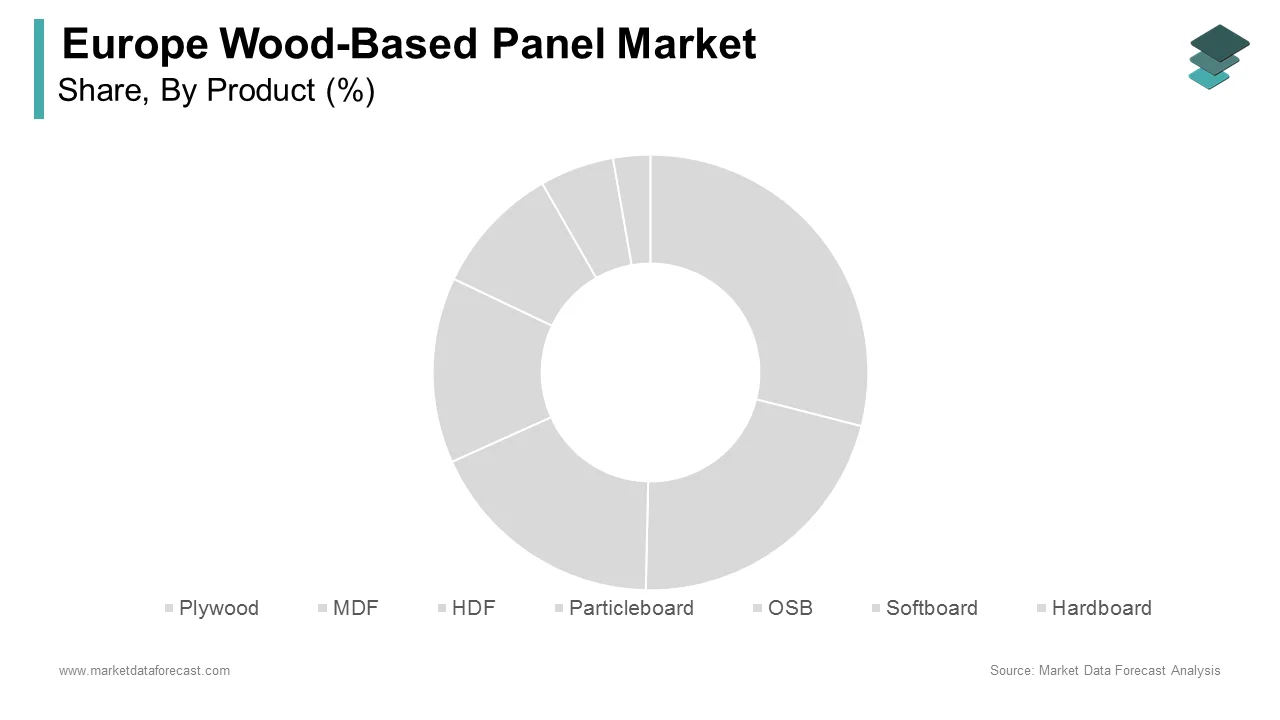
However, the oriented strand board segment is estimated to record a CAGR of 4.4% over the forecast period in the European market as timber frame construction becomes the standard for modern, energy-efficient housing. Oriented strand board is emerging as the fastest-growing segment in the Europe wood-based panel market due to the rising adoption of timber frame construction and prefabricated housing solutions, where OSB serves as a critical structural component. Unlike traditional panels, OSB offers superior strength and stiffness, making it ideal for sheathing, flooring, and roofing applications. According to the Confederation of European Paper Industries, the shift toward lightweight and sustainable building materials has increased the demand for OSB in residential construction projects. A key driver is the regulatory push for energy-efficient buildings, as OSB provides excellent thermal insulation properties when combined with other materials. The European Commission reports that new building standards require higher energy performance, prompting developers to choose OSB for its ability to create airtight building envelopes. The second factor is the material’s resistance to moisture and deformation compared to particleboard, enhancing its durability in external applications. As per industry data, OSB production has increased significantly in recent years to meet the needs of modern construction techniques. The versatility of OSB in both structural and decorative roles, coupled with its sustainability credentials, positions it as the most dynamic growth engine in the European panel market.
By Application Insights
The furniture segment held the largest share of the European market in 2025 and is expected to continue to hold its dominance in the European market throughout the forecast period due to the high volume of residential and commercial furniture production. Wood-based panels such as medium density fiberboard and particleboard are the primary materials for manufacturing cabinets, tables, chairs, and storage units. According to the European Furniture Industries Confederation, the EU furniture sector employs nearly 1 million people and generates significant economic value, relying heavily on engineered wood for cost-effective and scalable production. A primary driver is the trend toward modular and flat-pack furniture, which appeals to consumers seeking affordability and convenience. According to Statista, online furniture sales in Europe have grown steadily, driving demand for standardized panel sizes that facilitate easy shipping and assembly. The second driving factor is the aesthetic versatility of wood-based panels, which can be finished with various veneers, laminates, and paints to mimic solid wood or create modern designs. As per the European Panel Federation, advancements in surface treatment technologies have enhanced the durability and visual appeal of panels, making them suitable for high-end furniture applications. The continuous renovation of existing housing stock and the expansion of the hospitality sector further sustain demand. This combination of functional utility, design flexibility, and economic efficiency ensures that furniture remains the largest application area for wood-based panels in Europe.
On the other side, the construction segment is estimated to showcase a CAGR of 6.5% over the forecast period in the global market owing to the increasing adoption of sustainable building practices and the rise of prefabricated construction methods. Wood-based panels are essential for wall systems, flooring, roofing, and insulation in both residential and commercial projects. According to the European Green Deal, the construction sector must reduce its carbon footprint significantly, driving the substitution of concrete and steel with bio-based materials like oriented strand board and cross-laminated timber. A key driver is the government incentives for energy-efficient renovations and new builds, which favor materials with low embodied carbon. According to the European Commission, buildings account for 40% of energy consumption, prompting strict regulations that promote wood-based solutions for their insulating properties. The labor shortage in the construction industry, which accelerates the shift toward off-site manufacturing where panels are pre-cut and assembled quickly is further boosting the dominance of the construction segment in the European market. As per Euroconstruct, the use of timber frame construction has increased by 20% in Northern Europe, which is boosting the panel demand. The durability, lightweight nature, and ease of installation of wood-based panels make them indispensable for modern sustainable construction, driving rapid market expansion.
COUNTRY LEVEL ANALYSIS
Germany Wood-Based Panel Market Analysis
Germany dominated the market by holding 23.6% of the regional market share in 2025 and is expected to remain a dominant force in the European market by prioritizing high-end sustainable panel technologies over the next few years. The country’s robust manufacturing base and strong construction sector drive sustained demand for high-quality panels. According to the German Federal Statistical Office, the construction industry contributes significantly to GDP, with a growing emphasis on sustainable building materials. A major driving factor is the stringent energy efficiency regulations that mandate the use of insulated wood-based systems in new builds and renovations. The second factor is the well-established furniture industry, which relies heavily on medium density fiberboard and particleboard for domestic and export markets. Germany is also a leader in producing formaldehyde-free panels, aligning with strict environmental standards. The presence of major manufacturers and advanced processing technologies ensures a steady supply of innovative products. Government subsidies for energy-efficient housing further stimulate demand. Despite challenges related to raw material costs, Germany’s commitment to sustainability and industrial excellence maintains its leadership position in the European market.
France Wood-Based Panel Market Analysis
France is likely to see continued growth in its panel market as national building regulations prioritize bio-sourced materials in the coming years. France represents a significant market for wood-based panels in Europe due to a strong preference for certified sustainable products and a vibrant construction sector. According to the French Ministry of Ecological Transition, new building regulations promote the use of bio-sourced materials, boosting demand for wood panels. A primary driver is the renovation wave initiative, which aims to improve the energy performance of existing buildings using insulated wood systems. The second factor is the thriving furniture and packaging industries, which consume large volumes of particleboard and fiberboard. France has extensive forest resources, supporting local production and reducing reliance on imports. The government’s support for the forestry sector through national strategies ensures a stable raw material supply. Consumer awareness regarding indoor air quality drives demand for low-emission panels. The integration of digital tools in construction also favors prefabricated wood solutions. France’s focus on environmental responsibility and industrial innovation sustains its prominent role in the European wood-based panel landscape.
Sweden Wood-Based Panel Market Analysis
Sweden is expected to leverage its vast forest resources to lead in structural panel innovations throughout the next few years. Sweden occupies a leading position in the Europe wood-based panel market, particularly in the production and export of oriented strand board and softwood plywood. According to Statistics Sweden, the forest sector is a key contributor to the national economy, with wood products representing a major export category. A key driver is the widespread adoption of timber frame construction in residential housing, which utilizes OSB for structural integrity. The second factor is the strong global demand for Swedish sustainable wood products, supported by rigorous certification standards. Sweden’s commitment to carbon neutrality encourages the use of wood as a carbon-storage material in construction. The country is also a hub for innovation in bio-based adhesives and panel technologies. High levels of digitalization in forestry and manufacturing enhance efficiency and product quality. Sweden’s strategic location and logistics infrastructure facilitate exports to other European markets. The combination of natural resources, technological expertise, and sustainability leadership ensures Sweden’s continued influence in the regional panel market.
Italy Wood-Based Panel Market Analysis
Italy is likely to focus on high-value, design-driven panel applications to maintain its competitive edge in the near future. The Italian market prioritizes aesthetic finish and precision, driving demand for medium density fiberboard and hardwood plywood. According to the Italian National Institute of Statistics, the furniture sector is a vital part of the manufacturing economy, relying on premium panels for luxury and contemporary designs. A primary driver is the global reputation of Italian design, which commands higher prices for finished goods made from high-grade panels. The second factor is the renovation of historic buildings, where lightweight wood panels are used for interior fittings and insulation without altering structural integrity. Italy has a strong network of specialized panel producers who focus on custom finishes and technical performance. The construction sector is also adopting wood-based solutions for seismic-resistant structures. Government incentives for energy efficiency upgrades support market growth. Despite limited domestic forest resources, Italy’s industrial capability and design innovation maintain its competitive edge in the high-value segment of the European market.
United Kingdom Wood-Based Panel Market Analysis
United Kingdom is expected to increase its reliance on prefabricated systems to address persistent labor shortages and strong demand for oriented strand board in housing construction. The UK market is influenced by a shortage of skilled labor, which accelerates the adoption of prefabricated timber frame systems. According to the UK Office for National Statistics, the construction sector faces significant productivity challenges, driving the shift toward off-site manufacturing using OSB and plywood. A key driver is the government’s housing targets, which require rapid and cost-effective building methods. The second factor is the increasing focus on sustainability, with wood panels preferred for their lower carbon footprint compared to masonry. The UK has limited domestic timber production, relying heavily on imports from Scandinavia and Central Europe. Brexit has introduced some supply chain complexities, but demand remains robust due to housing needs. The renovation market also contributes to panel consumption, particularly for flooring and interior joinery. The UK’s commitment to net-zero emissions supports the long-term growth of wood-based materials in construction and refurbishment projects.
COMPETITIVE LANDSCAPE
Competition in the Europe wood-based panel market is intense and characterized by a mix of large multinational corporations and specialized regional producers vying for dominance. Major players compete on product quality, sustainability credentials, and technological innovation rather than price alone. The shift toward green building standards has intensified rivalry in the low-emission and certified panel segments as companies strive to meet regulatory requirements. Innovation in bio-based adhesives and recycled content serves as a key differentiator attracting environmentally conscious buyers. Regional players often compete by offering customized solutions and faster local delivery, leveraging their proximity to customers. Supply chain stability and access to raw materials influence competitive positioning as firms manage costs amidst volatility. Brand reputation for reliability and adherence to safety standards plays a crucial role in securing contracts with large construction firms. Private label offerings from retailers pose a threat in the lower end of the market. Overall, market participants must continuously adapt to changing regulations, sustainability expectations, and technological advancements to sustain growth and profitability in this essential industry sector.
KEY MARKET PLAYERS
The leading companies operating in the Europe wood-based panel market include:
- Ante-Group
- ARAUCO
- Canfor
- Dongwha Malaysia Holdings Sdn. Bhd.
- Georgia-Pacific
- Idaho Forest Group, LLC
- Interfor Corp.
- KLAUSNER-GROUP
- KlenkHolz AG
- Kronospan Global
- Weyerhaeuser
- Dieffenbacher GmbH
- Holzindustrie Schweighofer
- Shanghai Jechen Group Company Ltd.
- Sierra Pacific Industries
- Swiss Krono Group
- Södra
- Stora Enso
- Timber Products Co., Ltd.
- Tolko Industries
- West Fraser Timber Co., Ltd.
- Hampton Affiliates
- Pfeifer Gruppe
- Resolute Forest Products
- Rettenmeier Holding AG
TOP PLAYERS IN THE MARKET
- Kronospan Global operates as a leading manufacturer of wood-based panels across Europe with extensive production facilities in multiple countries. The company specializes in medium density fiberboard, particleboard, and oriented strand board products that serve construction and furniture industries. Recent actions include significant investments in upgrading manufacturing lines to produce low formaldehyde emission panels that meet strict environmental standards. The firm has also expanded its logistics network to ensure timely delivery across European markets. By focusing on sustainable forestry practices and obtaining relevant certifications, Kronospan strengthens its reputation for quality and responsibility. The company actively engages in research and development to create innovative surface finishes and technical improvements. These strategic initiatives enhance customer trust and solidify its position as a reliable supplier in the competitive European landscape while supporting the transition toward greener building materials.
- Swiss Krono Group is a prominent player in the European wood-based panel sector known for its high-quality particleboard and oriented strand board offerings. The company maintains a strong presence through modern production sites and a commitment to sustainable resource management. Recent actions involve launching new product lines featuring bio-based adhesives that reduce carbon footprints and improve indoor air quality. Swiss Krono has also implemented advanced digital monitoring systems to optimize energy consumption and operational efficiency. The firm collaborates with architects and builders to promote the use of engineered wood in sustainable construction projects. By emphasizing transparency in supply chains and adhering to rigorous certification schemes, the group enhances its brand value. These efforts demonstrate a dedication to innovation and environmental stewardship, allowing Swiss Krono to meet evolving regulatory requirements and consumer preferences for eco-friendly building solutions in Europe.
- Egger Group contributes significantly to the Europe wood-based panel market by providing a diverse range of products including medium density fiberboard and oriented strand board. The company is recognized for its technological leadership and comprehensive service offerings tailored to industrial and retail customers. Recent actions include expanding production capacity for specialized decorative panels that mimic natural wood textures with high durability. Egger has also invested in recycling initiatives to incorporate post-consumer wood waste into new panel production. The firm supports customers with digital tools for design and material selection, enhancing user experience and engagement. By prioritizing circular economy principles and reducing waste, Egger strengthens its market position as a sustainable partner. Continuous innovation in product performance and aesthetic variety ensures the company remains at the forefront of industry trends while addressing the growing demand for responsible and high-performance wood-based materials.
TOP STRATEGIES USED BY KEY MARKET PARTICIPANTS
Key players in the Europe wood-based panel market prioritize sustainability by adopting certified sourcing practices and developing low-emission products to comply with stringent environmental regulations. They invest heavily in research and development to create bio-based adhesives and innovative surface treatments that enhance product appeal and functionality. Digital transformation is another major strategy where companies implement smart manufacturing technologies to improve efficiency and reduce energy consumption. Expansion into niche markets such as mass timber construction and acoustic solutions allows participants to diversify revenue streams beyond traditional furniture applications. Strategic partnerships with architects and developers help promote the benefits of wood-based panels in green building projects. Companies also focus on optimizing supply chains to mitigate raw material volatility and ensure consistent product availability. Customer-centric services, including custom sizing and technical support, strengthen long-term relationships. These strategies collectively enable manufacturers to navigate regulatory complexities, meet evolving consumer demands, and maintain a competitive advantage in a dynamic market.
MARKET SEGMENTATION
This Europe wood-based panel market research report is segmented and sub-segmented into the following categories.
By Product
- Plywood
- MDF
- HDF
- Particleboard
- OSB
- Softboard
- Hardboard
By Application
- Construction
- Packaging
- Furniture
By Country
- UK
- France
- Spain
- Germany
- Italy
- Russia
- Sweden
- Denmark
- Switzerland
- Netherlands
- Turkey
- Czech Republic
- Rest of Europe