- Product Description Description
- Table of Contents TOC
- List of Table & Figure LOT
- Get Free Sample PDF Sample PDF
Market Size, 2025
$68.80 BnMarket Estimate, 2026
$71.35 BnMarket Forecast, 2034
$95.41 BnCAGR, 2026–2034
3.70%Europe Paint Market Report Summary
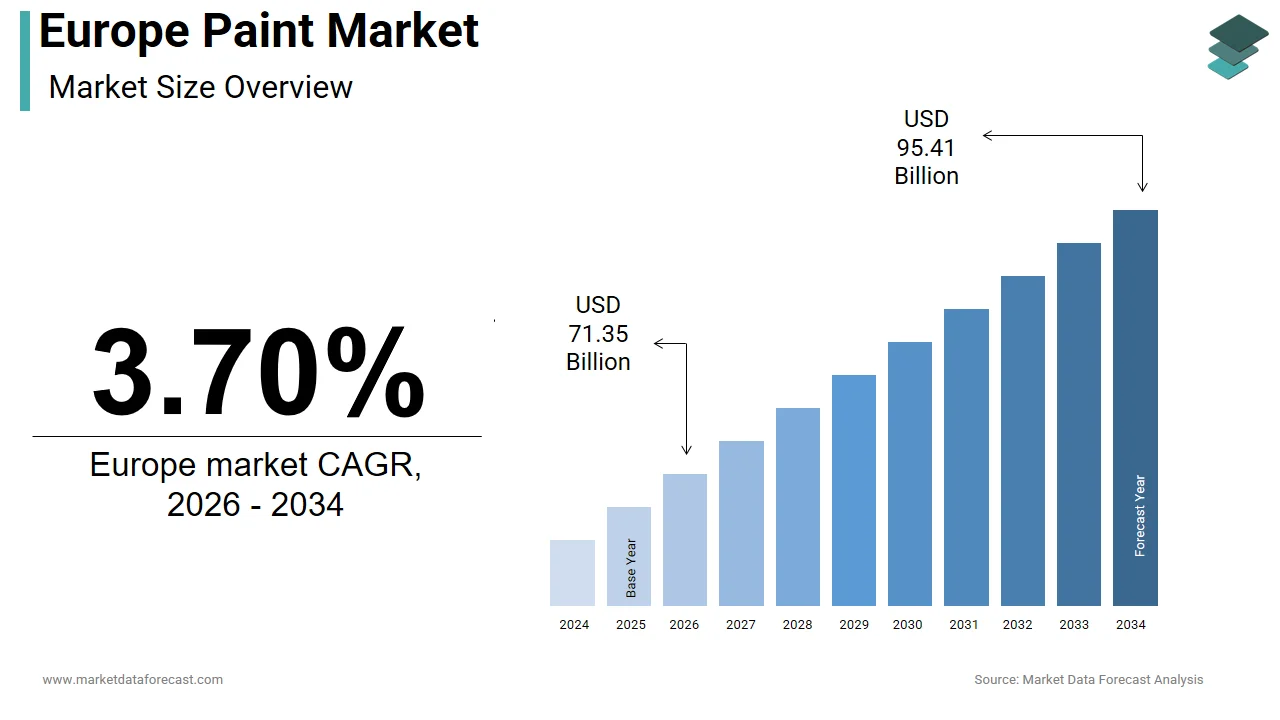
The Europe paint market was valued at USD 68.80 billion in 2025, is estimated to reach USD 71.35 billion in 2026, and is projected to reach USD 95.41 billion by 2034, growing at a CAGR of 3.70% from 2026 to 2034. Market growth is driven by increasing construction activities, rising demand for renovation and refurbishment, and growing adoption of environmentally sustainable coatings. Paints play a vital role in protecting surfaces, enhancing durability, and improving aesthetic appeal across residential, commercial, and industrial applications. Additionally, stringent environmental regulations promoting low-VOC formulations and increasing investments in infrastructure modernization are supporting the steady growth of the paint market across Europe.
Key Market Trends
- Rising adoption of eco-friendly and low-VOC waterborne coatings.
- Increasing demand from construction, renovation, and infrastructure projects.
- Growing popularity of durable, weather-resistant, and UV-resistant coatings.
- Expansion of sustainable and energy-efficient building initiatives.
- Increasing innovation in high-performance and specialty coatings.
Segmental Insights
- Based on resin type, the acrylic resin segment dominated the Europe paint market in 2025, driven by its superior durability, color retention, UV resistance, and compliance with environmental regulations.
- Based on product type, the waterborne coatings segment held the majority share in 2025, supported by increasing environmental regulations, low VOC emissions, and growing preference for sustainable coating solutions.
- Based on application, the architectural coatings segment led the market by accounting for 55.5% share in 2025, driven by rising demand from residential construction, commercial buildings, and renovation activities across Europe.
Regional Insights
The Europe paint market is experiencing steady growth across major economies, supported by infrastructure development, renovation trends, and growing emphasis on sustainable construction materials.
- Germany led the market by capturing 22.6% share in 2025, driven by strong construction activity, advanced manufacturing capabilities, and strict environmental standards promoting sustainable coatings.
- France held the second-largest share of 17.3% in 2025, supported by renovation initiatives, urban infrastructure development, and growing demand for decorative and protective coatings.
- The United Kingdom maintains a significant share, driven by strong DIY culture, housing refurbishment programs, and increasing adoption of eco-friendly paints and coatings.
Competitive Landscape
The Europe paint market is highly competitive, with global coating manufacturers and regional players focusing on innovation, sustainability, and product performance. Companies are investing in environmentally compliant formulations, advanced coating technologies, and expanding their product portfolios to meet evolving construction and industrial requirements. Strategic partnerships, acquisitions, and expansion into sustainable coating solutions are key strategies adopted by leading market participants.
Leading companies operating in the Europe paint market include BASF, The Sherwin-Williams Company, Axalta Coating Systems, Nippon Paint Holdings Co., Ltd., PPG Industries, Asian Paints, RPM International, and Jotun.
Europe Paint Market Size
The Europe paint market was valued at USD 68.80 billion in 2025, is estimated to reach USD 71.35 billion in 2026, and is projected to reach USD 95.41 billion by 2034, growing at a CAGR of 3.70% from 2026 to 2034.
Paint is a pigmented liquid or liquefiable substance that, when applied to a surface, converts into a solid, adherent film. Unlike generic definitions, the European context is defined by stringent environmental regulations that have fundamentally reshaped product chemistry over the past two decades. According to sources, a large majority of decorative paints sold within the European Union adhere to the VOC Directive, which mandates low solvent levels for interior wall paints. This regulatory pressure has driven a structural shift toward water-based, powder, and high-solids technologies across all segments. The European Union’s construction sector supports a substantial annual demand for decorative coatings, driven by extensive routine maintenance and residential refurbishment activities. Crucially, paint in Europe is no longer viewed merely as a finish but as a functional material, offering thermal insulation, antimicrobial properties, and air-purifying capabilities through photocatalytic additives such as titanium dioxide. Production is concentrated in integrated chemical hubs in Germany, France, and the Netherlands, where manufacturers operate under the EU Ecolabel and REACH frameworks. This convergence of sustainability mandates, performance innovation, and circular economy principles positions the European paint market as a global benchmark for eco-conscious surface protection.
MARKET DRIVERS
Stringent Environmental Regulations Driving Low-VOC Formulations
The European Union’s comprehensive regulatory framework on volatile organic compounds and hazardous substances serves as the primary driver of product innovation, demand for sustainable paints, and the growth of the Europe paint market. The EU Paints Directive, implemented in phases since 2007, has progressively lowered VOC limits across all coating categories, compelling manufacturers to reformulate entire portfolios. Mandatory VOC limits introduced by the European Union have significantly reduced the maximum allowable solvent content in decorative paints, with many products now far exceeding the strict regulatory requirements for environmental protection. This shift has accelerated the adoption of water-based acrylics, alkyds, and hybrid emulsions that meet both performance and environmental criteria. The voluntary EU Ecolabel scheme sets stringent environmental standards for paints and varnishes, certifying products from various manufacturers across Europe for low emissions and reduced hazardous substances. Additionally, the Classification, Labelling and Packaging Regulation mandates clear hazard communication, pushing formulators to eliminate substances of very great concern such as alkylphenol ethoxylates. These policies create non-discretionary demand for compliant products, ensuring that environmental regulation, not consumer preference alone, fuels the transition to greener coatings across residential, commercial, and industrial applications.
Robust Renovation Activity in Aging Building Stock
The region’s vast and aging building infrastructure generates consistent demand for decorative paints and further propels the expansion of the Europe paint market. This is driven by both aesthetic renewal and regulatory-mandated energy efficiency upgrades. According to a study, a substantial portion of the European housing stock consists of aging, energy-inefficient structures, while current yearly efforts to upgrade these buildings remain consistently low. The European Commission’s Renovation Wave Strategy aims to double this rate by 2030, directly stimulating paint consumption through deep energy retrofits that require primers, insulating coatings, and vapor-permeable finishes. The German state-owned development bank continues to provide extensive financial support for homeowners to upgrade their properties, fostering a steady market for residential interior and exterior improvements. Similarly, the French government utilizes a specialized subsidy program to encourage homeowners to undertake energy-saving renovations, particularly those that require breathable materials to maintain the integrity of older structures. This structural demand is further amplified by urban densification, where interior repainting is essential for rental turnover and property value maintenance. Unlike new construction, which fluctuates with economic cycles, renovation provides a resilient, policy-backed foundation for steady paint consumption across the continent.
MARKET RESTRAINTS
High Raw Material Price Volatility and Supply Chain Disruptions
Persistent cost pressures are restricting the growth of the Europe paint market. This is because of the extreme volatility in key raw material prices, particularly titanium dioxide, resins, and solvents. Titanium dioxide, a critical white pigment accounting for a notable share of paint formulation costs, saw its European price surge between 2021 and 2023 due to energy-driven production curtailments and Chinese export restrictions, according to various sources. Similarly, acrylic and alkyd resins, derived from propylene and fatty acids, experienced price swings during the same period due to crude oil and vegetable oil market fluctuations. The war in Ukraine exacerbated supply risks for key intermediates like methanol and benzene, disrupting integrated chemical supply chains in Central Europe. Many European paint manufacturers have had to carefully balance their pricing strategies to protect their profitability as the cost of raw materials fluctuated more rapidly than they could adjust their final product prices. This volatility undermines long-term planning, discourages inventory holding, and forces smaller decorators to absorb costs or switch to lower-quality alternatives, ultimately constraining market stability and innovation investment.
Complex Regulatory Fragmentation Across Member States
The paint sector operates under inconsistent national interpretations of environmental and safety regulations, despite EU-wide directives, which impedes the expansion of the Europe paint market. This creates compliance inefficiencies and competitive distortions. Beyond the maximum VOC limits set by the EU Paints Directive, individual countries may implement further restrictions. French regulatory frameworks require manufacturers to provide comprehensive documentation regarding the environmental footprint and health impacts of their building materials to support national sustainability goals for new construction. According to the European Decorative Paints Association, manufacturers must maintain up to seven different product formulations to meet divergent national requirements for the same paint type. Furthermore, classification of biocidal additives under the EU Biocidal Products Regulation varies by member state approval timelines, delaying pan-European launches. A fungicide approved in Spain may remain prohibited in Sweden for months, fragmenting the single market. These discrepancies increase administrative burden, raise time-to-market, and disadvantage SMEs lacking regulatory affairs capacity. The lack of full harmonization forces the European paint sector to navigate a diverse, complex regulatory patchwork, hindering economies of scale, stifling innovation, and distorting fair competition.
MARKET OPPORTUNITIES
Integration of Functional and Smart Coating Technologies
The evolution of paint from a passive finish to an active functional material offers a significant opportunity in the Europe paint market. Innovations such as photocatalytic coatings that break down nitrogen oxides under sunlight, thermochromic paints that regulate building temperature, and antimicrobial finishes for healthcare settings are gaining traction under the EU’s Green Deal and Horizon Europe programs. According to the Fraunhofer Institute for Silicate Research, air-purifying facade coatings can reduce local NOx concentrations by up to 20 percent in urban canyons, aligning with the EU’s Zero Pollution Action Plan. Similarly, insulating paints containing hollow ceramic microspheres are being specified in energy retrofit projects to improve U-values without altering building geometry. The European Commission’s Level(s) framework for sustainable buildings now recognizes functional coatings as contributing to indoor environmental quality and energy performance metrics. Companies like AkzoNobel and PPG are launching certified product lines that integrate these properties, enabling premium pricing and differentiation. The rise of resilient urban strategies is driving demand for functional, eco-friendly paints that go beyond traditional aesthetic appeal.
Expansion of Circular Economy Models and Recycled Content
The push toward circularity is unlocking new avenues for sustainable paint production and consumption in the region, and it is expected to fuel the expansion of the Europe paint market. Collaborative networks in the UK and France are successfully reclaiming and redistributing leftover household paint, though these efforts currently capture only a minor portion of the total paint waste generated each year. Industry experts have demonstrated that it is possible to incorporate a substantial amount of reclaimed paint into new products, though this technology is currently limited to specific product lines rather than general manufacturing. More significantly, chemical recycling of post-industrial paint sludge into reusable resins and pigments is advancing through EU-funded projects like CICLAMAT. Major producers are responding. Major global coating brands are setting ambitious long-term goals to transition toward circular production models, including increasing the use of sustainable raw materials and recycled components in their packaging and product ranges. The EU Packaging and Packaging Waste Directive’s emphasis on material recovery further incentivizes take-back schemes. The growth of Extended Producer Responsibility (EPR) frameworks is compelling the paint industry to adopt comprehensive lifecycle management, transforming potential waste into a strategic asset.
MARKET CHALLENGES
Labor Shortages in Skilled Painting and Application Services
An acute labour shortage, with insufficient skilled hands to meet demand, challenges the growth of the Europe paint market. This is because aging workforces and declining vocational training are reducing the availability of professional painters. The European Federation of Building and Woodworkers reports that the professional painting sector in Germany, Italy, and Spain is heavily reliant on an aging workforce, with a large share of painters nearing retirement age. The sector is facing a severe skill shortage, as interest in training to become a painter has declined among younger generations, leading to fewer new entrants compared to retiring professionals. This shortage delays renovation projects, increases labor costs, and drives demand for DIY solutions, even in complex commercial settings. However, improper application compromises coating performance, leading to premature failure and increased lifecycle costs. The problem is exacerbated by the technical complexity of modern low-VOC and functional paints, which require precise surface preparation and environmental conditions. In response, manufacturers are developing easier-to-apply formulations and digital tools like augmented reality color apps, but these cannot fully substitute skilled labor. Failure to address workforce gaps through training and immigration will limit the potential of advanced coatings, compromising both their aesthetic appeal and long-term durability.
Consumer Confusion Over Sustainability Claims and Certification Proliferation
Greenwashing and a fragmented landscape of eco-labels confuse consumers and dilute trust in genuine sustainability, and limit the expansion of the Europe paint market. Many different environmental certifications exist across the EU, from the EU Ecolabel and Nordic Swan to national schemes like Germany’s Blue Angel and France’s NF Environnement, each with varying criteria on VOCs, biocides, carbon footprint, and recyclability. European consumers often struggle to compare the environmental impact of products due to the widespread use of vague, unsubstantiated sustainability claims and inconsistent labeling, which leads to reduced trust in eco-friendly marketing. The European Commission and BEUC have emphasized that such practices, including the use of terms like "natural" or "eco-friendly," create significant consumer confusion in the market. This opacity allows less scrupulous brands to make unsubstantiated claims, eroding confidence in certified products. The European Commission’s upcoming Green Claims Directive aims to standardize verification, but implementation remains years away. The market’s transition to sustainable, circular coatings is stalled because, in the absence of clear, trusted communication, consumers continue to choose based on price or color rather than environmental value.
REPORT COVERAGE
| REPORT METRIC | DETAILS |
| Market Size Available | 2025 to 2034 |
| Base Year | 2025 |
| Forecast Period | 2026 to 2034 |
| Segments Covered | By Resin, Product Type, Application, and Country. |
| Various Analyses Covered | Global, Regional, and Country-Level Analysis, Segment-Level Analysis, Drivers, Restraints, Opportunities, Challenges; PESTLE Analysis; Porter’s Five Forces Analysis, Competitive Landscape, Analyst Overview of Investment Opportunities |
| Countries Covered | UK, France, Spain, Germany, Italy, Russia, Sweden, Denmark, Switzerland, Netherlands, Turkey, Czech Republic, and the Rest of Europe. |
| Market Leaders Profiled | Kansai Nerolac Paints Limited, BASF Coatings GmbH, Kwality Paints and Coatings Pvt. Ltd. (KPCPL), Nippon and Kansai (Kansai Paint Co., Ltd.), The Sherwin-Williams Company, NIPSEA Group, Nippon Paint Holdings Co., Ltd., Jotun, Axalta Coating Systems, Tikkurila Oyj, Dunn-Edwards Corporation, Asian Paints, RPM International Inc., PPG Industries, Inc., and Others. |
SEGMENTAL ANALYSIS
By Resin Type Insights
The acrylic resin segment dominated the Europe paint market in 2025. The dominance of the segment is driven by an optimal balance of durability, color retention, UV resistance, and environmental compliance. It supported the majority of decorative and industrial waterborne coatings in the region. According to sources, acrylic-based formulations account for a notable portion of all architectural paints sold in the EU, driven by their compatibility with low-VOC regulations and ease of application. The resin’s versatility allows it to be engineered for both interior flat finishes and exterior elastomeric systems that bridge hairline cracks, critical in Europe’s aging building stock. Moreover, acrylic emulsions exhibit excellent adhesion to diverse substrates, including concrete, wood, and metal, without requiring toxic co-solvents. The European Chemicals Agency confirms that acrylic polymers are not classified as substances of very great concern under REACH, simplifying regulatory approval. This combination of performance, safety, and regulatory alignment has made acrylic the default binder for mass-market and premium decorative paints across residential and commercial sectors, cementing its position as the backbone of Europe’s sustainable coating transition.
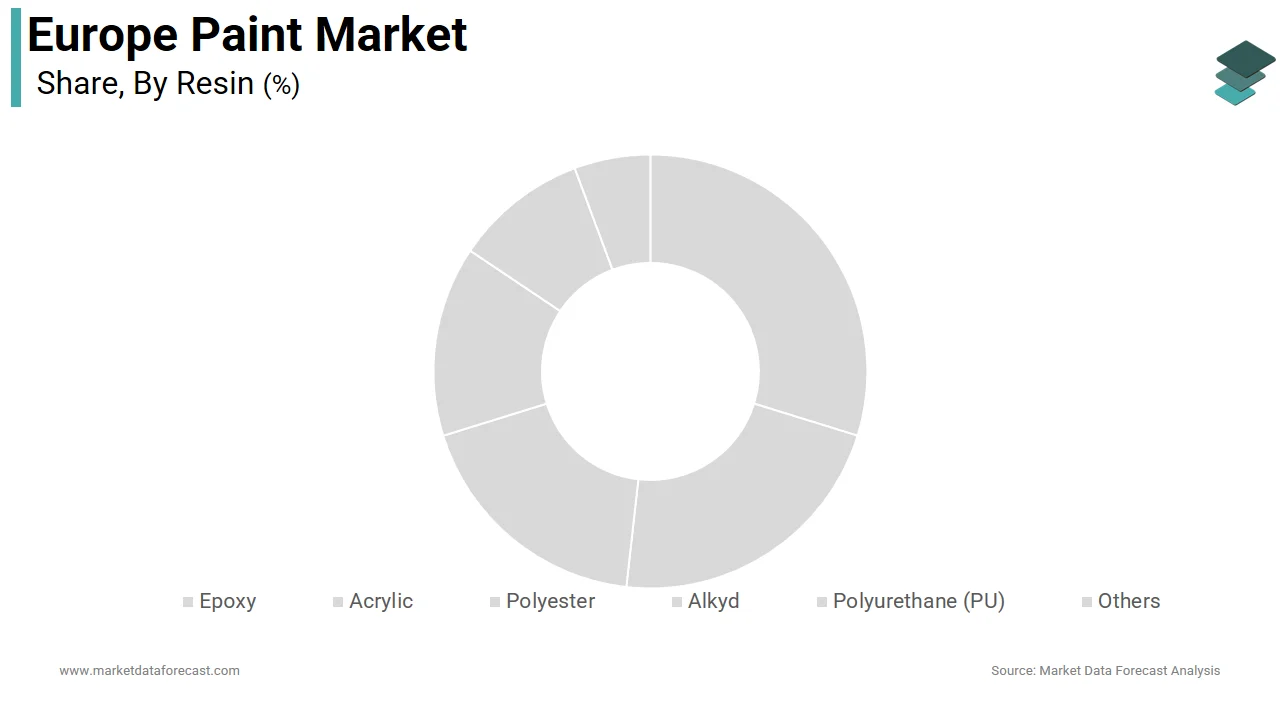
The polyurethane resin segment is predicted to witness the highest CAGR of 6.2% from 2026 to 2034 due to rising demand for high-performance protective and industrial coatings that offer exceptional abrasion resistance, chemical stability, and gloss retention. In the automotive refinish sector, two-component polyurethane clearcoats have become standard due to their ability to withstand car washes, UV exposure, and acid rain, critical in regions with strict vehicle appearance standards. According to research, a portion of premium car refinishing in Germany and France now uses polyurethane systems. Beyond transport, polyurethane floor coatings are surging in logistics warehouses and food processing plants, where seamless, hygienic surfaces are mandated under EU hygiene regulations. Innovations in waterborne polyurethane dispersions have further broadened adoption by reducing VOC content per liter while maintaining performance. The demand for durable, long-life polyurethane coatings will continue to surpass conventional options as the EU Green Deal drives a focus on asset longevity and infrastructure resilience.
By Product Type Insights
The waterborne coatings segment held the majority share of the Europe paint market in 2025. The supremacy of the segment is attributed to decades of progressive environmental regulation, particularly the EU Paints Directive, which has systematically restricted solvent content across all application categories. Waterborne technology aligns with consumer and contractor preferences for low-odor, easy-clean products that meet indoor air quality standards such as France’s A+ emission rating. European interior wall paint sales are overwhelmingly dominated by water-based formulations, representing a mature market transition toward sustainable, low-VOC products. The segment’s leadership is further reinforced by advances in acrylic and hybrid emulsion chemistry that now match or exceed the durability of traditional solvent systems in exterior applications. Major manufacturers have invested heavily in waterborne R&D. AkzoNobel has successfully converted the majority of its European decorative paint portfolio to water-borne technologies. This regulatory, technical, and behavioral convergence has made waterborne the de facto standard for sustainable painting across residential, commercial, and light industrial settings in Europe.
The powder coatings segment is estimated to register the fastest CAGR of 7.8% during the forecast period, owing to its zero-VOC profile, near-100 percent material utilization, and suitability for circular economy principles. Unlike liquid paints, powder coatings are applied electrostatically and cured thermally, eliminating solvent emissions and minimizing waste, attributes highly valued under the EU Industrial Emissions Directive. According to sources, architectural aluminum extrusions for windows and facades account for a portion of demand, with growth amplified by energy-efficient building mandates. The automotive sector is also adopting powder primers for wheels and underbody components to enhance corrosion resistance. Crucially, innovations in low-cure and UV-curable powders now enable application on heat-sensitive substrates like MDF and plastics, opening new markets in furniture and electronics. Powder coating stands out as Europe’s leading, high-durability, zero-waste finish, with its sustainability further bolstered by overspray recyclability in the face of tightening Extended Producer Responsibility (EPR) schemes.
By Application Insights
The architectural coatings segment led the Europe paint market and accounted for a 55.5% share in 2025. The leading position of the segment is credited to the continent’s vast and aging building stock, which requires continuous maintenance, renovation, and aesthetic updating. Various studies suggest that a significant volume of interior, renovation, and maintenance (R&M) work is conducted annually across the EU, representing over 54% of total construction production in 2022, and this is driven by rental turnover, property value enhancement, and energy efficiency retrofits. The European Commission’s Renovation Wave Strategy, targeting a doubling of renovation rates by 2030, directly stimulates demand for interior and exterior wall paints, primers, and insulating coatings. Unlike industrial segments tied to capital expenditure cycles, architectural painting is relatively recession-resilient, supported by both professional contractors and DIY consumers. National subsidy programs, such as Germany’s KfW and France’s MaPrimeRénov, often include repainting as an eligible activity, further anchoring demand. This structural, policy-supported, and demographically driven need ensures that architecture remains the bedrock application for the European paint industry.
The protective coatings segment is anticipated to witness the fastest CAGR of 6.5% from 2026 to 2034. The rapid growth of the segment is propelled by the continent’s strategic push toward infrastructure resilience and decarbonization. Offshore wind farms, hydrogen pipelines, and battery gigafactories require advanced epoxy and polyurethane systems that resist salt spray, chemical exposure, and thermal cycling. According to WindEurope, the EU installed 1.4 gigawatts of new offshore wind capacity in 2024, with total European (including UK) offshore capacity additions reaching 2.6 GW. Similarly, the European Hydrogen Backbone (EHB) initiative envisions a ~28,000 km hydrogen pipeline network by 2030, comprising a mix of new and converted infrastructure to connect industrial clusters. This plan necessitates significant internal lining and material upgrades to ensure pipelines are resistant to hydrogen embrittlement. The EU Taxonomy for Sustainable Activities now recognizes corrosion protection as a climate adaptation measure, unlocking green financing for infrastructure projects. Europe's massive investments in green energy and infrastructure durability are driving a demand surge for high-spec protective coatings, significantly outpacing traditional decorative markets.
COUNTRY-LEVEL ANALYSIS
Germany Paint Market Analysis
Germany was the top performer in the Europe paint market and captured a 22.6% share in 2025. The prominence of the German market is driven by its robust construction sector, advanced manufacturing base, and stringent environmental standards. The country’s growth exhibits a dual demand stream: massive renovation activity in its pre-1970 housing stock and high-performance coatings for automotive and machinery industries. According to the German Federal Statistical Office, residential construction permits in Germany continued a significant downward trend in twenty-twenty-four, hitting a multi-year low due to high costs and interest rates, while renovation activities, particularly focused on energy efficiency, remained a comparatively stable, though not dominant, part of the overall market. Simultaneously, Germany hosts Europe’s largest automotive OEM and refinish markets, demanding cutting-edge polyurethane and waterborne systems. The nation’s Blue Angel ecolabel sets some of the world’s strictest criteria for low-emission paints, pushing formulators toward ultra-low-VOC and biocide-free solutions. Leading producers like BASF Coatings and Caparol operate major R&D centers here, developing smart and insulating coatings aligned with the Energiewende. This blend of regulatory rigor, industrial sophistication, and renovation momentum solidifies Germany’s role as the continent’s paint innovation and consumption leader.
France Paint Market Analysis
France was the second largest player in the Europe paint market and accounted for a 17.3% share in 2025. The growth of the French market is attributed to strong policy-driven renovation and a cultural emphasis on facade aesthetics. Its status is shaped by national programs like MaPrimeRénov, which subsidized a considerable number of building facade restorations in 2024, often specifying breathable mineral paints to preserve historic masonry. French regulations necessitate regular, mandatory maintenance of building facades to ensure structural and aesthetic upkeep, particularly in urban areas such as Paris. France also pioneered mandatory Environmental and Health Declaration Sheets for all paints, accelerating the shift to waterborne and low-emission products. Major players like Saint-Gobain Weber and Tollens leverage this regulatory environment to offer certified eco-paints with full lifecycle transparency. Additionally, the nation’s luxury goods and aerospace sectors drive demand for high-gloss, durable finishes. This fusion of heritage preservation, environmental policy, and industrial excellence sustains France’s dynamic and quality-oriented paint ecosystem.
United Kingdom Paint Market Analysis
The United Kingdom maintains a significant share of the European paint market owing to a vibrant DIY culture, social housing refurbishment programs, and a growing focus on sustainable building materials. Its position emphasizes post-pandemic trends where homeowners prioritize interior upgrades, with a significant portion of UK adults undertaking painting projects. The UK government is continuing to provide funding through the Social Housing Decarbonisation Fund, transitioning towards a new "Warm Homes" funding phase, to assist social housing landlords in improving the energy efficiency of homes and lowering carbon emissions. Leading brands like Dulux and Crown have committed to recyclable packaging and recycled content by 2030, aligning with the UK Plastics Pact. Despite Brexit, the UK continues to mirror EU VOC limits through its own Decorative Paints Regulations. The rise of community paint reuse schemes further underscores the nation’s circular economy momentum. This mix of consumer engagement, public investment, and sustainability innovation ensures the UK remains a high-value and adaptive segment within Europe.
Italy Paint Market Analysis
Italy expanded steadily in the Europe paint market due to historic building restoration, seismic retrofitting, and a strong artisanal tradition in decorative finishes. The market is mainly supported by the need to preserve over 5 million culturally protected structures, many requiring vapor-permeable lime and silicate paints that prevent moisture trapping in centuries-old masonry. Italy's Ministry of Culture is actively funding comprehensive restoration initiatives for historical sites, driving demand for specialized, protective architectural coatings. The National Recovery and Resilience Plan (PNRR) is driving significant energy efficiency improvements in the residential building sector, incentivizing the application of insulating materials and advanced roofing solutions to meet sustainability targets. Italian manufacturers like Mapei and Kerakoll lead in developing breathable, mineral-based systems that comply with both conservation guidelines and modern energy codes. The country’s warm climate also drives demand for cool-roof paints that reduce urban heat island effects. This unique intersection of cultural heritage, climate adaptation, and regulatory compliance makes Italy a specialized yet influential player in Europe’s paint landscape.
Spain Paint Market Analysis
Spain is likely to grow in the European paint market from 2026 to 2034, owing to tourism-driven property maintenance, coastal infrastructure protection, and large-scale social housing programs. The trend shows intense repainting cycles in vacation rentals and hotels, with a significant number of tourist apartments requiring annual interior refreshes. Coastal cities like Barcelona and Valencia mandate anti-corrosive facade coatings for buildings within five kilometers of the sea, driving demand for silicone and acrylic renders resistant to salt-laden air. The Regional Government of Madrid is utilizing public-private partnerships to construct new, sustainable, and energy-efficient affordable rental homes on public land through its Plan Vive, with a focus on addressing housing demand for young people and vulnerable groups. Additionally, Spain’s high solar irradiance has spurred the adoption of cool-roof and photocatalytic paints that reduce cooling loads and break down urban pollutants. Local producers like Valentine and Titanlux are expanding waterborne lines to meet these dual demands for aesthetics and functionality. This combination of climatic necessity, tourism economics, and public investment positions Spain as a resilient and climate-responsive segment in the European market.
COMPETITIVE LANDSCAPE
The Europe paint market features intense competition among a few multinational leaders and numerous regional specialists, with rivalry centered on sustainability credentials, performance innovation, and regulatory compliance rather than price alone. Global giants like AkzoNobel, PPG, and BASF dominate through integrated supply chains, advanced R&D, and strong brand equity, while local players compete on heritage formulations and niche applications such as historic restoration. The market is highly regulated with VOC limits, Ecolabel requirements, and chemical safety rules, creating high barriers to entry and favoring incumbents with compliance expertise. Competition is bifurcated between mass-market decorative paints, where brand and distribution matter, and industrial segments where technical service and certification are critical. Innovation focuses on circularity through recycled content and take-back schemes as well as functionality via smart coatings that deliver measurable environmental benefits. Digital tools for color selection and project planning are becoming key differentiators in the DIY segment. Despite consolidation trends, smaller formulators thrive in specialty areas like lime washes or antimicrobial hospital paints. This dynamic environment rewards agility, sustainability, and deep customer collaboration over scale alone.
KEY MARKET PLAYERS
The leading companies operating in the Europe paint market include:
- Kansai Nerolac Paints Limited
- BASF Coatings GmbH
- Kwality Paints and Coatings Pvt. Ltd. (KPCPL)
- Nippon and Kansai (Kansai Paint Co., Ltd.)
- The Sherwin-Williams Company
- NIPSEA GROUP
- Nippon Paint Holdings Co., Ltd.
- Jotun
- Axalta Coating Systems
- TIKKURILA OYJ
- Dunn-Edwards Corporation
- Asian Paints
- RPM International Inc.
- PPG Industries, Inc.
TOP PLAYERS IN THE MARKET
- AkzoNobel NV is a Dutch multinational and one of Europe’s most influential paint manufacturers, with a comprehensive portfolio spanning decorative paints under the Dulux brand and high-performance coatings for marine, automotive, and industrial applications. The company contributes significantly to the global market through its leadership in sustainable innovation, including waterborne technologies and bio-based resins. In Europe, AkzoNobel has strengthened its position by committing to recyclable packaging and achieving carbon-neutral production at seven major sites. Recently, the company launched a new line of air-purifying interior paints infused with photocatalytic minerals that break down indoor pollutants, aligning with EU indoor air quality standards. Its investment in digital color-matching tools and e-commerce platforms further enhances consumer engagement and professional contractor support across the region.
- Although headquartered in the United States, PPG maintains a robust European presence through manufacturing facilities in Germany, France, and the UK, serving both architectural and industrial markets. The company is globally recognized for its advanced protective and aerospace coatings, many of which are developed in its European R&D centers. In Europe, PPG has deepened its footprint by expanding its powder coating capacity to meet demand from renewable energy and electric vehicle sectors. PPG also partners with European automakers to develop ultra-durable, low-VOC refinish systems, reinforcing its role as a solutions provider in high-performance surface protection aligned with EU environmental directives.
- BASF Coatings, a division of Germany’s BASF Group, is a leading supplier of OEM and refinish coatings for the automotive industry across Europe and globally. Operating from key hubs in Münster and Gladbeck, the company integrates cutting-edge resin chemistry with sustainability goals. BASF contributes to the worldwide market through its innovative CathoGuard e-coat technology and waterborne basecoats that reduce VOC emissions by over 90 percent compared to solvent systems. In Europe, it has reinforced its leadership by launching a circular economy initiative to recover and reuse solvents from refinish operations. Additionally, BASF collaborates with premium carmakers on custom-effect pigments and matte finishes, blending aesthetics with durability. Its commitment to REACH compliance and carbon footprint transparency strengthens trust among industrial customers navigating the EU Green Deal.
TOP STRATEGIES USED BY THE KEY MARKET PARTICIPANTS
Key players in the Europe paint market are accelerating the shift to waterborne and powder coating technologies to comply with stringent VOC regulations and meet consumer demand for low-odor products. They are investing heavily in bio-based and recycled raw materials to reduce carbon footprints and align with EU circular economy principles. Companies are developing functional coatings with air-purifying, thermal-regulating, and antimicrobial properties to differentiate in premium segments. Digital transformation through augmented reality color apps and online configurators enhances customer experience and drives e-commerce sales. Strategic partnerships with construction firms and automakers enable co-development of application-specific formulations. Expansion of low-cure and UV-curable powder coatings opens new markets in furniture and electronics. Compliance with national ecolabels like Blue Angel and A+ is prioritized through rigorous emission testing and transparent labeling. Take-back and paint recycling programs are being scaled to support Extended Producer Responsibility schemes. Innovation in insulating and cool-roof coatings supports EU energy renovation targets. Geographic consolidation of manufacturing ensures supply chain resilience and reduces logistics emissions.
MARKET SEGMENTATION
This research report on the Europe paint market has been segmented and sub-segmented into the following categories.
By Resin
- Epoxy
- Acrylic
- Polyester
- Alkyd
- Polyurethane (PU)
- Others
By Product Type
- Waterborne
- Solvent Borne
- Powder Coating
- UV Coatings
- Others
By Application
- Architectural
- Automotive OEM
- Marine
- Coil
- General Industries
- Protective Coatings
- Automotive Refinish
- Industrial Wood
- Packaging
- Others
By Country
- United Kingdom
- France
- Spain
- Germany
- Italy
- Russia
- Sweden
- Denmark
- Switzerland
- Netherlands
- Rest of Europe