- Product Description Description
- Table of Contents TOC
- List of Table & Figure LOT
- Get Free Sample PDF Sample PDF
Market Size, 2025
$4.55 BnMarket Estimate, 2026
$4.74 BnMarket Forecast, 2034
$6.58 BnCAGR, 2026–2034
4.18%Europe Palladium Market Size, Growth, Trends & Forecast (2026–2034)
The Europe palladium market size was calculated to be USD 4.55 billion in 2025, is estimated to reach USD 4.74 billion in 2026, and is anticipated to be worth USD 6.58 billion by the end of 2034, registering a compound annual growth rate (CAGR) of 4.18% during the forecast period from 2026 to 2034. Driven by the enforcement of stringent Euro 7 vehicle emission mandates, expanding secondary recycling infrastructure, and rising adoption in advanced electronics and clean hydrogen technologies, the European palladium market is navigating structural supply chain adjustments.
Key Executive Metrics (At-a-Glance)
- 2025 Base Valuation: USD 4.55 Billion
- 2026 Current Valuation: USD 4.74 Billion
- 2034 Forecast Valuation: USD 6.58 Billion
- Compound Annual Growth Rate (CAGR): 4.18% (2026–2034)
- Largest Application Segment: Automotive (Catalytic Converters)
- Fastest-Growing Application Segment: Electrical & Electronics (11.4% CAGR)
- Largest Regional Market: Germany (28.2% share in 2025)
- Key European Hubs: Germany, United Kingdom, France, Italy, Russia
Core Market Drivers
- Stringent Emission Standards: Implementation of Euro 7 regulations enforcing lower nitrogen oxide and particulate thresholds, compelling higher precious metal loadings in gasoline internal combustion and hybrid engines.
- Electronics & Hydrogen Infrastructure: Growing demand for palladium in multilayer ceramic capacitors, semiconductor manufacturing, and proton exchange membrane hydrogen purification.
Primary Market Restraints & Challenges
- Geopolitical Supply Concentration: High import dependency on primary extraction from Russia and South Africa, exposing European industrial supply chains to compliance scrutiny and trade volatility.
- Price Volatility & Substitution Risks: Severe price fluctuations and cost pressures driving automakers toward platinum substitution and low-loading catalyst designs.
Europe Palladium Market Segmentation Breakdown
| Segment Category | Dominant / Leading Segment | Fastest-Growing / High-Potential Segment |
|---|---|---|
| By Application | Automotive (Catalytic Converters) | Electrical & Electronics (11.4% CAGR) |
| By Region | Germany (28.2% share in 2025) | United Kingdom, France, Italy |
Major Industry Players Profiled
Key global and regional enterprises shaping the European palladium market include Nornickel, Anglo American Platinum, Sibanye-Stillwater, Impala Platinum Holdings (Implats), Northam Platinum, Johnson Matthey, Heraeus Holding, BASF SE, Noritake Co., and Umicore.
 Download Free Sample Report
Europe Palladium Market Size
The Europe palladium market size was calculated to be USD 4.55 billion in 2025 and is anticipated to be worth USD 6.58 billion by 2034, from USD 4.74 billion in 2026, growing at a CAGR of 4.18% during the forecast period.
Palladium is a lustrous platinum group metal widely utilized in converters for internal combustion engine vehicles, electronics, dentistry, and hydrogen purification technologies. In Europe, the palladium market operates within a unique confluence of stringent environmental regulations, evolving automotive trends, and increasing industrial demand for high-performance materials. The European Union has maintained aggressive emissions standards, notably under the Euro 7 framework, which continues to shape demand for emission control technologies reliant on palladium. The region’s limited domestic supply, with negligible primary mining output, makes it heavily dependent on imports from Russia and South Africa.
MARKET DRIVERS
Stringent Emission Regulations Continue to Drive Catalyst Demand
Europe’s regulatory architecture for vehicle emissions remains one of the most forceful global enablers of palladium consumption is majorly boosting the growth of the Europe palladium market. The Euro 7 standards, which became applicable in mid-2026 for new vehicle type approvals, mandate stricter limits on nitrogen oxides and particulate matter from both gasoline and diesel engines. According to the International Council on Clean Transportation, these new rules require up to 35% lower NOx emissions from gasoline engines compared to Euro 6, which is compelling automakers to increase precious metal loadings in catalytic converters. Palladium, due to its superior catalytic efficiency in oxidizing hydrocarbons and carbon monoxide in gasoline engines, is preferred over platinum in most European light-duty vehicles. As per the European Automobile Manufacturers Association, over 92% of newly registered passenger cars in the European Union in 2025 still featured internal combustion engines or hybrid configurations, sustaining robust palladium demand.
Growing Demand from the Electronics and Hydrogen Economy Sectors
The growing advanced electronics and clean hydrogen infrastructure is another factor ascribed to fuel the growth of the Europe palladium market. In electronics, palladium is integral to multilayer ceramic capacitors and plating applications due to its excellent conductivity and resistance to corrosion. According to the European Commission, electronics manufacturing in the EU grew by 6.2% year on year in 2025, with capacitor production alone accounting for nearly 8% of global output. Simultaneously, Europe’s hydrogen strategy targets the installation of 40 gigawatts of renewable hydrogen electrolyzer capacity by 2030. Palladium is a key component in hydrogen purification membranes, particularly in proton exchange membrane technologies. As per the Hydrogen Europe association, over 500 hydrogen pilot projects were operational in Europe by late 2025, with palladium-based membrane separators showing superior selectivity and durability.
MARKET RESTRAINTS
Geopolitical Supply Concentration Undermines Market Stability
The supply chain is vulnerable due to extreme geographic concentration in primary production, with Russia and South Africa restricting the growth of the Europe palladium market. Europe itself produces negligible quantities of palladium, which makes it almost entirely import-dependent. This structural imbalance became pronounced following Russia’s invasion of Ukraine, as sanctions and logistical disruptions triggered volatility. Although the European Union has not directly sanctioned Russian palladium, heightened compliance scrutiny and banking restrictions have discouraged many European refiners and industrial consumers from sourcing from Russian entities like Norilsk Nickel, which supplied nearly 40% of Europe’s palladium in 2021. As per the European Chemicals Agency, import diversification efforts have yielded limited results, with alternative sources like North America and Zimbabwe contributing less than 10% of Europe’s 2025 palladium intake. This constrained supply access not only inflates procurement costs but also introduces significant lead time uncertainties for automotive and electronics manufacturers.
Accelerating Electrification Reduces Long-Term Automotive Demand
The European Union’s binding legislative trajectory toward full vehicle electrification poses a structural threat to palladium demand over the medium to long term. The accelerating electrification reduces long-term automotive demand, is additionally leverages the growth of the Europe palladium market. Regulation 2023/851 mandates that all new passenger cars and vans registered in the EU from 2035 must be zero-emission, which is effectively phasing out internal combustion engines. Moreover, automakers are actively redesigning platforms to reduce precious metal content as cost pressures mount. Hybrid vehicles are also being phased out under the same regulatory framework.
MARKET OPPORTUNITIES
Recycling Infrastructure Expansion Offers Secondary Supply Growth
Europe’s well-established end-of-life vehicle and electronic waste recycling ecosystem, to offset primary supply constraints through increased secondary palladium recovery, is creating new opportunities for the growth of Europe's palladium market. According to Eurostat, over 9.5 million vehicles reached the end of life in the European Union in 2025, each containing on average 4 to 6 grams of palladium. Companies like Umicore and Heraeus have scaled hydrometallurgical and pyrometallurgical refining capacities in Germany and Belgium by recovering over 700000 troy ounces of palladium from scrap in 2025 alone, as per data from the London Platinum and Palladium Market. Advances in sensor-based sorting and automated dismantling technologies are improving recovery yields, with current refining efficiencies exceeding 95% for palladium from autocatalysts.
Emerging Applications in Green Hydrogen and Fuel Cell Technologies
Europe’s strategic pivot toward a hydrogen-based energy system is unlocking new demand avenues for palladium in purification and fuel cell components, which is another factor escalating the growth of Europe's palladium market. Palladium’s unique ability to selectively diffuse hydrogen atoms while blocking other gases makes it indispensable in high-purity hydrogen separation membranes. Additionally, palladium is gaining traction as a platinum replacement in proton exchange membrane fuel cell cathodes due to its lower cost and comparable oxygen reduction activity. The European Clean Hydrogen Partnership estimates that fuel cell electric vehicle deployment in heavy-duty transport will require between 120000 and 180000 troy ounces of palladium annually by 2030.
MARKET CHALLENGES
Price Volatility Hampers Industrial Planning and Investment
The growing price has exhibited extreme volatility in recent years, which is creating significant uncertainty for European manufacturers reliant on stable input costs is a significant challenge for the growth of the Europe palladium market. Between January 2022 and December 2025, palladium prices swung from a high of 3440 dollars per troy ounce to a low of 980 dollars, as per a recent survey. This instability stems from a combination of speculative trading, supply shocks, and demand fluctuations, particularly from the automotive sector. According to the European Central Bank’s 2026 industrial cost survey, over 65% of automotive suppliers cited palladium price unpredictability as a top-three risk to production planning. The lack of risk mitigation tools leaves industries vulnerable to sudden cost spikes, potentially accelerating substitution efforts or prompting relocation of production outside Europe.
Material Substitution Threatens Market Share in Key Applications
The escalating cost and supply insecurity of palladium have intensified research and commercialization of substitute materials is also expected to slow the growth of the Europe palladium market. Platinum, though less efficient in gasoline engines, has become increasingly viable due to advancements in formulation and the widening price differential. This trend is supported by new alloy technologies that enhance platinum’s oxidation performance under real-world driving conditions. Beyond platinum, non-precious metal alternatives such as perovskite-based oxides and cerium zirconium mixed oxides are under active development, with BMW and Stellantis testing prototype catalysts containing 30% less palladium, without compromising emission performance. In electronics, nickel palladium gold plating is being replaced by pure nickel gold or immersion silver finishes in cost-sensitive components.
REPORT COVERAGE
| REPORT METRIC | DETAILS |
| Market Size Available | 2025 to 2034 |
| Base Year | 2025 |
| Forecast Period | 2026 to 2034 |
| CAGR | 4.18% |
| Segments Covered | By Application and Region |
| Various Analyses Covered | Global, Regional & Country Level Analysis; Segment-Level Analysis; DROC, PESTLE Analysis; Porter’s Five Forces Analysis; Competitive Landscape; Analyst Overview of Investment Opportunities |
| Regions Covered | UK, France, Spain, Germany, Italy, Russia, Sweden, Denmark, Switzerland, Netherlands, Turkey, and the Czech Republic |
| Market Leaders Profiled | Nornickel, Anglo American Platinum, Sibanye-Stillwater, Impala Platinum Holdings (Implats), Northam Platinum, Johnson Matthey, Heraeus Holding, BASF SE, Noritake Co., Umicore |
SEGMENTAL ANALYSIS
By Application Insights
The automotive segment was the largest contributor to the Europe palladium market by accounting for a dominant share in 2025, with palladium’s irreplaceable role in three-way catalytic converters for gasoline-powered vehicles, which remain prevalent across the European Union despite electrification trends. The Euro 7 emissions regulation, enforced from mid-2026, has further intensified reliance on higher palladium loadings to meet stricter nitrogen oxides and particulate matter limits. Johnson Matthey’s 2025 Precious Metals Market Report confirms that average palladium usage per European gasoline car rose to 5.9 grams, up from 4.8 grams in 2020, reflecting engineering adaptations to regulatory pressure. Moreover, the slow pace of full electrification only 28% of new car sales were fully electric in 2025.
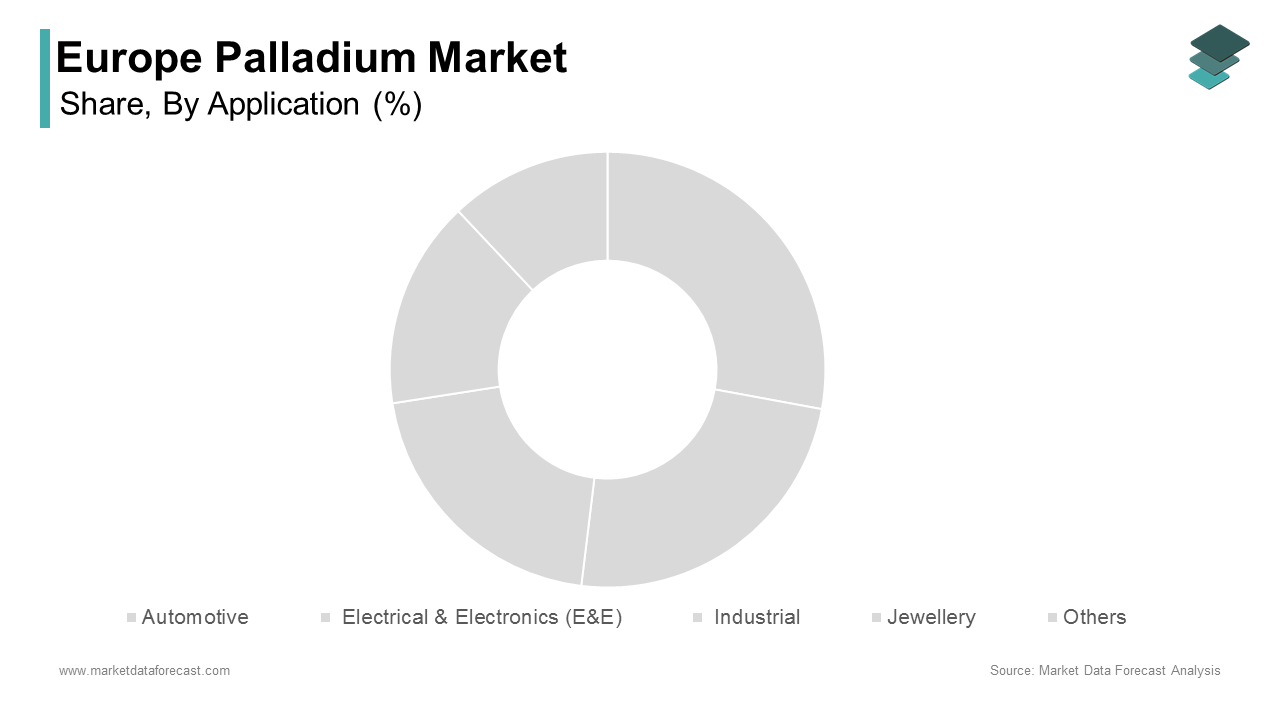
The electrical and electronics segment is expected to grow at the fastest CAGR of 11.4% from 2026 to 2034, with the European Chips Act, which mobilized over 43 billion euros in public and private investment to bolster semiconductor and advanced component manufacturing within the EU. Palladium is essential in multilayer ceramic capacitors, which are used in nearly every modern electronic device, and in electroplating for connector reliability. Additionally, the rollout of 5G infrastructure across Western Europe has increased demand for palladium-based surface mount components, as these materials offer superior signal integrity and thermal stability.
REGIONAL ANALYSIS
Germany Palladium Market Analysis
Germany was the largest contributor to the Europe palladium market with 28.2% of the share in 2025, with its world-leading automotive manufacturing sector, home to OEMs such as Volkswagen, BMW, and Mercedes-Benz, which collectively produced over 4.7 million passenger vehicles in 2025. Nearly all these vehicles utilized palladium-rich catalytic converters compliant with Euro 7 standards. Beyond automotive, Germany is Europe’s primary hub for industrial catalyst and chemical manufacturing, with companies like BASF and Clariant using palladium in hydrogenation and fine chemical synthesis. Germany’s National Hydrogen Strategy further stimulates demand with over 30 hydrogen pilot plants operational by year's end 2025, where many employ palladium membrane separators. Coupled with strict adherence to EU emissions directives and a robust circular economy framework, Germany’s integrated industrial ecosystem ensures its continued leadership in palladium consumption.
The United Kingdom Palladium Market Analysis
The United Kingdom palladium market was ranked second by capturing 16.8% in 2025, where the UK maintains stringent alignment with Euro 7 emissions standards through its own Vehicle Certification Agency regulations, sustaining demand for palladium in gasoline vehicle catalysts. The UK also hosts a specialized electronics manufacturing cluster around Cambridge and Glasgow focused on aerospace and defense systems, where palladium is used in high-reliability connectors and hybrid microcircuits.
France Palladium Market Analysis
France's palladium market growth is likely to be fuelled by the government’s economic planning agency. The country’s consumption is primarily driven by its automotive industry, led by Stellantis, which produced over 1.1 million vehicles in France during 2025. A majority of these were gasoline-powered models requiring palladium-loaded catalysts to meet EU emissions norms. France also maintains a strong jewelry sector due to its white luster and hypoallergenic properties, though this application has declined in favor of platinum and recycled gold. Furthermore, France’s Circular Economy Law mandates a 30% increase in urban mining by 2026, which is boosting secondary palladium recovery from electronic waste and catalytic converters.
Italy Palladium Market Analysis
Italy's palladium market growth is likely to be driven by the dual engine of automotive catalyst production and specialized industrial chemistry. Italy is home to FCA Heritage and other Stellantis assembly plants that produced approximately 700000 light-duty vehicles in 2025, most equipped with palladium-based catalytic systems. Additionally, Italy’s jewelry industry, centered in Vicenza, maintains a niche but consistent demand for palladium in white gold alloys, although this has diminished due to price volatility.
Russia Palladium Market Analysis
Russia's palladium market growth is likely to have prominent new opportunities in next coming years. Norilsk Nickel is the world’s largest palladium miner, supplying an estimated 40% of Europe’s palladium imports in 2021. Domestically, Russia’s limited but growing automotive catalyst production and aerospace electronics sector contribute modestly to end-use demand. The Skolkovo Innovation Center reported in 2025 increased R and D in palladium-based hydrogen sensors for industrial safety.
COMPETITION OVERVIEW
The Europe palladium market features intense competition among integrated refiners, catalyst manufacturers, and specialty chemical companies. Unlike commodity markets dominated by mines, the European landscape is shaped by firms that combine refining, recycling, formulation, and application engineering under one roof. This integration enables tighter control over quality, cost, and sustainability metrics, which are increasingly critical under EU regulations. Competition is not primarily on price but on technological capability, recovery efficiency, and supply chain reliability. Companies differentiate through innovation, low-loading catalysts, hydrogen purification membranes, and urban mining technologies. The absence of domestic mining means all players rely on imported or recycled feedstock, creating a level playing field based on processing expertise rather than resource ownership.
KEY MARKET PLAYERS
A few major players of the Europe palladium market include
- Nornickel
- Anglo American Platinum
- Sibanye-Stillwater
- Impala Platinum Holdings (Implats)
- Northam Platinum
- Johnson Matthey
- Heraeus Holding
- BASF SE
- Noritake Co
- Umicore
Top Strategies Used by the Key Market Participants
Key players in the Europe palladium market prioritize vertical integration to secure supply and manage volatility. They invest heavily in recycling infrastructure to recover palladium from end-of-life automotive catalysts and electronic waste, enhancing circularity. Companies actively develop low palladium or palladium-free catalyst formulations to mitigate cost and substitution risks. Strategic collaborations with the hydrogen and semiconductor industries open new demand avenues beyond automotive. Firms also deploy digital platforms for transparent raw material sourcing and price hedging. Continuous R and D in membrane and plating technologies strengthens their foothold in emerging sectors. Geographic diversification of supply chains reduces reliance on geopolitically sensitive regions like Russia. Participation in EU-funded sustainability initiatives aligns their operations with regulatory frameworks.
Leading Players in the Europe Palladium Market
Johnson Matthey
Johnson Matthey is a British multinational speciality chemicals and sustainable technologies company with deep involvement in the palladium value chain across Europe. The company supplies advanced catalyst formulations to major European automakers and operates refining facilities that recover palladium from end-of-life catalytic converters. In recent years, Johnson Matthey has intensified its focus on circular economy solutions by expanding its automotive catalyst recycling capacity at its facility in Royston, United Kingdom. The company also collaborates with hydrogen project developers to integrate palladium-based purification membranes into green hydrogen infrastructure. These initiatives reinforce its strategic positioning in both traditional and emerging palladium applications across the European market.
Umicore
Umicore is a Belgian materials technology and recycling group that plays a pivotal role in Europe’s palladium ecosystem through its catalyst production and precious metals recycling operations. Headquartered in Brussels, the company supplies high-performance palladium-based autocatalysts to European vehicle manufacturers while operating one of the continent’s largest precious metals refineries in Hanau, Germany. Umicore recently upgraded its recycling technology to achieve over 95% recovery efficiency for palladium from scrap. The company also invests in R and D for low palladium catalyst formulations aligned with Euro 7 standards.
Heraeus Precious Metals
Heraeus Precious Metals, a division of the German technology group Heraeus, is a leading player in the European palladium market through its refining, trading, and industrial application development activities. Based in Hanau, the company provides high-purity palladium to the electronics, automotive, and hydrogen sectors across Europe. Heraeus recently expanded its precious metals recycling hub to process increasing volumes of electronic waste and spent catalysts containing palladium. The company also launched a digital trading platform for critical raw materials to enhance supply chain transparency. Additionally, Heraeus collaborates with European research institutions on palladium membrane technologies for clean hydrogen production, reinforcing its commitment to next-generation applications beyond traditional uses.
MARKET SEGMENTATION
This research report on the Europe palladium market has been segmented and sub-segmented based on application and region.
By Application
- Automotive
- Electrical & Electronics (E&E)
- Industrial
- Jewellery
- Others
By Region
- UK
- France
- Spain
- Germany
- Italy
- Russia
- Sweden
- Denmark
- Switzerland
- Netherlands
- Turkey
- Czech Republic
- Rest of Europe