- Product Description Description
- Table of Contents TOC
- List of Table & Figure LOT
- Get Free Sample PDF Sample PDF
Market Size, 2025
$37.15 BnMarket Estimate, 2026
$40.12 BnMarket Forecast, 2034
$74.26 BnCAGR, 2026–2034
8%Europe Personal Computers Market Summary
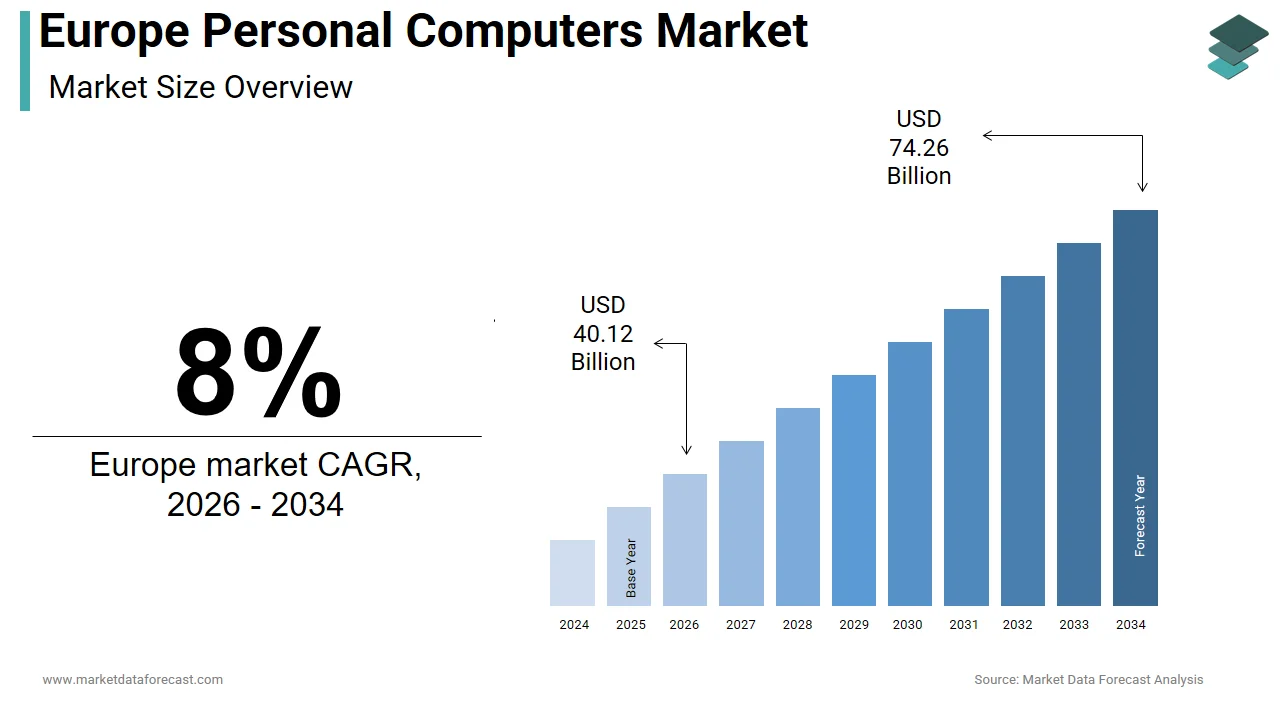
The European personal computers market was valued at USD 37.15 billion in 2025, is estimated to reach USD 40.12 billion in 2026, and is projected to reach USD 74.26 billion by 2034, registering a CAGR of 8% from 2026 to 2034. The growth of the European personal computers market is driven by rising remote and hybrid work culture, increasing digital transformation across businesses, growing demand for high-performance notebooks, and continuous technological advancements in processors and graphics. The expanding e-learning trend and the surge in gaming and content creation activities are further fueling the adoption of personal computers across the region.
Key Market Trends
- Rising demand for portable and high-performance notebooks driven by hybrid and remote working models.
- Increasing adoption of AI-powered and energy-efficient PCs with advanced chipsets and cloud integration.
- Growing popularity of gaming PCs and custom-built desktops due to the expansion of the European gaming community.
- Strong replacement demand for modernized enterprise computers with enhanced security and connectivity features.
- Expansion of e-learning and digital education programs across schools and universities supporting higher notebook and tablet usage.
Segmental Insights
- Based on Product: The notebooks segment led the European personal computers market, accounting for a substantial share in 2024. Its dominance is attributed to the growing adoption of lightweight, high-speed, and long-battery-life devices for professional, educational, and entertainment purposes. The shift toward flexible workplaces and mobile computing continues to strengthen notebook sales across both consumer and enterprise channels.
- Based on End Use: The commercial segment held the largest share of 54.8% in 2024, supported by the rising need for digital infrastructure modernization in enterprises and the growing use of personal computers for business analytics, operations, and collaboration. Demand from small and medium enterprises (SMEs) has also surged due to the adoption of cloud-based productivity tools and data management solutions.
Regional Insights
- The European personal computers market displays strong regional concentration in technologically advanced economies.
- Germany dominated the market with a 25.6% share in 2024, supported by its advanced industrial base, large enterprise sector, and rising remote workforce adoption.
- The United Kingdom and France showed consistent growth driven by increased business digitization, IT investments, and the expansion of education technology.
- Nordic countries such as Sweden and Finland demonstrated robust demand for sustainable, energy-efficient computing systems.
- Eastern Europe is experiencing rapid market growth due to increasing urban digitalization, growing e-commerce penetration, and government initiatives promoting digital literacy.
Competitive Landscape
- The European personal computers market is highly competitive, with major players focusing on innovation, performance optimization, and design differentiation to capture a wider customer base.
- Companies are introducing AI-integrated devices, sustainable product lines, and cloud-connected systems to align with the growing demand for intelligent and eco-friendly computing solutions.
- Prominent players in the European personal computers market include Lenovo Group Limited, Microsoft Corporation, Hewlett-Packard Development Company, L.P., Sony Corporation, Apple Inc., Micro-Star International Co. Ltd, NEC Corporation, AsusTek Computer Inc., Fujitsu Limited, Samsung Electronics Co., Ltd., Acer Inc., and Dell Technologies.
- These companies are emphasizing strategic partnerships, R&D investments, and channel expansion to strengthen their presence and capitalize on the growing demand for advanced personal computing solutions across Europe.
Europe Personal Computers Market Size
The Europe personal computers market was valued at USD 37.15 billion in 2025 and is projected to reach USD 74.26 billion by 2034 from USD 40.12 billion in 2026, registering a CAGR of 8% from 2026 to 2034.
Personal computers (PCs) are digital computing devices designed for use by one individual at a time. They typically consist of a central processing unit (CPU), memory (such as RAM), storage devices (hard drives or solid-state drives), and peripheral devices, including monitors, keyboards, and mice. Unlike markets driven purely by consumer upgrades, Europe’s PC landscape is heavily influenced by institutional procurement and policy frameworks. According to Eurostat, a notable share of households in the EU had internet access in 2023, with a portion owning at least one computer, reflecting deep digital penetration. According to the Eurostat data used in the 2023 Digital Economy and Society reports, 85.9% of Europeans aged 16 to 74 accessed the internet daily in 2023, not a specific figure for computer usage. This interplay of regulatory foresight, institutional investmen,t and digital dependency defines a market where functionality longevity, and compliance outweigh transient consumer trends.
MARKET DRIVERS
Institutional Procurement Through Public Sector and Education Initiatives
Government and educational institutions remain pivotal drivers for the growth of the Europe personal computers market. This is due to structured digital inclusion policies. According to the European Commission, over 28 billion euros were allocated to digital education under the Recovery and Resilience Facility between 2021 and 2023, with a significant portion dedicated to student device distribution. The implementation and scale of 1-to-1 device programs funded through the Recovery and Resilience Facility varied among EU member states by the end of 2023. These large-scale tenders favor durable standardized models with extended warranties, creating predictable volume demand insulated from consumer market volatility and strengthening the role of PCs as essential public infrastructure.
Prolonged Device Lifespan Driven by Economic and Regulatory Burdens
Consumers and organizations are retaining personal computers longer due to economic caution and new sustainability regulations, which further boost the expansion of the Europe personal computers market. According to sources, rising inflation across Europe has caused many households to postpone non-essential technology purchases. At the same time, the European Union’s new Right to Repair Directive requires manufacturers to ensure long-term availability of spare parts and software support for electronic devices, promoting better product durability. Manufacturers like Lenovo and HP now offer modular designs and upgradeable components to comply. This shift toward longevity reduces unit sales volume but increases demand for repair services, and high durability models align the market with circular economy principles.
MARKET RESTRAINTS
Supply Chain Disruptions and Geopolitical Trade Tensions
Persistent constraints from global supply chain fragility and export control measures are obstructing the growth of the Europe personal computers market. According to sources, Europe continued to face semiconductor shortages, with long delivery times for essential computer components due to heavy reliance on manufacturing in East Asia. As per research, trade restrictions introduced by the United States on advanced chips also had indirect effects on the availability of high-performance workstations in Europe, especially for AI and engineering fields. These disruptions delay deliveries, inflate costs, and force manufacturers to hold larger inventories, straining working capital. Physical and political obstacles make hardware inherently less adaptable than software when facing demand shifts or the need for new features.
High Cost of Living and Reduced Discretionary Consumer Spending
Economic headwinds have significantly dampened household demand, which restricts the growth of the Europe personal computers market. According to sources, inflation across the Eurozone has continued to put pressure on household budgets, with rising energy and food expenses limiting spending on discretionary goods. As per research, many consumers have chosen to delay new electronics purchases, with personal computers among the most commonly deferred items after smartphones. Higher production costs and currency movements have also pushed laptop prices upward, discouraging upgrades in several markets. This economic burden shifts demand toward budget models and refurbished devices, compressing margins for premium brands and slowing innovation adoption in the mass market.
MARKET OPPORTUNITIES
Expansion of Refurbished and Circular PC Ecosystems
Robust growth in certified refurbished and remanufactured devices driven by sustainability mandates and affordability needs creates new opportunities for the rise of the Europe personal computers market. Companies like Back Market and Circular Computing have scaled certified refurbishment operations across France, Germany, and the Netherlands, offering three-year warranties and carbon footprint savings of up to 80 percent compared to new devices. This formalized circular model meets both economic and environmental demands, creating a resilient secondary market that complements new device sales.
Integration of AI Capabilities in Productivity and Creative Workflows
These computers in Europe are evolving into AI-enabled productivity hubs as software and hardware converge to support next-generation workflows, which offer major prospects for the expansion of the Europe personal computers market. According to sources, a growing share of creative professionals and engineers across Western Europe are now relying on AI-powered tools for tasks such as design, data processing, and digital content development. These emerging applications from major software providers increasingly require hardware with built-in neural processing capabilities, leading to rising interest in system upgrades. This functional shift repositions PCs not as generic tools but as specialized AI workstations, justifying premium investments in enterprise and creative sectors.
MARKET CHALLENGES
E Waste Management and Compliance Burden Under New Regulations
Manufacturers and retailers face escalating operational complexity, which challenges the growth of the Europe personal computers market. This is due to Europe’s stringent electronic waste and repairability regulations. The EU’s Right to Repair Directive requires companies to maintain spare parts inventories for seven years and provide repair manuals to independent technicians. Small and medium brands struggle with these requirements, leading to market consolidation. Apart from these, national registries like Germany’s Stiftung EAR and France’s Ecologic impose divergent reporting formats, creating administrative overhead. These regulatory layers, while environmentally beneficial, increase time to market and reduce flexibility in product iteration.
Intensifying Competition from Mobile and Cloud-Based Alternatives
Sustained substitution burden from smartphones, tablets, and cloud-based computing solutions holds back the expansion of the Europe personal computers market. According to sources, smartphone use has become nearly universal across Europe, with most people now relying on mobile devices for communication, online engagement, and everyday productivity. As per research, cloud-based solutions are also gaining traction, allowing individuals to store and manage data more flexibly while decreasing dependence on personal computers. For many users, these alternatives fulfill daily digital needs without requiring a full PC purchase, particularly among younger demographics. This functional overlap erodes the necessity argument for personal computers outside professional or high-performance use cases.
REPORT COVERAGE
| REPORT METRIC | DETAILS |
| Market Size Available | 2025 to 2034 |
| Base Year | 2025 |
| Forecast Period | 2026 to 2034 |
| Segments Covered | By Product, End-user, and Region. |
| Various Analyses Covered | Global, Regional, and Country-Level Analysis, Segment-Level Analysis, Drivers, Restraints, Opportunities, Challenges; PESTLE Analysis; Porter’s Five Forces Analysis, Competitive Landscape, Analyst Overview of Investment Opportunities |
| Countries Covered | UK, France, Spain, Germany, Italy, Russia, Sweden, Denmark, Switzerland, Netherlands, Turkey, Czech Republic, and the Rest of Europe. |
| Market Leaders Profiled | Lenovo Group Limited, Microsoft Corporation, Hewlett-Packard Development Company, L.P., Sony Corporation, Apple Inc., Micro-Star International Co., Ltd, NEC Corporation, AsusTek Computer Inc., Fujitsu Limited, Samsung Electronics Co., Ltd., Acer Inc., Dell |
SEGMENTAL ANALYSIS
By Product Insights
The notebooks segment led the Europe personal computers market by accounting for a substantial share in 2025. The dominance of the notebooks segment is fuelled by mobility demands, institutional procurement, and hybrid work adoption. The structural shift toward flexible work arrangements has cemented notebooks as the default computing device across Europe. National education initiatives further amplify demand. These large-scale public tenders prioritize portability, durability, and standardized configurations, ensuring consistent volume demand. The notebook’s inherent mobility aligns perfectly with Europe’s policy-driven digital inclusion strategy, making it indispensable across both public and private sectors. European households increasingly favor notebooks due to urban living constraints and multifunctional usage patterns. Besides, the rise of cloud-based applications reduces reliance on local processing power, enabling thinner, lighter devices. This convergence of spatial practicality, functional versatility, and aesthetic preference supports the notebook’s dominance in the consumer segment.
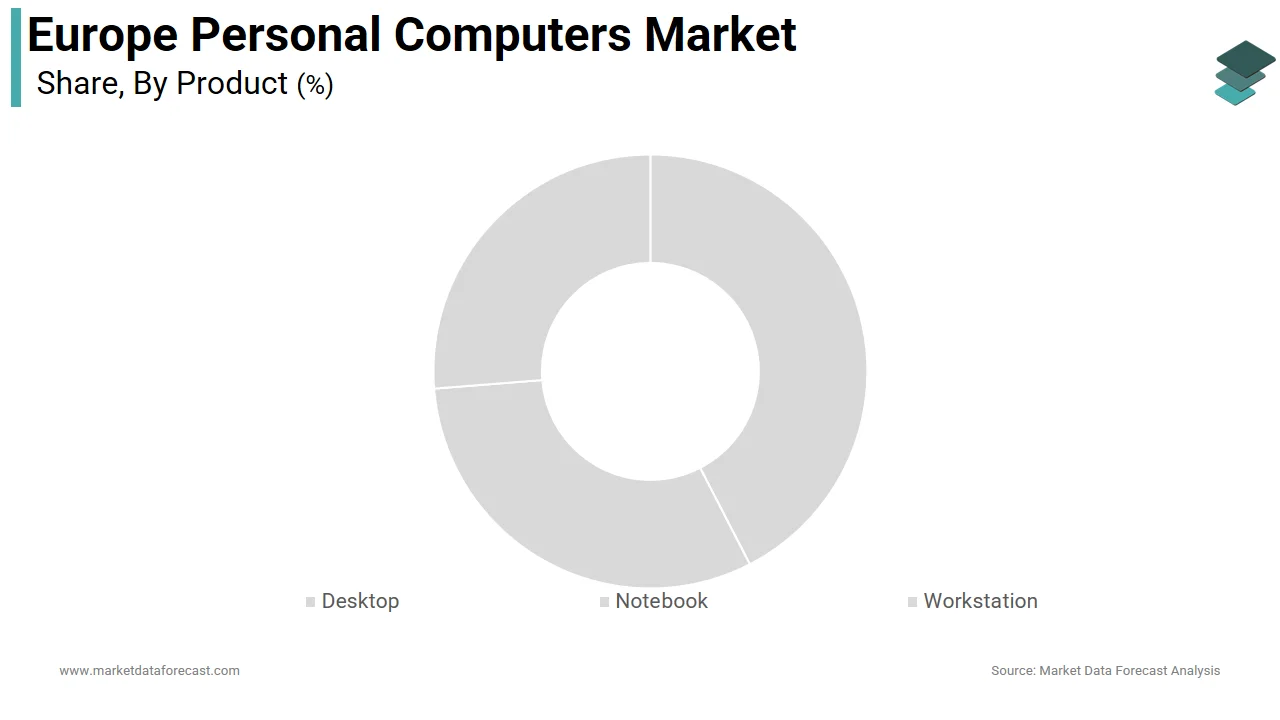
The workstations segment is likely to experience the fastest CAGR of 11.4%from 2024 to 2033. The rapid expansion of the workstations segment is fueled by specialized professional demand and AI integration. High-performance workstations are essential for complex computational tasks in Europe’s advanced industrial and academic sectors. The European Space Agency uses workstations for satellite design with processing requirements exceeding standard notebooks. The mission essential applications require certified hardware, ensuring stability and compatibility that consumer devices cannot provide. This specialized utility creates a resilient, high-value demand stream insulated from general PC market fluctuations. Workstations are evolving into AI-enabled productivity hubs as European regulations favor local data processing over cloud-based solutions. Furthermore, medical and financial institutions use secure workstations for sensitive data analysis, where cloud outsourcing poses regulatory risks. This convergence of performance, privacy, and policy compliance positions workstations as strategic assets in Europe’s digital sovereignty agenda.
By End Use Insights
The commercial segment held the largest share of 54.8% of the Europe personal computers market in 2024. The prominence of the commercial segment is due to structured corporate refresh cycles and digital transformation mandates. European businesses are compelled to modernize their IT infrastructure due to regulatory and operational imperatives. Apart from these, the EU’s Corporate Sustainability Reporting Directive mandates digital data collection systems, driving upgrades in professional services and manufacturing. Companies enforce standardized device policies across European operations, ensuring consistent procurement volumes. This regulatory-driven demand creates predictable multi-year replacement cycles independent of consumer sentiment. Commercial buyers prioritize lifecycle management over upfront cost through leasing and device-as-a-service models. This financial and operational efficiency cements the commercial segment as the market’s backbone.
The industrial end-use segment is on the rise and is expected to be the fastest-growing segment in the global market by witnessing a CAGR of 13.2% during the forecast period. The swift expansion of the industrial end-use segment is attributed to smart manufacturing and edge computing adoption. Ruggedized personal computers are increasingly embedded in production lines for real-time monitoring and control. Companies use panel PCs and box PCs on assembly lines to run SCADA and MES software with zero downtime requirements. These devices operate 24/7 in harsh environments where consumer-grade hardware would fail, making industrial PCs vital enablers of manufacturing digitization. Industrial PCs are evolving into edge computing nodes that process data locally to reduce latency and enhance security. Besides, GDPR compliance favors on-premises data handling, particularly in pharmaceutical and food processing, where traceability is mandatory. This functional shift from passive terminals to active intelligence units drives sustained growth in high-value industrial applications.
COUNTRY LEVEL ANALYSIS
Germany Personal Computers Market Analysis
Germany outperformed other regions in the European personal computers market in 2024 and captured 25.6% share in 2024. The domination of the Germany in the regional market driven by its advanced industrial base robust education infrastructure and strong corporate IT spending. According to sources, Germany’s public sector made substantial investments in computer systems, with a large share directed toward educational programs under national digitalization efforts. The country’s manufacturing industry also represents a key market for industrial and workstation-grade computers, as many factories continue upgrading their systems to align with modern automation and connectivity standards, as per research. The Federal Office for Information Security mandates regular device refreshes for important infrastructure, further stimulating demand. This combination of public investment, industrial digitization, and regulatory compliance secures Germany’s dominant position.
United Kingdom Personal Computers Market Analysis
The United Kingdom followed closely in the European personal computers market by accounting for 18.4% share in 2024. Strong consumer adoption and dynamic commercial sector activity have significantly contributed to the growth of the Europe personal computers market. London’s status as a global financial and tech hub drives commercial workstation sales with firms like Barclays and DeepMind requiring high-performance devices for data analysis and AI development. Apart from these, the UK’s departure from the EU has accelerated investments in sovereign cloud and local data processing infrastructure, increasing demand for secure PCs. This blend of household penetration, institutional programs, and professional services ensures the UK’s substantial market presence.
France Personal Computers Market Analysis
France remains an attractive region in the Europe personal computers market and is shaped by state-led digital inclusion and strong public sector procurement. The French National Cybersecurity Agency mandates regular hardware upgrades for government agencies to counter evolving threats, driving consistent commercial demand. Apart from these, France’s aerospace and automotive industries, including Airbus and Renault, rely on certified workstations for engineering design. This top-down digital strategy, combined with industrial innovation, maintains France’s notable market relevance.
Italy Personal Computers Market Analysis
Italy grew moderately in the European personal computers market, with educational modernization and growing SME digitization. According to sources, Italy’s national education plan has devoted substantial funding to modernizing classrooms with digital tools, leading to large-scale laptop adoption across schools. As per research, the country’s small and medium enterprises have also accelerated their digital transformation initiatives, increasing demand for computers to support online operations and cloud-based business management. In creative industries such as design and fashion, professionals continue to rely on high-performance workstations for 3D modeling and virtual presentations. This convergence of education supports SME adoption, and the creative industry needs to sustain Italy’s steady market growth.
Netherlands Personal Computers Market Analysis
The Netherlands is likely to expand in the European personal computers market owing to its advanced digital infrastructure and progressive circular economy policies. The country is a hub for European data centers and tech companies, including ASML and Booking.com, which require high-performance workstations for R and D. Furthermore, the Dutch government’s initiative funded for public sector digitization in 2023. This combination of environmental consciousness, corporate innovation, and public investment positions the Netherlands as a high-value forward forward-looking market.
COMPETITIVE LANDSCAPE
The Europe personal computers market features intense competition among global leaders who differentiate through regulatory compliance, sustainability, and enterprise services rather than price alone. Lenovo, HP, and Dell dominate through extensive public sector contracts, education deployment, and commercial leasing programs, while Apple maintains a premium niche in creative and consumer segments. Competition is shaped by the EU’s stringent environmental and cybersecurity regulations, which favor established players with robust compliance infrastructure and local service networks. The rise of device-as-a-service models has shifted focus from unit sales to lifecycle management, creating sticky customer relationships. Meanwhile, smaller brands struggle with the cost of meeting repairability and recycling mandates, leading to market consolidation. Innovation centers on AI integration, edge computing, and circular design rather than raw performance, as European buyers prioritize longevity, security, and sustainability over specifications.
KEY MARKET PLAYERS
Some of the companies that are playing a dominating role in the Europe personal computers market include
- Lenovo Group Limited
- Microsoft Corporation
- Hewlett-Packard Development Company, L.P.
- Sony Corporation
- Apple Inc.
- Micro-Star International Co. Ltd
- NEC Corporation
- AsusTek Computer Inc.
- Fujitsu Limited
- Samsung Electronics Co., Ltd.
- Acer Inc.
- Dell
Top Players in the Europe Personal Computers Market
- Lenovo Group maintains a strong presence in the Europe personal computers market through its diversified portfolio spanning consumer notebooks, commercial ThinkPads, and high-performance workstations. The company leverages its global supply chain and localized service networks to serve public sector education and enterprise clients across the continent. Lenovo has aligned its European strategy with sustainability mandates by introducing devices compliant with the EU Right to Repair Directive, featuring modular designs and longer software support. In recent years, the company expanded its device-as-a-service offerings in partnership with European leasing firms to support corporate digital transformation. It also established regional repair centers in Germany and the Netherlands to reduce e-waste and enhance customer retention through lifecycle management.
- HP Inc. is a key player in the Europe personal computers market with deep integration in education, commercial, and industrial segments. The company supplies ruggedized devices to European schools under national digital inclusion programs and provides secure workstations to engineering and healthcare institutions. HP has prioritized circular economy principles by incorporating recycled ocean-bound plastics into its Elite and ProBook lines and achieving carbon-neutral certification for several European manufacturing facilities. Recently, the company enhanced its HP Wolf Security suite to meet NIS2 Directive requirements, offering hardware-enforced protection against advanced threats. These initiatives support HP’s position as a trusted partner for compliant, secure, and sustainable computing solutions across public and private sectors.
- Dell Technologies holds a significant footprint in the Europe personal computers market, particularly in the commercial and workstation categories. The company serves major European corporations, financial institutions, and research organizations with its Latitude Precision and OptiPlex product lines. Dell has strengthened its European operations by expanding its configuration centers in Ireland and Poland to enable faster delivery and customization. The company also launched its Dell Technologies APEX device as a service platform across Western Europe, providing end-to-end lifecycle management, including deployment support and recycling. Apart from these, Dell collaborates with EU-funded AI initiatives to optimize workstation performance for local language models, ensuring compliance with GDPR through on-device processing capabilities.
Top Strategies Used by the Key Market Participants
Key players in the Europe personal computers market focus on compliance with EU regulations such as the Right to Repair Directive and Ecodesign requirements by designing modular devices with longer software support and recyclable materials. They expand device-as-a-service and leasing models to cater to commercial and public sector demand for predictable IT expenditure. Companies invest in localized repair and recycling infrastructure to meet circular economy targets and reduce e-waste. Strategic partnerships with educational institutions and government agencies secure large-scale procurement contracts. Besides, they enhance hardware-based security features to comply with NIS2 and GDPR mandates while integrating AI capabilities for on-device processing to support Europe’s digital sovereignty agenda.
EUROPE PERSONAL COMPUTERS MARKET NEWS
- In September 2023, Dell Technologies expanded its APEX device as a service platform to include AI-ready workstations compliant with GDPR data processing requirements.
- In April 2024, HP Inc. enhanced its HP Wolf Security suite with hardware-enforced protection features aligned with the EU NIS2 Directive.
MARKET SEGMENTATION
This research report on the Europe personal computers market has been segmented and sub-segmented into the following categories.
By Product
- Desktop
- Notebook
- Workstation
By End Use
- Consumer
- Commercial
- Industrial
By Region
- United Kingdom
- France
- Spain
- Germany
- Italy
- Russia
- Sweden
- Denmark
- Switzerland
- Netherlands
- Rest of Europe