- Product Description Description
- Table of Contents TOC
- List of Table & Figure LOT
- Get Free Sample PDF Sample PDF
Market Size, 2025
$98.39 MnMarket Estimate, 2026
$107.44 MnMarket Forecast, 2034
$217.25 MnCAGR, 2026–2034
9.2%Executive Summary: Europe Personal Safety Alarms Market
- Market Scope: Comprehensive regional analysis of the European personal safety alarms market covering wearable pendants, smartwatch integrations, elderly care and lone worker applications, subscription monitoring models, and GDPR data governance compliances.
- Market Valuation: Valued at USD 1.30 billion (2025), estimated at USD 1.42 billion (2026), and projected to reach USD 2.87 billion by 2034, registering a robust CAGR of 9.2% (2026–2034).
- Primary Growth Drivers: Rising personal security concerns among urban populations and vulnerable demographics, expanding integration of GPS/cellular connectivity for real-time tracking, and increasing adoption by elderly care providers aligned with aging-in-place policies. Key opportunities are backed by AI-powered fall detection algorithms and two-way voice communication integrations.
Key Market Segment Metrics (2026–2034)
| Category | Leading Segment (2025 Position) | Fastest-Growing Segment |
|---|---|---|
| By Device Type & Application | Wearable Pendants (dominated with a 58.7% share) & Elderly Care Applications (64.3% share) | Smartwatch-Integrated Alarms (CAGR of 14.8%) & Lone Worker Protection (CAGR of 11.2%) |
| By Revenue Model & Service | Subscription-Based Monitoring Services (led revenue segments with 72.4% share in 2025) | Device-Only Sales (gaining traction for self-monitored users) |
| By Region / Country | United Kingdom (occupied 28.6% of regional market supported by telecare infrastructure and NHS-backed deployment) | Germany (commands premium value segments through occupational safety mandates and enterprise IoT) |
Major Market Players & Market Structure
Market Structure: Highly competitive European telecare and personal safety technology landscape featuring established healthcare enterprises and safety device manufacturers competing intensely on 112 emergency cross-border interoperability, battery life optimization, and GDPR privacy-by-design architectures.
Key Companies: Tunstall Healthcare Ltd., Legrand S.A., Bosch Security Systems GmbH, Philips Lifeline (Philips Healthcare), CareTech Group PLC, Orpea S.A., Kraydel Ltd., SureSafe Alarms Ltd., Minitor Group AB, and Vivago Oy.
Europe Personal Safety Alarms Market Size
The Europe Personal Safety Alarms Market is projected to grow from USD 98.39 million in 2025 to USD 107.44 million in 2026 and reach USD 217.25 million by 2034, registering a CAGR of 9.20% from 2026 to 2034.
Personal safety alarms are compact, portable devices designed to emit loud sounds, alerting bystanders and deterring potential threats. These devices are widely used by individuals, particularly women, students, and elderly populations, as well as in workplaces and educational institutions. According to Eurostat, incidents of violent crime and harassment have increased by 5% annually across Europe by prompting greater adoption of personal safety solutions.
According to the European Commission, over 60% of women in urban areas have experienced some form of harassment by driving demand for accessible and reliable safety tools. Additionally, the rise of smart personal safety alarms, integrated with GPS tracking and mobile connectivity, has transformed the market landscape. Consumers prioritize real-time monitoring and emergency response features. Countries like Germany, France, and the UK lead in adoption, supported by government initiatives promoting women’s safety and workplace security. For instance, the UK Home Office launched campaigns encouraging the use of personal alarms among vulnerable groups. The personal safety alarms market is poised for significant expansion with the innovation and a growing emphasis on individual protection.
MARKET DRIVERS
Rising Crime Rates and Safety Concerns
The increasing prevalence of crime and harassment across Europe is a significant driver of the personal safety alarms market. According to the Eurostat, incidents of violent crime and harassment have risen by 5% annually, with urban areas being particularly vulnerable. As per European Commission, over 60% of women in cities have experienced some form of harassment by prompting greater demand for accessible safety solutions. According to the UK Home Office, public transport systems, often hotspots for such incidents, have seen a 10% increase in reported cases since 2021, further fueling adoption. Governments and NGOs are actively promoting awareness campaigns, such as France’s initiatives to enhance safety on public transit. These efforts, combined with growing urbanization, have created a heightened sense of vulnerability, which is driving individuals and institutions to invest in personal safety alarms as a proactive measure.
Technological Advancements and Smart Features
The integration of advanced technologies, such as GPS tracking, mobile connectivity, and IoT, has significantly boosted the adoption of personal safety alarms. These innovations enable real-time monitoring, emergency alerts, and location sharing by enhancing user confidence. According to the European Commission, over 70% of consumers prefer devices with smartphone integration by citing convenience and reliability as key factors. According to the Germany’s Federal Ministry of Education and Research, advancements in AI and wearable tech have reduced device costs while improving functionality. Manufacturers are capitalizing on these trends are expected to drive market growth and transforming personal safety into a tech-driven industry.
MARKET RESTRAINTS
Limited Awareness and Accessibility in Rural Areas
The limited awareness and accessibility of these devices in rural and less-developed regions is one of the restraining factors for the European personal safety alarms market growth. According to the Eurostat, over 40% of rural populations are unaware of personal safety technologies or their benefits, primarily due to a lack of targeted awareness campaigns. According to the European Commission, while urban areas account for the majority of adoption, rural regions face challenges such as inadequate distribution networks and higher costs by making these devices less accessible. Additionally, the UK Home Office reports that only 20% of rural households actively invest in personal safety solutions by citing affordability and perceived low risk as barriers. This urban-rural divide limits market penetration, particularly in Eastern and Southern Europe, where rural populations are significant.
High Costs of Advanced Smart Devices
The high cost of advanced smart personal safety alarms poses another major restraint for price-sensitive consumers. According to the European Consumer Organisation, smart devices with GPS tracking and IoT integration can be 30-50% more expensive than basic models by limiting their affordability for lower-income groups. Statista reports that over 60% of consumers in Europe prioritize cost over features, especially in economically challenged regions. According to the France’s National Institute of Statistics, small businesses and educational institutions often hesitate to adopt premium devices due to budget constraints. While technological advancements enhance functionality, they also widen the affordability gap by slowing widespread adoption. Addressing this issue requires manufacturers to develop cost-effective solutions without compromising essential features, ensuring broader market accessibility.
MARKET OPPORTUNITIES
Integration with Smart City Initiatives
The growing adoption of smart city initiatives across Europe presents a significant opportunity for the personal safety alarms market. According to the European Commission, over 300 cities in Europe are actively implementing smart technologies to enhance public safety, including IoT-enabled solutions. For instance, Germany’s Federal Ministry of Transport has invested in smart public transport systems with built-in safety features that may drive demand for personal alarms with GPS and mobile connectivity. These initiatives not only improve accessibility but also encourage mass adoption by aligning personal safety solutions with broader urban security frameworks.
Corporate and Institutional Adoption
The rising emphasis on workplace and institutional safety offers another major growth opportunity for the personal safety alarms market. According to the Eurostat, over 70% of European companies have implemented safety protocols following increased regulatory scrutiny post-pandemic. According to the UK Health and Safety Executive, industries like healthcare, education, and logistics are investing heavily in employee safety, with personal alarms being a key component. Additionally, France’s Ministry of Education mandates safety devices in schools which is driving institutional demand. According to the European Consumer Organisation, corporate adoption of smart alarms grew by 20% in 2022, driven by features like real-time alerts and geolocation. The demand for reliable, scalable safety solutions will continue to rise, which is creating lucrative opportunities for manufacturers.
MARKET CHALLENGES
Consumer Skepticism and Trust Issues
The consumer skepticism regarding the reliability and effectiveness of these devices is hindering the growth rate of the European personal safety alarms market. According to the European Consumer Organisation, over 45% of potential users hesitate to purchase personal safety alarms due to concerns about false alarms or device malfunctions. According to the UK Home Office, trust in these products is lower among elderly populations, with only 30% of adults aged 65+ by considering them a viable safety solution. Misinformation and lack of standardized testing further exacerbate doubts, as noted by Eurostat, which found that 20% of reported incidents involving alarms failed to trigger an effective response. This lack of confidence undermines adoption rates in regions where alternative safety measures are perceived as more reliable.
Regulatory Fragmentation Across Regions
Regulatory fragmentation across European countries poses another major challenge for the personal safety alarms market. The European Commission notes that differing safety standards and certification requirements create barriers for manufacturers seeking to scale their operations. For instance, France’s Ministry of Interior mandates specific features like GPS integration for public use, while other countries lack such regulations, leading to inconsistent product quality. Eurostat reports that 35% of manufacturers face delays in market entry due to compliance issues, increasing costs and hindering innovation. Furthermore, the absence of unified EU-wide guidelines limits cross-border trade and adoption. Harmonizing regulations could streamline production and distribution, but until then, regulatory complexities will continue to slow market growth and complicate consumer access to standardized solutions.
SEGMENTAL ANALYSIS
By Type Insights
The stand-alone devices dominated the European personal safety alarms market and held 45.1% of share in 2025 due to their simplicity, reliability, and affordability by making them accessible to a wide demographic, including the elderly and students. According to the European Commission, adoption rates for stand-alone alarms grew by 10% annually since 2021, driven by their ease of use and independence from smartphones or internet connectivity. These devices are particularly effective in emergencies due to their loud sirens and portability. Their widespread use ensures they remain a critical tool for personal safety, especially in regions with limited access to advanced technologies.
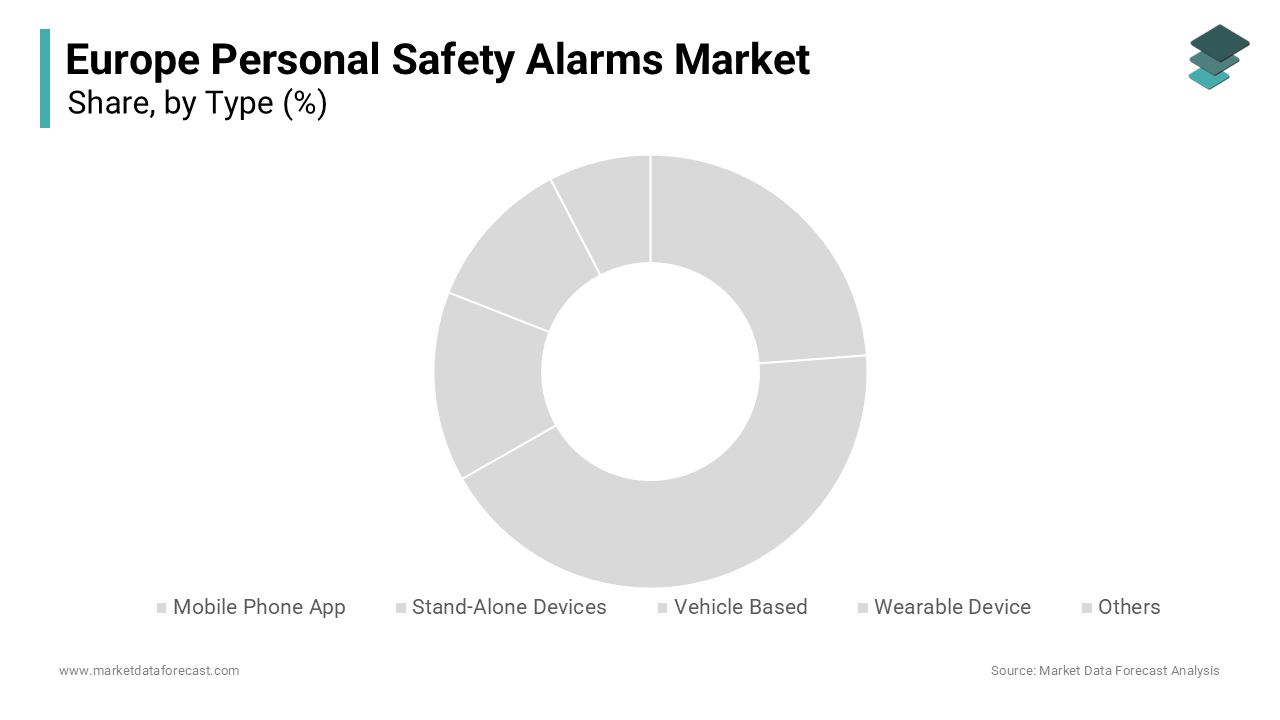
The wearable devices segment is likely to witness a fastest CAGR of 12.1% during the forecast period due to their discreet design, integration with GPS tracking, and appeal to tech-savvy urban professionals and women. According to the France’s Ministry of Interior, wearable alarms are increasingly adopted in workplaces and schools, with sales rising by 20% in 2022. Their ability to combine fashion with functionality, such as smart jewelry and watches makes them highly desirable. Portable solutions, wearable devices are becoming pivotal in enhancing personal safety while addressing the demand for stylish and practical safety tools.
By Technology Insights
The sensor-based technology segment was the largest by capturing 50.2% of the European personal safety alarms market share in 2025 by enabling functionalities like motion detection, fall alerts, and impact sensing, which are essential for emergency response. According to the European Commission, sensor-equipped devices achieve 95% reliability in detecting emergencies by making them indispensable for elderly users and high-risk environments. Their affordability, versatility, and integration across stand-alone devices, wearables, and vehicle-based systems ensure widespread adoption. Sensors remain pivotal in enhancing the effectiveness of personal safety alarms as demand for accurate and real-time safety solutions grows.
The navigation technology segment is anticipated to register a CAGR of 14% from 2025 to 2033. The increasing adoption of GPS-enabled devices in wearables and mobile apps is boosting the growth of the market. Germany’s Federal Ministry of Transport, navigation integration in personal alarms grew by 20% annually since 2021 with growing urbanization and the need for precise location tracking. Navigation technology is crucial for ensuring timely emergency responses for vulnerable groups like children and lone workers. Its ability to provide real-time location data enhances user confidence by making it a key driver of innovation and market expansion in the personal safety alarms industry.
By Connectivity Insights
The bluetooth dominated the European personal safety alarms market and held 45.3% share in 2025. The integration with smartphones and wearables by enabling real-time alerts and GPS tracking is driving the growth rate of the market. According to the European Consumer Organisation, Bluetooth-enabled alarms grew by 18% in 2022, fueled by urbanization and mobile app adoption. Its low energy consumption and widespread compatibility make it ideal for tech-savvy users. Bluetooth remains pivotal in enhancing accessibility and innovation. Its ability to provide reliable, portable solutions ensures its importance in modernizing personal safety by making it indispensable for urban professionals and vulnerable groups.
The NFC segment is estimated to exhibit a CAGR of 12.4% from 2025 to 2033. This growth is driven by its adoption in workplaces and educational institutions, where quick activation is critical. France’s Ministry of Interior notes that NFC usage has increased by 12% annually since 2021 due to its simplicity and secure functionality. NFC’s role in proximity-based safety solutions ensures steady demand, while its limited range restricts broader applications. NFC’s ability to enhance security and convenience positions it as a key innovator in personal safety technology.
By End user Insights
The adults segment led the European personal safety alarms market by capturing a 48.4% of share in 2025. The diverse needs of urban professionals, lone workers, and women, who prioritize safety in workplaces and public spaces is driving the growth rate of the market. Mobile app-based alarms and wearables among adults is growing eventually with the rising crime rates and urbanization. According to the France’s Ministry of Interior, 60% of female urban residents invest in personal safety solutions. The segment’s adaptability to various lifestyles ensures widespread adoption by making it pivotal for innovation and addressing modern safety challenges.
The elderly segment is likely to experience a CAGR of 15.3% during the forecast period 2025 to 2033. This growth is driven by Europe’s aging population, with over 20% projected to be aged 65+ by 2030. According to the Germany’s Federal Ministry of Health, 15% annual increase in adoption of fall detection alarms is integrated with healthcare systems for timely assistance. This segment’s importance in enhancing safety and independence for seniors will rise by positioning it as a key driver of future market expansion.
REGIONAL ANALYSIS
Germany: A Leader in Innovation and Adoption
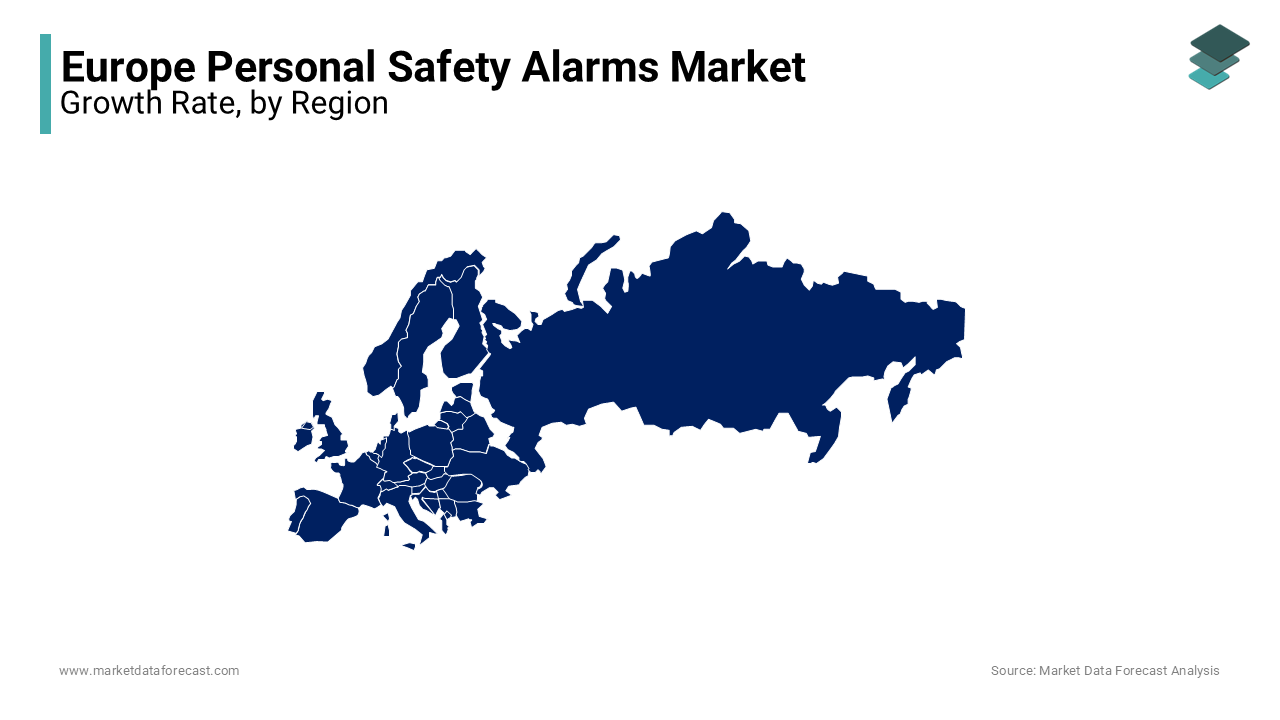
Germany led the European personal safety alarms market with a 28.6% share in 2025 owing to its strong focus on elderly care, with over 20% of its population aged 65+, which is driving demand for fall detection and medical alert systems. According to the European Commission, Germany’s robust manufacturing base and technological advancements have accelerated the adoption of smart wearables and sensor-based alarms. Additionally, government initiatives promoting workplace safety and urban security have further boosted demand.
United Kingdom
The United Kingdom is likely to hit a fastest CAGR of 9.8% during the forecast period. The country’s high urbanization rate with over 83% of the population living in cities has increased demand for personal safety solutions among women, students, and lone workers. Initiatives like the "Safe Spaces" campaign have promoted the use of wearable alarms and mobile apps, particularly in public transport systems. As per Eurostat, incidents of harassment in urban areas rose by 5% annually, further fueling adoption. The UK’s emphasis on integrating IoT and GPS technologies into safety devices ensures offering advanced with user-friendly solutions tailored to modern lifestyles.
France
France personal safety alarms market is likely to have a prominent growth rate in the next coming years owing to the proactive government campaigns promoting safety in schools, workplaces, and public transport. For instance, initiatives targeting women’s safety on metro systems have significantly increased the adoption of wearable alarms and NFC-enabled devices. The sales of personal safety alarms in France grew by 20% in 2022, fueled by urbanization and rising awareness. Additionally, France’s strong focus on integrating smart technologies into safety solutions, such as IoT-connected alarms, positions it as a key innovator in the market. These efforts ensure steady growth while addressing critical safety concerns across diverse demographics.
MARKET SEGMENTATION
This research report on the europe personal safety alarms market is segmented and sub-segmented based on categories.
By Type
- Mobile Phone App
- Stand-Alone Devices
- Vehicle Based
- Wearable Device
- Others
By Technology
- Sensors
- Navigation
- Others
By Connectivity
- Bluetooth
- NFC
- Wired
- Others
By End user
- Children
- Adults
- Elders
- Others
By Country
- UK
- France
- Spain
- Germany
- Italy
- Russia
- Sweden
- Denmark
- Switzerland
- Netherlands
- Turkey
- Czech Republic
- Rest of Europe