- Product Description Description
- Table of Contents TOC
- List of Table & Figure LOT
- Get Free Sample PDF Sample PDF
Market Size, 2025
$203.81 MnMarket Estimate, 2026
$217.97 MnMarket Forecast, 2034
$373.12 MnCAGR, 2026–2034
6.95%Executive Summary: Europe Petrochemical Market
- Market Scope: Comprehensive regional analysis tracking base chemicals, intermediates, and derivatives (ethylene, propylene, butadiene, benzene, xylene, toluene, and methanol) across European country-level markets.
- Market Valuation: Valued at USD 203.81 million in 2025, reaching USD 217.97 million in 2026, and projected to expand to USD 373.12 million by 2034, growing at a steady CAGR of 6.95% during the forecast period (2026–2034).
- Primary Growth Drivers: Strong downstream manufacturing demand from automotive, construction, and packaging sectors, and operational flexibility through vertical integration with refinery complexes. Key restraints include stringent carbon pricing/industrial emissions regulations and persistent feedstock cost disadvantages relative to US and Middle Eastern producers.
Key Market Segment Metrics (2026–2034)
| Category | Leading Segment (2025 Position) | Fastest-Growing Segment |
|---|---|---|
| By Product | Ethylene (held a dominant share in 2025 as the core foundational precursor for polyethylene, packaging, and engineering plastics) | Methanol (projected to expand at an anticipated CAGR of 9.2% driven by marine fuel blending and low-carbon energy storage) |
| By Region | Germany (top performer capturing 34.2% share in 2025, anchored by integrated chemical parks like Ludwigshafen and the Rhine cluster) | France (positioned second with refinery-integrated production assets) and the UK (supported by freeport investments and green hydrogen) |
Major Market Players & Market Structure
Market Structure: Highly competitive landscape comprising large integrated chemical majors, regional specialists, and emerging circular economy innovators competing on decarbonization, feedstock resilience, and sustainability credentials.
Key Companies: BASF SE, INEOS Group Ltd, TotalEnergies SE, LyondellBasell Industries, SABIC, Covestro AG, and Evonik Industries AG.
Europe Petrochemical Market Size
The Europe petrochemical market size was calculated at USD 203.81 million in 2025 and is anticipated to reach USD 373.12 million by 2034, from USD 217.97 million in 2026, growing at a CAGR of 6.95% during the forecast period.
The petrochemical industry is the integrated production and distribution of base chemicals, intermediates, and derivatives sourced primarily from naphtha, natural gas liquids, and increasingly, recycled feedstocks. These materials serve as essential building blocks for plastics, synthetic rubbers, solvents, fertilizers, and specialty chemicals used across automotive, construction, packaging, and pharmaceutical sectors. The sector faces mounting pressure under the European Green Deal, which mandates a 55% net reduction in greenhouse gas emissions by 2030 compared to 1990 levels. Simultaneously, the EU’s Circular Economy Action Plan requires that all plastic packaging be reusable or recyclable by 2030, which is compelling producers to innovate in chemical recycling and bio-based alternatives.
MARKET DRIVERS
Strong Downstream Manufacturing Demand Sustains Petrochemical Consumption
The extensive downstream manufacturing base continues to drive consistent demand for petrochemical derivatives despite macroeconomic headwinds is propelling the growth of the Europe petrochemical market. The automotive sector alone consumed over 4.2 million metric tons of engineering plastics in 2025, with polymers such as polypropylene, polycarbonate, and polyamides used in interior components, lightweight structural parts, and electric vehicle battery housings. Similarly, the construction industry is responsible for 9% of EU GDP, as per the European Construction Federation, which relies heavily on polyvinyl chloride for piping insulation and window profiles with annual consumption exceeding 6 million metric tons. The packaging sector also remains a major consumer, utilizing over 15 million metric tons of polyethylene and polyethylene terephthalate annually for food and medical applications, as documented by Plastics Europe.
Integration with Refinery Complexes Enhances Feedstock Security and Cost Efficiency
The vertical integration of Europe’s petrochemical operations with major refinery hubs provides a strategic advantage in feedstock sourcing and operational flexibility, which is driving the growth of Europe's petrochemical market. This configuration enables real-time adjustment between fuel and chemical production based on market signals, with a capability during periods of diesel or gasoline demand fluctuation. For instance, during the 2022 energy crisis, several integrated sites in Germany and the Netherlands increased naphtha allocation to petrochemical units as jet fuel margins collapsed. According to the International Energy Agency, such refineries can shift up to 15% of crude throughput toward chemical yield without major capital modifications.
MARKET RESTRAINTS
Stringent Carbon Pricing and Industrial Emissions Regulations Increase Operating Costs
The European Union’s aggressive climate policy framework imposes significant financial and operational burdens on petrochemical producers through escalating carbon costs and emissions compliance requirements. The stringent carbon pricing and industrial emissions regulations are increasing operating costs is restricting the growth of the Europe petrochemical market. The Industrial Emissions Directive further mandates Best Available Techniques for all large installations, which requires costly retrofits for flue gas treatment, solvent recovery, and leak detection systems. These regulatory layers increase capital expenditure and operational overhead, eroding margins, particularly for commodity products with global price competition.
Feedstock Disadvantage Relative to US and Middle East Producers Undermines Global Competitiveness
The petrochemical industry operates at a persistent feedstock cost disadvantage compared to regions endowed with low-cost shale gas or associated petroleum gas is hampering the growth of the Europe petrochemical market. While US Gulf Coast ethane prices averaged 250 dollars per metric ton in 2025, according to the US Energy Information Administration, European naphtha costs hovered near 700 dollars per metric ton as reported by Platts, more than doubling olefin production expenses. Similarly, Middle Eastern producers benefit from subsidized ethane at under 150 dollars per metric ton, enabling export of polyethylene and polypropylene at prices often below European manufacturing cost.
MARKET OPPORTUNITIES
Expansion of Chemical Recycling Infrastructure Creates Circular Feedstock Pathways
The rapid development of chemical recycling technologies that decouple petrochemical production from fossil resources, while complying with circular economy mandates, is driving the growth of the Europe petrochemical market. According to the European Chemical Industry Council, over 25 commercial-scale chemical recycling plants are now operational or under construction across the EU, with combined capacity exceeding 1 million metric tons per year as of 2025. Companies like BASF, LyondellBasell, and SABIC are already integrating certified circular naphtha into their cracker operations under mass balance accounting recognized by ISCC Plus. The European Commission’s revised Packaging and Packaging Waste Regulation mandates that 10% of new plastic packaging must contain recycled content by 2030, creating pull demand for these secondary feedstocks. This emerging ecosystem not only reduces fossil dependence but also positions Europe as a leader in circular molecular management with potential for exportable technology and standards.
Electrification of Steam Crackers Enables Deep Decarbonization of Core Processes
The piloting and scale-up of electrically driven steam crackers represent a transformative opportunity for Europe to reconcile petrochemical production with net-zero ambitions, which is also enhancing the growth of Europe's petrochemical market. Traditional crackers rely on fossil-fueled furnaces emitting 250 million metric tons of CO₂ annually across the EU, as estimated by the European Environment Agency. In 2025, BASF SABIC and Linde commissioned the world’s first industrial-scale electric cracker demo in Ludwigshafen, Germany, capable of producing 50 kilotons of ethylene per year with zero process CO₂. The European Commission’s Innovation Fund has allocated over 800 million euros to support such projects under its Low Carbon Industrial Partnerships initiative.
MARKET CHALLENGES
Energy Intensity and Volatility Threaten Long-Term Operational Stability
The petrochemical sector’s extreme energy dependence renders it acutely vulnerable to supply disruptions and price spikes that compromise production continuity and investment security is hampering the growth of Europe's petrochemical market. Steam crackers alone consume 28 to 35 gigajoules of energy per metric ton of ethylene, as per the International Energy Agency, making them among the most energy-intensive industrial processes. During the 2022 energy crisis, European natural gas prices surged above 300 euros per megawatt hour, prompting temporary shutdowns at sites in France and It,aly, according to the European Chemical Industry Council. The lack of long-term fixed price renewable power purchase agreements further exposes producers to market volatility.
Policy Fragmentation and Slow Permitting Hinder Low-Carbon Transition Investments
EU-level climate goals, national regulatory divergence, and bureaucratic delays significantly obstruct the deployment of next-generation petrochemical infrastructure is also degrading the growth of Europe's petrochemical market. Projects involving carbon capture, electrification, or chemical recycling often face multi-year permitting processes due to overlapping environmental zoning and safety regulations. In France, a proposed e-cracker project was stalled for 18 months, awaiting air emissions permits, while in the Netherlands, community opposition delayed a pyrolysis plant despite national policy support. This administrative inertia contrasts sharply with streamlined procedures in the United States under the Inflation Reduction Act. Consequently, European producers are increasingly redirecting capital to jurisdictions with faster approval cycles, weakening the region’s ability to retain technological leadership.
REPORT COVERAGE
| REPORT METRIC | DETAILS |
| Market Size Available | 2025 to 2034 |
| Base Year | 2025 |
| Forecast Period | 2026 to 2034 |
| CAGR | 6.95% |
| Segments Covered | By Product and Region |
| Various Analyses Covered | Global, Regional & Country Level Analysis; Segment-Level Analysis; DROC, PESTLE Analysis; Porter’s Five Forces Analysis; Competitive Landscape; Analyst Overview of Investment Opportunities |
| Regions Covered | UK, France, Spain, Germany, Italy, Russia, Sweden, Denmark, Switzerland, Netherlands, Turkey, and the Czech Republic |
| Market Leaders Profiled | BASF SE, INEOS Group Ltd, TotalEnergies SE, LyondellBasell Industries, SABIC, Covestro AG, Evonik Industries AG |
SEGMENTAL ANALYSIS
By Product Insights
The ethylene segment accounted in holding a dominant share of the Europe petrochemical market in 2025, with its foundational role as a precursor to a vast array of derivatives essential to modern industry. Over 60% of ethylene produced in Europe is converted into polyethylene, with the most widely used plastic globally by serving packaging films, containers, and pipes. According to Plastics Europe, more than 15 million metric tons of polyethylene were consumed in the EU in 2025 alone, driven by food safety regulations, medical device demand, and e-commerce packaging growth. Ethylene is also critical for ethylene oxide, ethylene glycol, and vinyl acetate monomer production, used in antifreeze, textiles, and adhesives, respectively. The automotive sector utilizes ethylene-based copolymers for interior trims and under-the-hood components, with the European Automobile Manufacturers Association reporting 4.2 million metric tons of engineering plastics usage in 2025. Furthermore, Europe’s dense network of integrated steam crackers in the Antwerp Rotterdam Rhine cluster ensures a high ethylene yield from naphtha cracking streams.
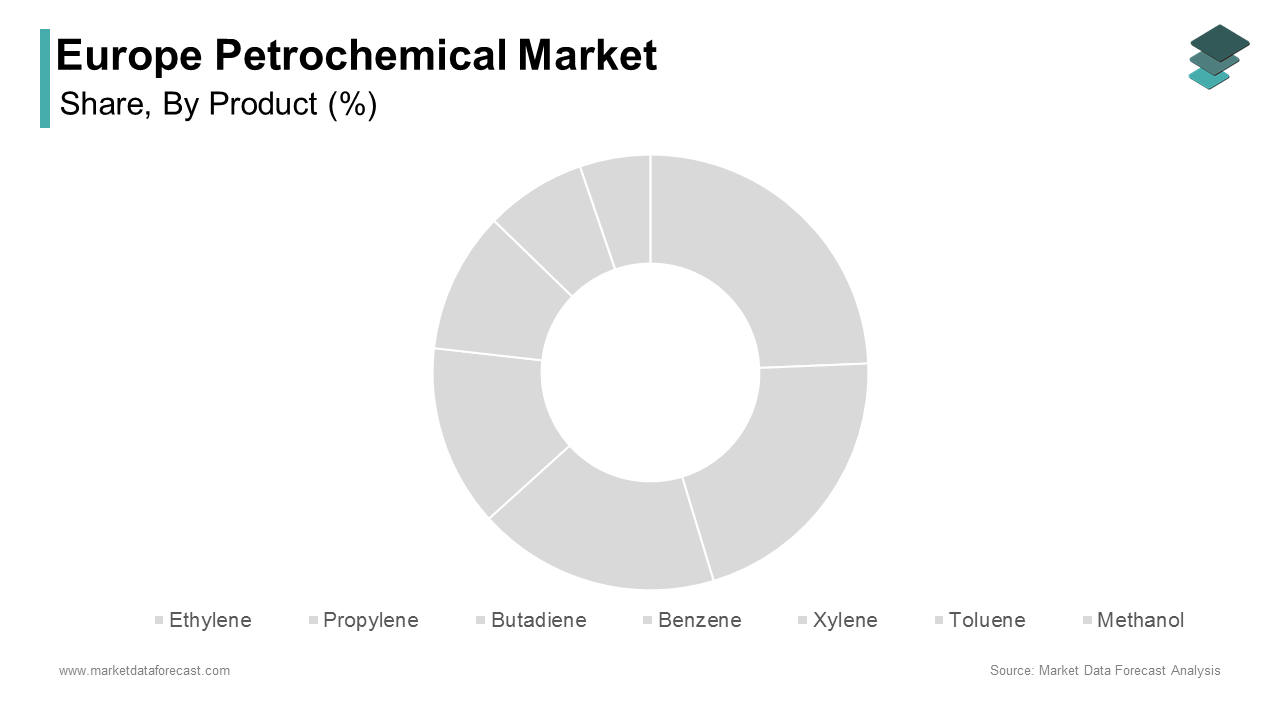
The methanol segment is swiftly emerging with an anticipated CAGR of 9.2% during the forecast period, with its dual role as a chemical building block and a low-carbon energy carrier. While traditionally used to produce formaldehyde, acetic acid, and methyl tert-butyl ether, methanol’s application is expanding into marine fuel blending, renewable energy storage, and green hydrogen transport. The European Maritime Safety Agency now recognizes methanol as a compliant alternative under the FuelEU Maritime regulation, targeting 2% renewable fuel use by 2026. Additionally, methanol serves as a key intermediate in power-to-X pathways with projects like Liquid Wind’s e-methanol facility in Sweden producing carbon-neutral fuel from captured CO₂ and green hydrogen.
REGIONAL ANALYSIS
Germany Petrochemical Market Analysis
Germany was the top performer of the Europe petrochemical market by capturing 34.2% of the share in 2025, owing to its integrated chemical parks, advanced engineering base, and central logistics position. The country hosts Europe’s largest chemical cluster in Ludwigshafen, operated by BASF, as well as major sites by Covestro, Evonik, and INEOS along the Rhine River. The CHEMPARK network alone consumes 12 terawatt hours of electricity annually, making it a prime candidate for renewable power purchase agreements.
France Petrochemical Market Analysis
The French petrochemical market was positioned second, thanks to its refinery-integrated production assets and state-supported energy transition initiatives. TotalEnergies operates the Grandpuits and Feyzin sites, which together produce over 2 million metric tons of ethylene annually, according to the French Ministry of Ecological Transition. The Grandpuits biorefinery conversion, completed in 2025, now co-produces renewable diesel and circular naphtha for chemical use, reducing fossil dependence. France’s national low-carbon strategy mandates a 40% reduction in industrial emissions by 2030, compelling investments in carbon capture and biomass co-processing. Additionally, the country’s nuclear-powered grid provides stable low low-carbon electricity for future electrified processes.
Italy Petrochemical Market Analysis
Italy's petrochemical market growth is likely to grow with the supply chain anchored by the integrated Priolo and Brindisi industrial zones in Sicily and Apulia. Italy’s strategic location enables efficient export to North Africa and the Balkans, with over 30% of its polymer output shipped outside the EU, according to Istat. Furthermore, Italy’s robust fashion and automotive sectors are home to brands like Ferrari and Prada that drive demand for high-performance polymers and synthetic rubbers.
United Kingdom Petrochemical Market Analysis
The United Kingdom petrochemical market is likely to experience steady growth during the forecast period. The Teesside Freeport, launched in 202,4, offers tax incentives and streamlined permitting to attract low-carbon chemical investments, including a 700 million pound project by Venator for titanium dioxide production using green hydrogen. According to the Chemical Industries Association, the UK chemical sector contributes 30 billion pounds to GDP and employs over 120,000 people.
COMPETITION OVERVIEW
The Europe petrochemical market is characterized by intense competition among large integrated producers, regional specialists, and emerging circular economy players. Incumbents like BASF, INEOS, and TotalEnergies dominate through scale, technological integration, and established logistics networks, yet face pressure from imported polymers and rising compliance costs. New entrants focused on chemical recycling, bio-based chemistry, and green hydrogen are gaining traction with support from EU innovation funds and corporate offtake agreements. Competition is increasingly non-price-based, shifting toward sustainability credentials, feedstock resilience, and digital traceability. The market is also experiencing consolidation as smaller players partner with majors to share decarbonization risks.
KEY MARKET PLAYERS
A few major players of the Europe petrochemical market include
- BASF SE
- INEOS Group Ltd
- Total Energies SE
- LyondellBasell Industries
- SABIC
- Covestro AG
- Evonik Industries AG
Top Strategies Used by the Key Market Participants
Key players in the Europe petrochemical market are prioritizing feedstock diversification by integrating circular and bio-based inputs through chemical recycling and renewable feedstock partnerships. They are investing in the electrification of core processes such as steam cracking to align with EU decarbonization mandates. Companies are strengthening downstream integration by developing high-value specialty polymers and performance materials less exposed to commodity volatility. Strategic collaborations with energy providers, port authorities, and technology firms are common to co-develop carbon capture, hydrogen supply, and renewable power infrastructure. Additionally, firms are adopting mass balance certification to meet brand owner demands for recycled content while maintaining product performance. These strategies collectively address cost competitiveness, regulatory compliance, and long-term sustainability in a transforming industrial landscape.
Leading Players in the Europe Petrochemical Market
BASF SE
BASF SE is a global chemical leader with a commanding presence in the European petrochemical market through its integrated Verbund system centered in Ludwigshafen, Germany. The company produces a full spectrum of base chemicals, including ethylene, propylene, and benzene, which feed into its downstream divisions for plastics coatings and performance materials. BASF actively contributes to global standards through its participation in the World Plastics Council and supplies specialty intermediates to markets across Asia and North America. These initiatives reinforce its dual role as a European industrial anchor and a global innovation driver in sustainable chemistry.
TotalEnergies SE
TotalEnergies SE leverages its integrated energy and chemical assets to shape the future of Europe’s petrochemical sector with a focus on circularity and low-carbon transition. Through its subsidiary Versalis, the company operates major crackers and polymer plants in France, Italy, and Belgium, producing polyethylene, polypropylene, and elastomers. Globally, TotalEnergies supplies polymers to over 80 countries and collaborates with value chain partners on advanced recycling projects.
INEOS Group Ltd
INEOS Group Ltd is a privately held European petrochemical powerhouse with extensive operations across the UK, Germany, and Norway. INEOS supplies base chemicals and polymers to automotive, construction, and healthcare sectors across the continent and exports specialty products globally. In 2025, INEOS announced a 2 billion euro investment in green hydrogen infrastructure at its Antwerp site to decarbonize ammonia and methanol production. It also partnered with Plastic Energy to scale chemical recycling capacity for food-grade polyethylene. Through strategic asset optimization and targeted decarbonization, INEOS maintains operational resilience while advancing the sector’s sustainability agenda without reliance on public markets.
MARKET SEGMENTATION
This research report on the Europe petrochemical market has been segmented and sub-segmented based on product and region.
By Product
- Ethylene
- Propylene
- Butadiene
- Benzene
- Xylene
- Toluene
- Methanol
By Region
- UK
- France
- Spain
- Germany
- Italy
- Russia
- Sweden
- Denmark
- Switzerland
- Netherlands
- Turkey
- Czech Republic
- Rest of Europe