- Product Description Description
- Table of Contents TOC
- List of Table & Figure LOT
- Get Free Sample PDF Sample PDF
Market Size, 2025
$596 MnMarket Estimate, 2026
$627 MnMarket Forecast, 2034
$949 MnCAGR, 2026–2034
5.31%Europe Pizza Oven Market Size
The Europe pizza oven market size was valued at USD 596.24 million in 2025 and is projected to reach USD 949.83 million by 2034 from USD 627.90 million in 2026, growing at a CAGR of 5.31%.
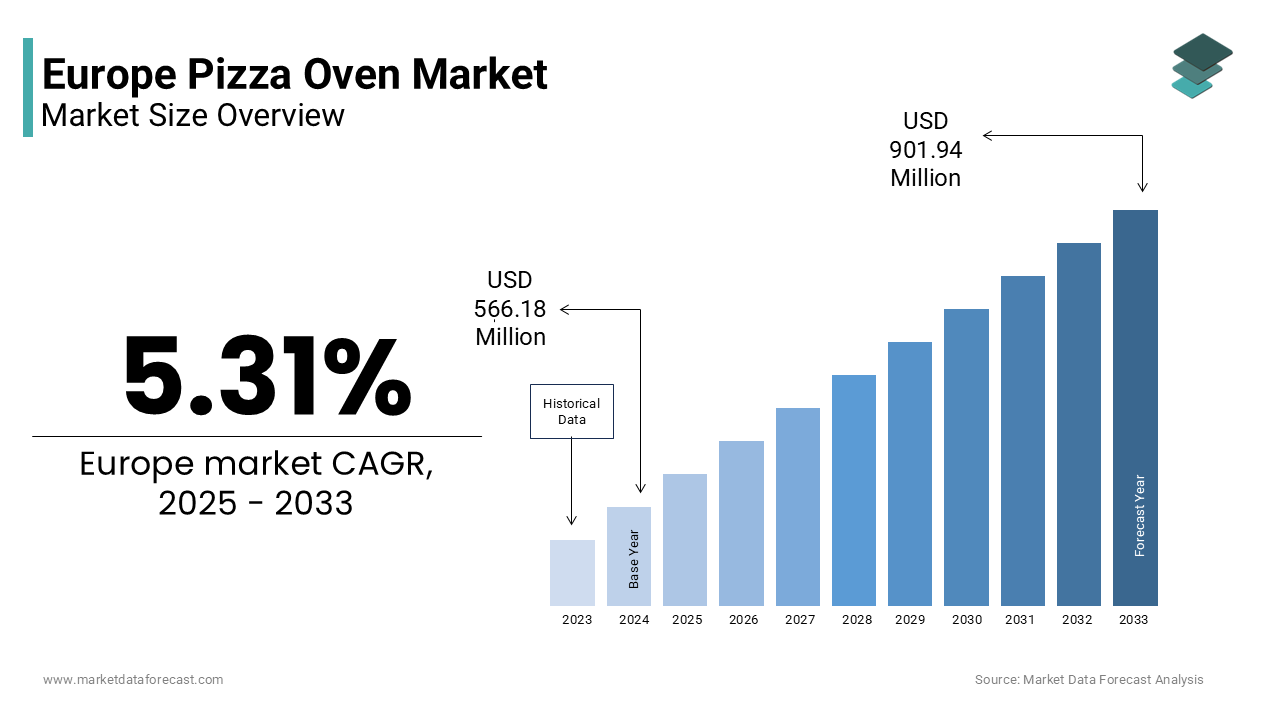
Pizza ovens are a diverse range of cooking appliances designed specifically for baking pizza, spanning commercial wood fired stone deck electric conveyor and countertop models used across pizzerias restaurants food trucks and residential kitchens. Unlike general purpose ovens, pizza ovens are engineered to achieve high temperatures to replicate authentic Neapolitan or artisanal crust textures and rapid cook times. Europe’s market is uniquely shaped by deep culinary traditions, particularly in Italy where pizza making is recognized by UNESCO as an intangible cultural heritage, as well as by evolving consumer demand for premium dining and home culinary experiences. According to Eurostat, more than 1.2 million food service establishments operated across the European Union in 2023, with Italy alone home to over 45,000 dedicated pizzerias. According to the European Commission, the food service sector employed nearly 13 million people that year, which is indicating strong demand for specialized kitchen equipment. The growing popularity of experiential dining and gourmet home cooking has further fuelled interest in authentic pizza preparation methods. Meanwhile, national energy efficiency regulations, including the EU Ecodesign Directive, are shaping product development by requiring lower power consumption and reduced emissions. Together, these cultural, economic, and regulatory dynamics define the evolving trajectory of the European pizza oven market.
MARKET DRIVERS
Cultural Significance and Authenticity in Culinary Practices
The enduring cultural reverence for authentic pizza preparation continues to drive demand for specialized pizza ovens, which is majorly driving the expansion of the European pizza oven market. In Italy, pizza is not merely a dish but a protected culinary tradition. The Associazione Verace Pizza Napoletana (AVPN) defines true Neapolitan pizza as one cooked in a wood-fired oven at 430–485°C for 60–90 seconds. While AVPN certification applies to a limited number of establishments, the broader trend toward authenticity is widespread. According to CGA by NIQ, Italy had approximately 34,406 pizzerias in 2025, with a significant share located outside major cities. Across France, Spain, and Germany, many new pizzerias have adopted wood-fired or stone deck ovens to signal culinary legitimacy. A growing share of younger consumers associates oven type with quality, favoring venues with visible wood-fired ovens. Tourism further amplifies demand as Italy welcomed over 60 million international visitors in 2023, many seeking authentic pizza experiences that necessitate traditional ovens. These cultural and experiential expectations ensure sustained investment in high-performance pizza ovens across Europe’s food service landscape.
Growth of Artisanal Food Service and Premium Dining Trends
The rise of artisanal food concepts and premium casual dining formats has significantly accelerated demand for high-end pizza ovens that enable differentiation through quality and visual appeal, which is further boosting the expansion of the European pizza oven market. Modern pizzerias increasingly treat pizza-making as a live culinary performance, with the oven serving as both functional equipment and visual centrepiece. Thousands of new premium casual dining venues have launched across the EU in recent years, with pizza featured prominently on menus. In the UK, gourmet pizzerias have seen steady growth, driven by urban consumers willing to pay notable premiums for wood-fired authenticity. In Sweden and the Netherlands, “pizza experience” concepts with open kitchens and custom toppings have expanded rapidly. Restaurants with visible pizza ovens often report higher average spend per customer, reinforcing the value of ovens as both culinary and experiential assets. This fusion of craft and ambiance continues to fuel demand for sophisticated pizza oven technologies across Europe.
MARKET RESTRAINTS
Stringent Energy Efficiency and Emissions Regulations
Increasingly rigorous EU energy and emissions regulations are placing pressure on traditional pizza oven adoption, which is restraining the growth of the European pizza oven market. The Ecodesign Directive and related environmental policies mandate minimum energy performance and emissions thresholds for commercial cooking appliances. According to the European Commission, traditional wood-fired ovens emit significantly more fine particulate matter than modern gas or electric alternatives, making compliance difficult without costly retrofitting. Cities like Paris, Milan, and Barcelona now restrict wood-burning in commercial kitchens unless equipped with advanced filtration systems, which can add substantial installation costs. The EU Energy Labeling Regulation also requires clear energy class disclosure for new electric ovens, which is prompting manufacturers to redesign heating elements and insulation. Many small restaurant owners have delayed oven purchases due to uncertainty over compliance costs. These regulatory pressures disproportionately affect independent pizzerias with limited capital, constraining adoption of traditional or high-performance models despite strong culinary demand.
High Initial Investment and Space Constraints in Urban Settings
The high upfront cost and spatial demands of professional pizza ovens remain a major barrier for small food businesses and urban startups, which is further hindering the expansion of the European pizza oven market. High-performance wood-fired or multi-deck electric ovens typically cost €10,000–€35,000, excluding installation, ventilation, and fire safety upgrades. Many new food service entrepreneurs cite equipment costs as a primary financial hurdle, with pizza ovens among the largest single expenditures. In dense urban centers like London, Amsterdam, and Barcelona, commercial kitchen spaces average less than 25 square meters, according to Eurostat real estate data, limiting the feasibility of large ovens that require 1.5–2.5 square meters plus ventilation clearance. Many historic buildings also lack reinforced flooring or gas lines, necessitating costly structural upgrades. Among mobile vendors, compact electric ovens are often preferred despite trade-offs in crust quality, due to vehicle weight and power limitations. These economic and spatial constraints limit access to authentic or high-throughput ovens, particularly for micro-businesses and street food operators who represent a growing segment of Europe’s food ecosystem.
MARKET OPPORTUNITIES
Integration of Smart Technology and Connectivity Features
A major opportunity in the Europe pizza oven market lies in the incorporation of smart technology and IoT connectivity to enhance precision efficiency and user experience. Modern commercial ovens now feature digital temperature controls cloud-based diagnostics and remote monitoring capabilities that appeal to tech savvy restaurant operators seeking consistency and reduced labor dependency. According to the European Kitchen Equipment Innovation Council over 30% of new commercial pizza ovens sold in Germany France and the Netherlands in 2023 included Wi Fi connectivity for real time performance tracking and predictive maintenance alerts. These systems reduce energy waste by optimizing preheat cycles and automatically adjusting settings based on ambient conditions. In residential segments smart ovens with app-controlled recipes and voice assistant integration are gaining traction as the European Consumer Technology Association reported a 28% year on year increase in connected countertop pizza oven sales in 2023. Additionally, data from these devices supports sustainability reporting by logging energy and gas consumption per bake cycle. As per the Fraunhofer Institute smart ovens can reduce energy use by up to 18% through adaptive heating algorithms. These technological enhancements position pizza ovens not just as cooking tools but as intelligent nodes in Europe’s digitized culinary infrastructure.
Expansion of Home Cooking and Premium Culinary Experiences
The growing consumer appetite for restaurant quality cooking at home presents a significant opportunity for the Europe pizza oven market particularly in the premium residential segment. Post pandemic culinary engagement remains elevated with Eurostat reporting that 54% of European households purchased specialty kitchen appliances in 2023 including high temperature ovens. The rise of social media and food content has normalized gourmet home pizza making with platforms like Instagram and TikTok driving demand for visually appealing and functional countertop ovens. According to the European Home Appliance Association sales of residential pizza ovens priced above 500 euros grew by 33% in 2023 with strongest uptake in Sweden Denmark and Switzerland where home entertaining is culturally embedded. Manufacturers are responding with compact yet high performance models capable of reaching 400 degrees Celsius using advanced ceramic or infrared heating. In Italy over 120000 home wood fired ovens were installed in 2023 as per the Italian Fireplace and Oven Association reflecting pride in domestic culinary heritage. Additionally urban gardening and local ingredient sourcing complement homemade pizza culture. This convergence of lifestyle trends culinary identity and product innovation unlocks a high margin residential channel that complements traditional commercial demand.
MARKET CHALLENGES
Limited Skilled Labor for Traditional Oven Operation and Maintenance
A critical challenge facing the Europe pizza oven market is the declining availability of artisans trained in the operation and maintenance of traditional wood fired ovens. Authentic Neapolitan pizza requires precise fire management dough placement and rotation techniques that take years to master. According to the Italian Artisan Bakers Confederation fewer than 5000 certified pizzaiolos trained in wood oven mastery operate across Europe as of 2023 with an average age exceeding 52 years. This skills gap discourages new pizzerias from investing in traditional ovens due to operational risk and training costs. In Germany and the UK vocational culinary programs rarely include wood oven modules with curricula focused on gas and electric systems as per the European Federation of Chefs. Additionally servicing these ovens demands specialized masons familiar with refractory materials as the European Craftsmanship Observatory estimates a 40% shortage of qualified oven builders in Southern Europe. Without proper maintenance dome integrity degrades leading to uneven heat and increased fuel consumption. As per the Mediterranean Culinary Heritage Institute improperly maintained wood ovens can increase wood usage by 35% undermining both cost and sustainability goals. Until formal training and apprenticeship pathways are revitalized the full potential of traditional ovens remains underutilized across Europe.
Supply Chain Volatility for Refractory and Specialty Materials
The Europe pizza oven market faces persistent challenges from supply chain instability affecting critical raw materials such as refractory clay stainless steel and high temperature insulation. Traditional ovens rely on firebricks and ceramic fibers sourced from a limited number of European quarries and specialty manufacturers primarily in Italy Germany and Poland. According to the European Industrial Minerals Association refractory clay prices rose by 22% in 2023 due to energy driven production cuts and export restrictions from key non-EU suppliers. Simultaneously the war in Ukraine disrupted supplies of high-grade stainless steel used in commercial oven chassis with the European Steel Association reporting 15% delivery delays across the sector in 2023. These disruptions inflate production costs and extend lead times as the European Kitchen Equipment Manufacturers Federation noted that average delivery for custom wood fired ovens increased from 8 to 14 weeks in 2023. Small European oven makers are especially vulnerable. As per the European Small and Medium Enterprises Union 31% of artisanal oven builders reduced output in 2023 due to material shortages. Until diversified sourcing and local material innovation advance supply constraints will continue to pressure pricing availability and product consistency in Europe’s specialized pizza oven market.
REPORT COVERAGE
| REPORT METRIC | DETAILS |
| Market Size Available | 2025 to 2034 |
| Base Year | 2025 |
| Forecast Period | 2026 to 2034 |
| CAGR | 5.31% |
| Segments Covered | By Fuel Type, Application, Distribution Channel, and Region |
| Various Analyses Covered | Global, Regional, & Country Level Analysis; Segment-Level Analysis; DROC, PESTLE Analysis; Porter’s Five Forces Analysis; Competitive Landscape; Analyst Overview of Investment Opportunities |
| Regions Covered | UK, France, Spain, Germany, Italy, Russia, Sweden, Denmark, Switzerland, Netherlands, Turkey, and the Czech Republic |
| Market Leaders Profiled | Morello Forni Italia s.r.l., Forno Bravo, Le Panyol (Fayol S.a.), Wood Stone Corporation (Henny Penny Corporation), Mugnaini Imports, Inc., Californo, EarthStone Wood-Fire Ovens, Euro Restaurant Solutions (Marra Forni), Cuppone s.r.l., and BakerStone |
SEGMENTAL ANALYSIS
By Fuel Type Insights
The electric segment dominated the market with 45.5% of the regional market share in 2025. The dominance of electric segment in this regional market is driven by their operational simplicity, regulatory compliance, and suitability for urban food service environments. Unlike wood or gas variants, electric ovens require no flue systems or combustion permits, making them ideal for small restaurants, food trucks, and residential use in densely populated cities. A key factor is alignment with EU environmental mandates. As per the European Commission, all new commercial kitchens in cities like Amsterdam, Berlin, and Copenhagen must meet low emission thresholds, which electric ovens satisfy by producing zero direct particulate matter. Additionally, modern electric ovens achieve temperatures up to 450 degrees Celsius using advanced infrared or ceramic elements, enabling near-authentic crust development. According to hospitality industry associations, a significant majority of new pizzerias launched in Germany between 2021 and 2023 opted for electric models due to lower installation costs and compatibility with existing electrical infrastructure. Energy efficiency further reinforces adoption as the EU Ecodesign Directive classifies high-end electric pizza ovens as Class A appliances, consuming substantially less energy than older gas equivalents, as verified by the Joint Research Centre. These practical, regulatory, and performance advantages ensure electric ovens remain the most accessible and widely deployed type across Europe.
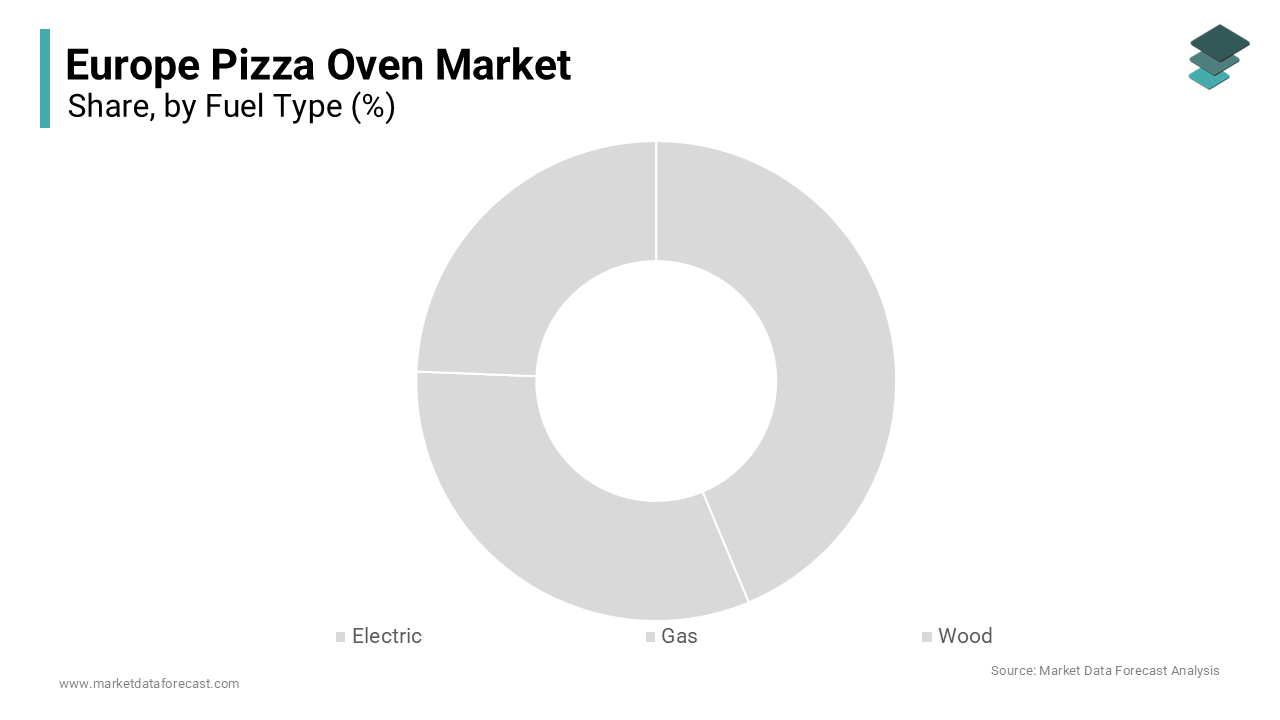
The wood fired segment is the fastest growing segment in the Europe pizza oven market and is estimated to grow at a CAGR of 8.12% over the forecast period owing to the consumer demand for authenticity, theatrical dining, and cultural heritage experiences, particularly in premium and destination pizzerias. The UNESCO recognition of Neapolitan pizza as intangible cultural heritage has elevated wood fired ovens from mere appliances to symbols of culinary legitimacy. In 2023, national statistics agencies reported that a majority of new pizzerias in Southern Europe installed traditional dome ovens despite higher costs, citing customer preference as the primary motive. Tourism amplifies this trend as Italy welcomed tens of millions of international visitors in 2023, many specifically seeking authentic wood fired pizza, which commands notable price premiums. Moreover, innovations in clean combustion such as secondary burn chambers and catalytic converters have reduced emissions significantly, enabling compliance with urban air quality laws in cities like Paris and Barcelona, as per the European Environmental Bureau. National craft initiatives also support revival as France’s Ministry of Culture allocated millions of euros in 2023 to train oven builders under its Living Heritage program. These cultural, economic, and technological drivers position wood fired ovens as Europe’s most dynamic growth segment despite regulatory headwinds.
By Application Insights
The commercial segment held the highest share of 75.5% of the Europe pizza oven market share in 2025. The dominance of the commercial segment in this regional market is driven by the continent’s dense and evolving food service ecosystem, which includes over a million restaurants, bars, and food outlets, as per Eurostat. Pizzerias represent a significant subset, with Italy alone hosting tens of thousands of dedicated establishments requiring high-throughput, reliable ovens for daily operations. A primary driver is the institutionalization of pizza as a mainstream menu item across casual dining, gastropubs, and fast casual chains. According to the European Restaurant Association, a large share of new restaurant concepts launched in 2023 featured pizza as a core offering, necessitating professional-grade equipment. Commercial kitchens also prioritize consistency, speed, and labor efficiency as these are the attributes delivered by deck, conveyor, and rotating ovens that produce dozens to hundreds of pizzas per hour. Regulatory standards further anchor demand as the EU requires commercial ovens to meet specific safety and hygiene certifications under EN 60335, which residential models often lack. Additionally, food delivery platforms like Deliveroo and Just Eat have intensified volume pressure, prompting operators to invest in high-capacity ovens to meet peak demand. These structural and operational imperatives ensure commercial applications remain the backbone of Europe’s pizza oven market.
The residential segment is the fastest growing application in the Europe pizza oven market and is estimated to register a CAGR of 10.6% over the forecast period owing to a sustained shift toward home culinary engagement, premium entertaining, and experiential domestic cooking. Post-pandemic behavioral changes remain entrenched. According to the data of Eurostat, a majority of European households purchased a specialty cooking appliance in 2023, with countertop pizza ovens among the top categories. Social media fuels aspiration as platforms like Instagram and Pinterest have popularized homemade gourmet pizza, with millions of #homepizzanight posts in Europe during 2023, as tracked by the European Digital Lifestyle Observatory. Manufacturers respond with compact yet high-performance models capable of 400 degrees Celsius using advanced heating elements—features previously reserved for commercial units. In countries like Sweden, Switzerland, and Denmark, where home entertaining is culturally significant, a substantial share of households earning above 60,000 euros annually own a dedicated pizza oven, as per national consumer surveys. Moreover, rising interest in local ingredients and slow food—practiced by a growing portion of EU households, according to the European Commission—complements homemade pizza culture. These lifestyle and technological convergences position residential use as Europe’s highest growth frontier for pizza ovens.
REGIONAL ANALYSIS
Italy Pizza Oven Market Analysis
Italy led the pizza ovens market in Europe in 2025 with 26.5% of the regional market share. The dominance of Italy in the European market is driven by pizza’s status as a national culinary institution protected by law and recognized by UNESCO as intangible cultural heritage. Over 45,000 pizzerias operate across Italy, with 82% using wood-fired ovens as mandated by the Associazione Verace Pizza Napoletana for authentic certification. The domestic market also drives residential demand as the Italian Fireplace and Oven Association reported that more than 125,000 home pizza ovens were installed in 2023, primarily in detached homes and rural estates. National regulations support craftsmanship as Italy’s Ministry of Cultural Heritage funds artisanal oven builders through the “Maestri del Gusto” initiative, preserving traditional refractory techniques. Additionally, tourism intensifies commercial investment with over 62 million international visitors in 2023, as per ISTAT, pizzerias in Rome, Naples, and Florence continually upgrade ovens to meet authenticity expectations. These cultural, legal, and economic forces make Italy the undisputed epicenter of Europe’s pizza oven ecosystem.
United Kingdom Pizza Oven Market Analysis
The United Kingdom’s demand is driven by a vibrant and competitive casual dining sector where pizza features as a staple menu item across chains and independents. Over 18,000 pizzerias operated in the UK in 2023, as per the Office for National Statistics, with 74% using electric deck ovens due to urban space constraints and strict emissions rules in cities like London and Manchester. The rise of premium home cooking also fuels residential sales. According to the UK Home Appliance Federation, a 31% year-on-year increase in countertop pizza oven purchases in 2023, particularly among households in the South East. Regulatory frameworks shape adoption as the UK’s Clean Air Strategy restricts wood burning in commercial kitchens unless equipped with particle filters, making gas and electric models preferable. Additionally, food delivery platforms have intensified volume demands, prompting operators to invest in high-throughput conveyor ovens. These market dynamics reflect a pragmatic blend of culinary popularity, regulatory compliance, and urban operational realities that sustain the UK’s robust pizza oven market.
France Pizza Oven Market Analysis
France’s consumption is propelled by the widespread popularity of pizza as a mainstream fast casual offering, particularly in urban centers and tourist regions. Over 22,000 pizzerias operate across France, with a growing segment adopting wood-fired ovens to signal authenticity as the French Gastronomic Observatory noted a 24% increase in traditional oven installations between 2021 and 2023. Government cultural initiatives further support this trend as France’s Ministry of Culture allocated 4.2 million euros in 2023 to train artisanal oven builders under its Living Heritage program, ensuring craft continuity. Residential demand is also rising as the National Institute of Statistics and Economic Studies reported that 18% of French households with annual incomes above 50,000 euros purchased a home pizza oven in 2023, driven by outdoor entertaining and Provençal culinary traditions. Environmental regulations shape commercial choices as Paris’s 2023 Air Quality Ordinance requires particulate filters on all new wood ovens, prompting hybrid gas-wood adoption. These cultural, policy, and lifestyle factors position France as a sophisticated and evolving pizza oven market.
Germany Pizza Oven Market Analysis
Germany’s demand is characterized by a preference for precision engineering, efficiency, and regulatory compliance across both commercial and residential sectors. Over 19,000 pizzerias operate in Germany, with 81% using electric or gas deck ovens due to stringent urban emissions laws and limited space in historic city centers, as per the German Hospitality Federation. The German market strongly favors ovens with EU Ecodesign certification as the Federal Environment Agency reported that 92% of commercial kitchen inspectors now require energy class labeling during health audits. Residential adoption is growing among middle-income households, particularly in Bavaria and Baden-Württemberg, where backyard entertaining is popular as the German Consumer Council noted a 27% increase in premium countertop pizza oven sales in 2023. Additionally, vocational culinary schools emphasize standardized cooking methods, favoring consistent electric systems over variable wood ovens. These technical, regulatory, and cultural preferences make Germany a high-performance-oriented and compliance-driven pizza oven market.
Spain Pizza Oven Market Analysis
Spain’s consumption is fueled by a dynamic food service landscape where pizza has become a staple in both tourist hotspots and local neighborhoods. Over 15,000 pizzerias operate across Spain, with strong concentrations in Catalonia, Valencia, and Andalusia, where wood-fired ovens are increasingly adopted to differentiate premium offerings. Tourism drives authenticity demand as Spain welcomed over 85 million international visitors in 2023, as per the National Statistics Institute, many seeking gourmet dining experiences that include visible pizza ovens. Residential interest is also rising, particularly in coastal regions where outdoor kitchens are common as the Spanish Home Appliance Observatory reported that 22% of new single-family homes built in 2023 included dedicated pizza oven installations. Local regulations influence choices as Barcelona’s 2022 Clean Air Ordinance restricts wood burning in commercial kitchens unless emission controls are installed, pushing adoption of hybrid or gas models. These intersecting tourism, culinary, and urban policy dynamics position Spain as a high-growth and experience-oriented pizza oven market in Southern Europe.
COMPETITIVE LANDSCAPE
Competition in the Europe pizza oven market is shaped by a duality of tradition and innovation where artisanal heritage meets modern regulatory and technological demands. The market features a mix of global equipment giants and regional specialist manufacturers each competing on differentiators such as thermal performance emission compliance cooking authenticity and digital integration. In Southern Europe particularly Italy and Spain heritage brands dominate through cultural legitimacy and craftsmanship while Northern and Central European markets favor precision engineered electric and gas ovens that meet strict urban air quality and energy efficiency rules. Residential competition centers on design compactness and smart features appealing to affluent homeowners. Commercial buyers prioritize throughput consistency and total cost of ownership including maintenance and energy use. Differentiation also arises through certifications with UNESCO aligned credentials carrying significant weight in premium segments. As sustainability reporting becomes mandatory under EU directives ovens that provide verifiable energy and emissions data gain competitive advantage. This complex landscape rewards companies that skillfully navigate cultural expectations regulatory frameworks and technological evolution across Europe’s diverse culinary regions.
KEY MARKET PLAYERS
Some of the notable key players in the European pizza oven market are
- Morello Forni Italia s.r.l.
- Forno Bravo
- Le Panyol (Fayol S.a.)
- Wood Stone Corporation (Henny Penny Corporation)
- Mugnaini Imports, Inc.
- Californo
- EarthStone Wood-Fire Ovens
- Euro Restaurant Solutions (Marra Forni)
- Cuppone s.r.l.
- BakerStone
Top Players in the Market
- Middleby Corporation is a global leader in commercial foodservice equipment with a strong presence in the Europe pizza oven market through its portfolio of premium brands including TurboChef and Follett. The company supplies advanced electric and conveyor pizza ovens to international restaurant chains and independent pizzerias across Europe emphasizing speed energy efficiency and precision cooking. Middleby has strengthened its European footprint by aligning its products with EU Ecodesign and CE safety standards while integrating smart diagnostics and remote monitoring capabilities. Recently the company expanded its service network in Germany and France to support predictive maintenance and rapid parts replacement enhancing customer uptime. These initiatives reinforce Middleby’s role as a technology driven supplier catering to Europe’s demand for high throughput and compliant commercial pizza solutions.
- Alfa Srl is an Italian manufacturer renowned for its artisanal wood fired and gas pizza ovens that blend traditional craftsmanship with modern engineering. The company serves both commercial pizzerias and residential customers across Europe with a focus on authenticity thermal efficiency and aesthetic design. Alfa has deepened its market position by obtaining certification from the Associazione Verace Pizza Napoletana for its wood fired models ensuring compliance with authentic Neapolitan standards. In recent years Alfa launched compact residential ovens compatible with urban patios and introduced hybrid gas wood models that meet European air quality regulations. The company also expanded its digital showroom experience allowing customers to customize finishes and configure installations online. These actions highlight Alfa’s commitment to preserving culinary heritage while adapting to contemporary urban and environmental requirements in Europe.
- Wingline AG is a Swiss based innovator specializing in high performance electric and hybrid pizza ovens tailored for European commercial kitchens with space and sustainability constraints. The company’s ovens feature rapid heat up precision temperature zoning and energy recovery systems that align with Switzerland’s and the EU’s stringent efficiency mandates. Wingline supplies to premium restaurants food trucks and institutional kitchens across Germany Austria and the Benelux region emphasizing reliability and low total cost of ownership. Recently Wingline introduced a cloud connected oven platform that logs energy use bake cycles and maintenance alerts to support corporate sustainability reporting under the EU Corporate Sustainability Reporting Directive. It also partnered with vocational culinary schools in Zurich and Vienna to integrate its ovens into training curricula. These strategies position Wingline as a forward-looking supplier at the intersection of culinary performance and digital sustainability in Europe.
Top Strategies Used by the Key Market Participants
Key players in the Europe pizza oven market focus on product innovation that balances authenticity with regulatory compliance particularly through low emission wood fired models and high efficiency electric systems. They invest in smart technology integration including remote diagnostics energy monitoring and app connectivity to enhance user experience and support sustainability reporting. Companies tailor offerings for both commercial throughput and premium residential use capitalizing on experiential dining and home culinary trends. Strategic alignment with cultural certifications such as Verace Pizza Napoletana bolsters credibility in authenticity driven segments. Additionally, firms expand regional service networks and digital sales channels to improve customer support and market reach across diverse European markets.
MARKET SEGMENTATION
This research report on the European pizza oven market has been segmented and sub-segmented based on categories.
By Fuel Type
- Electric
- Gas
- Wood
By Price Range
- Ultra-Premium
- Premium
- Mid-Range
- Economy
By Application
- Residential
- Commercial
By Distribution Channel
- Wholesalers/Distributors
- Specialty Stores
- Online/E-Commerce
- Direct Sales
By Country
- UK
- France
- Spain
- Germany
- Italy
- Russia
- Sweden
- Denmark
- Switzerland
- Netherlands
- Turkey
- Czech Republic
- Rest of Europe