- Product Description Description
- Table of Contents TOC
- List of Table & Figure LOT
- Get Free Sample PDF Sample PDF
Market Size, 2025
$11.26 BnMarket Estimate, 2026
$12.04 BnMarket Forecast, 2034
$20.58 BnCAGR, 2026–2034
6.93%Europe Polyurethane Foam Market Size
The Europe polyurethane foam market size was valued at USD 11.26 billion in 2025 and is projected to reach USD 20.58 billion by 2034 from USD 12.04 billion in 2026, growing at a CAGR of 6.93%.
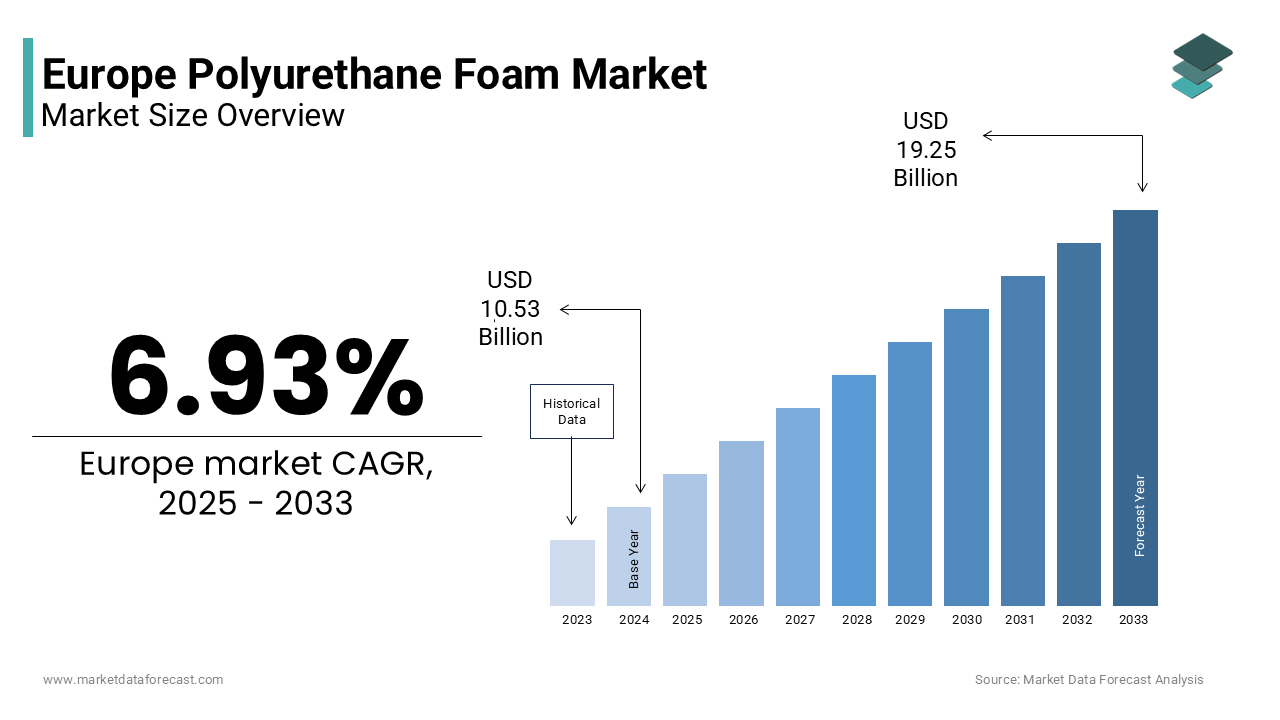
Polyurethane foam refers to the rigid and flexible cellular polymer systems engineered for thermal insulation, acoustic damping lightweight structural support and comfort applications across construction automotive furniture and refrigeration sectors. Characterized by tunable cell structures and exceptional performance-to-density ratios, polyurethane foams are critical enablers of energy efficiency, lightweighting, and user comfort in a region committed to decarbonization and resource efficiency. According to research, The European Commission's Energy Performance of Buildings Directive (EPBD) is accelerating the demand for highly efficient insulation materials, like rigid polyurethane foam, as the European Union moves toward zero-emission building standards for all new construction. Similarly, The International Council on Clean Transportation highlights the broader trend of vehicle lightweighting as a key strategy to improve fuel efficiency and energy consumption in the automotive industry, which includes the use of various advanced materials such as flexible polyurethane foam for interior components and acoustic management. As per the technical data from industry and scientific sources, the thermal conductivity of modern rigid polyurethane foam remains exceptionally low, making it one of the most efficient and widely used thermal insulation materials commercially available for construction applications. These technical and policy driven imperatives position polyurethane foam as a foundational material in Europe’s green transition and industrial competitiveness.
MARKET DRIVERS
Mandatory Building Energy Renovation Under the Energy Performance of Buildings Directive
Implementation of the EPBD's renovation requirements across the EU fuels the growth of the Europe polyurethane foam market. European Union policy requires that all buildings improve their energy performance rating by a specific date. This objective involves the extensive renovation of numerous existing structures throughout the region. Rigid polyurethane foam is a popular choice for these improvements. The material is valued for a high insulation quality per unit of thickness. Its use allows for effective insulation upgrades without reducing a building's interior dimensions. In one area, this foam was frequently used in residential renovation projects. It is considered to provide performance equivalent to alternative, thicker insulation systems. Buildings insulated with this material show significant reductions in heating energy use over a long period when compared to non-insulated buildings. National subsidy schemes like Germany’s Federal Building Efficiency Program and France’s MaPrimeRénov explicitly list polyurethane systems as eligible interventions, creating predictable and large scale demand across Europe’s vast building stock.
Lightweighting Demands in Electric Vehicle Manufacturing
The rapid electrification of the region’s automotive sector has intensified the use of flexible and semi rigid polyurethane foams to reduce vehicle mass, extend driving range, and improve interior comfort and thereby boost the expansion of the Europe polyurethane foam market. According to sources, A notable portion of new passenger vehicles sold included models that are either fully battery electric or plug-in hybrids, which benefit from weight-optimization efforts to balance the effect of their heavy battery systems. Polyurethane foams are extensively used in seat cushions headliners door panels and underbody systems to achieve weight reductions compared to traditional materials. Reducing vehicle mass can improve electric driving performance, a key consideration for consumers and manufacturers in the current market. Companies like BMW and Volvo now incorporate recycled content polyurethane foams in seating, while Renault uses bio-based formulations derived from castor oil. Employing strategies that lighten vehicle components is vital for complying with future environmental targets, positioning certain materials like polyurethane foam as important to the ongoing changes in transportation.
MARKET RESTRAINTS
Regulatory Phase Down of High Global Warming Potential Blowing Agents
The European Union's F-gases Regulation severely restricts the use of hydrofluorocarbon blowing agents, such as HFC-134a and HFC-245fa, and this consequently restrains the growth of the European polyurethane foam market. These agents have historically enabled low thermal conductivity in rigid polyurethane foams. As regulations shift, the quantity of specific supplies permitted for use is being reduced from prior levels, leading manufacturers to incorporate different blowing agents. Many polyurethane foam manufacturers are adapting their production lines to utilize substitutes, some of which present new challenges like increased flammability or decreased thermal efficiency. Consequently, the transition to these alternatives has increased costs for insulation manufacturers, specifically regarding fire safety compliance and the need for explosion-proof ventilation systems. Furthermore, some alternatives necessitate thicker insulation layers to achieve equivalent performance, partially offsetting space and material savings. These regulatory and technical trade-offs create capital expenditure burdens that particularly affect small and medium enterprises lacking resources for rapid line conversion.
Limited Recyclability and End of Life Management Barriers
Most conventional polyurethane foams, especially cross linked rigid and flexible variants, are not readily recyclable through mechanical means due to their thermoset nature low density and contamination with facers or adhesives, which further limits the expansion of the Europe polyurethane foam market. According to research, a very limited amount of post-consumer polyurethane foam waste was processed for reuse, with the majority being landfilled or burned. Expanded polyurethane packaging faces growing restrictions within waste management programs due to difficulties in its retrieval and processing. Although chemical recycling technologies like glycolysis are emerging, they remain limited in scale. As per sources, only a small number of commercial facilities are currently operating in Europe that can break down polyurethane foam waste into components that can be used again. This end-of-life bottleneck conflicts with the Circular Economy Action Plan’s goal of all products being reusable or recyclable by two thousand thirty and deters public procurement bodies from specifying foam products in green building projects, constraining market expansion despite strong functional demand.
MARKET OPPORTUNITIES
Adoption of Bio Based and Circular Foam Solutions Under the Green Deal
The European Green Deal is accelerating the development of polyurethane foams derived from renewable feedstocks and recycled content, which creates new opportunities for sustainable material innovation. This is expected to propel the growth of the Europe polyurethane foam market. The bio-based polyol landscape in Europe is seeing a rise in commercial availability of various formulations that use plant-derived oils or lignin for applications like insulation. These options offer insulation performance comparable to conventional materials. Several companies have introduced polyols that incorporate significant amounts of renewable carbon into products such as rigid foam. Furthermore, industry groups are pursuing an objective to incorporate a notable percentage of recycled content into insulation foams within the next several years, utilizing advanced chemical recycling processes. Consequently, structures utilizing certified circular foams may be eligible for improved energy performance certifications and public financial incentives in France. This policy driven shift toward bio circular materials opens new revenue streams while aligning with corporate net zero commitments across construction and automotive sectors.
Growth in Cold Chain and Temperature Sensitive Logistics
The expansion of e-commerce pharmaceutical distribution and perishable food delivery is driving demand for high-performance rigid polyurethane foam packaging, which in turn provides fresh prospects for the Europe polyurethane foam market. This packaging maintains thermal integrity over extended periods. According to sources, There has been an increase in the movement of temperature-sensitive goods between different European Union countries. Rigid polyurethane foam is the preferred material for insulated shipping containers vaccine shippers and refrigerated pallet covers due to its low thermal conductivity and moisture resistance. A large majority of specific temperature-sensitive shipments utilized polyurethane foam insulated containers to maintain required temperatures. Furthermore, the European Food Safety Authority now requires insulated packaging for high-risk perishables like seafood and dairy in online retail. Start-ups like Coldset in the Netherlands are commercializing reusable polyurethane containers with embedded temperature sensors, enhancing value beyond insulation. This logistics boom positions polyurethane foam as a critical enabler of Europe’s digital and health supply chains.
MARKET CHALLENGES
Flammability Concerns and Evolving Fire Safety Standards
These foams are inherently combustible requiring flame retardant additives to meet European construction and transportation fire safety norms, which hampers the growth of the Europe polyurethane foam market. However, many traditional halogenated flame retardants are now restricted under the REACH Regulation due to toxicity and persistence concerns. A number of flame-retardant substances commonly used in polyurethane foams have been subjected to increased regulatory oversight. The criteria used for the fire classification of materials have been revised, leading to more stringent requirements for certain safety ratings. As per sources, this has led to project delays as manufacturers seek compliant formulations. Moreover, public perception remains skeptical. Public opinion indicates that a significant portion of the population perceives a fire risk associated with polyurethane insulation. This regulatory and reputational pressure forces continuous reformulation without guaranteed performance parity.
Volatile Feedstock Prices and Energy Dependent Production Costs
High exposure to fluctuations in crude oil and natural gas prices directly impacts the cost of key raw materials like propylene oxide and toluene diisocyanate to ultimately hinder the expansion of the Europe polyurethane foam market. According to sources, average polyol prices increased recently due to energy market turbulence following geopolitical disruptions. This volatility compresses margins for foam fabricators who often operate on fixed price contracts with construction or automotive clients. Additionally, the European Union’s Carbon Border Adjustment Mechanism now imposes indirect costs on imported precursors, further distorting input economics. A significant number of smaller foam converters have reported reduced production capacity, potentially linked to increased material expenses. This supply chain fragility undermines long term planning and discourages investment in capacity expansion just as demand from green building and electric mobility peaks, making price stability a critical unresolved challenge for the sector.
REPORT COVERAGE
| REPORT METRIC | DETAILS |
| Market Size Available | 2025 to 2034 |
| Base Year | 2025 |
| Forecast Period | 2026 to 2034 |
| CAGR | 6.93% |
| Segments Covered | By Product, Application, and Region |
| Various Analyses Covered | Global, Regional, & Country Level Analysis; Segment-Level Analysis; DROC, PESTLE Analysis; Porter’s Five Forces Analysis; Competitive Landscape; Analyst Overview of Investment Opportunities |
| Regions Covered | UK, France, Spain, Germany, Italy, Russia, Sweden, Denmark, Switzerland, Netherlands, Turkey, and the Czech Republic |
| Market Leaders Profiled | Future PLC, Recticel, Rogers Corp, UFP Technologies Inc, Trelleborg AB, Sekisui Chemical Co., Ltd., Compagnie de Saint-Gobain SA, Huntsman Corp, Dow Inc, and BASF SE |
SEGMENTAL ANALYSIS
By Application Insights
The construction segment maintained the leading share of the Europe polyurethane foam market in 2025. Factors such as mandatory energy efficiency upgrades and new building standards under the European Green Deal have mainly contributed to the dominance of the construction segment. The Energy Performance of Buildings Directive requires new constructions to have nearly zero energy consumption within the current decade, and it necessitates extensive efficiency upgrades for all existing buildings across the European Union. The initiative calls for a significant number of properties to be renovated on a yearly basis to achieve these efficiency goals. Rigid polyurethane foam is utilized as a primary insulation material, valued for its efficient thermal properties. Its application can lead to a substantial reduction in heating energy requirements compared to structures without insulation. Additionally, fire safety standards drive demand for phenolic modified polyurethane systems in high rise applications. This policy enforced transformation of Europe’s building stock creates a structural and long term demand base unmatched by other sectors ensuring construction remains the market’s dominant application.
The transportation segment is anticipated to witness the fastest CAGR of 7.2% over the forecast period owing to the electrification of Europe’s automotive fleet and stringent lightweighting mandates to offset heavy battery packs. The sales of battery electric and plug-in hybrid models represent a notable portion of the new passenger cars sold, with each requiring flexible and semi-rigid polyurethane foams for various interior applications like seating and acoustic insulation. The reduction in vehicle weight has a proportional effect on electric driving range, which positions polyurethane foam as a strategic material for vehicle performance enhancement. Leading automotive companies are now incorporating polyurethane with recycled content in components such as seat cushions. Other manufacturers are using formulations with bio-based materials. Besides, regulations governing batteries specify that enclosures must utilize flame-retardant polyurethane composites to help resist thermal events. This convergence of clean mobility safety and sustainability positions transportation as the highest growth frontier for polyurethane foam in Europe.
REGIONAL ANALYSIS
Germany Polyurethane Foam Market Analysis
Germany led the Europe polyurethane foam market and accounted for 26.1% share in 2025. The dominance of the German market is attributed to its massive building renovation program and strong automotive manufacturing base. The country’s climate protection law is in place that drives significant emission reductions within the building sector, which requires deep energy retrofits that heavily rely on rigid polyurethane foam. According to research, a large number of buildings have been insulated using a specific type of polyurethane material. Germany is also home to leading chemical producers like Covestro and BASF which supply advanced foam systems across Europe. The majority of electric vehicles produced across the continent originate from a specific country's manufacturing centers. This integration of policy driven construction demand and industrial output solidifies Germany’s position as the market’s core engine.
France Polyurethane Foam Market Analysis
France was the second largest market for polyurethane foam in Europe and captured a 18.7% share in 2025. The demand for polyurethane foams in France is credited to ambitious energy renovation targets and leadership in circular foam solutions. he MaPrimeRénov scheme has facilitated a high volume of residential insulation projects. Rigid polyurethane foam has emerged as the most frequently selected material for these subsidized energy renovations. National legislation focusing on circular economy principles now requires insulation materials to meet specific recyclability standards. Regulatory mandates regarding waste reduction are encouraging a transition toward the use of bio-based polyurethane alternatives. Companies supply polyols derived from European castor crops for both construction and automotive use. Besides, the French Building Certification NF Habitat HQE rewards the use of low global warming potential foams. This blend of financial incentives regulatory foresight and green chemistry positions France as a high compliance high innovation market.
United Kingdom Polyurethane Foam Market Analysis
The United Kingdom witnessed consistent growth in the Europe polyurethane foam market because of its advanced automotive sector and booming pharmaceutical logistics. Despite Brexit the UK aligns closely with European thermal and emissions standards driving demand for lightweight polyurethane foams in electric vehicles from manufacturers like Jaguar Land Rover and Nissan Sunderland. According to research, the production of battery electric models in vehicle manufacturing has increased, driving a greater need for materials used in acoustic and thermal management.. Simultaneously the use of temperature-controlled packaging, often incorporating foam-based insulation, is widespread in the transportation of medical and healthcare products. The online retail sector for goods that perish has expanded, creating demand for packaging solutions that can maintain thermal integrity over potentially longer distribution chains. This dual engine of mobility and health logistics ensures sustained foam demand in a high value export-oriented economy.
Italy Polyurethane Foam Market Analysis
Italy remains a key player in the Europe polyurethane foam market due to its world renowned furniture industry and extensive residential retrofitting needs. The Superbonus tax credit program subsidized hundreds of thousands of building energy upgrades, with rigid polyurethane foam being used in the majority of cases. Simultaneously, the furniture sector in Italy, which includes well-known brands, produces a significant portion of European luxury seating, all of which relies on high resilience flexible polyurethane foams. The Italian Institute for Environmental Protection and Research confirms that modern water blown foams now meet indoor air quality standards for formaldehyde and volatile organic compounds. This unique synergy between heritage craftsmanship and policy driven construction modernization creates a balanced and resilient market.
Netherlands Polyurethane Foam Market Analysis
The Netherlands is expected to be the most lucrative region in the Europe polyurethane foam market during the forecast period owing to its command in circular packaging and sustainable logistics infrastructure. The government's national circular economy program encourages that all insulation and packaging materials support recyclability within the next few years, which is leading to a faster adoption of bio-based and chemically recyclable polyurethane foams. As per research, a significant majority of temperature-controlled pharmaceutical exports from a major airport utilize polyurethane foam-insulated containers. Companies operate circular foam collection and reuse schemes serving major e commerce and healthcare clients. Furthermore, the nation's strict building energy standards, requiring high energy efficiency for all new residences, increase the need for high-performance rigid foams in modular housing construction. Applied research indicates that bio-based polyurethane foams now achieve the same insulation performance as their fossil-based counterparts. This integration of logistics innovation circular policy and green construction positions the Netherlands as a scalable testbed for next generation foam systems.
COMPETITIVE LANDSCAPE
The Europe polyurethane foam market features intense competition among global chemical giants regional converters and emerging circular economy specialists each navigating a complex landscape of regulation sustainability and performance. Multinationals like Covestro BASF and Dow dominate through integrated raw material access advanced formulation capabilities and compliance expertise enabling them to serve large scale construction and automotive clients. Meanwhile specialized converters focus on niche applications such as medical packaging or acoustic foams where customization and rapid prototyping are valued over volume. The market is increasingly bifurcated between conventional fossil based foams under regulatory pressure and next generation bio circular alternatives gaining policy and consumer favor. Competition is no longer solely based on cost or thermal performance but on environmental credentials recyclability and alignment with the European Union’s net zero trajectory. This shift rewards innovation in green chemistry and end of life management while pressuring players without sustainable roadmaps. Success demands not only material science excellence but also strategic foresight in regulatory and circular economy trends.
KEY MARKET PLAYERS
Some of the notable key players in the Europe polyurethane foam market are
- Future PLC
- Recticel
- Rogers Corp
- UFP Technologies Inc
- Trelleborg AB
- Sekisui Chemical Co., Ltd.
- Compagnie de Saint-Gobain SA
- Huntsman Corp
- Dow Inc
- BASF SE
Top Players in the Market
- Covestro AG is a global leader in polyurethane materials with a dominant presence in the Europe polyurethane foam market through its high performance rigid and flexible foam systems for construction automotive and furniture applications. The company supplies advanced insulation solutions to major building contractors and automotive OEMs across Germany France and the Netherlands enabling compliance with energy efficiency and lightweighting mandates. The company also expanded its Desmopan thermoplastic polyurethane foam portfolio for recyclable automotive interiors aligned with the End of Life Vehicle Directive. These innovations reinforce Covestro’s role as a sustainability pioneer while supporting global export of European engineered foam solutions.
- BASF SE plays a pivotal role in the Europe polyurethane foam market through its extensive portfolio of polyol and isocyanate systems used in rigid insulation flexible seating and packaging applications. The company’s Elastoflex and Neopor technologies are widely specified in energy renovation projects across Southern and Central Europe due to their low thermal conductivity and flame retardancy. Additionally, BASF enhanced its chemical recycling capabilities for post consumer polyurethane foam through its ChemCycling project enabling circular feedstock for new insulation products. These actions strengthen BASF’s position as a technology integrator bridging performance sustainability and circularity in Europe’s foam value chain.
- Dow Inc contributes significantly to the Europe polyurethane foam market with its VORAFORCE composite systems for automotive lightweighting and STYROFOAM brand for below grade insulation in infrastructure projects. The company’s rigid foams are essential in cold chain logistics and building envelopes requiring high compressive strength and moisture resistance. The company also partnered with European logistics firms to pilot reusable foam containers with embedded temperature monitoring for pharmaceutical shipments. These strategic moves align Dow with Europe’s circular economy and digital logistics transformation while maintaining global leadership in performance foam technologies.
Top Strategies Used by the Key Market Participants
Key players in the Europe polyurethane foam market prioritize the development of bio based and circular foam formulations to comply with the European Green Deal and Packaging and Packaging Waste Regulation. They invest in chemical recycling infrastructure to process post consumer foam waste into virgin quality feedstock supporting closed loop systems. Companies align product portfolios with stringent building and automotive regulations including the Energy Performance of Buildings Directive and End of Life Vehicle Directive through enhanced thermal performance flame retardancy and lightweighting. Strategic partnerships with logistics and construction firms enable co development of application specific foam solutions for cold chain and deep energy retrofits. Additionally vendors focus on replacing high global warming potential blowing agents with hydrocarbons or water based systems to meet F gases Regulation phase down targets while maintaining insulation efficiency.
MARKET SEGMENTATION
This research report on the Europe polyurethane foam market has been segmented and sub-segmented based on categories.
By Product
- Rigid Foam
- Flexible Foam
By Application
- Bedding & Furniture
- Mattress
- Chairs
- Upholstery Components
- Transportation
- Automotive
- Railway
- Aerospace
- Marine
- Packaging
- Construction
- Electronics
- Footwear
- Others
By Country
- UK
- France
- Spain
- Germany
- Italy
- Russia
- Sweden
- Denmark
- Switzerland
- Netherlands
- Turkey
- Czech Republic
- Rest of Europe