- Product Description Description
- Table of Contents TOC
- List of Table & Figure LOT
- Get Free Sample PDF Sample PDF
Market Size, 2025
$196.26 MnMarket Estimate, 2026
$210.35 MnMarket Forecast, 2034
$366.31 MnCAGR, 2026–2034
7.18%Europe Portable Power Station Market Size, Growth, Trends & Forecast (2026–2034)
The Europe portable power station market size was calculated at USD 196.26 million in 2025, is anticipated to reach USD 210.35 million in 2026, and is projected to reach USD 366.31 million by 2034, registering a compound annual growth rate (CAGR) of 7.18% during the forecast period from 2026 to 2034. Driven by the rising frequency of climate-induced power outages, the growth of outdoor recreation and digital nomadism, and increasing integration with residential solar ecosystems, the European market continues to expand steadily despite strict regulatory hurdles.
Key Executive Metrics (At-a-Glance)
- 2025 Base Valuation: USD 196.26 Million
- 2026 Current Valuation: USD 210.35 Million
- 2034 Forecast Valuation: USD 366.31 Million
- Compound Annual Growth Rate (CAGR): 7.18% (2026–2034)
- Dominant Power Source: Single Power Source (accounted for 48.3% of the market share in 2025)
- Fastest-Growing Power Source: Hybrid Power Source (projected at a CAGR of 18.4% from 2026 to 2034)
- Dominant Capacity Segment: 500 Wh to 1,499 Wh (holding a prominent share in 2025)
- Fastest-Growing Capacity Segment: 1,500 Wh and Above (anticipated to register a CAGR of 22.7% throughout the forecast period)
- Dominant Battery Type: Lithium-ion (holding a prominent share in 2025)
- Fastest-Growing Battery Type: Lithium Iron Phosphate / LFP (witnessing the fastest CAGR of 24.1% from 2026 to 2034)
- Regional Highlights: Germany leads the market by capturing 26.3% of the share in 2026, followed by the United Kingdom with 19.2% in 2025.
Core Market Drivers
- Climate-Induced Outages: Escalating weather-related grid disruptions increasing household risk perception and demand for home backup power.
- Digital Nomadism & Outdoor Recreation: Rising numbers of remote workers and travelers needing reliable off-grid mobile power.
- Residential Solar Integration: Plug-and-play charging compatibility turning households into resilient microgrids during blackouts.
Primary Market Restraints & Challenges
- Stringent EU Regulations: The EU Battery Regulation and Ecodesign directives imposing complex digital passport and repairability compliance costs.
- Energy Density Limitations: High costs per kilowatt-hour and weight constraints restricting utility-scale heavy appliance applications.
- Recycling & Competition Gaps: Inadequate collection infrastructures for large-format batteries and margin compression from low-cost Asian imports.
Europe Portable Power Station Market Segmentation Breakdown
| Segment Category | Largest Segment in 2025/2026 | Fastest Growing Segment / Growth Rate |
|---|---|---|
| By Power Source | Single Power Source (48.3% in 2025) | Hybrid Power Source (18.4% CAGR) |
| By Capacity | 500 Wh to 1,499 Wh | 1,500 Wh and Above (22.7% CAGR) |
| By Battery Type | Lithium-ion | Lithium Iron Phosphate / LFP (24.1% CAGR) |
| By Region | Germany (26.3% share in 2026) | United Kingdom, France & Southern European reliability markets |
Major Industry Players Profiled
Key prominent companies operating in the Europe portable power station market include EcoFlow, Jackery, Goal Zero, Bluetti, Anker, Duracell, Suaoki, Milwaukee Tool, AllPowers, and CTECHi.
Europe Portable Power Station Market Size
The Europe portable power station market size was calculated at USD 196.26 million in 2025 and is anticipated to reach USD 366.31 million by 2034, from USD 210.35 million in 2026, growing at a CAGR of 7.18% during the forecast period.
The portable power stations are compact, battery-based energy storage systems equipped with inverters, charge controllers, and multiple output ports that deliver silent, emission free electricity for off grid and backup applications. In Europe, these devices have evolved from niche outdoor gear to essential tools for urban resilience, remote work, and emergency preparedness. Unlike traditional fuel powered generators, they operate without noise or fumes, making them suitable for indoor and residential use. The European Union experienced 142 significant grid disturbance events in 2025, as documented by the European Network of Transmission System Operators for Electricity, heightening consumer awareness of power vulnerability. Concurrently, extreme weather events have intensified, where the European Environment Agency reports a 42 % increase in heatwaves and storm related outages between 2020 and 2025. The rise of digital nomadism also contributes that 11.3 million EU residents engaged in remote work for at least half of their working days in 2025, creating demand for mobile power solutions. Additionally, the EU’s Circular Economy Action Plan promotes durable, repairable electronics by aligning with the long lifecycle and modular design of advanced portable power stations.
MARKET DRIVERS
Rising Frequency of Climate-Induced Power Outages Fuels Household Adoption
The escalating incidence of weather-related grid disruptions across Europe is a primary driver for the growth of the Europe Portable Power Station Market. In 2023 alone, Storm Babet caused power outages affecting over 250,000 households in the UK and Germany, while wildfires in Greece and Portugal led to preemptive grid shutoffs for more than 120,000 consumers, as per the European Civil Protection Mechanism. These events have heightened risk perception. A 2025 Eurobarometer survey found that 67 % of EU citizens now consider home backup power a “necessary precaution,” up from 41 % in 2020. Portable power stations offer a practical response, capable of running essential appliances like refrigerators, CPAP machines, and Wi Fi routers for 6 to 48 hours, depending on capacity. Their silent operation and zero emissions make them permissible in apartments and urban homes where gasoline generators are banned. Municipalities in fire-prone regions such as southern France and northern Spain have even begun subsidizing certified units through civil protection budgets, further accelerating adoption among vulnerable populations.
Growth of Outdoor Recreation and Digital Nomadism Drives Mobile Power Demand
The expansion of remote work and experiential travel in Europe has created a sustained consumer base for lightweight, high-capacity portable power stations, which is propelling the growth of the Europe portable power market. Eurostat data reveals that the number of EU residents identifying as digital nomads working remotely while traveling grew to 2.1 million in 2025, a threefold increase since 2019. These users require reliable off-grid power for laptops, drones, cameras, and small kitchen appliances, driving demand for units weighing under 15 kilograms with 500 to 1,500 watt-hour capacities. National parks in Sweden and Austria now provide designated solar recharging zones, signaling institutional recognition of this trend. The integration of lifestyle mobility and energy autonomy has transformed portable power stations from emergency tools into essential travel companions across the continent.
MARKET RESTRAINTS
Stringent EU Battery Regulations Increase Compliance Complexity and Costs
The European Union’s evolving regulatory framework for batteries imposes significant technical and financial burdens on manufacturers is restraining the growth of Europe's portable power station market. The EU Battery Regulation, fully applicable from February 2026, mandates that all lithium-based portable energy storage devices above 2 kilowatt hours must include a digital battery passport detailing carbon footprint, recycled content, and end-of-life instructions. According to the European Commission’s Directorate General for Internal Market, preparing this documentation requires lifecycle assessment software and third-party verification by adding 8 to 12 % to production costs. The European Chemicals Agency further restricts the use of certain electrolyte additives classified as substances of very high concern, necessitating reformulation. Compliance with the Ecodesign for Energy Related Products Directive also requires all units sold after 2026 to be repairable with standardized connectors and user-replaceable battery modules.
Limited Energy Density and High Cost Per Kilowatt-Hour Restrict Utility-Scale Use
The fundamental limitations in energy density and cost that prevent adoption in high load or long duration scenarios are additionally limiting the growth of the Europe portable power station market. Current lithium iron phosphate cells are the dominant chemistry in European models, which deliver an average energy density of 120 to 140 watt-hours per kilogram. This means a 1,000-watt-hour unit weighs approximately 8 to 10 kilograms, making it impractical for applications requiring multi-day runtime. Moreover, the levelized cost of stored energy in these devices averages 0.35 to 0.50 euros per kilowatt hour, compared to 0.12 euros for grid electricity in Germany. Consequently, they cannot economically power high-consumption appliances like air conditioners, electric water heaters, or large refrigeration units beyond a few hours.
MARKET OPPORTUNITIES
Integration with Residential Solar Ecosystems Creates Synergistic Value
The integration of portable power stations with home solar installations by enabling modular, scalable energy independence is creating new opportunities for the growth of the Europe portable power station market. The European Photovoltaic Industry Association reports that a few million residential solar systems were installed across the EU in 2025, many without fixed storage due to cost or permitting constraints. Portable units offer a plug-and-play alternative that can be charged directly from rooftop panels via DC input, which effectively turns homes into microgrids during outages. In Germany and Italy, where feed-in tariffs have declined, consumers increasingly prioritize self-consumption. The Fraunhofer Institute estimates that households using portable storage alongside solar achieve 70 to 85 % self-sufficiency, up from 40 to 50 % with solar alone. Companies like EcoFlow and Bluetti have developed bidirectional inverters that allow their stations to power essential circuits via a transfer switch, bridging the gap between temporary and whole-home backup. The European Investment Bank’s 2025 Clean Energy Lending Report notes a 200 % year-on-year increase in loans for integrated solar plus mobile storage kits in regions with unreliable grids, such as southern Italy and the Balkans.
Public Sector Procurement for Emergency Response and Community Resilience
The municipal and national governments across Europe are increasingly procuring portable power stations for civil protection and social equity initiatives, which is also to promote the growth of the Europe portable power station market. The European Civil Protection Mechanism allocated 85 million euros in 2025 to equip local emergency services with mobile power units capable of supporting communication hubs, medical tents, and water purification systems during disasters. In France, the Directorate General for Civil Security distributed over 4,000 certified portable stations to fire departments in wildfire-prone departments such as Alpes Maritimes and Gironde. Similarly, Sweden’s Municipal Energy Resilience Program provides grants covering 70 % of the cost for elderly and low-income households to purchase approved units by recognizing energy poverty as a climate vulnerability issue. These programs not only create stable demand but also establish technical standards that influence consumer product design, which is accelerating market maturation and interoperability across the region.
MARKET CHALLENGES
Recycling Infrastructure Gaps Threaten Circular Economy Compliance
The absence of a dedicated and scalable recycling ecosystem for large-format lithium batteries used in portable power stations poses a significant challenge for the growth of the Europe portable power station market. Although the EU mandates 65% collection and 50% material recovery rates for portable batteries by 2026, current infrastructure is optimized for small consumer cells like those in smartphones, not the 500 to 2,000-watt-hour packs common in power stations. As a result, over 70 % of end of end-of-life portable stations in 2025 were either landfilled improperly or stored indefinitely by consumers due to a lack of accessible drop-off points. This undermines the EU’s circular economy goals and risks reputational damage for manufacturers.
Intensifying Competition from Low-Cost Asian Brands Erodes Brand Premium
The flood of competitively priced entrants from China and Southeast Asia that challenge the value proposition of established Western brands is additionally degrading the growth of the Europe portable power station market. While these products often lack certified safety features, such as UL 2743 or IEC 62133 compliance as they appeal to cost-conscious consumers in a high inflation environment. This dynamic compresses margins for compliant manufacturers who must absorb the costs of EU certification, CE marking, and extended producer responsibility fees.
REPORT COVERAGE
| REPORT METRIC | DETAILS |
| Market Size Available | 2025 to 2034 |
| Base Year | 2025 |
| Forecast Period | 2026 to 2034 |
| CAGR | 7.18% |
| Segments Covered | By Power Source, Capacity, Battery Type, and Region |
| Various Analyses Covered | Global, Regional & Country Level Analysis; Segment-Level Analysis; DROC, PESTLE Analysis; Porter’s Five Forces Analysis; Competitive Landscape; Analyst Overview of Investment Opportunities |
| Regions Covered | UK, France, Spain, Germany, Italy, Russia, Sweden, Denmark, Switzerland, Netherlands, Turkey, and the Czech Republic |
| Market Leaders Profiled | EcoFlow, Jackery, Goal Zero, Bluetti, Anker, Duracell, Suaoki, Milwaukee Tool, AllPowers, CTECHi |
SEGMENTAL ANALYSIS
By Power Source Insights
The single power source portable power stations segment accounted in holding 48.3% of the Europe portable power station market share in 2025. The growth of the segment is likely to be driven by the regulatory alignment and consumer preference for simplicity and safety. The EU’s strict noise and emission controls under the Environmental Noise Directive effectively prohibit internal combustion components in residential and urban settings by making hybrid units with gasoline or propane generators non-viable for most households. Additionally, the European Commission’s Ecodesign Directive prioritizes all electric appliances by granting single-source units easier compliance pathways. This reflects the continent’s high grid accessibility and strong rooftop solar adoption, where over 3.2 million residential PV systems were installed in 2025 per SolarPower Europe by reducing the perceived need for hybrid flexibility. The simplicity of maintenance, silent operation, and lower upfront cost further cement single-source systems as the default choice for mainstream consumers.
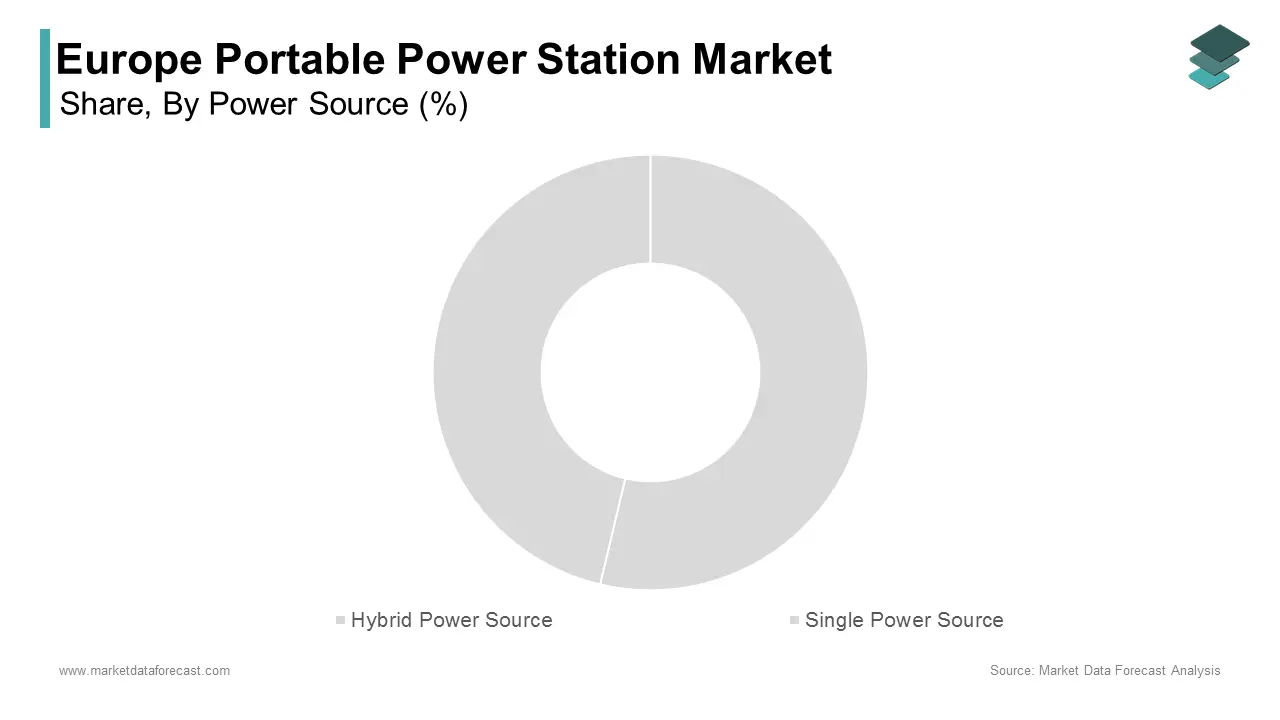
The hybrid power source segment is projected to expand at a CAGR of 18.4% from 2026 to 2034, owing to the specialized demand in remote professional and emergency response applications where energy assurance outweighs regulatory constraints. These users require the redundancy of both solar and fuel charging to ensure mission continuity. Additionally, civil protection agencies are adopting hybrid units for disaster zones where solar panels may be damaged or obscured by ash or debris. Although hybrid units represent a niche, their strategic value in high-stakes scenarios ensures sustained institutional procurement and technological refinement.
By Capacity Insights
The 500 to 1499 watt-hour capacity segment accounted in holding a prominent share of the Europe portable power station market in 2025, with an optimal balance between portability, runtime, and affordability for the majority of consumer and prosumer use cases. Additionally, this capacity class qualifies for carry-on luggage allowances on most European airlines under IATA guidelines, facilitating travel use. Retailers like Decathlon and MediaMarkt have standardized their private label offerings in this range, which is reinforcing consumer familiarity and driving volume through accessible pricing between 400 and 900 euros.
The 1,500-watt-hour and above capacity segment is anticipated to register a CAGR of 22.7% throughout the forecast period with the integration of home energy resilience and mobile professional needs. The increasing deployment of portable stations as temporary whole-home backup solutions during grid outages is additionally to leverage the growth of the segment. Simultaneously, mobile professionals such as film crews, field medics, and telecom technicians require high capacity for power-hungry equipment.
By Battery Type Insights
The lithium-ion batteries segment was the largest by holding a prominent share of the Europe portable power station market in 2025, owing to the superior energy density, safety, and lifecycle performance compared to legacy technologies. LFP cells offer 3,000 to 5,000 charge cycles with minimal degradation, versus 300 to 500 for sealed lead acid, according to testing by the Fraunhofer Institute for Solar Energy Systems. Moreover, lithium-ion units weigh 60 to 70 % less than equivalent lead acid models for portability and operate efficiently in temperatures as low as minus 10 degrees Celsius, a necessity in Nordic climates. The EU’s Ecodesign Directive also indirectly favors lithium by penalizing heavy, inefficient devices through energy labeling.
The lithium iron phosphate (LFP) segment is likely to witness the fastest CAGR of 24.1% from 2026 to 2034 with its enhanced safety profile and alignment with EU sustainability mandates. Unlike nickel manganese cobalt lithium-ion cells, LFP contains no cobalt or nickel materials classified as conflict minerals under the EU Conflict Minerals Regulation by making it easier to comply with due diligence requirements. This has led major retailers like Fnac and El Corte Inglés to exclusively stock LFP-based power stations. Additionally, the EU Battery Regulation’s 2031 recycled content targets are more achievable with LFP due to simpler material recovery, as validated by the Öko Institut. These regulatory and safety advantages position LFP as the de facto standard for new product development across Europe.
REGIONAL ANALYSIS
Germany Portable Power Station Market Analysis
Germany was the top performer of the European portable power station market by capturing 26.3% of share in 2026, with high consumer awareness, grid vulnerability concerns, and strong renewable integration. The country experienced 14 major grid instability events in 2025, according to the Federal Network Agency, with southern regions facing prolonged outages due to storm damage. Simultaneously, Germany’s Energiewende policy has spurred rooftop solar adoption with over 2.1 million residential PV systems now installed, creating natural demand for complementary storage. Regulatory support also plays a role, where the revised Technical Rule for Electrical Installations permits easy integration of portable units via standard Schuko sockets without complex permitting.
United Kingdom Portable Power Station Market Analysis
The United Kingdom was ranked second by occupying 19.2% of the Europe portable power station market in 2025, with elevated per capita ownership linked to frequent weather-induced outages. The UK’s National Grid recorded 127 significant power disruption events in 202,4, primarily from Storm Babet and persistent flooding in Wales and Northern England, affecting over 300,000 homes. Retailers like Argos and Decathlon UK have expanded their offerings with capacities tailored to British weather patterns by emphasizing 1000 to 1500 Wh units with rapid solar recharge. This combination of climate vulnerability and outdoor culture sustains robust demand despite the UK’s relatively high product prices and import duties.
France Portable Power Station Market Analysis
France's portable power station market growth is likely to be driven by the shape by proactive civil protection policies and persistent rural grid reliability issues. Additionally, the French Energy Regulatory Commission reports that rural communes in Occitanie and Provence experience average annual outage durations of 18.7 hours, nearly double the national average due to aging infrastructure and vegetation-related faults. Major retailers like Boulanger and Fnac have responded with in-store demonstrations and bundled solar panel offers. These institutional and geographic factors create a resilient market that transcends seasonal trends and anchors France as a key growth corridor in Western Europe.
Italy Portable Power Station Market Analysis
Italy's portable power station market growth is fueled by its massive tourism sector and chronic power reliability issues in the south. The average summer outage duration in Southern Italy reached 9.4 hours in 2025, per the Energy Market Regulatory Authority, where more than triple that of the north. This duality creates demand from both foreign visitors and residents. Retail chains like Unieuro and Euronics have introduced seasonal “Power for Holidays” campaigns featuring lightweight 500 to 1,000 Wh units with solar compatibility.
COMPETITION OVERVIEW
Competition in the Europe portable power station market is intensifying as global leaders and niche innovators vie for share across consumer, prosumer, and institutional segments. The market is bifurcated between premium brands offering certified high-capacity lithium iron phosphate units with smart features and budget entrants from Asia selling lower-priced alternatives with limited safety validation. Differentiation hinges on compliance with EU regulations such as the Battery Regulation Ecodesign Directive, and IEC safety standards, which act as significant entry barriers. Established players leverage localized service networks, multilingual support, and partnerships with outdoor and solar retailers to build trust.
KEY MARKET PLAYERS
A few major players of the Europe portable power station market include
- EcoFlow
- Jackery
- Goal Zero
- Bluetti
- Anker
- Duracell
- Suaoki
- Milwaukee Tool
- AllPowers
- CTECHi
Top Strategies Used by the Key Market Participants
Key players in the Europe portable power station market prioritize regulatory compliance through EU-specific safety and battery certifications, product localization with multilingual interfaces and climate-adapted performance features, strategic retail and e-commerce partnerships, expansion of after-sales service network, and integration with residential solar ecosystems. Companies invest heavily in lithium iron phosphate chemistry to meet sustainability and safety expectations while developing smart apps for remote monitoring and energy management. They also engage in consumer education campaigns around energy autonomy and emergency preparedness to stimulate demand. Additionally, brands are forging alliances with outdoor gear retailers, telecom providers, and solar installers to embed portable stations into broader lifestyle and infrastructure solutions, enhancing relevance beyond standalone backup use.
Leading Players in the Europe Portable Power Station Market
EcoFlow
EcoFlow is a global innovator in portable power solutions with a strong foothold in the European market through its high performance lithium iron phosphate based stations. The company is recognized for pioneering fast charging technology and smart energy management via its EcoFlow app, which enables remote monitoring and solar integration. In Europe, EcoFlow has established localized customer support centers in Germany and the Netherlands and partners with outdoor retailers such as Decathlon and Globetrotter to enhance accessibility.
Jackery
Jackery is a leading portable power station brand that has significantly influenced consumer adoption in Europe through user-centric design and solar ecosystem integration. The company offers a streamlined product lineup focused on reliability, simplicity, and outdoor compatibility, making it a preferred choice for campers, digital nomads, and emergency preparedness users. Jackery maintains strategic distribution partnerships with major European e-commerce platforms and specialty retailers, including Amazon, MediaMarkt, and REI Europe.
Bluetti
Bluetti has emerged as a key player in the European portable power station market by targeting the high-capacity segment with modular expandable systems suitable for home backup and professional use. The company’s AC200 and EP800 series support stacking and whole-house integration, appealing to tech-savvy homeowners and small business operators seeking energy resilience. Bluetti operates a dedicated European logistics and service hub in Poland, ensuring faster delivery and warranty support.
MARKET SEGMENTATION
This research report on the Europe portable power station market has been segmented and sub-segmented based on power source, capacity, battery type, and region.
By Power Source
- Hybrid Power Source
- Single Power Source
By Capacity
- Less than 500 Wh
- 500 Wh to 1,499 Wh
- 1,500 Wh and Above
By Battery Type
- Lithium-ion
- Sealed Lead-acid
By Region
- UK
- France
- Spain
- Germany
- Italy
- Russia
- Sweden
- Denmark
- Switzerland
- Netherlands
- Turkey
- Czech Republic
- Rest of Europe