- Product Description Description
- Table of Contents TOC
- List of Table & Figure LOT
- Get Free Sample PDF Sample PDF
Market Size, 2025
$49.17 BnMarket Estimate, 2026
$52.56 BnMarket Forecast, 2034
$89.63 BnCAGR, 2026–2034
6.9%Executive Summary: Europe Personal Protective Equipment (PPE) Market
- Market Scope: Comprehensive regional market evaluation of personal protective equipment in Europe covering product types, end-user industry verticals, and country-level distribution frameworks.
- Market Valuation: Valued at USD 49.17 billion (2025), estimated at USD 52.56 billion (2026), and projected to reach USD 89.63 billion by 2034, registering a robust CAGR of 6.9% (2026–2034).
- Primary Growth Drivers: Stringent EU occupational safety regulations (such as Regulation EU 2016/425 enforcing Category III third-party certification), expansion of healthcare and laboratory infrastructure, and strict workplace exposure limits for hazardous substances. Key operational catalysts include the rise of smart, connected PPE and sustainable circular economy initiatives.
Key Market Segment Metrics (2026–2034)
| Category | Leading Segment (2025 Position) | Fastest-Growing Segment |
|---|---|---|
| By Product | Hand Protection (held 28.3% market share in 2025 due to universal workplace hazard exposure and hand injuries) | Respiratory Protection (expected to register a CAGR of 9.6% driven by updated crystalline silica and isocyanate exposure limits) |
| By End-User | Manufacturing (accounted for 34.3% of the market in 2025 due to extensive industrial scale and ISO 45001 compliance) | Oil and Gas (likely to register a CAGR of 10.3% driven by North Sea projects and hydrogen infrastructure development) |
| By Country / Region | Germany (top-performing market backed by a world-leading industrial base and rigorous safety enforcement) | United Kingdom, France, and Italy (showcasing strong healthcare stockpiles, nuclear energy projects, and SME safety upgrades) |
Major Market Players & Market Structure
Market Structure: Highly regulated and quality-driven European PPE landscape dominated by global multinational corporations and strong regional manufacturers competing on certified compliance reliability, ergonomic design, smart connectivity, and sustainability.
Key Companies: 3M, Honeywell International Inc., Drägerwerk AG & Co. KGaA, DuPont, Cardinal Health, Medline Industries Inc., Kimberly-Clark Corporation, Ansell Ltd., MSA Safety Inc., and O&M Halyard Inc.
Europe PPE Market Size
The europe PPE market size was valued at USD 49.17 billion in 2025 and is anticipated to reach USD 52.56 billion in 2026 from USD 89.63 billion by 2034, growing at a CAGR of 6.9% during the forecast period from 2026 to 2034.
Personal protective equipment (PPE) in Europe encompasses garments, devices, and accessories designed to safeguard workers and the public from occupational, environmental, and health related hazards. This includes respirators, gloves, safety eyewear, protective clothing, hearing protection, and fall arrest systems used across healthcare, construction, manufacturing, and emergency services. According to the European Agency for Safety and Health at Work, many million people in the EU are employed in sectors where PPE is legally required, which is reflecting the scale of baseline demand. Furthermore, as per Eurostat, occupational injuries resulting in more than three days of absence totaled over 2.8 million cases in 2023, underscoring persistent workplace risks. The European Commission’s Strategic Framework on Health and Safety at Work 2021–2027 has intensified enforcement, requiring employers to conduct real time risk assessments and provide certified PPE tailored to specific hazards.
MARKET DRIVERS
Stringent EU Occupational Safety Regulations Mandate PPE Use Across Industries
The European Union’s comprehensive occupational health and safety legislation by making usage compulsory rather than optional in high risk environments is propelling the growth of Europe personal protective equipment market. Regulation EU 2016 425 classifies PPE into three risk categories, with Category III covering protection against lethal or irreversible harm requiring third party certification by notified bodies. The Construction Products Regulation further integrates PPE into site safety plans, which is requiring contractors on EU funded projects to submit PPE inventories as part of tender documentation. Additionally, the REACH regulation restricts hazardous substances in PPE materials, pushing manufacturers to innovate with safer alternatives. This multi layer regulatory ecosystem ensures consistent baseline demand, as employers face legal and financial consequences for lapses, transforming PPE from a cost center into a compliance imperative across the industrial landscape.
Expansion of Healthcare and Laboratory Infrastructure Fuels Demand for Medical Grade PPE
The ongoing investment in public health resilience has significantly increased demand for medical grade personal protective equipment in the wake of pandemic preparedness initiatives is escalating the growth of Europe personal protective equipment market. According to the European Centre for Disease Prevention and Control, EU member states collectively stockpiled items of PPE, including masks gowns and respirators in 2023. The European Federation of Pharmaceutical Industries and Associations reported that new vaccine and cell therapy manufacturing plants were commissioned across the EU in 2023. National health agencies updated biosafety guidelines in 2024 to mandate N95 equivalent respirators in all level 3 laboratories, which is affecting over 1200 research institutions.
MARKET RESTRAINTS
High Costs of Certified PPE Limit Adoption Among Small and Medium Enterprises
The elevated cost of CE certified personal protective equipment, where profit margins are tight and compliance resources are limited is restraining the growth of Europe personal protective equipment market. According to the European Small Business Portal, 62% of SMEs in construction and agriculture reported difficulty affording Category III PPE such as chemical resistant suits or powered air purifying respirators, which can cost three to five times more than non-certified alternatives. In Italy and Greece, national labor inspectorates found in 2023 that over 30% of inspected SMEs used substandard or counterfeit PPE to reduce expenses by exposing workers to unnecessary risk.
Fragmented National Enforcement Weakens Uniform Compliance Across the EU
The inconsistent enforcement by national labor inspectorates integrity and worker safety, which is additionally hindering the growth of Europe personal protective equipment market. This disparity allows substandard or non CE marked PPE to circulate in regions with lax oversight. In 2023, the European Market Surveillance Authority intercepted over 1.2 million counterfeit PPE items at EU borders with the majority destined for Eastern European construction sites. This regulatory asymmetry incentivizes cost cutting in low enforcement zones and complicates supply chain due diligence for multinational employers.
MARKET OPPORTUNITIES
Integration of Smart and Connected PPE in Industrial Digitalization Initiatives
The trend toward Industry 4.0 embedded with sensors connectivity and real time monitoring capabilities is likely to elevate new opportunities for the growth of Europe personal protective equipment market. As part of the EU’s Digital Europe Programme, over 200 industrial sites have piloted connected PPE that tracks vital signs gas exposure and fall detection, feeding data into centralized safety dashboards. Similarly, France’s Ministry of Labour endorsed smart vests with thermal stress sensors for outdoor workers after a 2023 heatwave caused over 3000 occupational heat related emergencies. Companies like Honeywell and 3M have partnered with European tech firms to develop PPE compliant with the General Data Protection Regulation by ensuring biometric data remains anonymized and locally processed. These innovations align with the EU’s Vision Zero goal of eliminating work related fatalities by 2050, which is transforming PPE from passive barriers into active prevention systems and opening a high value technology segment within the broader market.
Growth of Circular Economy Models for Reusable and Sustainable PPE
The European Green Deal’s emphasis on sustainability is accelerating the adoption of reusable, recyclable, and bio based personal protective equipment across public and private sectors. According to the European Environment Agency, single use PPE generated over 120000 tonnes of plastic waste in the EU in 2023, prompting policy shifts toward circular alternatives. The Netherlands launched a national PPE take back scheme in 2023 where hospitals return used gowns and masks to certified recyclers, with 78% of materials repurposed into construction panels. In Sweden, the Work Environment Authority updated procurement guidelines to prioritize PPE made from recycled polyester or biodegradable polymers, affecting over 400 public institutions. Companies like Ansell and Mapa now offer industrial gloves with up to 50% post-consumer recycled content, certified under the EU Ecolabel. Additionally, the European Commission’s 2024 Circular Economy Action Plan includes PPE in its product as a service pilot, encouraging leasing models for high end respirators and suits.
MARKET CHALLENGES
Counterfeit and Non-Compliant PPE Undermines Market Trust and Worker Safety
The persistent influx of counterfeit and non-CE marked personal protective equipment into European supply chains is to degrade the growth of Europe personal protective equipment market. According to the European Union Intellectual Property Office, seizures of fake PPE at EU borders rose by 27% in 2023, with falsified CE markings being the most common violation. The problem is exacerbated by online marketplaces where third party sellers list uncertified gear as “EU compliant.” In a 2024 investigation, Germany’s Federal Institute for Occupational Safety found that 41% of PPE purchased via major e commerce platforms lacked valid EU declaration of conformity. This erosion of trust forces legitimate manufacturers to invest in anti-counterfeiting measures, such as QR code verification and blockchain traceability, increasing costs.
Shortage of Skilled Labor in High Risk Sectors Increases Reliance on Advanced PPE
The aging workforce and labor shortages in construction, mining, and waste management are intensifying dependence on high performance personal protective equipment to extend working life and reduce injury rates. According to some reports, the construction sector faces a deficit of over 400000 skilled workers by 2026, with the average age of on-site personnel exceeding 47 in countries like Germany and Italy. Similarly, chemical plants in Belgium now issue smart gloves with vibration feedback to alert workers of improper grip, which is preventing repetitive strain injuries. However, these advanced solutions require training and fit testing, which many SMEs lack.
REPORT COVERAGE
| REPORT METRIC | DETAILS |
| Market Size Available | 2025 to 2034 |
| Base Year | 2025 |
| Forecast Period | 2026 to 2034 |
| Segments Covered | By Product, End-user, and Region |
| Various Analyses Covered | Global, Regional & Country Level Analysis, Segment-Level Analysis; DROC; PESTLE Analysis; Porter’s Five Forces Analysis, Competitive Landscape, Analyst Overview of Investment Opportunities |
| Regions Covered | North America, Europe, APAC, Latin America, Middle East & Africa |
| Market leaders Profiled | 3M, Honeywell International Inc., DuPont, Cardinal Health, Medline Industries Inc., Kimberly-Clark Corporation, Ansell Ltd., MSA Safety Inc., and O&M Halyard Inc. |
SEGMENTAL ANALYSIS
By Product Insights
The hand protection segment held 28.3% of the Europe personal protective equipment market share in 2025 with the universal exposure of hands to mechanical chemical and thermal hazards across nearly every industrial sector. The high incidence of hand injuries in European workplaces is driving the growth of segment. According to Eurostat, over 620000 non-fatal occupational injuries involving hands or fingers were reported in the EU in 2023. In the manufacturing and automotive sectors alone, hand injuries account for one in three lost time incidents as documented by the European Federation of Automotive Suppliers. This reality compels employers to provide cut resistant heat resistant and chemical resistant gloves compliant with EN 388 and EN 420 standards.
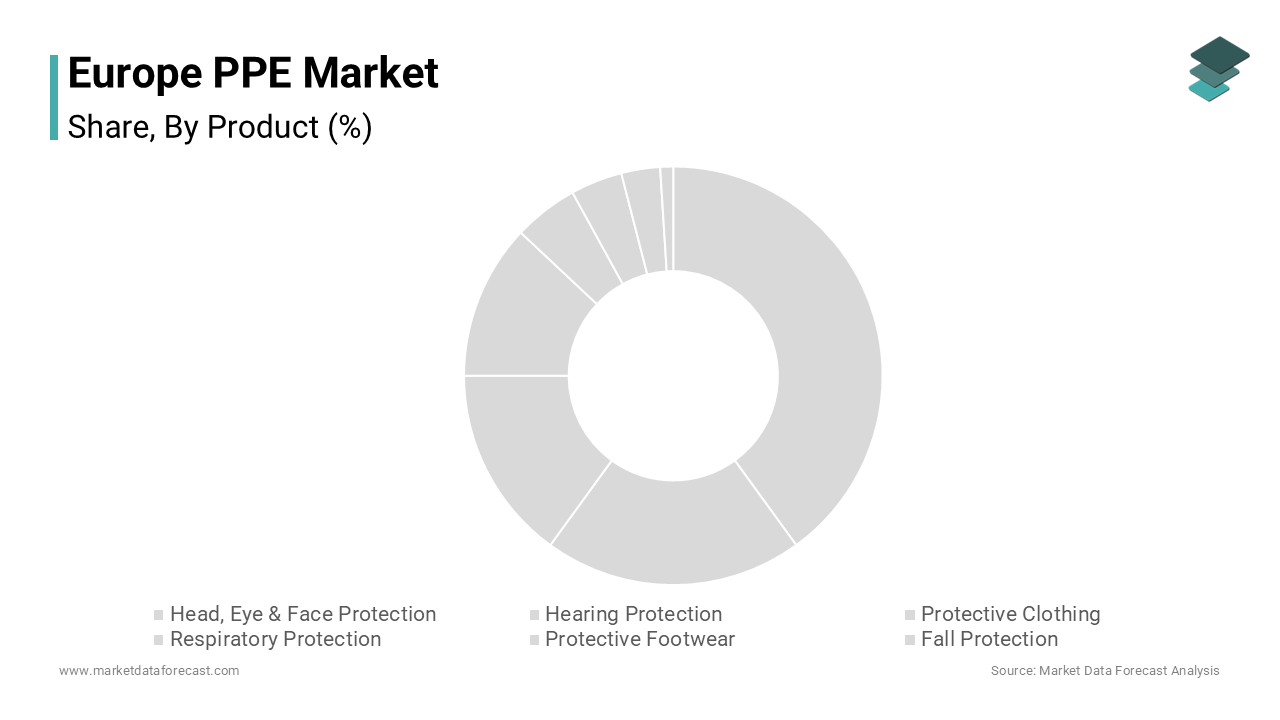
The respiratory protection segment is expected to register a CAGR of 9.6% throughout the forecast period owing to the EU’s updated workplace exposure limits for crystalline silica and isocyanates. As per the European Commission’s 2023 Directive on Carcinogens and Mutagens, the permissible exposure limit for respirable crystalline silica was reduced to 0.1 mg per cubic meter by affecting over 3 million workers in construction and foundries. The public health policy integration is additionally to enhance the growth of the segment. Additionally, urban air quality regulations in cities like Paris and Milan mandate FFP2 use for municipal workers during high pollution days.
By End-use Industry Insights
The manufacturing sector was the largest by accounting for 34.3% of Europe personal protective equipment market in 2025 owing to the scale and regulatory intensity of European manufacturing operations. According to Eurostat, the EU employs over 34 million people in manufacturing, with sub sectors like metal fabrication automotive assembly and chemical processing requiring comprehensive PPE protocols. The European Agency for Safety and Health at Work found that 89% of EU manufacturing facilities conduct mandatory PPE audits quarterly, driven by ISO 45001 compliance and insurer requirements. The integration of PPE into lean and safety management systems is gearing up the growth of the segment. Companies like Siemens and Bosch embed PPE usage metrics into their operational excellence dashboards, linking compliance to production line performance. The European Federation of Pharmaceutical Industries and Associations reported that sterile glove and gown use in biopharma manufacturing grew by 18% in 2023 due to expanded vaccine production.
The oil and gas industry segment is likely to register a CAGR of 10.3% throughout the forecast period with the reactivation of North Sea projects, hydrogen infrastructure development, and stringent new safety mandates for high-risk operations. The EU’s Hydrogen and Decarbonisation Strategy, which has spurred investment in blue hydrogen and carbon capture facilities that require Category III PPE for high pressure and cryogenic hazards. As per the European Network of Transmission System Operators for Gas, over 22 new hydrogen processing sites are under construction in Norway the Netherlands and Germany, each mandating flame retardant apparel and supplied air respirators. The aging infrastructure of North Sea assets is also prompting the growth of segments. The UK’s Oil and Gas Authority reported that 65% of active platforms are over 25 years old, increasing risks of fire explosion and chemical leaks. Consequently, operators like Shell and TotalEnergies now require full body harnesses and multi gas detectors for all offshore personnel.
REGIONAL ANALYSIS
Germany Europe PPE Market Analysis
Germany was the top performer of the Europe personal protective equipment market owing to its world leading industrial base and rigorous occupational safety enforcement. The country employs over 7 million people in manufacturing construction and chemicals sectors, where PPE is legally mandated under the German Occupational Safety Act. The nation also hosts major PPE manufacturers like Dräger and uvex, which export certified products across the EU.
United Kingdom Europe PPE Market Analysis
The United Kingdom PPE market was positioned next by its offshore energy sector healthcare system and construction industry. The National Health Service distributed over 8 billion items of PPE in 2023 as part of its pandemic resilience stockpile. The UK also enforces strict conformity assessments through the UKCA marking system post Brexit, which is requiring local notified bodies for certification. Companies like Arco and Seton dominate domestic distribution, while ports like Felixstowe handle significant PPE imports.
France Europe PPE Market Analysis
France PPE market growth is likely to grow with its centralized labor policies and public sector procurement power. The French Labour Code mandates employer funded PPE for all workers exposed to identified risks, with the state-owned occupational health service conducting over 95000 annual inspections. The country’s investment in nuclear energy renewal, including 14 new reactor projects that has intensified demand for anti-contamination suits and respiratory gear. Additionally, France’s national stockpile holds over 3 billion PPE items for public health emergencies. Major domestic players like Sioen and Delta Plus benefit from strong “Made in France” procurement preferences in public tenders.
Italy Europe PPE Market Analysis
Italy PPE market is likely to grow with a dense network of small and medium enterprises in manufacturing and construction. According to Istat, over 4.3 million Italians work in sectors requiring PPE, with high injury rates in metalworking and footwear production driving glove and eye protection demand. Italy is also a hub for PPE innovation companies like Cofra and Cimadoro export flame retardant and anti-static footwear globally. Southern regions have seen increased PPE adoption due to EU cohesion funds supporting workplace safety upgrades.
COMPETITIVE LANDSCAPE
Competition in the Europe personal protective equipment market is highly regulated and quality driven with dominance by global players like 3M Honeywell and Dräger alongside strong regional manufacturers such as uvex and Delta Plus. The market features high barriers to entry due to stringent EU certification requirements Category III conformity assessments and national enforcement variations. Differentiation occurs through product innovation ergonomic design and compliance reliability rather than price alone. The shift toward smart connected and sustainable PPE is reshaping competitive dynamics with technology integration becoming a key differentiator. Public procurement policies favoring certified local suppliers further consolidate the position of established brands.
KEY MARKET PARTICIPANTS
Some of the companies that are playing a dominating role in the Europe PPE Market include
- 3M
- Honeywell International, Inc.
- DuPont
- Cardinal Health
- Medline Industries, Inc.
- Kimberly-Clark Corporation
- Ansell Ltd.
- MSA Safety Inc.
- O&M Halyard, Inc.
Top Players in the Market
3M Company
3M Company is a global leader in personal protective equipment with a strong presence across the Europe market through its extensive portfolio of respirators hearing protection safety eyewear and protective clothing. The company supplies certified PPE to healthcare construction and industrial sectors in compliance with EU Regulation 2016 425 and EN standards. 3M leverages its advanced materials science expertise to develop high performance solutions such as reusable FFP3 respirators and anti fog safety glasses. In recent years the company has expanded its European manufacturing capacity in Germany and Poland to ensure supply resilience and reduce lead times. 3M also collaborates with European occupational health agencies to provide training on correct PPE usage reinforcing its role as a safety partner beyond product supply.
Honeywell International Inc
Honeywell International Inc plays a pivotal role in the Europe personal protective equipment market through its integrated safety solutions for industrial and emergency response applications. The company offers a comprehensive range including fall protection gas detection equipment and flame resistant apparel tailored to European regulatory requirements. Honeywell actively aligns its products with EU directives on chemical and fire hazards and maintains local certification through notified bodies in the Netherlands and France. Recently the company enhanced its connected PPE offerings by integrating sensors into helmets and vests for real time worker monitoring in accordance with GDPR. These innovations support Europe’s Vision Zero workplace safety goals while strengthening Honeywell’s position as a technology driven safety provider.
Drägerwerk AG & Co KGaA
Drägerwerk AG & Co KGaA is a Germany based global specialist in medical and safety technology with deep roots in the European PPE market. The company is renowned for its high integrity respiratory protection systems including supplied air and self-contained breathing apparatus used in firefighting industrial hygiene and healthcare. Dräger’s products comply with the strictest EU Category III requirements and are widely adopted by national emergency services and chemical plants. The company invests heavily in R&D at its Lübeck facility focusing on ergonomic design and user comfort without compromising protection levels.
Top Strategies Used by the Key Market Participants
Key players in the Europe personal protective equipment market prioritize regulatory compliance by ensuring all products meet EU 2016 425 and relevant EN standards through accredited notified bodies. They invest in local manufacturing and distribution networks to enhance supply chain resilience and reduce delivery times. Companies integrate smart technologies such as sensors and connectivity into PPE to support Industry 4.0 and worker health monitoring while adhering to GDPR. Strategic partnerships with national health agencies occupational safety bodies and large industrial clients strengthen market access and trust. Additionally, they develop sustainable PPE solutions using recycled or bio-based materials to align with the European Green Deal and circular economy initiatives.
MARKET SEGMENTATION
This research report on the European PPE market has been segmented and sub-segmented based on the following categories
By Product
- Head, Eye & Face Protection
- Hearing Protection
- Protective Clothing
- Heat & Flame Protection
- Chemical Defending
- Cleanroom Clothing
- Mechanical Protective Clothing
- Limited General Use
- Others
- Respiratory Protection
- Air-purifying Respirators
- Supplied Air Respirators
- Protective Footwear
- Leather
- Rubber
- PVC
- Polyurethane
- Others
- Fall Protection
- Hand Protection
- Disposable Gloves
- By Type
- General Purpose
- Chemical Handling
- Sterile Gloves
- Surgical
- Others
- By Material
- Natural Rubber
- Nitrile
- Neoprene
- Vinyl
- Others
- By Type
- Durable Gloves
- Mechanical Gloves
- Chemical Handling
- Thermal/Flame Retardant
- Others
- Disposable Gloves
- Others
By End-User
- Construction
- Manufacturing
- Oil & Gas
- Chemicals
- Food
- Pharmaceuticals
- Healthcare
- Transportation
- Mining
- Others
By Country
- UK
- France
- Spain
- Germany
- Italy
- Russia
- Sweden
- Denmark
- Switzerland
- Netherlands
- Turkey
- Czech Republic
- Rest of Europe