- Product Description Description
- Table of Contents TOC
- List of Table & Figure LOT
- Get Free Sample PDF Sample PDF
Market Size, 2025
$4.87 BnMarket Estimate, 2026
$5.54 BnMarket Forecast, 2034
$15.47 BnCAGR, 2026–2034
13.7%Europe Precision Agriculture Market Size, Share, Trends & Forecast (2026–2034)
- Market Scope: Comprehensive European precision agriculture market analysis covering core offerings (hardware, software, services), technologies, applications, and extensive country frameworks (UK, France, Spain, Germany, Italy, Russia, Sweden, Denmark, Switzerland, Netherlands, Turkey, Czech Republic, and Rest of Europe).
- Market Valuation: Valued at USD 4.87 billion (2025), estimated at USD 5.54 billion in 2026, and projected to reach USD 15.47 billion by 2034, registering a strong CAGR of 13.7% (2026–2034).
- Primary Growth Drivers: EU environmental regulations and the Farm to Fork Strategy (pushing for reduced chemical and pesticide use), chronic agricultural labor shortages driving automation, and the rapid rollout of 5G rural connectivity for real-time edge analytics.
Key European Precision Agriculture Segment Metrics (2026–2034)
| Category | Leading Segment (2025 Position) | Fastest-Growing Segment |
|---|---|---|
| By Offering | Hardware (held 58.2% market share in 2024 due to high adoption of GPS tractors and sensors) | Software (expanding at a 14.2% CAGR with cloud-based management platforms and AI agronomy) |
| By Technology | Guidance systems (dominant market share backed by the European Space Agency's Galileo constellation) | Remote sensing (projected at a 16.8% CAGR driven by Copernicus Sentinel satellite and drone imagery) |
| By Application | Yield monitoring (accounted for 28.3% market share in 2024 for direct profit and compliance tracking) | Irrigation management (projected at an 18.3% CAGR amid intensifying water stress across Southern Europe) |
| By Country / Region | Germany (largest market holding 19.2% share in 2024 backed by heavy large-scale arable farming and digital hubs) | Spain and Italy (scaling rapidly through climate-induced water scarcity and high-value specialty crops) |
Major Market Players, Structure & Strategic Landscape
Market Structure: Highly competitive European ecosystem featuring global machinery leaders, agrochemical giants, and digital native agronomic software firms competing on platform interoperability, regulatory compliance, and data trust.
Key Companies: Deere & Company, Trimble, Inc., CNH Industrial, Leica Geosystems, BASF Digital Farming, AJ Junction, Inc., Monsanto Company, AgSmarts Inc., CropMetrics LLC, and Dickey-John Corporation.
Europe Precision Agriculture Market Size
The European precision agriculture market was valued at USD 4.87 billion in 2025 and is anticipated to reach USD 5.54 billion in 2026, from USD 15.47 billion by 2034, growing at a CAGR of 13.7% during the forecast period from 2026 to 2034. Precision agriculture in Europe is a technologically advanced approach to farming that leverages data-driven decision-making to optimize crop yields while minimizing environmental impact. This methodology integrates satellite imagery, drone-based monitoring, soil sensors, and variable rate application technologies to tailor agricultural practices to specific field conditions. The European Union has increasingly emphasized sustainable food production under its Farm to Fork Strategy, which aims to reduce chemical pesticide use by 50% and nutrient losses by at least 20 % by 2030, as per the European Commission.
MARKET DRIVERS
Integration of EU Environmental Regulations Drives Adoption
The European Union’s stringent environmental directives serve as a pivotal driving factor for the growth of Europeanrope precision agriculture market. These legally binding targets compel farmers to adopt site-specific management techniques that minimize chemical inputs while maintaining productivity. Precision technologies such as GPS-guided sprayers and soil nutrient mapping enable compliance by applying agrochemicals only where necessary. Additionally, the Nitrates Directive, which limits nitrogen application in vulnerable zones, has prompted widespread use of variable rate technology in countries like Germany and the Netherlands, where over 60 % of arable land falls under nitrate vulnerable zones according to the European Environment Agency.
Labor Shortages Accelerate Technological Substitution
The persistent agricultural labor shortages across Europe are compelling farmers to adopt automation and data-driven tools as substitutes for manual labor, which is additionally accelerating the growth of the European Precision Agriculture Market. In Southern and Eastern Europe, where seasonal labor dependency is high, the gap is more acute. For instance, Spain’s fruit and vegetable sector faces an annual shortfall of approximately 150,000 seasonal workers, according to the Spanish Ministry of Agriculture. In Germany, over 35 % large-scale farms now utilize automated guidance systems for planting and harvesting, as per the German Agricultural Society.
MARKET RESTRAINTS
High Initial Investment Remains a Barrier
The substantial upfront capital required to deploy precision agriculture systems continues to hinder widespread adoption among smand all medium-sized farms is restraining the growth of the European Precision Agriculture Market. This financial threshold is prohibitive for many family-run operations, especially in Eastern and Southern Europe, where access to credit remains constrained. Although the Common Agricultural Policy provides subsidies through its Rural Development Program, only 22 % of eligible farmers applied for digitalization grants in 2022, as per the European Court of Auditors, due to complex application procedures anlack ack of awareness. Moreover, the return on investment timeline often exceeds five years, which deters risk-averse farmers.
Fragmented Data Standards Impede Interoperability
The absence of unified data protocols across European precision agriculture platforms significantly restricts system interoperability and data utility, which is also an attribute that is hindering the growth of the European Precision Agriculture Market. Farmers frequently use equipment and software from multiple vendors, yet these systems often operate on proprietary data formats, preventing seamless integration. The European Data Act aims to address this by promoting data portability, but sector-specific standards for agronomic data remain underdeveloped. Unlike the United States, where the AgGateway consortium has established widely adopted protocols such as ADAPT, Europe lacks a comparable harmonized framework. This technical disarray not only reduces operational efficiency but also discourages adoption among tech-savvy farmers who expect plug-and-play functionality.
MARKET OPPORTUNITIES
Expansion of 5G Connectivity Unlocks Real-Time Field Analytics
The rapid rollout of 5G networks across rural Europe is creating unprecedented opportunities for real-time data transmission and edge computing in precision agriculture. As per the European 5G Observatory, over 75 % of EU rural municipalities are expected to have 5G coverage by 2025, enabling low-latency communication between field sensors, autonomous machinery, and cloud platforms. The European Commission’s Digital Europe Programme has allocated 200 million euros specifically for rural digital infrastructure, including 5G testbeds in agriculture. This enhanced bandwidth also facilitates the deployment of artificial intelligence models that require continuous data streams for predictive analytics, such as disease outbreak forecasting.
Policy Support for Carbon Farming Creates New Revenue Streams
The European Union’s emerging carbon farming framework is a significant commercial opportunity for precision agriculture by enabling farmers to monetize verified carbon sequestration, which is lucratively showcasing new opportunities for the growth of the European Precision Agriculture Market. Under the EU Climate Law, member states must achieve net zero emissions by 2050, and agriculture is increasingly recognized as a carbon sink rather than just a source. Precision technologies are essential for accurate measurement, reporting, and verification of soil carbon stocks, with satellite imagery and IoT sensors providing the granularity required by certification bodies.
MARKET CHALLENGES
Cybersecurity Vulnerabilities Threaten Operational Integrity
The increasing digitization of European farms introduces significant cybersecurity risks that could compromise both data integrity and physical operations, which is one of the major challenges for the growth of the European Precision Agriculture Market. In 2022, a coordinated cyberattack on a cooperative in Denmark disrupted planting schedules for over 200 farms by corrupting seed prescription maps stored on a shared server, according to the Danish Agriculture and Food Council. The consequences extend beyond financial loss to food safety and supply chain reliability. Unlike industrial sectors covered by the NIS2 Directive, agriculture remains largely unregulated in terms of cyber resilience. Farmers often reuse default passwords and connect legacy equipment to modern networks, creating exploitable entry points.
Data Ownership Ambiguity Undermines Farmer Trust
The uncertainty over who controls and benefits from farm-generated data continues to erode trust and deter adoption of advanced technology, which also hinders the growth of the European Precision Agriculture Market. A 2023 survey by Copa Cogeca revealed that 68 % of EU farmers are unwilling to share field data due to concerns about losing a competitive advantage or facing discriminatory pricing from input suppliers. In Germany, legal disputes have arisen where machinery manufacturers used telematics data to void warranties based on alleged misuse, a practice challenged by the German Farmers Association. This legal vacuum stifles innovation as developers hesitate to build interoperable solutions without standardized data governance.
REPORT COVERAGE
| REPORT METRIC | DETAILS |
| Market Size Available | 2025 to 2034 |
| Base Year | 2025 |
| Forecast Period | 2026 to 2034 |
| CAGR | 13.7% |
| Segments Covered | By offering Technology, Application, and Country |
| Various Analyses Covered | Global, Regional, and Country Level Analysis, Segment-Level Analysis; DROC, PESTLE Analysis; Porter’s Five Forces Analysis; Competitive Landscape; Analyst Overview of Investment Opportunities |
| Regions Covered | UK, France, Spain, Germany, Italy, Russia, Sweden, Denmark, Switzerland, Netherlands, Turkey, Czech Republic, and the Rest of Europe |
| Market Leaders Profiled | Deere & Company, Trimble, Inc., Leica Geosystems, AJ Junction, Inc., Monsanto Company, AgSmarts Inc., CropMetrics LLC, and Dickey-John Corporation |
SEGMENT ANALYSIS
By Offering Insights
The hardware segment accounted in holding 58.2% of the European Precision Agriculture Market share in 2024, with the foundational role of physical equipmesuch ass h GPS-enabled tractors, automated steering systems, soil sensors, drones, and yield monitors that enable data collection and field operations. Farmers across the EU prioritize tangible assets that deliver immediate operational benefits, especially in large-scale arable farming systems prevalent in Germany, France, and the Netherlands. Leading manufacturers like John Deere and CNH Industrial report that over 70 % of new tractor sales in Western Europe now include factory-installed precision guidance kits.
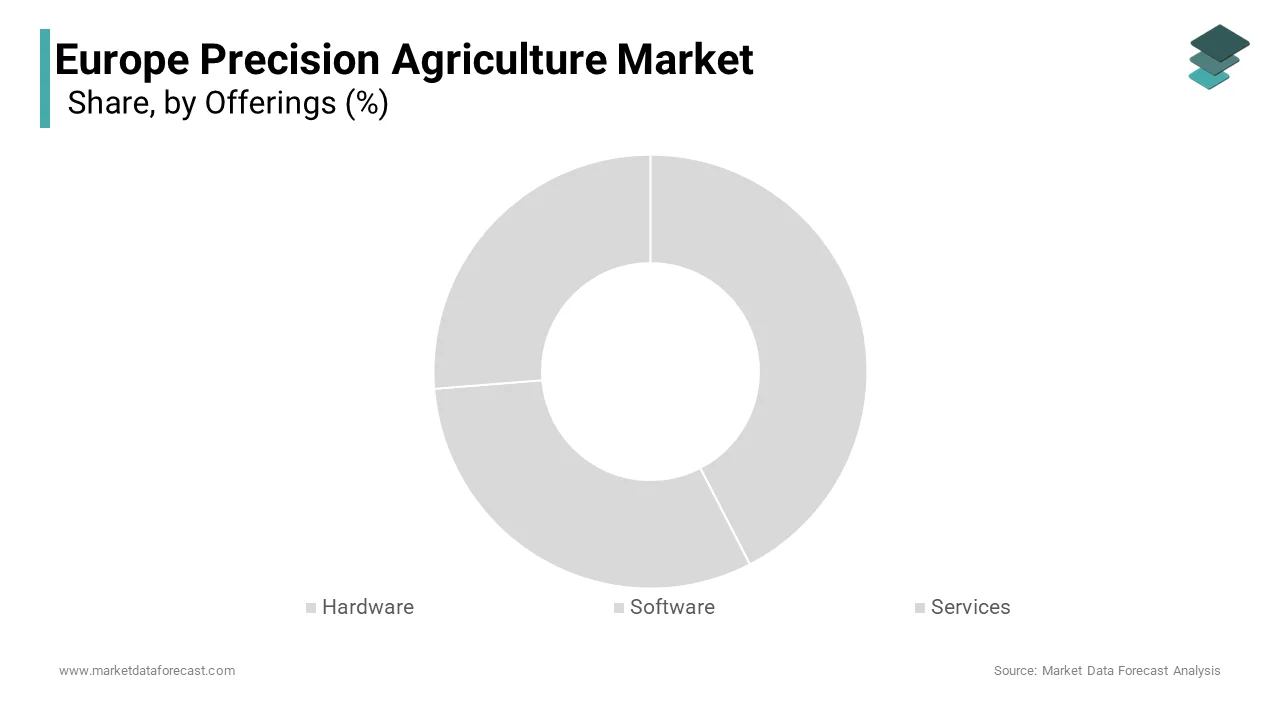
The software segment is projected to expand at a CAGR of 14.2 % from 2025 to 2033, with the increasing integration of artificial intelligence, cloud computing, and farm management information systems that transform raw field data into actionable insights. This regulatory shift compels even smallholders to adopt basic software platforms. In France, over 60 % of farms with more than 50 hectares now use integrated farm management software such as Akkerweb or 365FarmNe, as reported by FranceAgriMer. Similarly, in the Netherlands, Wageningen Economic Research notes that software-driven variable rate nitrogen applications have reduced fertilizer use by 18 % while maintaining yields.
By Technology Insights
The guidance systems segment was the largest by occupying a dominant share of the European precision agriculture market in 2024, with the widespread adoption of auto steering and GPS-based navigation that reduces overlap during field operations, lowers fuel consumption,n and minimizes operator fatigue. This technology is particularly valuable in large-scale cereal and sugar beet production, where precision in row alignment directly impacts yield and harvesting efficiency. The European Space Agency’s Galileo satellite constellation,n which offers centimeter-level accuracy across the continent, has significantly enhanced the reliability of these systems. Moreover, the Common Agricultural Policy’s greening requirements, which penalize inefficient land use, have made accurate field navigation essential for compliance.
The remote sensing segment is more likely to grow with an anticipated CAGR of 16.8% during the forecast period, with the integration of high-resolution satellite ima,rone drone-based multispectral, and AI-powered analytics that enable real-time crop health assessment at scale. The Copernicus Sentinel 2 satellites operated by the European Space Agency provide free multispectral imagery with 10-meter resolution every five days, covering the entire EU, which has democratized access to field-level data.
By Application Insights
The yield monitoring segment was the largest by occupying 28.3% of the European precision agriculture market share in 2024, with its direct link to profitability. Real-time yield maps enable farmers to assess field performance, identify underperforming zones, and adjust inputs for subsequent seasons. German sugar beet cooperatives mandate yield data submission from all contracted growers to optimize processing logistics and payment structures according to the German Sugar Association.
The irrigation management segment is likely to grow with an expected CAGR of 18.3% throughout the forecast period, with the intensifying water stress across Southern and Central Europe. Italian rice growers in the Po Valle, facing unprecedented drought, have adopted precision irrigation to reduce water consumption by 30 % while maintaining yields, as reported by Coldiretti.
COUNTRY ANALYSIS
Germany Market Analysis
Germany was the largest and held 19.2% of Europeanrope precision agriculture market share in 2024. Over 65 % of German farms larger than 100 hectares utilize at least three precision agriculture technologies, including auto guidance, yield monitoring, and variable rate application as per the Thünen Institute. The government’s Digital Innovation Hubs have trained over 12000 farmers in data-driven farming since 2021. Germany also hosts Europe’s highest concentration of agritech startups, with Berlin and Bonn emerging as innovation clusters supported by 250 million euros in public funding from the Federal Office for Agriculture and Food.
France Market Analysis
France was positioned second with 17.2% of the European Precision Agriculture Market share in 2024, which is heavily influenced by national strategies such as the Ecophyto Plan and the France Relance recovery program, which allocated 300 million euros to accelerate digital farming. Cooperative networks like InVivo and Axéréal provide bundled hardware, software, and advisory services, lowering entry barriers for smallholders. France also leads in drone regulation, with the Civil Aviation Authority establishing clear rules for agricultural UAV operations, enabling rapid scaling. The mandatory digital crop passport introduced in 2023 further embeds data collection into routine farming.
Spain Market Analysis
Spain's precision agriculture market is likely to grow with the urgent need to adapt to climate-induced water scarcity. Over 70% of the country’s agricultural land is classified as vulnerable to desertification by the European Environment Agency, making efficient resource management onegotiable Precision irrigation systems now cover 2 1 million hectares, representing 45 % of all irrigated land, as per the National Statistics Institute. Spain also leads isolated-power-driven drone operations, with over 5000 agricultural UAVs registered in 202,3, according to AESA, the national aviation authority.
Italy Market Analysis
Italy's precision agriculture market growth is likely to grow, with growth centered on high-value specialty crops such as wine, olives, and tomatoes. The National Recovery and Resilience Plan allocates 420 million euros to digitalize 300000 farms by 202,6 with emphasis on traceability and sustainability certification. In the Po Valley, where rice production faces dual pressures of water scarcity and methane emission, farmers deploy satellite-guided laser leveling and alternate wetting-drying protocols monitored via IoT senors, s, reported by Coldiretti. Italy’s Protected Designation of Origin system, which covers over 800 products, creates strong incentives datafor -driven quality control.
COMPETITIVE LANDSCAPE
The European precision agriculture market features intense competition among global machinery manufacturers, agrochemical giants, and specialized agritech firms. Competition centers on interoperability,typey data ownership, and compliance with the EU’s stringent environmental directives rather than just hardware performance. Established players like John Deere and CNH Industrial leverage their extensive dealer networks and machinery integration, while digital natives such as BASF Digital Farming and Yara focus on agronomic insights and sustainability metrics. New entrants often target niche applications like drone scouting or irrigation analytics and scale through partnerships rather than direct sales. The absence of universal data standards fuels competition around platform openness and farmer trust.
KEY MARKET PLAYERS
A few of the market players in Europeanrope precision agriculture market include
- Deere & Company
- Trimble, Inc.
- Leica Geosystems
- AJ Junction, Inc.
- CNH Industrial
- BASF Digital Farming
- Monsanto Company
- AgSmarts Inc.
- CropMetrics LLC
- Dickey-John Corporation
Top Players In The Market
- John Deere has established a formidable presence in the European precision agriculture market through its integrated suite of hardware and software solutions. The company offers advanced GPS guidance systems, automated machinery, and the Operations Center platform, which enables real-time data analytics and farm management. In recent years, John Deere has strengthened its position by acquiring Bear Flag Robotics to accelerate autonomous tractor deployment and by launching its See and Spray Select technology in Europe, which uses computer vision to target weeds, reducing herbicide use.
- CNH Industrial operates across Europe under its Case IH and New Holland Agriculture brands, delivering precision farming technologies such as AFS Connect, telemat, AccuGuide auto steering, and Pulsar variable rate controllers. The company has intensified its digital offerings by integrating its fleet management systems with third-party agronomic platforms and expanding its dealer network’s technical training programs. In 2023, CNH Industrial launched the MyPLM Connect platform in France and Germany, enabling seamless data flow between machinery and farm management software.
- BASF Digital Farming has emerged as a key player by focusing on data-driven agronomic decision support rather than machinery. Its Xarvio FIELD MANAGER platform provides field zone management, crop protection recommendations, and nitrogen optimization tools tailored to European regulatory and climatic conditions. The company recently enhanced its offering by integrating satellite imagery from the European Space Agency and partnering with local cooperatives in Spain and Poland to deliver region-specific advisories. BASF also launched a carbon footprint tracking module in 2023 to help farmers comply with the EU’s emerging carbon farming framework.
MARKET SEGMENTATION
This research report on Europeanrope precision agriculture market is segmented and sub-segmented into the following categories.
By Offering
- Hardware
- Automation and Control Systems
- Sensing and Monitoring devices
- Software
- Web-based
- Cloud-based
- Services
By Technology
- Guidance Systems
- Variable Rate Technology
- Remote Sensing
By Application
- Yield Monitoring
- Field Mapping
- Crop Scouting
- Weather Tracking and Forecasting
- Irrigation Management
- Inventory Management
- Farm Labor Management
- Financial Management
By Country
- UK
- France
- Spain
- Germany
- Italy
- Russia
- Sweden
- Denmark
- Switzerland
- Netherlands
- Turkey
- Czech Republic
- Rest of Europe