- Product Description Description
- Table of Contents TOC
- List of Table & Figure LOT
- Get Free Sample PDF Sample PDF
Market Size, 2025
$8.35 BnMarket Estimate, 2026
$9.58 BnMarket Forecast, 2034
$28.69 BnCAGR, 2026–2034
14.7%Global Precision Agriculture Market Size, Share, Trends & Forecast (2026–2034)
- Market Scope: Comprehensive global precision agriculture market analysis covering core technologies, diverse agricultural applications, regional frameworks across North America, Europe, APAC, Latin America, and Middle East & Africa, and key growth dynamics.
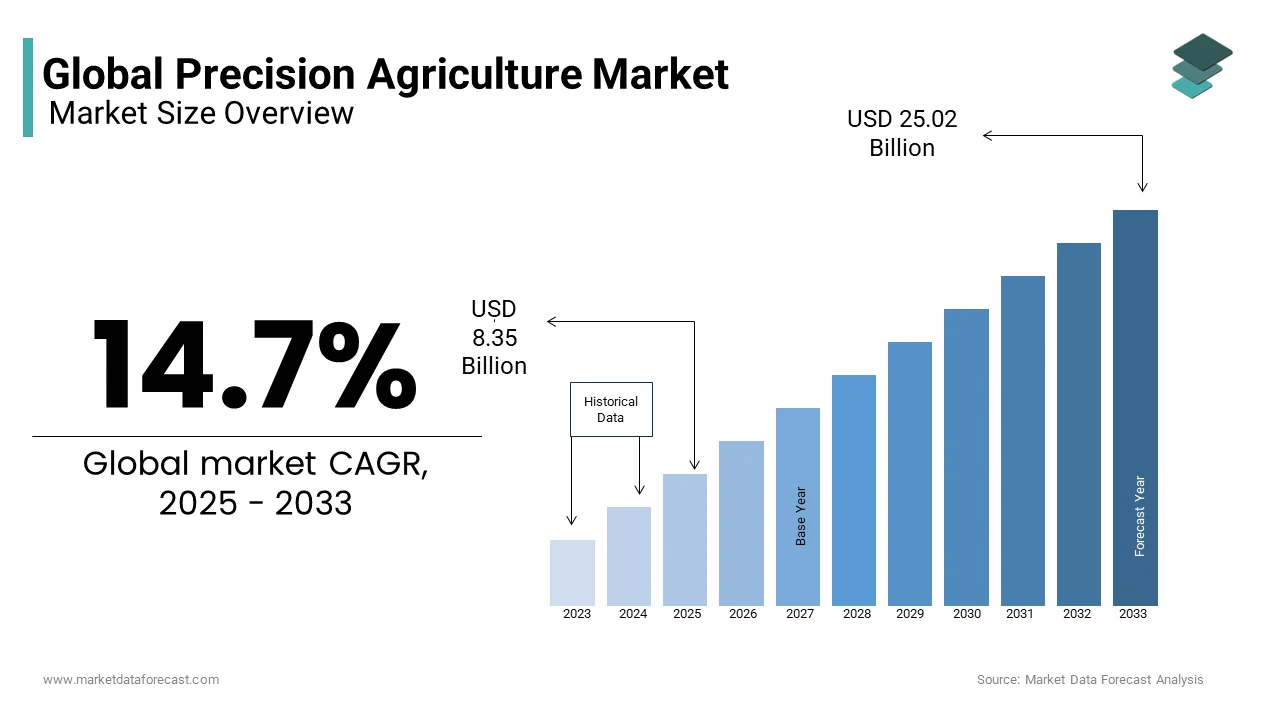
- Market Valuation: Valued at USD 8.35 billion (2025), estimated at USD 9.58 billion in 2026, and projected to reach USD 28.69 billion by 2034, registering a remarkable CAGR of 14.7% (2026–2034).
- Primary Growth Drivers: Rising global population increasing food demand, technological advancements in IoT, machine learning, and GPS navigation, push for sustainable and traceable farming practices, and the need to limit labor costs while maximizing crop yields.
Key Global Precision Agriculture Segment Metrics (2026–2034)
| Category | Leading Segment (2025 Position) | Fastest-Growing Segment |
|---|---|---|
| By Technology | Guidance systems (largest share, providing precise GPS-based navigation for minimal overlap) | Variable-Rate Technology (VRT) and Remote Sensing (surging due to real-time crop health monitoring and input optimization) |
| By Application | Weather tracking, forecasting, and yield monitoring (dominant tools for informed planting and resource allocation) | Irrigation management and field mapping (scaling rapidly in water-scarce regions) |
| By Region | North America (highest market share and fastest regional CAGR driven by advanced technology infrastructure) | Asia Pacific (predicted to grow the fastest due to rising food production demands in China and India) |
Major Market Players, Structure & Strategic Landscape
Market Structure: Highly competitive global technology and machinery ecosystem featuring established agricultural heavyweights and specialized precision innovators competing on telematics integration, automated guidance, and data-driven agronomic insights.
Key Companies: Deere & Company, Trimble Inc., Ag Leader Technology, Raven Industries, Topcon Positioning Systems, AGCO Corporation, CNH Industrial N.V., DICKEY-john Corporation, AgJunction Inc., Precision Planting Inc., TeeJet Technologies, CropMetrics LLC, Farmers Edge Inc., Iteris, Inc., Agribotix LLC, SST Development Group, Inc., Granular, Inc., Gamaya, and The Climate Corporation.
 Download Free Sample Report
Global Precision Agriculture Market Size
The global precision agriculture market size was valued at USD 8.35 billion in 2025 and is anticipated to reach USD 9.58 billion in 2026 to reach USD 28.69 billion by 2034, growing at a CAGR of 14.7% during the forecast period from 2026 to 2034.
Current Scenario Of The Global Precision Agriculture Market
Precision agriculture is the new advanced farming method where farmers utilize advanced technological management to improve production. Precision farming helps farmers enhance sustainability and crop yield and manage resources such as water and fertilizer, which increases productivity, quality, and yield. Precision agriculture uses various technologies such as sensor technology, GPS, robotics, drones, and planes, and these advanced technologies are expected to boost the applications of precision agriculture in the agricultural industry. The global precision agriculture market has witnessed significant growth in recent years and is projected to experience notable growth during the forecast period. Precision agriculture practices use technology to manage fertilizers and water supply effectively. It also helps farmers with climate change, which enhances their adoption. Precision agriculture is an advanced innovation and optimized field-level management that aims to improve the productivity of agriculture.
MARKET DRIVERS
The increasing global population is causing relentless growth in the precision agriculture market. With precision agriculture, farmers focus on advanced technologies and data analytics to optimize their practices. They can significantly enhance crop yields and livestock production while conserving vital resources such as water, land, and energy. As the demand for sustainable and traceable food rises, precision agriculture also ensures that agricultural practices align with consumer preferences for transparency and eco-friendly methods. The combination of technological advancements and the imperative to feed a growing population propels the precision agriculture market forward, making it an indispensable tool in modern agriculture's quest for efficiency and sustainability.
Technological advancement is acting as a transformative driver in the precision agriculture market. GPS technology enables precision in planting and harvesting, optimizing resource use. Machine learning algorithms process this data to offer insights, from predicting crop yields to identifying disease outbreaks.
The increased adoption of IoT and advanced analytics in the agricultural industry, which helps collect information regarding yield and soil assurance and supports farmers with valid decision-making, augments the global market revenue expansion. The rising adoption of precision agricultural practices to limit labor costs and the escalating demand for food worldwide, owing to the increasing population, will fuel the market share growth. The growing introduction of advanced and innovative farming methods, such as vertical farming, maximizes yield and reduces waste by limiting resource utilization, propelling market growth.
MARKET RESTRAINTS
High costs can be a significant restraint in the precision agriculture market. These financial barriers can be especially daunting for farmers with limited resources. Precision agriculture demands investment in various components, including specialized equipment, cutting-edge software, and data services. These expenditures often prove prohibitive, preventing widespread adoption. The high initial costs extend to the purchase of sensors, GPS devices, drones, and data management systems. Such financial demands can place a heavy burden on the financial stability of farming operations. Smaller and resource-constrained farms may find it particularly challenging to allocate capital to embrace these innovations. Efforts are underway to mitigate this restraint, such as government subsidies, grants, and financing options. These initiatives aim to make precision agriculture more accessible and equitable, allowing even smaller-scale farmers to benefit from the advantages of increased efficiency, resource conservation, and higher yields. Overcoming the financial hurdle is pivotal for realizing the full potential of precision agriculture in modern farming.
MARKET OPPORTUNITIES
The escalating demand for climatic information technologies among farmers for better yield production and the rising demand for clean-labeled agricultural goods are expected to increase the adoption of precision agriculture practices, which provide market growth opportunities in the coming years. Various benefits of precision agriculture, such as yield monitoring, crop scouting, weather forecasting, irrigation management, field mapping, and farm labor management, are driving growth opportunities in the global precision agriculture market. Temperature and rain sensors, water meters, and weather-based controllers are advanced technologies incorporated into the irrigation management services that propel the market expansion.
MARKET CHALLENGES
Alternative farming methods, such as conventional farming, are expected to be challenging for market growth as some farmers choose non-technological methods due to limited budgets. The stringent regulations by the agricultural authorities and the rising concerns related to privacy and data security, as these work by cloud-based systems that store the complete data, are estimated to hinder the market growth rate. The presence of limited technological knowledge and the lower ability of the farmers to understand the advanced technologies, especially among the people belonging to the emerging nations where the traditional farming methods are widely utilized, hampers the global precision agriculture market expansion.
REPORT COVERAGE
| REPORT METRIC | DETAILS |
| Market Size Available | 2025 to 2034 |
| Base Year | 2025 |
| Forecast Period | 2026 to 2034 |
| CAGR | 14.7% |
| Segments Covered | By Technology, Applications, and Region |
| Various Analyses Covered | Global, Regional, and Country Level Analysis, Segment-Level Analysis; DROC; PESTLE Analysis; Porter’s Five Forces Analysis; Competitive Landscape; Analyst Overview of Investment Opportunities |
| Regions Covered | North America, Europe, APAC, Latin America, Middle East & Africa |
| Market Leaders Profiled | Deere & Company, Trimble Inc., Ag Leader Technology, Raven Industries, Topcon Positioning Systems, AGCO Corporation, CNH Industrial N.V., DICKEY-john Corporation, AgJunction Inc., Precision Planting Inc., TeeJet Technologies, CropMetrics LLC, Farmers Edge Inc., Iteris, Inc., Agribotix LLC, SST Development Group, Inc., Granular, Inc., Gamaya, The Climate Corporation. |
SEGMENTAL ANALYSIS
By Technology Insights
The Guidance systems hold the largest share in the precision agriculture market as they provide accurate positioning and navigation for farming equipment. Global Positioning System (GPS) technology is commonly used to ensure straight and precise rows, minimize overlap, and reduce the risk of underutilized or missed areas. Guidance systems enhance operational efficiency, save time and resources, and enable consistent and precise placement of seeds, fertilizers, and pesticides. They reduce driver fatigue, resulting in better productivity and yield.
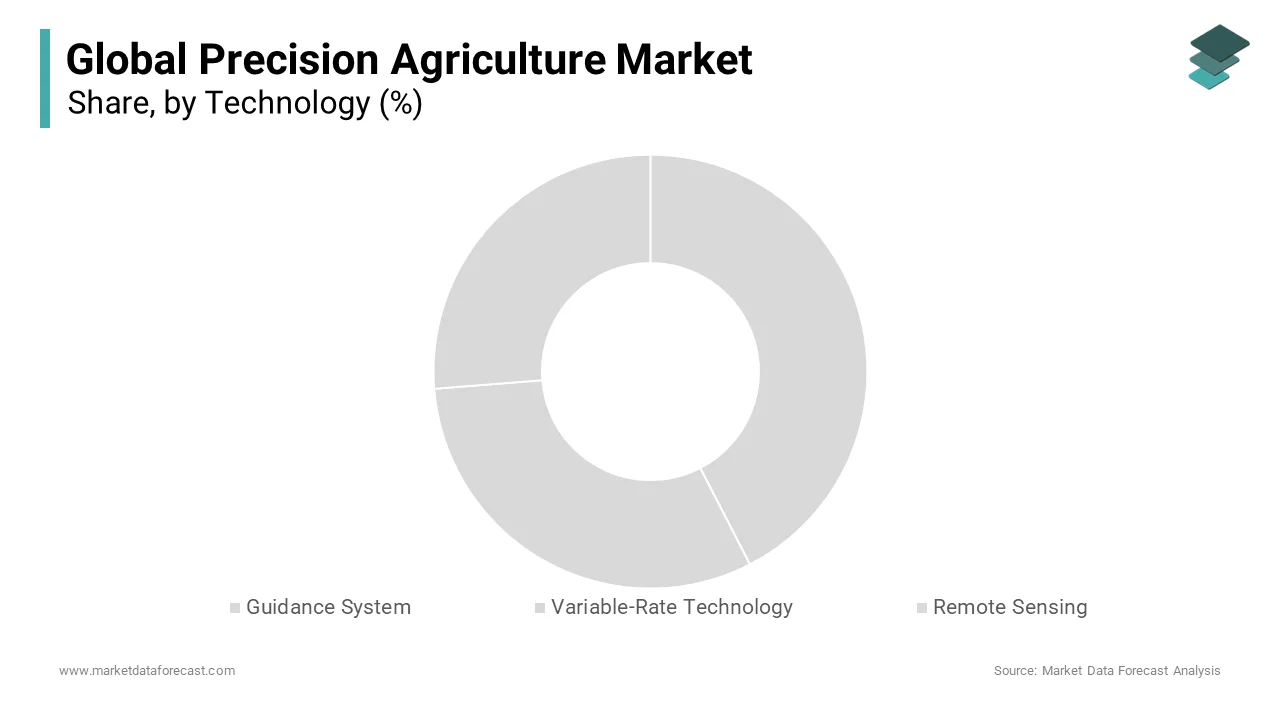
VRT has gained significant prominence as the second dominant player in the precision agriculture market due to its ability to adjust input application rates based on field variability. It tailors the distribution of resources like fertilizers and pesticides to specific areas within a field. VRT maximizes resource utilization, reduces input costs, and minimizes environmental impact by only applying what is needed in each area of the field. It can result in higher crop yields and better soil health.
Remote sensing technologies, including satellite and drone imagery, are increasingly influential in precision agriculture. They provide real-time data on crop health, pest infestations, and soil conditions. Remote sensing allows for proactive decision-making. It can help identify issues early, enabling precise interventions. The detailed data obtained from these technologies contributes to better yield forecasts and more targeted responses to challenges.
By Application Insights
Weather tracking and forecasting are dominating the precision agriculture market share due to the access to real-time weather data, which helps in decision-making related to planting, harvesting, and resource management.
Yield monitoring is a well-established and second-dominant application. It involves tracking and recording crop yields throughout the growing season. This data helps farmers make informed decisions regarding planting, irrigation, and harvesting. It provides valuable insights into crop performance and helps optimize resource allocation, making it an indispensable tool for farmers.
Field mapping is another fundamental application in precision agriculture. It involves creating detailed digital maps of fields and identifying variations in soil type, topography, and drainage. Field mapping assists in precise planting and application of resources, addressing soil variability, and improving crop management.
Irrigation management also plays a significant role in precision agriculture, especially in water-scarce regions. It involves the precise control of irrigation systems to conserve water and enhance crop yields. Efficient water use is critical for sustainable farming, and precision irrigation optimizes water distribution.
REGIONAL ANALYSIS
North America Market Analysis
North America is gaining traction in the market. The region has a well-developed technology infrastructure, large-scale commercial farming operations, and a focus on efficiency and sustainability. Precision agriculture has gained prominence, with farmers widely using various technologies to optimize their operations.
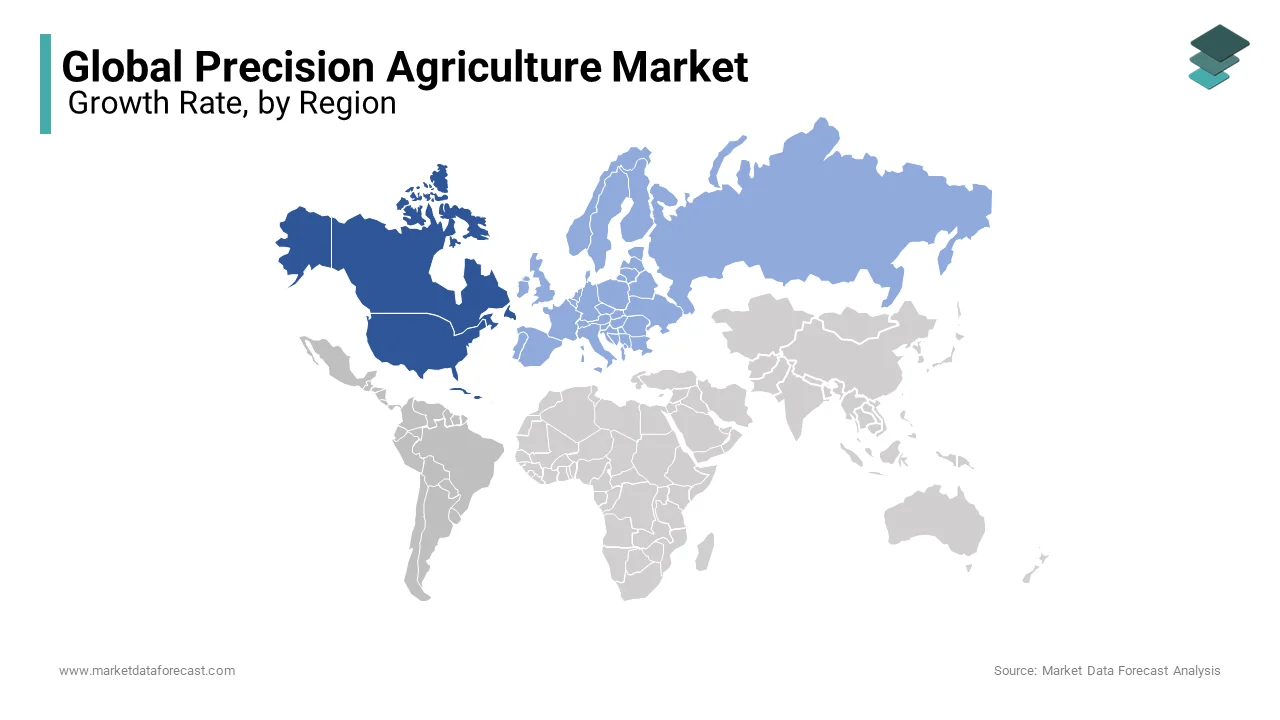
The North American region is estimated to record the highest CAGR during the forecast period, owing to advanced technologies in the agricultural industry. The government supports initiatives for adopting modern technologies to enhance productivity and the presence of developed infrastructure across the regional countries, boosting regional market growth. For instance, the government of Canada announced an investment of USD 4,41,917.5 to develop an integrated system for precision fruit tree farming in 2022. This initiative will enhance the sustainability of Canada’s apple industry.
Europe Market Analysis
Europe is a significant player and the second largest in the precision agriculture market, with substantial adoption. European countries emphasize sustainable agriculture, and there is strong government support for precision farming practices. The region's diverse climates and farming practices drive the use of precision agriculture technologies.
The European region is projected to register considerable growth during the forecast period. The U.K. precision agriculture market accounts for a significant share owing to the rising adoption of efficient and sustainable agricultural practices.
Asia Pacific Market Analysis
The Asia Pacific precision agriculture market is predicted to grow fastest during the forecast period. The growing government initiatives across the developing countries for the implementation of modern agricultural practices will provide the regional market with growth opportunities. The growing demand for increased crop yield, sustainable farming, and optimized resource utilization is accelerating the adoption of precision agriculture among farmers, which leads to market growth across the region.
Asia Pacific is witnessing a growing dominance in the precision agriculture market. The region's vast and diverse agricultural landscape, coupled with a rising need for increased food production, has driven adoption. Countries like China and India are increasingly investing in precision agriculture to enhance agricultural productivity.
Latin America Market Analysis
Latin America is gradually gaining prominence in precision agriculture, especially in countries with large agricultural sectors. The region's extensive farmlands, coupled with a growing focus on sustainability and export-oriented agriculture, are driving adoption. Precision agriculture is becoming more accessible to farmers in Latin America.
Middle East and Africa Market Analysis
Middle East and Africa have a relatively smaller presence in the precision agriculture market, but the adoption is increasing. These regions face unique challenges, such as water scarcity and harsh environmental conditions. However, some countries in the Middle East are investing in precision agriculture to optimize resource use and increase food security.
COMPETITIVE LANDSCAPE
KEY MARKET PLAYERS
A few of the dominating players in the global precision agriculture market include
- Deere & Company
- Trimble Inc.
- Ag Leader Technology
- Raven Industries
- Topcon Positioning Systems
- AGCO Corporation
- CNH Industrial N.V.
- DICKEY-john Corporation
- AgJunction Inc.
- Precision Planting Inc.
- TeeJet Technologies
- CropMetrics LLC
- Farmers Edge Inc.
- Iteris, Inc.
- Agribotix LLC
- SST Development Group, Inc.
- Granular, Inc.
- Gamaya
RECENT MARKET NEWS
- In 2023, John Deere continued to integrate advanced precision farming technologies into its equipment, offering features such as automated guidance systems, variable rate applications, and data analytics.
- In 2023, Trimble expanded its precision agriculture solutions by introducing enhanced data management and analysis tools, helping farmers make informed decisions based on real-time field data.
- In 2023, AGCO enhanced its precision farming offerings with the integration of telematics and connectivity solutions, enabling farmers to monitor and control their equipment remotely.
MARKET SEGMENTATION
This research report on the precision agriculture market has been segmented & sub-segmented into the following categories.
By Technology
- Guidance System
- Variable-Rate Technology
- Remote Sensing
By Application
- Yield Monitoring
- Field Mapping
- Crop Scouting
- Weather Tracking and Forecasting
- Irrigation Management
- Inventory Management
- Farm Labour Management
- Financial Management
By Region
- North America
- Europe
- Asia Pacific
- Latin America
- Middle East and Africa