Europe Printer Market Size, Share, Trends & Growth Forecast Report – Segmented By Printer Type, Technology Type, Printer Interface, End User, and Country (UK, France, Spain, Germany, Italy, Russia, Sweden, Denmark, Switzerland, Netherlands, Turkey, Czech Republic & Rest of Europe), Industry Analysis From 2026 to 2034
Market Size, 2025
$13.94 BnMarket Estimate, 2026
$14.55 BnMarket Forecast, 2034
$20.49 BnCAGR, 2026–2034
4.37%Europe Printer Market Size
The Europe printer market size was valued at USD 13.94 billion in 2025 and is projected to reach USD 20.49 billion by 2034 from USD 14.55 billion in 2026, growing at a CAGR of 4.37%.
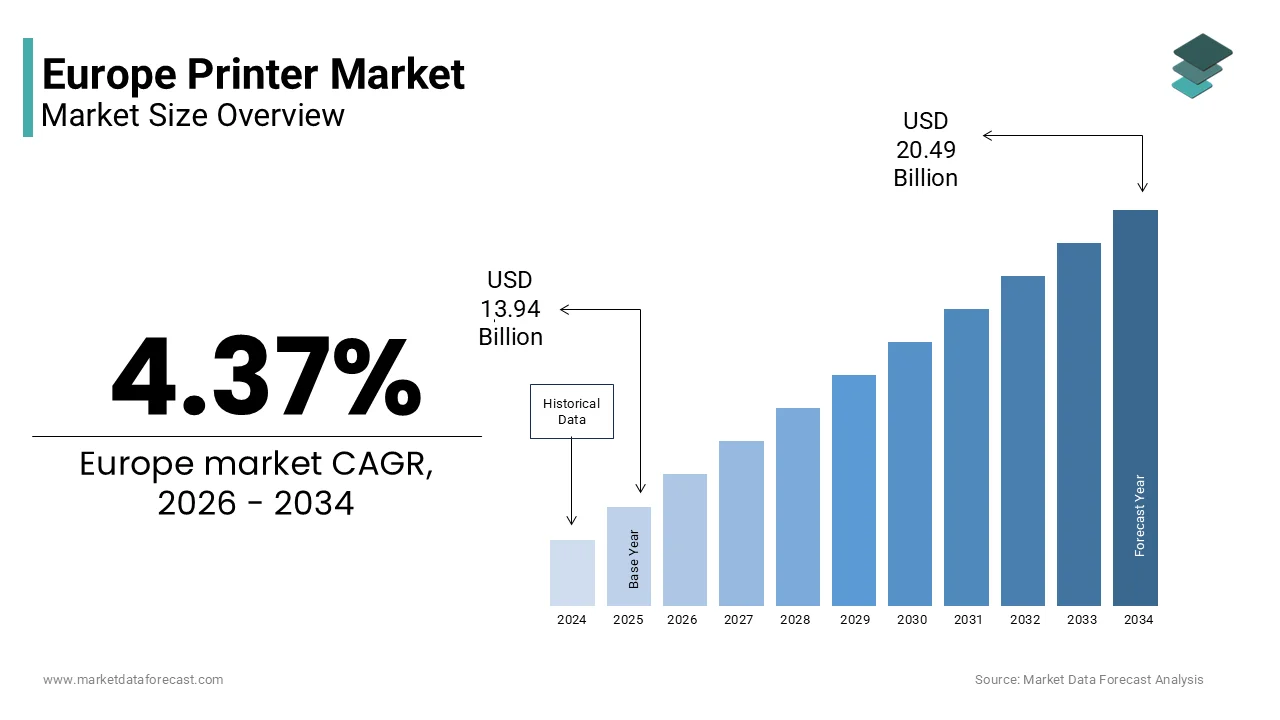
Printers are a diverse array of devices designed for the physical reproduction of digital content across commercial, industrial, and residential environments. These include inkjet, laser, thermal, and speciality printers serving applications ranging from office documentation to packaging, textiles, and additive manufacturing. Unlike purely digital workflows, printing in Europe retains strategic relevance due to regulatory, cultural, and operational imperatives that necessitate tangible outputs. According to Eurostat, a significant proportion of enterprises in the European Union continue to use printed documentation for legal compliance, archival, or client communication purposes, although exact figures vary by sector and country. Furthermore, Europe’s education sector maintains substantial printing demand; the European Higher Education Area includes over eleven million students, many of whom still rely on printed learning materials as a supplementary or primary resource. The continent also hosts a dense network of small and medium enterprises,h many of which depend on localised printing for branding, invoicing, and operational record keeping. Amid digitisation trends, printing endures not as a legacy function but as an integrated layer within hybrid information ecosystems shaped by data privacy norms, supply chain documentation, and consumer preference for physical media in specific contexts.
MARKET DRIVERS
Persistent Institutional Reliance on Physical Documentation
The enduring institutional requirement for physical records across public administration, legal, healthcare, and education sectors is majorly propelling the growth of the European printers market. Despite digital transformation initiatives, European regulatory frameworks often mandate hard copy retention for audit trails, patient records, and official correspondence. According to a 2025 review of German primary care data systems, many clinics in Germany continue to use printed medical records alongside digital systems, often due to concerns around interoperability and legal compliance. Similarly, the General Data Protection Regulation indirectly reinforces controlled printing by restricting unsecured digital sharing, prompting organisations to generate confidential documents on demand via secure in-house printers. As per the European Court of Auditors, public sector entities across the European Union continue to rely on printed administrative documentation, although specific annual page volumes per country are not consistently reported in public audits. Educational institutions further amplify demand; according to the UNESCO Institute for Statistics, European universities continue to distribute large volumes of printed examination materials and course packs, particularly for in-person assessments and coursework. This institutional inertia ensures steady procurement of reliable, secure, and often high-volume printing infrastructure across the continent.
Resurgence of On-Demand and Short-Run Commercial Printing
The evolution of digital printing technologies has catalysed a renaissance in short-run and personalised commercial printing, which is significantly bolstering hardware adoption across Europe’s creative and retail sectors and further boosting the printers market expansion in Europe. Unlike traditional offset methods, digital printers enable cost-effective production of customised packaging, promotional materials, and limited-edition publications without minimum order constraints. According to the Intergraf Economic Report 2025, digital printing adoption continues to rise across Europe, particularly in the packaging and commercial sectors. E-commerce growth has further amplified this trend; as per EuroCommerce, B2C e-commerce turnover in Europe reached €842 billion in 2025, which is a 7% increase from the previous year. Fashion and cosmetics brands now routinely use desktop and mid-volume printers for rapid prototyping of packaging mock-ups, which is a practice that significantly reduces time to market by enabling faster iteration and design validation. This shift transforms printers from static office peripherals into agile production tools embedded in fast-paced commercial cycles, which is sustaining hardware refresh and innovation in ink, toner, and media handling capabilities.
MARKET RESTRAINTS
Accelerated Shift Toward Paperless Workflows
A significant restraint on the European printer market stems from deliberate organisational and governmental efforts to minimise paper consumption through digital-first policies. The European Union’s Green Public Procurement criteria now discourage unnecessary printing in public institutions, with over eighteen member states implementing internal limits on printed pages per employee. According to the European Environment Agency, paper consumption in EU offices has declined significantly in recent years, which is contributing to reduced demand for consumables and associated hardware. Corporate enterprises are equally proactive, with many large firms in Europhavingve adopted digital contract signing and cloud-based document management, helping to reduce internal printing volumes, although specific adoption rates vary across sectors. Remote and hybrid work models further dampen demand. As per the European Foundation for the Improvement of Living and Working Conditions, telework has become a widespread practice across the EU, with many knowledge workers operating in paper-lean home environments where printing is occasional rather than routine. This systemic devaluation of physical output erodes the foundational use case for traditional office printers, particularly in urban professional hubs where digital literacy and infrastructure are most advanced.
Environmental Regulations on Consumables and E-Waste
Stringent European environmental legislation governing printer consumables and electronic waste imposes operational and design constraints that temper market expansion. The EU’s Restriction of Hazardous Substances Directive and Waste Electrical and Electronic Equipment Framework classify ink cartridges and printer units as regulated e-waste, mandating producer responsibility for collection and recycling. According to the European Commission, EU waste legislation under the WEEE Directive sets a minimum collection target of 65% of the average weight of electrical and electronic equipment placed on the market in the preceding three years, which includes printer-related e-waste. Additionally, the European Printing Ink Association (EuPIA) maintains an exclusion list of hazardous substances, including certain colourants and solvents, to align with REACH regulations and protect health and the environment. EU initiatives such as LIFE NEW4CARTRIDGES indicate the need for improved reuse and recycling of ink cartridges, whichreflectsg growing regulatory scrutiny. Consumers are also increasingly wary. As per a 2025 Eurobarometer survey, 78% of Europeans agree that environmental issues directly affect their daily life and health, and a majority consider environmental impact when making purchasing decisions. This regulatory and behavioural pressure discourages casual printing and elevates the total cost of ownership, acting as a structural brake on hardware proliferation.
MARKET OPPORTUNITIES
Integration of Printers into Smart Office Ecosystems
A compelling opportunity for the European printer market lies in the convergence of printing devices with intelligent workplace platforms that enhance security, efficiency, and user experience. Modern printers are increasingly embedded within unified communication and document management systems using protocols such as Mopria and AirPrint to enable seamless mobile and cloud printing. According to the European Telecommunications Standards Institute, office printers in Western Europe increasingly feature native integration with Microsoft Azure Active Directory and Google Workspace for authenticated access. This interoperability transforms printers into managed endpoints within zero-trust security architectures, which is critical for industries like finance and legal services. As per the German Federal Office for Information Security, increased attention is being paid to secure printing among German enterprises, particularly in regulated sectors. Furthermore, predictive maintenance powered by embedded IoT sensors reduces downtime. HP and Vodafone have explored AI-driven predictive maintenance in enterprise contexts. As hybrid work stabilises, the role of the office printer is redefined not as a standalone device but as a secure, connected node in distributed enterprise infrastructure, which is opening premium segments for vendors offering end-to-end digital workflow solutions.
Growth in Industrial and Functional Printing Applications
Beyond conventional document output, the European printer market is expanding into high-value industrial domains where printing serves functional rather than representational purposes, which is another promising opportunity in the European printer market growth. This includes 3D printing of aerospace components, conductive ink deposition for printed electronics, and digital textile printing for sustainable fashion. According to the Horizon Europe program, funding has been allocated to support functional printing technologies across multiple EU member states. The textile sector is particularly active; as per FESPA, digital fabric printers significantly reduce water consumption compared to traditional dyeing, which is driving adoption by brands aiming to meet EU sustainability targets. In electronics, the EU’s Chips Act supports printed circuit board innovation, with pilot lines in Finland and Belgium advancing inkjet-based microelectronics under initiatives like the APECS project. These applications command higher hardware margins and less susceptibility to paperless trends, positioning industrial printing as a strategic growth vector that redefines the market’s technological and economic boundaries.
MARKET CHALLENGES
Intensifying Competition from Refurbished and Clone Devices
A persistent challenge confronting established players in the EEuropeanprinter market is the proliferation of low-cost refurbished units and unauthorised clone devices that undermine brand integrity and service economics. The secondary market for used printers has expanded significantly, with online platforms in Poland, Romania, and Greece offering reconditioned models at discounted prices for budget-constrained small businesses. These units often bypass firmware security and use non-certified consumables, increasing failure rates. Simultaneously, unbranded clones mimic the form and basic function of leading models without adhering to CE safety or RoHS environmental standards. According to the European Union Intellectual Property Office, counterfeit printer cartridges and devices seized at EU borders rose in 2025, with Germany and the Netherlands as primary entry points. This undermines consumer trust in genuine products and complicates support ecosystems, as service technicians report a growing share of malfunctions linked to third-party hardware incompatibilities. The challenge is exacerbated by limited enforcement capacity in Eastern Europe, which is allowing grey market channels to flourish and eroding the value proposition of innovation-driven original equipment manufacturers.
Complexity of Cross-Border Consumables Logistics
The fragmented regulatory and logistical landscape across European countries poses a substantial operational challenge for printer vendors managing consumables distribution. Despite EU harmonisation, national differences in packaging labelling and chemical registration requirements necessitatecountry-specificc cartridge SKUs. According to the European Association of Printing Equipment Manufacturers, companies must manage multiple ink formulations to comply with local environmental and safety rules across the bloc. This complexity inflates inventory costs and slows time to shelf. As per a 2025 industry analysis by the Fraunhofer Institute, consumables logistics represent a significant portion of total supply chain expenditure for major printer brands in Europe. Additionally, Brexit introduced customs delays and dual compliance burdens for UK–EU shipments, with increased clearance times for ink cartridges reported by logistics providers. These inefficiencies reduce margin resilience and hinder just-in-time replenishment models, particularly for subscription-based ink services that promise automatic delivery. As consumer expectations for seamless consumables access rise, managing this regulatory patchwork becomes a critical bottleneck in sustaining customer retention and service profitability.
REPORT COVERAGE
| REPORT METRIC | DETAILS |
| Market Size Available | 2025 to 2034 |
| Base Year | 2025 |
| Forecast Period | 2026 to 2034 |
| CAGR | 4.37% |
| Segments Covered | By Printer Type, Technology Type, Printer Interface, End User, and Region |
| Various Analyses Covered | Global, Regional, & Country Level Analysis; Segment-Level Analysis; DROC, PESTLE Analysis; Porter’s Five Forces Analysis; Competitive Landscape; Analyst Overview of Investment Opportunities |
| Regions Covered | UK, France, Spain, Germany, Italy, Russia, Sweden, Denmark, Switzerland, Netherlands, Turkey, and the Czech Republic |
| Market Leaders Profiled | HP Inc., Canon Inc., Epson Europe B.V., Brother Industries, Ltd., Xerox Corporation, Konica Minolta Business Solutions Europe, Lexmark International, Inc., Kyocera Document Solutions Europe B.V., Sharp Corporation, Samsung Electronics Co., Ltd., Fujifilm Business Innovation Corp., OKI Electric Industry Co., Ltd., Zebra Technologies Europe Ltd. Dell Technologies and Ricoh Europe PLC |
SEGMENTAL ANALYSIS
By Printer Type Insights
The multi-functional printers segment dominated the market by holding 61.5% of the European market share in 2025. The dominance of the multi-functional printers segment in this regional market is attributed to the operational efficiency imperatives and space optimisation in increasingly compact work environments. The consolidation of printing, scanning, copying, and faxing into a single device significantly lowers capital expenditure and maintenance complexity for European organisations. According to the European Commission’s Green Public Procurement guidelines, public sector procurement policies explicitly favour multi-function devices that meet energy efficiency and duplex printing criteria. In Germany, federal agency printer tenders since 2022 have increasingly mandated multi-functionality as a minimum requirement, as per the Federal Ministry of the Interior. Additionally, the rise of hybrid work has increased reliance on scanning and digital archiving from home offices, which is prompting demand for compact all-in-one units capable of handling professional-grade document digitisation. This functional synergy ensures sustained institutional preference for integrated systems over specialised single-purpose hardware.
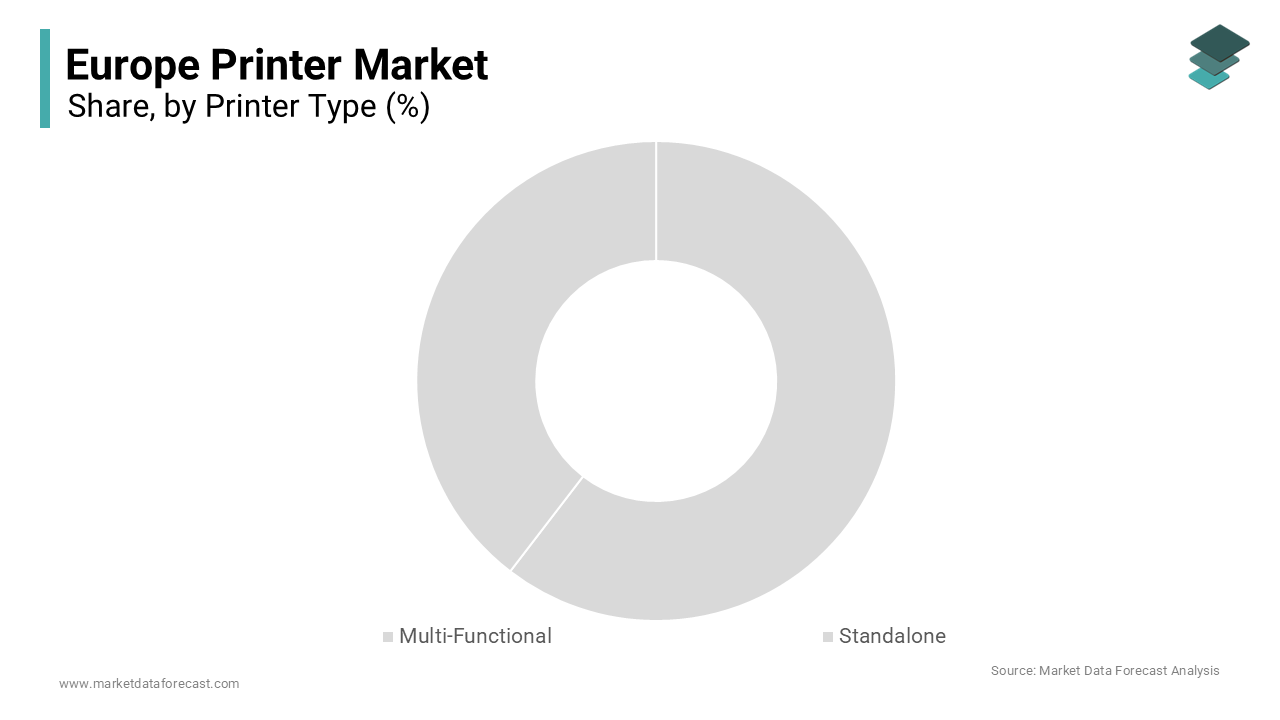
While smaller in overall share, the standalone printer segment is projected to grow at a CAGR of 5.4% over the forecast period in this regional market, owing to the expanding use cases thatprioritisee simplicity and task-specific performance over integration. Standalone printers are increasingly deployed in environments where reliability, speed,d and media flexibility outweigh the need for scanning or copying. In Europe’s expanding logistics sector, thermal label printers operate as standalone units at numerous warehouse and retail locations. Similarly, the food service industry has adopted dedicated receipt printers across millions of establishments in the EU. These applications require rugged,ged always-on devices with minimal interfaces and high uptime, as these are the characteristics that multi-function devices often compromise due to complexity. The rise of micro-fulfilment centres in urban areas further fuels demand for compact, standalone label and barcode printers that integrate directly with warehouse management software without peripheral functions. This functional purity ensures unmatched performance in high-cycle operational settings.
By Technology Type Insights
The laser printers segment captured the leading share of 54.6% of the regional market in 2025. The leading position of the laser printer segment in this regional market is driven by performance, reliability and total cost advantages in high volume environments. Laser technology excels in speed, print quality, ty and page yi, eld, making it indispensable for corporate legal and administrative workflows. Enterprises with more than fifty employees process high volumes of printed pages per month, with laser devices handling the majority of this output. The technology’s electrostatic process ensures consistent output even under continuous operation, which is a critical requirement for public institutions such as tax offices and courts. In France, the Ministry of Justice standardised monochrome laser printing across all regional tribunals in 2023 to improve reliability and reduce service interruptions. Furthermore, European data protection laws incentivise in-house printing of sensitive documents, and laser printers’ faster warm-up times and secure pull printing features align with these compliance needs. This operational robustness cements laser technology as the backbone of professional printing across the continent.
The inkjet technology sepromisingg segment is expected to expand at a CAGR of 6.64% over the forecast period, owing to the advances in performance and the rise of specialised applications that leverage inkjet’s unique capabilities. Modern inkjet printers now rival laser devices in office environments thanks to innovations in printhead architecture and ink formulation. Page output speeds for business inkjet models have increased significantly since 2020, while reliability has also improved. Companies like Epson and Canon have introduced heat-free inkjet systems that reduce energy consumption compared to laser counterparts, as verified by the European Commission’s Energy Efficiency Directive compliance database. These advances have prompted adoption in sectors previously dominated by laser printing. The UK’s National Health Service has begun replacing laser printers with inkjet models, citing lower running costs and quieter operation in clinical settings. This technological parity unlocks new institutional markets previously considered inaccessible to inkjet.
By Printer Interface Insights
The wired connectivity segment held 60.5% of the regional market share in 2025. The growth of the wired connectivity segment in this regional market is attributed to the security requirements and legacy infrastructure compatibility. In regulated sectors such as finance, healthcare,e and public administration, wired interfaces are mandated to minimise cyber intrusion risks. According to the European Union Agency for Cybersecurity, data protection compliance frameworks for document handling often discourage or restrict wireless printing due to vulnerabilities in Bluetooth and Wi-Fi protocols. For instance, the German Banking Industry Committee requires all internal printers in credit institutions to use Ethernet connections with MAC address filtering, which is a policy adopted by many banks, as per the German Federal Financial Supervisory Authority. Similarly, the European Health Data Space initiative promotes isolated printing networks in hospitals to prevent patient record leakage. According to France’s National Health Insurance Fund, a majority of its affiliated clinics use exclusively wired printers. This security imperative ensures that wired interfaces remain the default in high-stakes environments despite the convenience of wireless options.
The wireless connectivity segment is on the rise and is projected to grow at a CAGR of 7.55% over the forecast period in this regional market. This acceleration reflects evolving work patterns and technological maturation. The normalisation of remote and hybrid work has made wireless printing indispensable for seamless document output from personal devices. According to the European Foundation for the Improvement of Living and Working Conditions, many European knowledge workers now use smartphones or tablets as primary work devices, which requires Wi-Fi or cloud-based printing. In Sweden and Denmark, national telework guidelines updated in 2023 recommend wireless printer compatibility for home office subsidies. Universities have followed suit, as the University of Barcelona equipped all student dormitories withWi-Fi-enabledd printers in 2025 to reduce campus print queue congestion. This shift embeds wireless as a baseline expectation rather than a premium feature, particularly among younger users and distributed teams.
REGIONAL ANALYSIS
Germany Printer Market Analysis
Germany led the market by holding 19.5% of the European printers market share in 2025. The dominance of Germany in the European market is driven by its dense concentration of industrial enterprises, public administration bodies,s and research institutions that maintain high print volumes despite digitisation. Over 98% of German companies with more than ten employees use printers, according to the Federal Statistical Office. The German government’s stringent data sovereignty laws restrict cloud-based document handling for sensitive operations, which is reinforcing reliance on local secure printing infrastructure. Additionally, Germany hosts Europe’s most advanced manufacturing base for printing hardware, including production facilities for Kyocera and Ricoh, which ensures rapid service access and parts availability. The country’s emphasis on energy efficiency also drives adoption of certified low-consumption devices, with over seventy per cent of new printers sold meeting the Blue Angel environmental label criteria, as per the German Environment Agency. This combination of regulatory, institutional, and industrial factors solidifies Germany’s position as the continent’s printing technology anchor.
United Kingdom Printer Market Analysis
The United Kingdom captured the second leading share of the European printers market in 2025. Despite its post Brexit divergence, the UK maintains robust printing demand driven by its extensive legal, financial and educational sectors. English common law traditions necessitate physical documentation for contracts, deeds, and court filings. Universities also remain significant users; UK institutions continue to distribute large volumes of printed teaching materials. The National Health Service relies on wired label and form printers across its hospitals for patient safety compliance. Moreover, the UK’s strong small business ecosystem fuels demand for affordable all-in-one devices, particularly in professional services such as accounting and real estate. Although paper reduction initiatives exist, the entrenched procedural role of print in British institutions ensures sustained hardware utilisation across commercial and public domains.
France Printer Market Analysis
France is a prominent regional segment in the European printer market. The strong public sector demand and a vibrant creative economy that sustains diverse printing needs in France are propelling the French market growth. French administrative culture emphasises paper-based record keeping. France’s global leadership in fashion, luxury, and design fuels demand for high-fidelity inkjet and large-format printers, with many creative studios use specialized color-accurate printers for prototyping and client presentations. National education policy also supports printing,g as the Ministry of Education allocated funding in 2025 to equip vocational schools with digital printing labs for graphic arts training. Furthermore, France’s investment in smart city infrastructure has increased demand for thermal and receipt printers in automated municipal services such as parking and permits. This dual engine of bureaucratic continuity and creative innovation ensures France’s enduring relevance in Europe’s printing landscape.
Italy Printer Market Analysis
Italy is estimated to exhibit a prominent CAGR in the European printers market over the forecast period, od owing to its vast network of small and micro enterprises that rely on cost-effective printing for daily operations. Artisanal businesses in textiles, food, and furniture use label and packaging printers extensively. According to the Italian Confederation of Small and Medium Enterprises, strong demand among micro firms, primarily for branding and compliance labelling. Additionally, Italy’s decentralised public administration maintains localised printing needs for citizen services, often in legacy environments with limited IT support. Cultural factors also play a role, as the Italian preference for physical documentation in notarial and property transactions ensures steady demand for reliable monochrome laser devices. Moreover, Italy is a hub for industrial inkjet innovation, with clusters in Milan and Bologna developing printers for ceramic tile decoration and leather marking. This blend of microenterprise pragmatism, public sector fragmentation, and industrial specialisation sustains Italy’s consistent position in Europe’s printing market.
Netherlands Printer Market Analysis
The Netherlands is anticipated to account for a notable share of the European printers market over the forecast period, owing to its early adoption of sustainable and smart printing solutions aligned with national environmental policies. Over 80% of Dutch enterprises participate in certified circular economy programs that include printer leasing and cartridge recycling, according to the Netherlands Enterprise Agency. The country’s logistics and port sectors drive demand for high-durability thermal and label printers, with the Dutch Logistics Association estimating over 150,000 industrial printing units in active use. Simultaneously, the Netherlands is a pioneer in secure cloud printing as the Dutch Standardisation Institute developed the first EU-compliant zero trust printing protocol, reportedly adopted by over forty per cent of large corporations, as per the Dutch Cyber Security Council. Education and research institutions also contribute significantly, as Leiden University and TU Delft operate major academic print farms for scientific poster and thesis production. This convergence of sustainability, logistics, security, and academia positions the Netherlands as a high-value niche leader in Europe’s evolving printing ecosystem.
COMPETITIVE LANDSCAPE
The European printer market features intense rivalry among global technology leaders and agile regional specialists who compete on performance, sustainability, and service innovation. Established brands leverage extensive distribution networks, advanced R&D centres, advancedR&D centress and deep institutional relationships to maintain dominance, particularly inthe public sector and enterprise segments. Simultaneously, niche players gain traction through specialised offerings in industrial inkjet textile printing and secure compact devices for regulated environments. Regulatory pressures, including the EU Ecodesign Directive and General Data Protection Regulation, act as both barriers and catalysts,s pushing firms to innovate in energy efficiency, cybersecurity and circular design. Competition increasingly extends beyond hardware to encompass subscription models, cloud services, and integrated workflow solutions. This dynamic landscape rewards companies that balance global scale with local compliance and rapidly adapt to shifting demands across commercial, governmental, and industrial user groups throughout the region.
KEY MARKET PLAYERS
Some of the notable key players in theEuropeane printer market are
- HP Inc.
- Canon Inc.
- Epson Europe B.V.
- Brother Industries, Ltd.
- Xerox Corporation
- Konica Minolta Business Solutions Europe
- Lexmark International, Inc.
- Kyocera Document Solutions Europe B.V.
- Sharp Corporation
- Samsung Electronics Co., Ltd.
- Fujifilm Business Innovation Corp.
- OKI Electric Industry Co., Ltd.
- Zebra Technologies Europe Ltd.
- Dell Technologies
- Ricoh Europe PLC
Top Players in the Market
- HP Inc maintains a robust presence in the European printer market through its extensive portfolio spanning home office and enterprise-grade printing solutions. The company actively aligns its product development with European sustainability mandates by advancing its Instant Ink subscription model and pioneering ocean-bound plastic cartridge recycling initiatives. In recent years, HP has expanded its managed print services across public sector contracts in Germany and France while launchingregion-specificc security firmware compliant with EU cyber resilience standards. Its investment in industrial inkjet technology for textile and packaging applications further strengthens its footprint beyond traditional document printing, reinforcing its role as a global innovator in both consumer and functional printing domains.
- Canon Europe plays a pivotal role in the regional market by deliveringhigh-reliabilityy imaging and printing systems tailored to European legal healthcare and creative sectors. The company has intensified its focus on circular economy principles by introducing cartridge return programs in over twenty European countries and achieving ISO fourteen zero zero one certification across its logistics hubs. Canon recently enhanced its imageRUNNER ADVANCE line with GDPR compliant data erasure protocols and deployed AI-driven predictive maintenance tools for enterprise clients in the Netherlands and Sweden. These actions reflect its strategic emphasis on data security, sustainability,y and service differentiation, solidifying its global reputation for precision engineering anuser-centricic innovation.
- Epson Europe distinguishes itself through its heat-free PrecisionCore inkjet technology, which delivers significant energy savings and operational quietness valued in European office and education environments. The company has accelerated adoption of its EcoTank systems across schools and small businesses through partnerships with national education ministries and sustainability councils. Epson recently inaugurated a new digital textile printing innovation centre in Barcelona to support EU fashion brands transitioning to waterless dyeing processes. It also expanded its fleet management software to integrate with Microsoft Azure Active Directory, enhancing secure mobile printing capabilities. These initiatives underscore Epson’s commitment to environmental stewardship and digital workflow integration within Europe’s evolving printing ecosystem.
Top Strategies Used by the Key Market Participants
Key players in theEuropeane printer market prioritise sustainability through closed-loop recycling programs and the use of recycled materials in hardware and consumables. They invest heavily in security enhancements to comply with stringent EU data protection regulations, embedding features like encrypted hard drives and automatic data wipe functions. Companies expand managed print services with cloud-based monitoring and AI-driven predictive maintenance to increase customer retention. Strategic partnerships with enterprise software providers ensure seamless integration with digital workplace ecosystems. Additionally, firms diversify into industrial and speciality printing applications such as textile packaging and labelling to offset declining demand in traditional office segments and capture high-margin opportunities aligned with Europe’s green and digital transitions.
MARKET SEGMENTATION
This research report on the European printer market has been segmented and sub-segmented based on categories.
By Printer Type
- Multi-Functional
- Standalone
By Technology Type
- Dot Matrix Printer
- Inkjet Printer
- LED Printer
- Thermal Printer
- Laser Printer
By Printer Interface
- Wired
- Wireless
By End User
- Residential
- Commercial
- Educational Institutions
- Enterprises
- Government
- Others
By Country
- UK
- France
- Spain
- Germany
- Italy
- Russia
- Sweden
- Denmark
- Switzerland
- Netherlands
- Turkey
- Czech Republic
- Rest of Europe
Frequently Asked Questions
1. What is driving the Europe printer market?
The market is driven by steady demand from offices, educational institutions, commercial printing, and the need for reliable document management solutions.
2. Which printer types are most commonly used in Europe?
Laser printers dominate office environments, while inkjet printers are widely used in homes and small businesses.
3. How is digitalization affecting printer demand in Europe?
Digital workflows reduce printing volumes in some sectors, but demand remains stable for essential business, packaging, and labeling applications.
4. What role do multifunction printers play in the market?
Multifunction printers are popular due to their ability to print, scan, copy, and fax, improving efficiency and reducing equipment costs.
5. How important is sustainability in the Europe printer market?
Sustainability is increasingly important, with demand for energy-efficient printers, recyclable consumables, and reduced paper waste.
6. Which industries are major users of printers in Europe?
Key users include corporate offices, education, healthcare, government, and commercial printing services.
7. What impact do regulations have on printer manufacturing?
European regulations encourage energy efficiency, eco-design compliance, and lower emissions, influencing printer design and production.
8. Which regions lead the Europe printer market?
Western Europe leads due to strong enterprise adoption, while Central and Eastern Europe show growth potential.
9. What technological trends are shaping the market?
Trends include cloud printing, wireless connectivity, enhanced security features, and smart device integration.
10. What is the future outlook for the Europe printer market?
The market is expected to grow moderately, supported by enterprise demand, managed services, and technological advancements.
Related Reports
Access the study in MULTIPLE FORMATS
Purchase options starting from
$ 2000
Didn’t find what you’re looking for?
TALK TO OUR ANALYST TEAM
Need something within your budget?
NO WORRIES! WE GOT YOU COVERED!
Call us on: +1 888 702 9696 (U.S Toll Free)
Write to us: sales@marketdataforecast.com