- Product Description Description
- Table of Contents TOC
- List of Table & Figure LOT
- Get Free Sample PDF Sample PDF
Market Size, 2025
$0.91 BnMarket Estimate, 2026
$0.97 BnMarket Forecast, 2034
$1.66 BnCAGR, 2026–2034
6.97%Executive Summary: Europe Procurement as a Service Market
- Market Scope: Comprehensive European procurement as a service market analysis covering solution types, enterprise sizes, vertical end-use industries, regional leadership frameworks, and adoption metrics.
- Market Valuation: Valued at USD 0.91 billion (2025), estimated at USD 0.97 billion (2026), and projected to reach USD 1.66 billion by 2034, registering a robust CAGR of 6.97% (2026–2034).
- Primary Growth Drivers: Cloud adoption, cost optimization, AI-driven procurement, ERP modernization, supply-chain resilience, and ESG integration. Key macroeconomic and digital adoption indicators include approximately 77.6% of large EU enterprises purchasing cloud computing services and euro-area inflation averaging around 2.4% in 2025.
Key Market Segment Metrics (2026–2034)
| Category | Leading Segment (2025 Position) | Fastest-Growing Segment |
|---|---|---|
| By Solution / Service Type | Strategic Sourcing (held a dominant market share in 2025) | Category Management (projected to grow at a high 13.9% CAGR) |
| By Enterprise Size | Large Enterprises (held the largest enterprise-size share in 2025) | SMEs (forecast to register the fastest CAGR of 19.4%) |
| By Vertical | Manufacturing (dominated the vertical landscape with a 55.7% market share in 2025) | Retail (anticipated to expand at a rapid 17.4% CAGR) |
| By Region / Country | Germany (led the regional market with a 25.7% share in 2025) | Emerging European economies adopting digital supply chain transformation |
Major Market Players & Market Structure
Market Structure: Highly competitive European ecosystem featuring major global consultancy and technology service leaders competing intensely on AI-enabled procurement, predictive savings, supplier-risk scoring, ERP integration, ESG analytics, and regulatory compliance.
Key Companies: Accenture, Capgemini SE, Corbus LLC, Genpact Ltd, GEP, HCL Technologies, IBM Corporation, Infosys Ltd, Wipro Limited, and WNS (Holdings) Limited.
Europe Procurement as a Service Market Size
The European procurement as a service market size was valued at USD 0.91 billion in 2025 and is projected to reach USD 1.66 billion by 2034 from USD 0.97 billion in 2026, growing at a CAGR of 6.97%.
Procurement as a service refers to the delivery of end-to-end procurement functions that include sourcing, supplier management, contract administration, spend analytics, and purchase execution as outsourced, cloud-based or managed services to enterprises across public and private sectors. Unlike traditional in-house procurement departments, this model leverages standardised digital platforms, artificial intelligence, and domain expertise to enhance efficiency, compliance, and cost savings. The service is typically offered on a subscription or outcome-based pricing model and integrates with existing ERP systems such as SAP or Oracle. According to the Eurostat 2023 “Cloud computing — statistics on the use by enterprises” report, 77.6% of large EU enterprises purchased cloud computing services, which reflects a structural shift toward operational agility. Large businesses across the EU widely use cloud-based enterprise software, which is creating fertile ground for scalable procurement-as-a-service adoption. Many European firms cited supply chain volatility as a top operational risk in 2025. This is accelerating demand for resilient and expert-led procurement solutions. These foundational digital and risk management trends underpin the evolution of the European procurement-as-a-service market from a back-office function to a strategic and service-oriented capability.
MARKET DRIVERS
Escalating Pressure to Optimise Costs Amid Persistent Inflationary Conditions
The cost pressures that European businesses are facing due to elevated energy prices, wage growth, and supply chain disruptions are compelling them to seek external expertise for spend rationalisation, which is primarily driving the procurement as a service market growth in Europe. According to Eurostat (2025), inflation in the euro area averaged around 2.4%, which reflects continued cost pressures across manufacturing and supply chains. In this environment, procurement-as-a-service provides organisations with access to category specialists who can renegotiate contracts, consolidate suppliers, and identify alternative sourcing geographies. Across Europe, CFOs and operations leaders increasingly cite procurement transformation as a core cost-optimisation priority, particularly amid persistent input cost volatility. Companies leveraging procurement-as-a-service often report double-digit savings on indirect spend within the first year of implementation, based on multiple industry benchmarking studies. For example, a German automotive supplier reduced logistics expenses significantly after outsourcing freight procurement to a specialised service provider. This measurable financial impact delivered without long-term capital investment makes the model highly attractive to firms navigating margin compression across the region.
Accelerated Digital Transformation and ERP Modernisation Initiatives
The widespread migration to cloud-based enterprise resource planning systems has created technical and operational alignment with procurement as a service platform, which is another major factor boosting the European market growth. According to Eurostat (2023), around 78% of large enterprises in the EU used some form of cloud computing service, with many migrating their core enterprise resource planning (ERP) systems to platforms such as SAP S/4HANA and Oracle Cloud. These modern systems generate vast transactional datasets that can be leveraged by AI-driven procurement services for predictive analytics, anomaly detection, and automated requisitioning. Across Europe, numerous mid-sized companies have also received EU-backed digitalisation support to integrate intelligent procurement modules with their financial systems, which is reducing implementation friction and accelerating time to value. Moreover, procurement-as-a-service providers offer pre-built connectors and compliance templates tailored to European regulatory requirements, such as VAT rules and public procurement directives, to eliminate costly customisation. The synergy between enterprise cloud adoption and modular, API-based procurement services is creating a self-reinforcing cycle of efficiency and scalability across European organisations.
MARKET RESTRAINTS
Data Sovereignty and Regulatory Compliance Concerns Across Jurisdictions
European organisations remain cautious about entrusting sensitive procurement data, such as supplier contracts, pricing terms, and spend patterns, third-party service providers, particularly those operating outside the European Economic Area, which is one of the key restraints to the growth of the European procurement-as-a-service market. According to the General Data Protection Regulation (GDPR), non-compliance with data processing requirements can result in fines of up to 4% of global annual turnover or €20 million, whichever is higher. As per the European Data Protection Board (EDPB), numerous enforcement actions were initiated across the EU in 2025 related to third-party data processors, which confirms the regulation’s growing scrutiny. Additionally, sector-specific frameworks, such as the EU Public Procurement Directives for government entities and MiFID II for financial institutions, require granular compliance that generic platforms often fail to support. As per a 2025 industry survey, a majority of procurement professionals view data residency and auditability as key barriers to outsourcing procurement functions. While leading providers now offer EU-hosted datacentres and ISO 27001-certified environments, the perception of risk remains particularly strong among public-sector and defence-related organisations. This regulatory complexity continues to slow adoption and raise the cost of compliant service delivery across Europe.
Organisational Resistance and Perceived Loss of Strategic Control
Many European enterprises view procurement as a core strategic function tied to supplier relationships, innovation sourcing, and risk management, which is making them reluctant to delegate it externally and hampering the expansion of the European market. According to a 2023 Deloitte Global Chief Procurement Officer Survey, a majority of European procurement leaders expressed concerns that outsourcing core functions could reduce their strategic influence on areas such as product innovation and sustainability. This hesitation is reinforced by legacy organisational structures where procurement teams are tightly integrated with cross-functional business processes. As per the research from the European Foundation for Management Development, relatively few European firms have clearly defined procurement governance frameworks distinguishing tactical from strategic responsibilities, which often causes uncertainty about which activities can be safely eexternalised Additionally, language and cultural nuances in supplier negotiations, particularly in Southern and Eastern Europe,, continue to creatscepticismsm about the effectiveness of centralized or offshore procurement models. Until organisations reframe procurement as a tiered capability with transactional tasks outsourced and strategic oversight retained, the adoption of procurement-as-a-service is likely to progress cautiously and inhibit the regional market growth.
MARKET OPPORTUNITIES
Integration of ESG and Sustainable Sourcing into Core Procurement Workflows
The unprecedented demand for procurement services that embed environmental, social, and governance criteria into supplier selection and performance management is one of the potential opportunities for the European procurement as a service market. The EU Corporate Sustainability Reporting Directive (CSRD), effective from 2025, requires large companies to disclose Scope 3 emissions and demonstrate supply chain due diligence, which is significantly expanding corporate accountability across Europe. According to the European Environment Agency (EEA), a substantial majority of a typical European company’s carbon footprint originates from its supply chain. Procurement-as-a-service providers are responding by integrating ESG scoring engines, supplier carbon calculators, and ethical risk dashboards into their platforms. According to the European Sustainable Procurement Network, a growing share of public sector tenders across the EU now includes mandatory sustainability criteria, which is driving demand for compliant sourcing support. Companies such as EcoVadis and Normative have also partnered with procurement service firms to automate ESG data collection and benchmarking. This convergence of regulation, risk management, and brand reputation is transforming sustainability from a compliance obligation into a value-added service layer are creating a fast-growing niche within the European procurement landscape.
Expansion into Mid-Market and Public Sector Through Standardised Offerings
Historically focused on large enterprises, procurement as a service provider is now developing modular, fixed price packages tailored to mid-sized businesses and public institutions that lack dedicated procurement teams, which is considered a promising opportunity for the European market. According to Eurostat (2023), there are approximately 230,000 medium-sized enterprises in the EU that collectively account for nearly 30% of private-sector employment. However, many of these firms still depend on manual or fragmented purchasing processes. Recognising this gap, the European Investment Bank (EIB) launched an initiative in 2025 to support digital procurement adoption among SMEs, with procurement-as-a-service identified as an eligible expense. At the same time, the European Commission’s Digital Europe Programme allocated €120 million in 2025 to modernise public procurement systems across member states. Providers such as Proactis and Jaggaer have introduced pre-configured solutions tailored for local governments, hospitals, and universities that comply with national tendering regulations. This democratisation of professional procurement capabilities represents a vast untapped market, which is poised for rapid expansion as standardisation continues to reduce cost and complexity barriers across Europe.
MARKET CHALLENGES
Fragmented Procurement Maturity and Process Standardisation Across Industries
The wide disparities in procurement sophistication among European organisations are a significant challenge to the European market. According to a 2025 Deloitte Global CPO Survey, many European industries, particularly retail and construction, lag in procurement process maturity, with significantly fewer firms maintaining formalised category management structures compared to sectors like pharmaceuticals or aerospace. This disparity requires extensive customisation during onboarding, which is increasing both implementation time and cost for procurement-as-a-service providers. As per the research from the European Institute for Procurement Excellence, deployment timelines are notably longer in low-maturity sectors than in highly standardised industries. Furthermore, an inconsistent chart of accounts, approval hierarchies, and supplier master data across subsidiaries continues to hinder automation. According to a 2025 study by the WHU Otto Beisheim School of Management, a majority of failed procurement outsourcing initiatives in Europe resulted from inadequate process harmonisation before transition. Until European firms invest in internal standardisation or providers develop adaptive AI systems capable of learning from heterogeneous inputs, scalability and return on investment in this market will remain uneven.
Talent Shortage in Specialised Procurement and Data Analytics Domains
The delivery of high-value procurement as a service requires a rare blend of category expertise, data science skills, and multilingual communication abilities and talent that is in critically short supply across Europe, which is further challenging the expansion of the European procurement as a service market. According to the European Labour Authority (2025), the technology and professional services sectors of Europe are experiencing significant talent shortages in roles that blend supply chain expertise with data analytics and AI capabilities, which is a trend that also impacts the procurement technology domain. This shortage is intensified by competition from higher-paying industries such as fintech and e-commerce. According to the European Association of Procurement Professionals, many service providers face difficulties recruiting certified procurement specialists fluent in multiple European languages and experienced in indirect categories such as IT or facilities. This talent gap has led to increased reliance on offshore teams, which can affect responsiveness and cultural alignment, which are key priorities for European clients. While several firms are investing in upskilling programs in collaboration with institutions such as the University of Twente and ESCP Business School, the current talent pipeline remains insufficient to meet accelerating demand. This persistent human capital constraint risks impacting service quality and limits the sector’s capacity to scale premium procurement offerings across Europe.
REPORT COVERAGE
| REPORT METRIC | DETAILS |
| Market Size Available | 2025 to 2034 |
| Base Year | 2025 |
| Forecast Period | 2026 to 2034 |
| CAGR | 6.97% |
| Segments Covered | By Component, Enterprise Size, Vertical, and Region |
| Various Analyses Covered | Global, Regional, & Country Level Analysis; Segment-Level Analysis; DROC, PESTLE Analysis; Porter’s Five Forces Analysis; Competitive Landscape; Analyst Overview of Investment Opportunities |
| Regions Covered | UK, France, Spain, Germany, Italy, Russia, Sweden, Denmark, Switzerland, Netherlands, Turkey, and the Czech Republic |
| Market Leaders Profiled | Accenture, Capgemini SE, Corbus LLC, Genpact Ltd, GEP, HCL Technologies, IBM Corporation, Infosys Ltd, Wipro Limited, and WNS (Holdings) Limited |
SEGMENTAL ANALYSIS
By Component Insights
The strategic sourcing segment held a dominant share of 3.1% of the European market in 2025. The dominance othe f the strategic sourcing segment is majorly attributed to its direct impact on cost reduction, risk mitigation, and supplier innovation, that priorities intensified by economic volatility and supply chain disruptions. The growing focus on total cost of ownership and supplier risk mitigation is propelling the growth of the strategic sourcing segment in the European market. European enterprises increasingly recognise that transactional purchasing is insufficient in an era of geopolitical instability and regulatory complexity. Strategic sourcing services provide deep market intelligence, scenario modelling, and multi-tier supplier risk assessments that go beyond price negotiation. According to the European Commission’s 2023 Critical Raw Materials factsheet, the EU relies on China for about 98% of rare earth permanent magnets, which indicates supplier concentration and geographic dependency. In response, procurement as a service providers deploy advanced analytics to diversify sourcing across Eastern Europe, North Africa, and nearshore hubs. Many strategic sourcing engagements in 2025 included dual-sourcing mandates for critical components like semiconductors and rare earth materials. As per a German industry case study, automotive manufacturers using external strategic sourcing reduced supply disruption incidents. This proactive, intelligence-led approach delivers measurable resilience, which is contributing to the growth of the strategic sourcing segment in the European market.
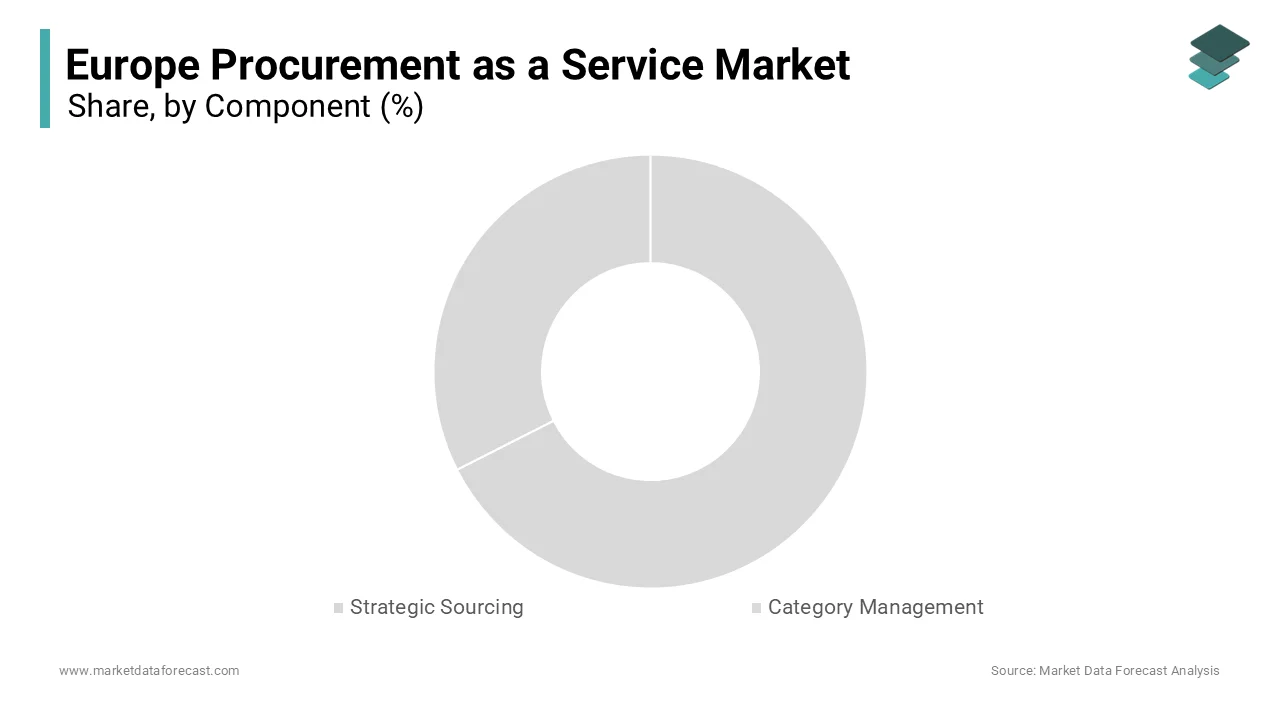
The category management segment is anticipated to register a CAGR of 13.9% over the forecast period in the European procurement as a service market. The rise of tail spend optimisation and cross-functional category governance is boosting the growth of the category management segment in the European market. Historically neglected, tail spend comprising low-value, high-volume purchases now represents a major efficiency frontier. According to McKinsey & Company (2018), tail spend typically represents 10–20% of total spend while comprising 80–90% of purchased items. Category management as a service provider specialises in consolidating this fragmented spend through pre-negotiated supplier catalogues and automated compliance rules. Companies using external category managers have reported reductions in tail-spend leakage. Moreover, European firms are adopting cross-functional category teams that include finance, operations, and sustainability officers, which requires external facilitation to align objectives. A pilot by a Dutch healthcare group that is supported by a procurement service provider and achieved measurable savings in medical consumables through standardised specifications and demand pooling across hospitals. This operational granularity and stakeholder orchestration make category management indispensable for holistic spend control and propelling the expansion of the category management segment in the European market.
By Enterprise Size Insights
The large enterprises segment occupied the largest share of the European procurement as a service market in 2025. Large enterprises dominate due to their complex supply chains, regulatory exposure, and internal capacity to manage vendor relationships. Complex global supply chains requiring specialised external expertise of large enterprises are also driving the expansion of the large enterprises segment in the European market. According to Deloitte’s Global CPO Survey (2023), more than 70% of procurement leaders in multinational organisations cite managing supplier relationships across multiple geographies as one of their top three operational challenges. Multinational corporations headquartered in Europe operate across dozens of countries with divergent tax regimes, labour laws, and import regulations, which is making in-house procurement teams increasingly insufficient. Strategic procurement-as-a-service providers offer regional category specialists who understand local market dynamics from Eastern European logistics to Iberian energy contracts while maintaining global visibility. Many large firms using external procurement services have reported a reduction in cross-border compliance incidents and improved governance consistency. Additionally, these enterprises require sophisticated risk monitoring for critical categories such as IT hardware and raw materials, which service providers deliver through real-time supplier health dashboards. The scale and complexity of multinational operations thus create an enduring demand for expert-led, scalable procurement support that only large enterprises can fully leverage, which is primarily driving the growth of the large enterprises segment in the European market.
The SME segment is estimated to witness the fastest CAGR of 19.4% over the forecast period in the European market.EU-funded digitalisation initiatives, lowering adoption barriers, are primarily driving the expansion of the SME segment in the European market. According he Eurostat (2023), 45.2% of EU enterprises purchased cloud computing services, which indicates broad digital readiness among businesses. The European Union has prioritised SME digital transformation through targeted subsidies and simplified procurement tools. The Digital Europe Programme supports SME digitisation initiatives with procurement as a service, qualifying as an eligible expense. National agencies in countries such as Germany and France offer grants that subsidise certified platform adoption. Many European SMEs adopted cloud-based procurement services under these schemes. Providers responded with fixed price, modular offerings, such as “Procurement in a Box”, that require no IT integration. For instance, according to a Dutch bakery chain, significant reductions were noticed in catering supply costs using a preconfigured SME package. This public-private synergy is rapidly democratizing access to professional procurement capabilities previously reserved for large corporations and supporting the growth of the SME segment in the European market.
By Vertical Insights
The manufacturing segment occupied 55.7% of the European market share in 2025. The growth of the manufacturing segment is driven by its capital intensity, global supply dependencies, and stringent quality requirements. The growing critical need for raw material and component sourcing in volatile markets in the manufacturing industry is also propelling the growth of the manufacturing segment in the European market. According to Eurostat (2025), producer price indices for EU manufacturers showed continued volatility, which reflects heightened input cost fluctuations across metals, polymers, and electronic components amid trade tensions and logistics bottlenecks. Procurement-as-a-service providers help manufacturers navigate this environment through real-time commodity tracking, alternative material sourcing, and nearshoring strategies designed to mitigate disruption. As per the reports, automotive suppliers using external strategic sourcing have successfully reduced semiconductor lead times through better supplier diversification and coordination. Additionally, just-in-time production models leave little margin for inventory buffers, which makes supplier reliability critical. To address this, service providers deploy predictive risk models that identify financial distress or geopolitical exposure early, enabling proactive mitigation. This operational necessity reinforces manufacturing’s central role within the procurement-as-a-service market and boosts the expansion of the manufacturing segment in the European market.
The retail segment is anticipated to exhibit a 17.4% CAGR over the forecast period in the European procurement as a service market. The rising demand for agile private label and seasonal sourcing capabilities in the retail sector is one of the major factors driving the growth of the retail segment in the European procurement as a service market. Retailers must rapidly source fashion, home goods, and consumables to match fast-changing consumer trends that require flexible and responsive procurement. According to Eurostat (2023), private-label products accounted for roughly 38% of grocery sales in Europe, which indicates the growing reliance of retailers on agile, cost-efficient sourcing strategies. Procurement-as-a-service providers support this shift by offering on-demand category teams capable of launching supplier searches by conducting factory audits and negotiating contracts within weeks. As per the industry case studies, major retail chains have significantly reduced supplier onboarding times through the use of external procurement specialists. The continued expansion of private-label programs demands rigorous quality assurance and cost ooptimisationareas where external procurement experts add substantial value. This speed and adaptability are vital in a retail sector where rapid product turnover and inventory obsolescence can erode margins almost instantly, and are contributing to the growth of the retail segment in the European procurement as a service market.
REGIONAL ANALYSIS
Germany Market Analysis
Germany held 25.7% of the European procurement as a service market share and emerged as the leading performer in the regional market. The industrial depth, regulatory rigour, and leadership in digital transformation of Germany have primarily contributed to the domination of Germany in the European market. The manufacturing base of Germany, and Germany being home to automotive, machinery, and chemical giants, demands sophisticated procurement to manage global supply chains and comply with stringent quality standards. According to Eurostat (2023), Germany leads Europe in digital adoption among large enterprises, with the majority using cloud-based business systems to manage supply chains and procurement operations. The “Digital Now” (Digital Jetzt) initiative of othe German government has allocated €1.2 billion to support ERP and cloud-based procurement adoption among Mittelstand companies to encourage modernisation across mid-sized industries. Additionally, Germany’s dual vocational training system continues to produce a strong pipeline of procurement and supply chain professionals who enable effective collaboration with service providers. The presence of global leaders such as SAP and Siemens further drives innovation in procurement technology. This combination of industrial scale, public digitalisationsupport, and skilled talent infrastructure is significantly contributing to the procurement as a service market growth in Germany.
United Kingdom Market Analysis
The United Kingdom is estimated to account for a promising share of the European market over the forecast period, owing to its mature professional services ecosystem, early adoption of cloud procurement, and strong public sector digitisation. Despite Brexit, the UK remains a hub for procurement as a service innovation, which is hosting global providers and specialised consultancies. According to the UK Government’s Crown Commercial Service (2025), a large majority of public sector organisations have adopted digital procurement platforms as part of the Government Digital Service (GDS) transformation mandate. The private sector is following a similar trajectory, with many FTSE 250 firms outsourcing parts of their strategic sourcing and supplier management functions to specialised providers. The position of London as a global financial and legal hub also supports complex, multi-jurisdictional procurement engagements. Additionally, several UK universities now offer dedicated procurement and supply chain management degrees that ensure a steady flow of qualified professionals into the market. This combination of progressive public policy, private sector sophistication, and strong human capital development is propelling the procurement as a service market in the UK.
France Market Analysis
France had a substantial share of the European procurement as a service market in 2025, and the growth of the French market is driven state-led digitalisation, strong public procurement reform, and corporate sustainability mandates. According to INSEE (2025), a majority of France’s large enterprises, including many CAC 40 companies, have adopted ESG-integrated sourcing practices that are influenced by the nation’s Duty of Vigilance Law, which mandates responsible supply chain oversight. The French government’s “Action Publique 2026” program has also advanced the digitalisation of central administration procurement processes, which is driving increased demand for managed procurement services. The French Ministry of Economy allocated €45 million in 2025 to support SME procurement digitisation, which is further strengthening the ecosystem. Major industrial groups such as Airbus and L’Oréal depend on sophisticated supplier risk management frameworks due to their global supply chains. Additionally, France’s focus on developing “sovereign” digital infrastructure has encouraged the rise of local procurement technology startups that collaborate with international service providers. This combination of regulatory leadership, corporate innovation, and public investment is driving the growth of the procurement as a service market in France.
Netherlands Market Analysis
The Netherlands is predicted to account for a notable share of the European market during the forecast period due to its logistics excellence, open economy, and leadership in sustainable procurement. Dutch companies operate highly internationalised supply chains, necessitating agile, multilingual procurement support. According to Eurostat (2023), the Netherlands ranks among the top EU member states for cloud computing adoption, with a large majority of medium and large enterprises using cloud-based business solutions, including procurement platforms to manage sourcing and supplier operations. The government’s “Green Deal Sustainable Procurement” initiative has made ESG criteria mandatory in public tenders since 2023, which is boosting demand for compliant service providers. Multinationals such as Philips and Shell have pioneered circular procurement models that are setting benchmarks for sustainable supply chain practices. The Netherlands also serves as one of Europe’s key logistics and distribution hubs, which is making procurement central to inventory efficiency and supply chain optimisation. According to the Dutch Ministry of Economic Affairs (2025), a growing share of procurement-as-a-service contracts now includes carbon footprint tracking components. This strong alignment of sustainability, digitalisation, and logistics excellence is contributing to the growing demand for procurement as a service in the Netherlands.
Sweden Market Analysis
Sweden is a notable market for procurement as a service in Europe, and the market in Spain is anticipated to be driven by its innovation culture, public sector transparency, and integration of procurement with climate goals. Sweden treats procurement as a strategic policy tool, with all public agencies required to report sustainability metrics since 2022. According to Eurostat (2023), Sweden is among the most digitally advanced economies in Europe, with a large share of enterprises using cloud-based and data-driven systems for supply chain and procurement management. The country’s tech-savvy corporate sector—anchored by global leaders such as Ericsson and Electrolux—has been an early adopter of AI-enhanced procurement platforms, driving demand for advanced analytics and automation. The Swedish Agency for Digital Government reported that digital transformation initiatives in public procurement generated substantial cost savings through efficiency improvements and increased competition. Additionally, Sweden’s collaborative industrial culture promotes close knowledge sharing between companies, universities, and service providers. This alignment of progressive public policy, corporate responsibility, and high digital maturity positions Sweden as a values-driven, innovation-led force in Europe’s procurement-as-a-service market.
COMPETITIVE LANDSCAPE
KEY MARKET PLAYERS
Some of the notable key players in theEuropeane procurement as a service market are
- Accenture
- CAPGEMINI SE
- Corbus, LLC
- Genpact Ltd
- GEP
- HCL Technologies
- IBM Corporation
- Infosys Ltd
- Wipro Limited
- WNS (Holdings) Limited
TOP STRATEGIES USED BY THE KEY MARKET PARTICIPANTS
Key players in the European procurement as a service market prioritise regulatory alignment by embedding GDPR, VAT, and public procurement directive compliance directly into their platforms. They invest in artificial intelligence to deliver predictive savings, anomaly detection, and automated supplier risk scoring tailored to European supply chains. Strategic partnerships with SAP, Oracle, and Microsoft ensure seamless ERP integration and reduce implementation friction. Companies also develop vertical-specific solutions for manufacturing, retail, and public sector clients to address unique category dynamics. Additionally, they leverage EU digitalisation funding programs to offer subsidised or fixed price packages for SMEs and local governments. Sustainability is integrated as a core feature through ESG scoring, carbon tracking, and ethical sourcing workflows. These strategies collectively enhance relevance, accelerate adoption, and differentiate offerings in a complex and fragmented regional landscape.
COMPETITION OVERVIEW
Competition in the European procurement as a service market is characterised by a mix of global technology vendors, regional specialists, and niche vertical providers vying for enterprise and public sector clients. While global players like Coupa and Jaggaer dominate large enterprise contracts through scalable platforms and brand recognition, regional firms such as Proactis and Esker gain traction by offering localised compliance, language support, and public sector expertise. The market lacks price-based competition; instead, differentiation hinges on regulatory adherence, ESG integration, ERP compatibility, and industry specialisation. Fragmentation across 27 national jurisdictions creates both barriers and opportunities—global firms struggle with local nuances, while local providers lack scale. However, EU-wide initiatives like the Digital Europe Programme are standardising demand, enabling agile players to expand cross-border. As procurement evolves from a cost centre to a strategic function, competition is intensifying around innovation in AI, sustainability analytics, and SME accessibility, fostering a dynamic and increasingly sophisticated ecosystem across the region.
TOP PLAYERS IN THE MARKET
- Coupa Software maintains a strong presence in the European procurement as a service market through its cloud-based business spend management platform, which integrates procurement, invoicing, and expense management into a unified suite. The company serves numerous multinational corporations and public sector entities across Germany, France, and the UK, offering localised compliance with VAT, GDPR, and EU public procurement directives. In 2025, Coupa expanded its European data centres in Frankfurt and Dublin to ensure data sovereignty and launched AI-powered savings discovery tools tailored to European indirect spend categories. It also deepened partnerships with SAP and Microsoft to streamline ERP integrations for European clients. These initiatives reinforce Coupa’s global leadership while enhancing its relevance and responsiveness to Europe’s regulatory and operational landscape.
- Jaggaer plays a pivotal role in the European procurement as a service market by delivering industry-specific solutions for manufacturing, healthcare, and higher education sectors across the continent. Headquartered in Germany with major operations in the UK and Sweden, the company leverages deep European domain expertise to support complex sourcing needs. In late 2025, Jaggaer introduced a sustainability intelligence module that aligns supplier evaluations with the EU Corporate Sustainability Reporting Directive. It also launched a dedicated SME offering with fixed price packages supported by EU digitalisation grants. Furthermore, Jaggaer enhanced its public sector procurement suite to comply with national tendering laws in Italy, Spain, and the Netherlands. These actions strengthen its position as a trusted, locally attuned provider capable of addressing both strategic and compliance-driven procurement requirements across diverse European markets.
- Proactis Holdings is a key enabler of procurement digitisation for mid-market and public sector organisations throughout Europe, particularly in the UK, France, and the Nordic region. The company specialises in source-to-pay solutions that simplify compliance, reduce maverick spending, and improve supplier onboarding for resource-constrained teams. In early 2026, Proactis integrated real-time carbon footprint tracking into its e-sourcing platform in response to growing ESG mandates. It also partnered with national digital agencies in Denmark and Belgium to deliver subsidised procurement as a service bundle for local governments and hospitals. Additionally, Proactis expanded its multilingual support and ppre-configuredtemplates for EU funding applications, such as Horizon Europe grants. By focusing on accessibility, public sector alignment, and sustainability, Proactis amplifies procurement maturity across Europe’s underserved yet high-potential segments.
MARKET SEGMENTATION
This research report on the European procurement as a service market has been segmented and sub-segmented based on categories.
By Component
- Strategic Sourcing
- Category Management
By Enterprise Size
- Large Enterprises
- Small and Medium-Sized Businesses (SMEs)
By Vertical
- Manufacturing Industry
- Retail Sector
By Country
- UK
- France
- Spain
- Germany
- Italy
- Russia
- Sweden
- Denmark
- Switzerland
- Netherlands
- Turkey
- Czech Republic
- Rest of Europe