Europe Protective Packaging Market Size, Share, Trends & Growth Forecast Report – Segmented By Material Type (Plastics, Paper and Paperboard), Product Type, End-user Vertical, and Country (UK, France, Spain, Germany, Italy, Russia, Sweden, Denmark, Switzerland, Netherlands, Turkey, Czech Republic & Rest of Europe), Industry Analysis From 2026 to 2034
Market Size, 2025
$8.24 BnMarket Estimate, 2026
$8.53 BnMarket Forecast, 2034
$11.30 BnCAGR, 2026–2034
3.58%Executive Summary: Europe Protective Packaging Market
- Market Scope: European market analysis covering material types, product categories, end-user industries, and country-level landscapes.
- Market Valuation: Valued at USD 8.24 billion (2025), estimated at USD 8.53 billion (2026), and projected to reach USD 11.30 billion by 2034, growing at a CAGR of 3.58% (2026–2034).
- Primary Growth Drivers: Stringent EU packaging sustainability requirements, expanding e-commerce (European B2C parcel volumes reaching 6.2 billion units in 2025 up from 5.2 billion in 2020), circular-economy initiatives, and demand for high-performance protection across electronics, pharmaceuticals, and industrial logistics. Secondary sustainability indicators note that 32% of protective packaging resins incorporate post-consumer recycled material.
Key Market Segment Metrics (2026–2034)
| Category | Leading Segment (2025 Position) | Fastest-Growing Segment |
|---|---|---|
| By Material Type | Plastics (51.5% market share) | Paper and Paperboard (8.12% CAGR) |
| By Product Type | Rigid Protective Packaging (41.4% market share) | Foam-Based Packaging (9.4% CAGR) |
| By End-User | Consumer Electronics (31.4% market share) | Pharmaceuticals (11.3% CAGR) |
| By Country | Germany (24.7% share; United Kingdom holding second-largest position) | — |
Major Market Players & Market Structure
Market Structure: Highly competitive landscape centering on recyclable and reusable packaging, bio-based alternative materials, digital supply-chain optimization, localized manufacturing footprint, and strict adherence to evolving EU regulatory compliance standards.
Key Companies: Universal Protective Packaging, Point Five Packaging, EcoEnclose, Storopack, Pro-Pac Packaging, Intertape Polymer Group, Pregis, Smurfit Kappa Group, DS Smith, International Paper, WestRock, Sealed Air, Dow, Huhtamäki, and Sonoco Products.
Europe Protective Packaging Market Size
The Europe protective packaging market size was valued at USD 8.24 billion in 2025 and is projected to reach USD 11.30 billion by 2034 from USD 8.53 billion in 2026, growing at a CAGR of 3.58%.
Protective packaging is used to safeguard goods during storage, transit and handling while aligning with the region’s stringent sustainability and circular economy mandates. Unlike conventional packaging, this segment prioritises shock absorption, moisture resistance and structural integrity for orhigh-valuee fragile or sensitive items ranging from electronics and pharmaceuticals to precision machinery. The European Union’s Packaging and Packaging Waste Regulation proposed in 2023 sets binding targets requiring all packaging to be reusable or recyclable by 2030, which is reshaping material selection and design philosophies across the value chain. For instance, logistics operators across Europe have faced challenges with lightweighting initiatives, as these sometimes compromise protective performance and lead to higher damage claims. Simultaneously, the rise of direct-to-consumer e-commerce has amplified demand for right-sized protective solutions, with parcel deliveries in Europe expected to reach over 6.2 billion in 2025, driven largely by online retail. This dual pressure of performance reliability and environmental compliance defines the market’s evolution, wherein innovation in bio-based foams, moulded pulp and reusable systems is accelerating. The convergence of regulatory rigour, supply chain complexity, and consumer expectations positions protective packaging as a critical enabler of both product integrity and ecological accountability in Europe.
MARKET DRIVERS
Stringent EU Regulations on Packaging Sustainability and Circularity
The aggressive regulatory framework of the European Union is a primary catalyst for innovation and adoption in protective packaging, which is a key factor propelling the protective packaging market growth in Europe. The Packaging and Packaging Waste Regulation mandates that all packaging placed on the EU market must be designed for reuse or high-quality recycling by 2030 and bans certain single-use formats that lack collection infrastructure. According to the European Environment Agency, plastic packaging waste in the EU continues to be significantly due to transport and protective applications, which indicates the urgency for alternatives. This has driven rapid substitution of expanded polystyrene with fibre-based moulded pulp derived from agricultural residues or recycled paper streams. In Germany, the newly enforced Packaging Act requires producers to register with the LUCID system and pay fees proportional to recyclability, which is a policy that has incentivised companies like BMW and Siemens to shift to returnable protective totes for intra-European component shipping. Additionally, the EU’s Ecodesign for Sustainable Products Regulation compels life cycle assessments for all packaging, which favours mono-material or compostable protective designs. For instance, a majority of European packaging converters have reconfigured production lines to accommodate recyclable or compostable protective formats. These regulatory levers ensure that compliance is not optional but a competitive necessity, accelerating structural transformation in the protective packaging landscape.
Explosive Growth of E Commerce and Direct-to-Consumer Logistics
The structural shift toward online retail has fundamentally altered protective packaging requirements across Europe, which is further fuelling the growth of the European market. As per Eurostat, the volume of business-to-consumer parcels in the EU surged to 6.2 billion units in 2025, which is up from 5.2 billion in 2020 and reflects sustained post-pandemic digital adoption. Unlike traditional bulk distribution, which relies on palletised stacking and warehouse handling e e-commerce involves multiple last-mile handovers and individual parcel drops, increasing the risk of product damage. For instance, a significant share of consumer returns for electronics and home goods is attributed to transit damage, often due to inadequate or oversized packaging. This has compelled brands to invest in precision-engineered protective solutions such as custom die-cut cardboard inserts, ir cushion systems, nd paper-based void fill that balance protection with material efficiency. Major retailers, including Zalando and Fnac, now enforce packaging specifications for third-party sellers, mandating certified drop test performance. Furthermore, the rise of urban fulfilment centres favours lightweight protective formats that reduce shipping weight and emissions. This consumer-driven logistics revolution ensures that protective packaging is no longer ancillary but central to brand reputation and return economics.
MARKET RESTRAINTS
High Cost and Limited Availability of Bio-Based Protective Materials
Despite strong regulatory and consumer push toward sustainable alternatives, the adoption of bio-based protective packaging in Europe faces significant economic and supply-side constraints, which are majorly restraining the market growth in Europe. Materials such as mycelium foam, seaweed-based cushioning and moulded fibre from non-wood sources remain significantly more expensive than conventional expanded polyethene or polystyrene. This price differential is prohibitive for small and medium enterprises, which constitute over 95% of EU packaging users, according to the European Commission. Additionally, feedstock availability is inconsistent with agricultural residues like wheat straw or bagasse, subject to seasonal harvest cycles and competing demands from bioenergy sectors. For instance, only a limited share of European packaging converters has stable year-round access to certified compostable cushioning materials. Furthermore, industrial composting infrastructure remains underdeveloped, with the European Environment Agency reporting that less than 30% of municipalities offer collection for compostable packaging, leading to contamination in recycling streams. These interlinked cost, supply and end-of-life challenges delay the scalability of next-generation protective solutions despite their environmental promise.
Fragmented Waste Management and Recycling Infrastructure Across Member States
The effectiveness of protective packaging recycling in Europe is severely hampered by inconsistent collection and sorting systems across member states, which is further hampering the protective packaging market growth in Europe. According to the European Court of Auditors, recent reviews indicate that several EU countries are struggling to meet interim packaging recycling targets, with Southern and Eastern European nations lagging due to underfunded municipal systems. Protective packaging often comprises multi-layer or composite structures such as paper laminated with plastic films, which are technically recyclable only specialised facilities. However, according to Eurostat, only a limited number of facilities in the EU are equipped to delaminate and process such materials at scale. As a result, even well-designed recyclable protective packaging frequently ends up in residual waste. In Italy, a significant share of protective packaging waste is incinerated due to a lack of sorting capacity, according to ISPRA, the national environmental agency. This infrastructure gap creates a paradox wherein brands invest in recyclable designs but recovery rates remain low, which is undermining both environmental claims and circular economy objectives. Until harmonised collection protocols and investment in advanced sorting technologies are implemented, the circularity of protective packaging will remain aspirational rather than operational.
MARKET OPPORTUNITIES
Innovation in Reusable and Returnable Protective Packaging Systems
Reusable protective packaging is emerging as a high-potential opportunity driven by industrial efficiency and regulatory incentives, which is one of the notable opportunities for the European protective packaging market. The European Commission’s Circular Economy Action Plan explicitly promotes reusable packaging models, particularly for B2B logistics, where closed loop systems are feasible. Companies such as Bosch and Airbus have implemented standardised returnable containers with integrated shock sensors for transporting sensitive components across European supply chains, which significantly reduces single-use waste according to internal sustainability disclosures. These systems are supported by digital tracking via RFID or QR codes, which enables real-time monitoring of container location, condition and maintenance needs. In the Netherlands, a national pilot led by the Ministry of Infrastructure demonstrated that reusable protective totes for automotive parts achieved high return rates and lowered logistics costs over three years. Moreover, the EU’s Extended Producer Responsibility schemes now offer fee reductions for reusable formats, further improving economics. Startups such as RePack and Circularise are enabling small businesses to access shared returnable packaging pools through subscription models. This convergence of digital enablement policy support and proven ROI positions reusable systems as a scalable and profitable frontier in protective packaging.
Advancement of Digital Design and Simulation Tools for Packaging Optimisation
Digital twin and finite element analysis technologies are unlocking unprecedented precision in protective packaging design, which is reducing material use while enhancing performance and is another promising opportunity for the European protective packaging market. European packaging developers now routinely use software such as ANSYS and Packsize to simulate drop impacts, vibration, and compression forces before physical prototyping. For instance, a growing share of packaging engineering firms in Germany have adopted virtual testing platforms, which are significantly cutting development cycles. These tools enable right-sizing wherein protective structures are tailored to exact product dimensions, minimising void fill and shipping volume. Amazon’s European Frustration Free Packaging program, which mandates ISTA 6 certification, has accelerated adoption as non-compliant sellers face listing restrictions. Additionally, generative design algorithms can propose bio-inspired geometries such as honeycomb or lattice structures that maximise strength-to-weight ratios. For instance, digitally optimised moulded pulp for medical devices can reduce material consumption without compromising shock absorption. As cloud-based simulation becomes more accessible, even SMEs can leverage these capabilities, ensuring that innovation in protective packaging is increasing, data-driven, and resource-efficient.
MARKET CHALLENGES
Escalating Consumer and Brand Backlash Against Plastic-Based Protective Solutions
Public perception and brand reputation risks are mounting against traditional plastic protective packaging across Europe, which is majorly challenging the protective packaging market growth in Europe. As per a 2025 Eurobarometer survey, a majority of EU citizens support bans on single-use plastic packaging, including protective foams and air pillows. Social media campaigns highlighting marine pollution and landfill accumulation have intensified pressure on retailers, with over fifty major European brands including IKEA and Decathlon committing to eliminate polystyrene by 2026. This sentiment is reinforced by retailer scorecards such as the WWF Packaging Scorecard, which publicly ranks companies on recyclability and material reduction. In France, the Anti Waste Law for a Circular Economy prohibits the use of non-recyclable protective packaging for e-commerce, with fines for violations as per ADEME, the national environmental agency. Consequently, brands are arfast-trackingng trials of alternatives even at higher costs to avoid reputational damage. However, the rush to substitute sometimes leads to functional compromises such as inferior cushioning or moisture sensitivity, resulting in increased product damage and returns. This tension between environmental optics and performance integrity creates a complex risk landscape where material choices must satisfy both ecological and operational criteria.
Technical Limitations of Sustainable Alternatives High-Performance Applications
While bio-based and paper-derived protective materials are gaining traction, they often fall short in demanding industrial or pharmaceutical contexts where extreme shock absorption, moisture barrier or static control is required, which is further challenging the expansion of the European protective packaging market. For instance, expanded polyethene and polypropylene foams offer consistent performance across temperature and humidity ranges critical for transporting medical devices or aerospace components. For instance, no commercially available compostable material currently meets the ISTA 3A standard for high-value electronics shipping, which mandates survival through multiple drops from 76 centimetres. Similarly, moulded pulp lacks the resilience for repeated use in returnable systems and absorbs moisture,, recompromising structural integrity in humid climates. In the pharmaceutical sector, where temperature excursions can render products, which is ineffective vacuum vacuum-insulated panels with plastic cores remain irreplaceable for cold chain shipping. The European Medicines Agency has not yet approved any fully bio-based alternative for such applications. This performance gap forces sectors with zero tolerance for damage to retain conventional plastics despite sustainability goals, creating a critical innovation bottleneck that cannot be resolved by policy alone but requires materials science breakthroughs.
REPORT COVERAGE
| REPORT METRIC | DETAILS |
| Market Size Available | 2025 to 2034 |
| Base Year | 2025 |
| Forecast Period | 2026 to 2034 |
| CAGR | 3.58% |
| Segments Covered | By Material Type, Product Type, End-user Vertical, and Region |
| Various Analyses Covered | Global, Regional, & Country Level Analysis; Segment-Level Analysis; DROC, PESTLE Analysis; Porter’s Five Forces Analysis; Competitive Landscape; Analyst Overview of Investment Opportunities |
| Regions Covered | UK, France, Spain, Germany, Italy, Russia, Sweden, Denmark, Switzerland, Netherlands, Turkey, and the Czech Republic |
| Market Leaders Profiled | Universal Protective Packaging, Point Five Packaging, EcoEnclose, Storopack, Pro-Pac Packaging (Aust) Pty Ltd, Intertape Polymer Group, Pregis, Smurfit Kappa Group PLC, DS Smith PLC, International Paper Co, WestRock Co, Sealed Air Corp, Dow Inc, Huhtamäki Oyj, and Sonoco Products Co |
SEGMENTAL ANALYSIS
By Material Type Insights
The plastics segment accounted for 51.5% of the European protective packaging market share in 2025. Despite mounting regulatory pressure, plastics retain a slight edge due to their performance reliability in high-risk applications, particularly in electronics and industrial logistics, which is majorly contributing to the dominance of the plastics segment in the European market. Plastics continue to dominate in sectors where product integrity is non-negotiable. Expanded polyethene and polypropylene foams offer consistent shock absorption, moisture resistance, and static dissipation, critical for transporting medical devices, semiconductors and aerospace components. For instance, a large share of ISTA-certified protective packaging used in EU pharmaceutical cold chain logistics continues to rely on plastic foam elements due to their thermal stability. Even as brands pursue sustainability, many cannot compromise on protection forhigh-marginn goods. For instance, damage rates for electronics shipped with paper-based alternatives are significantly higher than those using engineered plastic foams. This performance gap sustains demand despite environmental headwinds. Moreover, recycled content in protective plastics is rising, with Plastics Europe reporting that 32% of protective packaging resins now incorporate post-consumer recycled material meeting both performance and partial circularity goals.
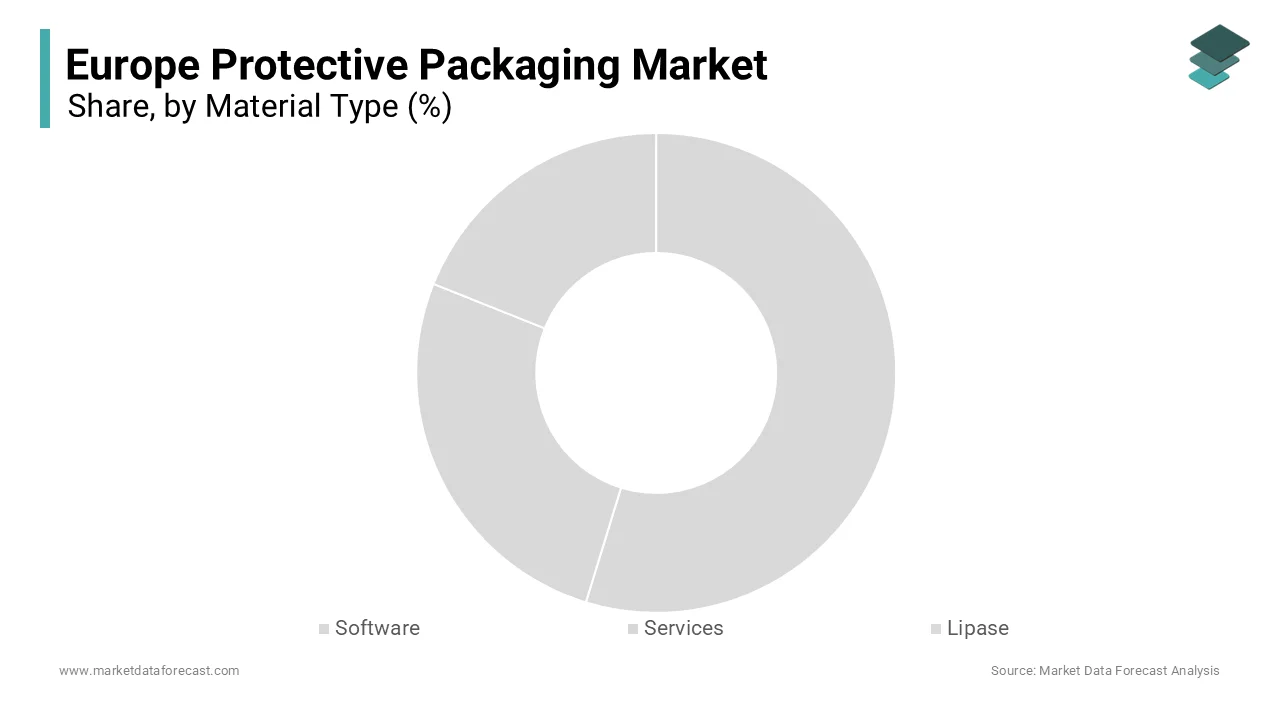
The paper and paperboard segment is the fastest-growing material category in the European protective packaging market with a projected CAGR of 8.12% over the forecast period. Factors such as regulatory mandates, consumer pressure and technological advances in fibre engineering are contributing to the growth of the paper and paperboard segment in the European market. The European Union’s Packaging and Packaging Waste Regulation explicitly prioritises fibre-based materials by imposing higher extended producer responsibility fees on non-recyclable plastics and setting recyclability thresholds that favour mono-material paper solutions. As per the European Commission, multiple member states have introduced fiscal incentives for paper-based protective packaging, including tax credits for moulded pulp adoption in e-commerce. Anti-Waste Law prohibits non-recyclable protective fillers in online retail, which has driven a significant increase in paper cushioning sales according to ADEME. Additionally, the EU’s Ecodesign for Sustainable Products Regulation mandates that all packaging must be compatible with existing recycling infrastructure by 2027, which is a criterion that paper inherently satisfies given Europe’s mature paper collection rate of seventy 2% according to Eurostat. This regulatory tailwind ensures structural displacement of plastics in favour of paper across retail and logistics sectors.
By Product Type Insights
The rigid protective packaging segment accounted for 41.4% of the European market share in 2025. The leading position of rigid segments in the European market is attributed to their structural integrity, reusability and compatibility with automated handling systems in industrial supply chains. Rigid protective packaging, such as corrugated trays, plastic totes, and returnable container,s is deeply embedded in Europe’s industrial logistics infrastructure. For instance, a significant share of intra-EU automotive and machinery shipments utilises standardised rigid containers that interface seamlessly with robotic palletising and conveyor systems. These systems reduce manual handling damage and enable closed-loop reuse, with companies like Volkswagen reporting extensive reuse cycles per container. The shift toward Industry 4.0 further entrenches rigid formats as they can embed RFID tags for real-time tracking and condition monitoring. In Sweden, national logistics initiatives have identified rigid packaging as critical to achieving zero waste in manufacturing, with a majority of large manufacturers adopting returnable rigid systems according to the Swedish Transport Administration. This operational efficiency, combined with lifecycle cost advantages,is majorly propelling the dominance of the rigid segment in the European market.
The foam-based protective packaging segment is estimated to register a CAGR of 9.4% over the forecast period in the European market, owing to the performance demands in electronics and the rise of bio-based foam alternatives. The proliferation of sensitive electronic,, including wearable devices, drones and diagnostic equipment, has intensified demand for precision shock absorption that only engineered foams can provide. According to Eurostat, the EU imported over 200 billion euros worth of electronic components in 2025, with many requiring static dissipative or vibration-dampening packaging. Foam-based solutions, such as cross-linked polyethene and ethylene vinyl acetate o,,ff offerustomizable density gradients that protect delicate circuits during air and road transit. In Ireland, a hub for MedTech manufacturing, a large share of Class II and III medical devices shipped in 2025 used foam inserts to meet ISO 11607 sterility and integrity standards, according to the Irish Medical Devices Association. The inability of paper or rigid formats to replicate this level of micro-level cushioning is driving the foam-based protective packaging segment in the European market.
By End-user Vertical Insights
The consumer electronics segment led the European protective packaging market in 2025 with a31.4% of the regional market share. The dominance of the consumer electronics segment in the European market is attributed to its high product value, fragility, and e-commerce dependency. Consumer electronics represent one of the most damage-sensitive and high-margin categories in European retail. For instance, the average smartphone retails for 700 euros with internal components vulnerable to micro shocks and electrostatic discharge. This requires multi-layer protective systems, including anti-static foam, rigid tray,,s and moisture barrier wraps. In 2025, e-commerce accounted for a majority of electronics sales in the EU, as per Eurostat, which is amplifying the need inffor individualisedotective packaging that survives last-mile handling. Major brands like Samsung and Sony enforce strict ISTA 6 Amazon certification, requiring drop tests from multiple orientations. Returns due to transit damage cost the sector billions of euros annually, which is prompting aggressive investment in advanced protective solutions. This combination of value sensitivity and logistics complexity is driving the dominance of the consumer electronics segment in the European market.
The pharmaceutical vertical segment is anticipated to record a CAGR of 11.3% over the forecast period in the European market, owing to the expansion of biologics and stringent cold chain requirements. The European pharmaceutical landscape is shifting toward complex biologics, monoclonal antibodies, and mRNA-based therapies, which require strict thermal control and shock protection during transit. According to the European Medicines Agency, a growing share of new drug approvals in 2025 were temperature-sensitive biologics that degrade if exposed to vibrations or thermal excursions. This necessitates multi-component protective systems, including vacuum-insulated panels, phase change materials and rigid foam encasements. The EU’s rollout of personalised cancer therapies that use patient-specific cell shipments has further intensified demand for single-use protective solutions with real-time temperature monitoring. In Germany, the biopharma cluster around Munich reported a notable increase in protective packaging procurement in 2025, according to the German Biotech Association. These high-value low low-volume shipments command premium packaging solutions far beyond standard retail needs and drive the growth of the pharmaceutical segment in the European market.
REGIONAL ANALYSIS
Germany Market Analysis
Germany led the protective packaging market in Europe in 2025 by holding 24.7% of the regional market share. The dominance of Germany in the European protective packaging market is rooted in its world-class manufacturing base, automotive industry, and engineering culture that prioritises precision and durability. A significant share of Germany’s protective packaging is used in industrial and automotive logistics, where reusable rigid systems are standard. The German government’s Resource Efficiency Programme mandates that all industrial packaging must be reusable or recyclable by 2026, which is a policy that has accelerated investment in returnable plastic containers and moulded fibre inserts. Companies like Bosch and Siemens operate closed-loop systems, recovering the majority of protective packaging annually. Furthermore, Germany hosts leading material science institutes such as Fraunhofer IVV, which collaborate with packaging firms on bio-based foam development. The country’s dual vocational training system also produces skilled packaging engineers, ensuring high standards in design and implementation. This ecosystem of regulation industry and innovation is boosting the dominating position of Germany in the European market.
United Kingdom Market Analysis
The United Kingdom occupied the second-largest share of the European protective packaging market in 2025. The UK is Europe’s largest e-commerce market, with online retail penetration among adults driving the protective packaging market in the UK. This drives massive demand for individualised protective packaging, particularly for electronics, cs fashion and beauty. Post Brexit, the UK has maintained alignment with EU packaging principles through its own Plastic Tax and Extended Producer Responsibility scheme, which came into force in 2023. These policies have spurred the adoption of paper-based void fill and recyclable mailers. London and the Midlands have emerged as hubs for sustainable packaging startups with numerous new firms launching in 2025 focused on mycelium and seaweed-based cushioning. Major retailers like Tesco and ASOS enforce strict packaging guidelines for third-party sellers, requiring damage rates below one % %. Despite regulatory divergence, the UK remains a high-volume high high-innovation market shaped by digital retail and environmental accountability.
France Market Analysis
France commanded a considerable share of the European protective packaging market in 2025. France is a pioneer in circular economy legislation with its Anti-Waste for a Circular Economy,, banninsingle-usese plastic packaging and mandating reusable or recyclable alternatives by 2026. This has driven the rapid substitution of plastic air pillows with paper-based solutions across retail and logistics. In 2025, retailers reported a significant year-on-year increase in moulded pulp usage according to ADEME. The government also funds industrial symbiosis networks where agricultural residues from wine and cereal production are converted into protective packaging feedstock. Regions like Auvergne-Rhône-Alpes host clusters of packaging converters serving the pharmaceutical and luxury goods sectors, which demand high integrity yet sustainable solutions. French consumers are among Europe’s most eco-conscious, with surveys showing that a majority avoid brands using non-recyclable packaging. This alignment of policy, industry, and industrylic sentiment makes France a decisive force in the market’s green transition.
Netherlands Market Analysis
The Netherlands is projected to account for a notable share of the European protective packaging market during the forecast period. The strategic position of the Netherlands as Europe’s logistics gateway, with the Port of Rotterdam and Schiphol Airport, rt makes it a critical hub for packaging innovation and distribution. A significant share of European e-commerce parcels transits through Dutch fulfilment centres, necessitating high-performance yet sustainable protective solutions. The Dutch government’s National Circular Economy Programme targets one hundred% % recyclable packaging by 2026, with specific support for reusable systems in B2B logistics. Companies like Philips and ASML use returnable protective totes with embedded sensors for intra-European component shipping. The Netherlands is also home to leading R&D initiatives such as the TNO Circular Packaging Lab, which developed enzymatic recycling for multi-layer protective films. Amsterdam’s startup ecosystem includes firms like FlexiHex, producing paper-based alternatives to bubble wrap, now adopted by major sports brands. This fusion of logistics scale, regulatory ambition and technological experimentation positions the Netherlands as an innovation catalyst.
Sweden Market Analysis
Sweden is expected to showcase a healthy CAGR in the European protective packaging market during the forecast period. Sweden stands out for its holistic integration of sustainability into industrial operations and public policy. Sweden’s protective packaging sector is increasingly shifting toward reusable solutions and certified renewable fibres, which reflects the country’s strong circular economy policies. The government’s climate roadmap requires all sectors to achieve net zero emissions by 2045, a target that has driven companies like IKEA and Electrolux to eliminate plastic protective foams. Sweden’s forest industry supplies high-quality pulp for moulded fibre, with companies like Billerud developing innovative paper-based materials such as FibreForm that replace plastic in electronics. The country also leads in reverse logistics with national take-back schemes for industrial packaging, achieving high recovery rates across materials. Educational institutions such as Chalmers University collaborate with industry on life cycle assessment tools, which ensure packaging decisions are data-driven. This systemic approach to circularity makes Sweden a model for sustainable protective packaging despite its smaller market size.
COMPETITIVE LANDSCAPE
KEY MARKET PLAYERS
Some of the notable key players in the European protective packaging market are
- Universal Protective Packaging
- Point Five Packaging
- EcoEnclose
- Storopack
- Pro-Pac Packaging (Aust) Pty Ltd
- Intertape Polymer Group
- Pregis
- Smurfit Kappa Group PLC
- DS Smith PLC
- International Paper Co
- WestRock Co
- Sealed Air Corp
- Dow Inc
- Huhtamäki Oyj
- Sonoco Products Co
TOP STRATEGIES USED BY THE KEY MARKET PLAYERS
Key players in the European protective packaging market prioritise the development of recyclable and reusable packaging systems aligned with EU regulatory mandates. They invest heavily in research and development to create high-performance paper-based and bio-derived alternatives that match the protective qualities of traditional plastics. Strategic partnerships with e-commerce platforms, logistics providers, and brand owners enable co-developed packaging solutions that reduce damage and waste. Companies also deploy digital tools such as packaging simulation software and lifecycle assessment platforms to optimise material use and validate sustainability claims. Furthermore, they expand localised production networks to shorten supply chains, lower emissions and ensure compliance with country-specific extended producer responsibility schemes.
COMPETITION OVERVIEW
The European protective packaging market features intense and multifaceted competition among multinational corporations, regional converters, rs, and agile innovators. Large players leverage integrated paper mills, advanced automation and circular business models to dominate industrial and e-commerce segments while smaller firms differentiate through nichebiobasedror digital customisation services. Competition is increasingly defined not by price alone but by compliance with EU sustainability regulations, material innovation, and supply chain reliability. The rise of extended producer responsibility laws has elevated the importance of end-of-life management, making recyclability and reuse central to competitive positioning. Simultaneously t, , he demand for high-performance solutions in electronics and pharmaceuticals creates a dual market where sustainability must coexist with stringent protective requirements. This dynamic fosters both collaboration and rivalry as companies race to balance ecological accountability with functional excellence in one of the world’s most regulated packaging environments.
TOP PLAYERS IN THE MARKET
- DS Smith is a leading European packaging company headquartered in the United Kingdom with a strong global footprint across thirty-eight countries. The company plays a pivotal role in the protective packaging market through its expertise in corrugated solutions engineered for e-commerce, retail logistics. DS Smith contributes globally by advancing circular design principles and operating one of Europe’s most integrated paper and packaging recycling loops. In recent years, the company strengthened its position by launching its Protect range, which includes paper-based foam alternatives and custom die-cut inserts for high-value electronics. It also expanded its RightCycle program in partnership with major European brands to recover and reuse protective packaging materials, supporting EU circular economy goals.
- Sealed Air Corporation is a US-based multinational with deep operational roots across Europe, particularly in Germany, France and the Netherlands. The company is globally recognised for its innovative protective packaging technologies, including the CRYOVAC and AIRCAP brands, which serve pharmaceutical electronics and industrial sectors. To reinforce its European presence, Sealed Air has invested in recyclable and bio-based cushioning solutions compliant with EU sustainability directives. In 2025, the company introduced its Net Zero Protective Packaging Roadmap, featuring fully recyclable air cushion systems and digital tools that optimise packaging volume. These initiatives align with European customer demands for performance and environmental responsibility while enhancing Sealed Air’s integration into automated fulfilment ecosystems.
- Smurfit Kappa Group is an Ireland-headquartered global leader in paper-based packaging with extensive manufacturing and R&D capabilities throughout Europe. The company significantly influences the protective packaging landscape through its innovative use of sustainably sourced fibres and proprietary design software that enables precise protective structures without plastic. Smurfit Kappa contributes to the global market by exporting its circular packaging models and engineering expertise to emerging regions. Recently, the company enhanced its market position by launching its Circular Design Principles framework, which guides customers in developing protective packaging that meets EU recyclability standards. It also opened a dedicated innovation centre in the Netherlands, focused on developing moulded fibre solutions for electronics and medical devices, reinforcing its commitment to performance-driven sustainable performance.
Europe Protective Packaging Market News
- In March 2025, DS Smith launched its Protect Eco range of paper-based cushioning solutions across Germany, France and Italy, replacing traditional plastic foams and strengthening the European protective packaging market presence.
- In May 2025, Sealed Air Corporation introduced fully recyclable AIRCAP R5 air cushion systems compliant with EU packaging regulations, enhancing its sustainable offering in the European protective packaging market.
- In February 2025, Smurfit Kappa Group inaugurated an innovation centre in Utrecht, Netherlands, dedicated to developing moulded fibre protective packaging for electronics and medical devices, reinforcing the European protective packaging market leadership.
- In June 2025, S Smith partnered with Zalando to co-design right-sized protective packaging for fashion e-commerce, reducing material use by twenty % and advancing circularity in the European protective packaging market.
- In April 2025,ealed Air Corporation rolled out its Net Zero Protective Packaging digital toolkit,e e enabling European owners to simulate, optimise and certify protective packaging designs, accelerating compliance in the European protective packaging market.
MARKET SEGMENTATION
This research report on the European protective packaging market has been segmented and sub-segmented based on categories.
By Material Type
- Plastics
- Paper and Paperboard
- Other Material Types
By Product Type
- Rigid
- Molded Pulp
- Paperboard-based Protectors
- Insulated Shipping Containers
- Flexible (Mailers, Paper Full, and Air Pillows)
- Bubble Wraps
- Foam Based
By End-user Vertical
- Food and Beverage
- Pharmaceutical
- Consumer Electronics
- Beauty and Homecare
- Other End-user Verticals
By Country
- UK
- France
- Spain
- Germany
- Italy
- Russia
- Sweden
- Denmark
- Switzerland
- Netherlands
- Turkey
- Czech Republic
- Rest of Europe
Frequently Asked Questions
1. What is driving the growth of the Europe protective packaging market?
E-commerce expansion, stricter product safety standards, and rising demand for safe transportation of goods are major drivers.
2. What industries use protective packaging the most in Europe?
Key industries include electronics, food & beverages, pharmaceuticals, automotive, and consumer goods.
3. What types of protective packaging are commonly used?
Foam packaging, bubble wrap, airbags, corrugated boxes, molded pulp, and protective mailers.
4. Why is e-commerce influencing protective packaging demand?
More online orders require safe, impact-resistant, and lightweight packaging to protect products during shipping.
5. What materials are popular in protective packaging?
Paper-based, plastic-based, foam, molded pulp, and biodegradable or recyclable materials.
6. How is sustainability affecting the protective packaging market?
Companies are shifting toward recyclable, compostable, and reusable packaging because of EU sustainability regulations.
7. Why are companies adopting lightweight packaging solutions?
To reduce shipping costs, carbon footprint, and material usage while maintaining product protection.
8. What challenges does the Europe protective packaging market face?
Rising raw material prices, strict environmental laws, and pressure to reduce plastic waste.
9. How are technological innovations improving protective packaging?
Smart packaging, automation, material optimization, and advanced cushioning technologies are enhancing product protection.
10. What opportunities exist for manufacturers in this market?
Eco-friendly options, customized packaging, automation-based solutions, and protective packaging for fragile electronics.
Related Reports
Access the study in MULTIPLE FORMATS
Purchase options starting from
$ 2000
Didn’t find what you’re looking for?
TALK TO OUR ANALYST TEAM
Need something within your budget?
NO WORRIES! WE GOT YOU COVERED!
Call us on: +1 888 702 9696 (U.S Toll Free)
Write to us: sales@marketdataforecast.com