- Product Description Description
- Table of Contents TOC
- List of Table & Figure LOT
- Get Free Sample PDF Sample PDF
Market Size, 2025
$0.51 BnMarket Estimate, 2026
$0.53 BnMarket Forecast, 2034
$0.73 BnCAGR, 2026–2034
4.09%Executive Summary: Europe Protein Hydrolysis Enzymes Market
- Market Scope: Comprehensive regional market evaluation of the European protein hydrolysis enzymes sector covering source classifications, industrial applications, and country-level distribution frameworks.
- Market Valuation: Valued at USD 0.51 billion in 2025, estimated at USD 0.53 billion in 2026, and projected to reach USD 0.73 billion by 2034, registering a solid CAGR of 4.09% from 2026 to 2034.
- Primary Growth Drivers: Growing consumer and industrial demand for plant-based and alternative protein systems, expansion of clinical and medical nutrition applications, and EU clean-label processing initiatives.
Key Market Segment Metrics (2026–2034)
| Category | Leading Segment (2025 Position) | Fastest-Growing / Preferred Segment |
|---|---|---|
| By Source | Microorganisms (occupied the most dominant share in 2025 due to industrial scalability, safety, and consistent microbial protease production) | Plant Segment (predicted to witness the fastest CAGR of 12.1% driven by consumer demand for clean-label, non-GMO processing aids) |
| By Application | Food & Beverage / Food Industry (core established base for modifying flavor, solubility, and functional peptide profiles in hydrolysates) | Pharmaceuticals & Clinical Nutrition (expanding via high-value medical foods, infant nutrition, and bioactive therapeutic peptides) |
| By Country | Germany (dominated regional market capturing 23.8% share backed by advanced biopharma, food processing clusters, and R&D strategies) | The Netherlands (growing at a promising CAGR, serving as Europe’s central enzyme innovation, pilot-testing, and logistics hub) |
Major Market Players & Market Structure
Market Structure: Highly concentrated European biotechnology and enzyme manufacturing marketplace dominated by global industrial leaders and specialized biotech firms competing through precision fermentation, enzyme specificity, and stringent EFSA regulatory alignment.
Key Companies: AB Enzymes, Dyadic International, Inc., Solvay Enzymes, Royal DSM, Novozymes A/S, Specialty Enzymes, and Biotechnologies Co.
Europe Protein Hydrolysis Enzymes Market Size
The Europe Protein Hydrolysis Enzymes Market is projected to grow from USD 0.51 billion in 2025 to USD 0.53 billion in 2026 and reach USD 0.73 billion by 2034, registering a CAGR of 4.09% from 2026 to 2034.

Protein hydrolysis enzymes catalyse the breakdown of complex proteins into peptides and free amino acids to enhance functionality, solubility, digestibility, and flavor in food, feed, and pharmaceutical applications. In Europe, these enzymes are integral to producing hypoallergenic infant formulas, plant-based meat analogs, sports nutrition products, and bioactive hydrolysates for clinical nutrition. As per the European Food Safety Authority, proteolytic enzymes are approved for food use under Regulation EC 1332/2008 with strict specifications on origin, purity, and residual activity. As per the European Biotechnology Industry Association, enzyme-based protein modification reduces reliance on chemical hydrolysis, which can generate undesirable byproducts like lysinoalanine. Furthermore, the EU’s Farm to Fork Strategy emphasizes clean-label processing, which favors enzymatic over synthetic methods. Eurostat reports that the EU processes millions of tons of plant and animal protein annually for human and animal consumption, which is creating substantial substrate volume for enzymatic valorization. With rising demand for sustainable and high-value protein ingredients, enzyme-mediated hydrolysis has become a cornerstone of Europe’s advanced protein transformation infrastructure.
MARKET DRIVERS
Growing Demand for Plant-Based and Alternative Proteins
The rapid expansion of plant-based food systems in Europe is a primary driver of the European protein hydrolysis enzymes market. Consumers are increasingly shifting toward legume cereal and algal proteins to reduce environmental impact and improve health, yet these sources often suffer from poor solubility, bitterness, and low digestibility. Enzymatic hydrolysis effectively mitigates these limitations by cleaving anti-nutritional factors and unlocking functional peptides. Retail sales of plant-based meat and dairy alternatives in Europe reached over 5 billion euros in 2023, with major markets driving the majority of the total. Major manufacturers rely on proteases like alcalase to debitter pea and fava bean proteins and improve emulsification in meat analogs. The European Commission’s protein initiatives aim to increase EU production of legumes by 2030, which will further amplify demand for enzymatic processing. According to studies, enzymatically hydrolyzed fava bean protein increases solubility compared to native forms. This convergence of consumer behavior, policy support, and technical necessity positions plant protein hydrolysis as a sustained growth engine for enzymes in Europe.
Expansion of Medical and Clinical Nutrition Applications
Protein hydrolysis enzymes are increasingly critical in producing specialized medical foods for patients with metabolic disorders, malabsorption syndromes, or critical care needs, which is further boosting the regional market expansion. Hydrolyzed proteins offer enhanced bioavailability, rapid absorption, and reduced allergenic potential attributes essential for enteral formulas and infant nutrition. According to the European Society for Clinical Nutrition and Metabolism, millions of Europeans suffer from disease-related malnutrition requiring tailored nutritional support. The European Medicines Agency recognizes specific hydrolysates as active ingredients in foods for special medical purposes under Regulation (EU) 609/2013. For instance, extensively hydrolyzed whey formulas are standard care for infants with cow milk protein allergy, which affects approximately 2% to 3% of European newborns, according to the European Academy of Allergy and Clinical Immunology. Companies like Nutricia and Nestlé Health Science use proprietary protease blends to achieve precise peptide profiles with low molecular weights. The growing aging populations in Europe are also contributing to the growing demand for protein hydrolysis enzymes in Europe. According to Eurostat, 21% of the EU population is aged 65 or older, which is a demographic highly susceptible to sarcopenia and protein-energy malnutrition. This clinical imperative ensures continued enzyme adoption in high-value therapeutic nutrition segments.
MARKET RESTRAINTS
Stringent Regulatory Approval Processes for Novel Enzymes
The commercial deployment of new or modified protein hydrolysis enzymes in Europe faces prolonged and complex regulatory hurdles, which are majorly hindering the protein hydrolysis enzymes market growth in Europe. All food enzymes must undergo pre-market safety evaluation by the European Food Safety Authority and receive authorization under the EU positive list established by Regulation EC 1332 2008. According to the European Commission, approval of a novel enzyme requires comprehensive data on source organism, production process, purity, and toxicological profile, and timelines are often lengthened,y often exceeding a year. This deters small biotech firms from introducing innovative proteases even when they offer superior specificity or sustainability. Furthermore, enzymes derived from genetically modified microorganisms face additional scrutiny under Directive 2001/18/EC, which governs GMO use. For instance, only a limited number of new food enzymes have been added to the EU list in recent years despite dozens of global innovations. This regulatory latency limits formulators’ access to next-generation enzymes that could improve hydrolysis efficiency or reduce energy consumption. Consequently, manufacturers often rely on legacy enzymes that may be less effective for emerging protein substrates like lentils or microalgae.
High Sensitivity of Enzyme Performance to Substrate Variability
The efficacy of protein hydrolysis enzymes is highly dependent on the composition, on struct, urea, and purity of the protein substrate, which varies significantly across plant and animal sources, which is further hindering the regional market growth. Unlike standardized dairy or soy protein,,s emerging alternatives such as lupin, chickpea, and insect proteins contain diversant-nutritional compounds, polyphenols, and fiber that interfere with enzyme kinetics. Enzymatic hydrolysis yields for fava bean protein vary widely depending on cultivar and processing history. Similarly, insect meal protein hydrolysates exhibit batch-to-batch inconsistency due to differences in species, feed, and drying methods as noted by the European Feed Manufacturers Federation. This variability forces producers to constantly re-optimize enzyme dosage, pH, temperature, and reaction time, which is increasing operational complexity and cost. Moreover, many European food processors lack in-house enzymology expertise to troubleshoot suboptimal hydrolysis. Without standardized protein feedstocks or adaptive enzyme systems, which is achieving consistent product quality remains a persistent technical barrier across the value chain.
MARKET OPPORTUNITIES
Rise of Precision Fermentation for Tailored Protease Production
Precision fermentation is unlocking new opportunities for engineering bespoke protein hydrolysis enzymes with enhanced specificity, stability, and sustainability, which is a potential opportunity for the European protein hydrolysis enzymes market. Using synthetic biology, European biotech firms can design proteases that selectively cleave at desired peptide bonds in challenging substrates such as pea or mycoprotein. Precision fermentation startups in the EU are developing food-grade enzymes with reduced off-flavor generation and higher catalytic efficiency at ambient temperatures. Companies like Novozymes and DSM utilize this platform to create protease variants that operate effectively at low pH, which is critical for hydrolyzing plant proteins in acidic beverage applications. The EU’s Horizon Europe program has allocated funding to support fermentation-based enzyme production as part of its circular bioeconomy agenda. Furthermore, these engineered enzymes often require lower dosages, which reduces residual protein contamination and downstream purification costs. As clean label and energy efficiency become non-negotiable in food manufacturing, precision fermentation–derived proteases are poised to redefine performance benchmarks in the European market.
Integration of Enzymatic Hydrolysis in Upcycled Protein Streams
The Circular Economy Action Plan of the European Union is catalyzing the use of protein hydrolysis enzymes to valorize food processing byproducts into high-value ingredients, which is another major opportunity for the regional market. Sources such as brewer’s spent grain, cheese whey, blood meal, and fish trimmings contain abundant protein that is currently underutilized or discarded. Enzymatic hydrolysis converts these waste streams into functional hydrolysates for use in sports nutrition, pet food, and fortified foods. According to Eurostat, around 130 kg of food waste per inhabitant was generated in the EU in 2023, which amounts to nearly 59 million tons annually, with households accounting for over half of this waste. Brewer’s spent grain, which is a major brewing by-product and is recognized as a rich source of proteins, with studies showing it contains significant amounts of digestible protein suitable for food applications. Similarly, fish processing waste can be enzymatically converted into collagen peptides that are increasingly used in dietary supplements. With EU regulations mandating a 10% reduction in food waste from processing and manufacturing and a 30% reduction at retail and consumption levels by 2030, enzymatic upcycling offers both economic and environmental returns. This alignment with policy and sustainability goals creates a significant growth corridor for hydrolysis enzymes beyond conventional protein sources.
MARKET CHALLENGES
Thermal and pH Instability of Conventional Proteases
Many commercially available protein hydrolysis enzymes exhibit limited stability under industrial processing conditions, which leads to inconsistent hydrolysis and increased operational costs, and is a significant challenge to the European market. Standard proteases like alcalase function optimally within a narrow pH range, typically between 7 an,d 9, and lose activity rapidly above 60 degrees Celsius, and these conditions do not align with many food manufacturing processes. Studies indicate that enzymatic hydrolysis processes often face interruptions in industrial settings to adjust pH or temperature in order to maintain enzyme efficacy. This inefficiency is particularly acute when processing heat-treated plant proteins, which demand simultaneous high temperature and neutral pH for solubility yet degrade conventional enzymes. Furthermore, residual enzyme activity in final products can cause texture or flavor drift during shelf life, necessitating costly inactivation steps. Without robust enzymes capable of withstanding real-world processing variability, manufacturers struggle to achieve reproducible peptide profiles and functional outcomes, which is hindering product innovation and scale-up.
Limited Consumer and Regulatory Clarity on Hydrolysate Labeling
Ambiguity in EU labeling regulations for enzymatically hydrolyzed proteins creates marketing and compliance challenges for food manufacturers, which is further challenging the regional market expansion. While Regulation EU 1169 2011 mandates ingredient transparency, it does not specify how hydrolysates should be declared, which is leading to inconsistent labeling such as “hydrolyzed pea protein,” “pea protein isolate,” or simply “pea protein.” According to the European Consumer Organisation, this lack of standardization confuses consumers about the degree of processing and nutritional value. Moreover, hydrolysates used in clean-label products risk being perceived as “highly processed” despite their natural enzymatic origin. Regulatory gray areas also exist around allergen declaration. According to the European Food Safety Authority, hydrolysis can reduce but not eliminate allergenicity, yet labeling rules do not differentiate between partially and extensively hydrolyzed forms. Consumer research indicates that many people remain uncertain whether hydrolyzed proteins are safe for allergy sufferers. This informational gap limits brand storytelling and consumer trust, even when hydrolysates offer functional and health benefits, which poses a significant market adoption barrier.
REPORT COVERAGE
| REPORT METRIC | DETAILS |
| Market Size Available | 2025 to 2034 |
| Base Year | 2025 |
| Forecast Period | 2026 to 2034 |
| Segments Covered | By Source, Application, and Region. |
| Various Analyses Covered | Global, Regional and Country-Level Analysis, Segment-Level Analysis, Drivers, Restraints, Opportunities, Challenges; PESTLE Analysis; Porter’s Five Forces Analysis, Competitive Landscape, Analyst Overview of Investment Opportunities |
| Countries Covered | UK, France, Spain, Germany, Italy, Russia, Sweden, Denmark, Switzerland, Netherlands, Turkey, Czech Republic, Rest of Europe |
| Market Leaders Profiled | Ab Enzymes, Dyadic International, Inc., Solvay Enzymes, Royal DSM, Novozymes A/S, Specialty Enzymes, Biotechnologies Co. |
SEGMENTAL ANALYSIS
By Source Insights
The microorganisms segment occupied the most dominant share of the European market in 2025. The dominance of the microorganisms segment in the European market is driven by the industrial scalability, safety profile, and genetic tractability of microbial hosts such as Bacillus subtilis and Aspergillus oryzae. These microorganisms produce highly specific and consistent proteases like alcalase and neutrase under controlled fermentation conditions compliant with EU food safety standards. As per the European Food Safety Authority, all microbial enzymes used in food must originate from non-pathogenic non-toxigenic strains listed in the EU’s positive register, which is a criterion that industrial microbes reliably meet. Furthermore, microbial fermentation aligns with EU sustainability goals. According to sources, microbial enzyme production can significantly reduce carbon emissions compared to animal-sourced alternatives. Major enzyme producers such as Novozymes and DSM operate large-scale fermentation facilities in Denmark and the Netherlands that supply standardized protease batches across Europe. This combination of regulatory acceptance, environmental efficiency, and production reliability is propelling the dominance of the microorganisms segment in the European market.
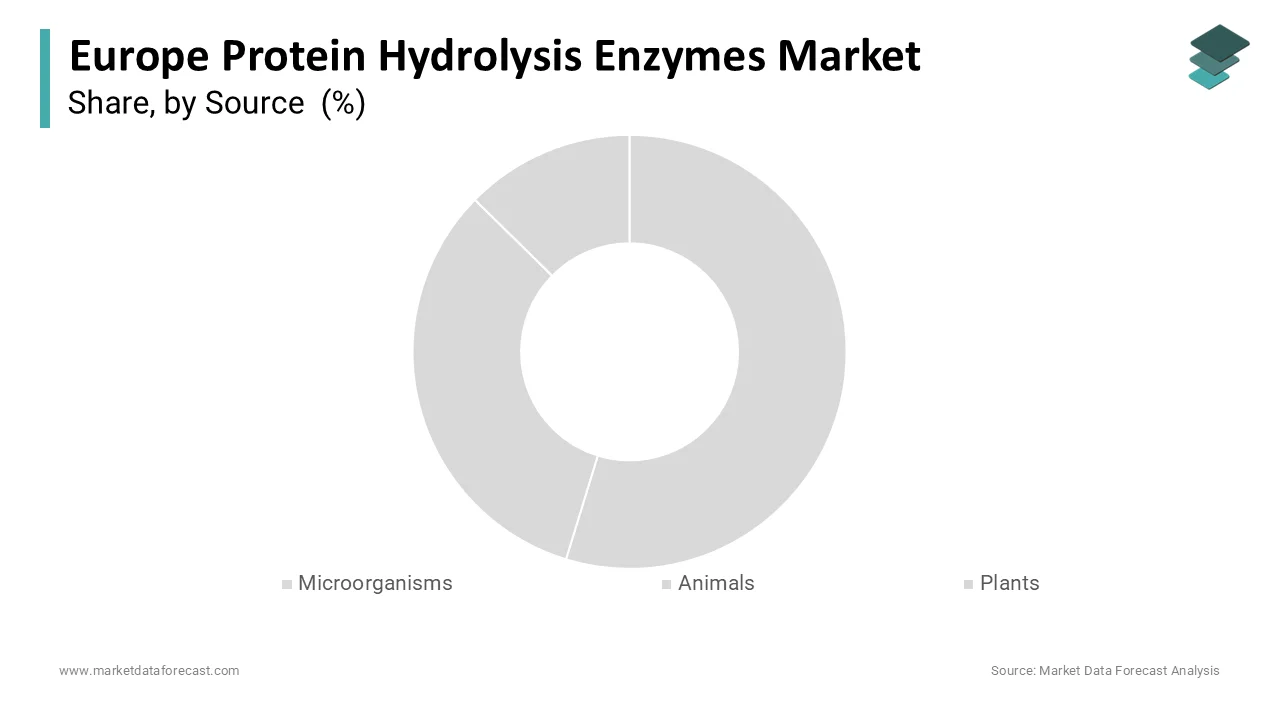
The plant segment is predicted to witness the fastest CAGR of 12.1% over the forecast period in the European protein hydrolysis enzymes market, owing to the rising consumer demand cforlean-label and non-GMO processing aids in organic and plant-based foods. Enzymes such as papain from papaya, bromelain from pineapple, and ficin from fig trees are perceived as natural and minimally processed qualities that align with the European Organic Regulation EU 2018 848, which permits certain plant proteases in certified organic production. Plant enzymes function effectively under mild conditions, reducing energy use in hydrolysis. According to sources, bromelain can achieve high hydrolysis efficiency on plant proteins under moderate temperature conditions without pH adjustment. As clean label trends intensify and organic food sales in the EU continue to grow, plant-sourced proteases are gaining traction beyond niche applications into mainstream protein processing.
COUNTRY LEVEL ANALYSIS
Germany Protein Hydrolysis Enzymes Market Analysis
Germany dominated the protein hydrolysis enzymes market in Europe with a 23.8% of the regional market share. The dominance of Germany in the European protein hydrolysis enzymes market is driven by its advanced biopharma and food processing industries that demand high-purity hydrolysates for clinical nutrition and meat analogs. Germany hosts Europe’s largest cluster of enzyme application labs with key facilities operated by BASF and Evonik in Ludwigshafen and Essen. Germany processes significant volumes of plant protein isolates annually, primarily from peas and fava beans, which makes it one of the leading contributors within the EU. Strict German food labeling laws under the Lebensmittel und Futtermittelgesetzbuch require full enzyme disclosure, which has driven investment in traceable microbial protease supply chains. Additionally, Germany’s National Research Strategy BioEconomy 2030 funds collaborative projects between Fraunhofer Institutes and food companies to optimize enzymatic protein valorization. This blend of industrial-scale regulatory rigor and public R&D support is contributing to the dominating position of Germany in the European protein hydrolysis enzymes market.
France Protein Hydrolysis Enzymes Market Analysis
France captured the second-largest share of the European market in 2025 due to its integrated dairy and plant protein sectors, which extensively use hydrolysis for infant formula, sports nutrition, andclean-labell metal meatalternatives. France is a leading producer of whey in Europe and requires proteases for hypoallergenic hydrolysate production. Major players like Lactalis and Roquette operate dedicated enzymatic hydrolysis lines in Normandy and Picardy. France’s regulatory environment actively supports enzymatic over chemical processing. As per the French National Food Program 2023, “natural transformation methods” are included in public procurement guidelines. Moreover, the French National Research Institute for Agriculture, Food and Environment leads EU-funded projects on legume protein, which is debittered using tailored protease blends. With strong agri-industrial infrastructure and policy alignment with clean label principles, France maintains a robust and innovation-driven enzyme market.
Netherlands Protein Hydrolysis Enzymes Market Analysis
The Netherlands is predicted to grow at a promising CAGR in the European protein hydrolysis enzymes market during the forecast period. The Netherlands functions as Europe’s enzyme innovation and logistics hub, hosting the global headquarters of DSM and the key fermentation facilities of Novozymes. The country’s advanced port infrastructure and cold chain logistics enable rapid distribution of temperature-sensitive enzymes across the continent. According to Wageningen University and Research, Dutch research centers play a leading role in pilot-scale protein hydrolysis trials for novel plant sources in the EU. The Dutch government’s National Protein Strategy explicitly promotes enzymatic valorization of legumes and byproducts, with funding allocated for enzyme-based upcycling projects. Additionally, the Netherlands leads in regulatory pre-consultation services, helping startups navigate European Food Safety Authority requirements. This ecosystem of R&D logistics and regulatory support positions the Netherlands as the strategic nerve center for enzyme deployment in European protein transformation.
Denmark Protein Hydrolysis Enzymes Market Analysis
Denmark held a considerable share of the European protein hydrolysis enzymes market in 2025. The growth of Denmark in the European market is attributed to its world-class enzyme manufacturing base anchored by Novozymes in Bagsværd, the largest industrial enzyme producer globally. Denmark is a major supplier of microbial proteases used in European food processing, supported by its advanced fermentation plants. The enzyme sector contributes significantly to national exports with protein hydrolysis enzymes as a core product line. Denmark’s strong public-private research model accelerates the development of high-efficiency proteases tailored for European protein substrates. The Danish Food Authority also operates one of Europe’s fastest novel enzymes pre-approval pathways, reducing go-to-market timelines. This combination of industrial-scale scientific excellence and agile regulation makes Denmark indispensable to the European enzyme supply chain.
United Kingdom Protein Hydrolysis Enzymes Market Analysis
The United Kingdom is expected to hold a notable share of the European protein hydrolysis enzymes market during the forecast period, owing to the strong demand from clinical nutrition and sports supplement sectors, which rely on precisely hydrolyzed whey and pea proteins. Companies like GlaxoSmithKline Consumer Healthcare and Myprotein use proteases to produce bioactive peptides for immune and muscle health products. The UK processes significant volumes of dairy products enzymatically for high-value applications. Post Brexit, the UK has implemented a streamlined enzyme authorization process under the Food Standards Agency, which approved new microbial proteases in 2023, which is faster than the EU average. Additionally, the UK Research and Innovation agency funds the PROTEOS project to develop low-allergen plant hydrolysates using engineered enzymes. This focus on high-value health applications and adaptive regulation sustains the UK’s relevance despite its reduced access to EU funding mechanisms.
TOP LEADING PLAYERS IN THE MARKET
- Novozymes is a global leader in industrial enzymes with deep involvement in the European protein Hydrolysis Enzymes Market through its portfolio of microbial proteases such as alcalase and neutrase. The company supplies food, feed, and pharmaceutical manufacturers across Europe with highly specific enzymes tailored for plant and dairy protein hydrolysis. Novozymes operates one of the world’s largest enzyme fermentation facilities in Denmark, which serves as a strategic hub for European distribution. In recent years, the company has intensified R&D on protease variants that reduce bitterness in legume hydrolysates and enhance solubility in plant-based beverages. It also collaborates with EU-funded initiatives like the PROTEIN2FOOD project to optimize the enzymatic processing of fava bean and lentil proteins. These efforts reinforce Novozymes’ role as an innovation driver linking European protein transition goals with scalable enzymatic solutions.
- DSM plays a critical role in the European Protein Hydrolysis Enzymes Market by integrating enzymatic hydrolysis into its broader portfolio of nutritional and sustainable food solutions. The company offers proprietary protease blends designed for hypoallergenic infant formula, sports nutrition, and clean-label meat alternatives. DSM’s enzyme division works closely with its nutrition business to develop bioactive peptides with proven health benefits, such as muscle synthesis and immune support. In 202,3, DSM launched a new protease system that operates efficiently at low temperatures, preserving heat-sensitive nutrients in plant proteins. The company also partners with Dutch and German food processors to co-develop enzymatic processes that meet organic certification standards. Through this synergy of nutrition science and enzymatic innovation, DSM strengthens its position aas olutions-oriented partner in Europe’s protein transformation landscape.
- DuPont Nutrition and Biosciences contributes significantly to the European Protein Hydrolysis Enzymes Market by delivering high-performance proteases for functional protein hydrolysates used in dairy alternatives, clinical nutrition, nd pet food. The company leverages its global enzyme library to engineer proteases with enhanced specificity for difficult substrates like pea and fava bean. DuPont maintains dedicated application centers in the Netherlands and Germany, where food scientists work directly with manufacturers to optimize hydrolysis parameters for texture, re-flavor, and digestibility. In 2024, the company introduced a novel protease that minimizes lysinoalanine formation during plant protein processing, addressing a key safety concern raised by the European Food Safety Authority. By combining regulatory expertise with application-driven innovation, DuPont enables European producers to meet both clean label and safety requirements in high-growth protein categories.
TOP STRATEGIES USED BY THE KEY MARKET PARTICIPANTS
Key players in the European Protein Hydrolysis Enzymes Market prioritize enzyme specificity, sustainability, and regulatory alignment to maintain a competitive advantage. Companies invest heavily in protein substrate research to develop tailored proteases that address bitterness, solubility, and digestibility in novel plant sources. Strategic collaborations with food manufacturers and research institutes accelerate application testing and commercial adoption. Firms actively engage with the European Food Safety Authority to fast-track novel enzyme approvals and ensure compliance with clean-label expectations. Sustainability is embedded through low-temperature,high-efficiency enzymes that reduce energy and water use. Vertical integration from fermentation to formulation enhances quality control and supply reliability. Additionally, companies expand their service offerings to include hydrolysis process consulting and peptide analytics. These strategies collectively drive technical leadership, consumer trust, and operational resilience in a rapidly evolving protein landscape.
COMPETITIVE LANDSCAPE
The European Protein Hydrolysis Enzymes Market is characterized by intense innovation and strategic differentiation among a few global leaders and specialized regional players. Competition centers on enzyme performance precision and compatibility with Europe’s stringent food safety and sustainability mandates rather than price. Global giants like Novozymes, DSM, and DuPont dominate due to their extensive R&D infrastructure, fermentation capacity, a nd regulatory expertiseenabling them to deliver consistent,high-purity proteases. Meanwhile, niche biotech firms focus on plant-derived or precision-fermented enzymes to capture clean-label and organic segments. Barriers to entry are high owing to complex EU enzyme authorization processes and the need for application-specific validation. However, demand from plant-based food and clinical nutrition sectors continues to attract investment, fostering a dynamic ecosystem. The market is less fragmented than other biotech sectors, with collaboration often complementing competition through public-private partnerships and EU-funded protein valorization projects.
KEY MARKET PLAYERS
Prominent Companies dominating the europe protein hydrolysis enzymes market profiled in the report are
- Ab Enzymess
- Dyadic International, Inc.
- Solvay Enzymess
- Royal DSM
- Novozymes A/S
- Specialty Enzymes
- Biotechnologies Co.
MARKET SEGMENTATION
This research report on the europe protein hydrolysis enzymes market has been segmented and sub-segmented into the following categories
By Source
- Microorganisms
- Animals
- Plants
By Application
- Detergent Industry
- Pharmaceuticals
- Food Industry
- Others
By Country
- UK
- France
- Spain
- Germany
- Italy
- Russia
- Sweden
- Denmark
- Switzerland
- Netherlands
- Turkey
- Czech Republic
- Rest of Europe