- Product Description Description
- Table of Contents TOC
- List of Table & Figure LOT
- Get Free Sample PDF Sample PDF
Market Size, 2025
$21.26 BnMarket Estimate, 2026
$22.47 BnMarket Forecast, 2034
$34.95 BnCAGR, 2026–2034
5.68%Executive Summary: Europe Pyrethrin Market
- Market Scope: Comprehensive European pyrethrin market analysis covering product types, pest type classifications, application segments, country-level adoption metrics, and regulatory compliance frameworks.
- Market Valuation: Valued at USD 21.26 billion in 2025, estimated at USD 22.47 billion in 2026, and projected to reach USD 34.95 billion by 2034, registering a steady CAGR of 5.68% from 2026 to 2034.
- Primary Growth Drivers: Escalating adoption of organic agriculture and integrated pest management (IPM) across EU member states, rising municipal vector control campaigns against climate-driven pest proliferation, and increasing consumer demand for natural household and pet care alternatives.
Key Europe Pyrethrin Market Segment Metrics (2026–2034)
| Market Category | Leading Segment (2025 Position) | Fastest-Growing Segment |
|---|---|---|
| By Type | Pyrethrin I (held 58.3% market share in 2024 due to superior rapid knockdown efficacy) | Pyrethrin II (projected to register a CAGR of 13.2% due to enhanced photostability and residual activity) |
| By Pest Type | Diptera (dominated with 38.2% market share targeting mosquitoes, flies, and vectors) | Sucking pests (projected to witness the fastest CAGR of 15.4% driven by greenhouse and organic crop pressures) |
| By Application | Household (accounted for 44.3% market share in 2024 due to preference for natural domestic pest control) | Animal Health (lucratively growing at an 11.4% CAGR due to natural ectoparasiticide and livestock demands) |
| By Country | France (top performer holding 34.5% share in 2024 backed by extensive organic acreage and vector campaigns) | Spain (accelerating growth driven by intensive greenhouse horticulture and expanding organic farming) |
Major Europe Pyrethrin Market Players & Industry Structure
Market Structure: Highly fragmented and specialized European botanical insecticide landscape comprising agile extractors, formulators, and biopesticide leaders competing on isomer purity, microencapsulation stability, strict EU regulatory compliance, and ethical sourcing frameworks.
Key Companies: Sinclair Animal & Household Care Ltd, Botanical Resources of Australia, Horizon Sopyrwa, AgroNatural Solutions BV, Beaphar UK, Kalyx Botanicals GmbH, Ecoflor SAS, and Elanco.
Europe Pyrethrin Market Size
The Europe pyrethrin market size was valued at USD 21.26 billion in 2025 and is anticipated to reach USD 22.47 billion in 2026 to reach USD 34.95 billion by 2034, growing at a CAGR of 5.68% during the forecast period from 2026 to 2034.

Pyrethrins are natural insecticidal compounds extracted from the flower heads of Tanacetum cinerariifolium, commonly known as the Dalmatian chrysanthemum. Valued for their rapid knockdown effect on insects and low mammalian toxicity, pyrethrins serve as key active ingredients in household insecticides, agricultural pest control formulations, and public health vector management across Europe. As per Eurostat, over 18000 hectares of EU farmland were managed under organic standards in 2024 by creating steady demand for compliant biopesticides. The European Centre for Disease Prevention and Control also recognizes pyrethrin-based space sprays as effective tools in controlling nuisance and disease-carrying insects in urban settings. This dependency on external botanical supply defines a market where regulatory acceptance and ecological alignment outweigh production autonomy.
MARKET DRIVERS
Growing Adoption in Organic Farming Drives Pyrethrin Demand
The expansion of organic agriculture, as farmers seek effective yet regulation-compliant pest control solutions, is driving the growth of the Europe pyrethrin market. Pyrethrins are among the few natural insecticides permitted under EU organic farming rules due to their botanical origin, rapid degradation,n and minimal impact on non-target organisms. This growth is particularly pronounced in countries like France, Italy, and Spain, where policy incentives have accelerated conversion. The European Organic Market Report 2024 notes that organic fruit and vegetable production increased by 8.7% year on year, and crops highly vulnerable to aphids, thrips, and whitefly pests were effectively managed by pyrethrin sprays. In France alone, over 42000 organic farms utilize pyrethrin-based products in 2023, as documented by the French Agency for Biodiversity.
Rising Urban Vector Control Needs Bolster Household and Public Health Applications
The urbanization and climate-driven vector proliferation have amplified demand for pyrethrin-based insecticides in residential and municipal settings is also fuelling the growth of the Europe pyrethrin market. Warmer temperatures and erratic rainfall patterns have expanded the habitats of nuisance and disease-associated insects such as mosquitoes, wasps, and other insects into regions previously unaffected. In response, cities like Rome, Marseille, and Barcelona have integrated pyrethrin fogging into seasonal public health campaigns. The European Centre for Disease Prevention and Control confirms that pyrethrins are preferred for space spraying in sensitive environments such as schools, hospitals, and food processing zones due to their low toxicity and rapid breakdown. Consumer behavior also reflects this trend.
MARKET RESTRAINTS
Limited and Geographically Concentrated Raw Material Supply
The near-total absence of commercial pyrethrum flower cultivation within the European Union creates heavy reliance on imports from a narrow geographic corridor. This factor is restraining the growth of the Europe pyrethrin market. Over 90% of global pyrethrin raw material originates from Kenya, Tanzania, and Rwanda, where smallholder farms produce dried pyrethrum flowers under specific high altitude conditions. According to the Food and Agriculture Organization of the United Nations, European pyrethrin imports exceeded 1200 metric tons in 2024, with supply chains vulnerable to political instability, climatic shock,,s and foreign exchange fluctuations in source countries. The European Commission’s Joint Research Centre notes that no EU member state maintains economically viable pyrethrum cultivation at scale due to unsuitable growing conditions and a lack of processing infrastructure. Attempts in France and the Netherlands to pilot cultivation yielded less than 0.5 tons per hectare compared to 3 to 4 tons in East Africa. This dependency not only inflates input costs but also complicates traceability and sustainability certification.
Regulatory Complexity and Residue Tolerance Limitations
Pyrethrin faces increasing scrutiny under Europe’s stringent chemical safety frameworks, which impose strict maximum residue levels and environmental risk assessments. The European Food Safety Authority sets very low tolerance thresholds for pyrethrins on food commodities that are often below 0.01 milligrams per kilogram by making compliance difficult for growers using even approved formulations. Additionally, pyrethrins are classified as highly toxic to aquatic organisms and bees under Regulation EC No 1272 2008, necessitating buffer zones and application restrictions that reduce practical utility. The European Chemicals Agency further subjects pyrethrin to biocidal product authorization under the Biocidal Products Regulation, which requires extensive toxicological data and environmental fate studies. These regulatory hurdles increase formulation costs, limit application windows, and deter small organic farmers from adoption despite pyrethrin’s biodegradability. The tension between natural product status and modern hazard-based regulation constrains market accessibility.
MARKET OPPORTUNITIES
Integration into Integrated Pest Management Programs in Vineyards and Orchards
The formal inclusion of pyrethrins in certified Integrated Pest Management or IPM protocols is another significant opportunity boosting the growth of the Europe pyrethrin market. IPM mandates prioritize non-chemical methods but allow targeted use of low-risk pesticides when thresholds are exceeded, and pyrethrins fit this criterion due to their fast action and environmental compatibility. In Italy’s Emilia Romagna region, pyrethrin-based sprays are approved for controlling grape berry moth during critical phenological stages where synthetic alternatives are restricted. Similarly, Spain’s Ministry of Agriculture has listed pyrethrins as a reference substance for olive fly management in Andalusian groves under its National IPM Strategy.
Expansion into Pet Care and Livestock Ectoparasite Control
The veterinary and pet care segment offers a high potential opportunity for pyrethrin-based formulations due to growing demand for natural flea and tick solutions that avoid synthetic neurotoxins. The expansion into pet care and livestock ectoparasite control is ascribed to bolstering the growth of the Europe pyrethrin market. Consumers are increasingly wary of permethrin and fipronil-based treatments, which have faced regulatory restrictions due to toxicity risks,, ks especially in cats. Pyrethrins, when properly formulated and dosed, offer a safer alternative with rapid insecticidal action and minimal systemic absorption. Additionally, organic dairy and poultry farms utilize pyrethrin dusts for fly control in barns, which is a practice endorsed by the International Federation of Organic Agriculture Movements.
MARKET CHALLENGES
High Production Cost and Price Volatility Relative to Synthetic Alternatives
The significantly higher production costs and price instability compared to synthetic pyrethroids, such as deltamethrin or cypermethrin, are a challenge for the growth of the Europe pyrethrin market. The labor-intensive cultivation and low yield of pyrethrum flowers require hand harvesting of blooms at peak potency, which drives raw material costs that are three to five times higher than synthetic equivalents. According to the European Chemical Industry Council, the average wholesale price of technical grade pyrethrins in 2024 was 185 euros per kilogram compared to 35 euros per kilogram for deltamethrin. This cost differential discourages large-scale agricultural users despite pyrethrin’s environmental benefits. Formulators must absorb these fluctuations or pass them to consumers, resulting in retail products priced 25 to 50% higher than synthetic sprays. In price-sensitive markets such as Eastern Europe, this gap limits adoption even among environmentally conscious users.
Photodegradation and Short Residual Activity Limit Field Efficacy
The rapid degradation under sunlight, ht, which results in very short residual activity that is often less than 24 hours, is reducing practical utility in open field applications. The photodegradation and short residual activity are more likely to hamper the growth of the Europe pyrethrin market. Ultraviolet radiation breaks down pyrethrin molecules within hours of application, rendering them ineffective against subsequent pest invasions. According to research published by the Julius Kühn Institute in Germany, field trials on cabbage showed pyrethrin efficacy dropped by 85% within eight hours of midday application. This necessitates frequent reapplication, which increases labor costs and raises residue concerns even for organic growers. While microencapsulation and UV stabilizers can extend activity, ty these technologies add cost and are not universally approved under organic standards.
SEGMENTAL ANALYSIS
By Type Insights
The Pyrethrin I segment accounted in holding 58.3% of the Europe Pyrethrin Market share in 2024 due to its superior insecticidal potency and faster knockdown effect compared to Pyrethrin II. Chemically, Pyrethrin I features a pentadienyl side chain that enhances neuronal sodium channel disruption in insects, leading to rapid paralysis. This performance advantage makes it the preferred active ingredient in commercial aerosol formulations and public health vector control products across Southern and Western Europe. Additionally, most certified organic pest control products registered under EU Regulation 889 2008 list Pyrethrin I as the primary component due to its compliance with residue degradation timelines. Manufacturers also favor Pyrethrin I for its compatibility with synergists like piperonyl butoxide, which further amplifies its activity without violating organic standards.
The pyrethrin II segment is likely to grow with an anticipated CAGR of 13.2% during the forecast period, with its enhanced photostability and synergistic role in broad-spectrum formulations. While less potent alone, Pyrethrin II contains a methoxy group that slows ultraviolet degradation, enabling longer residual activity when combined with Pyrethrin I. According to research published by the French National Research Institute for Agriculture, Food, and Environment, field trials on organic tomato crops showed that Pyrethrin I and II extended effective control of whiteflies by 11 hours compared to Pyrethrin I alone. Moreover, the European Biocidal Products Committee has recognized balanced Pyrethrin I II ratios as optimal for minimizing non-target toxicity while maintaining efficacy, with a finding influencing new product registrations in Germany and the Netherlands.
REPORT COVERAGE
| REPORT METRIC | DETAILS |
| Market Size Available | 2025 to 2034 |
| Base Year | 2025 |
| Forecast Period | 2026 to 2034 |
| CAGR | 5.68% |
| Segments Covered | By Type, Pest Type, Application, By Country |
| Various Analyses Covered | Global, Regional & Country Level Analysis; Segment-Level Analysis, DROC, PESTLE Analysis, Porter’s Five Forces Analysis, Competitive Landscape, Analyst Overview of Investment Opportunities |
| Regions Covered | UK, France, Spain, Germany, Italy, Russia, Sweden, Denmark, Switzerland, Netherlands, Turkey, Czech Republic & Rest of Europe |
| Market Leaders Profiled | Sinclair Animal & Household Care Ltd (Gainsborough, U.K.), Botanical Resources of Australia (Tasmania, Australia), Horizon Sopyrwa (Rwanda, Africa), Beaphar UK (Haverhill, U.K.), Elanco (Indiana, U.S.). |
SEGMENTAL ANALYSIS
By Pest Type
The diptera segment was the largest by occupying 38.2% of the Europe pyrethrin market share in 2025 due to their ubiquity, public health implications, and rapid reproductive cycles. Mosquitoes have become a year-round concern as climate change extends their active season and geographic range. According to the European Centre for Disease Prevention and Control, the presence of invasive Aedes species capable of transmitting dengue and chikungunya now spans 18 EU countries, with over 200 locally acquired cases reported between 2020 and 2024. Municipalities in Italy, Spain, and France routinely deploy pyrethrin-based space sprays during the summer months to suppress adult populations. Indoors, pyrethrin aerosols remain the dominant solution for fruit fly and drain fly infestations in food processing facilities, with their rapid knockdown minimizing contamination risk. Household demand is equally strong, where a 2024 consumer survey by the European Public Health Alliance found that 71% of Southern European households keep pyrethrin sprays for seasonal fly control.
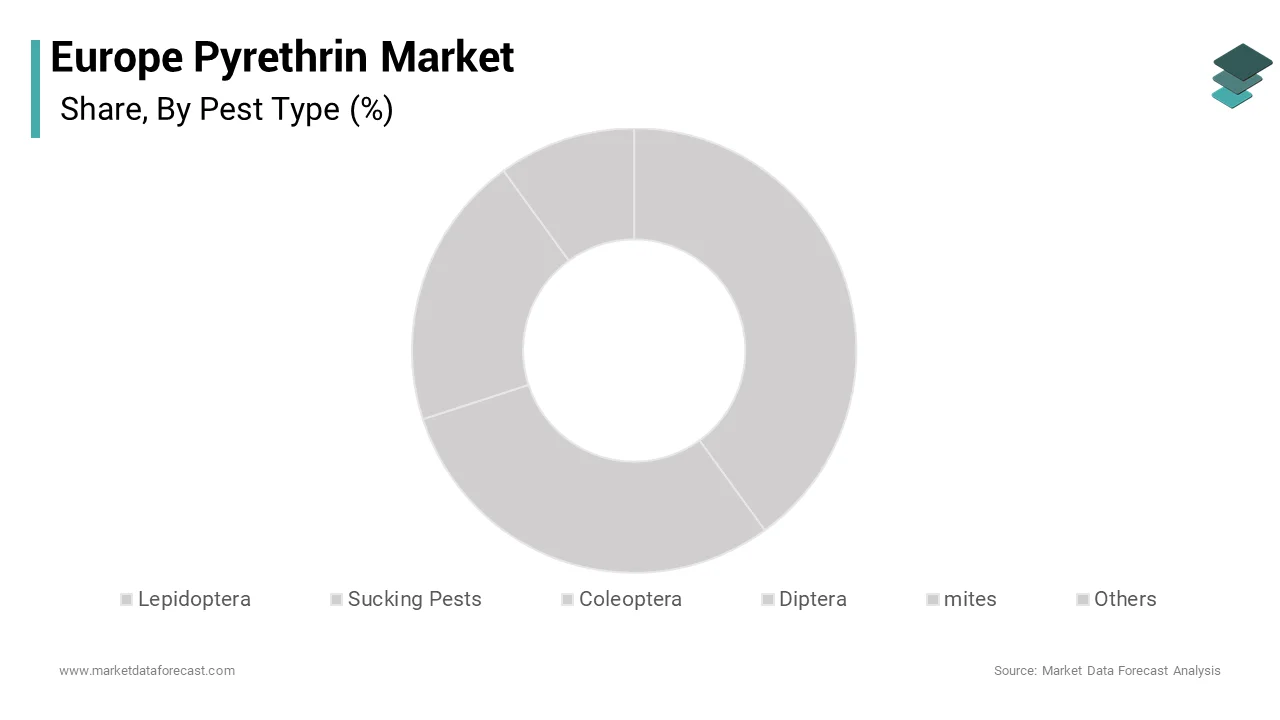
The sucking pests segment is expected to register the fastest CAGR of 15.4% from 2025 to 2033, with the expansion of organic vegetable and greenhouse production. These pests cause direct yield loss through sap extraction and indirect damage by transmitting plant viruses like Tomato Yellow Leaf Curl, which devastated over 12000 hectares of greenhouse tomatoes in Spain and Italy in 2023, according to the European and Mediterranean Plant Protection Organization. Organic growers have limited chemical options, and pyrethrins offer one of the few fast-acting solutions approved under EU organic standards. Additionally, new application technologies such as electrostatic sprayers improve pyrethrin deposition on the undersides of leaves where sucking pests congregate, increasing efficacy without raising dosage.
By Application Insights
The household segment accounted in holding 44.3% of the Europe Pyrethrin Market share in 2024 due to widespread consumer preference for natural insecticides in domestic environments where children, pets, and food are present. Pyrethrins are perceived as safer alternatives to synthetic neurotoxins with rapid degradation,n, minimizing indoor residue accumulation. Aerosol sprays, flying insect traps, and mosquito coils containing pyrethrins generated over 210 million euros in retail sales in 2024, as per market data compiled by the European Household Insecticide Association. Seasonal demand spikes during summer months are predictable and substantial.
The Animal Health application segment is lucratively to grow at a fast CAGR of 11.4% in next coming years owing to the rising demand for natural ectoparasiticides in companion animals and organic livestock systems. Consumers are increasingly avoiding synthetic actives like fipronil due to safety concerns, especially in cats, where pyrethroid toxicity can be fatal. Pyrethrins, when properly formulated, offer a lower risk alternative with rapid flea and tick knockdown. The European Medicines Agency has authorized several topical pyrethrin-based shampoos and sprays for dogs under strict labeling conditions. In parallel, organic dairy and poultry farms are adopting pyrethrin dusts to control red mites and stable flies with a practice endorsed by the International Federation of Organic Agriculture Movements.
COUNTRY LEVEL ANALYSIS
France Pyrethrin Market Analysis
France Pyrethrin Market was the top performer by holding 34.5% of the share in 2024, with its extensive organic farming base, strong household insecticide culture, and active vector control programs. The country leads the EU in organic agricultural land with over 2.8 million hectares certified in 2024, according to the French Ministry of Agriculture. Simultaneously, the French public maintains a longstanding preference for natural household insecticides, with brands like Pyréflor dominating retail shelves. The government’s anti-mosquito initiatives in regions like Provence-Alpes-Côte d'Azur further boost public health usage. Over 150 municipalities conducted pyrethrin fogging campaigns in 2024 as per the Regional Health Agency. Additionally, France hosts key pyrethrin formulators and distributors that serve both domestic and Southern European markets.
Italy Pyrethrin Market Analysis
Italy Pyrethrin Market was next by holding a significant share in 2024 by owing to the high summer pest pressure, ban mosquito proliferation, and a growing organic fruit and vegetable sector. The country’s warm Mediterranean climate supports year-round activity of Diptera and sucking pests, creating sustained demand across applications. According to the Italian National Institute of Health, 22 regions implemented mosquito abatement programs in 2024 with pyrethrin-based ULV sprays as the primary tool. Household usage is equally robust, particularly in coastal cities like Naples and Palermo, where summer fly infestations are severe. National regulations permit pyrethrins in residential settings without licensing, reinforcing accessibility. These overlapping agricultural, domestic, and public health needs make Italy a high-intensity pyrethrin market with consistent growth momentum.
Spain Pyrethrin Market Analysis
Spain Pyrethrin Market growth is likely to grow with its vast greenhouse horticulture industry, intense vector pressure, and expanding organic acreage. The provinces of Almería and Murcia alone account for over 30000 hectares of greenhouse vegetables, which aphids and anandrips require frequent ccontrololclimatee factors further amplify demand. Spain recorded the EU’s highest number of autochthonous dengue cases in 2023, prompting municipalities from Barcelona to Seville to intensify mosquito control using pyrethrin fogging. The household segment is also significant, with summer temperatures driving high sales of flying insect sprays. Spain’s strategic location as a gateway to North Africa also positions it as a distribution hub for pyrethrin formulations targeting Southern Europe.
Germany Pyrethrin Market Analysis
Germany's Pyrethrin Market growth is likely to grow with its stringent regulatory environment, strong organic movement, and demand for certified natural pet care products. The country has over 1.8 million hectares of organic farmland, as per the Federal Ministry of Food and Agriculture, with pyrethrins among the few permitted insecticides for high-value crops like berries and herbs. This preference extends to pet care, where natural flea sprays containing pyrethrins saw a 28% sales increase in 2024, according to the German Pet Industry Association. Regulatory rigor also plays a role, where the German Federal Institute for Risk Assessment maintains strict approval protocols ensuring only high-purity pyrethrin formulations enter the market.
United Kingdom Pyrethrin Market Analysis
The United Kingdom Pyrethrin Market growth is anticipated to grow with its mature pet care sector, active public health vector monitoring, and growing organic horticulture. According to the UK Health Security Agency, 14 local authorities conducted mosquito surveillance and control operations in 2024 using pyrethrin-based sprays, particularly in London and the Southeast, where Aedes albopictus has been detected. Additionally, the UK’s organic fruit sector, especially soft fruits in Kent and Scotland, relies on pyrethrins for aphid control during flowering when synthetic options are restricted.
COMPETITIVE LANDSCAPE
Competition in the Europe Pyrethrin Market is characterized by a mix of specialized botanical extractorsreformulatorss, and multinational biopesticide companies vying for niche dominance. The market lacks large consolidated players, creating space for agile firms that combine regulatory expertise with formulation innovation. Differentiation hinges on pyrethrin isomer purity, stability enhancements, and certification credentials rather than price alone. Companies compete intensely in the organic farming and natural household segments where consumer trust and product transparency are paramount. Barriers to entry include access to a consistent high quality pyrethrum flower supply and expertise in navigating EU biocidal and pesticide regulations. While global pyrethroid producers exert downward price pressure, natural product positioning insulates pyrethrin to some extent. Recent years have seen increased collaboration between extractors and agritech firms to integrate pyrethrins into digital IPM platforms.
KEY MARKET PLAYERS
These are the market players that are dominating the Europe pyrethrin market.
- Sinclair Animal & Household Care Ltd (Gainsborough, U.K.)
- Botanical Resources of Australia (Tasmania, Australia)
- Horizon Sopyrwa (Rwanda, Africa)
- AgroNatural Solutions BV
- Beaphar UK (Haverhill, U.K.)
- Kalyx Botanicals GmbH
- Elanco (Indiana, U.S.).
Top Players In The Market
- Ecoflor SAS is a France-based specialty botanicals company and a leading European producer of high-purity pyrethrin extracts. The company sources pyrethrum flowers primarily from East African cooperatives and processes them in its GMP-certified facility in Provence to produce standardized Pyrethrin I and II concentrates for agricultural and household applications. Ecoflor supplies certified organic pyrethrin to formulators across the EU and exports to North America and Japan. In recent years, the company has invested in cold chain logistics for raw flower transport and implemented blockchain traceability to meet EU due diligence requirements. It also launched a stabilized pyrethrin emulsion technology that enhances field persistence without synthetic additives. These initiatives reinforce Ecoflor’s position as qua quality-driven innovator in the global natural insecticide supply chain.
- Kalyx Botanicals GmbH is a German specialty ingredients supplier focused on natural pest control solutions derived from pyrethrum and other botanicals. The company serves organic farmers, household product manufacturers, and veterinary brands across Europe with certified pyrethrin formulations compliant with EU Regulation 889 2008 and Biocidal Products Regulation. Kalyx differentiates itself through rigorous quality control, including GC-MS verification of isomer ratios and residual solvent testing. Recently, the company expanded its R&D partnership with the Julius Kühn Institute to develop synergistic blends with plant-based synergists that reduce required application rates. It also introduces child-safe packaging for household sprays, meeting German consumer safety standards. These actions demonstrate Kalyx’s commitment to scientific validation, regulatory excellence, and consumer trust in the European and global biopesticide markets.
- AgroNatural Solutions BV is a Netherlands-based agrochemical formulator specializing in biopesticides with pyrethrin as a core active ingredient. The company offers ready-to-use and concentrated formulations for greenhouse horticulture, organic field crops, and public health applications across Europe and the Mediterranean. AgroNatural leverages the Netherlands’ advanced logistics infrastructure to ensure rapid delivery of temperature-sensitive pyrethrin products. In 2024 t,, he company launched a microencapsulated pyrethrin product that extends residual activity while maintaining organic certification. It also integrated IoT-enabled application guidance into its digital agronomy platform, helping growers optimize timing and dosage.
Top Strategies Used By The Key Market Participants
Key players in the Europe Pyrethrin Market focus on vertical integration from raw material sourcing to finished formulations to ensure purity and traceability. They invest in stabilization technologies such as microencapsulation and UV-resistant carriers to overcome pyrethrin’s natural photodegradation limitations. Regulatory compliance is central for companies aligning products with EU organic farming rules Biocidal Products Regulation, and pesticide residue thresholds. Strategic partnerships with research institutes enhance efficacy data and support health claims. Companies also develop segment-specific formulations for household animal health and greenhouse use to address diverse application needs. Sustainability initiatives, including ethical sourcing from smallholder farmers and recyclablepackagingn, , meet evolving ESG expectations.
MARKET SEGMENTATION
This research report on the European pyrethrin market is segmented and sub-segmented into the following categories.
By Type
- Pyrethrin 1
- Pyrethrin 2
By Pest Type
- Lepidoptera
- Sucking Pests
- Coleoptera
- Diptera
- mites
- Others
By Application
- Household
- Crop protection
- Commercial and Industrial
- Animal Health
- Public health applications
By Country
- UK
- France
- Spain
- Germany
- Italy
- Russia
- Sweden
- Denmark
- Switzerland
- Netherlands
- Turkey
- Czech Republic
- Rest of Europe